Date: 13 Sep 2018
Season Colors from Kristi, TopTropicals Flower Queen
Q: I live in New Jersey and I have a collection of potted tropical plants in my sun room. Our Fall season comes in bright colors, do you have something with colorful foliage for Fall?
A: For our northern customers it's almost time for the changing of the seasons. It is a very exciting and enjoyable time. The onset of fall means, less humidity, cooler nights and the Fall foliage. Here in Florida we do not get the chance to see the changing of the leaves, except maybe a few like Florida Maple Tree. So we use plants that mimic the season change, for all year round color! These are a few examples of the plants with colorful leaves that you may use for your Fall colors, plus remember - there is always a big list of Fall and Winter Flowering Tropicals!
Colorful tropical plants for Fall
Hibiscus tiliaceus - Variegated MahoeAcalypha wilkesiana - Chicago Brick Copper Leaf - see all acalyphas
Mussaenda philippica x flava - Calcutta Sunset Marmelade
Pseuderanthemum atropurpureum Purple Haze
Acer rubrum - Red Maple
Adenium Nil with red veined leaves
Cerbera x manghas hybrid - Enchanted Incense
Cordyline fruticosa Willies Gold - see all codyline
Graptophyllum pictum Chocolate Queen
Date: 15 Aug 2018
Care for a Baobab Bonsai
Q: How to grow Baobab bonsai properly? How long does it take to shape a nice little bonsai tree?
A: Baobab,
or Adansonia digitata, is a unique addition to a bonsai collection. Native
to Africa, it has an unusual structure and appearance. Some legends say that
the tree was cast down from the heavens and landed upside down, where it
began to grow. This story is no doubt a result of its appearance in the
winter, when the upper branches of the tree look more like roots than treetops.
The Baobab has some specific needs, but if you pay careful attention to its
requirements, this tree is not difficult to grow and makes an excellent
bonsai specimen.
1. Keep Baobab warm, it is sensitive to freeze.
2. Place Baobab in a bright, sunny window. Baobabs need at least six
hours of full sunlight per day, so a window with a western or southern exposure
is best. If your house doesn't get enough light, supplement natural light
with artificial grow lights. See article Indoor lighting for
tropical plants.
3. Water Baobab regularly during the growing season whenever the soil
is dry. Never water the tree when it is dormant (dropped leaves).
4. Feed Baobab a good-quality fertilizer about once a month. Apply
micro-element solution SUPERFOOD once a month, as well as SUNSHINE-BC plant booster for Bonsai and Caudex plants.
5. Prune the branches of your Baobab bonsai as often as they need it to
give the tree the shape you desire, pruning or pinching off branches that
are growing at odd angles or are too long. Trim early in the spring before new
growth appears.
6. Repot the baobab bonsai every year in Spring. Remove it from pot and
trim the roots back by one-third of their length, completely removing any
that are damaged or dead. Place it in a container that is twice the size of the
root ball and fill the pot with a well-drained soil like Adenium Mix.
It is believed that it takes forever to form a nice shaped tree, up to a few years. However if you provide warmth and bright light, branches grow very quickly, and an experienced bonsai hobbyist can make a unique specimen within 2-3 years. And then, the tree will stay with you for 5000 years - it can be passed from generation to generation!
Check
out this plant... with FREE shipping to all states!
Se also Baobab Bonsai Kit and save more!
Date: 14 Jul 2018
How to grow a Dragon Fruit
Q: I want to grow a Dragon Fruit. Should I use cuttings or seed? What varieties do you recommend? How difficult it is to grow? How soon does it start flowering and fruiting?
A: Dragon Fruit, or Pitaya is a highly prized, vining, fruit bearing
cactus, extremely unusual terrestrial/epiphytic plant. It has magnificent flowers,
stunningly beautiful fruit with an intense color, curious shape, and a
delicious taste. The night blooming white flowers can be up to 14 inches in
length. The fruit is most often eaten chilled and cut in half so the flesh may be
spooned out. The juice is used in frozen drinks and it is in a new Tropicana
Twister flavor. It is a must have for any collector or gardener with the flair
for the unusual.
It takes 2-3 years for seedlings to fruit, besides the variety pay not
come true to seed. We grow our plants from cuttings that are easy to root.
We offer many selected varieties, most of them self-pollinating. The plants are
ready to flower and fruit this year, or the next year.
Dragon Fruit Cactus is easy to grow, doesn't need much other than strong
support, full sun, well-drained soil - adenium soil mix works great - and fertilizer during hot months, and SUNSHINE-Honey applications for growing sweeter fruit. For larger fruit
bud thinning is recommended.
Date: 24 Jun 2018
Plant Horoscope. Scorpio Zodiac lucky plants: Peppers, Ceiba, Baobab,Pistachio, Nutmeg
Scorpio Zodiac lucky plants
Scorpio - 10/23-11/21. A WATER sign ruled by both Mars and Pluto. Scorpio's plants are often found in remote places or on poor ground. They will likely have thorns, can be red in color, and grow under adversity. The good news is, most of these plants are nearly indestructible! This makes them desirable for every gardener.
Scorpio Zodiac lucky plants: Peppers, Ceiba, Baobab, Pistachio, Nutmeg, Black-eyed Susan Thunbergia, Combretums, Dragon fruit, Medinilla, Camphor Basil, Cuban Oregano, Vanilla orchid, Hibiscus, Various cacti and succulents, Adenium, Honeysuckle, Cordyline, Spider plant, Jasmine, Gooseberries, Wild indigo, Bougainvillea, Aloe vera, Raspberry, Palmetto, Horseradish tree, Camphor, Allspice and Bay Rum, Jujube, Sweet Mimosa, Agave, Milkweed, Hong Kong Orchid Tree, Pony Tail, Dwarf Poinciana, Bottlebrushes, Clusias, Crocosmia, Zig-Zag Cactus, Dracaena, Fire Bush, Hoyas, Jatropha, Kalanchoe, Sausage tree, Devils Backbone, Pereskia, Red Plumeria, Firecracker, Rattlebox, Rhoeo, Calendula, Geranium, Thistles, Mint, Sage, Catnip, Coriander, Sandalwood, Ginseng, Euphorbias, Acacias.
For more info on Scorpio Lucky plants, links to these plants and other signs information, see full Plant Horoscope
Date: 24 Jun 2018
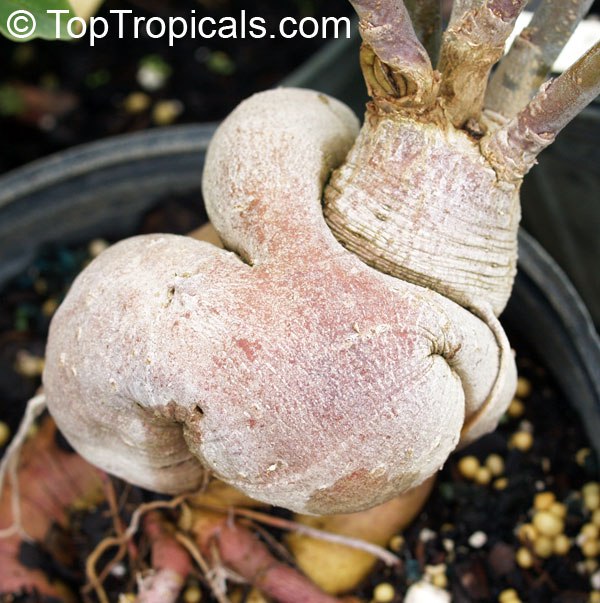
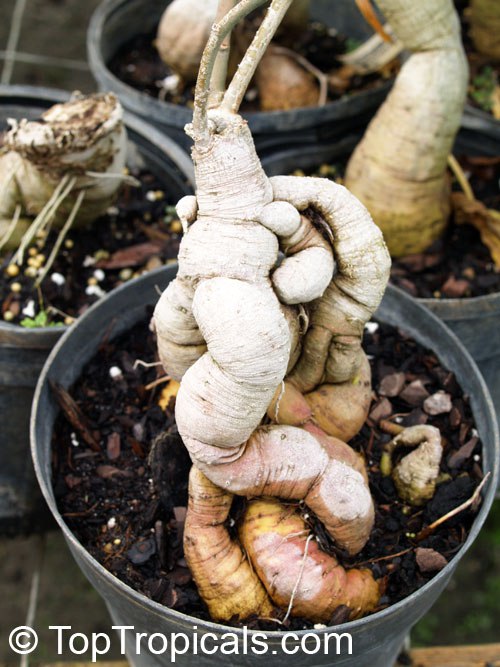
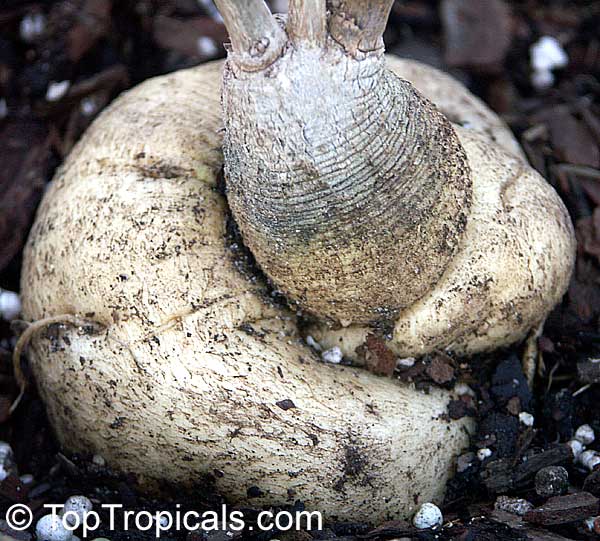
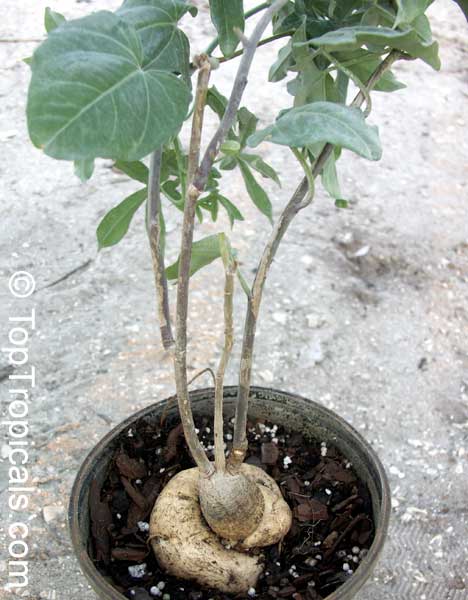
Elephant Foot, Turtle Shell - back in stock!
Dioscorea
elephantipes.
Dioscorea is a curious plant
with tuber above ground level covered with layers of corky
bark, resembling a caudex. It is a slow growing, very
unusual succulent. Tuber contains saponins, originally
cooked and eaten as a famine food by the Hottentots.
Caudex that grows up to 6' in nature, resembling an
elephant's foot and looks as if it is segmented into
geometric patterns (smaller plants look like tortoises)
and looks dead but is actually a living tuber. A plant
with 18"caudex can be almost 100 years old! The plant
grows into a vine with attractive heart-shaped leaves and
small yellow flowers. Culture is relatively easy. The
vines may die back and regrow several times a year,
depending on the particular plant and your region. The
plant doesn't send down deep roots, so plant in a shallow
pot about 1" larger than the diameter than the caudex. Potting soil should be very
porous/loose so that there is easy drainage. Water
well around the edges. Keep in a warm area and wait for
the first shoots of the vine to appear. Water regularly
from that point on. The plant should not be kept damp as
with other tropical plants. Allow it to dry before
watering again. Many books will say that they are winter
growers, because they are native to the southern
hemisphere. In fact, they grow in all seasons! Let the
plant be your guide. You cannot force them to grow, and
over watering will simply cause them to rot.
Elephant Foot is a collectors item, but remarkably easy to
grow. It will be with you for years with no effort. It is
a wonderful conversation piece! See more info about Dioscorea
elephantipes.
We have limited stock, while supply lasts, hurry up!
*** 4-6"caudex *** 6-8" caudex *** 10-12"caudex *** Seeds. Don't forget special TopTropicals Adenium Soilless Mix