Garden Blog - Top Tropicals

Date: 4 Sep 2018

Checklist - Preparing for winter in subtropical areas

TopTropicals

Watering. Start reducing the amount you water your plants in early fall, once the temperature drops below 65F. Avoid watering your plants during cool nights, as this may cause serious root rot.

Mulch. When a plant is protected by a thick layer of mulch, the root system stays healthy.

No Pruning. Avoid pruning, trimming, or pinching branch tips altogether during the fall and winter which encourages new shoots that are soft, tender, and very cold sensitive. Last trimming should be done no later than September - early October.

No Fertilizer. Avoid fertilizers during the winter. The main reason being the same as above for pruning: fertilizing promotes growth of the upper plant parts which should be avoided during the winter months. The last time for fertilizer should be no later than October.

Date: 20 Aug 2018

6 things NOT to do in Summer planting

TopTropicals

Q: What a hot summer we have... everything I plant in the ground seem to be unhappy and doesn't seem to grow. I water a lot but it seems not enough? leaves stay droopy or get burned. Are there any secrets for summer planting?

A: End of Summer is still a good time for planting in the South, because there are a few more warm months until winter and your plants need enough time to establish before cold season. However because of high temperatures, a few things should be avoid to reduce stress on the plant:

1. Do not plant mail-ordered plant directly from a box into the ground. Keep it in a pot for a week or two and gradually move the pot from shade into permanent location in full sun.

2. Do not expose to full time direct sun even if potted plant was adjusted to sun. Cover newly planted tree with a shade cloth or simply a bed sheet for a few days. Use bamboo stakes to support the cloth. Even tough, sun-loving plants may get a leaf burn if not established.

3. Do not put mulch too close to the stem/trunk. Keep it 1-1.5 inches away from the plant for air circulation.

4. Do not keep wet. Combination of extreme heat and wet is not good for roots (as well as cold and wet). If you notice that soil dries too quickly - water more frequently but lightly, without creating soggy hot swamp.

5. Do not overfertilize. A handful of slow-release fertilizer is good at time of planting, however do not try to push your plant to grow and do not apply more chemicals or manure until you see a new growth.

6. Do not get discouraged and give the plant some time to establish. In most cases, a new growth starts with roots which you can't see. Sometimes it takes a few months until you see the upper part of the tree suddenly starts growing rapidly.

Date: 15 Aug 2018

Care for a Baobab Bonsai

TopTropicals

Q: How to grow Baobab bonsai properly? How long does it take to shape a nice little bonsai tree?

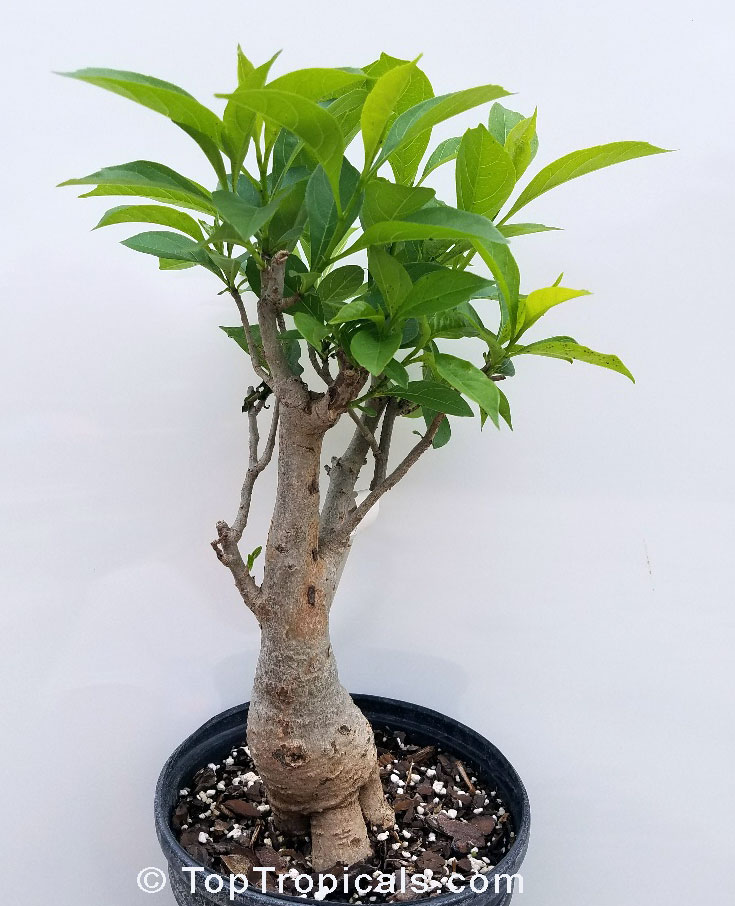
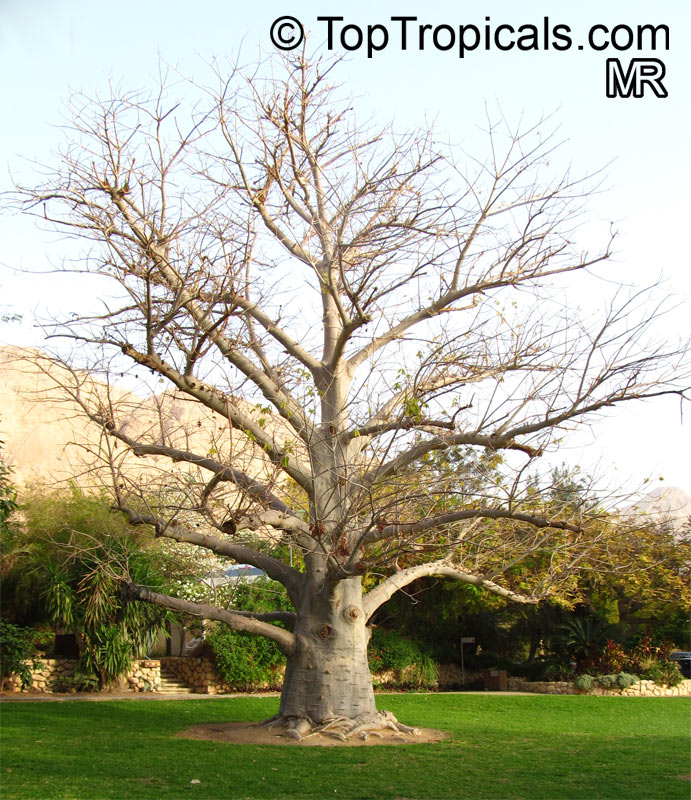
A: Baobab, or Adansonia digitata, is a unique addition to a bonsai collection. Native to Africa, it has an unusual structure and appearance. Some legends say that the tree was cast down from the heavens and landed upside down, where it began to grow. This story is no doubt a result of its appearance in the winter, when the upper branches of the tree look more like roots than treetops. The Baobab has some specific needs, but if you pay careful attention to its requirements, this tree is not difficult to grow and makes an excellent bonsai specimen.
1. Keep Baobab warm, it is sensitive to freeze.
2. Place Baobab in a bright, sunny window. Baobabs need at least six hours of full sunlight per day, so a window with a western or southern exposure is best. If your house doesn't get enough light, supplement natural light with artificial grow lights. See article Indoor lighting for tropical plants.
3. Water Baobab regularly during the growing season whenever the soil is dry. Never water the tree when it is dormant (dropped leaves).
4. Feed Baobab a good-quality fertilizer about once a month. Apply micro-element solution SUPERFOOD once a month, as well as SUNSHINE-BC plant booster for Bonsai and Caudex plants.
5. Prune the branches of your Baobab bonsai as often as they need it to give the tree the shape you desire, pruning or pinching off branches that are growing at odd angles or are too long. Trim early in the spring before new growth appears.
6. Repot the baobab bonsai every year in Spring. Remove it from pot and trim the roots back by one-third of their length, completely removing any that are damaged or dead. Place it in a container that is twice the size of the root ball and fill the pot with a well-drained soil like Adenium Mix.

It is believed that it takes forever to form a nice shaped tree, up to a few years. However if you provide warmth and bright light, branches grow very quickly, and an experienced bonsai hobbyist can make a unique specimen within 2-3 years. And then, the tree will stay with you for 5000 years - it can be passed from generation to generation!

Check out this plant... with FREE shipping to all states!
Se also Baobab Bonsai Kit and save more!

Date: 14 Jul 2018

How to grow a Dragon Fruit

TopTropicals

Q: I want to grow a Dragon Fruit. Should I use cuttings or seed? What varieties do you recommend? How difficult it is to grow? How soon does it start flowering and fruiting?

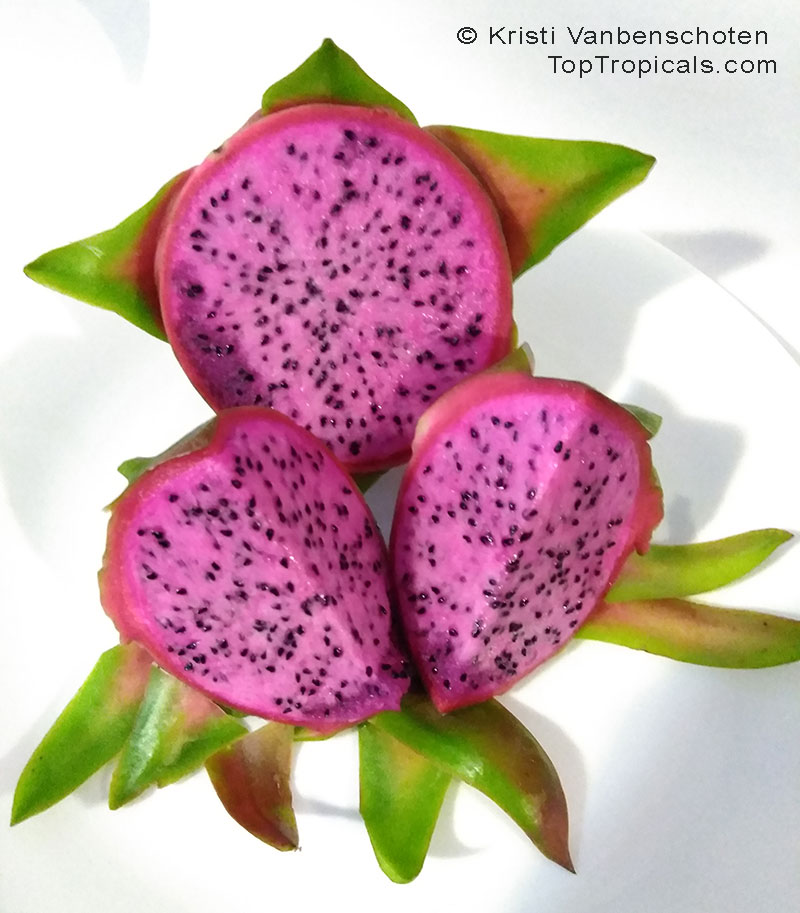
A: Dragon Fruit, or Pitaya is a highly prized, vining, fruit bearing cactus, extremely unusual terrestrial/epiphytic plant. It has magnificent flowers, stunningly beautiful fruit with an intense color, curious shape, and a delicious taste. The night blooming white flowers can be up to 14 inches in length. The fruit is most often eaten chilled and cut in half so the flesh may be spooned out. The juice is used in frozen drinks and it is in a new Tropicana Twister flavor. It is a must have for any collector or gardener with the flair for the unusual.
It takes 2-3 years for seedlings to fruit, besides the variety pay not come true to seed. We grow our plants from cuttings that are easy to root. We offer many selected varieties, most of them self-pollinating. The plants are ready to flower and fruit this year, or the next year.
Dragon Fruit Cactus is easy to grow, doesn't need much other than strong support, full sun, well-drained soil - adenium soil mix works great - and fertilizer during hot months, and SUNSHINE-Honey applications for growing sweeter fruit. For larger fruit bud thinning is recommended.

Check out Dragon Fruit varieties

Date: 24 Jun 2018

TopTropicals

Winter mulching in Southern landscapes

"My rule of green thumb for mulch is to double my initial estimate of bags needed, and add three. Then I'll only be two bags short." (Author unknown)

Q: What is the best time for mulching in Florida? What type of mulch do you recommend and how much should I use?

A: Every gardener knows that spreading mulch in the garden helps to protect the soil in general, prevents weeds from growing, plus it has specific benefits during harsh winter conditions. A layer of mulch will keep the soil insulated, roots protected from possible freezing, so you'll also end up with better results in spring by laying down mulch in the cold months.
When? We lay mulch in our Florida garden right now. It is cool so we work twice more efficient. After rainy summer-fall season, most of mulch around plants had broken down and in many areas soil is exposed: easy target for weeds.
In general, in warm climates Fall and Winter mulching is the most effective. Mulch creates an insulating barrier between the soil and air, thereby protects plant roots from rapid fluctuations in soil temperature.
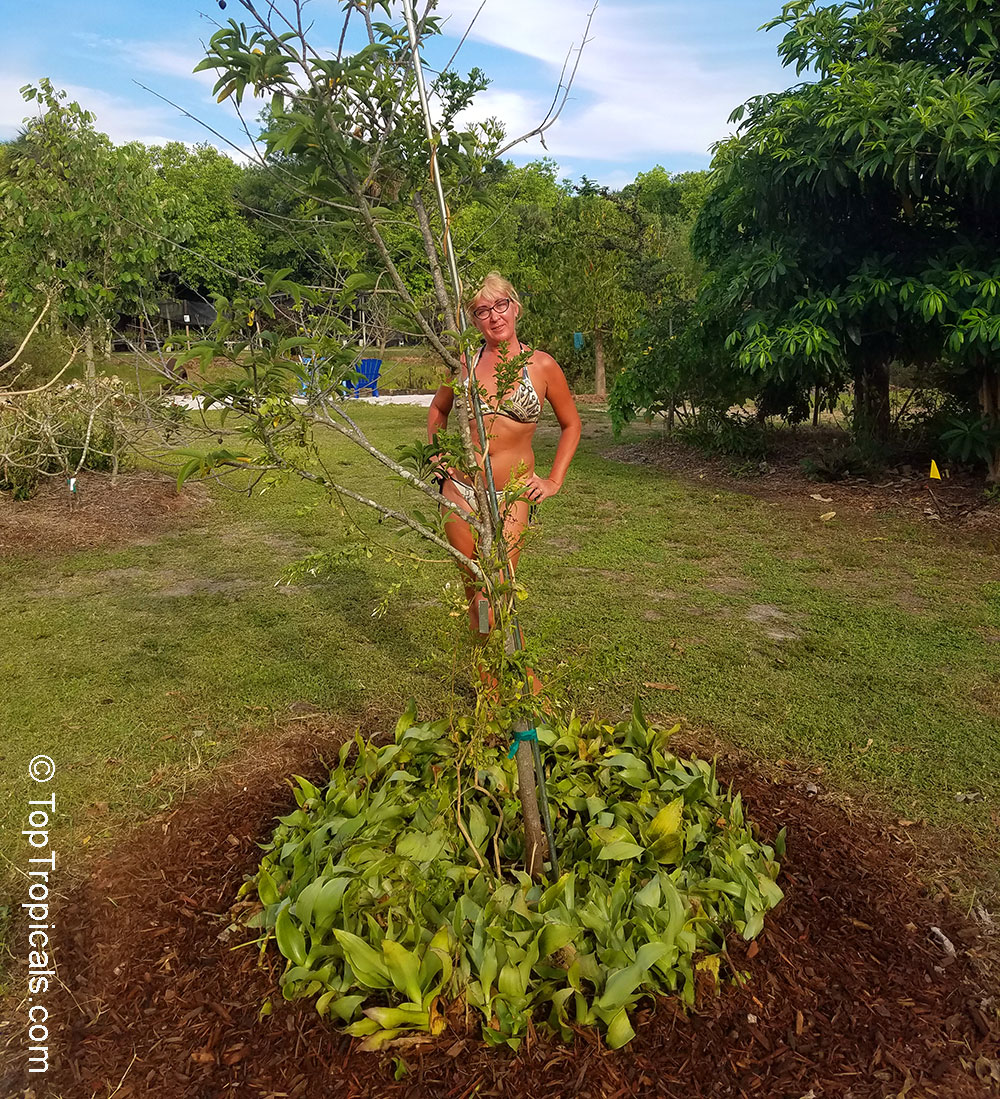
How much? There is never too much mulch. Just make sure to put it 2-3 inches away from the trunk to prevent rotting and mold.
What kind? Different types of mulch can be used, including wood chips, shredded leaves, straw and hay. Yes, leaves and hay too! Remember all green parts of a plant (= your leaves and grass) are full of Nitrogen so important for plant vigor, it eventually will go back into the soil as extra benefit. Unless you want to spend a fortune on a fancy red or cypress mulch, you may use these natural materials that are handy in every garden. After raking leaves, pile them up and in couple weeks of drying and breaking down leaves will become a perfect, soft mulch that is best to use around fragile and herbaceous plants. After mowing your lawn, save the cut grass and use the hay as mulch. It always works the best in our garden, keeps weeds away better than wood chips, and in spite of a common belief that cut grass is full of weed seeds, we never seen grass or weeds sprouting from that hay.
Happy mulching and stay warm!