Date: 24 Jun 2018
Growing tropicals from seeds.
From Kristi the Wizard of Rose: I grow many plants from seeds, both for my personal collection, and for TopTropicals. I receive many questions from customers who want to grow tropical plants from seeds. Some of them live in colder climates and try to extend growing season of their tropical collections by starting new varieties early in the year from seeds. These are a few tips that may be helpful.
Q: What do I need to do to speed up germination process?
A:
Many factors affect germination. Considering you get fresh
seeds (for example from TopTropicals) and Mother Nature
gives them a good kick start, there are a few things that
may speed up germination:
1) Scarification. Large seeds with a hard outer
shell can be slightly sanded down just enough for moisture
to get inside to wake up the seed during the pre-soaking.
Be careful not to damage the seed. See example of Lotus seed
scarification.
2) Pre-soaking. We recommend pre-soaking most of
the seeds for only a few hours (3-8 depending on species.
Some seeds are very sensitive to moisture and may start
rotting if stay wet without air circulation. Small seeds,
especially tiny ones like dust, should not be soaked.
3) SUNSHINE-S treatment. Adding a few drops of SUNSHINE-S booster when
pre-soaking seeds increases their germination rate 3-5
times.
4) Temperature. Warm temperatures help germination.
If grown indoors, put seeds containers or trays in the
warmest spot of your house; you may use heat pads.
Outdoors, putting them in full sun helps a lot, just don't
let soil to dry out.
Use only special porous seed germination mix
Date: 24 Jun 2018
Elephant Foot, Turtle Shell - back in stock!
Dioscorea
elephantipes.
Dioscorea is a curious plant
with tuber above ground level covered with layers of corky
bark, resembling a caudex. It is a slow growing, very
unusual succulent. Tuber contains saponins, originally
cooked and eaten as a famine food by the Hottentots.
Caudex that grows up to 6' in nature, resembling an
elephant's foot and looks as if it is segmented into
geometric patterns (smaller plants look like tortoises)
and looks dead but is actually a living tuber. A plant
with 18"caudex can be almost 100 years old! The plant
grows into a vine with attractive heart-shaped leaves and
small yellow flowers. Culture is relatively easy. The
vines may die back and regrow several times a year,
depending on the particular plant and your region. The
plant doesn't send down deep roots, so plant in a shallow
pot about 1" larger than the diameter than the caudex. Potting soil should be very
porous/loose so that there is easy drainage. Water
well around the edges. Keep in a warm area and wait for
the first shoots of the vine to appear. Water regularly
from that point on. The plant should not be kept damp as
with other tropical plants. Allow it to dry before
watering again. Many books will say that they are winter
growers, because they are native to the southern
hemisphere. In fact, they grow in all seasons! Let the
plant be your guide. You cannot force them to grow, and
over watering will simply cause them to rot.
Elephant Foot is a collectors item, but remarkably easy to
grow. It will be with you for years with no effort. It is
a wonderful conversation piece! See more info about Dioscorea
elephantipes.
We have limited stock, while supply lasts, hurry up!
*** 4-6"caudex *** 6-8" caudex *** 10-12"caudex *** Seeds. Don't forget special TopTropicals Adenium Soilless Mix
Date: 24 Jun 2018
Fruitful Fruit and SuperFood...
Q: I have a large fruit garden here in Florida with many mango trees, avocadoes, guavas, and other tropical fruit. Last year hurricane Irma and flooding killed a few avocado trees, but mangos and guavas survived OK, but the sad part is, very few flowers this year and almost no fruit setting. I noticed on your website your Superfood and Sunshine-Honey boosters that supposedly help fruiting? But I am afraid it is too late now as your instructions say first application must be in early Spring? I wish I discovered earlier that my trees wouldn't want to fruit this year...
A:
First of all, it is never late to give the food! You may
start applications of SUNSHINE products at any time
of the year. The best results will be achieved once you
treat your plants on regular basis throughout the whole
year cycle of metabolism.
Couple weeks ago we started harvesting our 2 guava trees.
These two are the same variety (Variegated Honeymoon),
planted within 20 ft from each other and growing in the
same conditions. The only difference was, one was treated
with SUNSHINE-Honey and SUNSHINE-SuperFood, and another
one didn't get any treats in order to have a control
plant.
Results are very interesting, see the picture. Both trees
were heavily covered with fruit. However the one with
treatments developed fruit that is much larger, much
sweeter and juicier, and the most interestingly - with
less seeds, almost no seeds!
To answer your question: yes, you can start feeding your
fruit trees right now. It is still a Springtime. Many
mango varieties have late season; even early varieties may
delay their fruiting if flowering triggered by
miscro-elements. Guavas have very long season and most
varieties can have multiple crops throughout Summer-Fall.
Here is a simple and affordable feeding schedule to
help your fruit garden recover from last year hurricane
stress, and establish reliable production:
1) SUNSHINE-E - for boosting
metabolism - once a month
2) SUNSHINE-Honey - for bringing
sugars to the heart of the tree and boosting fruit
sweetness and quality - now and in 2 weeks
3) SUNSHINE-SuperFood - for
overall health, recovering from hurricane and fixing root
damage from flood - now and every 2 weeks throughout warm
season.
4) You may apply regular balanced fertilizer NPK as
usual (we apply once a month, a handful per in-ground
tree)
It's that simple. Just try and watch your trees produce
again!
Check out all SUNSHINE boosters... We offer FREE shipping on them, so you can make your plants happy!
Date: 3 Aug 2025
☕ Coffee, Straight from Your Windowsill
Coffee Crew at Work: Harvest, Grind, Brew
Let's be honest - coffee prices are climbing, supplies are tightening, and that morning cup isn't getting any cheaper. But right now, our Coffea arabica trees are covered in green berries, quietly ripening toward harvest time. Soon, they'll turn red - and that's when it's go time.
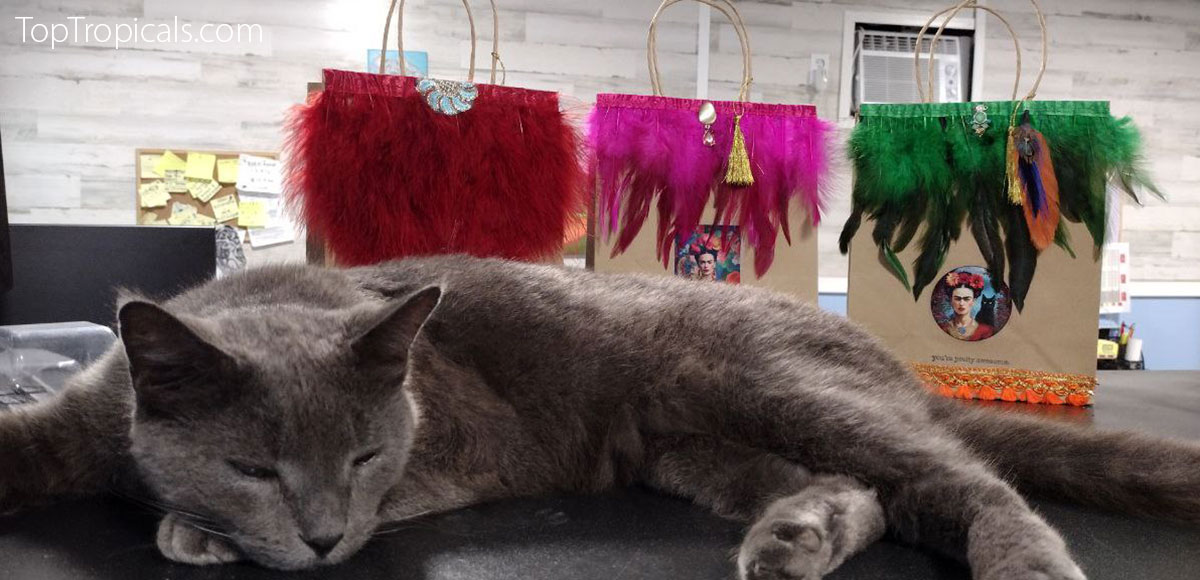
This isn't just a pretty plant. It's a compact, shade-loving fruit tree that thrives indoors and adds year-round tropical beauty to any space. Even your cat will approve 🐱🐾.
Date: 27 Oct 2025
Meet Mittens!
Chiane and Mittens the cat
Mittens little kitten
Mittens the kitten sleeping
Mittens the kitten with a plant
🐱 Meet Mittens!
- 🐾 Mittens showed up one day out of nowhere and immediately won everyone's heart. Our Shipping Specialist, Chiane, stood no chance against those bright eyes and tiny white paws - so Mittens was hired on the spot!
- 🐾 Now she’s in training, assisting Chiane with packing orders, inspecting boxes, and occasionally napping on the job (for quality control, of course). Every evening she clocks out and heads home with Chiane to rest up for another big day of helping.
- 🐾 If you ever spot tiny paw prints inside your plant box, that’s Mittens saying hello! It’s her little “magic paw” blessing to make sure your plants thrive happily in their new jungle home.
🐈📸 Chiane and Mittens shipping plants - from TopTropicals to your door! PeopleCats.Garden
#PeopleCats
🟢 Join 👉 TopTropicals