Date: 17 Nov 2023
Privacy Hedges with Benefits
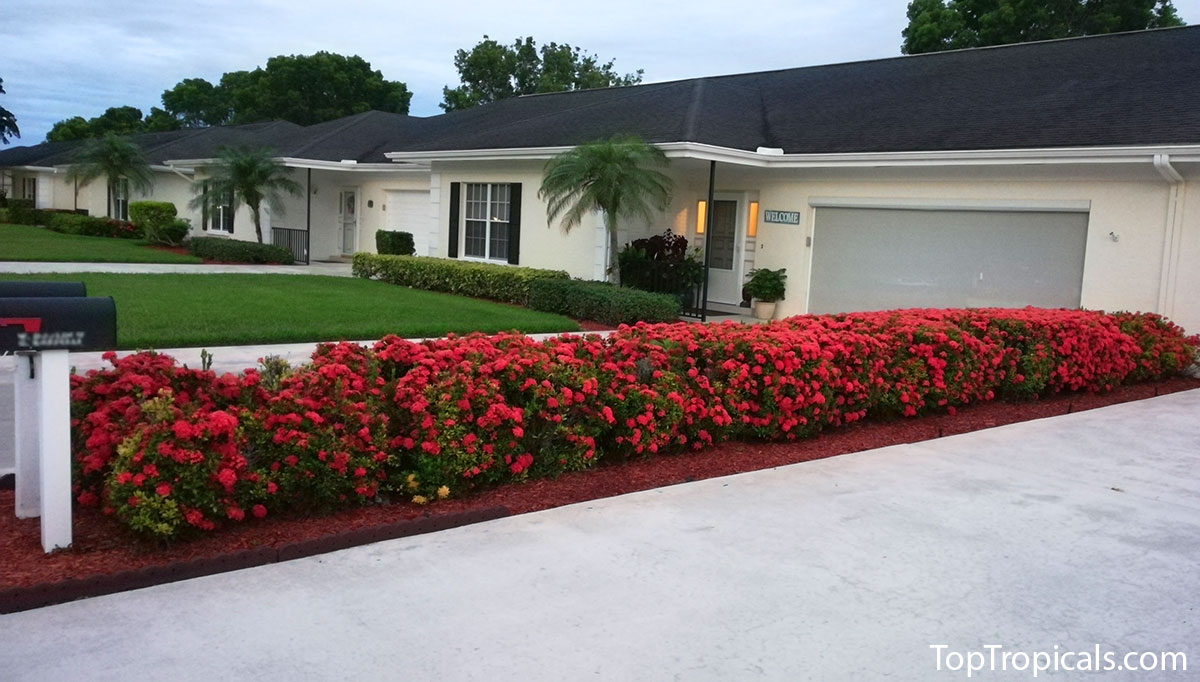
What's the numero uno question we get bombarded with at Top Tropicals Nursery? Well, it's a real head-scratcher:
Q: "...Can you recommend me a flowering privacy hedge to spice up my yard's life? My current hedge is just a green wall and I'm tired of the monthly trim routine. I need something lively, fast-growing, and unusual if possible. No plain old ixora, please!.."
A: After over two decades of being the go-to advice-givers, we thought, "Why not spill the floral beans and share our tropical wisdom?" But where to begin? The jungle of flowering ornamentals is vast, and picking the perfect shrub is like finding the missing piece of a gardening puzzle. So, in our new column "Hedges with Benefits" we're dishing on those not-so-average shrubs that'll not only prettify your patch but also bring some serious practicality. Today's lineup is -
Top Ten Winners:
Fast growing flowering shrubs
Below is the top selection of spectacular flowering shrubs that can create a nice hedge or a natural screen within just a couple of seasons.
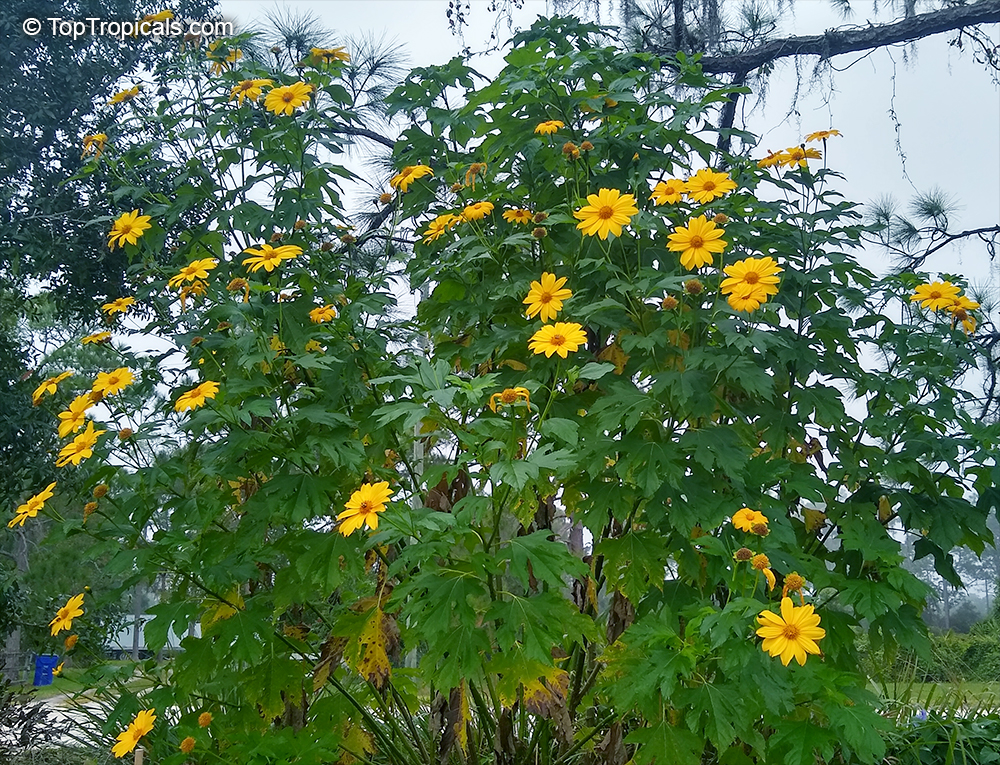
Tithonia diversifolia - Sunflower tree.
Grows super fast to a very tall dense hedge, and starts flowering right away. Full sun, very easy, not
fussy about soil or water. Winter bloomer.
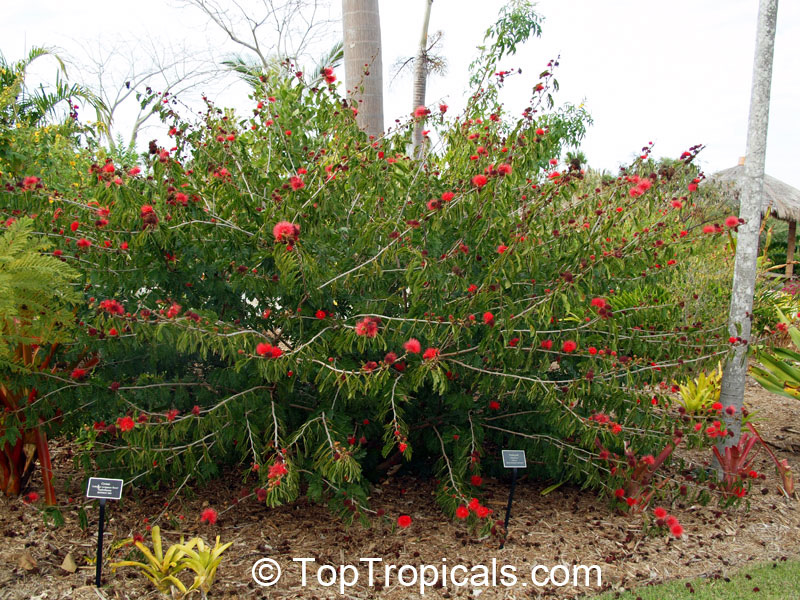
Calliandra surinamensis - Powderpuff.
Pretty pink powderpuffs almost year around! Easy to prune.
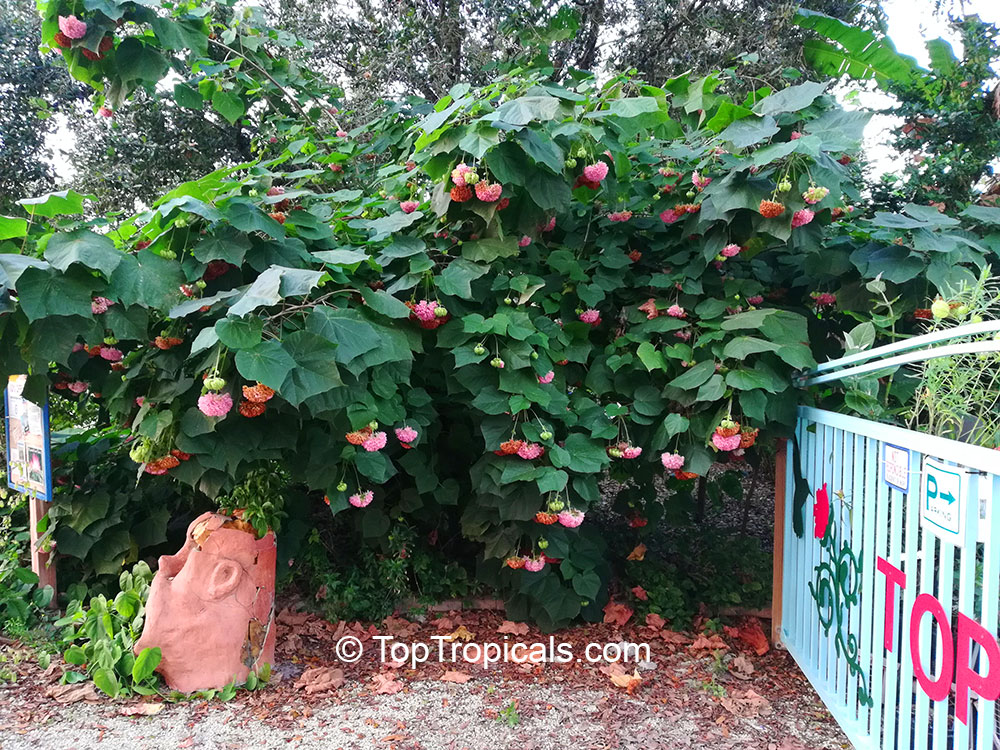
Dombeya x wallichii - Tropical Hydrangea.
You can see this beautiful bush right at Top Tropicals gate. Winter bloomer, large lush leaves and huge, pink hydrangea-like blooms. Very large and fast growing, likes water, tolerates shade.
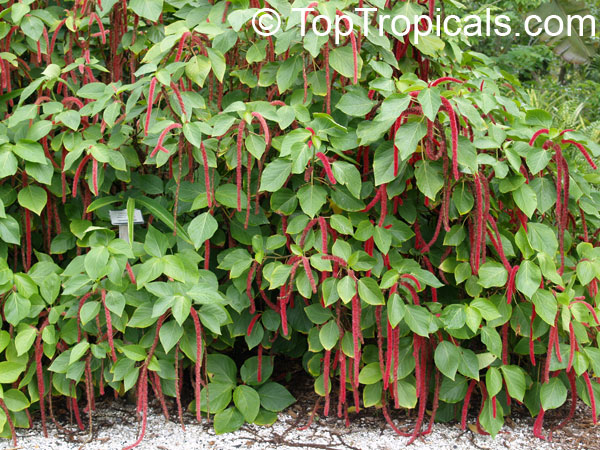
Acalypha hispida - Cat tail, Chenille plant.
All time favorite, everblooming with red cat tails! Full sun. Easy to control.
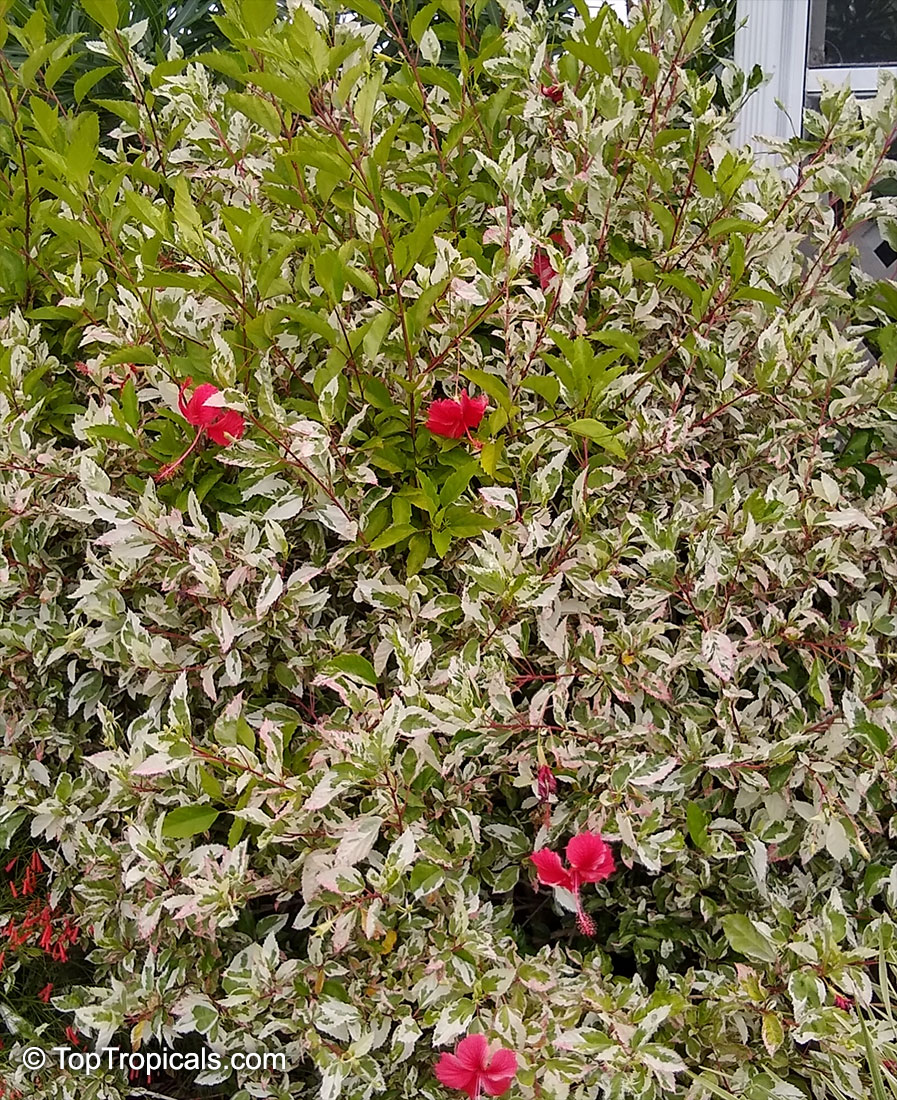
Hibiscus variegated Snow Queen.
Popular landscape bush with unusual look, red flowers over snow white variegation, very showy! Responds well to
pruning. Full sun.
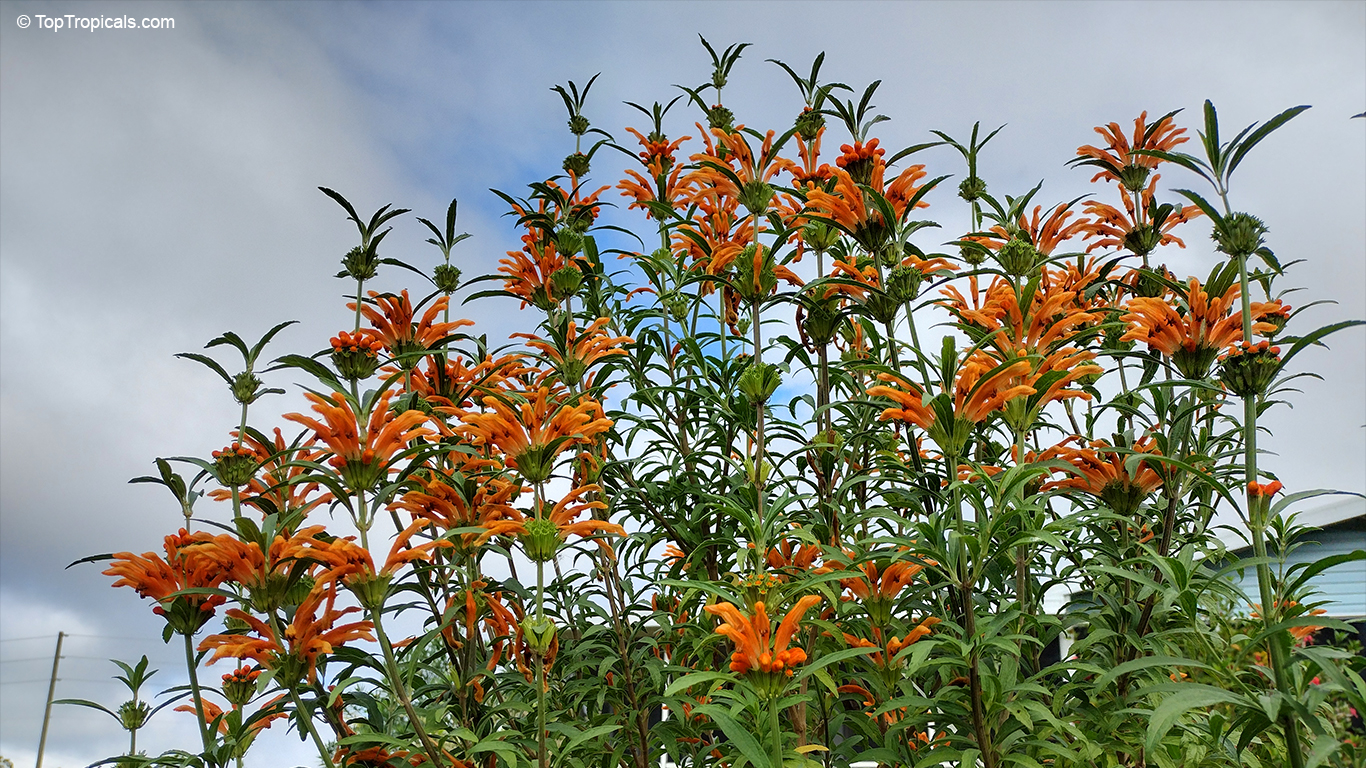
Leonotis leonurus - Lions Ears.
Winter bloomer, great for low hedges. Covered with bright orange curious flowers,
medium sized, easy to control at 3-4 ft. Full sun.
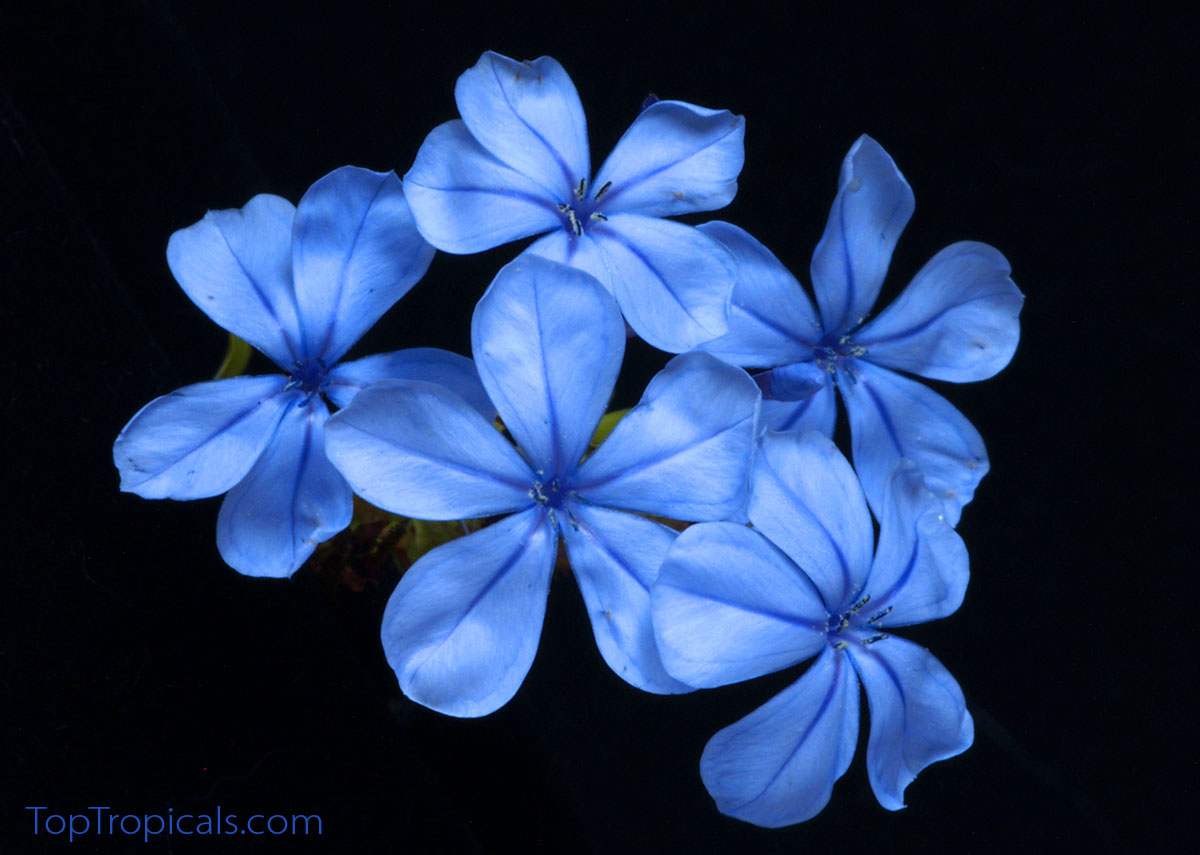
Plumbago auriculata Imperial Blue
One of the most popular Southern hedge plants, everblooming with bright blue flowers, tolerant to drought, heat, and poor soils. Can be maintained short or tall (2-6 ft).
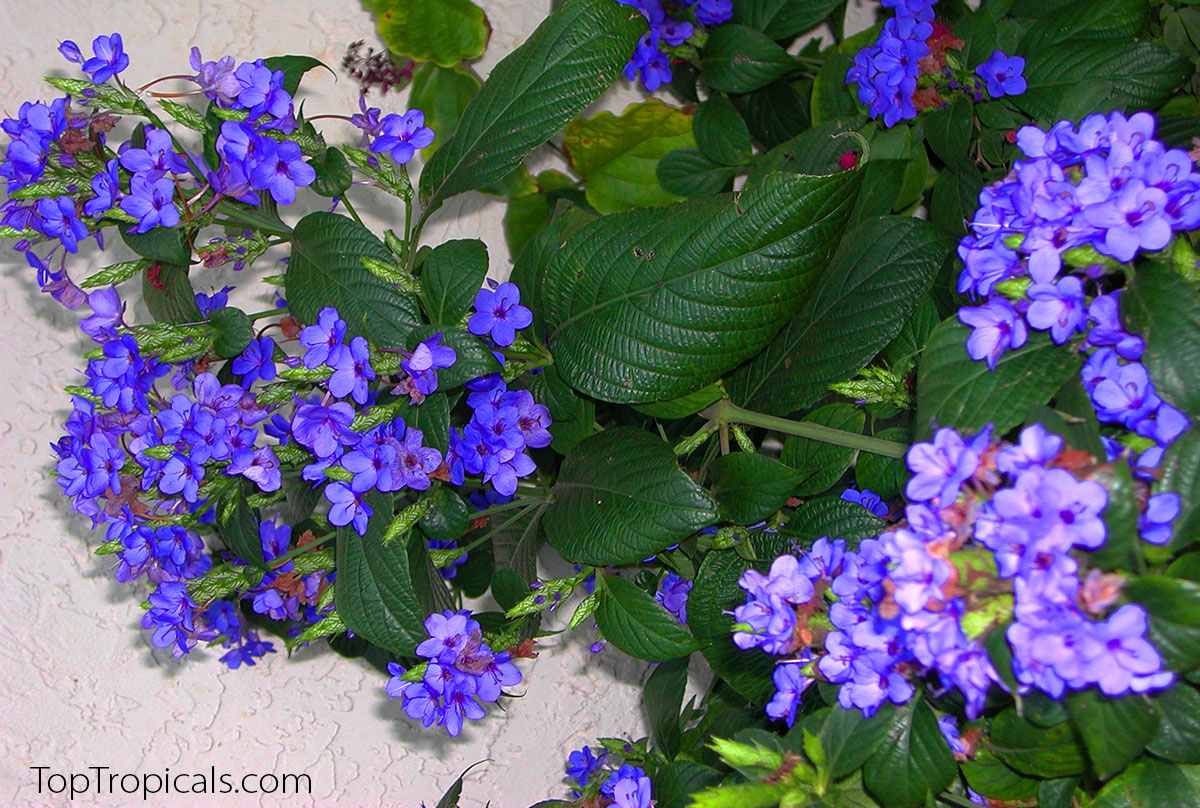
Eranthemum pulchellum - Blue Sage, Lead Flower.
Great for shady spots, winter bloomer with dark green leaves and unusual sky-blue flowers. Can be trimmed if needed. Nice and dense.
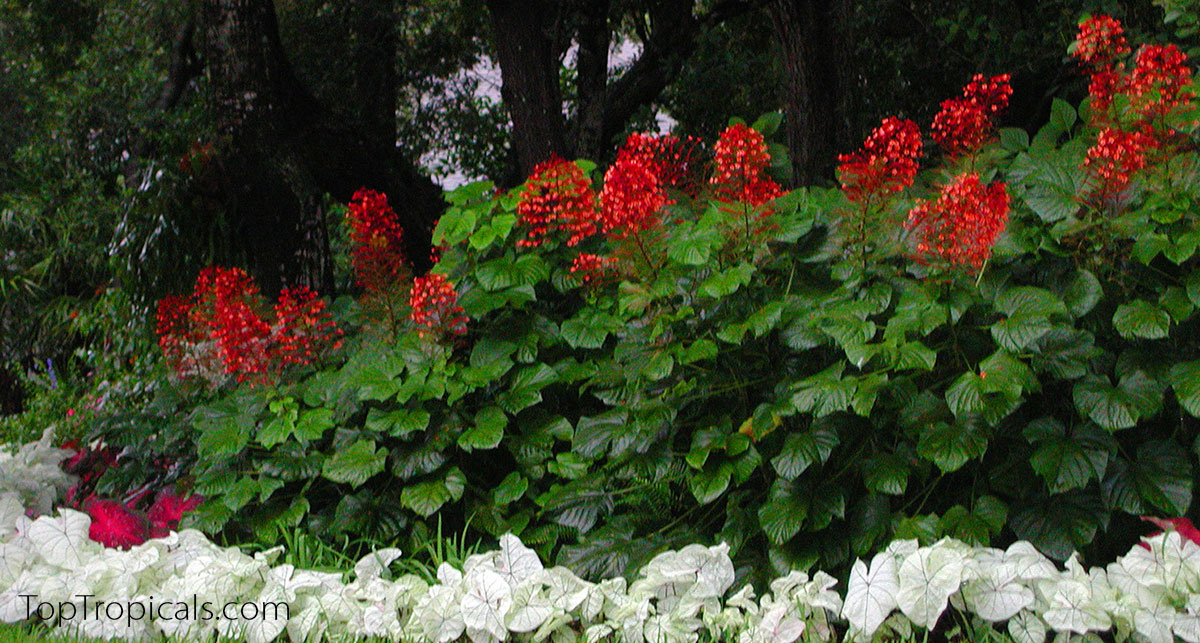
Clerodendrum paniculatum - Pagoda Flower. Happy in the sun or shade, easy plant. Loves water.
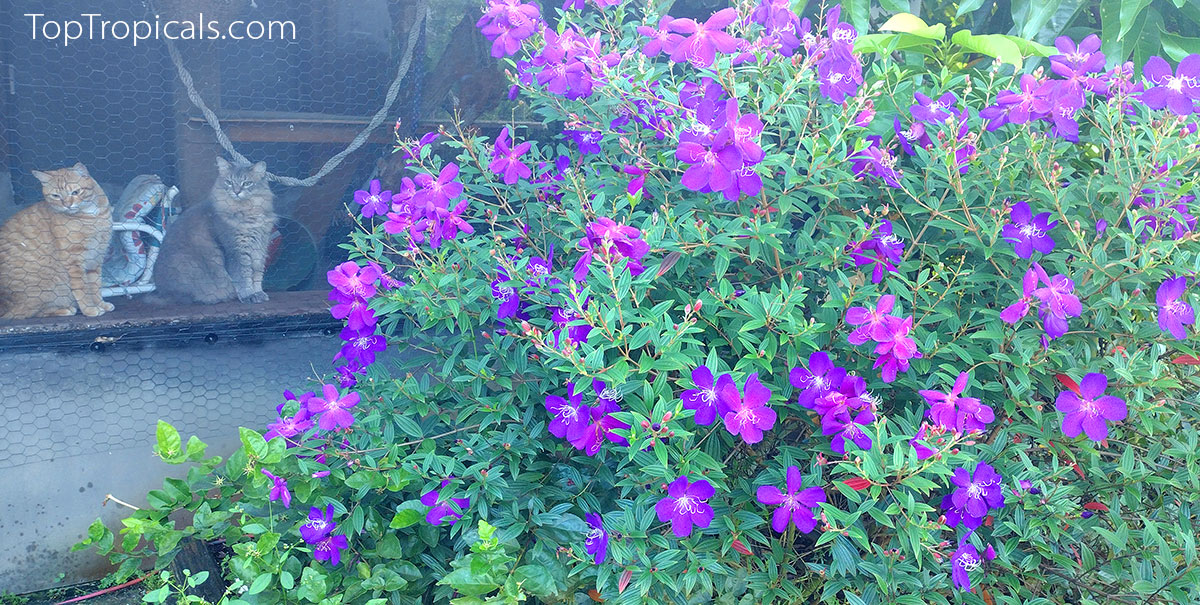
Tibouchina lepidota - Ecuador Princess, Jules Dwarf.
Sun or shade, blooms on and off throughout the year. Beautiful Purple
Princess!
Date: 13 Jan 2017
January kaleidoscope: Top Tropicals plants... and cats
Plants in Winter
Q: My plants Mango and Sapodilla (I got from Top Tropicals) got cold frost recently up to the roots recently in a cold wave in NJ. The leaves are dry. The plant was kept in a green house. But the heater was off for a night. During that time the in the pot got frozen. Will the plants survive? Will they come back during spring?
A: Unfortunately, the chances are slim. It is hard to determine now if they will survive. Those plants can take a very short cold. They might survive when the root system was not frozen solid. To ensure your plants cold protection in the future, this is what we recommend:
1) Use temperature alarm. Nowadays they're very cheap, they can send a message to your email or cell phone.
3) Heaters like any other piece of machinery may fail. Redundancy is the keyword. Instead of one large heater use two of smaller capacity. If one fails, then second one will prevent catastrophic failure
4) Insulation. Extra layer of insulation helps greatly.
5) If you leave for vacation, then plan ahead. Have somebody to watch over your greenhouse. Move plants or at least the most sensitive ones inside of your house if possible.
Meet Top Tropicals Team. Part 1 - PeopleCats! Did you know that here at Top Tropicals we care not only about plants, but also animals? Most of our PeopleCats and PeopleDogs either came to us from nowhere in hope of survival, or have been rescued. TopTropicals is proud to support all of our People. A portion of every dollar you spend on a plant purchase goes to our Cat Community maintenance, food and other needs of these Little People. We will keep you updated with more pictures and videos on our PeopleCats (that also includes one dog Bob). They all are members of our Team, helping us to grow plants for you, pack them and send to you from our Shipping Department. Visit our Facebook, YouTube Channel and LIKE all of our People!
Stay updated with TopTropicals Videos by subscribing to our channel at YouTube.com/TopTropicals
Date: 11 Oct 2022
Fertilizing in Fall:
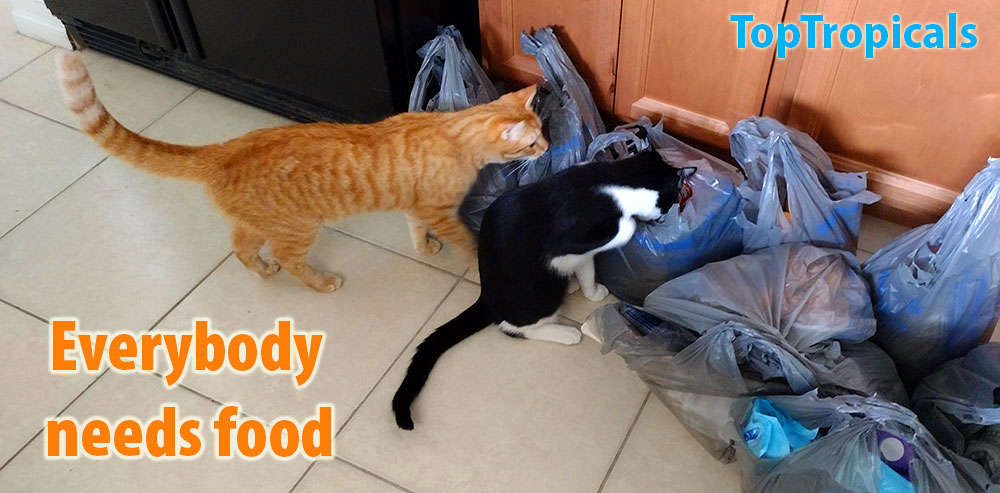
Plants need food too!
Q: I know that I am not supposed to fertilize plants in winter. But I just bought several ground orchids from you, they are blooming now and I wonder if I can give them some food to support their bloom energy? When should I do the last application of fertilizer? I will keep them in a sun room during Winter until Spring.
A: Traditionally, end of October to November is the time when we
give the last dose of fertilizer to our tropical plants. Liquid fertilizers,
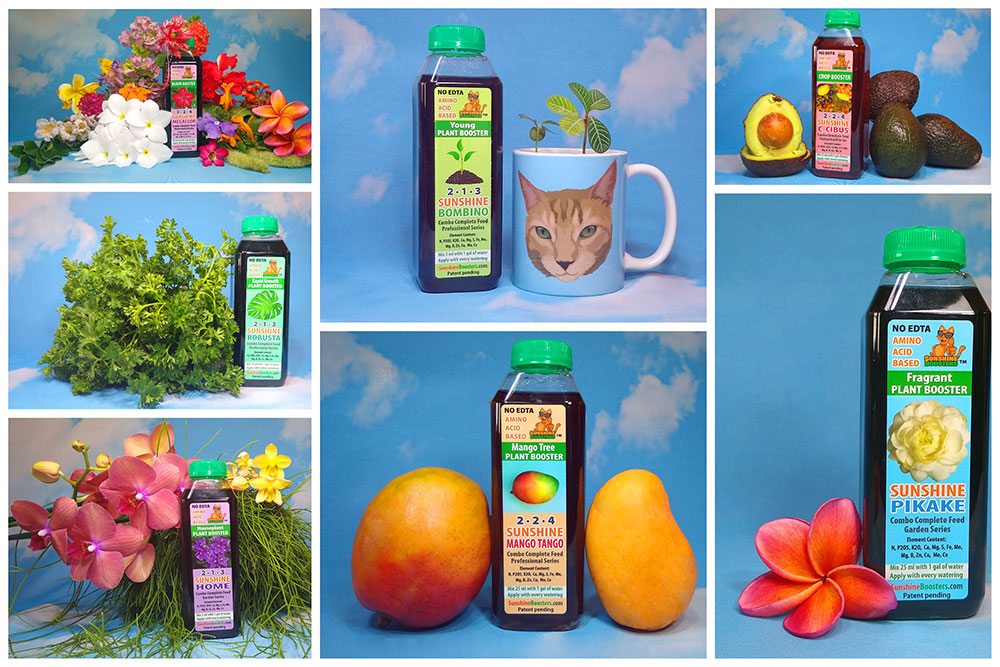
and especially amino-acid based Sunshine Boosters, are safe to apply year around. This means, you can
continue feeding your plants with Sunshine Boosters through the Winter without
risk of over-feeding or burning roots. Why?
The answer is very simple: even with their metabolism slowed down in
Winter, plants will use all that food.
Sunshine Boosters have special mild formulas that are scientifically
designed and based on Amino Acids. Plants will use all essential elements from the
solution as needed.
Liquid fertilizer is diluted in water, and will be applied only when you
water the plant. During Winter, water needs are lowered = watering times are
less frequent, with less amount of water = the plants will get less water and
less fertilizer accordingly.
Importance of micro elements
in combination with plant food during winter
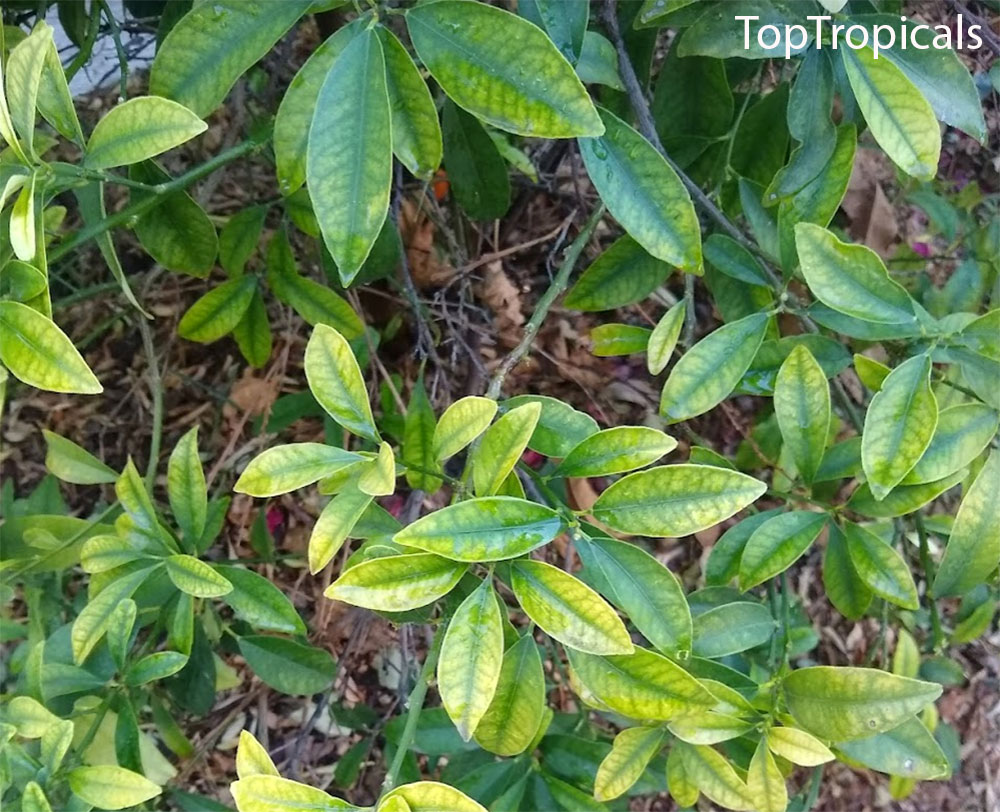
In the photo: winter chlorosis on Kumquat leaves that is very hard to treat and should be prevented instead
Keep in mind that feeding your plants regularly during Winter will help to avoid "winter chlorosis" and other deficiency problems. So called "cool-temperature-induced chlorosis" (CTIC) is especially common in Spring on young, actively growing leaves. Unless chlorosis is prevented by micro-element applications, affected leaves may remain in this condition for the rest of the growing season.
Make sure to select proper type of fertilizer for your over-wintering plants. We have special formulas for foliage, flowering plants, fruit trees, young seedlings, even for for orchids and bromeliads. Check out our selection!
Date: 2 Nov 2025
Winter flowering trees and shrubs - all you need for winter color in your garden
🌺 Winter flowering trees and shrubs - all you need for winter color in your garden.
Many snowbirds ask what to plant when they’re here just for the season. The answer is simple: go for trees and shrubs that bloom in winter. Fall is the perfect time to plant them, so your garden bursts with flowers once the cool season arrives.
📱 We put everything in one place for you!
Check out this single YouTube Post with all our favorite winter-blooming trees and shrubs - your shortcut to a colorful garden this season:
https://youtube.com/post/UgkxRWCHqNDqrRIIwK_BAeWjfi3spnZK0EbA?si=LbNv_RhkKGkc0rxv
Save it for later and share it with your garden friends.
🌸 Videos on Winter flowering trees and shrubs:
👉 See more...
🛒 Want to grow your own winter color garden?
🟢 Join 👉 TopTropicals
Date: 8 Jul 2024
What is the best Avocado variety? Five most popular Avocado varieties
Avocado Brogdon
Avocado Hass
Avocado Fuerte
Avocado Oro Negro
Avocado Winter Mexican
Five most popular Avocado varieties
❓ "What is the best variety of Avocado?"
"Do you have the one with small black fruit and bumpy skin?"
"I have avocado with very large green fruit, what variety is it?"
These are frequently asked questions we get from our customers. This basic "classification" by black/green doesn't encompass all the wonderful qualities avocados have to offer. There are numerous hybrids in cultivation, and once you plant your first tree and taste the REAL fruit (not from the grocery store), you'll be eager to explore other varieties. While it's true that avocado fruit can vary in "butter" content, most superior varieties are equally delicious.
✅ We will guide you through Avocado varieties like we did with Mango varieties in earlier posts. First comes first -
🏆 The most popular Avocado varieties:
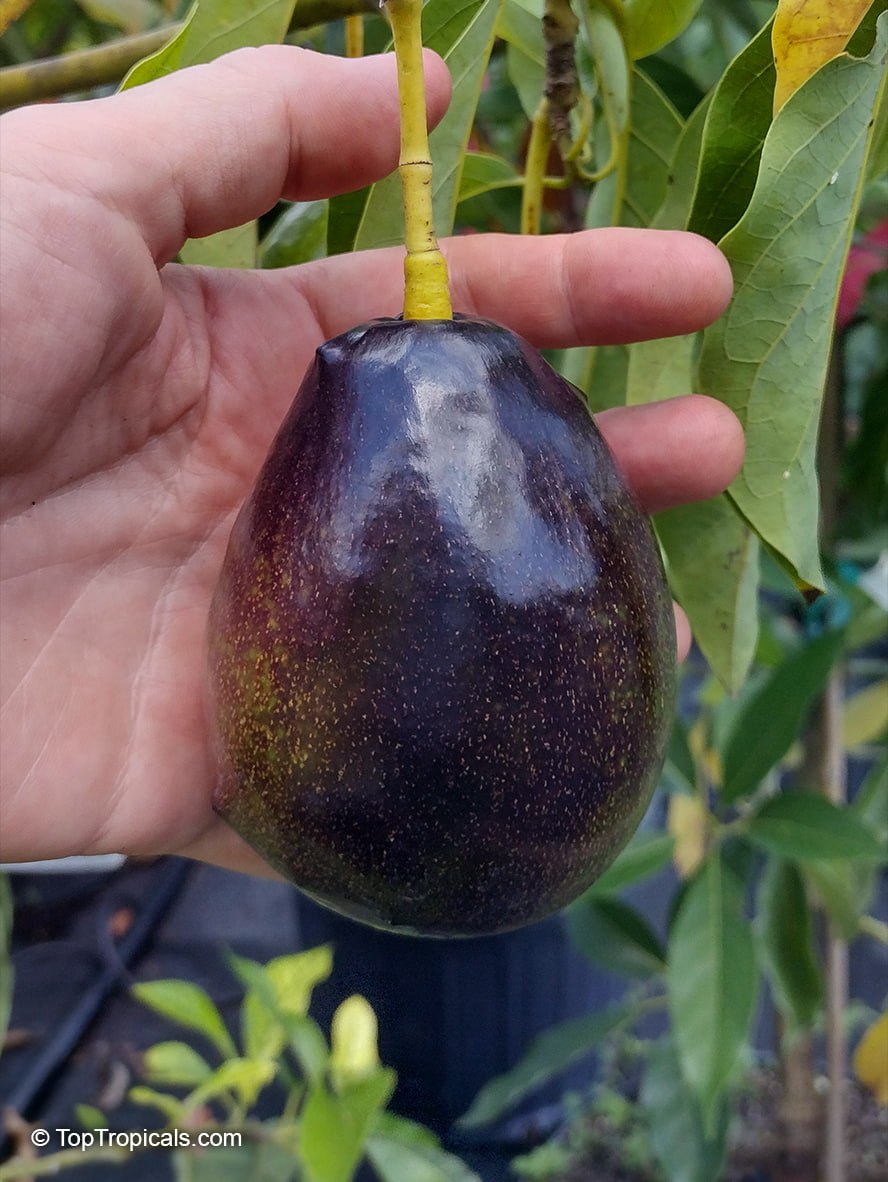
1. Brogdon - red-purple pear-shaped fruit, 7-15 oz. Skin is very thin, yellow buttery flesh. Fruit ripens in late summer-fall. Very cold hardy.
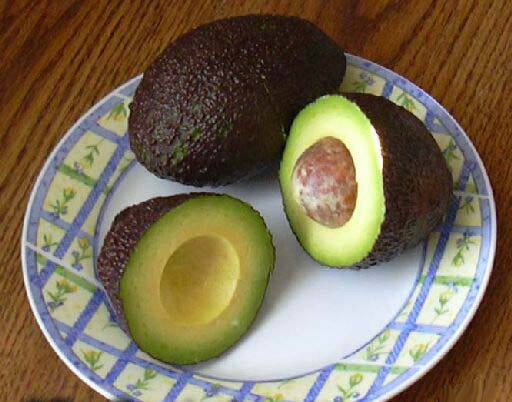
2. Hass - probably the most popular, but this tree prefers drier climate (Florida is humid, so we plant adaptable Florida Hass here). The fruit is dark-colored with a rough and bumpy skin, turns black when ripe.
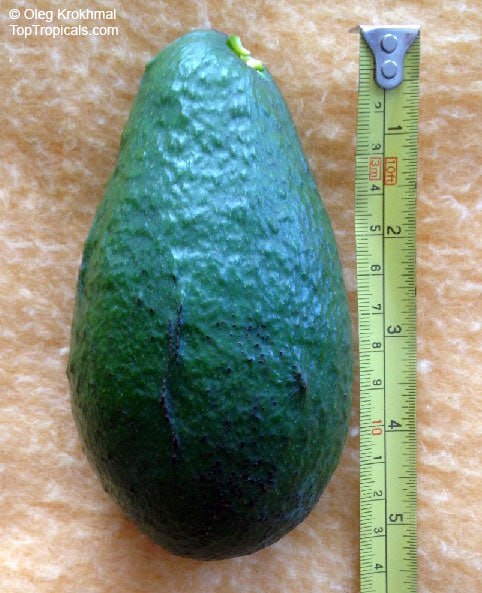
3. Fuerte - a dwarf and a very cold hardy variety. Everybody's favorite "Condo Avocado": perfect for container culture and small yards. The mature tree in the ground is under 15 ft; 6-7 ft in containers.
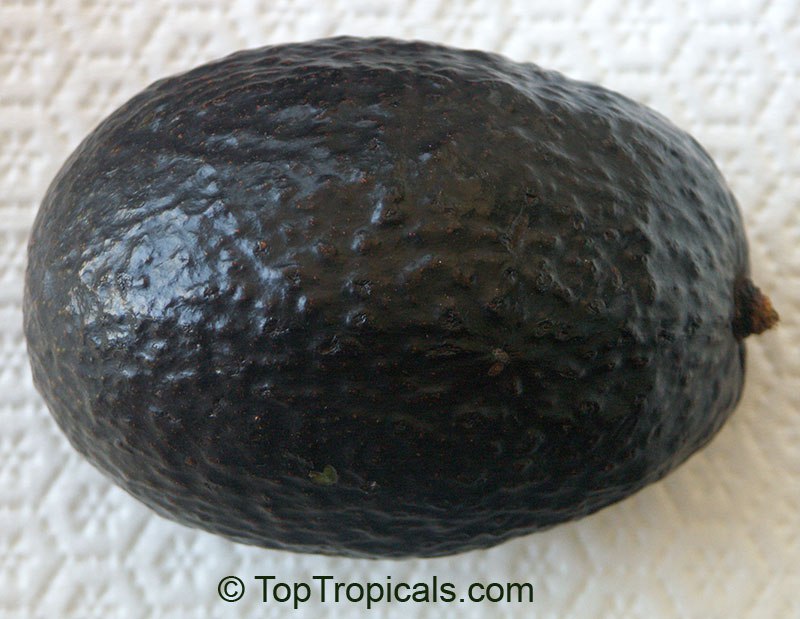
4. Oro Negro - Oro Negro means "black gold" in Spanish, which is an incredibly appropriate name for this fruit. This Monroe hybrid (with big size fruit) is crossed with a Mexican type which would explain the black skin. The flesh is rich and buttery with a creamy texture.
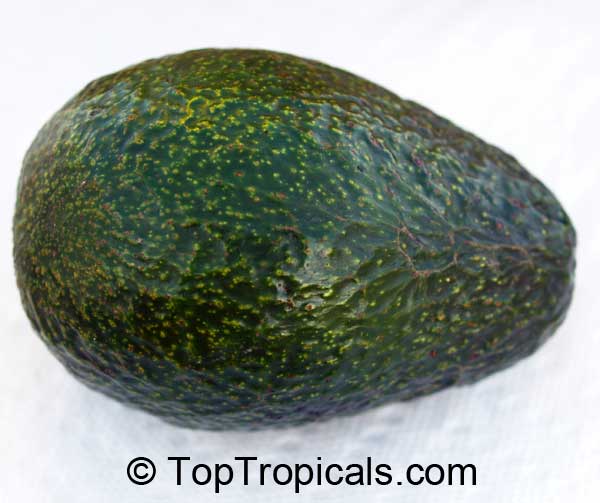
5. Winter Mexican - one of most cold hardy varieties, Guatemalan x Mexican origin. Mature trees may withstand temperatures in the mid 20s. Oblong fruit, 12-18 oz, thick green skin. Very vigorous tree, bears heavily and regularly in December-January.
📚 Learn more: Avocado Variety Guide - check this out for interactive chart of Avocado varieties and sort them by flower type A or B, tree habit, fruit shape and quality, cold hardiness, origin, season and more!
🛒 Shop Avocado Trees
#Food_Forest
🏵 TopTropicals