Date: 27 Apr 2020
How to feed a Mango tree...
and to grow a Dwarf Mango
How to fertilize a Mango tree
Q: My mango trees that I bought and planted last august now have fruit. I bought 2 types of fertilizer from you and never used it. Should I use your fertilizer now?
A: It is a perfect time now to fertilize your plants as they
start active growth.
For mango trees, we recommend liquid fertilizer Sunshine Booster - Mango Tango. It is formulated for Mango trees,
especially for container grown. It improves quantity and quality of flowers and
ability to set fruit, reduces bud-flower-fruit drop. Can be used as often as
with every watering. For best results, use in combination with Sunshine Honey and Sunshine Superfood plant supplements. Its scientifically-balanced
stable formula is organic Amino-acid based and has NO EDTA chelators to eliminate
nutrients lockup; it does not affect crop taste.
Additionally, you may use slow-release granulated fertilizer Mango-Food once a month during hot season only. Dosage: 1 teaspoon per
each gal of soil.
Water-soluble fertilizers can be also used, however, those are usually
EDTA-chelated which is not as efficient as Amono-acid based Sunshine Boosters and
may create nutrients build up, especially if overdosed in containers.
For in-ground mango trees, you may use all the above, and slow-release
granulated fertilizer can be applied in larger quantities: spread a handful
around the drip line.
Remember that only liquid Sunshine Boosters can be applied year around. With other fertilizers, you need to be careful not to overdose, and apply only during hot weather (when night temperatures are steadily above 65F).
How to grow a Dwarf Mango tree
Q: I received the Ice cream mango tree in great condition (thank you for the ingenious packing job) on Wednesday and have planted it in a pot slightly bigger than the root ball. I plan to grow the tree on my front porch, so how big a container should I ultimately use when the tree outgrows this pot? How big a container does it need to fruit? I hope to keep it around 6-7 feet high, if possible. I live in Hawaii.
A: Ice Cream mango is a perfect variety for container culture, and it should be happy in Hawaii. You did everything right. Keep it in this small pot for now and wait until it starts vigorous growth in Summer. Once it starts growing (and you will notice roots growing too, sometimes they try to grow through the holes in the bottom of the pot), then it's time to step up into a bigger container (7-10 gal). Eventually you may use container size as large as 15 gal. Ice cream mango is slow growing and compact, and you will be able to maintain it under 7 ft with very minimal pruning if any.
Date: 16 Nov 2019
When to apply super boost?
Sunshine Boosters: a breakthrough in Winter fertilizing
In the photo: plants are tough survivors. Life can't be stopped even by a brick road!
Q: Just wanted to know best time of day to apply super boost as spray and watering? Only listed to make sure night temp doesn't drop below 65F...
A: As a rule of thumb, plant's needs in fertilizers are very low
in the cold season because they consume less nutrients during dormancy. For
tropical plants, when minimum temperatures drop below 65F - we stop
applications of dry (granulated) fertilizers until spring, to avoid root burn.
Liquid Sunshine Boosters are exceptions from this rule to a certain extent,
for 2 reasons:
- they are amino-acid based which means, salts do not build up in the soil,
and thus will not burn the roots even with slower plant metabolism.
- concentrations/formulas are mild and designed for as frequent as daily
watering
Tips for winter fertilizing:
1) When a plant goes into full dormancy (drops leaves and does not show any new growth), you may stop fertilizing with any Macro NPK products (both dry and liquid)
2) If a plant is evergreen and continues growing during the cooler
period, and especially if it is a winter bloomer, mild liquid fertilizers can be
applied, depending on the stage of plant development.
Robusta and TotalFeed are used for vegetative growth and pre-flower.
Megaflor and C-Cibus are used for winter flowering/ fruiting plants during the bloom
stage.
See full list of liquid boosters
3) Micro-elements can be used all year round for all plants that are not dormant (do not drop leaves)
4) Always use Sunshine-Epi as a foliar spray to activate immune system and unlock protective mechanisms, BEFORE applying other boosters. It is especially important during Fall-Winter for improving cold tolerance and disease resistance.
5) Always apply foliar spray and/or drench the soil with solutions in morning hours so the plant has time to process the nutrients during daylight when metabolism is the most active.
6) Avoid any dry fertilizers during winter
Date: 7 Oct 2019
Fertilizing in Winter?
Q: I'm a bit confused about what winter fertilization schedule I should follow in South Florida. For blooming plants, usually, I use a monthly granular bloom booster fertilizer as well as a liquid fertilizer every 10 days or so. Should I continue that schedule in the winter as well? Should I stop fertilizing altogether in the winter? How about fruit trees? What fertilization schedule should I follow in the winter?
A: Here is a general fertilizing schedule for established plants that we follow here
in SW Florida.
The rule of thumb is, do not fertilize (with macro- NPK elements) when
minimum temperatures drop below 65F and stay at that level for more than 7
days. At this temperature point, most of the tropical and subtropical plants
slow down their metabolism and some of them going into dormancy. This means,
nutrients are not consumed as much as during active growth period, and built-up
nutrient supply within a plant plus whatever is available in the soil is
just enough to get by through the winter. So additional fertilizing is not
necessary. You may continue micro-element supplements and bio-stimulants
throughout the year. In fact, it is highly recommended to do so, to help the plant
survive cold spells. These are very effective tropical plant protectors:
SUNSHINE-Epi - Brassinosteroid plant hormone
SUNSHINE-Power-Si - Advanced plant protector with Silicon
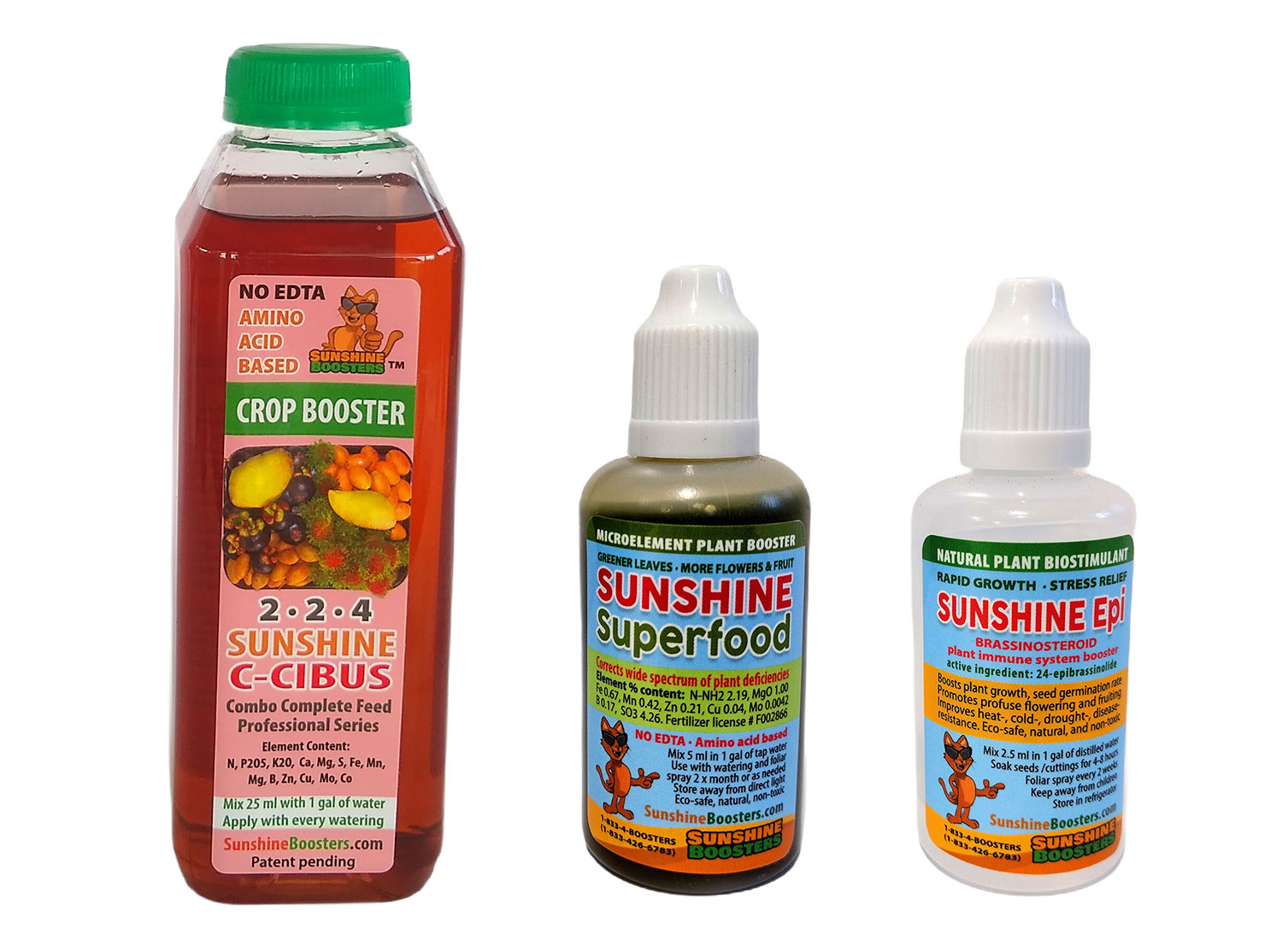
SUNSHINE SuperFood - Complex microelement supplement
This rule is applied to both flowering and fruiting plants, in general. However, some species are winter-flowering and winter-fruiting. For those, you can make an exception and provide extra nutrients for flowering and fruiting, as long as the weather stays warm. During cold spells, avoid any NPK fertilizers and use only bio-stimulants and micro-elements. If you apply NPK during cold, it won't be consumed by a plant, build up in the soil, and may create a root burn situation.
In simple words, fertilize from March to October. Give plants some rest from November to February.
Date: 24 May 2019
Synergy of SUNSHINE, biostimulants, and macro-micro
Q: I've heard that plants grow better and bigger with SUNSHINE boosters and when using Myco-Mix instead of regular soil mix. Do they work like fertilizers? If I use a Myco-mix, do I still need a fertilizer?
A: SUNSHINE boosters are not fertilizers, they are natural plant hormones, or biostimulants, as well as Myco-Mix which is a naturally occurring compound or microbes. Biostimulants are becoming increasingly attractive to folks interested in sustainable agriculture, and very popular for plant growth or pest resistance. A plant biostimulant is not a fertilizer because it provides no nutritional value to the plants. But, it can promote greater nutrient and water use efficiency, increase resistance to pests and diseases, reduce abiotic stresses, and in turn, lead to plant growth and health.
To answer your question, you can not replace regular fertilizers (NPK) and micro-elements with plant boosters and stimulants. However, fertilizers and microelements will work more efficiently when used in combination with biostimulants. Together they create a synergy, so plants use the most of fertilizer's potential, and will grow a lot better, faster, and healthier.
4 components for the best growing results
1. SUNSHINE boosters. They are a must during the juvenile stage of plant
development - seedlings and cuttings. They are especially important for
recovery of weak or stressed plants (boosting their immune system).
2. SuperFood microelements
3. NPK fertilizers. Select from water-soluble and smart-release types and
make sure do not exceed the recommended concentration. Lower dose and more
frequent use is always better for a plant.
4. Specialized soilless mixes: Myco-Mix (with biostimulant Mycorrhiza) for exclusive growing projects
and special/unique plants, Professional potting mix for potted plants, and Propagation mix for seeds and cuttings.
Date: 5 Apr 2025
Go Bananas - up to 20% OFF Banana Trees!
Now through 4/15 - Limited Time Only!
Banana Health Benefits
Bananas are a powerhouse of nutrition - rich in potassium for heart health, and packed with vitamins B6 and C to boost energy and immunity. They come from fast-growing, easy-care trees that thrive in warm climates or containers. Whether eaten fresh, blended, or baked, bananas are a naturally sweet and tasty treat you can grow yourself!
Ready to turn your garden into a tropical paradise and grow your own delicious bananas? Now's your chance - use our offer below!
A Banana for Every Space and Taste
At Top Tropicals, we've got over a dozen top banana varieties - from exotic ornamental beauties like Blood Leaf and Siam Ruby to edible showstoppers. Edible varieties range from popular, heavy-producing types like Double Mahoi to rare collector favorites like Ice Cream (Blue Java) - the kind you'll never find at the grocery store. We also carry dwarf varieties that grow just 4 feet tall but still produce full-sized fruit - perfect for containers, patios, and small spaces. Collect them all - edible, ornamental, dwarf, rare - and enjoy the fun, flavor, and beauty of growing your own banana grove.
From Collectors to Beginners - We've Got Your Banana
"Growing bananas is like growing sunshine. They bring energy, beauty, and fruit to your doorstep." - said Dr. Richard Campbell, tropical fruit expert and co-creator of the condo mango concept.
Growing bananas is easy, low-maintenance, and budget-friendly. With Sunshine Boosters plant food, these tropical favorites grow fast and can start producing as soon as next season! Whether you live in the South or up North, in a house or an apartment - you can grow your own bananas in the garden, on a balcony, patio, or lanai and enjoy the taste of the tropics at home.
Special Offer
Get instant 10% off all bananas for 1 week only, plus extra 10% OFF sitewide with code below for qualified orders.
Additional 10% off your entire purchase (including any other plants), saving total of 20% on your Banana trees:
GOBANANAS
Min order $150, excluding S/H. Exp. 4-15-25
Hurry, offer ends April 15th!
Learn More About Banana Varieties:
- Top Ornamental Banana Varieties - Which One Belongs in Your Garden?
- Best Edible Bananas to Grow - Sweet, Unique, and Delicious!
- How Many Banana
Varieties Can You Grow? (More Than You Think!)
In the photo above: Sunshine Boosters are the best fertilizers for ornamental (Sunshine Robusta) and edible bananas (Sunshine C-Cibus