Garden Blog - Top Tropicals

Date: 23 Oct 2019

Best tasting white guava

Q: What's your best tasting white guava?

A: Our favorite white Guava is Viet Nam variety that is also very rare and hard to find. The fruit is very large, up to 6" in diameter, the pulp is very sweet and somewhat crunchy. The seeds are small which makes it more pleasurable to eat out of hand.
Another great feature of this variety, it stays compact and branches do not get leggy, unlike most guavas. It can be easily grown in a container, trimmed to the desired size and it will produce fruit under proper care.

Another cool variety is Indonesian, it also has a large round fruit and very few seeds to compare with others.

And last but not least, if you prefer soft fruit to crunchy, the Peruvian variety is a great choice. The fruit is pear-shaped.

Remember to provide plant food for good production, especially if grown in a container.

Fruit Festival Plant Food - Super Crop Booster
Mango-Food - Smart Release Fruit Tree Booster
SUNSHINE C-Cibus - Crop Nutrition Booster

Date: 28 Dec 2018

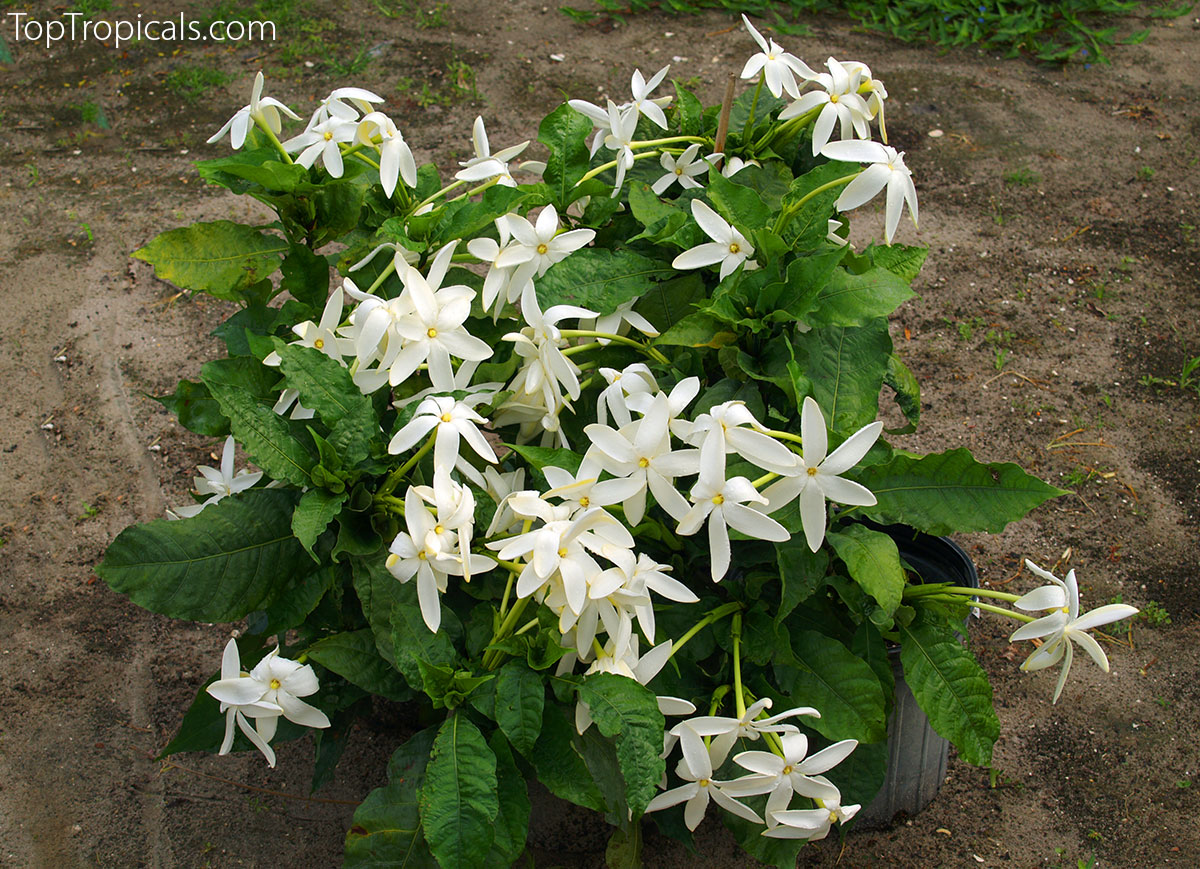
How to get a Jasmine to bloom.
Caring for jasmines as container plants during Winter

TopTropicals.com

Locate the jasmine plant where it will receive bright filtered light at least six hours every day.

Put a few pebbles in a shallow plate or tray and pour fresh water over the pebbles. Set the pot on the pebbles, but don't let the water level touch the bottom of the pot. This increases the humidity in the air around the jasmine. Keep the plant away from wood stoves, heat vents and radiators.

Water the jasmine when the top 1/2 inch of the soil feels dry. Don't let the soil get soggy, and never let the pot sit in water. Water the plant sparingly during the winter.

Feed jasmine twice a month between Spring and early Fall, using a granulated slow-release, or water-soluble houseplant fertilizer mixed at half strength. Don't fertilize during the winter months.

Prune the jasmine as needed to maintain the desired shape. Never prune in winter, as the plant will be preparing to bud.

Encourage the jasmine to bloom by putting it in a cool room at night for four to five weeks during Fall to Early Winter. The plant should get plenty of sunlight during the day, but during the night, move it to a pitch-dark room where the temperature is between 40 and 50 degrees F. After four to five weeks, leave the plant in its regular, daytime location. The plant should start blooming in mid-Winter to early Spring.

See all jasmine plants...

Date: 27 Jun 2018

TROPICAL GARDENING: How to grow Brugmansia (Angel Trumpet) in the ground outside.

TopTropicals

Q: I recently moved from New Jersey to Florida and I brought with me my Brugmansia that I used to have as a house plant. Can I plant it in the ground now?

A: Angel Trumpet - Brugmansia - is a very popular container plant valued for its large, stunning fragrant flowers. Originated from South America, it will be happy to grow in tropical to subtropical climate outdoors. These are a few useful tips to get the most out of this beautiful plant:
1) Light. Plant it in full sun - the more sun, the more flowers you get, although Brugmansias tolerate shade. If the plant was previously grown in container indoors, to avoid leaf burn, keep it protected with a shade cloth or simply white sheet for a while and gradually open to adjust to full sun.
2) Soil and fertilizer. Use fertile soil with lots of organic matter (add compost to existing soil). It must be very well drained, Angel Trumpet won't tolerate waterlogged conditions. Plant it on a little "hill" elevated 3-4" above the surrounding area. Brugmansias are very heavy feeders. Once the plant is established, fertilize on regular basis with Slow Release Fertilizer - a handful once a month.
3) Water. Water daily until established. Once the root system is well developed, the plant is drought tolerant and won't require too much care. But at the beginning, watch the leaves - the lush foliage droops quickly if the plant is thirsty.
4) Plan space. Brugmansia is a short tree, but it needs a lot of room to spread branches with its heavy hanging flowers. Think 12" wide and maybe almost as much tall.
5) Support. Being widespread plant, Brugmansia can be blown with strong winds. Stake with strong support until established.
6) Propagation. Brugmansia is one of the few plants that propagates with semi-woody cuttings; soft green cuttings usually have little success. Other than that, it is pretty easy!

Check out our Brugmansia collection and... collect them all!

Date: 3 Aug 2025

Four  stages  of  Coffee  Tree  growth:  a  young  potted  plant,  a  mature  tree  in  the  ground,  white  star-shaped  blooms,  and  a  branch  full  of  ripening  red  and  green  coffee  cherries.

What is the most popular and easiest tropical fruit tree to grow indoors?

No doubt about it - it's the Coffee Tree.

  • Coffee is shade-loving and easy to grow with regular water
  • It grows into a dark green shrub or small tree (about 3 to 5 feet tall in a pot)
  • Its fragrant, star-shaped flowers resemble gardenias
  • The whole fruit is edible and turns green to yellow to red
  • The seeds are real "coffee beans" that can be dried, roasted, and ground at home.

Five Reasons to Grow a Coffee Plant

  • Perfect Indoor Fruit Tree: Thrives in filtered light and stays compact
  • Low Maintenance: Forgiving, adaptable, and ideal for new gardeners
  • Aesthetic Appeal: Glossy green leaves and clusters of white blooms
  • Homegrown Coffee: Yes, you can roast your own beans.
  • Year-Round Beauty: Evergreen with seasonal fragrance

Coffee Plant Care Tips

  • Light: Bright, indirect light is best. Avoid harsh afternoon sun.
  • Water: Keep soil lightly moist but not soggy. Let the top inch dry out before watering again.
  • Humidity: Loves higher humidity. Mist regularly or place on a pebble tray.
  • Fertilizer: Use a balanced, gentle fertilizer like Sunshine Boosters C-Cibus every few weeks during growing season.
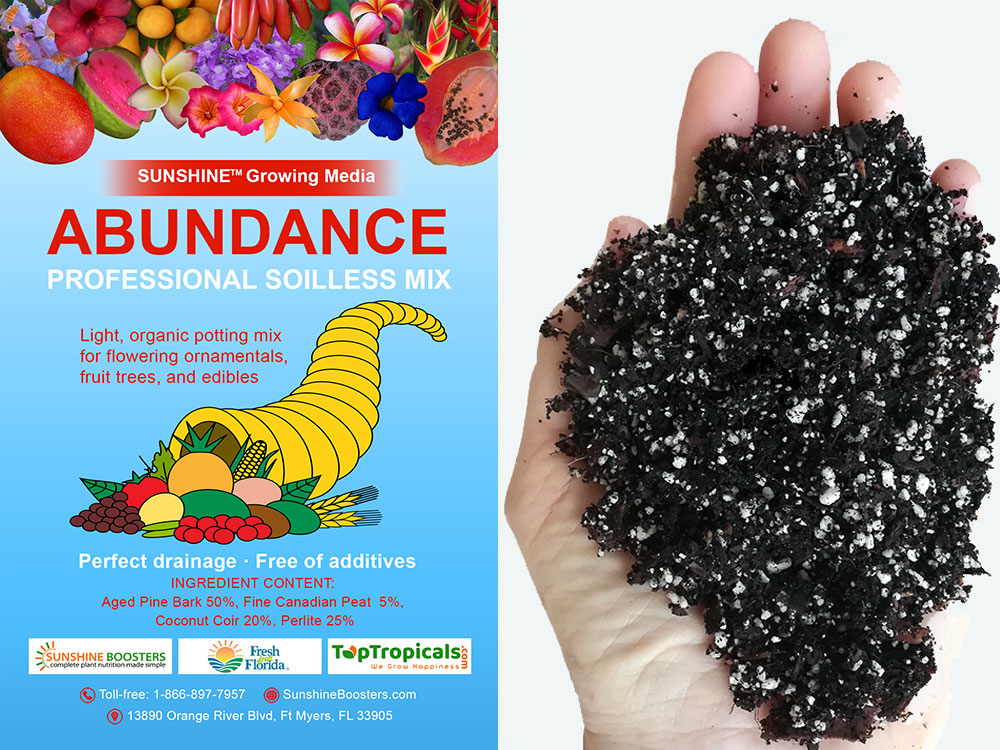
  • Soil: Loose, rich, and well-drained. High in organic matter and slightly acidic. For potted plants, use a quality indoor tropical mix, such as Top Tropicals Abundance mix
  • Repotting: Refresh soil and size up the pot every 1–2 years to keep roots healthy.
  • Can I grow it outdoors?: Yes - bring it outside in warm months and back indoors before frost. It's best suited for USDA zones 10-11, but container growing gives you flexibility in cooler climates.
  • How long until I get beans?: Expect flowers and fruit within 3 to 4 years from seedling stage - often sooner if you start with a young tree.
  • What does the fruit taste like?: Mild and sweet-tart, like a mix between a cherry and a cranberry. You can eat it fresh.

How to Make Coffee from Your Own Tree

  • Harvest: Pick the ripe red cherries
  • Pop and Soak: Squeeze out the beans and ferment 1-2 days to remove pulp
  • Dry: Spread out to dry for 1-2 weeks until hard and papery
  • Husk: Remove the thin shell to reveal green beans
  • Roast: Use a dry skillet or oven until fragrant
  • Grind and Brew: Cool, grind, and enjoy the freshest coffee you've ever had.
    Learn more: How to make your own coffee from homegrown beans

Coffee Health Benefits

  • Rich in antioxidants - supports heart and brain health
  • Boosts focus and mental alertness
  • Supports metabolism and fat-burning

Why Coffee Makes the Perfect Gift Plant

  • Long-living and beautiful
  • Symbolic, useful, and personal
  • Great for coffee lovers, gardeners, and the "person who has everything"

Read Garden Blog about Coffee

Shop Coffee Plants

Date: 29 Sep 2020

Healthy Plant Food: Q&A from Mr Booster

Why my Sapodilla is not fruiting?

Q: I bought a Sapodilla tree from you several years ago, Silas Woods. I live in Houston area. The tree grows and produces blossoms for fruits, but then they just dry up and fall off. To-date, I have not gotten any fruits off the tree. Is there a reason for this? I really want a fruiting tree because Sapodilla is one of my favorite fruits. I have attached pictures of the tree. Please help.

A: Silas Woods is a free-flowering variety and in favorable conditions it should produce fruit almost year round, considering warm temperatures. The fact that the tree is producing flowers indicates that it is strong, overall healthy and ready for production, but for some reason these flowers don't set fruit. There may be several reasons for such behavior.

1) Too high temperature and too low humidity
In Houston area, humidity should be good in summer. However, if temperatures stay above 90F for a long time, this may cause flower dry-n-drop.
Solution: try to move the potted tree into filtered light, or in a spot where it does not get direct burning sun during the hottest hours of the day (morning sun is the best)

2) Root bound.
Solution: check if the tree needs stepping up into a larger container.

3) Lack of certain nutrients that are responsible for proper fruit formation.
In particular, elements B (Boron), Mo (Molybdenum), and a few other micro-elements (Fe - iron, Cu - Copper, etc.). This is most likely the cause of a flower drop. This is very common reason for undeveloped fruit or lack of fruit in container-grown fruit trees. When grown in the ground, plants can reach out to all necessary elements in surrounding soil (considering soils are not too poor on necessary elements). In a pot, a supply of nutrients can be exhausted very quickly, so a quality fertilizer program is very important. Fertilizer must include all necessary nutrients in easy accessible form, and a plant must have their constant supply for proper development.
Solution: prescribe to your Sapodilla tree the following combination of plant food:
- SUNSHINE C-Cibus - Crop Nutrition Booster. It will provide well-balanced amounts of high absorption Nitrogen, as well as other macro-elements - to provide enough energy to the tree, plus a combination of all necessary micro-elements. It is safe to apply this fertilizer as frequent as with every watering, including winter time.
- SUNSHINE-Honey - sugar booster. This supplement has a high content of elements Mo and B - once the tree starts getting them on regular basis (a few times a year, according to the label), it will change its habit dropping flowers and/or premature fruit drop. As extra bonus, Sunshine Honey makes fruit sweeter by bringing sugars from all over the plant and concentrating them into fruit.

4) Lack of pollinating insects.
Solution: For most effective pollination, we always recommend to put some pieces of fruit under the tree, apple peels, or even banana peel. Those attract tiny beetles that are responsible for small flower pollination.

With winter time approaching, fruiting season is about to end, however, do not get discouraged and start the fertilizing program right away: this will bring up the plant into a healthy stage within a few months, and by next season it should be covered with fruit you like so much! Remember, Sunshine liquid fertilizers can be used year round, including winter, without a risk to burn roots or overdose, as long as you follow label instructions.

SUNSHINE C-Cibus - Crop Nutrition Booster from Garden Series, or Combo Total Feed Collection - all nutrients in just one bottle, for fruit trees and edibles.