Garden Blog - Top Tropicals

Date: 16 Dec 2021

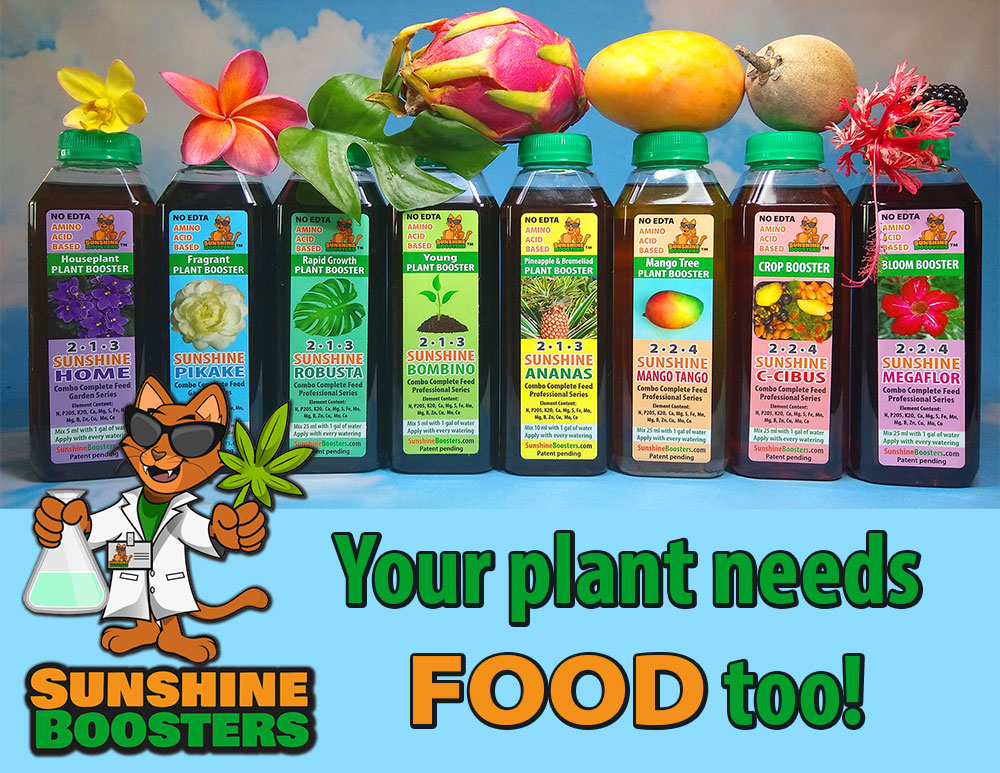
Why should you use Sunshine Boosters?

by Ed Jones, the Booster guy

...You have heard it before, but I will tell you again. Sunshine Boosters are safe to use with every watering. It means that you can use Sunshine Boosters amino acid based fertilizers whenever you water your plants, even in the winter. Why is that so important?..

...We normally stop using dry, timed release, fertilizers around the first of November and not resume using them until the first part of March. This is true in many areas of the deep south where the ground stays above freezing year round...

However, it is safe to use Sunshine Boosters during these cooler months... Temperature does not play a role in the absorption of nutrients when using Sunshine Boosters...

To find out how it works, see Ed's new Article Why should you use Sunshine Boosters. If you want to learn even more in depth, check out his blog: Micronutrients Delivery Systems.

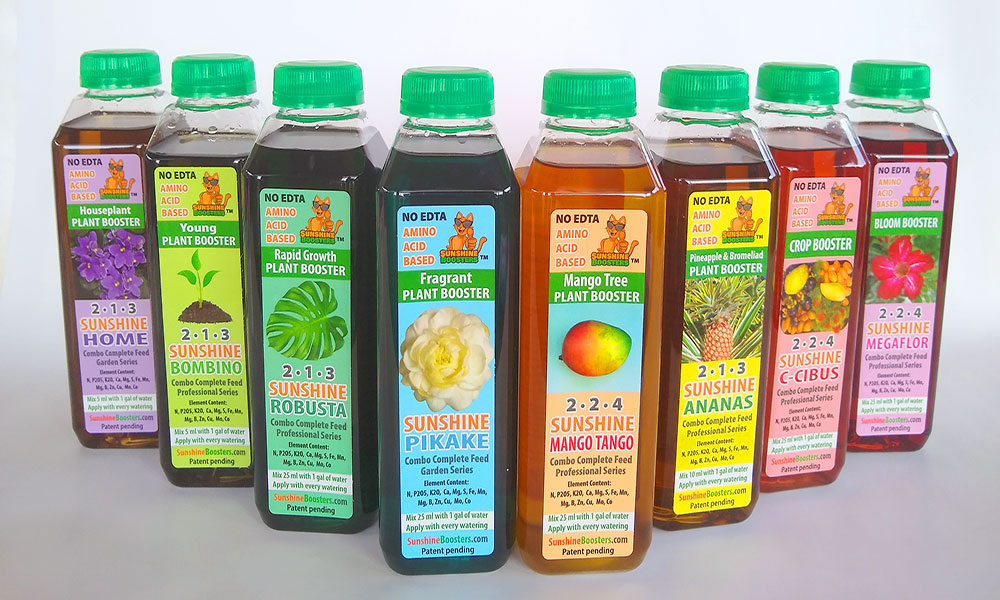
As of this writing, all Sunshine Boosters are on Holiday Sale. There are boosters for all different types of plants. Check them out and -

Give your plants a little something extra for Christmas!

CONTINUE READING >>

Date: 13 Jun 2026

Why June Is the Most Important Month for Potted Tropical Plants

Cats Smokey and Sunshine planting tropical plants

Cats Smokey and Sunshine planting tropical plants

Why June Is the Most Important Month for Potted Tropical Plants


For many tropical plants, June is the start of peak growing season. Days are longer, temperatures are warmer, and plants that spent winter indoors or in a greenhouse are suddenly growing at full speed.
A few simple tasks now can mean stronger growth, more flowers, and better fruit later in the season.


Smokey: Sunshine, why are you mixing fertilizer with coffee and donut crumbs?
Sunshine: I'm testing a new growth formula.
Smokey: Based on what research?
Sunshine: Based on a highly controlled breakfast study. I call it Hibiscus Turbo Boost Deluxe.


✅ 1. Repot Before Plants Become Root-Bound


·  If roots are circling the pot, growing through drainage holes, or the soil dries out unusually fast, it's time to move up one pot size.
·  Fresh potting mix provides new space, better drainage, and access to nutrients that older soil may no longer contain. Use professional soilless mix Abundance for best results.
·  Don't jump from a small pot to an oversized container. One size larger is usually enough.

✅ 2. Feed Hungry Summer Growth


· Tropical plants are no longer resting. They are actively producing roots, leaves, flowers, and fruit.
· June is the perfect time to begin regular feeding.
· A balanced fertilizer program helps support strong growth, while products such as Green Magic and Sunshine Boosters provide additional nutrients that fast-growing tropicals can quickly use during summer.
· A well-fed plant grows faster, recovers from stress better, and flowers more heavily.

✅ 3. Acclimate Plants to Full Sun


One of the most common mistakes is moving a plant directly from indoors or a greenhouse into full summer sun. Leaves that developed in shade can burn within hours.
Start with bright shade or morning sun, then gradually increase exposure over one to two weeks. Even sun-loving plants benefit from a transition period.

✅ 4. Prune for Shape and Strength


June is an excellent time to remove weak, damaged, or overly long branches.
Light pruning encourages branching and creates a fuller, stronger plant.
For fruit trees, selective trimming can also help maintain a manageable size for container growing.

✅ 5. Check for Pests Before They Multiply


·  Warm weather brings rapid plant growth - and rapid pest growth.
·  Inspect new leaves, stems, and undersides of foliage for aphids, scale, spider mites, mealybugs, and whiteflies.
·  Treat problems early before populations explode during the heat of summer. We recommend Sunshine NoBug all-natural pesticide.

✅ 6. Add Stakes, Trellises, and Supports


·  Many tropical plants can double or triple their size during summer.
·  Climbing plants, vanilla orchids, passion fruit, dragon fruit, mandevilla, and many vining species appreciate support before they become tangled.
·  Installing stakes or trellises now is much easier than trying to do it later.

✅ 7. Water for Active Growth


·  A tropical plant that needed water once a week in spring may need it every day during summer.
·  Higher temperatures mean faster growth, greater water use, and more nutrient uptake.
·  Check containers frequently, especially during hot or windy weather. Water thoroughly and allow excess water to drain away.

✅ 8. Refresh Mulch and Clean Up Pots


·  Remove weeds, old leaves, and debris from containers.
·  A thin layer of mulch helps moderate soil temperatures and slows moisture loss during the hottest months.
·  Clean pots also reduce hiding places for pests and disease.

✅ The Bottom Line


June is when potted tropical plants shift into high gear. Repot if needed, fertilize regularly, inspect for pests, provide support, and keep up with watering. A little attention now often produces the biggest growth, best blooms, and heaviest fruiting of the entire year.

🛒
Get fresh soilless mix and real food for your plants

📚
Learn more:
Sunshine Boosters: Complete Plant Nutrition System
Why young trees need staking?
The SECRET growers never tell you: simple trick how to bring plants back to life and keep green 
How to re-pot a plant properly?

#Discover #How_to #Smokey_Sunshine

🟢 Join 👉 TopTropicals

Date: 12 Sep 2019

Helping Citrus and other fruit trees with Nutritional Supplements

Q: Can you recommended a product to help with my citrus? Combating greening and chlorosis.

A: Citrus greening is spread by an insect called the Asian citrus psyllid. The psyllid feeds on the stems and leaves of the trees, infecting the trees with the bacteria that causes citrus greening. Florida Citrus growers dedicated the last decade to researching citrus greening. Officially, currently there is still no cure, however, some Nutritional solutions have shown promising results. To slow the progression of citrus greening in infected trees, nutrients are applied to the leaves and to the roots. Providing better nutrition helps trees fight against citrus greening and enables them to continue to produce quality fruit.

We recommend the following products for use on regular basis:

SUNSHINE Epi is a natural Brassinosteroid plant hormone and a bio-stimulant that may be very effective as citrus greening treatment. It works through plant's immune system and shows amazing results of recovery of weak and sick plants.

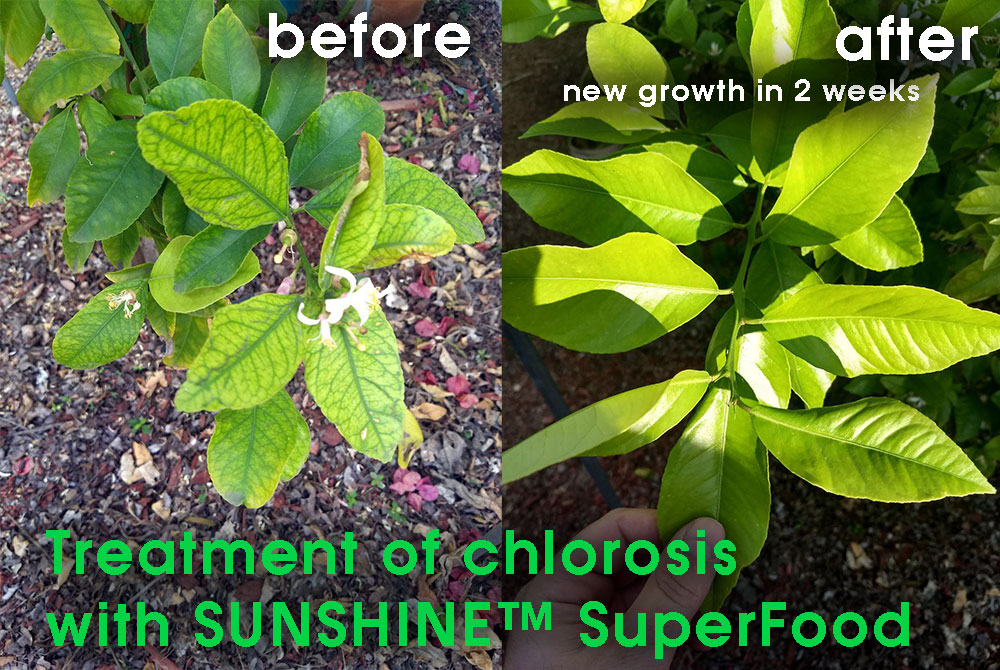
SUNSHINE Superfood, a complex micro-element supplement, maintains plant's health and provides vigorous growth.

SUNSHINE-Honey is a basic nutritional complement, it contains essential plant micronutrients Boron (B) and Molybdenum (Mo). These elements are essential to vegetative and reproductive growth, cell expansion, tissue growth, and fertility. A very common problem for most unimproved garden soils is lack of Molybdenum and Boron as soil micro-component. This results in underdeveloped / low quality fruit and/or premature fruit drop. Applying SUNSHINE Honey on your fruit trees will fill that gap and help a fruit tree to form a healthy fruit.

Macro-nutrients should be applied in combination with micro-nutrients on regular basis:

Mango-Food - Smart Release Fruit Tree Booster (works great for all tropical fruit trees)
Fruit Festival Plant Food - Ideal blend designed to improve fruit trees health and vigor, and increase crop yield.

See SUNSHINE Boosters page for the complete list of plant boosters.

Date: 13 Apr 2021

Healthy Plants: Q&A from Mr Booster

Why my Avocado is not flowering?

Q: I have 5 avocados. Three of your cold hardy varieties and two others that have all flowered and set fruit in the past. The last two years including this year, not a single one of them has put out any flowers. I am getting lots of new growth like one would expect on a tree too young to flower. The last two years have been very mild with out any damaging frost where in previous years they lost all their leaves due to frost yet started putting out flowers once winter was over. I am confused because they have all flowered and set fruit previous years. Any ideas would be appreciated.

A: From information you provided, and considering the trees get lots of full sun and cold was not an issue, the only explanation is - lack of nutrients. Here is an example.
Very common situation: you get a small 2-3 ft Avocado or Mango tree in 3 gal pot (or even smaller) from a nursery, full of flowers, and sometimes even a small fruit. You bring it home, plant it in the ground or a bigger pot, it looks happy and grows like crazy. Then next year - oops, no fruit, sometimes not even flowers. What happened?
When the tree lived in a nursery, it was provided with all necessary nutrients through the injector systems (continuous feed); or some nurseries may use top dress smart release on regular schedule. Regardless of fertilizer type, professional grower's set up delivers plant food non-stop, on regular basis, with balanced formulas. Plants are not only growing fast but also ready to produce, since nutrients are always available for a full growth cycle.
When you plant a tree in the ground (or larger pot), conditions change. They may be beneficial for the plant: lots of room for roots to establish, hence lots of vegetative growth. Even if you planted it using good quality fertile soil, this soil may contain mostly nutrients responsible for vegetative growth (branches and leaves). Chances are, your soil may be rich in Nitrogen (good for green growth), but poor in other elements responsible for flowering and fruiting (Phosphorous, Potassium, and many important micro-elements such as Molybdenum, Boron, Iron, etc.). Besides, existing soil gets exhausted quickly, and within a year a two, if you don't add fertilizer, flowering and fruiting may be reduced or even stopped. This is why fertilizing program is very important for fruit trees that are expected to bring a crop soon.

We recommend:

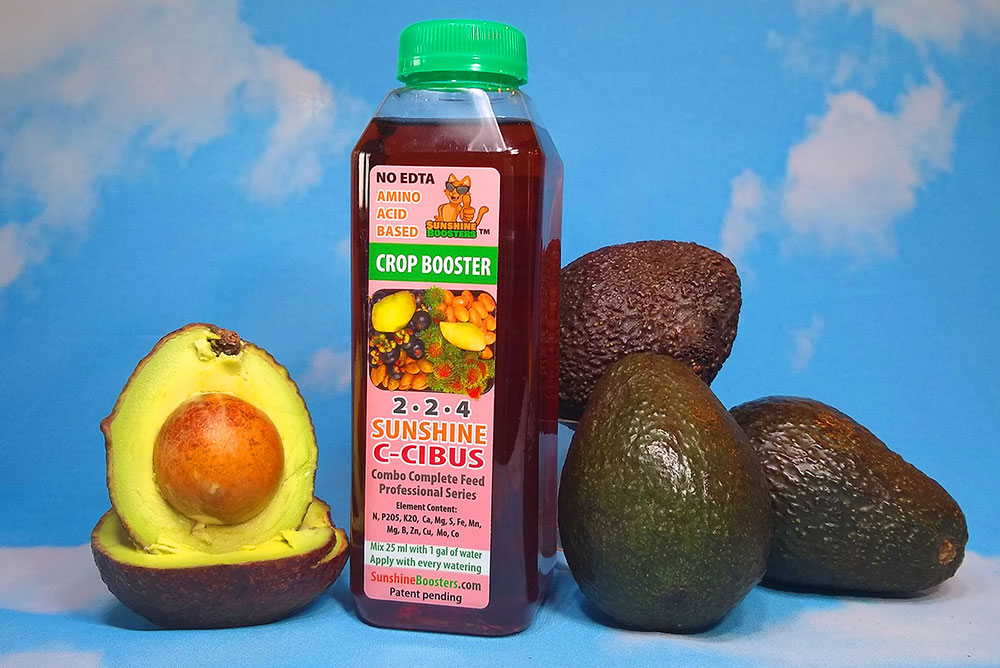
- SUNSHINE C-Cibus - Crop Nutrition Booster - balanced food for fruit trees
- SUNSHINE-Honey - sugar booster - promotes more efficient blossoming and pollination, makes flowers bigger and reduces bud drop
- SUNSHINE SuperFood - for improving fruit trees production

Also keep in mind that some fruit trees have a habit of "skipping" a year and may either produce less or not produce at all every other year. In any case, balanced nutrition program can help to fix this "bad habit".

Date: 19 Apr 2026

Complete Adenium Care Guide: 9 tips how to keep it simple and thriving

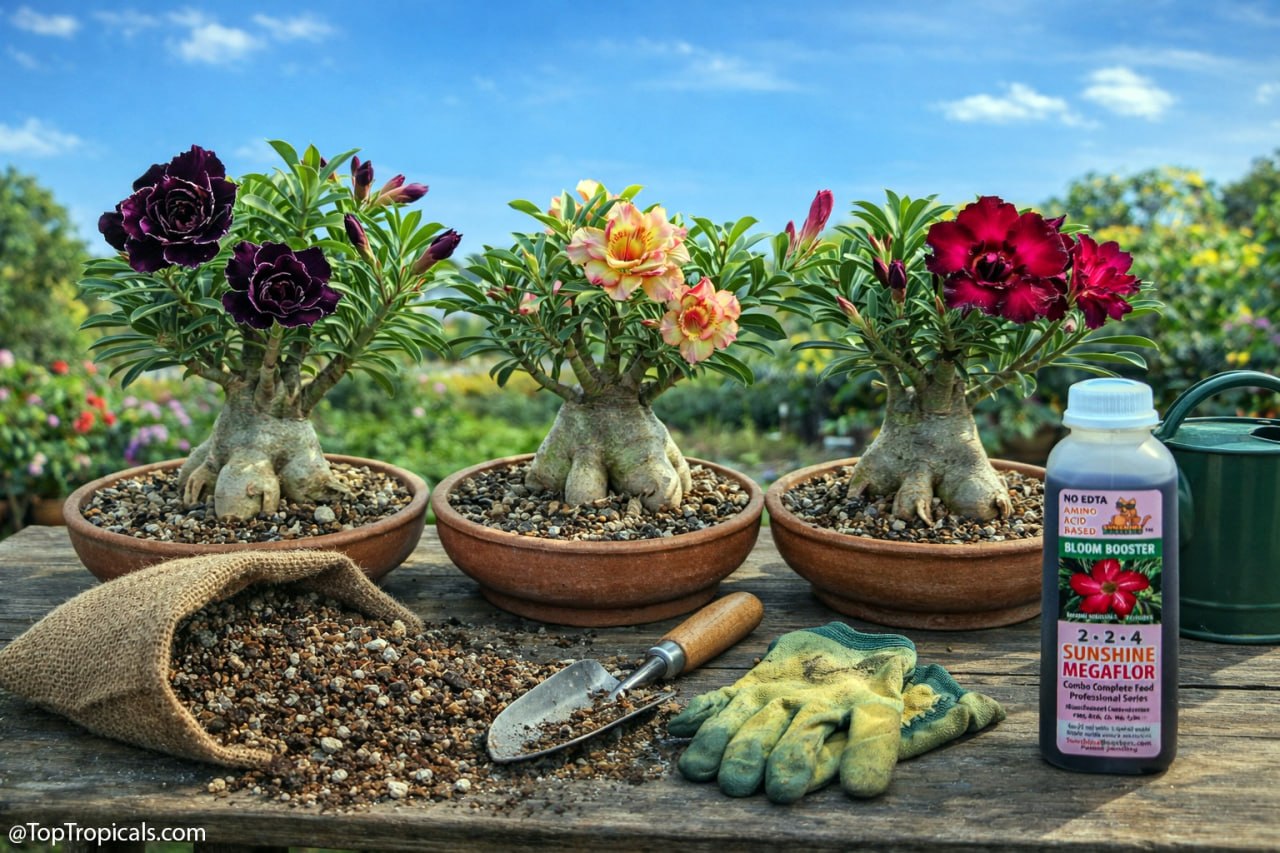
Asdenium plants on the table with adenium soil mix and fertilizer

Asdenium plants on the table with adenium soil mix and fertilizer

🌸 Complete Adenium Care Guide: 9 tips how to keep it simple and thriving


Adeniums don’t need intense care - just the right balance.
Most problems come from too much water, not enough light, or the wrong soil.

Adenium Plant Facts

Botanical name: Adenium sp.
Also known as: Adenium, Desert Rose, Impala Lily
USDA Zone: 9 - 10
Highligths Plant with caudexLarge shrub 5-10 ft tallSmall tree 10-20 ftFull sunWater Requirement: Low. Allow soil to dry out between wateringsWatering: Moderate. Water when top soil feels dryYellow, orange flowersRed, crimson, vinous flowersUnusual colorBlue, lavender, purple flowersWhite, off-white flowersPink flowersToxic or Poisonous
Get personalized tips for your region


🌸 1. Soil is everything


Why it matters
Adeniums are succulents with thick roots and a caudex that stores water. They must never sit in wet, heavy soil.
Most problems come from soil that stays wet too long - leading to root rot, soft caudex, weak growth, and poor flowering.
Good soil builds strong roots, dries faster, supports a healthy caudex, and improves blooming.

Ideal soil formula
Use a very fast-draining, airy mix with perlite, bark, sand, coconut fiber. Avoid heavy peat-based mixes.
A simple formula: TopTropicals Abundance potting mix + coarse sand (50/50). Use coarse sand (for construction), not fine beach sand. Sand improves drainage, structure, and aeration.
You can also add lava rock and charcoal.

Soil pH
Adeniums prefer slightly alkaline soil. Too much peat (acidic) holds moisture and increases rot risk.
Tip: add a few sea shells on top - watering slowly raises pH.

Golden rule
Better too fast-draining than too heavy.
You can water more. You can’t fix rot.

🌸 2. Containers


Use shallow, unglazed clay pots. They dry faster, improve airflow, and stabilize the plant as the caudex gets heavy.
Do not oversize - keep close to root ball.
When repotting, raise the caudex slightly each time to develop that thick base.

🌸 3. Light


Give as much light as possible.
Full sun is best, but in very hot climates, bright filtered light prevents leaf burn and helps flowers last longer.
Too little light = weak growth and poor blooming.

🌸 4. Watering


Water deeply, then let soil dry out completely before watering again.
Do not keep soil constantly wet. Adeniums prefer the dry side and hate sitting in moisture.
In rainy climates, protect from excess water. Keep under cover - bright light, no constant soaking.

🌸 5. Fertilizer


Feed lightly and regularly during active growth.
Use liquid fertilizer Sunshine Megafloк Bloom Booster on soil and lightly on leaves - avoid the caudex.
Bloom boosters (high phosphorus) support flowers and caudex growth.
Add controlled-release fertilizer (Green Magic) twice a year - spring and late summer. Do not fertilize during winter dormancy.
Add microelements (iron, boron, molybdenum) - Sunshine Superfood supplement - for healthier leaves and longer blooms.

🌸 6. Trimming (pruning)


Trim after flowering, especially leggy branches.
Pruning encourages branching - more branches = more flowers.
Don’t be afraid to cut - it improves structure and blooming.

🌸 7. Caudex development (secret trick)


When repotting, raise the caudex slightly above soil level.
Combined with regular feeding (bloom booster), this helps develop a thicker, more pronounced base.

🌸 8. Seedlings vs grafted plants


Seed-grown plants form a natural caudex but take 2-3 years to bloom and do not come true to type (often simple pink).
Grafted plants combine a developed caudex with a known variety.
Best choice for predictable, high-quality blooms.

🌸 9. Troubleshooting


If something goes wrong, check these first:
· Too much water
· Not enough light
· Soil too heavy
Fix these, and your plant will recover.

🛒 Explore Exotic Thai Adeniums

📚 Learn more:


· Adenium varieties in Plant Encyclopedia
· About #Adenium Rainbow - fantastic varieties
· Adenium rainbow - warm, bright, and full of energy
· Adenium rainbow - pink in every shade
· Dark tones that don’t look real. Secret of a Big Caudex.
· Variegated and impossible to ignore adeniums that change your collection. Soil tips.
· We picked 6 adeniums - you’ll probably want all 6. Soil and Watering tip.
· A few adeniums you don’t want to miss. Trimming tip.
· The adenium colors everyone is talking about right now. Light tips for hot climates.
· Adenium rainbow: these 6 will pull you in. Fertilizing tips.
· How to start your dream collection: before you start
· How to grow a happy Adenium

#Container_Garden #Adeniums #How_to #Discover

🟢 Join 👉 TopTropicals