Garden Blog - Top Tropicals

Date: 26 Mar 2026

🌸 How to Grow Adeniums Without Overthinking It

By Tatiana Anderson, Horticulture Expert at Top Tropicals with Smokey & Sunshine help

Adenium  desert  roses  blooming  in  greenhouse  during  winter  freeze,  rows 
 of  potted  plants  with  colorful 
 flowers

Adeniums blooming inside the Top Tropicals greenhouse during the record freeze of February 2026 - protected from the cold, kept above 40F, and fed with liquid Sunshine Megaflor. They responded with a spectacular, synchronized winter bloom. Quite a surprize!

✅ Simple rules that actually make them bloom and grow well

  • Light - The more light, the better the growth and flowering. Full sun is ideal, but in very hot climates, filtered bright light keeps plants looking healthier.
  • Water - Water well, then let soil dry on the surface. Sitting in wet soil damages roots, but letting plants dry out too often can push them into early dormancy.
  • Pot and shaping - Use a shallow pot with excellent drainage. To develop a sculptural caudex, lift the plant slightly each time you repot and remove some of the top soil so upper roots become exposed. Over time, this creates a thicker, more prominent base.
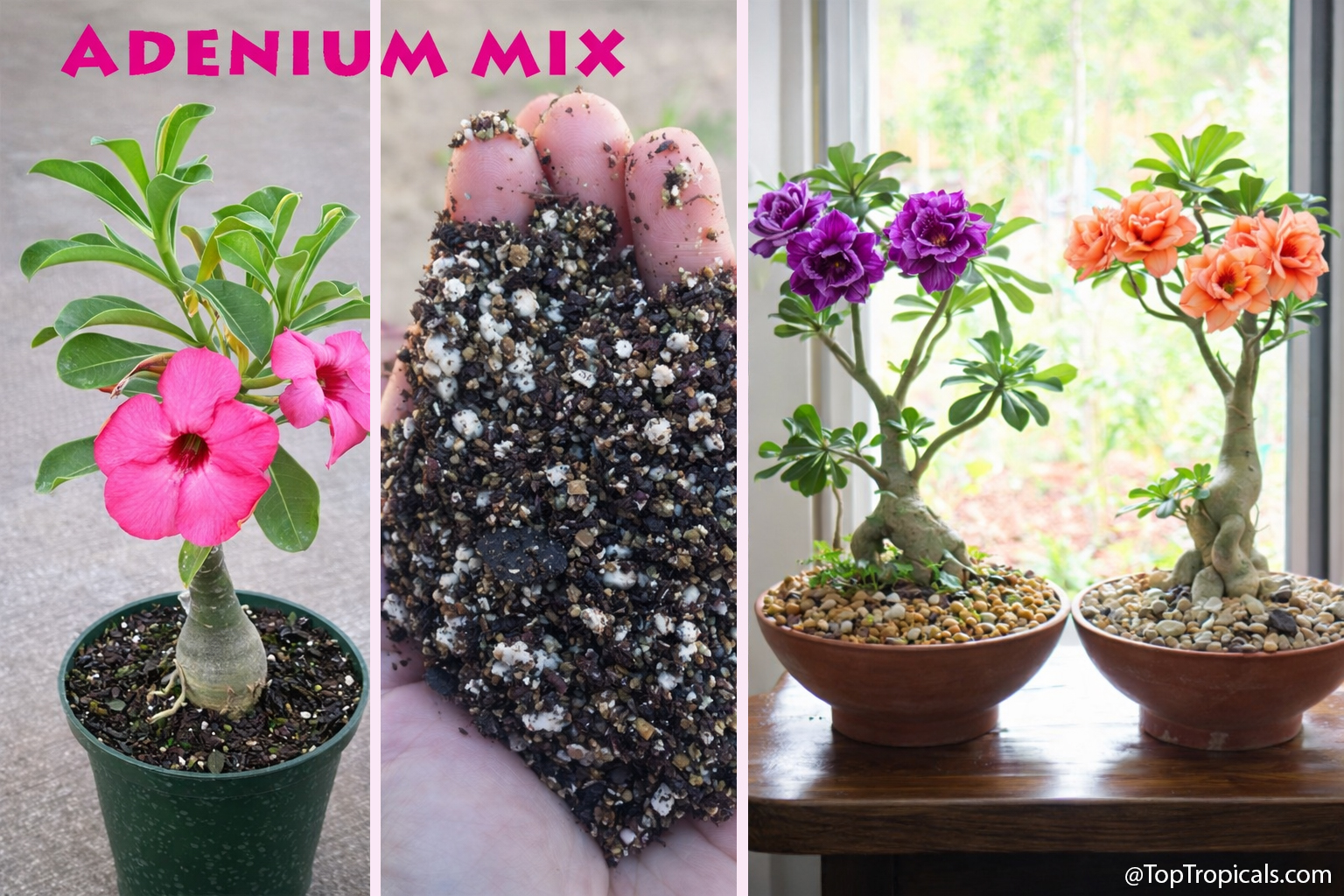
  • Soil - Use a fast-draining Adenium potting Mix.
  • Adenium  desert  rose  plant,  fast  draining  soil  mix  in  hand,  and  bonsai 
 style  adeniums  blooming  indoors

    Healthy adeniums start with the right foundation - a fast-draining soil mix and careful watering only when dry to avoid caudex rot.

  • Cold hardiness - Adeniums are tropical and do not tolerate frost. Keep above 40 F. Brief drops to mid 30s may be tolerated if dry, but cold and wet conditions can damage or kill the plant. In cooler climates, bring indoors or protect during cold nights.
  • Indoor winter care - Move plants indoors before cold nights. Place in the brightest spot possible, ideally a south-facing window. Or use additional lighting. Water very lightly and less often, as growth slows. Do not fertilize during dormancy. Some leaf drop is normal in winter.
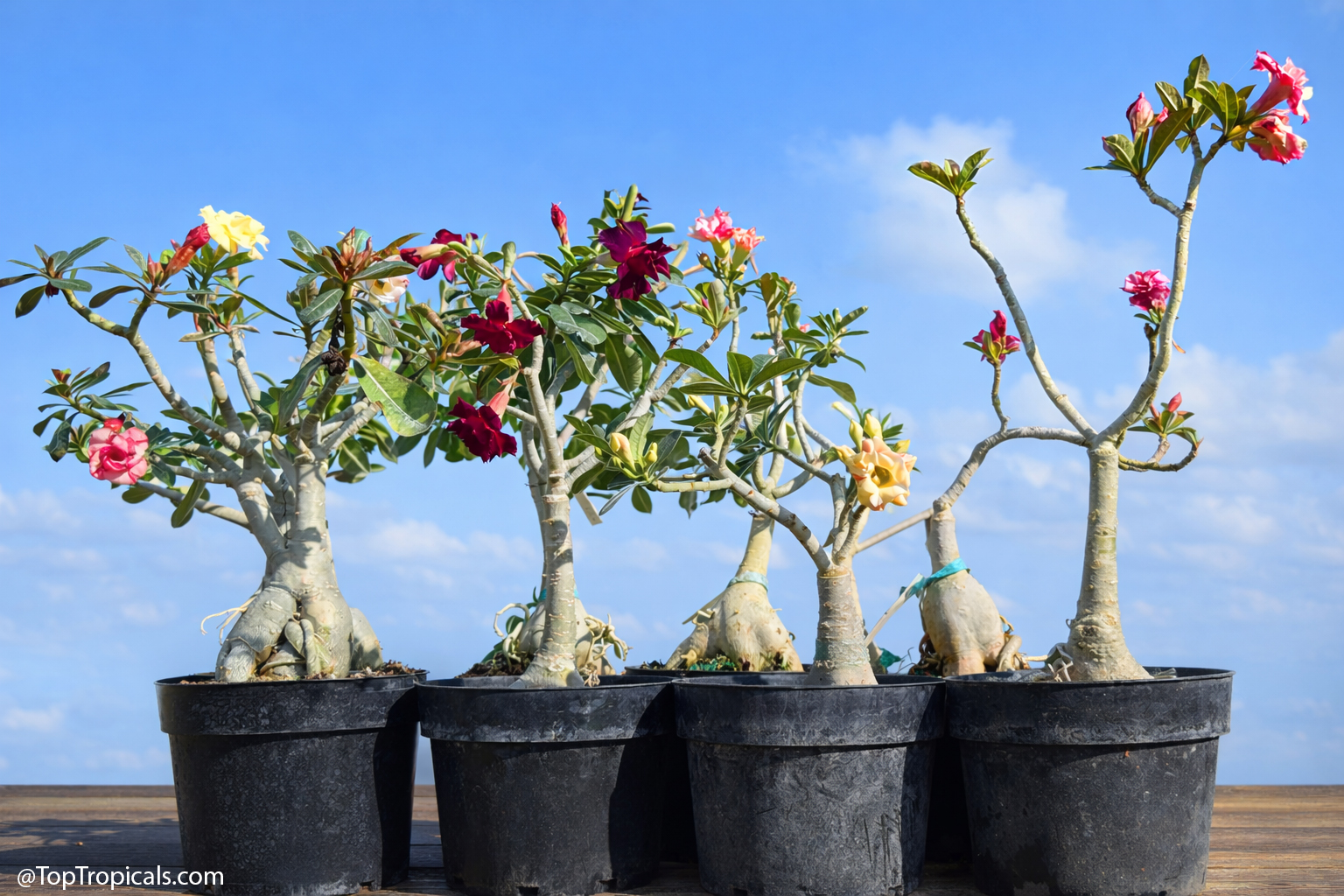
  • Freshly  grafted  Adenium  desert  rose  plants  in  dormancy  arranged  in 
 greenhouse  rows  with  bare  branches

    Freshly grafted adeniums in dormancy - a crucial resting phase. Keep watering low (once a month) and avoid overcare; this is the time to let them rest and etablish.

  • Feeding - Adeniums respond best to liquid fertilizer. We apply Sunshine Megaflor Booster with each watering throughout the year. During dormancy, watering is reduced, so fertilizer use decreases accordingly. Consistent, light feeding promotes strong roots, a thicker caudex, and improved flowering.
  • Pruning - For multiple blooms, regular pruning is essential. After flowering, cut back long or leggy growth to stimulate branching. Each new branch can produce more buds, leading to a much fuller bloom in the next cycle.

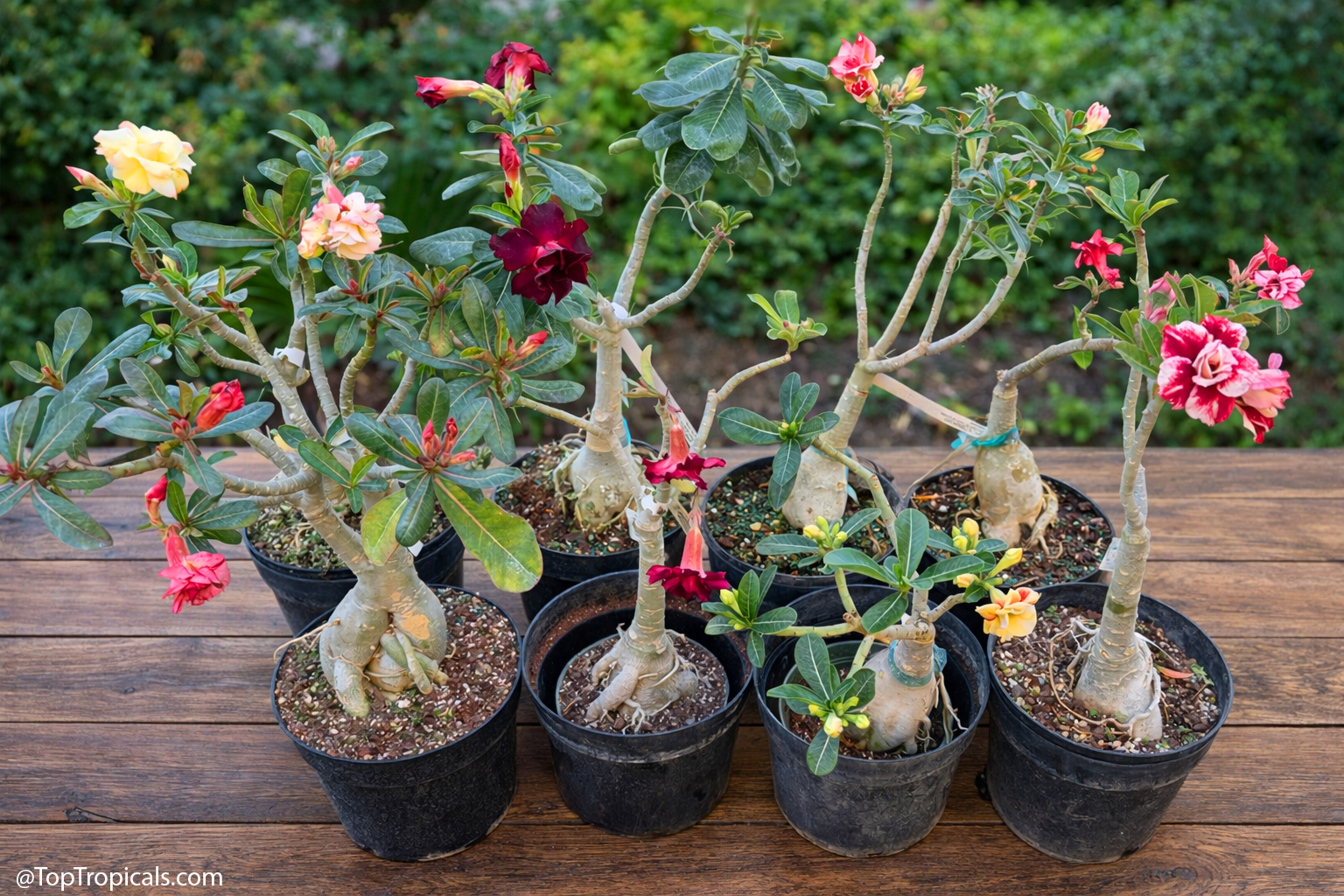
Pruned  and  unpruned  Adenium  desert  rose  plants  showing  difference  in 
 branching  and  flowering

Pruned vs. unpruned - the difference is clear. The four plants on the left were trimmed 6 months ago, while the two on the right were not. Same species, very different results.

✍️ Learn more about Adeniums from our Blog

🎥 Watch videos of Adenium Rainbow

Free Shipping on Adeniums
Add bold color and unique forms to your collection with no extra shipping cost.

🛒 Explore Exotic Adenium varieties

Leggy  Adenium  desert  rose  plants  with  sparse  branching  and  flowers, 
 ready  for 
 pruning

These Adeniums are screaming for pruning so they can bush out and produce more blooms

Date: 13 Jul 2024

How to grow everblooming orchids like these?

Sunshine Orchidasm Fertilizer

Sunshine Orchidasm Fertilizer

Orchids in bloom

🌸❓How to grow everblooming orchids like these?
  • 💋Orchids culture is different from garden ornamental plants. They are epiphytes, so you cannot use regular garden fertilizer on orchids, because they are very sensitive to salts.
  • 💋Orchids need a special, acidic type of fertilizer, very mild in action.
  • 💋Sunshine Boosters formula is exactly what orchids need. It is amino-acid based, very mild, and doesn't create nutrient lock up (building up salts is one of the biggest enemies of tender orchids). Sunshine Boosters Orchidasm Complete Feed is scientifically balanced orchid food that contains all necessary nutrients, including micro-elements, for healthy, happy, vigorous orchids.
  • 💋 Sunshine Orchidasm can be used as often as daily with every foliage spray.
  • 💋From our testing experience, after using Orchidasm Booster, orchids not only get happy and thriving - they also bloom more often - up to several times a year, shooting new flower spikes one after another (while normal blooming cycle for most orchids is once a year). It gets even better - the flower display lasts twice longer!


😊To enjoy beautiful Orchid flowers year around - treat them with Love, give them some Orchidasm!

📚 Learn more: Sunshine Orchidasm

🛒 Order Sunshine Orchidasm

#Fertilizers #How_to #Container_garden

🏵 TopTropicals

Date: 6 Jun 2025

Flower of Happiness and Sunshine

Adenium Sunshine

Adenium Sunshine

Adenium Sunshine

Adenium Sunshine

Adenium Sunshine

Adenium Sunshine

☀️ Flower of Happiness and Sunshine


📸 Photos ofAdenium Sunshine for the previous post 👆

🛒 Shop adeniums

#Nature_Wonders #Container_Garden #Adenium

🟢 Join 👉 TopTropicals

Date: 27 Apr 2020

How to feed a Mango tree...
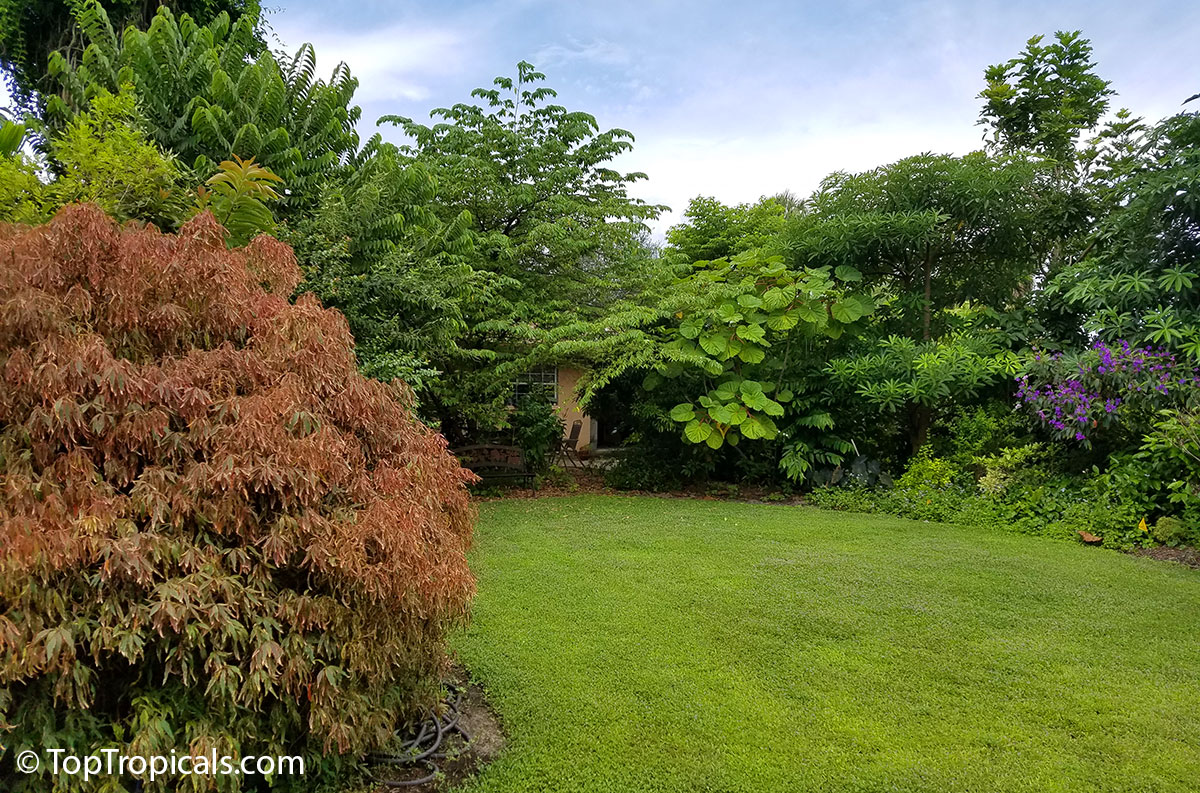
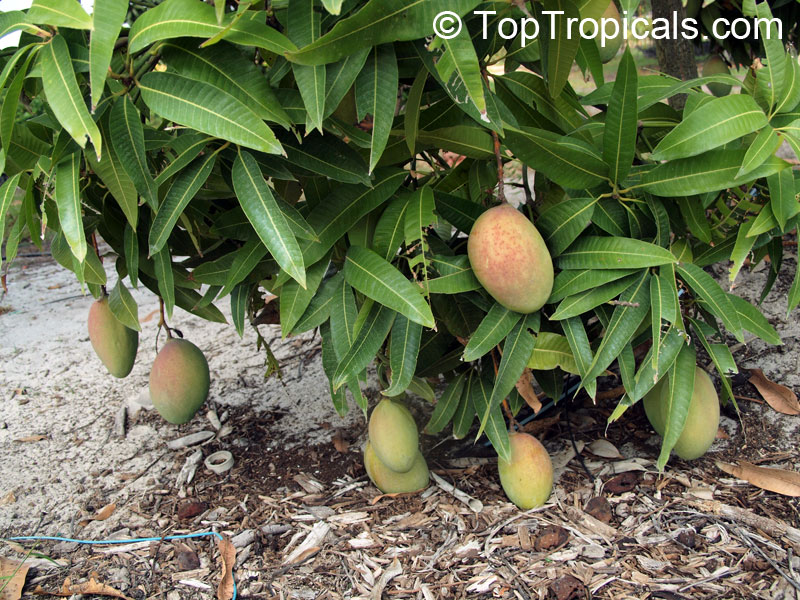
and to grow a Dwarf Mango

How to fertilize a Mango tree

Q: My mango trees that I bought and planted last august now have fruit. I bought 2 types of fertilizer from you and never used it. Should I use your fertilizer now?

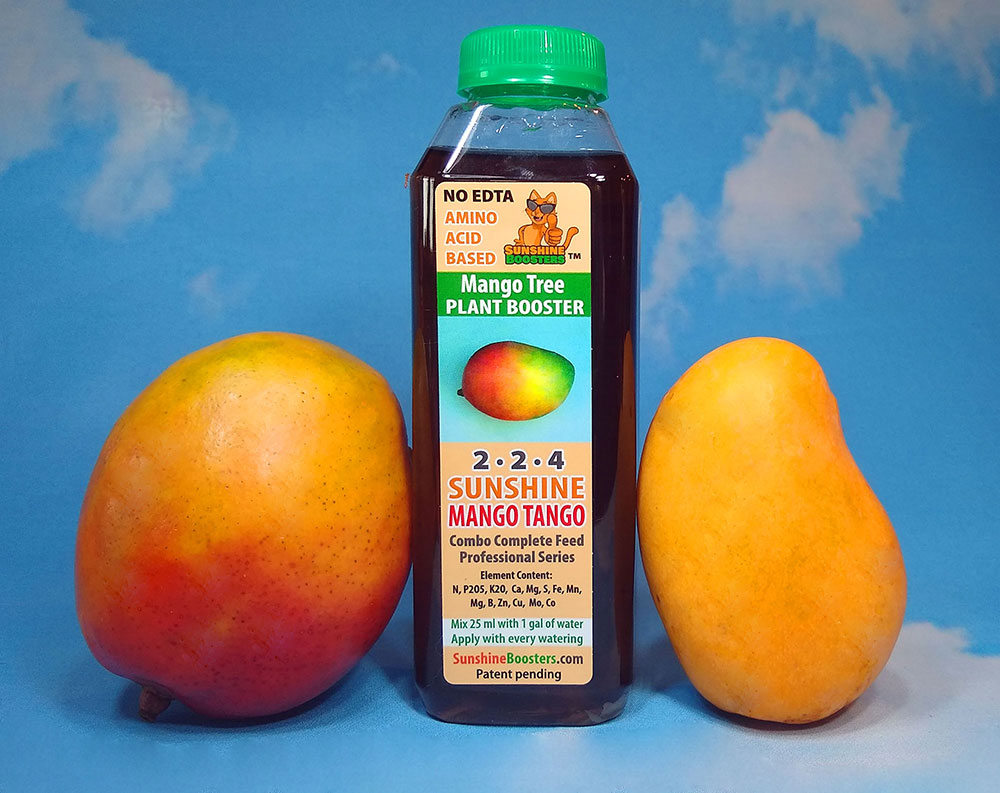
A: It is a perfect time now to fertilize your plants as they start active growth. For mango trees, we recommend liquid fertilizer Sunshine Booster - Mango Tango. It is formulated for Mango trees, especially for container grown. It improves quantity and quality of flowers and ability to set fruit, reduces bud-flower-fruit drop. Can be used as often as with every watering. For best results, use in combination with Sunshine Honey and Sunshine Superfood plant supplements. Its scientifically-balanced stable formula is organic Amino-acid based and has NO EDTA chelators to eliminate nutrients lockup; it does not affect crop taste.
Additionally, you may use slow-release granulated fertilizer Mango-Food once a month during hot season only. Dosage: 1 teaspoon per each gal of soil. Water-soluble fertilizers can be also used, however, those are usually EDTA-chelated which is not as efficient as Amono-acid based Sunshine Boosters and may create nutrients build up, especially if overdosed in containers.
For in-ground mango trees, you may use all the above, and slow-release granulated fertilizer can be applied in larger quantities: spread a handful around the drip line.

Remember that only liquid Sunshine Boosters can be applied year around. With other fertilizers, you need to be careful not to overdose, and apply only during hot weather (when night temperatures are steadily above 65F).

How to grow a Dwarf Mango tree

Q: I received the Ice cream mango tree in great condition (thank you for the ingenious packing job) on Wednesday and have planted it in a pot slightly bigger than the root ball. I plan to grow the tree on my front porch, so how big a container should I ultimately use when the tree outgrows this pot? How big a container does it need to fruit? I hope to keep it around 6-7 feet high, if possible. I live in Hawaii.

A: Ice Cream mango is a perfect variety for container culture, and it should be happy in Hawaii. You did everything right. Keep it in this small pot for now and wait until it starts vigorous growth in Summer. Once it starts growing (and you will notice roots growing too, sometimes they try to grow through the holes in the bottom of the pot), then it's time to step up into a bigger container (7-10 gal). Eventually you may use container size as large as 15 gal. Ice cream mango is slow growing and compact, and you will be able to maintain it under 7 ft with very minimal pruning if any.

Date: 16 Nov 2019

When to apply super boost?

Sunshine Boosters: a breakthrough in Winter fertilizing

In the photo: plants are tough survivors. Life can't be stopped even by a brick road!

Q: Just wanted to know best time of day to apply super boost as spray and watering? Only listed to make sure night temp doesn't drop below 65F...

A: As a rule of thumb, plant's needs in fertilizers are very low in the cold season because they consume less nutrients during dormancy. For tropical plants, when minimum temperatures drop below 65F - we stop applications of dry (granulated) fertilizers until spring, to avoid root burn.
Liquid Sunshine Boosters are exceptions from this rule to a certain extent, for 2 reasons:
- they are amino-acid based which means, salts do not build up in the soil, and thus will not burn the roots even with slower plant metabolism.
- concentrations/formulas are mild and designed for as frequent as daily watering

Tips for winter fertilizing:

1) When a plant goes into full dormancy (drops leaves and does not show any new growth), you may stop fertilizing with any Macro NPK products (both dry and liquid)

2) If a plant is evergreen and continues growing during the cooler period, and especially if it is a winter bloomer, mild liquid fertilizers can be applied, depending on the stage of plant development.
Robusta and TotalFeed are used for vegetative growth and pre-flower.
Megaflor and C-Cibus are used for winter flowering/ fruiting plants during the bloom stage.

See full list of liquid boosters

3) Micro-elements can be used all year round for all plants that are not dormant (do not drop leaves)

4) Always use Sunshine-Epi as a foliar spray to activate immune system and unlock protective mechanisms, BEFORE applying other boosters. It is especially important during Fall-Winter for improving cold tolerance and disease resistance.

5) Always apply foliar spray and/or drench the soil with solutions in morning hours so the plant has time to process the nutrients during daylight when metabolism is the most active.

6) Avoid any dry fertilizers during winter