Garden Blog - Top Tropicals

Date: 27 Jun 2026

Canistel coconut fritters: quick-n-fun exotic recipes

Canistel coconut fritters: quick-n-fun exotic recipes

🍴 Canistel coconut fritters: quick-n-fun exotic recipes


🟡Mash ripe canistel until smooth and stir in flour and a splash of coconut milk to form a thick batter.
🟡Add a drizzle of honey or a spoonful of sugar if you like a sweeter fritter.
🟡Drop spoonfuls of the mixture into a lightly oiled skillet and flatten slightly.
🟡Pan-fry until golden brown and crisp on both sides, with a soft, creamy center.
🟡Serve warm with a drizzle of honey, maple syrup, or a sprinkle of powdered sugar for a tropical breakfast or dessert.

🌿 About the plant:


Canistel, Pouteria campechiana, is a member of the sapote family. The fruit develops a smooth yellow to orange skin and firm flesh that becomes soft and custard-like when fully ripe.

🏡 In the garden:


Trees prefer full sun and well-drained soil. They handle heat well and are moderately drought tolerant once established. Light pruning helps maintain a manageable shape.

🛒 Plant Canistel Egg Fruit tree - grows well in container too

📚 Learn more:

Canistel Plant Facts

Botanical name: Pouteria campechiana
Also known as: Canistel, Eggfruit, Chesa
USDA Zone: 9 - 11
Highligths Large tree taller than 20 ftSmall tree 10-20 ftFull sunWatering: Regular. Let topsoil dry slightlyEdible plant
Get personalized tips for your region

Pouteria campechiana - Canistel, Eggfruit - in Plant Encyclopedia
Golden canistel cream: quick-n-fun exotic recipes
This old-school tropical fruit is making a quiet comeback: Eggfruit - Canistel
Canistel breakfast mash: quick-n-fun exotic recipes
Health Benefits of Canistel Fruit
Pouteria campechiana - Canistel, the curious heart-shaped Egg Super-Fruit

#Food_Forest #Recipes

🟢 Join 👉 TopTropicals

Date: 16 Jun 2026

💜 The Tree Everyone Stops to Take Pictures Of

Sunshine,  an  orange  tabby  cat,  takes  a  selfie  beneath  a  blooming  purple
    jacaranda  tree  while  Smokey,  a  tuxedo  cat  wearing  glasses,  watches  nearby 
 at  Top 
 Tropicals.
Sunshine: Every angle looks good.
Smokey: That's because you're photographing a Jacaranda at peak bloom.
Sunshine: I think the purple brings out my orange.
Smokey:The Jacaranda makes everything look better.

There's a moment, if you've never seen a mature Jacaranda in full bloom, that stops you completely.

You're driving down a street, or walking through a neighborhood you've passed through a hundred times, and suddenly there it is — a tree that looks like someone painted it from memory rather than from life. The canopy spreads wide and low, covered so thoroughly in lavender-blue flower clusters that you can barely see the branches beneath. People are already stopped on the sidewalk. Someone has their phone out. A couple is standing beneath it, looking up.

You understand immediately why they stopped. You stop too.

That first encounter with a Jacaranda mimosifolia in bloom is the kind of thing gardeners remember for years. It's also, for many of them, the moment they decided they needed one.

👉Plant Your Purple Jacaranda

💜 The Tree That Turns Cities Purple
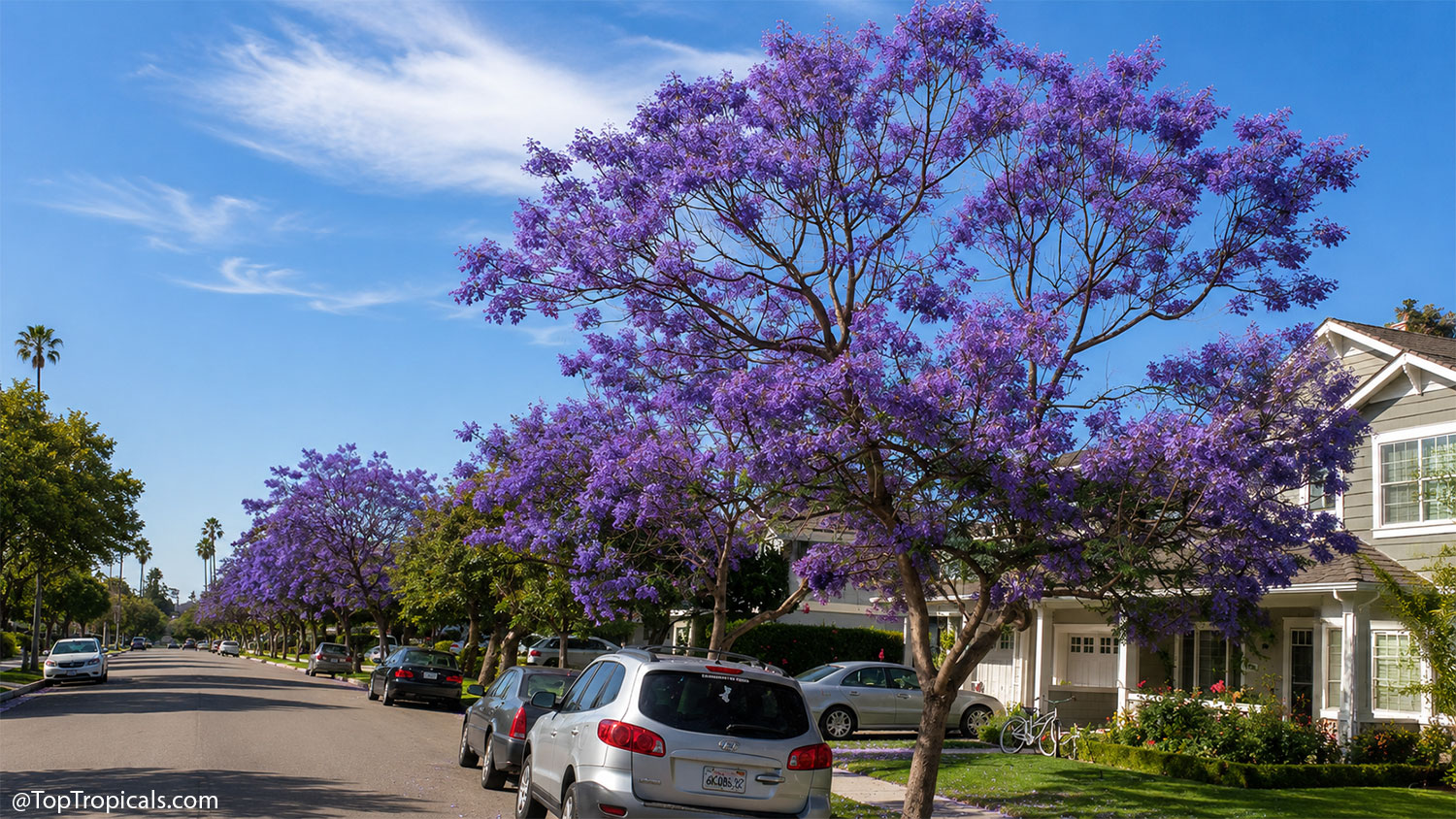
Residential  street  lined  with  blooming  jacaranda  trees  covered  in 
 vibrant  purple  flowers.  A  large  jacaranda  shades  parked  cars  and  front 
 yards,  while  additional  flowering  trees  create  a  stunning  purple  avenue 
 beneath  a  bright  blue 
 sky.

When jacarandas bloom, entire neighborhoods are transformed into rivers of purple. Their spectacular floral display turns ordinary streets into some of the most photographed landscapes of spring and early summer.

Most flowering trees get admired. Jacarandas become events.

Pretoria, South Africa is known worldwide as "Jacaranda City." During bloom season, entire neighborhoods seem to disappear beneath a haze of lavender-blue flowers.

Buenos Aires, Sydney and Brisbane have their own Jacaranda traditions. In Southern California, mature Jacarandas are so anticipated that bloom season regularly fills social media with photos of purple-lined streets and neighborhoods.

People don't merely grow Jacarandas. They wait for Jacaranda season. There's something unusual about a tree that generates that kind of anticipation. Most ornamental trees are appreciated in passing. Jacaranda creates a ritual.

💜 A Tree Surrounded by Legends
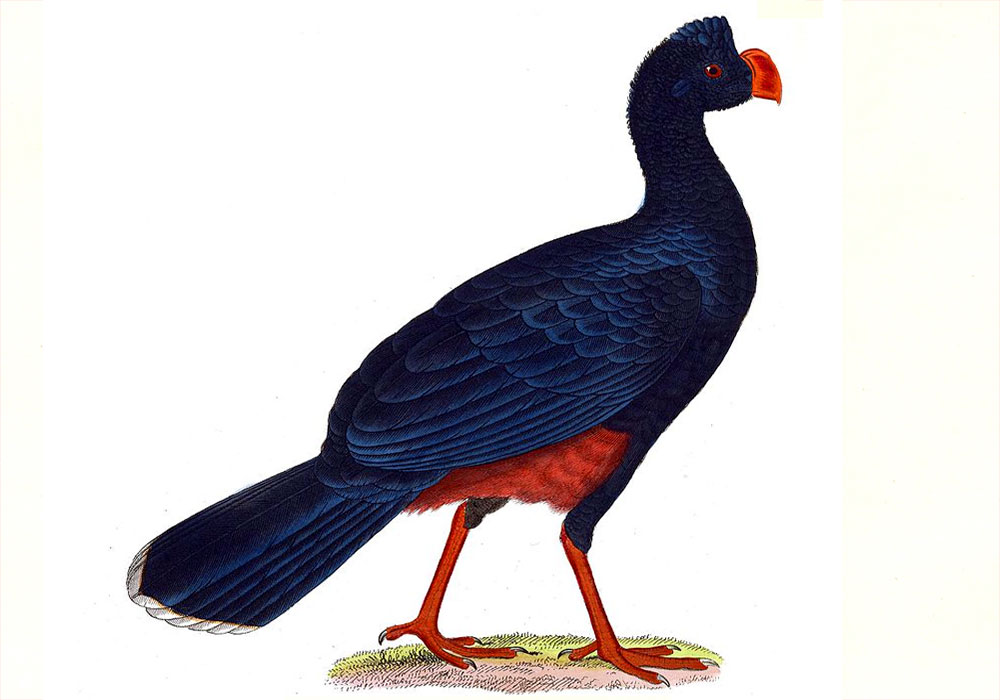

Mitu  mitu  bird  (Alagoas  Curassow)  -  adult  male.  Illustration  from 
 Nouveau  recueil  de  planches  coloriées 
 d'oiseaux,  1838

Mitu mitu — the bird of the Tupi-Guarani legend (Wikimedia Commons)

In Tupi-Guarani tradition, Mitu, a great forest bird, carried the Daughter of the Moon from the heavens and placed her in a flowering Jacaranda tree. She descended among the people, bringing wisdom and knowledge before returning to the sky.

Few trees become part of local folklore. Fewer still become part of everyday life across multiple continents.

💜 Beautiful Beyond Bloom
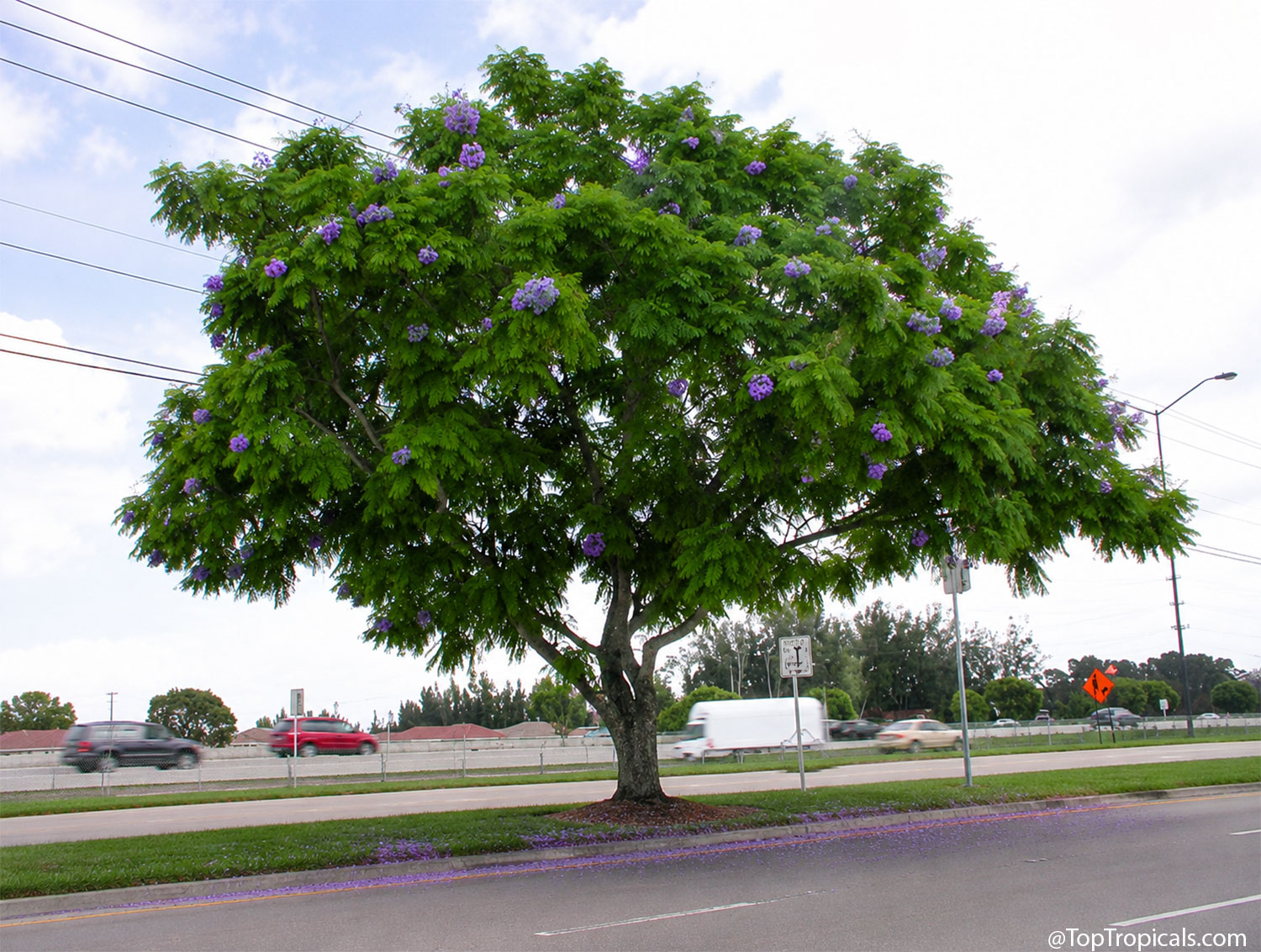
Young  jacaranda  tree  with  lush  fern-like  green  foliage  and  scattered 
 clusters  of  purple  flowers  growing  along  a  roadside.  The  broad  canopy  forms 
 a  graceful  umbrella  shape,  showing  the 
 tree's  attractive  structure  even  when  not  in  peak  bloom.

Jacaranda is beautiful even outside its main flowering season. Its finely divided, fern-like foliage creates a soft tropical canopy, while occasional clusters of purple blooms offer a preview of the spectacular display that transforms the tree into a cloud of lavender each year.

Here's what surprises people who plant their first Jacaranda: they love it even when it isn't flowering.

The foliage is finely divided and fern-like, giving the tree a delicate, airy texture that softens any landscape. The branching structure is naturally graceful, spreading wide with a canopy shape that looks considered rather than accidental. The light that comes through the leaves is gentle and dappled — the kind of shade that doesn't feel heavy, that lets enough brightness in to make the space beneath feel pleasant rather than dim.

💜 Mature Size
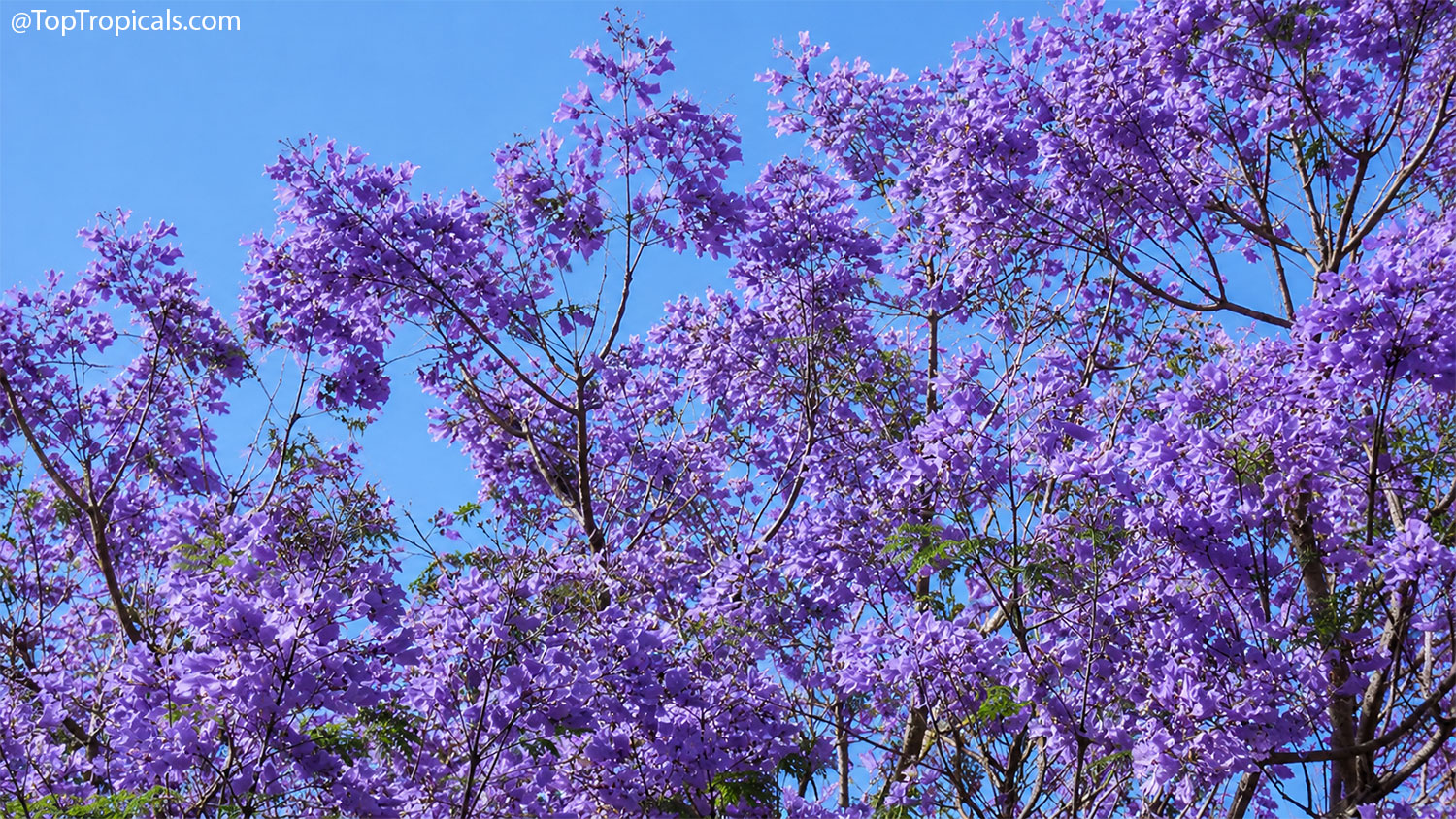
Upper  canopy  of  a  blooming  jacaranda  tree  filled  with  thousands  of 
 lavender-purple  flowers  against  a  clear  blue  sky.  The  delicate 
 trumpet-shaped  blossoms  create  a  soft,  cloud-like  effect  among  the 
 tree's  fine  branches  and  sparse  fern-like  foliage.

At peak bloom, jacaranda trees appear draped in purple clouds. The airy canopy of lavender blossoms creates a breathtaking display that has made this tree famous in gardens, parks, and city streets around the world.

A mature Jacaranda typically reaches 25 to 30 feet tall with a broad, spreading canopy of similar width. Given room to grow, it becomes a true focal point in the landscape.

That size is the point. A Jacaranda works beautifully as a specimen tree where you have room to let it express itself fully. It makes an excellent lawn tree, its canopy casting light shade over a wide area. Planted where it can be seen from a distance, it becomes a focal point in any season and a spectacle during bloom.

If you want a tree that will grow into something people notice — something that will still be there and still be blooming long after you've finished planting the rest of the garden — Jacaranda delivers.

How to Grow Jacaranda

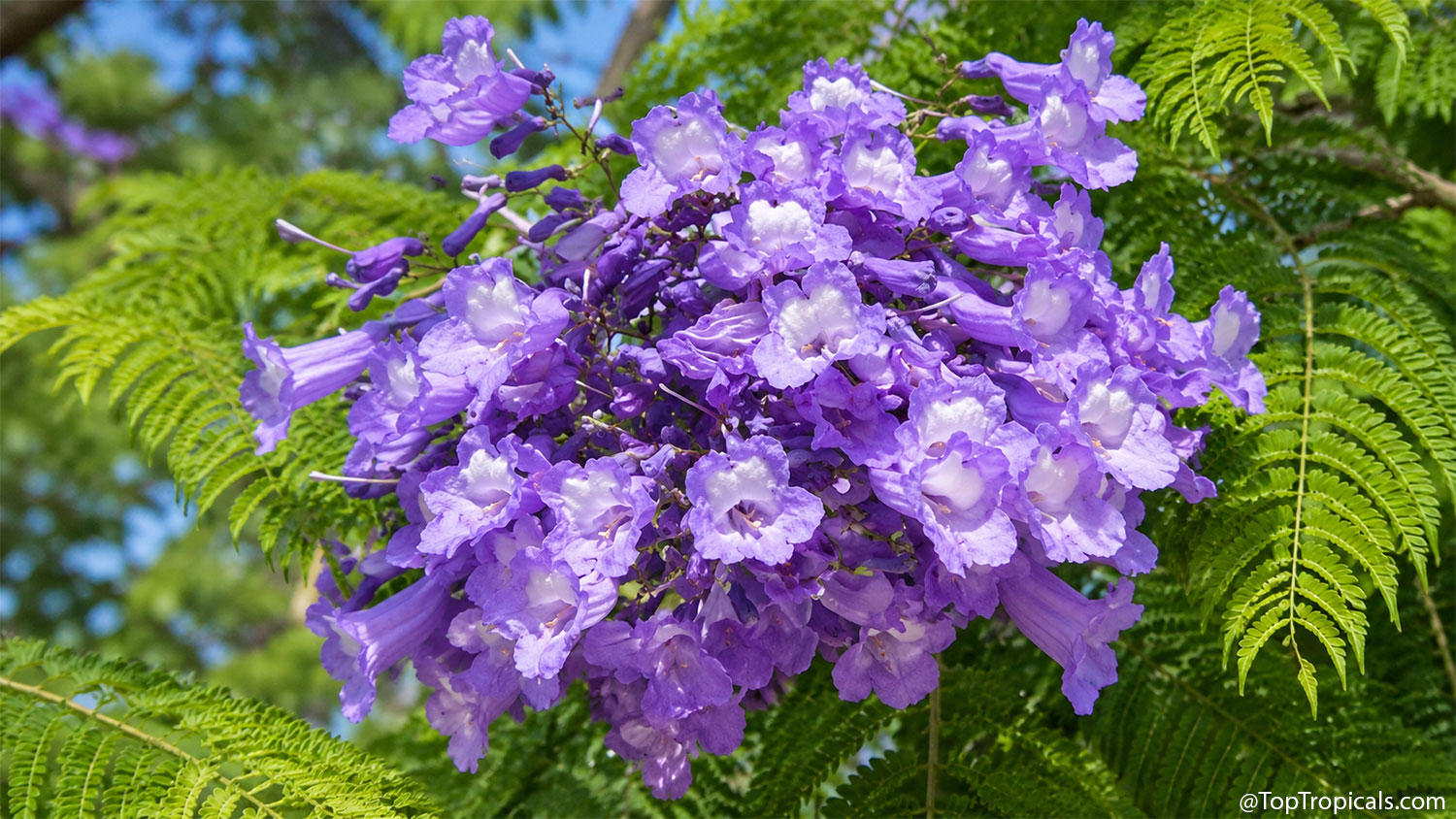
Dense  cluster  of  lavender-purple  jacaranda  flowers  surrounded  by 
 delicate  fern-like  green  foliage.  The  trumpet-shaped  blooms  are  packed 
 tightly  together,  with  pale  white  throats  creating  a  striking  contrast 
 against  the  vibrant  purple 
 petals.

The beauty of jacaranda is not only in its massive floral display but also in the individual flower clusters. Each bouquet combines dozens of delicate trumpet-shaped blooms framed by soft, fern-like foliage, creating a perfect balance of texture and color.

For best results, provide:

  • Full sun
  • Best planted away from sidewalks and driveways
  • Well-drained, sandy loam; highly sensitive to waterlogged or heavy clay soils
  • Regular watering while establishing
  • Moderate watering once mature
  • A balanced fertilizer during the growing season
  • USDA Zones: 9B – 11. Can tolerate brief, light frosts once mature. Protect from cold while young

Bloom season: Late Spring to Early Summer (Main flush), occasional light scattered bloom in Fall. As the flowers fall, they often create a colorful purple carpet beneath the canopy, extending the display from the branches to the ground below.

In warm climates such as South Florida, coastal Southern California, and Hawaii, Jacaranda can become a long-lived landscape tree that provides shade, beauty, and spectacular seasonal blooms for decades.

Top Tropicals Tip:
To help young trees get established quickly, consider using Sunshine Boosters Green Magic when planting or transplanting. During the growing season, regular feeding with Sunshine Boosters Megaflor can help support vigorous growth and a healthy canopy.
To maximize the bloom density for next season, ensure the tree receives consistent micronutrients during the late summer growth surge.

Read Top Tropicals Guide to Sunshine Boosters™

Jacaranda can also be grown in large containers, where its size may be managed through container culture and occasional pruning. This is a useful option for gardeners in colder climates or for those who wish to enjoy the tree on patios and terraces.

📚 More About Jacaranda on the Top Tropicals Garden Blog

💜 Why Gardeners Fall in Love With Jacaranda
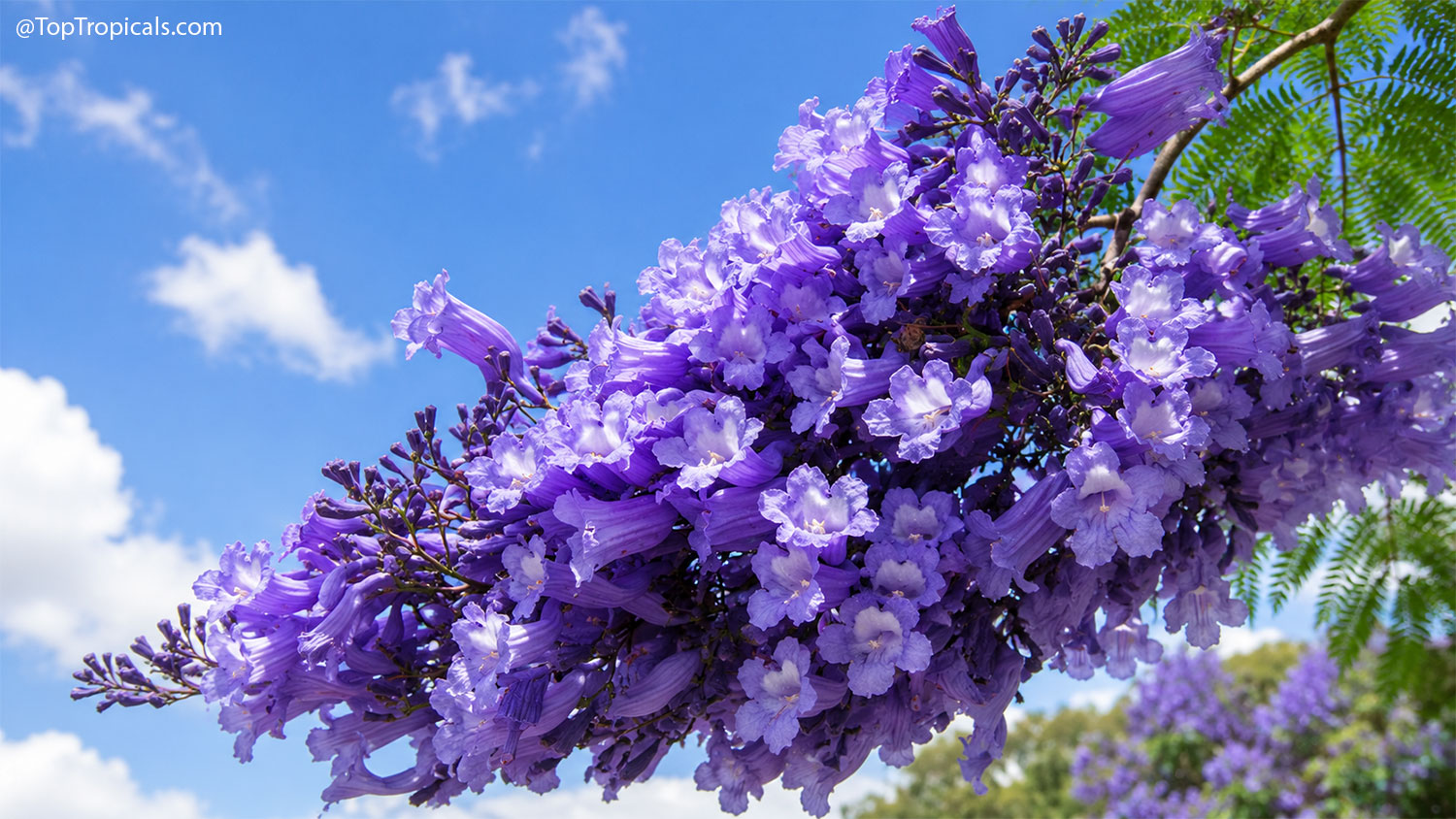
Large  cluster  of  lavender-purple  jacaranda  flowers  hanging  from  a 
 branch  against  a  bright  blue  sky  with  white  clouds.  The  trumpet-shaped 
 blooms  are  packed  tightly  together,  creating  a  spectacular  display  of  color,
    while  delicate  fern-like  foliage  frames  the 
 scene.

Jacaranda flowers bloom in dense clusters of lavender-purple trumpets, creating one of the most spectacular floral displays in the tree world. Against a clear blue sky, the blossoms seem to glow, giving the tree its famous "purple cloud" appearance.

Ask someone with a mature Jacaranda in their yard what it's like when it blooms, and they'll usually smile before they answer.

There's a particular pleasure in seasonal anticipation - in knowing that something beautiful is coming, in watching for the first flower clusters to appear, in the morning you walk outside and realize the tree has finally opened. Jacaranda delivers that pleasure reliably, year after year.

Mature trees become landmarks. "Turn left at the purple tree" is a surprisingly common way to find a house during Jacaranda season. They become the reason people slow down while driving past your house. They become the tree your kids remember.

Few landscape trees combine beauty, shade, elegance, and seasonal drama quite the way a Jacaranda does. Long after the flowers fade, the tree remains a graceful presence in the garden. And when bloom season returns, it reminds you exactly why you planted it.

Some trees provide shade. Others provide flowers. Jacaranda provides both.

That's a rare thing in a garden, and it's worth planting.

Sunshine: What happens when the flowers are gone?
Smokey: Then you enjoy the tree.
Sunshine: And when the flowers come back?
Smokey: Then you remember why you planted it.

👉Shop Jacaranda Trees
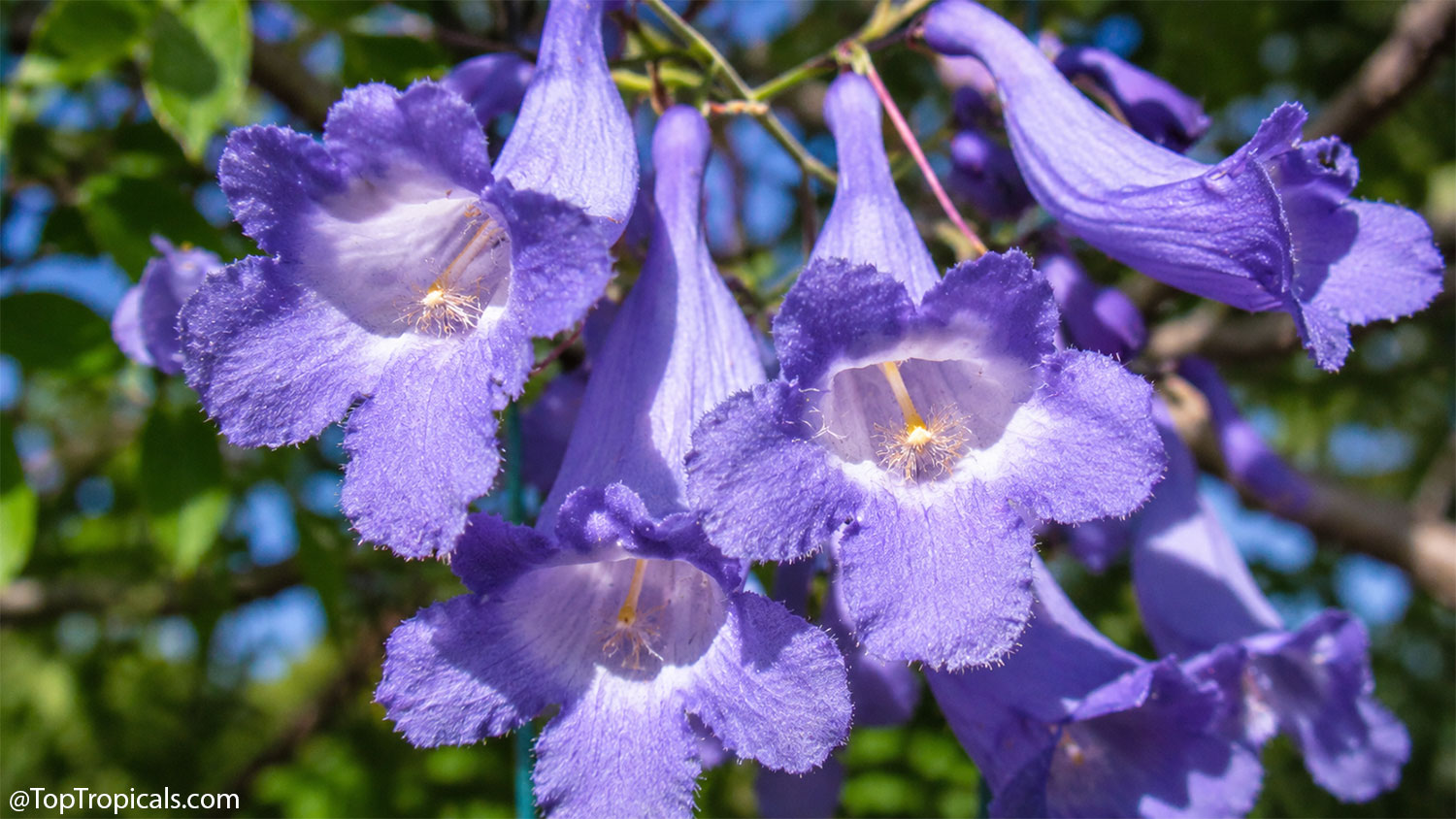
Close-up  of  pale  lavender  jacaranda  flowers  showing  the  distinctive 
 trumpet-shaped  blooms  with  soft,  velvety  petals  and  fuzzy  white  throats. 
 Sunlight  highlights  the  delicate  flower  texture  against  a  softly  blurred 
 background  of  green 
 foliage.

A close-up look at the intricate flowers of the Jacaranda tree (Jacaranda mimosifolia). Each velvety trumpet-shaped bloom combines soft lavender tones with delicate textures that make this tree one of the most recognizable flowering trees in the world.

Date: 7 Jun 2026

🌿 The Vanilla Plant That Outgrew Its 100-Gallon Container.

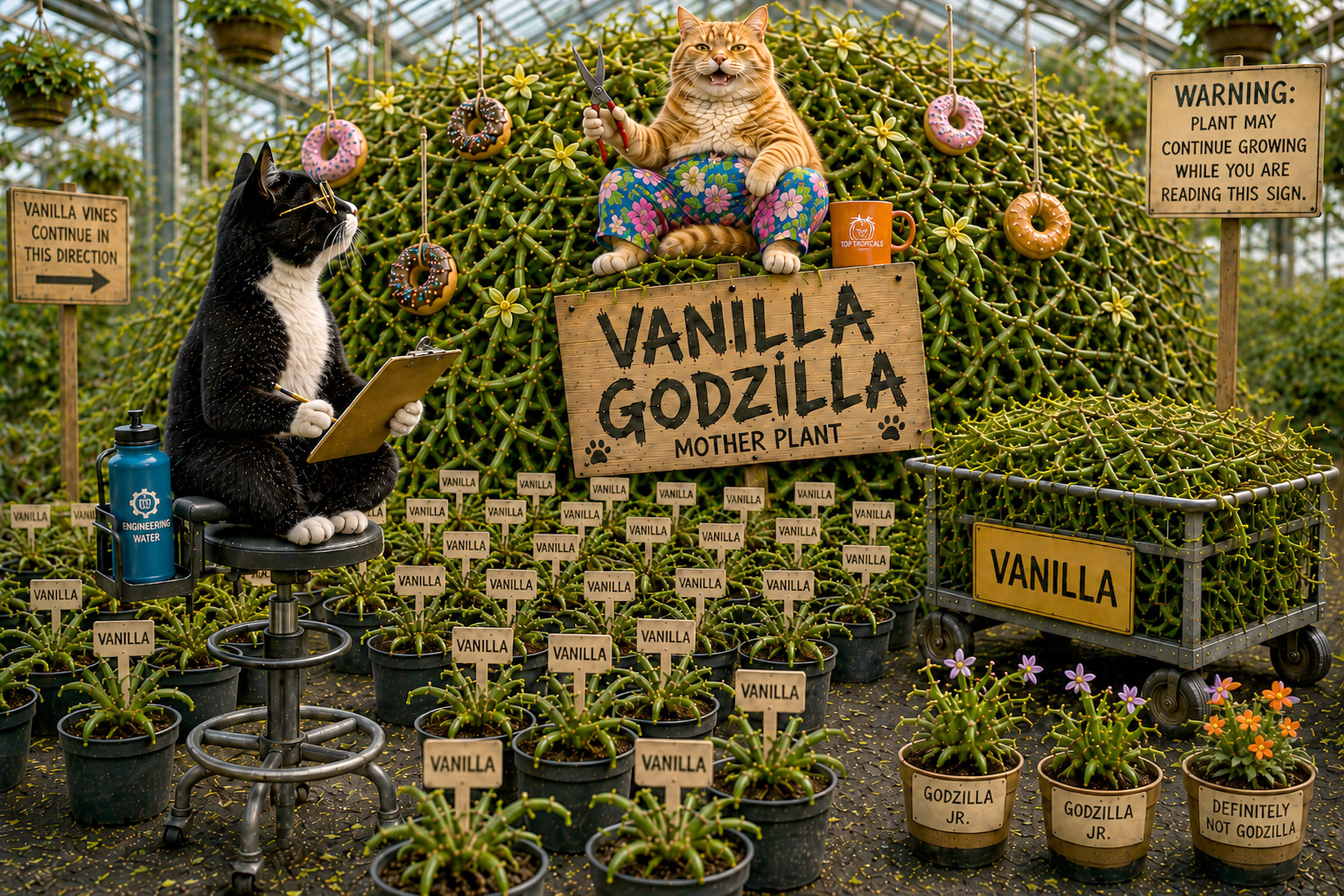
Smokey  the  tuxedo  cat  and  Sunshine  the  orange  cat  inspect  a  giant 
 Vanilla  Godzilla  mother  plant  in  a  greenhouse.  Sunshine  sits  atop  a  massive 
 mound  of  leafless  vanilla  vines  holding  pruning  shears,  while  Smokey  takes 
 notes  among  dozens  of  young  vanilla  plants  propagated  from  the  giant 
 specimen.
Smokey: Is that really the entire mother plant?
Sunshine: Most of it.
Smokey: What do you mean "most of it"? And why are there donuts hanging from the plant?
Sunshine: We still haven't found the other end. The donuts attract pollinators.
Smokey: Donuts do not attract pollinators.
Sunshine: Then explain why I keep visiting the plant.
Smokey: You work here.
Sunshine: That's what the plant wants you to think. It's called "Intelligent Design" for a reason.

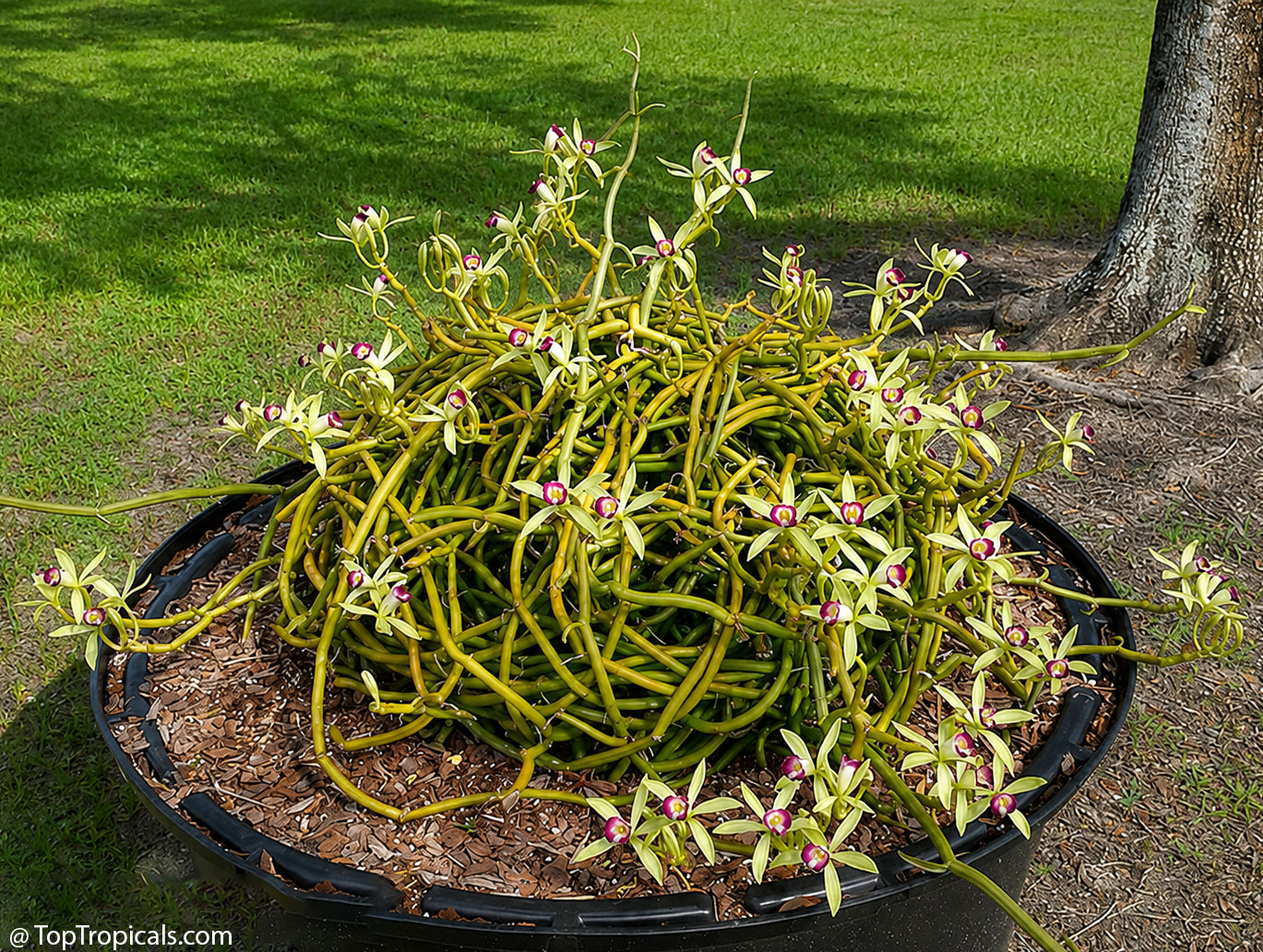
The plant Sunshine is perched on is not a hedge. It is not a wall. It is a single specimen of Vanilla dilloniana, Dillon's Vanilla, and it has a name: Intelligent Design. Unlike the familiar Vanilla planifolia — the commercial vanilla of ice cream and extract — dilloniana produces no leaves. The plant is essentially a green vine, photosynthesizing entirely through its stems. It is an unusual and striking grower, and in good conditions it can develop into an impressive, multi-branched specimen. It is classified as rare, and is considered vulnerable or endangered across portions of its native range.

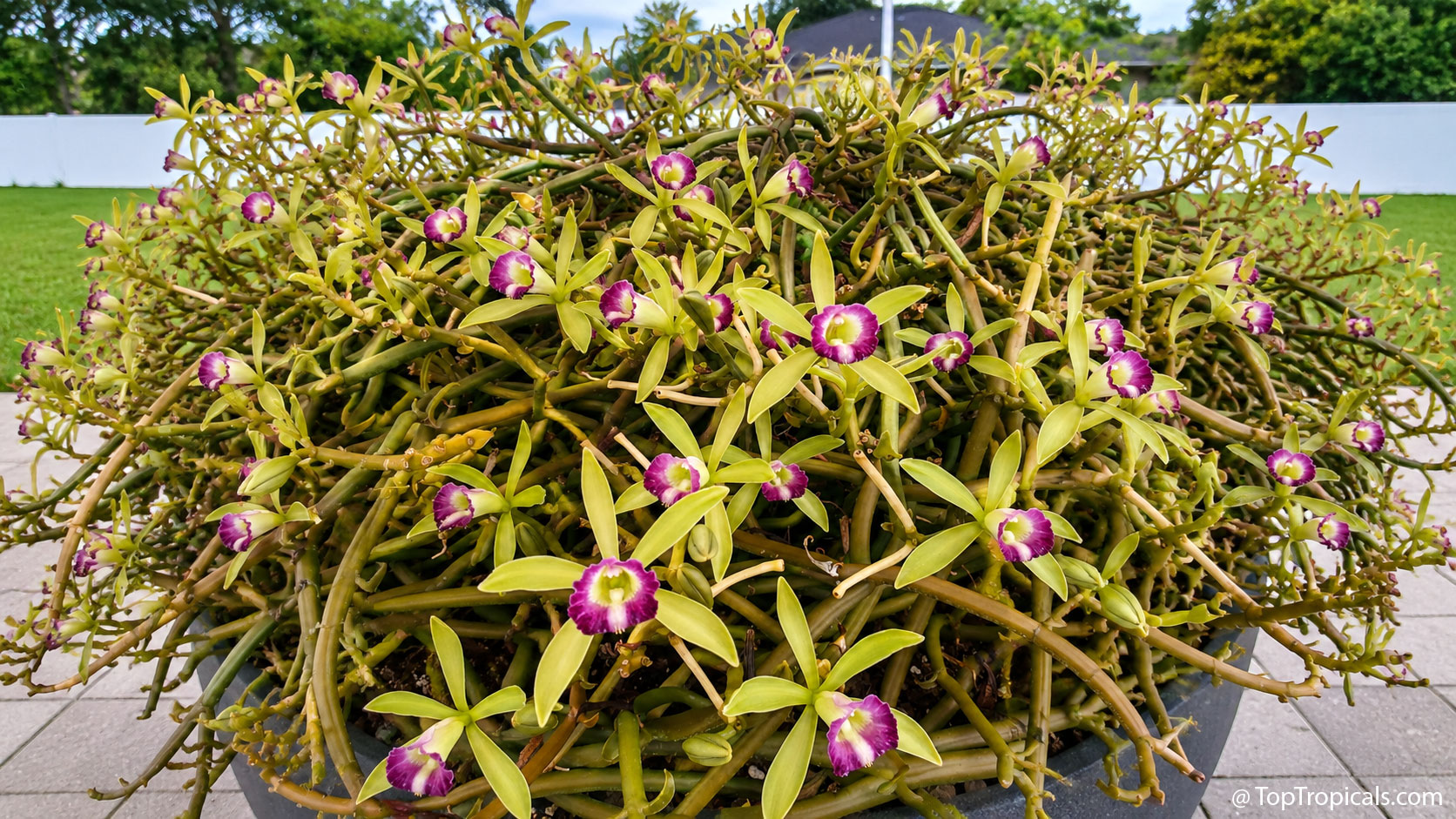
Close-up  of  the  Vanilla  dilloniana  mother  plant,  Intelligent  Design, 
 growing  in  a  100-gallon  container.  Hundreds  of  leafless  green  stems  weave 
 together  into  a  dense  mound  covered  with  pale  green  orchid  flowers  featuring
    vivid  purple  and  white 
 centers.

Vanilla dilloniana in full bloom before its next major upgrade.

Intelligent Design was grown and lovingly tended for years by Robert Riefer, a grower who is both a good friend of Top Tropicals and one of the most dedicated orchid collectors we know. The mother plant of this specimen traces its origins back to 1927 - nearly a century of continuous cultivation.

In 2011, the American Orchid Society recognized this remarkable plant with a Certificate of Horticultural Merit (CHM), one of the society's formal awards for plants of exceptional quality.

By 2017, the plant had already become well known in the orchid and tropical plant community, appearing in a video that documented Robert moving it into a 100-gallon container. That video became something of a legend among collectors.

🎥 Video: the biggest Vanilla Orchid in the world moving to 100 gal pot

Then the plant kept growing.

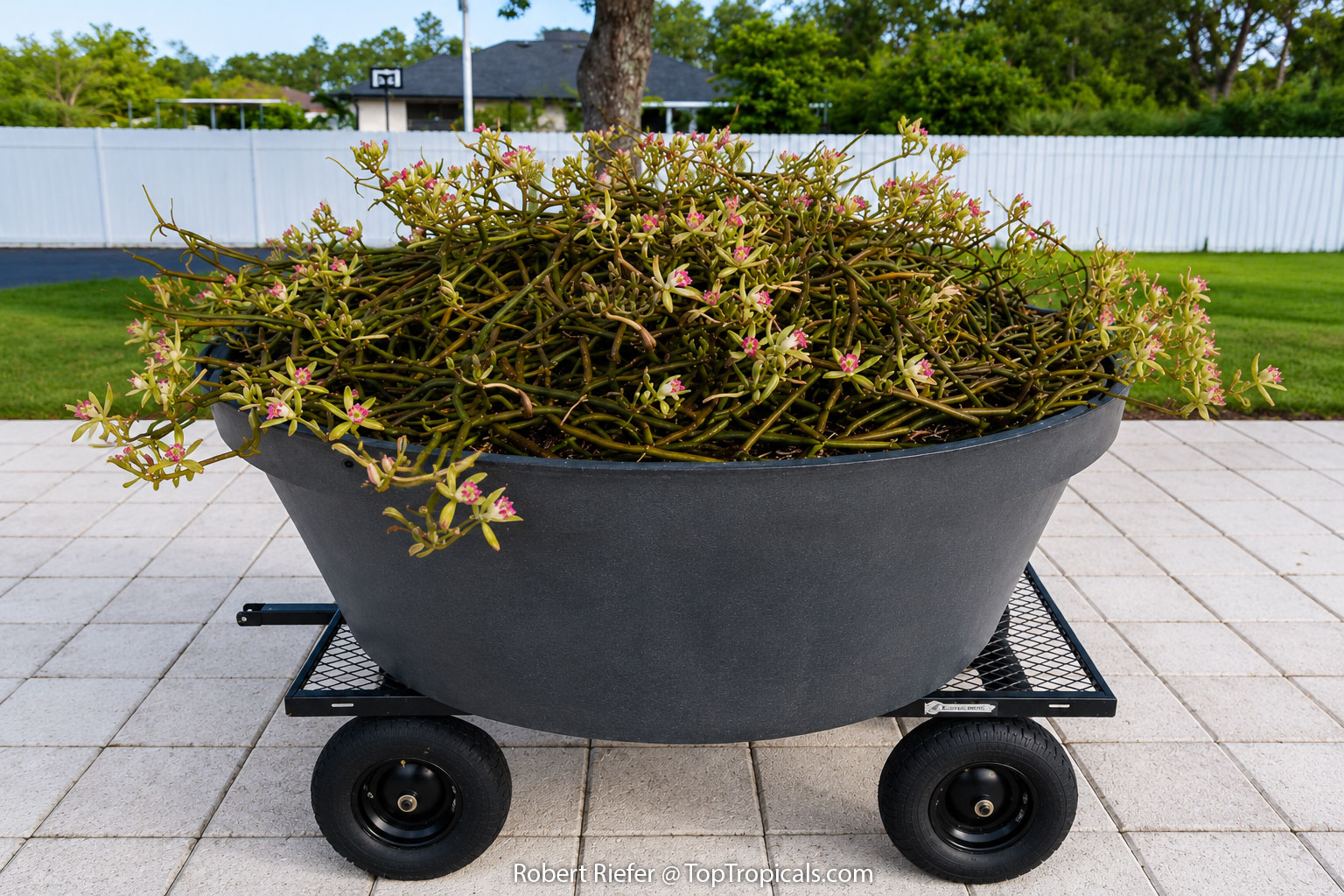
It outgrew the 100-gallon container. Robert eventually moved it into a 250-gallon pool on wheels - because when a plant refuses to stop, you give it room.

The  Vanilla  dilloniana  mother  plant,  Intelligent  Design,  growing  in  a 
 massive  250-gallon  container  on  wheels,  with  thousands  of  leafless  green 
 stems  forming  a  dense  mound  covered  in  small  orchid 
 flowers.

The move to a custom 250-gallon container allowed continued growth and flowering.

The plant is currently on display at Edison Ford Winter Estates museum and botanical garden in Ft Myers, Florida, during the month of June, where recent photographs show it larger and more floriferous than ever. It is, as best anyone can determine, the largest known cultivated specimen of Vanilla dilloniana in the world. If you are local or visiting Florida, don't miss the chance to see this world-famous orchid in person. It is expected to continue blooming through June.

And here's the remarkable part: the Vanilla dilloniana plants available from Top Tropicals are propagated directly from this exact plant - Intelligent Design itself.

🛒 Add Intelligent Design Vanilla to your collection

👉 A Piece of Living History - Direct from the Source

Young  Vanilla  dilloniana  plants  at  different  stages  of  growth,  showing 
 rooted  cuttings  trained  on  bamboo  stakes  in  1-gallon  pots  alongside  a  larger
    wrap-around  specimen  filling  a  7-gallon  container  with  thick  leafless 
 vines.

Every legendary Vanilla dilloniana starts somewhere. On the left are young Vanilla dilloniana plants. On the right is a more mature specimen in a 7-gallon pot beginning the characteristic wrap-around growth habit that eventually transforms this unusual orchid into a sprawling, sculptural giant.

Vanilla dilloniana is a rare species, considered vulnerable to endangered across parts of its native Caribbean range. Plants with documented provenance - especially provenance tied to a named, award-winning, century-old specimen - are genuinely uncommon in cultivation.

What you would be growing is a direct descendant of the famous Intelligent Design mother plant, carrying the same historic lineage recognized by the American Orchid Society.

For collectors, opportunities to acquire plants with this kind of documented history are exceptionally rare.

🛒 Start your own Vanilla Godzilla

Growing Leafless Vanilla

Large  specimen  of  Vanilla  dilloniana  growing  in  a  wide  container 
 beneath  a  tree,  with  a  dense  mass  of  leafless  green  vines  covered  in  unusual
    pale  green  flowers  with  purple 
 centers.

This is how the legendary Vanilla dilloniana mother plant, Intelligent Design, started its world-famous "Godzilla" journey in 50-gallon container. It's in full bloom, and its leafless stems form a living sculpture, dotted with dozens of striking orchid flowers that make this rare vanilla one of the most unusual cultivated orchids in the world.
  • Light: Bright filtered light is ideal. Morning sun is generally well tolerated. Avoid intense afternoon sun, especially during summer.
    Ideal: Dappled shade, eastern exposure, greenhouse conditions, or 30-50% shade cloth.
  • Temperature: Warm-growing tropical species.
    Best: 70-95F
    Protect below: 40F
    Not frost tolerant.
  • Cold Protection: In USDA Zones below 10, grow in a container and move indoors or to a protected greenhouse before temperatures drop below 40F.
  • Humidity: Prefers moderate to high humidity with good air circulation. Avoid cold, stagnant, damp conditions.
  • Watering: Water thoroughly, then allow the potting mix to partially dry before watering again. Do not keep constantly wet. In cool weather and winter, keep the soil on the drier side. Overwatering when temperatures are low is the most common mistake.
  • Potting Mix: Plant in a very fast-draining medium.
    Recommended: Top Tropicals Abundance Mix.
    The open structure allows excellent root aeration while retaining enough moisture for healthy growth.
  • Support & Growth Habit: Unlike most vanilla orchids that are trained vertically on posts or trellises, Vanilla dilloniana can be grown using the "Intelligent Design" method. Start with a sturdy support while the plant is young, then allow the stems to wrap around themselves in wide circles. As new growth emerges, continue guiding the vines around the container. Over time, the plant forms an impressive sculptural mound of intertwined stems.
  • Container Growing: Excellent for wide containers. The larger the mass of stems becomes, the more impressive the display and the greater the flowering potential. Unlike traditional vanilla culture, extensive vertical space is not required.
  • Repotting: Move to progressively larger containers as needed. Rather than growing upward indefinitely, the plant can continue expanding into a larger circular mass, making it well suited for long-term container culture.
  • Fertilizing: Feed lightly but consistently during active growth.
    Recommended: Sunshine Booster™ Orchidasm.
    Apply according to label directions every 2-4 weeks during warm growing weather. Reduce feeding during cool periods or when growth slows. Read our Guide to Sunshine Boosters™
  • Growth Rate: Moderate to fast under warm conditions. Established plants can branch freely and become surprisingly large over time.
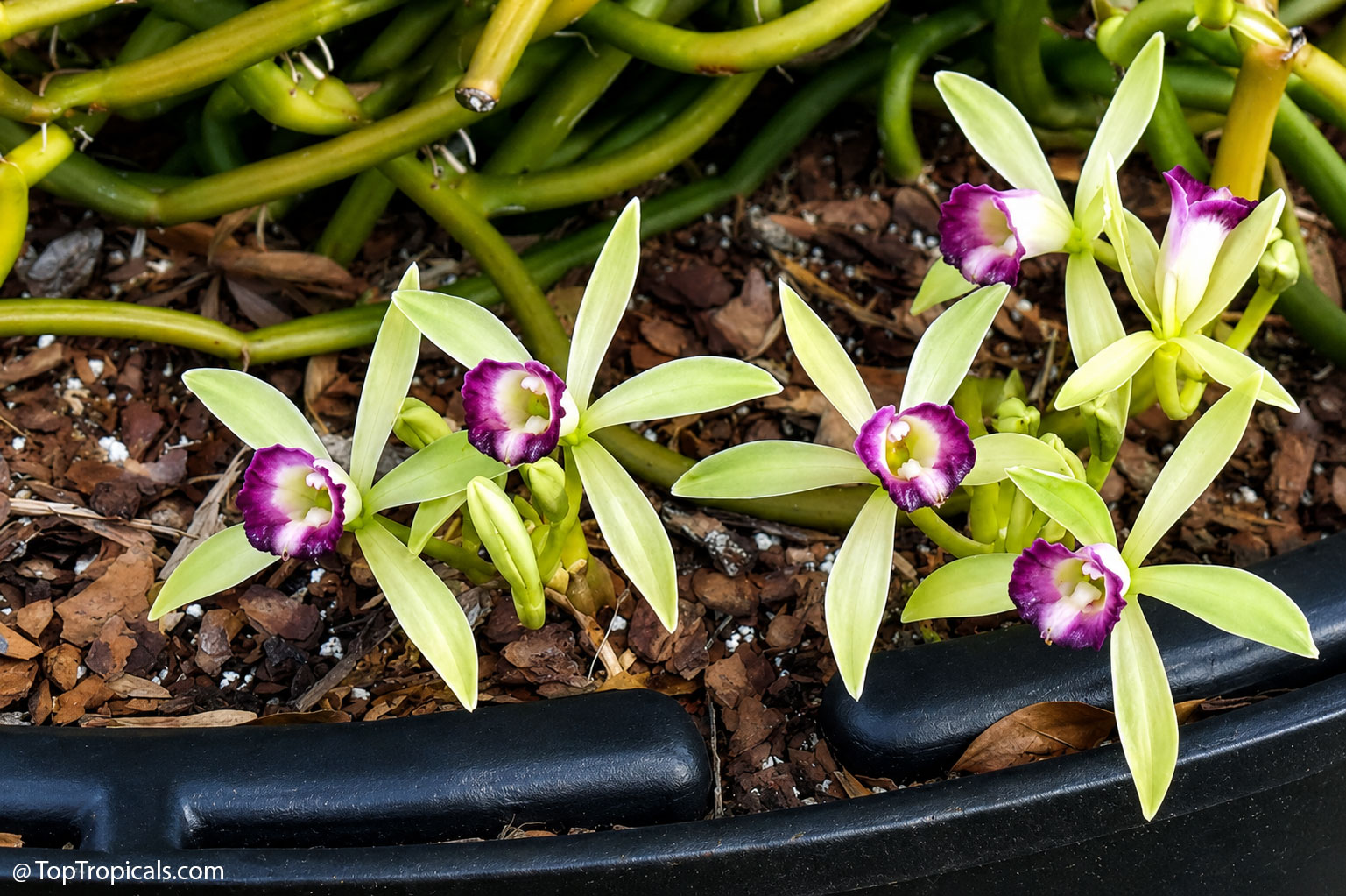
  • The Flowers: Pale green to yellow-green flowers with a deeply fluted reddish-purple lip and yellow crest. Mature plants in bloom are highly prized by orchid collectors.
  • Collector Appeal: Unusual leafless growth habit. Historic provenance. Highly desirable among orchid collectors.

Why Is It Called "Intelligent Design"?

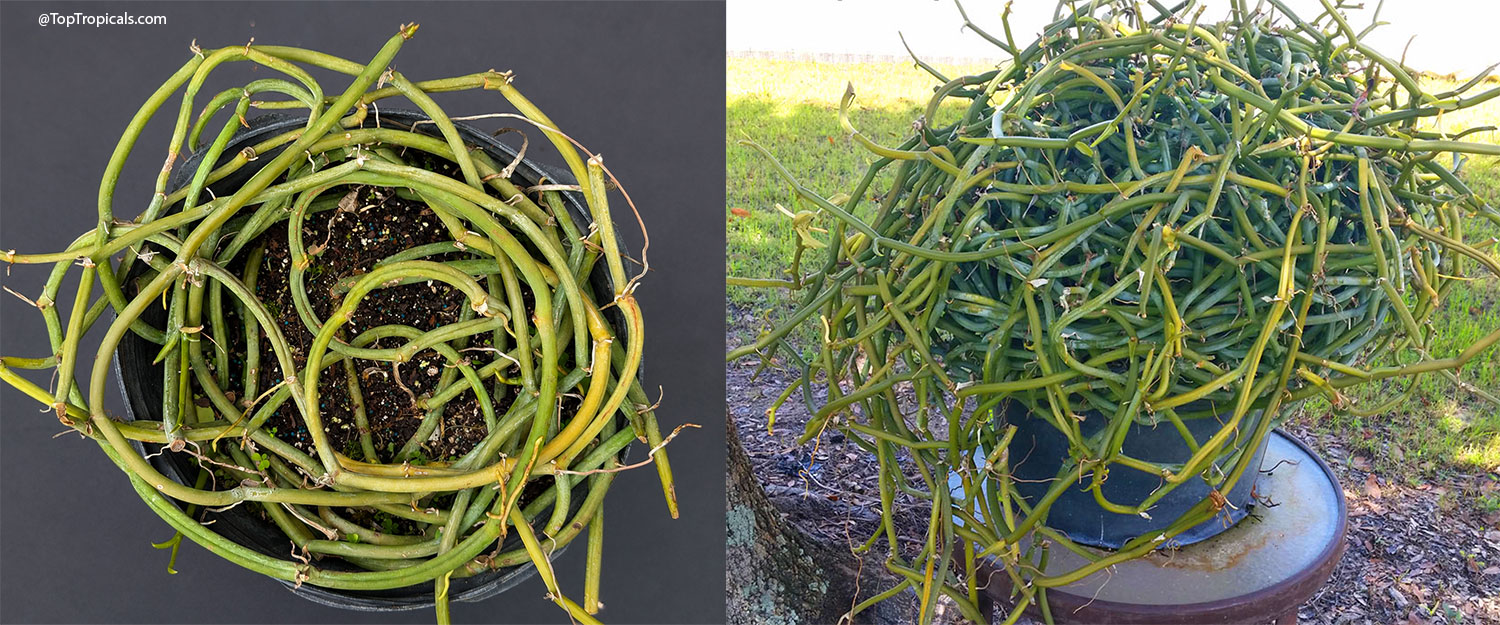
Side-by-side  comparison  of  a  young  Vanilla  dilloniana  in  a  7-gallon 
 pot.  The  left  image  shows  the  plant  beginning  to  wrap  around  the  container, 
 while  the  right  image  shows  the  same  plant  later  forming  a  dense  ball  of 
 leafless  green  vines  as  it  continues  its  characteristic  growth 
 habit.

The making of Intelligent Design. As Vanilla dilloniana grows, its long leafless stems naturally wrap around themselves, creating a dense sculptural mass of living vines. Even in a 7-gallon pot, the plant is already beginning to develop the unusual growth pattern that would eventually make its famous mother plant one of the largest cultivated specimens of its species.

The famous mother plant was named Intelligent Design by its grower, Robert Riefer. After decades of growth, countless blooms, container upgrades, and an apparent determination to occupy every available square foot of greenhouse space, the name seemed increasingly appropriate.

Unlike commercial vanilla, Vanilla dilloniana is grown primarily as a collector's orchid. Its leafless, sculptural stems create a living tangle of green architecture unlike almost any other cultivated vanilla species.

Ready to grow this remarkable Vanilla dilloniana? Start your own chapter in the story of Intelligent Design.

📚 Learn more from our Blog

🛒 Order Legendary Leafless Vanilla Dilloniana

Close-up  of  Vanilla  dilloniana  flowers  blooming  along  the  edge  of  a 
 large  container,  showing  pale  green  star-shaped  petals  with  striking  purple 
 and  white  centers  against  a  tangle  of  leafless  green 
 vines.

The unusual flowers of Vanilla dilloniana emerge directly from its leafless stems, creating a stunning contrast of pale green petals and vibrant purple throats.
Smokey: We cannot guarantee that your plant will eventually require a 250-gallon pool on wheels.
Sunshine: We also cannot rule it out.
Smokey: Officially, we cannot confirm that the plant possesses intelligence.
Sunshine: The evidence is mounting.
Smokey: What evidence?
Sunshine: It convinced humans to build larger containers, move it into a 250-gallon pool on wheels, transport it to museum exhibitions, and place its agents in collections across the country.
Smokey: That's called excellent horticulture.
Sunshine: That's exactly what the Intelligent Design plant wants you to think.

Date: 22 Sep 2025

When do I get the fruit from my Dragon Fruit?

Dragon fruit varieties

🍉 When do I get the fruit from my Dragon Fruit?


🌵Dragon Fruit (Pitaya) is one of the most rewarding exotic fruits to grow. Sweet pulp, striking looks, and plenty of health benefits make it a favorite. You'll see it in three main types: white-fleshed (Hylocereus undatus), red-fleshed (Hylocereus costaricensis), and yellow-skinned (Hylocereus, or Selenicereus megalanthus).

🌵Don't want to wait years for fruit? Here’s the good news: unlike many tropical trees that test your patience, dragon fruit is a fast-fruiting, easy-going cactus. With the right care, you can harvest in just 1-2 years from a cutting - or even the same season if you plant a well-established specimen.

🌵 How to get Dragon Fruit faster


Give it strong support - trellis, fence, or post. This cactus loves to climb.
Full sun and good drainage - sandy or well-draining soil works best.
Smart watering - water deeply in hot weather, then let the soil dry. Dragon fruit loves water during active summer growth, but remember it's still a cactus - don’t keep soil soggy.
Pollination matters - flowers open at night. Some varieties are self-fertile, but planting a few different types boosts fruit set. This is why it helps to keep several varieties close together.
Feed well - use organic liquid fertilizers like Sunshine Boosters C-Cibus with every watering, or Green Magic controlled-release fertilizer every 6 months.

With these steps, dragon fruit quickly rewards you with flowers, followed by colorful, delicious fruit. Few exotics are this easy - or this fast!

🛒 Start your fast-growing Dragon Fruit production


📚 Learn more:


· Pitaya vs Dragon fruit - what is the difference and how to grow it. Varieties.
· The secret to abundant dragon fruit harvests
· How to grow Dragon Fruit from a cutting - Quick Guide
· How to grow Dragon Fruit 📱
· Planting your own Dragon Fruit plantation
· Do-It-Yourself Support Structure for Dragon Fruit
· Grow Your Own Exotic Dragon Fruit Garden
· Top 10 fruit you'll ever need for your health benefits: Dragon fruit
· What does Dragon Fruit Flower look like?
· Why you need to grow your own dragon fruit
· Do red, white and yellow Dragon fruit taste differently?
· What to do with a lot of Dragon Fruit

#Food_Forest #How_to #Dragon_Fruit

🟢 Join 👉 TopTropicals

Date: 3 Jul 2025

Coral-blooming bonsai with a bottle-shaped trunk - perfect container plant

🔥 Coral-blooming bonsai with a bottle-shaped trunk - perfect container plant


Jatropha podagrica - Gout Plant - is a one-of-a-kind tropical showpiece with a knobby, swollen caudex, massive umbrella-like leaves, and bright coral-red flowers that pop like underwater treasures.

Compact and only 2-3 feet tall, it's perfect for containers, bonsai lovers, and small gardens craving something bold and unusual. It thrives in partial shade, grows giant leaves in low light, and needs little water to stay happy. Easy-care and eye-catching, it's more than a plant it’s a conversation starter.

🛒 Get your Gout plant - the plant with a personality

📚 Learn more:


Attention grabber: swollen trunk, giant leaves, and flowers just like corals

#Container_Garden #Nature_Wonders #Shade_Garden

🟢 Join 👉 TopTropicals