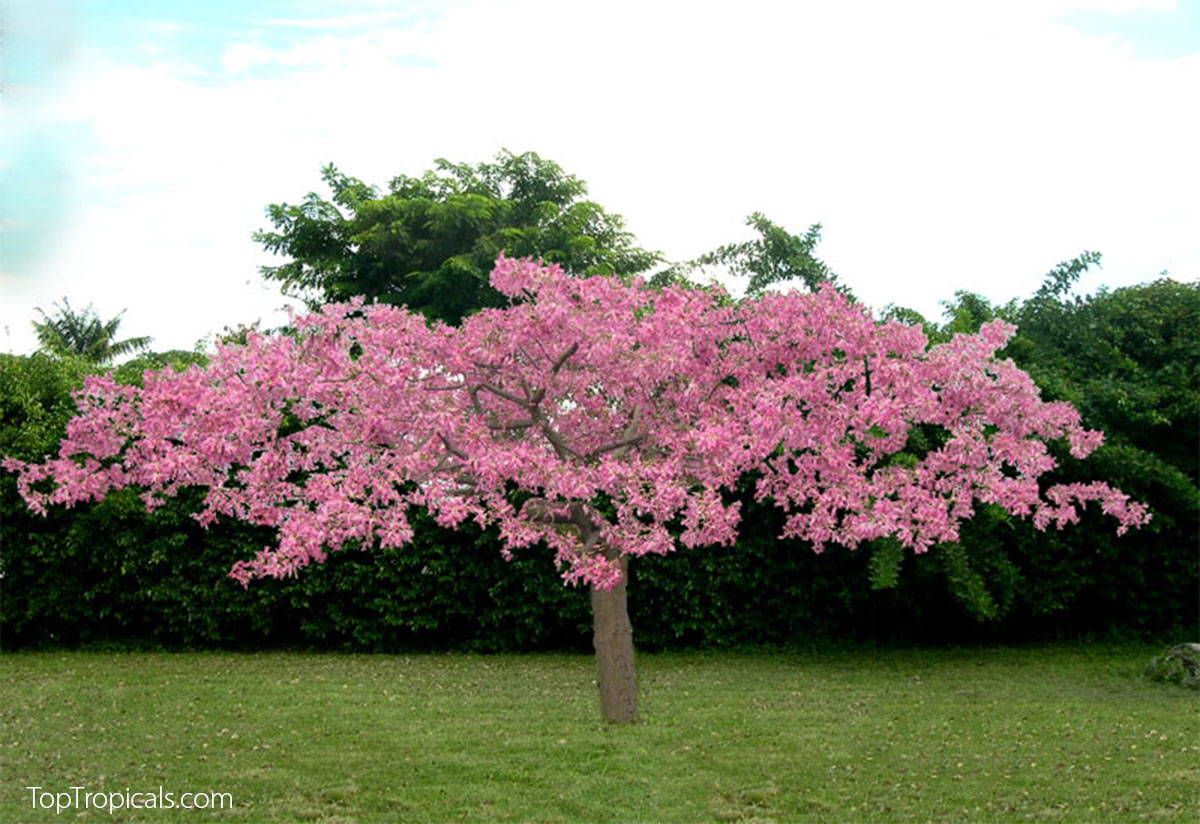
Why you should grow your own Pomegranate Tree:
The "Fruit of Miracles" in your backyard
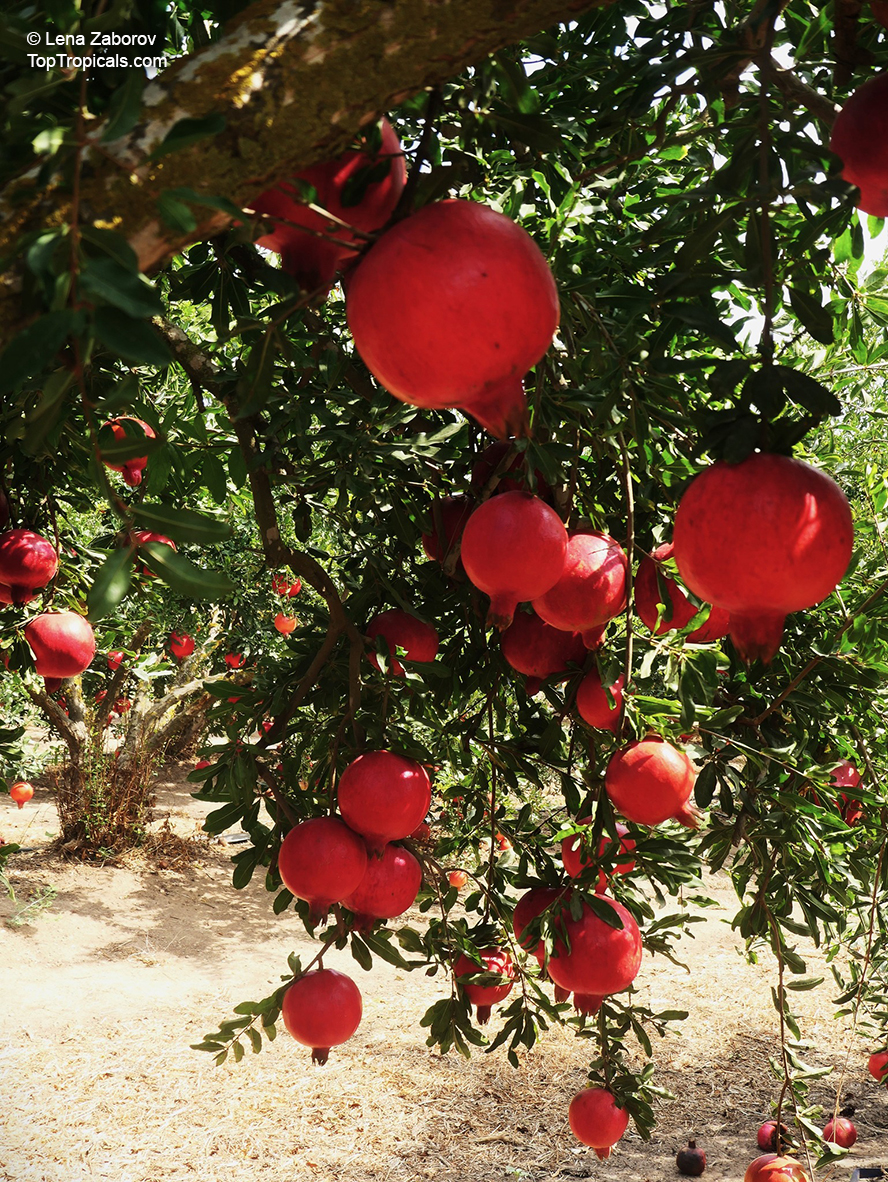
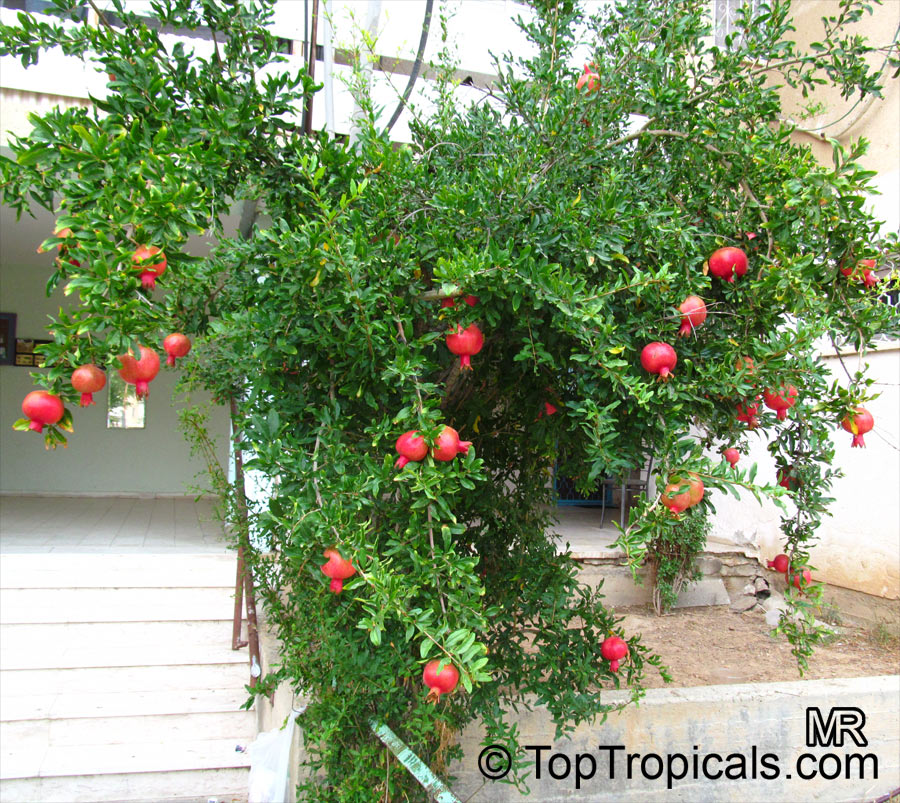
Pomegranates aren't just pretty to look at - they're packed with nutrients that make them a true "fruit of miracles". Adding a pomegranate tree to your garden can offer you a bountiful supply of this health-boosting superfruit and bring a bit of Mediterranean charm to your backyard.
Health Boosters in Every Bite
Pomegranates are loaded with antioxidants, vitamins, amino acids, and minerals. These nutrients work wonders for your health, from boosting hemoglobin levels to strengthening your immune system. Here's why this gem of a fruit deserves a spot in your diet (and your garden):
Antioxidant Power: Pomegranates are rich in antioxidants that fight off free radicals - those pesky molecules that can damage cells and lead to various diseases.
Heart Health Hero: They can reduce cholesterol and improve blood flow, lowering your risk of cardiovascular issues. Plus, they're known for increasing hemoglobin!
Blood Sugar Support: Pomegranate helps regulate blood sugar and offers a whole range of benefits, from diuretic and anti-inflammatory effects to even a little pain relief!
Beauty Booster: This fruit has benefits for your teeth, can help prevent hair loss, and even promotes youthful-looking skin.
Seeds of Goodness
Ever thought about tossing those pomegranate seeds? Think again! Eating the seeds can help keep your gut and hormones in check. These tiny bits are packed with oils that do wonders for
your skin, blood vessels, and heart.
How often to indulge?
To enjoy the maximum benefits, you can eat one pomegranate daily or
drink 300 ml of juice. Try to do this 30-40 minutes before a meal to prepare your stomach for digestion.
So, why not give this "miracle fruit" a home in your garden? You'll have a natural health booster right at your fingertips, ready to add a pop of flavor and color to your meals!
Q: It's getting so hot that my plants stay droopy
all day, how much water is enough water? Any advice how to help them to
survive this heat?
A: Yes, it's official - summer has cranked up the
heat, and your garden knows it. Blame it on the dreaded heat dome - a big
ol' pressure lid in the sky that traps hot air like a pressure cooker.
Basically, it's summer's version of putting your plants in an oven - without the
cookies... But don't panic! With a little extra care (and water), you can help
your leafy friends make it through the sizzle without going crispy. Here's how
to beat the heat in your garden:
Eight rules during summer heat
1. Water early, and generously. Morning is the magic hour. Before
the sun gets too intense, give your plants a slow, deep drink - like a spa
treatment before a big day. Watering in the middle of the day? Bad idea. It's
like pouring water on a hot frying pan - evaporates fast, and can even scorch
leaves.
2. Mulch like you mean it. A nice 2-3 inch blanket of mulch keeps
your plants' roots cool and the moisture locked in. Think of it as sunscreen
and air conditioning for the soil. Pine straw, bark chips, shredded leaves -
whatever you've got, pile it on.
3. Give them some shade. If your plants are looking like they're
sunbathing without sunscreen, help them out. Use old sheets, umbrellas, shade
cloth - whatever works. Even a light shade can make a big difference. New
plants, veggies, and shade lovers like philodendrons will thank you.
4. Put down the pruners. Right now, your plants are in survival
mode. Pruning in extreme heat can stress them out more. Let them ride out the
heat wave before giving them a trim.
5. Don't move in this heat. If you're thinking of transplanting
that poor little tree - hold that shovel. Moving plants during extreme heat is
like moving house during a heatwave - everyone ends up grumpy. Wait until
cooler weather rolls back in.
6. Pamper your potted plants. Pots heat up fast and dry out even
faster. Move your container plants to shadier spots and check their soil
often - don't let it go bone dry. They can't dig deeper for water, so you're
their lifeline.
7. Know the signs of heat stress:
- Droopy in the day, perky at night? Normal. They're just hot, not dying.
Keep watching.
- Crispy edges or curling leaves? They're too dry. Deep water, mulch,
shade.
- Still wilted the next morning? That's a red flag. Time to step up the TLC
- soak thoroughly and shield from the sun.
8. Don't forget about yourself! If your plants are feeling the
heat, you probably are too. So wear a hat, slap on sunscreen, hydrate, and do
your gardening early or late in the day.
Need help planning your garden's heatwave strategy? We're here for you,
7 days a week. Reach out to the Top Tropicals team and we'll get your plants through
summer with style!
Stay cool and grow on,
Kristi V. - your Tropical Plant Expert 🌴
Garden Sustainability Tips: Live your Life. Dig your Garden.
You can grow herbs and vegetables that can be easy incorporated into
your home landscape. You don't need a raised bed for a few little things that
will come really handy for your kitchen.
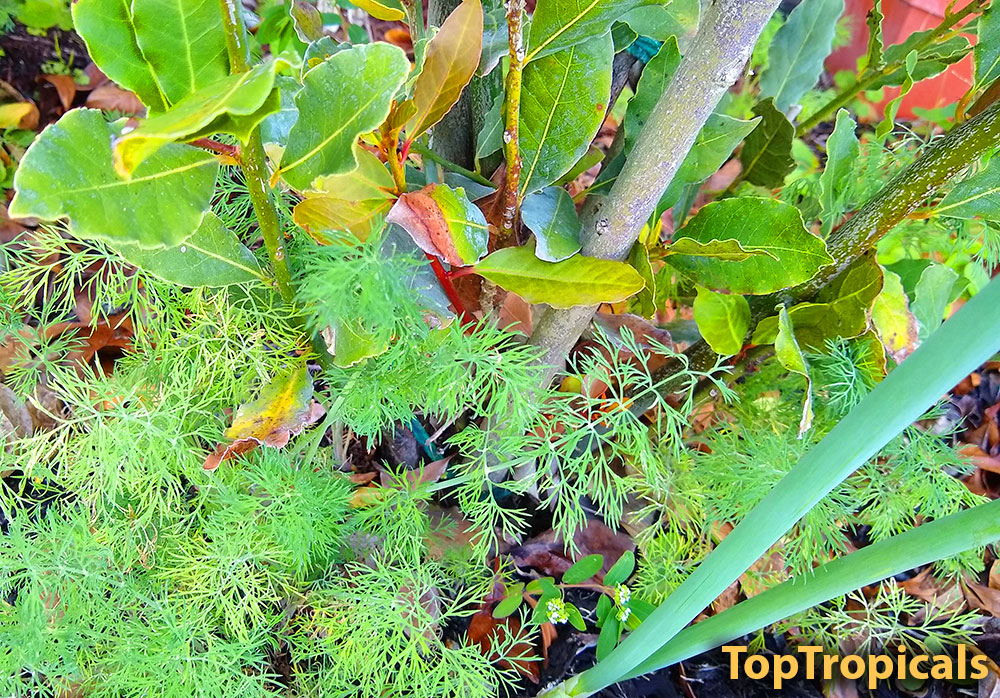
1. Parsley. Get a small 4"pot parsley plant from a local garden
center. It grows super fast and just one plant can provide great healthy
addition for your cooking for a few months. Plant in in full sun, under a tree or
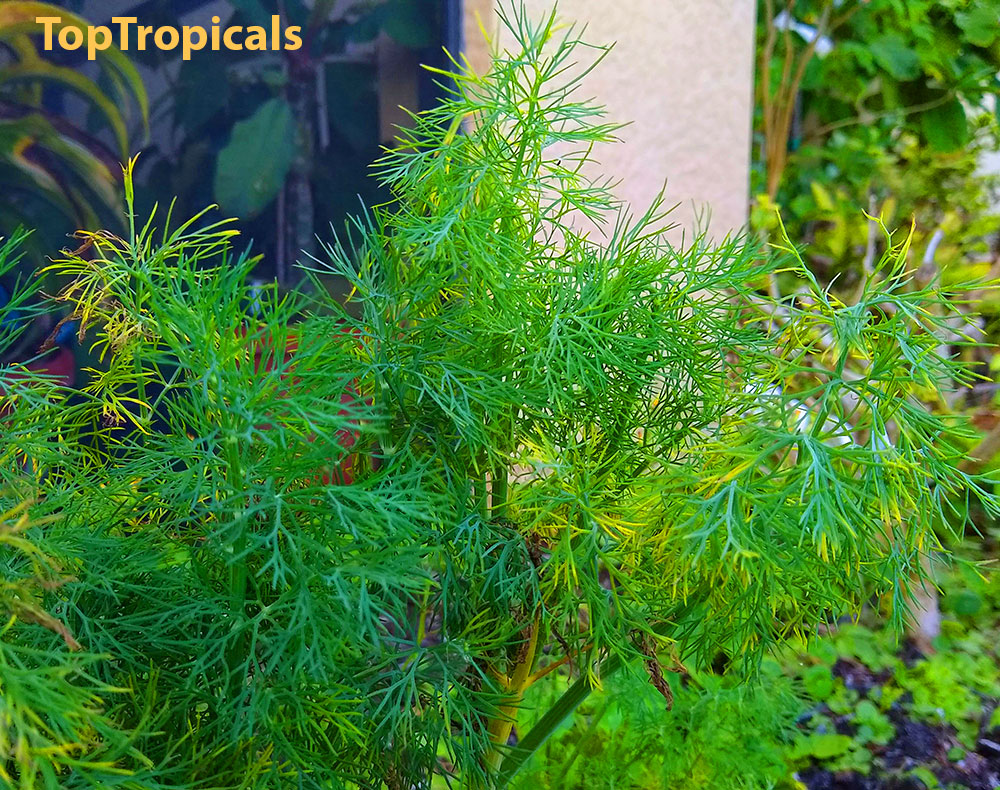
shrub, where it gets hit by a sprinkler. 2. Dill. This one grows from seeds quickly and easily. It also needs
full sun and regular water. 3. Chives, or Green Onion. Don't through away"bulbs"from chives
you got from the store. Stick them in the ground, pretty much anywhere in your
garden. You will have supply of fresh chives loaded with vitamins right away
(withing a few days!) and for many months. You can also plant an onion bulb
(root-end down... duh) - this one will produce greens even faster! 4. Bay Leaf. If you live in a mild climate, plant a Bay Leaf in your yard (closer to the door - closer to the kitchen!). It
is a wonderful healthy spice for soups and stews that makes them super
flavorful. If your winters are cold, keep the plant in a pot. Bay Leaf makes a
great undemanding houseplant that needs bright light, but very little water. 5. Cherry tomatoes are easy to grow, heat tolerant and even grow in
lower light, so they are easy to incorporate into any existing landscape. Get
Sunshine Boosters to double your crop: see how it works. 6. More herbs and spices. Check out our large selection of herbs and spices - they are on sale today! 7. Garden work is a great exercise. While the gym is closed - get to
gardening. Read about Fun workout and Calories Burning Gardening. 8. Lemons. Vitamin C is your best friend for boosting immune system,
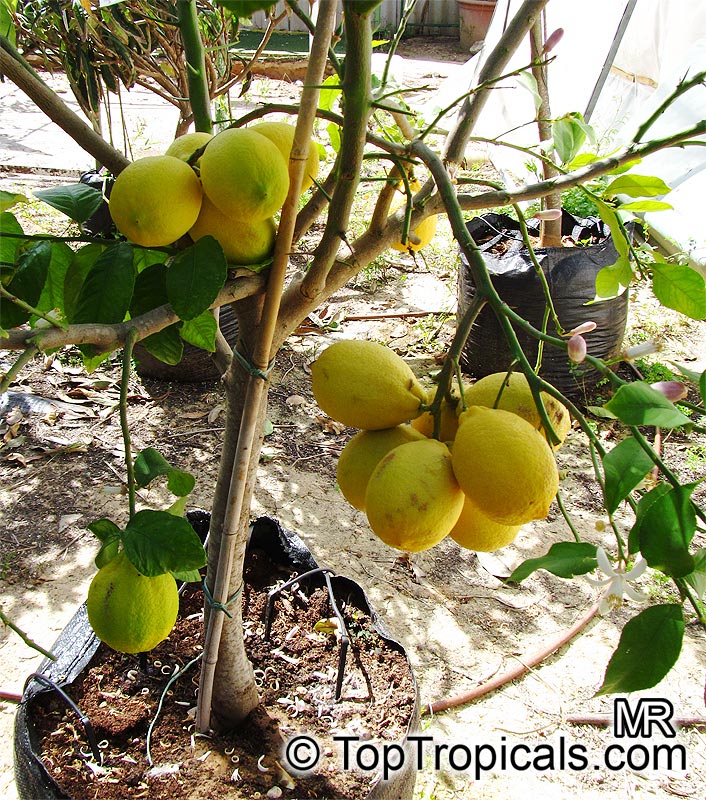
and Lemons have tons of it! In areas where citrus can grow outside, Lemon
tree is a must-have for your garden, or at least find a friend who has one!
Citrus also makes a great house plant, so you can keep it in a pot, too. Just
make sure to have a grafted tree that will produce right away.
Lemon Juice Health Booster Recipe
1. Squeeze juice from 1 lemon and mix it with 1 cup of water.
2. Add ice cubes and 1-2 tbsp of any flavored syrup (optional). You may add
some fresh mint for Mojito flavor.
3. Enjoy this drink at least once a day.
4. Get a bunch of lemons, squeeze fresh juice into ice cube trays and
freeze. 1 lemon = makes 1 ice cube. Store in freezer and use 1-2 cubes to make the
above drink, daily.
Besides being rich in vitamin C that will boost your immune system,
Lemon juice is a Natural medicine that helps to treat:
- cold and flu
- headaches and high blood pressure
- stomach problems
- insomnia
- and much more
Drinking lemon juice on regular basis will make your body stronger and more
resistant to infections and many illnesses.
Please take good care of yourself and your loved ones. Stay
healthy.
Date: 17 Nov 2025
❄️Cold Night Survival Guide
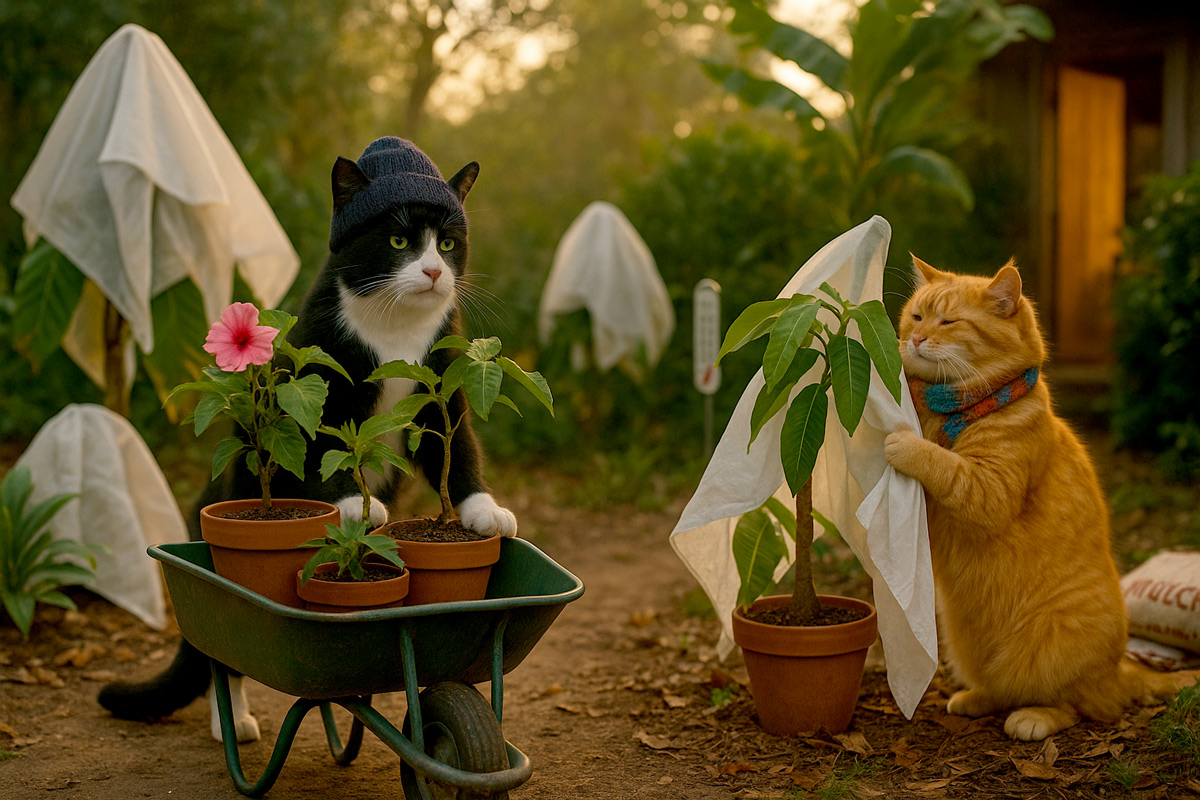
Smokey and Sunshine Prepare Plants for the Cold Night.
Smokey: Come on, Sunshine, help me move these plants inside before it gets
dark!
Sunshine: I am helping... see? I’m supervising the mango
tree.
Smokey: You call that supervising? The frost cloth’s upside down!
When the forecast drops into the 30s, panic is not a plan. This is your
simple, clear checklist to protect every tropical in your garden. Think of
it as the quick emergency manual that goes hand in hand with the previous
cold-weather newsletter.
"We
all love our tropical flowers, mangoes, bananas, and rare fruit trees. A
single cold night does
not have to be a disaster. The key is knowing what to do, when to do it, and
what mistakes to avoid." - Tatiana Anderson, Top Tropicals Plant
Expert
🌡️ FROST AND FREEZE
A frost and a freeze are not the same. A frost is when you see ice crystals
on leaves or grass, while a freeze is when the air temperature drops below
32 F. The tricky part is that you can get
frost even when the air is above freezing, and you can have a freeze with no
frost at all. It all depends on humidity and the dew point. If the dew
point
is below freezing, the ground can cool faster than the air, letting frost
form even when your thermometer reads 35 or 36 F. And once the air itself
drops below 32 F, even for an hour, tender tropicals can be damaged. For
plants, a freeze is far more dangerous, because freezing air pulls heat out
of stems, branches, and roots. Frost usually burns leaves, but a true freeze
can injure wood, kill buds, and damage the entire plant.
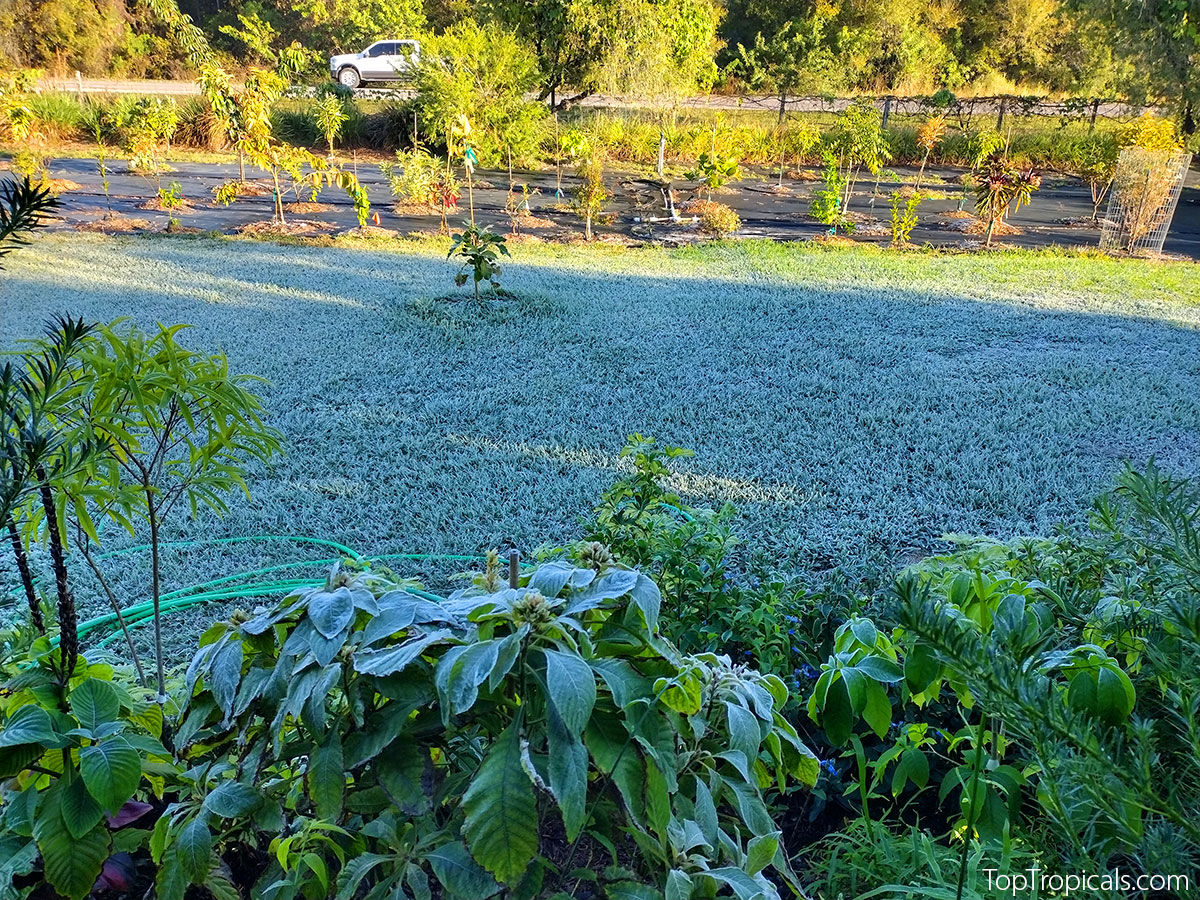
Frost on the grass and leaves on Winter morning in Central
Florida
WHAT TO DO
AND NOT TO DO BEFORE A COLD SNAP
✔️ 5 THINGS TO DO:
Water well. Hydrated plants tolerate cold better than dry, stressed
ones.
Add mulch. A thick layer around the base keeps roots warm.
Block the wind. Move pots to a sheltered corner or patio.
Cover at night, uncover in the morning. Let plants breathe and get
light.
Add gentle heat if needed. Non-LED Christmas lights or a small old style
15-20W light can raise temps a few degrees.
❌ 5 THINGS NOT TO DO:
Do not prune or trim. Fresh cuts freeze first.
Do not overwater. Wet, cold soil invites root rot.
Do not let plants dry out either. Wilted plants freeze more easily.
Do not use dry fertilizer. Gentle liquid feeds like Sunshine
Boosters are safe to use with every watering: its intake naturally slows
down as watering decreases.
Do not look only at the thermometer. A long, windy night can be worse
than a short freeze.
TEMPERATURE
ACTION GUIDE (40 to 25 F)
40 to 38 F: Move potted plants to shelter, water soil, and cover
tender tropicals.
37 to 33 F: Use frost cloth and anchor it down so the wind does
not lift it.
32 to 30 F: Add a heat source like non-LED lights.
29 to 25 F: Double-cover sensitive plants, wrap trunks, and
protect roots heavily.
COLD
TOLERANCE BY PLANT TYPE
Before a cold night, it really helps to know your plant’s exact
cold limits. Every species is different, and young plants are always more
sensitive than mature ones. Take a few minutes to look up your varieties in
our Tropical
Plants Encyclopedia
— it will tell you the safe temperature range, how much protection
each plant needs, and which ones must be covered or moved before the next
cold snap hits.
Bananas: leaf burn below 37 F
Mango, Annona: hurt around 32 F
Cold hardy avocados: Mature tree can take about 25 F. Young trees must
be protected
Olives, Citrus, Guava, Jaboticaba: usually OK outside with mulch
QUICK-ACTION
TABLE
Before the cold arrives, make yourself a quick list of every plant and
what action each one needs. It saves time when temperatures start dropping
and keeps you from scrambling in the dark. Check that you have enough frost
cloth, blankets, and supplies on hand so you can cover everything without
rushing. Planning ahead makes cold nights much less stressful.
Bring Indoors: Cacao, Bilimbi, Coffee. They need warm, bright
light.
Cover Outdoors: Mango, Jackfruit, Banana, Annona. Use frost cloth, not
plastic on leaves.
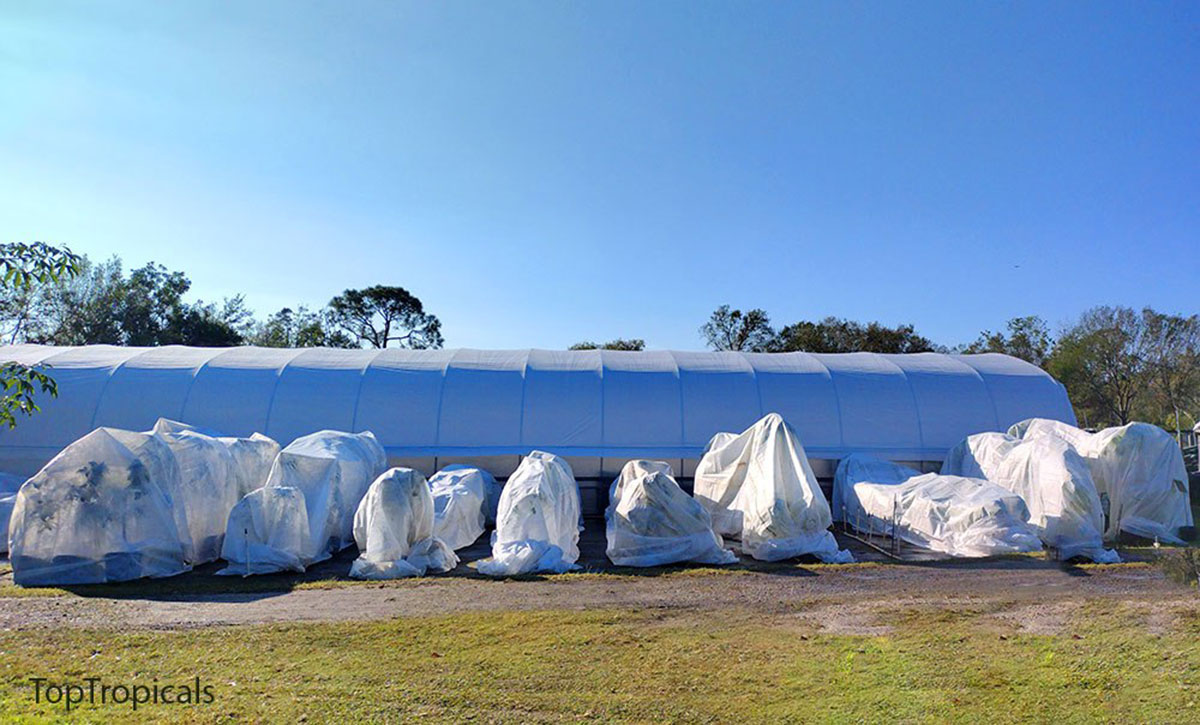
Covering large mango and avocado trees in pots at TopTropicals during
cold nights
GADGETS AND
TOOLS THAT HELP
Indoor helpers: LED lights, small heaters, bottom-heat mats,
timers.
Outdoor helpers: frost cloth rolls, mini greenhouses, non-LED Christmas
lights or small incandescent lights, smart thermometers.
Always keep electrical safety in mind, especially if you are using extension
cords outdoors. Use only weather-rated cords, keep all connections off the
ground, and protect plugs from moisture. Make sure heaters and lights are
stable, secured, and never touching fabric covers. A few minutes of safety
check
can prevent a dangerous situation on a cold, wet night.
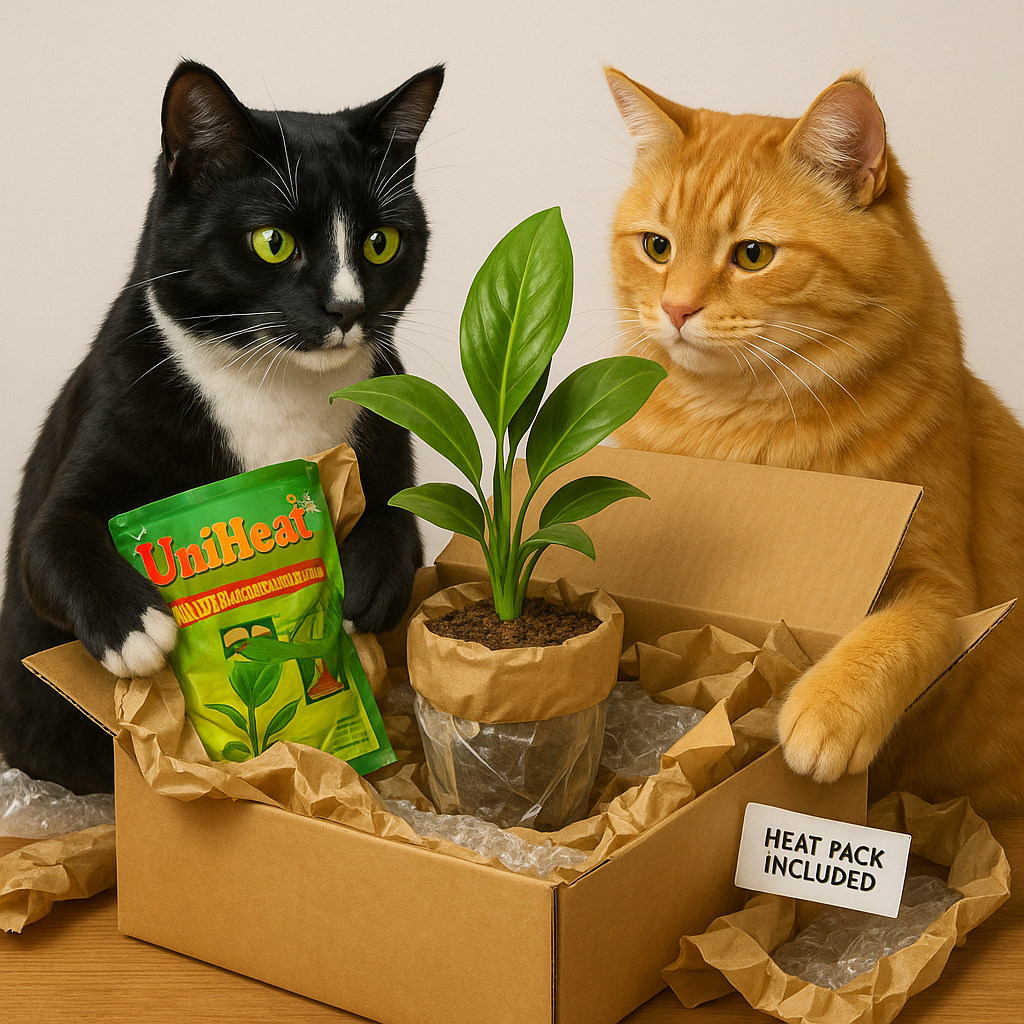
And if you want to keep plants strong through winter, add Sunshine
Boosters to your watering routine. It is gentle, safe in cold weather,
and gives plants an extra edge.
AFTER THE
COLD PASSES
In the morning, uncover plants. Leaving covers on during the day can trap
heat and cook the tender new growth, especially under the sun. The only
exception is true frost cloth designed for all-day use, which allows air,
light, and moisture to pass through. Regular blankets, sheets, and plastic
must come off as soon as the sun rises.
Do not cut anything yet. A plant can look completely dead after a freeze,
but many branches are still alive under the bark. Cutting too soon removes
wood that would recover on its own. Wait until new growth begins in spring.
That is when you can see exactly which branches are truly dead.
Use the scratch test. Gently scratch the bark with your nail or a small
knife. If the layer underneath is green, the branch is alive. If it is brown
and dry, it is likely dead. But even then, wait until warm weather to be
sure, because sometimes only the tips die back while the lower part of the
branch survives.
Once the weather stabilizes, resume light feeding. Plants coming out of cold
stress need gentle support, not heavy fertilizer. A mild liquid feed like
Sunshine
Boosters helps them rebuild roots and push new growth without burning
tender tissue.
Your tropical garden can survive any cold night if you prepare right. Cold
snaps always feel stressful in the moment, but once you know your plants,
have the right supplies, and follow a simple plan, it becomes routine. A few
minutes of preparation before dark can save months of growth and keep your
collection healthy all winter.
Frost cloth is the true workhorse of cold protection: it keeps heat in,
keeps frost off, and will not suffocate plants the way plastic or blankets
can. Having a few rolls ready means you never have to scramble at the last
minute. Sunshine
Boosters give your plants gentle support during the colder months so
they stay strong enough to bounce back quickly when warm weather
returns.
A little planning now will pay off in spring, when your mango, banana,
citrus, and all your favorite tropicals come back happy and ready to
grow.
How to use your yard instead of being used by your yard? Grow your own food - we can help! Sound on
How to use your yard instead of being used by your yard? Grow your own food - we can help!
🌳 How to use your yard instead of being used by your yard? Grow your own food - we can help! Sound on 🎶
😩 "I want to buy some Mango fruit for my kids but prices continue to skyrocket! How can we afford healthy food? I wish I could grow money, like that useless grass in the yard – it grows faster than we can mow it!"
You don't have to grow money, grow the fruit. Use your yard instead of being used by your yard: grow your own mango and stay happy!
⬆️ Start your own Food Forest today by planting the edible landscape. Plant a tree today and enjoy your fruit tomorrow!
🛒 Order your trees online from TopTropicals.com - we ship Nationwide!