Garden Blog - Top Tropicals
Date: 8 Sep 2026
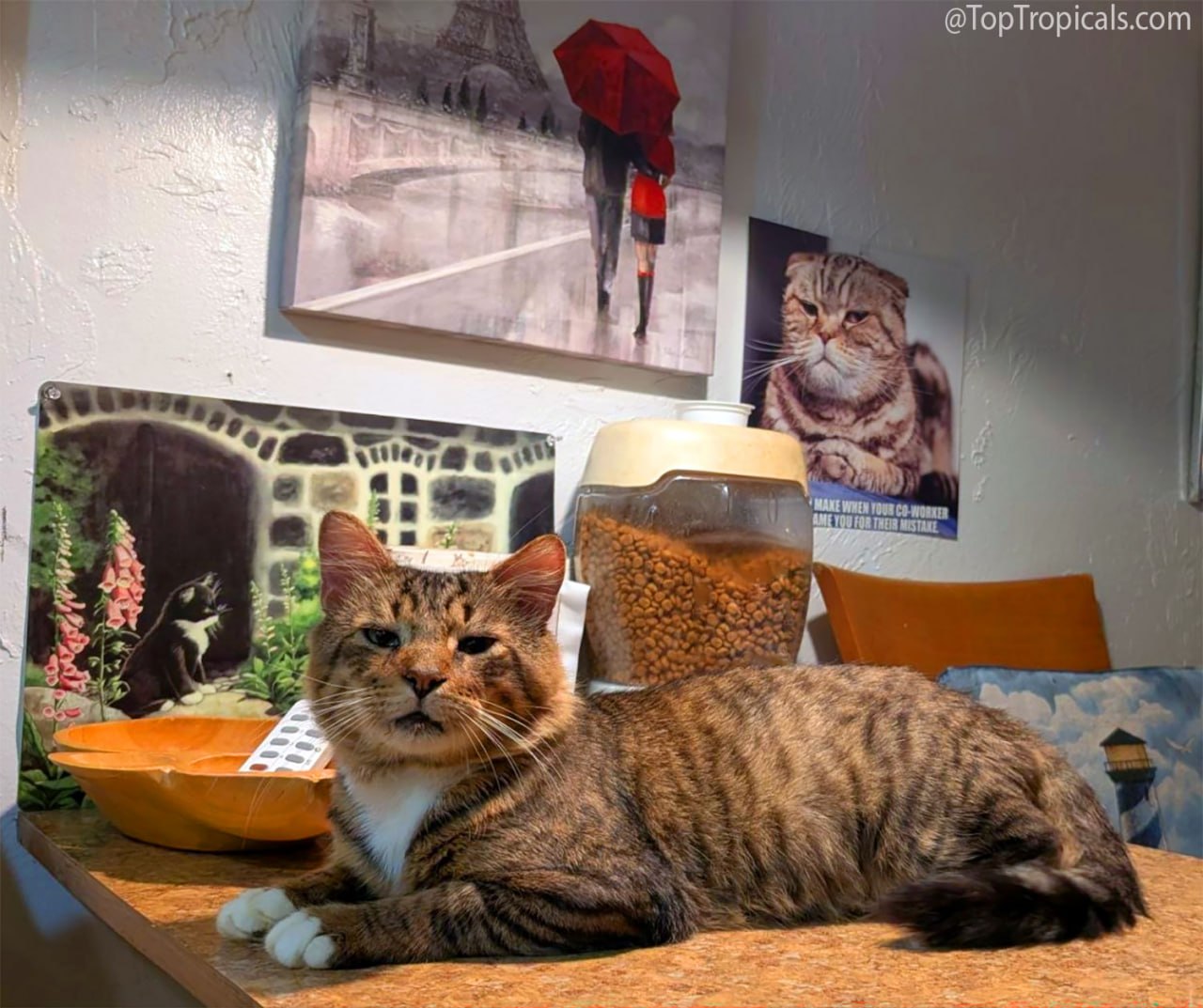
Daily Cat Lesson #18: Once a Street Cat, Always Watching the Bowl
🐾 Daily Cat Lesson #18: Once a Street Cat, Always Watching the Bowl
Simon was a street cat just over a month ago. He still eats like there may never be another meal and keeps careful watch over the food station.
🐾 Why are rescued cats obsessed with food?
Cats that lived with unpredictable meals can remain very food-focused after moving indoors. They may gulp food, beg constantly, steal from other cats or hang around the feeding area.
🐾 Should you let them eat as much as they want?
Once an underweight cat has recovered, unlimited food can quickly lead to excess weight. Regular, measured meals are usually better. Several smaller meals throughout the day can work especially well for food-obsessed cats.
With time, many cats learn the wonderful new rule: Food always comes back.
🐈📸 Top Tropicals rescued cat Simon remains skeptical and continues guarding the food supply at PeopleCats.Garden.
🐈 Stay with us for your Daily Dose of Cat! #DailyCatLesson #PeopleCats
🟢 Join 👉 TopTropicals
Date: 8 Sep 2026
This Rare Philodendron Forgot Who He Is
👽 This Rare Philodendron Forgot Who He Is
If you saw Philodendron tortum across the room, "philodendron" probably wouldn't be your first guess. Fern? Palm? Prehistoric skeleton? Its leaves are so deeply divided that it barely resembles its broad-leafed relatives.
And that's exactly why plant collectors are obsessed with it.
🌿 What is Fernleaf Philodendron
Native to tropical South America, Philodendron tortum shatters the standard heart-shaped leaf mold.
The Foliage: Long, deeply laciniate leaves divided into thin, finger-like segments that twist and spread in every direction.
The Silhouette: Light, airy, and architectural - giving the plant a striking, palm-like canopy.
The Vibe: Completely weird. In the best way possible.
🌿 The New Leaves Are the Real Show
Watching new growth unfurl is where this plant truly shines:
The Unfurl: Fresh leaves emerge tightly curled like delicate corkscrews.
The Color: New growth opens with a soft, pinkish-copper blush before hardening into a deep green.
🌿 Exotic Looks, Easy Care
Despite looking like a finicky greenhouse holy grail, Philodendron tortum is surprisingly resilient.
Light: Bright, indirect light to keep the leaf segments tight and vibrant.
Soil: A chunky, well-draining aroid mix (heavy on orchid bark and perlite) to protect sensitive roots. We use Abundance potting mix as a base, and add extra bark.
Support: Give it a moss pole or totem as it matures to encourage larger climbing foliage, or prune it to maintain a bushy shape.
🌿 For Collectors Who Have Seen It All
Standard philodendrons follow a predictable rulebook: big leaf, bigger leaf, even bigger leaf. Philodendron tortum didn't get that memo. Its skeletal structure gives you maximum visual drama without taking up massive physical block space in your room.
👀 When visitors inevitably point and ask, "What IS that?" - you get to tell them it's a philodendron.
Nobody ever guesses right!
🛒 Bring Home This Rare Weirdo
📚 Learn more:


• Philodendron tortum in Plant Encyclopedia
• The Marble Queen that thrives on neglect
• Philodendron hederaceum mediopictum Brazil
• What is the most colorful houseplant: Chartreuse Vine of Gold
• Rare showy Paraiso thrives indoors
• How big does Paraiso Verde grow
• The best plants for a bathroom oasis
• Swiss Cheese Plant is so holy!
• It looks like painted on the wall: Monstera dubia
• The Big Secret Behind the "Mini Monstera" - Rhaphidophora tetrasperma
• How mini is Mini Monstera?
#Shade_Garden #Nature_Wonders #Container_Garden #Discover
🟢 Join 👉 TopTropicals
Date: 7 Sep 2026
Daily Cat Lesson #17: The Fine Art of Doing Nothing

🐾 Daily Cat Lesson #17: The Fine Art of Doing Nothing
Today's lesson comes directly from Pelmen the Cat:
Not every minute needs to be productive.
🐾 Cats are masters of resting when there is nothing that urgently needs doing. No checking the clock. No feeling guilty. No inventing a project simply because they happen to have a free afternoon.
They find a comfortable spot, stretch out - and simply exist.
Perhaps that's one reason a peacefully resting cat is so pleasant to have around.
They give us permission to slow down too.
"Sit quietly, doing nothing; spring comes, and the grass grows by itself." - Zen proverb
🐈📸Pelmen the Sphynx cat - a friend of TopTropicals PeopleCats.Garden.
🐈 Stay with us for your Daily Dose of Cat! #DailyCatLesson #PeopleCats #Quotes
🟢 Join 👉 TopTropicals
Date: 7 Sep 2026
The Official Plant of Chicken Cowards That Cures a Very Specific Phobia (Yes, Really)
🐓 The Official Plant of Chicken Cowards That Cures a Very Specific Phobia (Yes, Really)
Afraid of chickens? There’s a plant for that:
Neea psychotrioides - Jelly Bean, or Pigeon Plum. It has always been one of the most intriguing additions to our shade garden. Just look at those berries: bright red, glossy, and hanging in rich clusters beneath the foliage. As they ripen, the red berries fall to the ground, creating a beautiful coral-red carpet beneath the plant. But beyond its stunning display, this rare tropical shrub carries a delightfully absurd piece of botanical folklore: a wonderfully ridiculous story involving babies - and chickens.
🐥 A Year-Round Color Engine
Native to Central America, Neea psychotrioides grows as a compact shrub or small tree. While its tiny blossoms are easy to overlook, the aftermath is unmissable.
The Fruit: Clusters of brilliant, jelly bean-like red berries decorate the underside of the branches.
The Lifespan: Unlike plants with fleeting display windows, Neea fruits continuously for months, keeping your garden vibrant for most of the year.
Care Level: Exceptionally low-maintenance and easy to cultivate, making it a hidden gem for shade collectors.
🐥 Hilarious Secret History: a Remedy for "Chicken Fright"
Beyond its ornamental value, Neea holds a unique place in Belizean traditional medicine. Historically, local herbal remedies used the plant specifically for infants who suffered from sleeplessness and crying after being startled by chickens.
So, among all the exotic flora in the garden, Neea stands out as the ultimate antidote to poultry-induced terror! 🐣
🐥 Why You Need One in Your Collection
Whether or not chickens pose a threat to your daily peace of mind, Neea psychotrioides deserves a spot in the spotlight. It's hardy, visual, rare in mainstream cultivation, and comes with a conversation-starting story that few other plants can match.
Some plants give you seasonal blooms; Neea gives you red jelly beans and courage against chickens. 🐔
🛒 Chicken-Proof Your Garden: Buy Neea - Fear No Chicken
📚 Learn more:


Neea psychotrioides in Plant Encyclopedia
What plant you need if your kid is afraid of chickens
#Hedges_with_benefits #Remedies #Discover
🟢 Join 👉 TopTropicals
Date: 6 Sep 2026
Daily Cat Lesson #16: Professional Sleeper at Work
🐾 Daily Cat Lesson #16: Professional Sleeper at Work 😴🐈
Your cat isn't lazy. Sleeping is serious cat business.
- 🐾 How much do cats sleep?
Most cats sleep around 12–16 hours a day, and kittens and senior cats may sleep even longer. Some cats can spend close to two-thirds of the day asleep. - 🐾 Why so much?
Cats evolved as predators. Hunting requires short bursts of intense energy, followed by long periods of rest. Your house cat may be hunting a bowl of Fancy Feast instead of a mouse, but the ancient operating system is still installed. - 🐾 Do cats dream?
Very likely! Cats experience REM sleep, the stage strongly associated with dreaming in humans. Those twitching whiskers, moving paws and tiny noises during sleep may be signs that something interesting is happening in Cat Dreamland. - 🐾 Why do cats sleep curled into a ball?
Curling up helps conserve body heat and protects the belly and other vulnerable areas. When a cat sleeps stretched out, belly exposed, it often means she's warm, relaxed and feels safe. - 🐾 Are cats nocturnal?
Not exactly. Cats are generally crepuscular, meaning they're naturally most active around dawn and dusk.
Which explains why your cat can sleep peacefully for 14 hours - and suddenly decide that 5:17 a.m. is an excellent time to reorganize the house! - 🐾 Should you wake a sleeping cat?
Unless you have a very good reason - Niki recommends that you absolutely do not. 💤
🐈📸 Top Tropicals rescued cat Niki at PeopleCats.Garden.
🐈 Stay with us for your Daily Dose of Cat! #DailyCatLesson #PeopleCats
🟢 Join 👉 TopTropicals