Garden Blog - Top Tropicals
Date: 2 Aug 2026
🏡 You Do Not Need More Room. You Need to Use It Better.
By Tatiana Anderson, Plant Expert, Top Tropicals
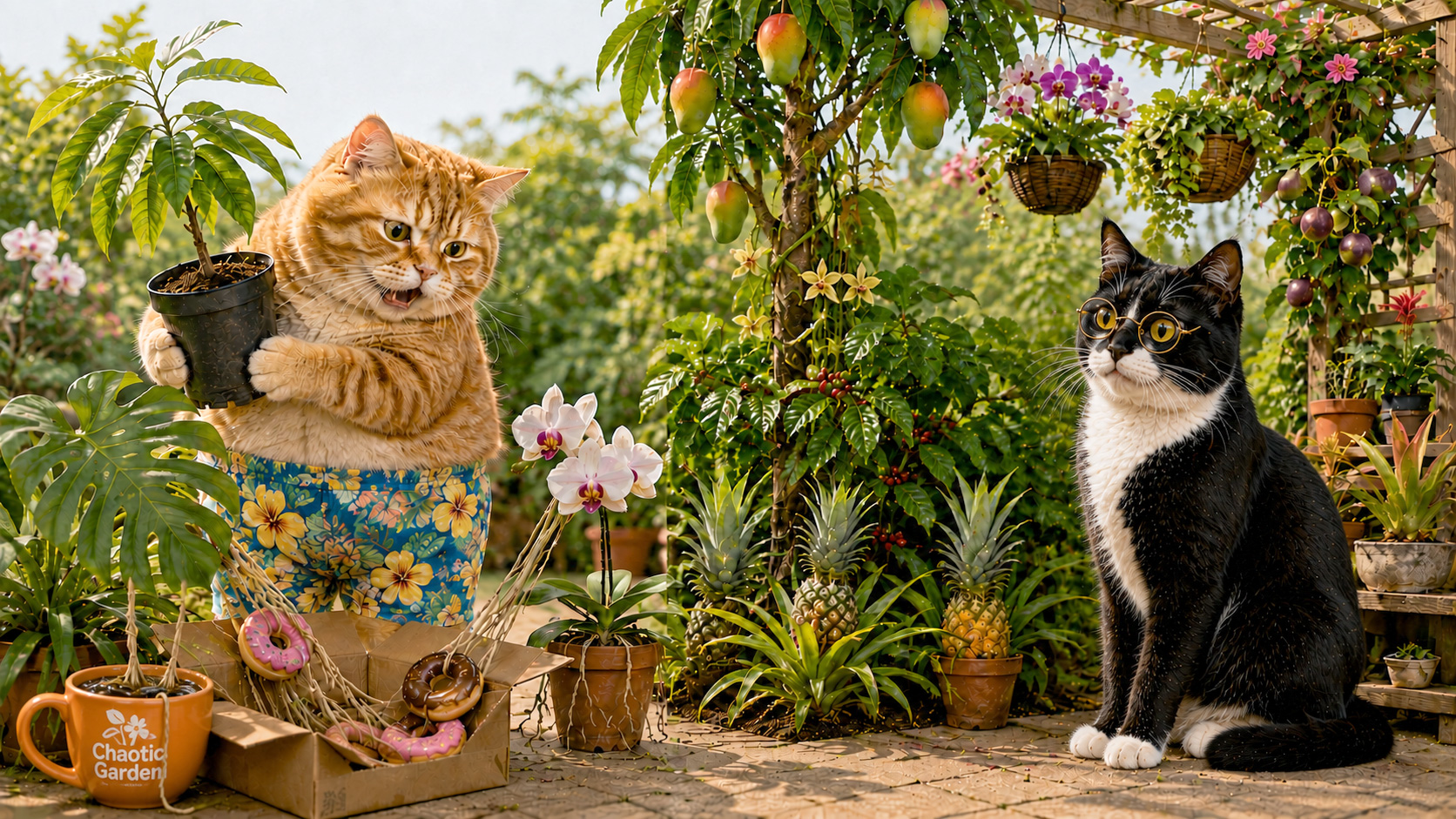
Smokey: They found an unused food source.
Sunshine: Look, that was my last chocolate one!
Smokey: Poor planning creates crowded gardens and chaotic consequences.

Most of us run out of garden space long before we run out of plants we want to grow. But the limit is rarely the space itself. It is how you use the air above it, the ground below, and every wall, fence, and railing in between.
This works whether you have a small yard, a patio, a balcony, a deck, or a cluster of pots by the door. The method is the same. Grow upward, plant in layers, and let one footprint carry several plants.
A Garden That Changed How We Think About Space
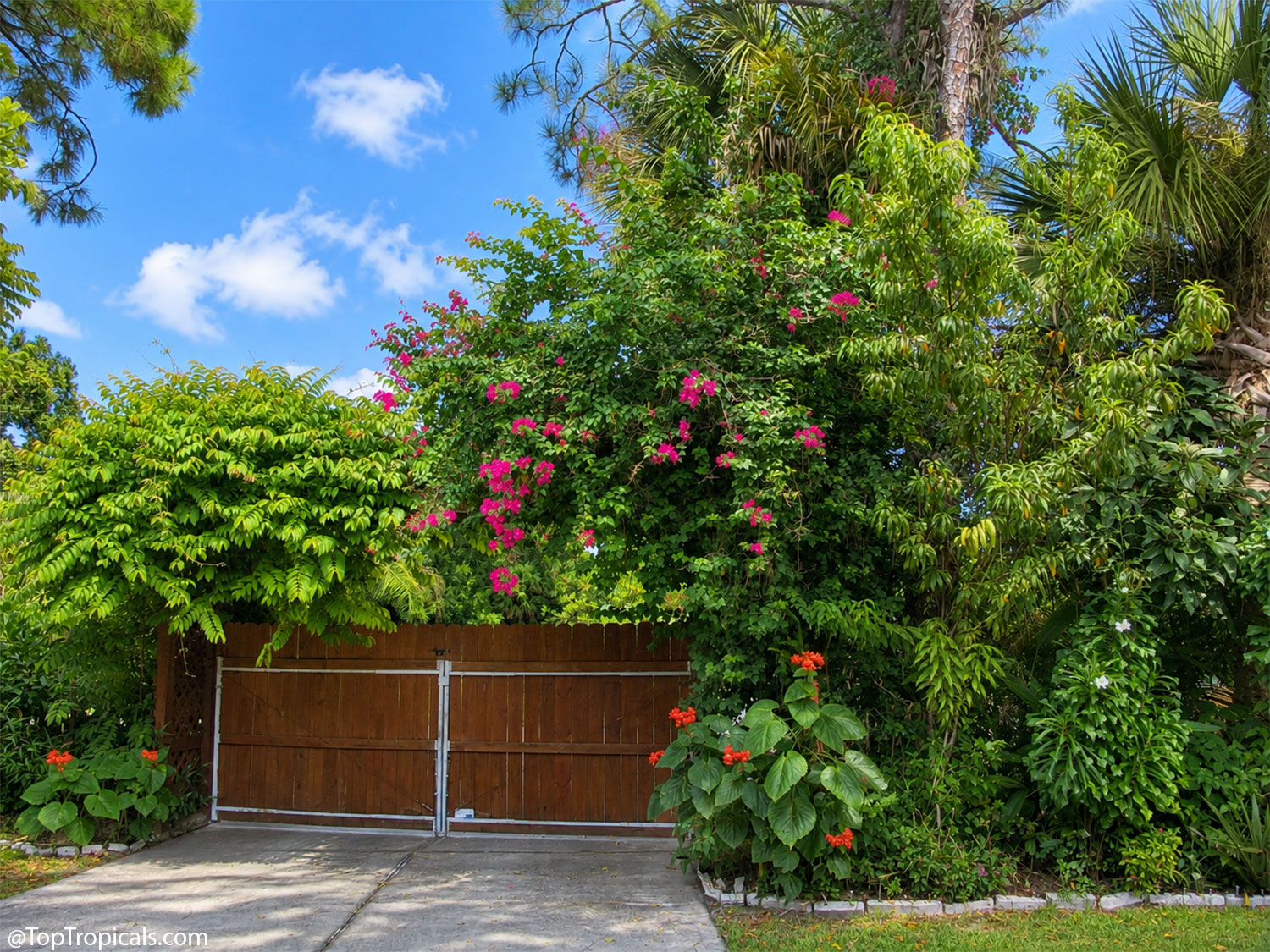
A few years ago we visited the Florida garden of TopTropicals customers Gregory and Amprai Gurvits. Amprai came from Thailand, and she brought a way of gardening with her that most of us here rarely see.
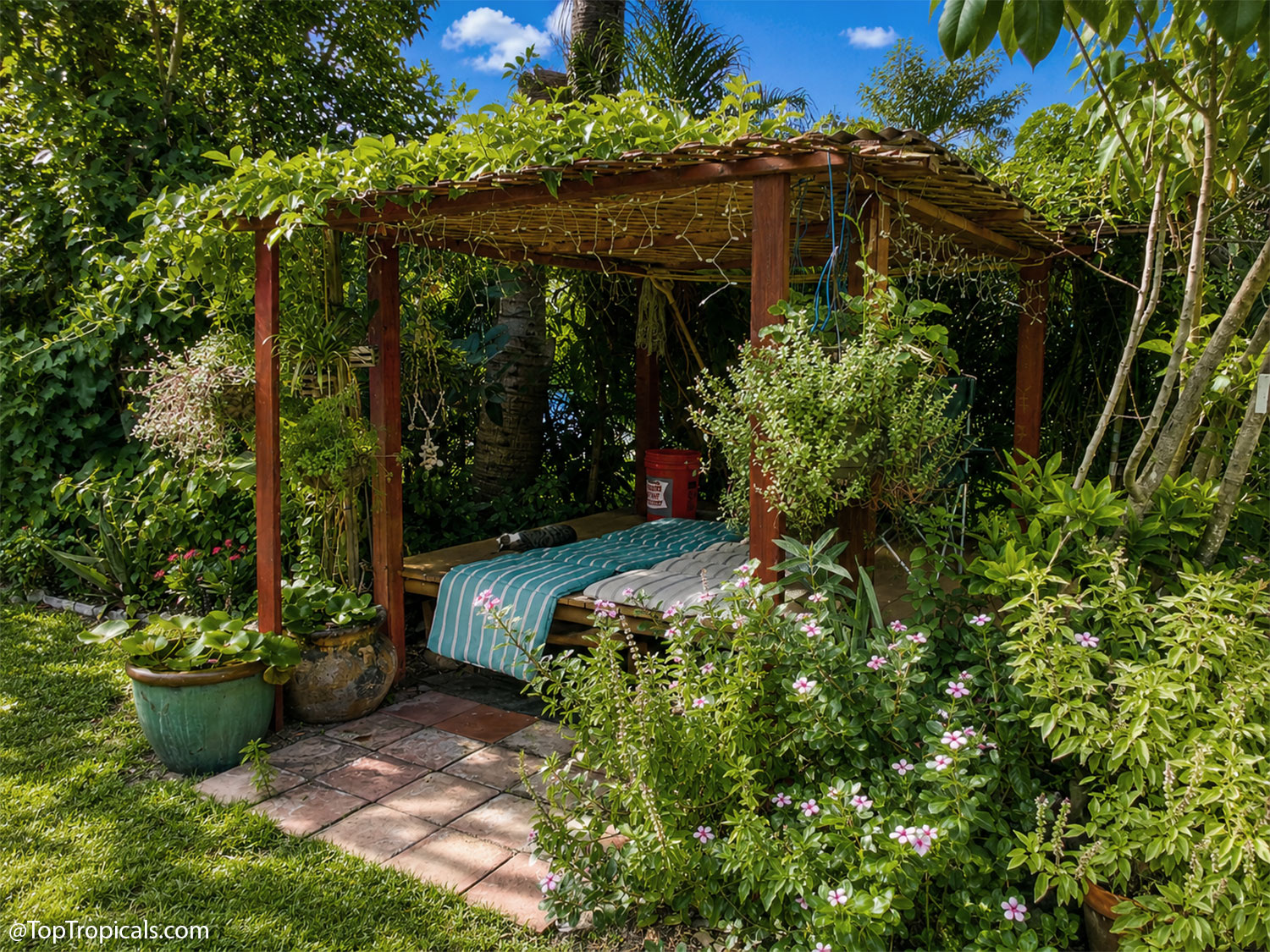
Their property was about an acre, so this was not a tiny backyard. What stopped us was not the size. It was how many different plants were growing well in it. Hundreds of species shared the garden: fruit trees, tropical ornamentals, vines, potted plants, and low understory plants tucked in everywhere.
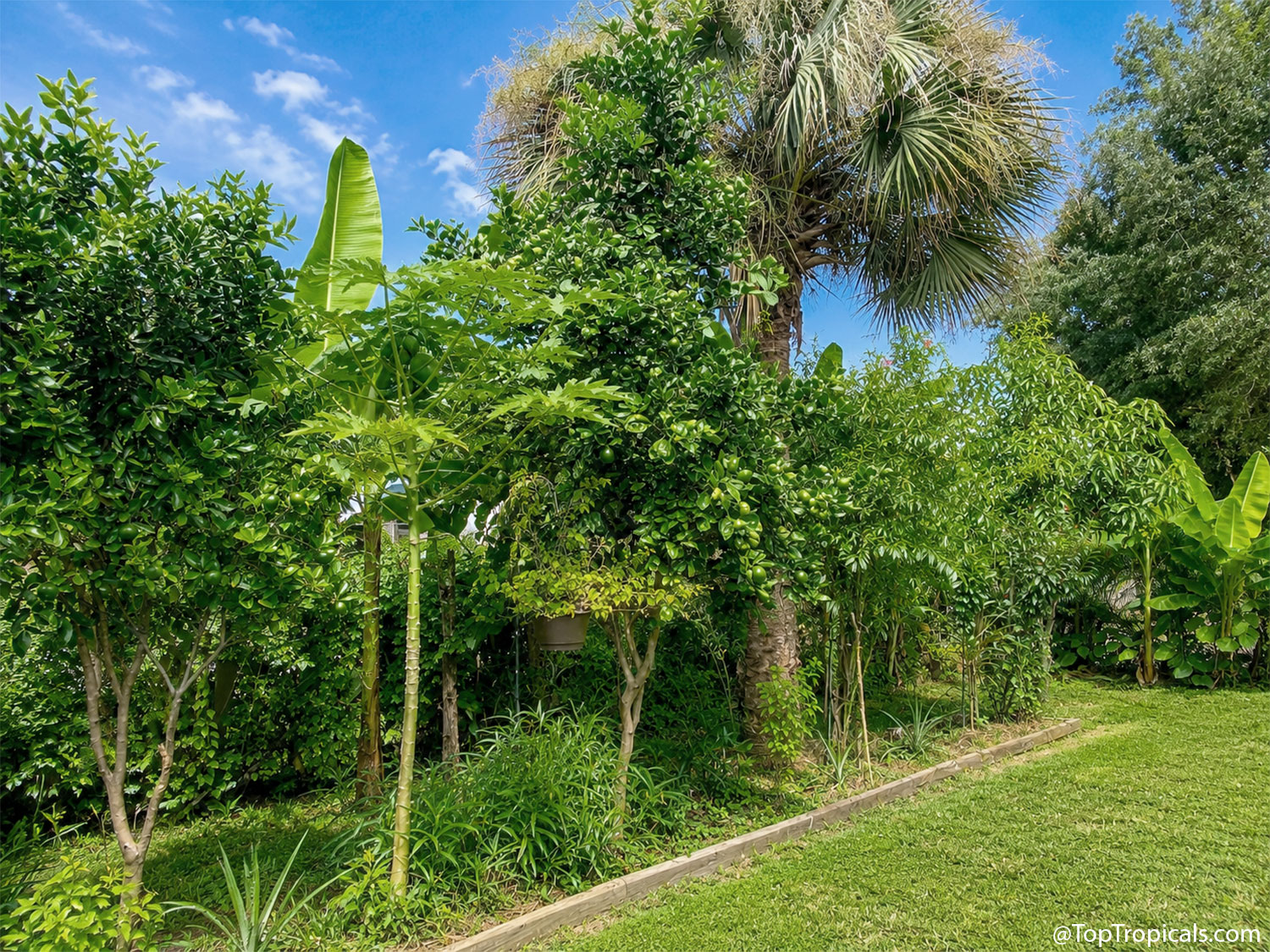
The trees and shrubs were not spreading out wide the way they usually do here. They were trained to grow upward. That one choice let light reach the plants beside them and left the ground below open for smaller ones. Low growers filled the gaps, and pots sat throughout the garden wherever they were useful. The result was a garden organized by height and light, not just by square footage.
One Small Space, Four Growing Levels
Here is the idea made concrete. Picture a single spot that holds:
- Mango overhead
- Coffee or ginger underneath
- Pineapple around the base
- Vanilla Orchid climbing the trunk
A spreading mango on its own would take up most of that ground and shade out whatever grew near it. Trained narrow and upright, it becomes the top of a stack instead. The coffee or ginger takes the filtered light below, the pineapple fills the sunny edge of the base, and the vanilla climbs the trunk like a ladder. One footprint, four plants, where before there was room for one. That is the whole idea in a single picture.
The Thai Trick: Train Trees Upward
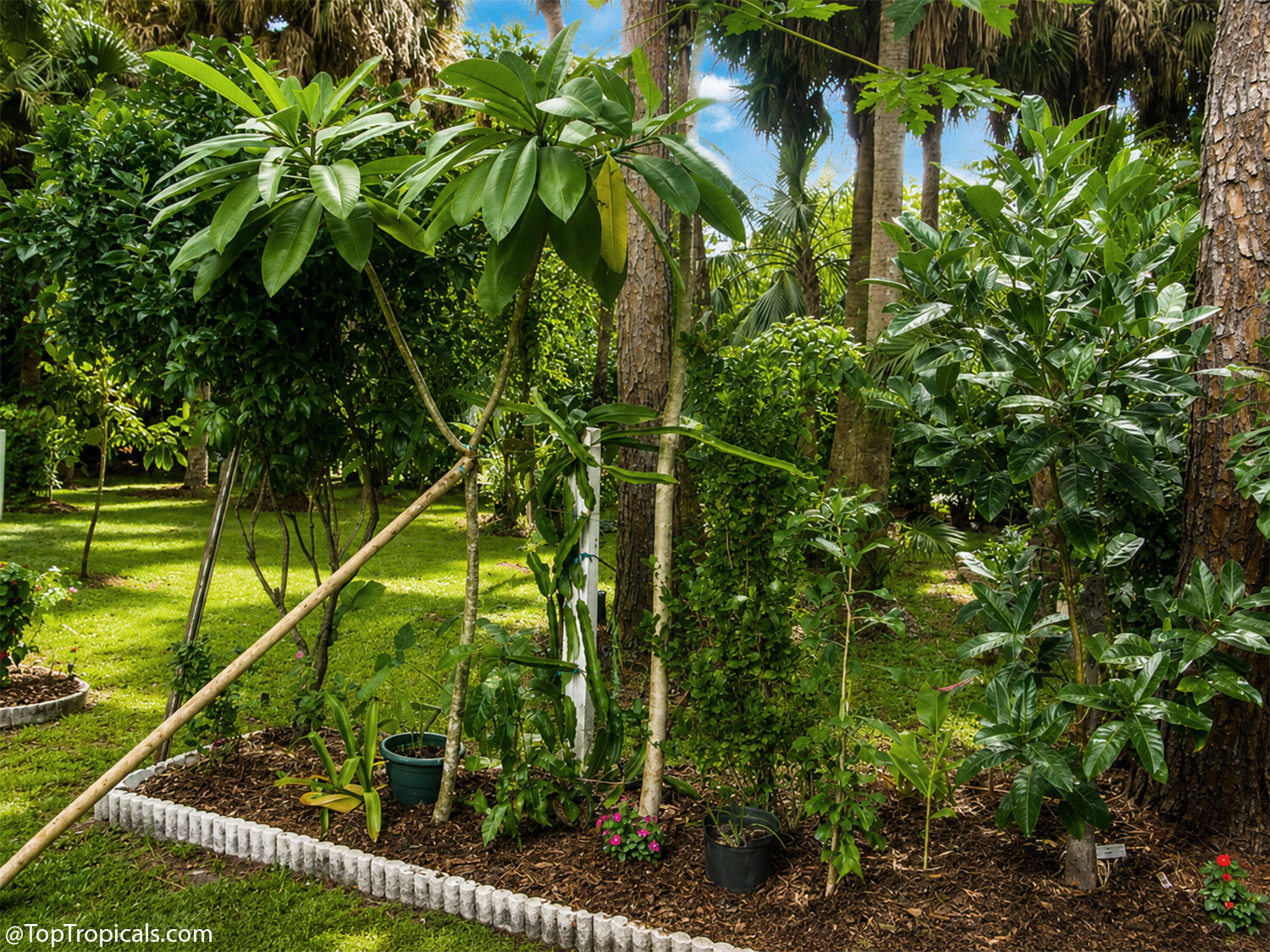
This is the move at the heart of Amprai's garden. Guide a tree or shrub to grow tall and narrow instead of wide, and everything changes around it. The canopy shrinks, more light slips past to the plants beside it, and the ground underneath opens up for smaller ones.
Start while branches are young and flexible, since they guide easily and set into their new direction as they harden. Use broad, soft, adjustable ties rather than anything that bites into the bark, and check them regularly so they do not cut in as the branch thickens. If a heavy branch needs support, place the prop far enough from the trunk to avoid the major roots.
One honest note. This works best for plants that tolerate pruning and training. Not every tropical enjoys being shaped, so learn what yours can handle before you start bending branches.
8 Ways to Fit More Plants Into a Small Space
1. Train Trees and Shrubs Upward
Start with the technique above. A narrow, upright canopy is the single change that makes room for everything else, so it is worth doing first on any plant that tolerates it.
2. Add Trellises and Vertical Supports
A climber is only as useful as the thing it climbs. Give it a structure and a bare wall becomes a productive vertical garden.
Supports to use:
- Trellises, arbors, and pergolas
- Obelisks for a single pot
- Fences and railings
- Overhead supports for hanging plants
Good climbers:
- Passionfruit
- Vanilla orchid
- Dragon fruit
- Barbados gooseberry
Match the support to the plant. Light vines are happy on a trellis or an obelisk, but heavy climbers like dragon fruit and mature passionfruit need something sturdy, such as a strong fence, a post, or a cattle panel, so the whole thing does not sag under the weight.
3. Plant in Layers: Rainforest Style
Once one plant is trained upward, the space it frees is an invitation. A rainforest fills the same ground several times over, from a tall canopy tree down through smaller trees, shrubs, understory plants, and ground covers, with climbers threading through it all. You do not need every layer. Even two or three, a tree with something shade-tolerant beneath it and a climber up the trunk, turns a single footprint into a small community of plants. The four-level example above is this idea at full strength.
4. Use Containers Strategically
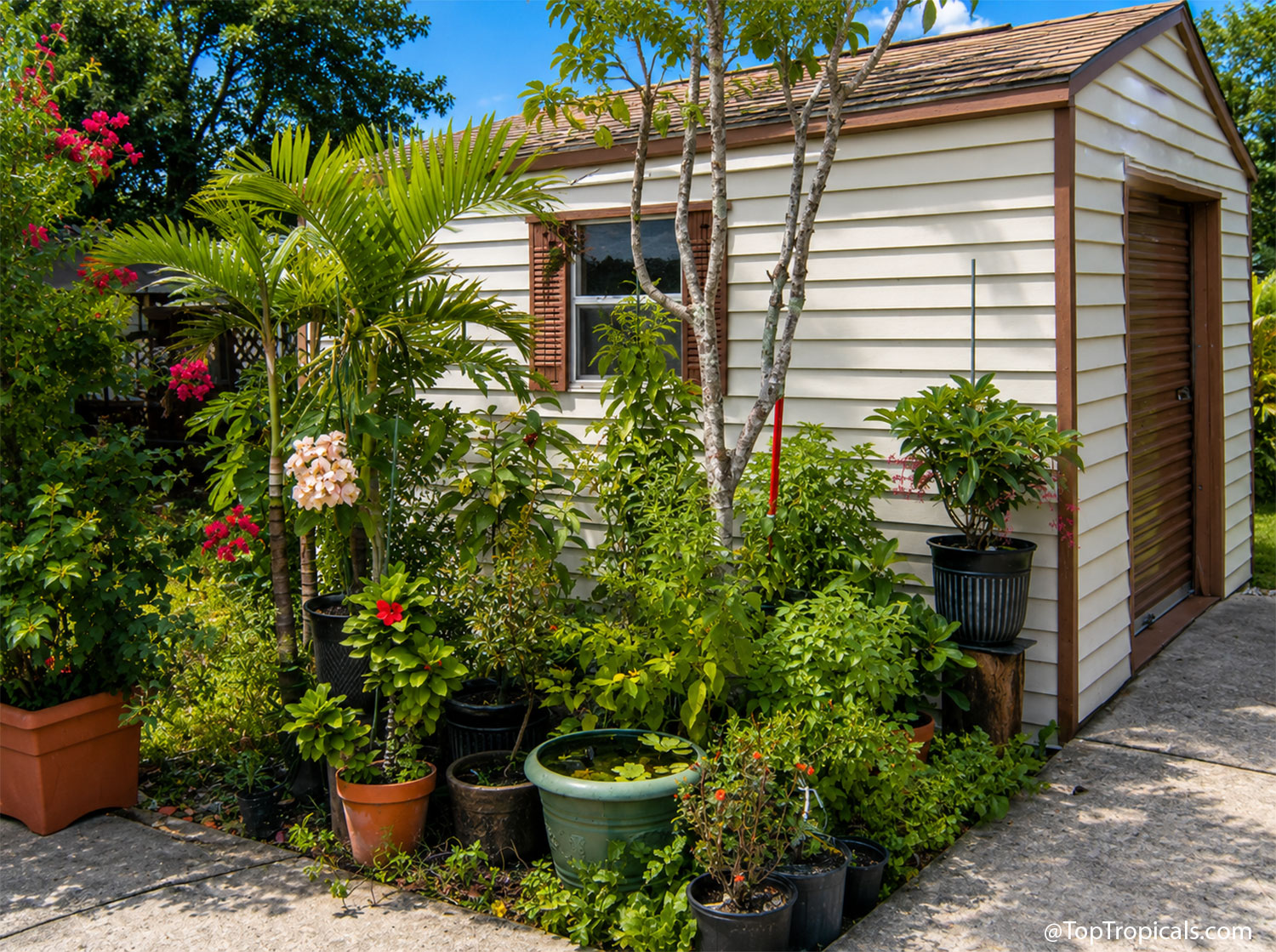
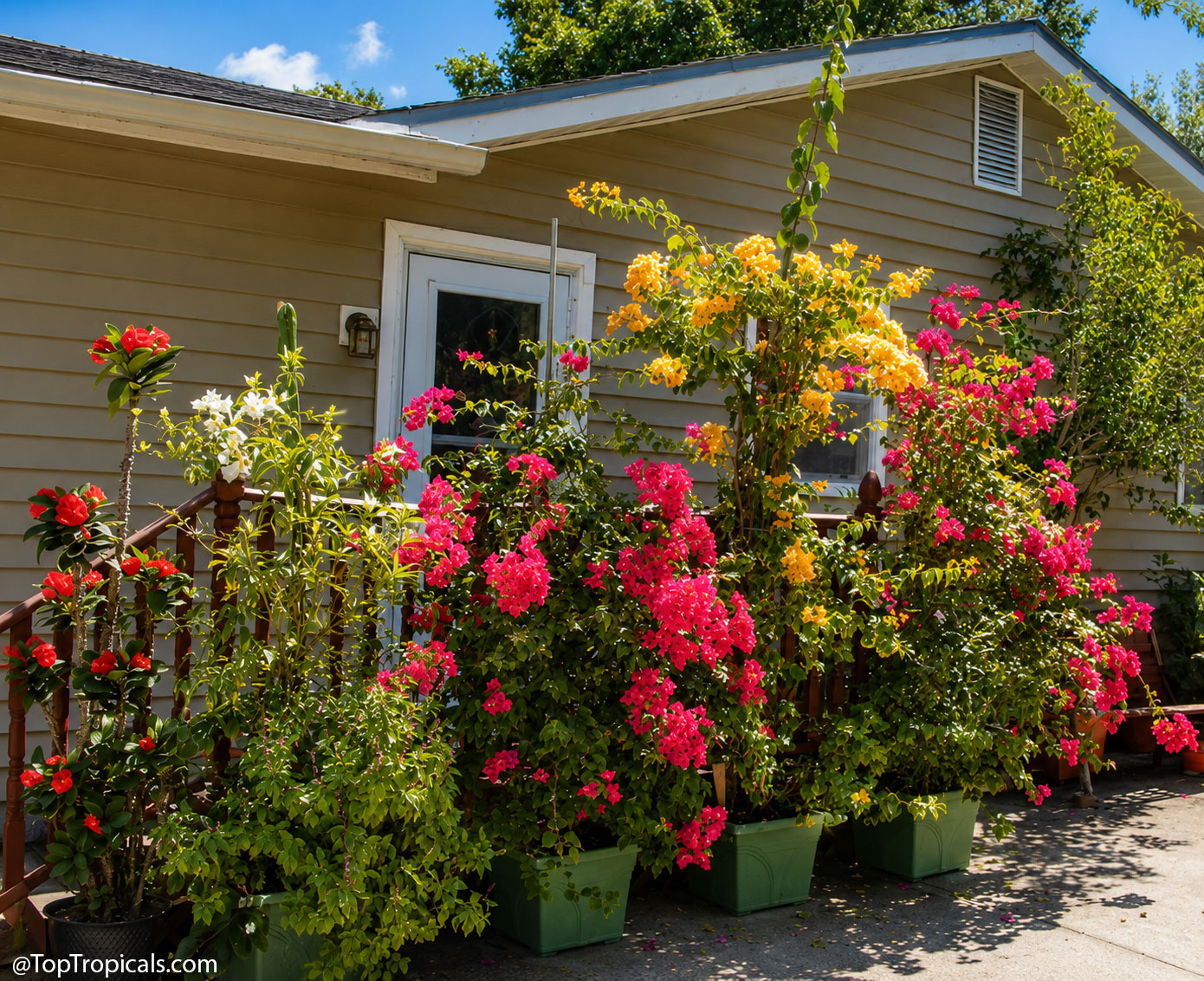
Pots let you garden on surfaces that have no soil at all: patios, decks, steps, and entryways. A compact fruit tree like a condo mango starts happily in a large pot, around 15 to 20 gallons, and moves up as it fills out. Smaller plants like coffee are content in something closer to 7 to 10 gallons.
Good in containers:
- Coffee
- Grumichama and other Eugenias
- Jaboticaba
- Sugar apple
- Condo mangoes and Compact avocados
Pots also let you rearrange the garden and move tender plants when cold or a storm threatens.
5. Choose Compact Plants
Breeders have done the work for you. Compact and dwarf varieties give full-sized harvests on much smaller plants.
Worth a look:
- Condo mangoes and Compact avocados
- Dwarf mulberries
- Guava
- Blackberry Jam Fruit
- Peanut Butter Fruit
- Dwarf bananas
6. Hang and Mount Plants
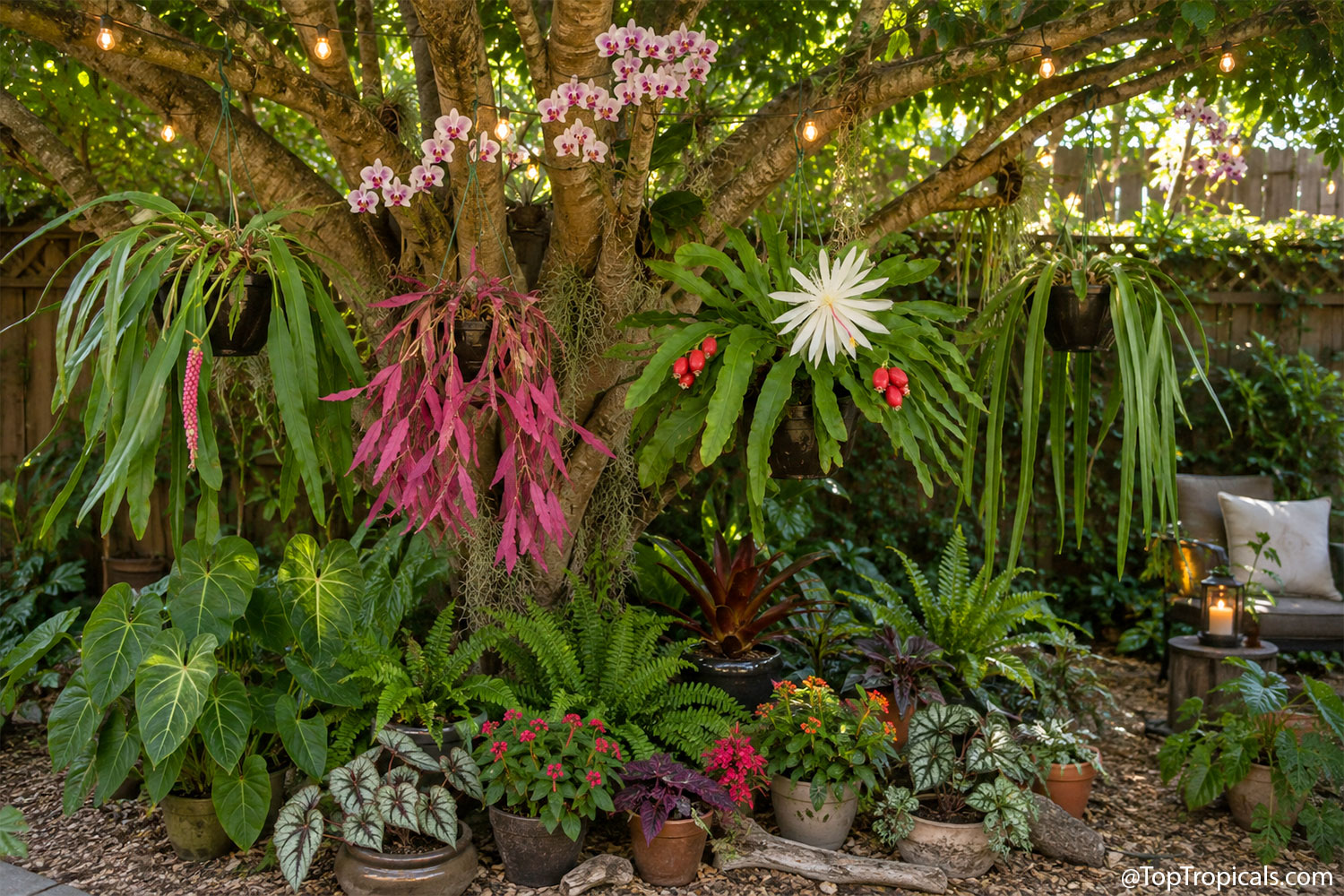
The space above your head is usually empty. Hanging and mounted plants fill it without touching the ground.
Good choices:
- Orchids
- Anthuriums
- Hoyas
- Rhipsalis
- Epiphyllums
- Hanging baskets
7. Use Fences, Railings, and Narrow Spaces
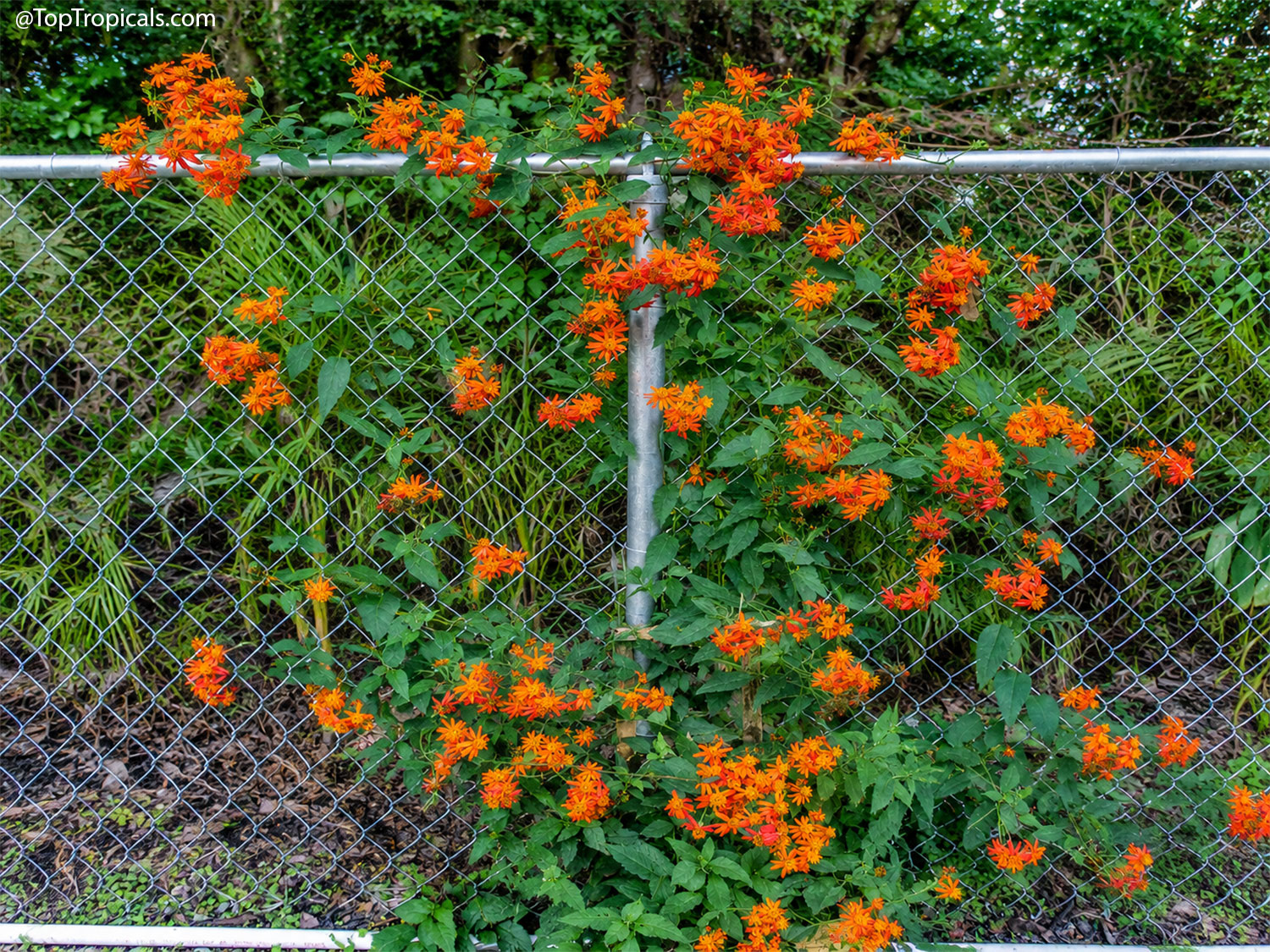
The thin strips beside driveways, walkways, pools, and fence lines are easy to overlook, and a balcony railing counts too. Plenty of plants are happy in a narrow bed or along a boundary.
Good fits:
- Jasmines
- Allamanda
- Mexican flame vine
- Gingers and Heliconias
- Bromeliads
- Ground orchids
8. Put Shade to Work
Shady spots are growing zones, not wasted space. Many tropicals prefer filtered light and struggle in full sun.
Happy in shade:
- Coffee Tree
- Vanilla Orchid
- Monstera
- Philodendrons and Monsteras
- Gingers
- Ground orchids
- Brunfelsias
Make Every Plant Earn Its Space
When room is tight, favor plants that do more than one job. The best ones feed you, smell good, screen a view, or feed pollinators while still looking good doing it.
A few that pull double duty: pineapple, moringa, curry leaf, roselle, katuk, edible hibiscus, and bay laurel. A plant that looks attractive and hands you dinner has earned its place twice over.
On a Patio or Balcony
The same method shrinks neatly into a single large pot: one compact tree in the center, one climber on a support beside it, one shade-tolerant plant at its feet, and one trailing plant over the rim. That is the full stack in a container you can move. Keep an eye on weight and drainage, since a full pot is heavier than it looks. And group your pots together rather than scattering them, since clustering shades their sides, holds humidity, and cuts how often you have to water on a hot paved surface.
Keep a Full Garden Manageable
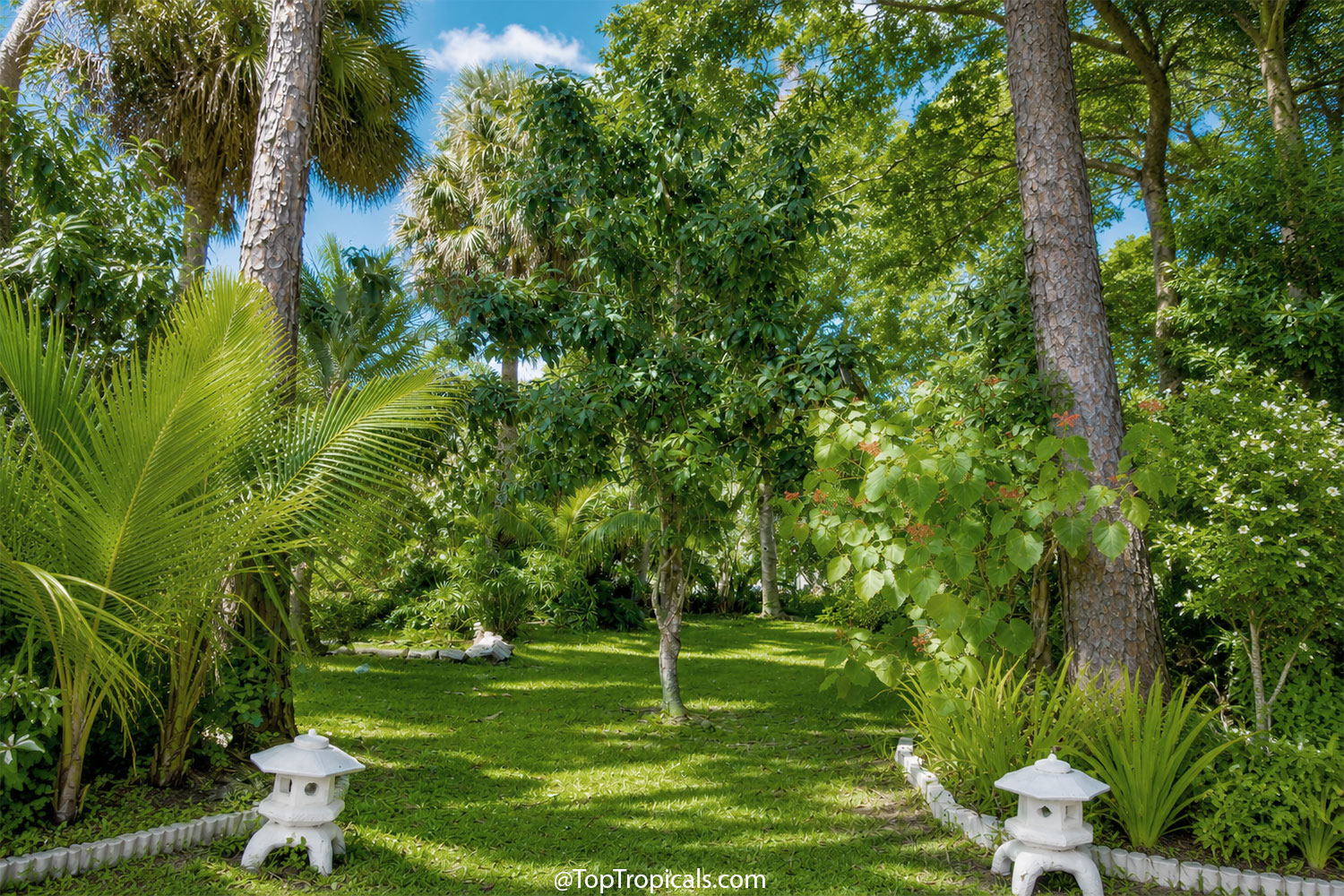
A packed garden stays easy to live with if you plan for access and air.
Keep clear paths so you can reach everything, and prune regularly to keep canopies open enough for light and airflow. Check ties and supports as plants grow. Use mulch to hold moisture, but keep it pulled back from trunks so they do not stay wet and rot. Group plants with similar needs, and resist letting the whole thing become a solid wall of foliage.
Where to Begin
If Amprai's garden has you looking at your own space differently, here are some plants that pull their weight, in the ground or in a pot.
Vertical growers:
- Passionfruit
- Vanilla orchid
- Dragon fruit
- Barbados gooseberry
Compact fruit plants:
- Condo mangoes
- Compact avocados
- Coffee
- Jaboticaba
- Eugenias
- Sugar apple
Lower-layer plants:
- Pineapples
- Gingers
- Katuk
- Longevity spinach
- Ground orchids
- Bromeliads
How to make tiny garden feel twice as big
The biggest mistake in a small garden is treating it like a shrunken version of a big one. It is a different kind of garden, and it rewards a different kind of thinking.
So look up, look under, look along your fences, over your railings, inside your containers, and through every level you have.
Sometimes the only thing limiting a garden is not space. It is imagination.
🛒 Find plants for your small garden:
Date: 2 Aug 2026
Easy way

👍 Easy way
"I choose a lazy person to do a hard job. Because a lazy person will find an easy way to do it." - Bill Gates
🐈📸 Jim II the cat at hard work at TopTropicals PeopleCats.Garden.
#PeopleCats #Quotes
🟢 Join 👉 TopTropicals
Date: 2 Aug 2026
The Tree That Isnt: African Giant Single-Leaf Wonder - Anchomanes difformis
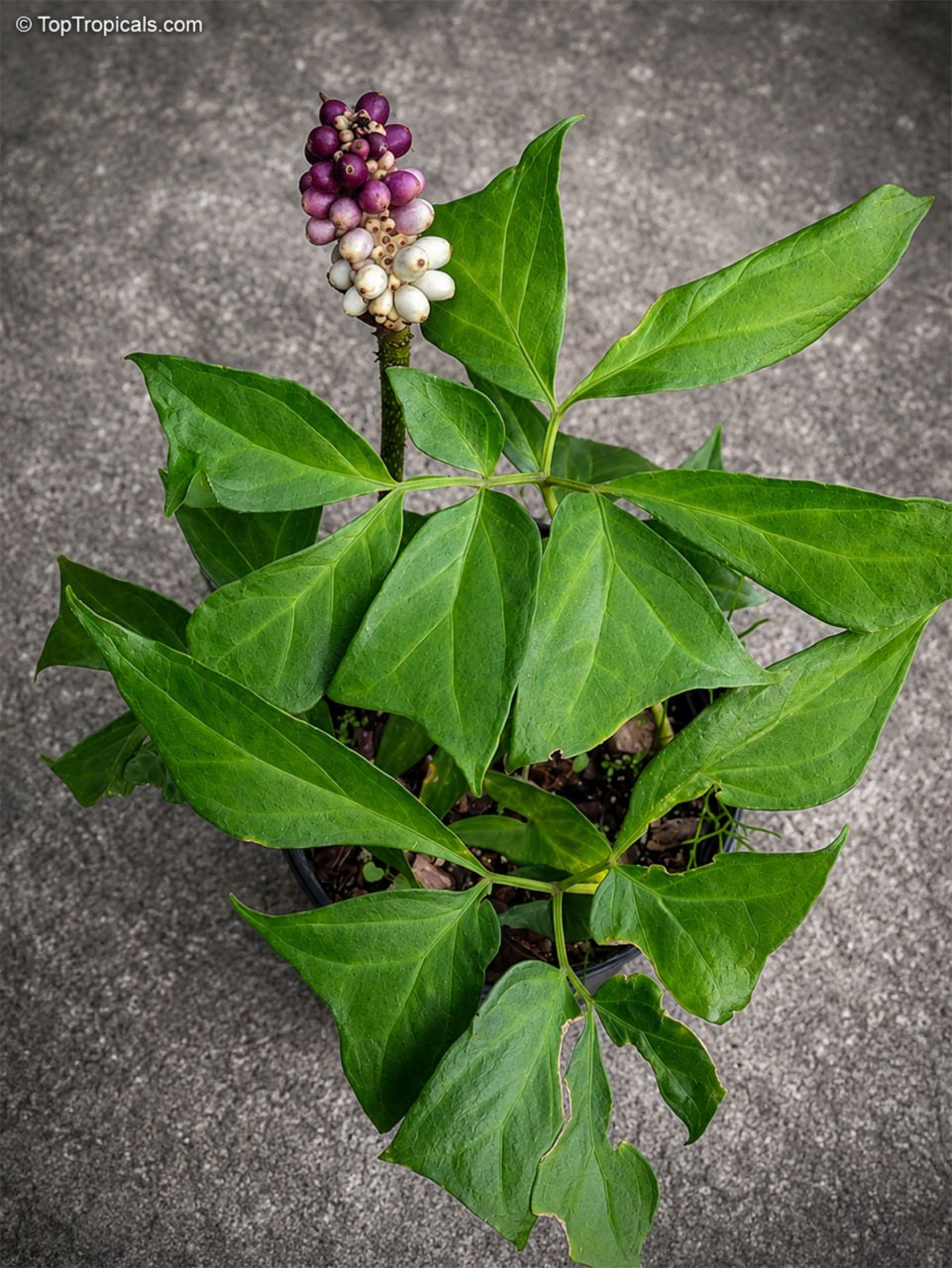
👽 The "Tree" That Isn't: African Giant Single-Leaf Wonder - Anchomanes difformis
Quick Take: It boasts a thorny trunk, a lace-like canopy, and stands several feet tall - yet it isn’t a tree at all. The entire structure is just one single leaf.
Walk through a tropical rainforest in West Africa and you might spot what appears to be a young, prickly tree with huge, deeply divided foliage. Look closer, though, and you’ll discover one of the botanical world's greatest illusions: Anchomanes difformis (previously classified as Amorphophallus difformis var. Benin).
For rare plant collectors, this strange survivor breaks almost every rule in the book.
🌵 One Leaf Does All the Heavy Lifting
Unlike standard plants that sprout dozens of stems and leaves, Anchomanes grows a single spectacular leaf each season.
The Canopy: Reaching over 30 inches tall, the single leaf branches into dozens of leaflets, creating an intricate canopy.
The Look: Featuring bi-lobed lobes and natural leaf windows (fenestrations), it looks like a cross between a giant fern, a Monstera, and bat wings.
The Reset: When the season ends, the leaf dies back completely, leaving an empty plot of soil until the plant re-emerges in spring.
🌵 A "Trunk" Made of Pure Deception
The thick, patterned stalk supporting the plant looks remarkably like a young tree trunk covered in snake-patterned skin and sharp prickles.
In reality, it’s just a petiole (the stalk supporting the leaf). Those rose-like prickles give the plant a prehistoric, dinosaur-era aesthetic, but their main job is keeping that massive single leaf upright and protected.
🌵 The Hidden Underground Giant
The real engine behind this botanical marvel stays completely out of sight:
• Massive Tubers: Anchomanes grows from a thick, creeping underground tuber just below the soil surface.
• Smart Strategy: Instead of wasting energy building permanent woody branches, the plant invests everything into expanding its underground reserve.
• Yearly Comebacks: As the tuber branches over time, it stores enough energy to power an even larger leaf the following season.
Botanical Surprise: Mature tubers will often send up a dramatic flower before the leaf even emerges for the season.
🌵 Weird Flowers & Purple Berries
Like many members of the Araceae (aroid) family, its bloom consists of a fleshy hood (spathe) wrapped around a central spike (spadix).
The Pollinator Trap: Rather than sweet perfume, the short-lived flower can emit a pungent odor designed to lure wild flies and beetles.
The Reward: If pollination succeeds, the bloom transforms into striking clusters of bright violet-purple berries.
🌵 Growing & Care Guide
Native to tropical West African woodlands (including Benin), Anchomanes thrives on warmth and humidity.
Active Season: Warm temperatures, rich soil, high humidity, and consistent moisture.
Dormancy: Keep the subterranean tuber cool (frost-free) and mostly dry once the leaf drops.
Outdoor Growth: Thrives in the ground year-round in frost-free climates (like South Florida).
Safety Note: Like most aroids, the plant contains calcium oxalate crystals, which cause irritation if handled carelessly or ingested.
🌵 Why Collectors Can't Resist It
Anchomanes difformis delivers maximum drama:
• A single leaf pretending to be a whole tree.
• A snake-patterned, thorny stalk that’s secretly just a leaf stem.
• A crawling subterranean tuber that resets every winter.
It’s the ultimate garden conversation starter - a plant that inevitably makes visitors stop, stare, and ask: "Wait... what on Earth is that?"
🛒 Bring Home This Alien Plant
📚 Learn more:


· Anchomanes difformis in Plant Encyclopedia
· The world's strangest plant that makes healthy noodles
· Amorphophallus konjak
· Amorphophallus bulbifer
· Amorphophallus paeoniifolius: what's inside the Devils Tongue that smells like trouble?
· The biggest flower in the world - Amorphophallus
· Different species of Amorphophallus
#Nature_Wonders #Shade_Garden #Container_Garden #Discover
🟢 Join 👉 TopTropicals
Date: 1 Aug 2026
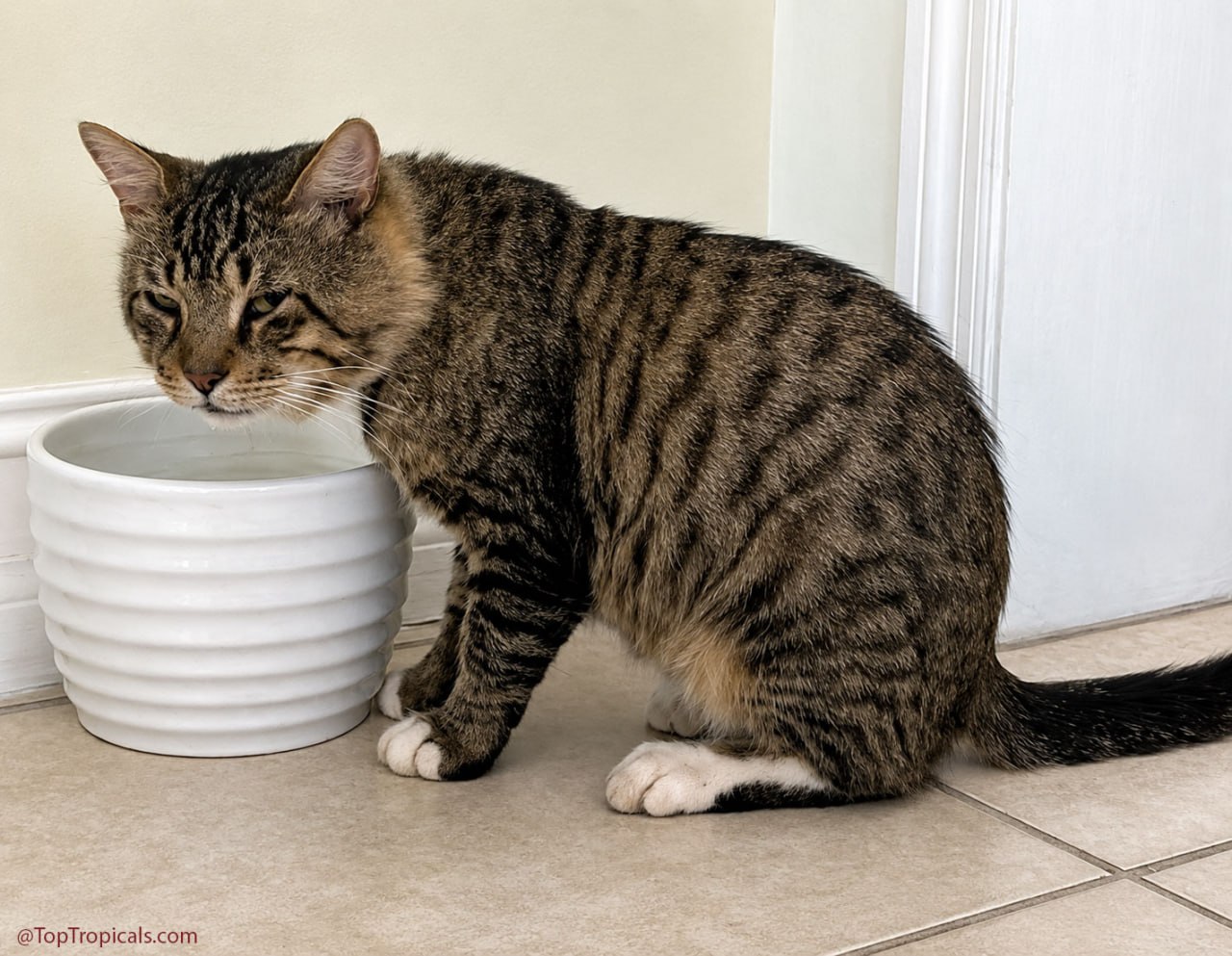
Meet Simon Walkie-Talkie - the cat who made the right decision



"The hardest thing to learn in life is which bridge to cross and which to burn" - David Russell
Some cats run away from people.
Simon did the opposite.
He showed up at our front porch... and simply refused to leave. He seemed to know something wasn't right. Like he'd already made up his mind that these humans might actually help.
Turns out he was right.
Our new hire arrived looking pretty rough. He has almost no teeth, one loose canine, a sore mouth, an infected eye, scabs all over his skin, and enough battle scars to tell stories for a lifetime. He's probably much younger than he looks - street life simply aged him before his time.
So... we hired him anyway.
First order of business? A trip to the vet. Medications. Flea treatment. Lots of good food. Plenty of naps. Recovery has officially begun.
The funny part?
Simon talks. Constantly.
Not loud meows. More like a tiny walkie-talkie: "Mrr?.. "Mrr?.. "Mrr?.."
He strolls around narrating his day in the sweetest little voice.
And despite everything he's been through, Simon is one of the most affectionate cats we've ever met. He rubs against you, purrs nonstop, and has already made friends with the other PeopleCats.
We haven't heard a single bad word out of his mouth.
Welcome home, Simon.
❤️ Every rescued cat deserves the chance to become somebody's PeopleCat.
Some cats are rescued. Others simply choose their people.
🐈📸 Simon - the newest TopTropicals rescue cat at PeopleCats.Garden.
📚 Learn more:
• Meet Max - the cat who won the Life lottery
• What happened to James Coconuts: before and after
#PeopleCats #Quotes
🟢 Join 👉 TopTropicals
Date: 1 Aug 2026
Meet Monstera Tiny Cousin That Never Outgrows Your Wall
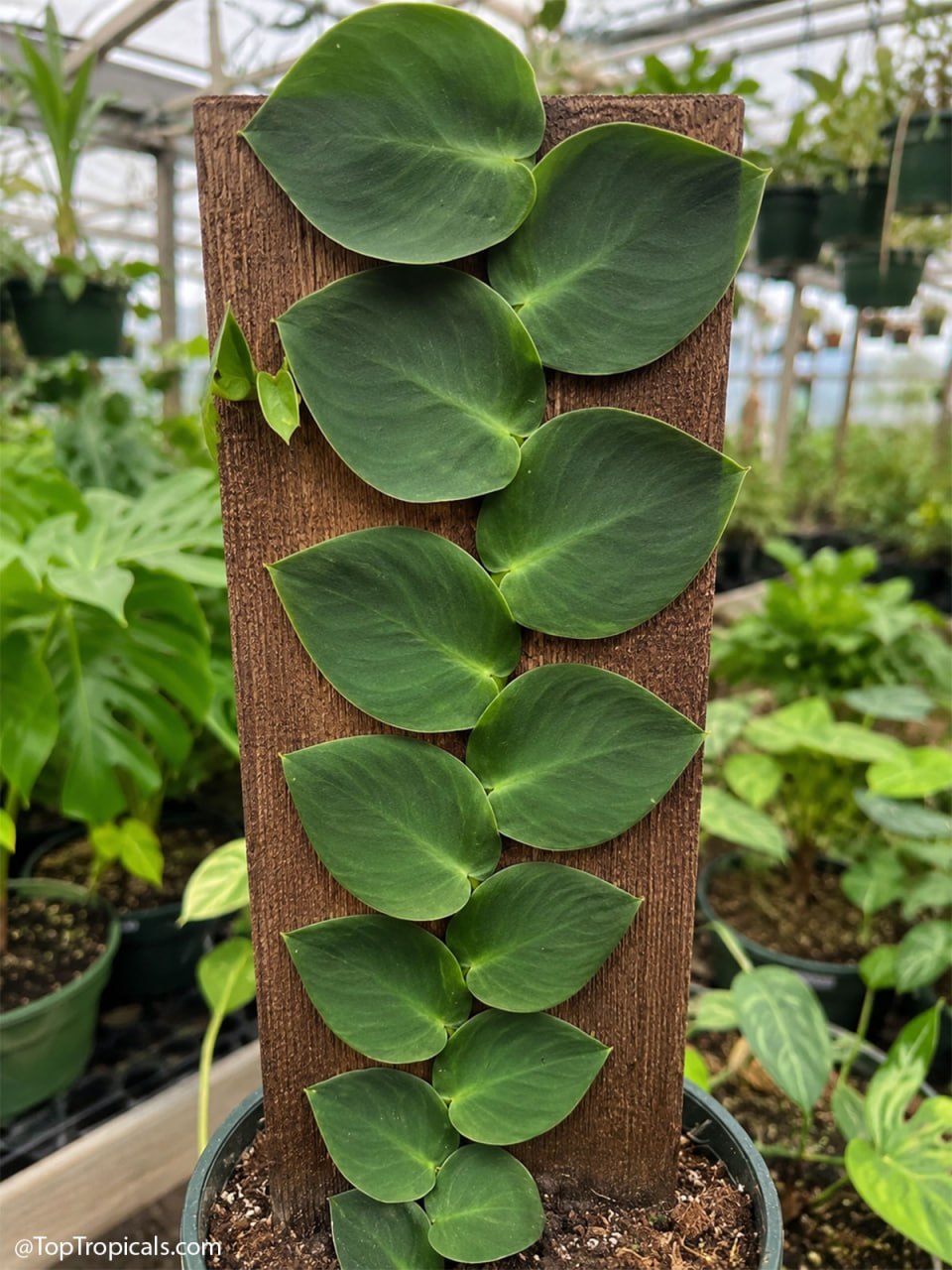
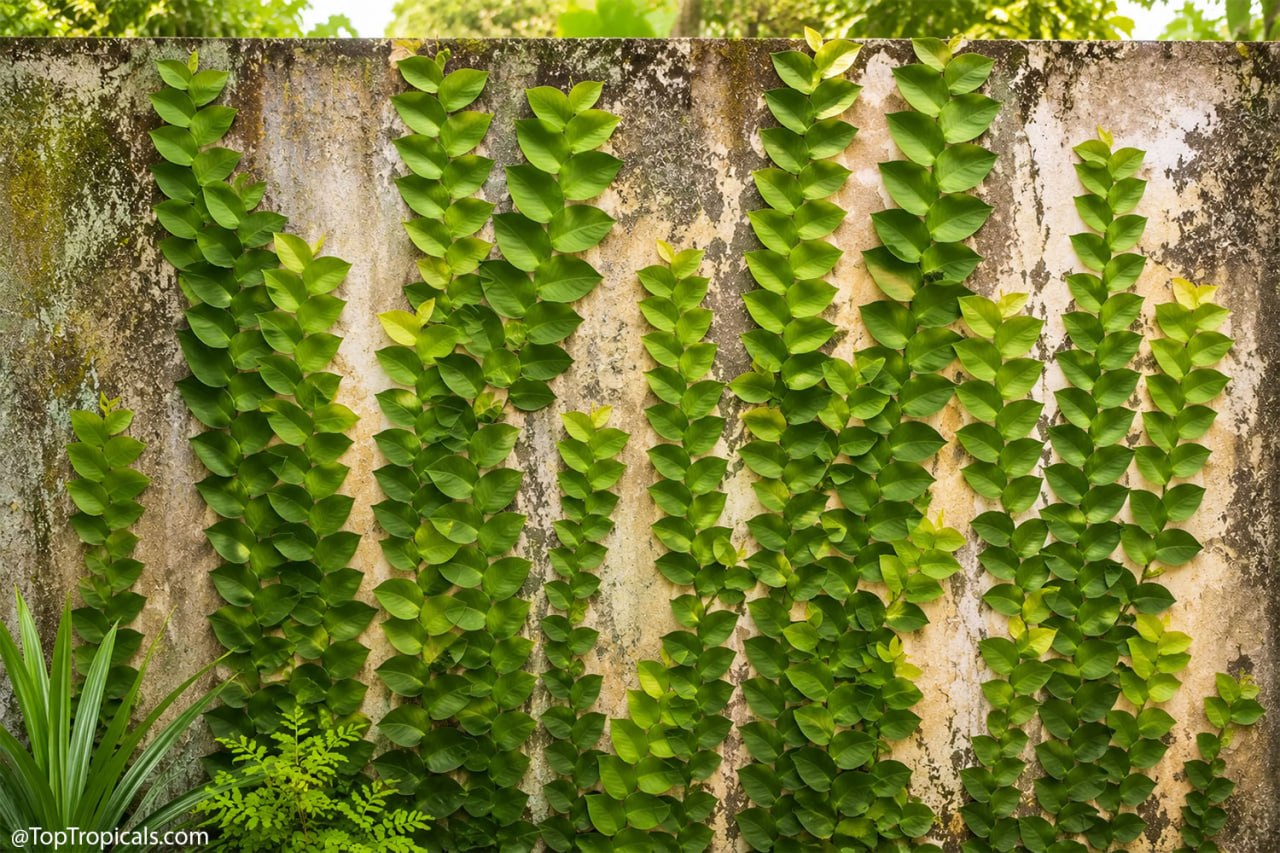
🍃 Meet Monstera Tiny Cousin That Never Outgrows Your Wall
Rhaphidophora hayi belongs to the same genus as the popular Mini Monstera (Rhaphidophora tetrasperma), but instead of developing dramatic split leaves, it hugs tree trunks and wooden boards so tightly it looks painted on. At first glance, you might mistake it for a young Monstera dubia. Both grow in a fascinating habit called shingling, where overlapping leaves cling flat to their support.
Unlike Monstera dubia, Rhaphidophora hayi keeps its compact, architectural look instead of transforming into a giant fenestrated vine.
🌿 Nature's Living Wallpaper (In Miniature)
Native to the tropical rainforests of Papua New Guinea and northeastern Australia (Queensland), Rhaphidophora hayi spends its life hugging tree trunks.
Each leaf overlaps the previous one like roof shingles, creating an elegant pattern of deep green foliage that almost looks attached by glue.
Give it a cedar plank, wooden board, or moss pole indoors - and it immediately starts doing exactly what nature intended. Tiny aerial roots anchor the stem firmly to the surface, allowing the leaves to lie almost perfectly flat.
It's one of the few houseplants that actually looks better when grown vertically.
🌿 Small Leaves. Big Personality.
This is where Rhaphidophora hayi differs from Monstera dubia, even though both are commonly known as the Shingle Plant.
Instead of eventually producing enormous split leaves, it usually keeps its attractive rounded juvenile foliage.
That means you can enjoy the shingled look for many years without needing a huge room or tall greenhouse.
It's perfect for:
• apartments
• offices
• terrariums
• indoor green walls
• anyone who loves unusual foliage without giant plants
🌿 Built to Climb
In the rainforest, shingling isn't just for looks.
Growing flat against the bark helps the plant capture precious filtered sunlight while resisting heavy tropical rains and strong winds.
Its aerial roots grip rough surfaces naturally, so once attached, the plant needs very little encouragement.
Just provide warmth, above-average humidity, bright indirect light, a chunky aroid mix, and a porous support such as a wooden board or moss pole.
The board does the rest.
🌿 Rhaphidophora hayi Quick Care Guide
🍀 Growth Habit: Compact shingling climber
☀️ Light: Bright indirect light
💧 Water: Keep evenly moist, never soggy
Soil: Chunky, well-drained aroid mix
🌡 Temperature: Warm tropical conditions
📏 Size: Slow-growing climber that eventually reaches several feet tall while keeping its compact foliage
🏡 Best For: Moss poles, wooden boards, terrariums, green walls, collectors, and anyone who appreciates living art.
🌿 Did You Know? Botanical Fast Facts
• A young species. Although the plant has existed for thousands of years, it wasn't formally described by botanists until 2000 by Peter Boyce and Josef Bogner.
• A true rainforest climber. It naturally occurs from Papua New Guinea to tropical Queensland, where it spends its life clinging to tree trunks.
• Easy to propagate. New plants root readily from stem cuttings because each node is capable of producing roots.
🌿 Why You'll Love It
If Monstera dubia is the dramatic shape-shifter of the shingling world, Rhaphidophora hayi is its elegant minimalist cousin.
It delivers the same mesmerizing "living wallpaper" effect, but in a compact package that's easy to display almost anywhere. Once it starts climbing, it's nearly impossible to walk past without stopping for another look.
🛒 Shop Rhaphidophora hayi and All Monstera plants
📚 Learn more:


• Rhaphidophora hayi in Plant Encyclopedia
• It looks like painted on the wall: Monstera dubia
• The Big Secret Behind the "Mini Monstera" - Rhaphidophora tetrasperma
• How mini is Mini Monstera?
• How to harvest and eat Monstera Ice Cream
• Monstera x adansonii - Baby Swiss Cheese Plant
#Shade_Garden #Nature_Wonders #Container_Garden #Discover
🟢 Join 👉 TopTropicals