Garden Blog - Top Tropicals
Date: 24 Jun 2026
The Flower of God That Outsmarts Summer Heat: Why Your Garden Needs Queens Wreath

🔮 The "Flower of God" That Outsmarts Summer Heat: Why Your Garden Needs Queen's Wreath
Since April, one tropical climber has completely stolen the spotlight: Petrea volubilis, commonly known as Queen’s Wreath or Sandpaper Vine. Also called Fleur de Dieu ("Flower of God"), this fast-growing woody vine looks like a tropical wisteria but boasts a clever trick for surviving the heat.
💟 The Illusion of the Everlasting Bloom
Queen's Wreath produces massive, 12-inch cascading clusters of vibrant purple flower sprays. While the true flowers - small, deep purple velvet gems - drop after a few days, the star-like, pale blue-mauve calyxes remain on the vine for weeks. This botanical illusion creates a spectacular, continuous flowering display that draws in butterflies and hummingbirds all season.
Named for 18th-century plant collector Lord Petre, this Caribbean favorite is famous for its large, dull-green leaves. True to its nickname, the foliage feels exactly like rough sandpaper - even new leaves emerge stiff and resilient, giving the vine a striking texture year-round.
💟 Fast-Growing, Tough, and Low-Maintenance
Don't let the delicate look fool you; Petrea is exceptionally hardy and pest-resilient:
Growth: A vigorous climber that rapidly covers arbors, fences, or trellises. Without support, it naturally twines around itself to form a rounded landscape shrub. It also thrives in patio containers and hanging baskets.
Care: Best in full sun to part shade. It prefers moist soil but becomes highly drought-tolerant once established. If your soil is alkaline, use mulch and an acid-loving plant fertilizer such as Sunshine Booster Megaflor.
Cold Hardy: Tolerant down into the high 20s Fahrenheit.
💡 Pro Tip: For indoor arrangements, do not cut the woody stems, or the blooms will droop. Instead, snip just the individual flower sprays and float them in a shallow bowl to keep them fresh for days.
💟 The Master Pruning Schedule for Maximum Blooms
Because Queen’s Wreath blooms on new growth, strategic pruning is the key to maximizing its purple sprays:
✓ Late Winter / Early Spring: Perform your major clean-up before spring growth begins. Cut unruly trailing stems back by one-third and thin out crowded areas to maximize sunlight and airflow.
✓Mid-to-Late Summer: Give the vine a light trim after the main flowering flush. Snipping off old flower stem tips triggers an immediate wave of fresh growth, forcing a heavy secondary bloom cycle for autumn.
✓The Technique: Always use sharp, sterile bypass pruners. Make your cuts at a 45-degree angle roughly 1/4 inch above a leaf node; this forces the branch to split into two flowering shoots instead of one.
👉 More...
🛒 Claim Your "Flower of God"
📚 Learn more:


· Petrea volubilis in Plant Encyclopedia
· Petrea volubilis, Queen's Wreath - stunning purple profusion from a Caribbean Garden
· You can't get enough of this purple: Queen's Wreath
· The Royal Snow White that everyone loves
· Want a Fence Covered in Royal Blooms?
· Top irresistible vines for a hummingbird haven
#Butterfly_Plants #Hedges_with_benefits #Discover
🟢 Join 👉 TopTropicals
Date: 23 Jun 2026
Our Network is Secure
💻 Our Network is Secure
Scooby: "How secure is our network?"
Riki: "Very secure."
Scooby: "How do you know?"
Riki: "Nobody can log in."
🐈📸 Cats Riki and Scooby secured our network at TopTropicals PeopleCats.Garden.
#PeopleCats
🟢 Join 👉 TopTropicals
Date: 23 Jun 2026
Move Over Adeniums: Why This Unusual Gout Plant Is the Ultimate Natural Bonsai

🔥 Move Over Adeniums: Why This Unusual "Gout Plant" Is the Ultimate Natural Bonsai
If you love the sculpted look of Adeniums (Desert Roses), there is a rare tropical showpiece you need to add to your collection right now: Jatropha podagrica, commonly known as the Gout Plant.
With its knobby, swollen bottle-like stem and striking blooms, this plant looks less like a typical houseplant and more like a piece of living coral reef art.
The Ultimate Lazy Gardener's Bonsai
Unlike traditional bonsai trees that require years of meticulous wire training, pruning, and root shaping, Jatropha podagrica is a "natural bonsai." It does all the hard structural work for you.
Staying compact at just 2 to 3 feet tall, this unusual succulent is an absolute must-have for container gardens, succulent collectors, and bonsai lovers looking for an effortless, natural focal point.
✓The Caudex (Swollen Trunk): It forms a distinctive, bottle-shaped, knobby trunk completely on its own, mimicking the aged look of a masterfully trained bonsai from day one.
✓Massive Tropical Foliage: It features surprisingly large, umbrella-like leaves that can reach 10 to 12 inches in diameter, creating a bold contrast against the rugged trunk.
✓Coral-Red Flowers: It produces vibrant, eye-catching red flower clusters that resemble ocean coral. These terminal clusters pop brilliantly and stand high above the foliage canopy.
The Shade Trick for Giant Leaves
One of the coolest features of the Gout Plant is how it adapts to light. While it prefers partial sun and handles bright conditions beautifully, it thrives in the shade.
When kept in lower light or partial shade, the plant reacts by growing even larger, broader leaves to catch the light. This creates a dramatic, lush tropical canopy right above that textured, rugged trunk - giving you an even more exaggerated, stunning bonsai silhouette.
Effortless Care: Low Water, High Reward
If you are prone to forgetting to water, this is the plant for you. Because that beautiful, swollen trunk acts as a built-in water reservoir, the Gout Plant is highly drought-tolerant.
👉 Quick Care Guide
Light: Partial sun to partial shade (shade yields bigger leaves).
Soil: Must be planted in loose, well-draining soil mix.
Water: Low. Let the soil dry out significantly between waterings.
Size: Stays a manageable 2-3 feet high, making it ideal for small patios, bright windowsills, or compact garden spaces.
Easy to care for, completely unique, and an instant conversation starter - the Gout Plant brings an exotic, dramatic flair to any space without demanding constant attention.
🛒 Get Yours Before They're Gone
📚 Learn more:


· Jatropha podagrica in Plant Encyclopedia
· 9 awesome accent plants and vines that love heat and dry conditions
· Coral-blooming bonsai with a bottle-shaped trunk - perfect container plant
· Attention grabber: swollen trunk, giant leaves, and flowers just like corals
🎥 Plant this bonsai with a bottle-shaped trunk - perfect container plant
#Container_Garden #Nature_Wonders #Discover
🟢 Join 👉 TopTropicals
Date: 22 Jun 2026
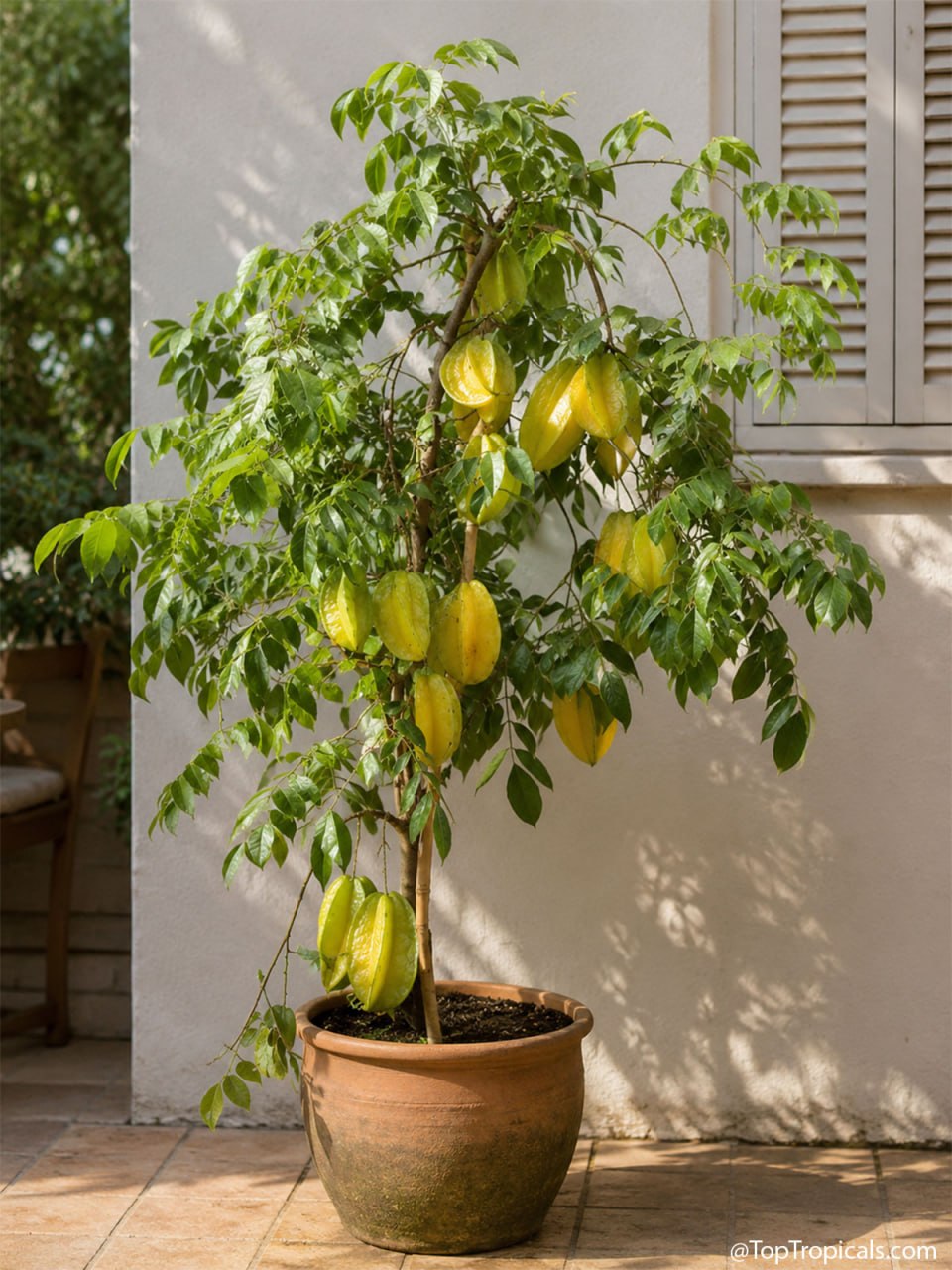
Carambola Starfruit FAQ: how dwarf is a seedling?
🌟 Carambola Starfruit FAQ: how dwarf is a seedling?
❓ I recently ordered a dwarf Hawaiian star fruit seedling from your glorious stock of tropical trees, however upon doing further research it seems like grafted trees guarantee fruit results while seedlings may vary from what the parent plant was. I was planning on putting it in a planter since it’s a dwarf but I’m worried about the quality of fruit since it’s a seedling. Could you elaborate on that a bit?
✅ You are correct that grafted trees provide the greatest certainty because they are clones of a known variety. Seedling trees can show some variation from their parents.
In this case, however, your seedling is not from an unknown or mixed genetic background. The seeds were collected from a true Dwarf Hawaiian cultivar that was growing among other selected dwarf carambola cultivars, primarily Dwarf Hawaiian and a few Fwang Tong trees. Because both the seed parent and the surrounding pollen parents were dwarf, we expect the offspring to retain many of the desirable dwarf characteristics.
While we cannot guarantee that every seedling will be identical to the parent tree, the chances of obtaining a compact, productive tree with good fruit quality are quite favorable. In fact, seedlings sometimes combine the best qualities of both parents and may even produce fruit that is equal to or better than either parent.
The main difference between a grafted tree and a seedling is predictability. A grafted tree gives you a known result. A seedling introduces some genetic variation, but in this case the variation comes from a pool of carefully selected dwarf varieties rather than from unknown parents.
For container growing, we would still expect your tree to be well suited to pot culture, especially with periodic pruning to maintain size and shape. Many growers actually enjoy growing seedlings because there is always the possibility of discovering an exceptional individual. Carambola is a quick fruit tree: 3-4 years from seed to fruit.
We believe your Dwarf Hawaiian seedling has excellent potential and should make a rewarding container-grown fruit tree.
🛒 Plant Star Fruit Carambola Tree
📚 Learn more:


✦ Averrhoa carambola in Plant Encyclopedia
✦ Star fruit chili relish: quick-n-fun exotic recipes
✦ Grilled star fruit slices: quick-n-fun exotic recipes
✦ How to gets lots of Star Fruit Carambola
✦ Star Fruit from our garden
✦ Grow your own Carambola
✦ Top 10 fast-fruiting trees: #8. Carambola - Starfruit
✦ Carambola Banana Whip
✦ Carambola Jam recipe
✦ When young Carambola trees are covered with fruit
✦ Carambola tree is the Star of the orchard
#Food_Forest #Discover #How_to
🟢 Join 👉 TopTropicals
Date: 21 Jun 2026
🍓The Strawberry Moon Rises: A Gardener's Excuse to Go Outside

Smokey: Science hasn't found much evidence for it.
Sunshine: Then what's the point?
Smokey: If the moon gets people into the garden, that's good enough for me.

On the evening of Monday, June 29, 2026, the full Strawberry Moon will rise low in the southeastern sky. Whether you follow a lunar calendar or not, it's a good excuse to spend a little time outside on a summer evening.
🌛 What Is the Strawberry Moon, Exactly?
Many of the familiar full moon names come from Native American traditions and reflect seasonal events in nature. June's full moon was named for the season when wild strawberries ripen across much of North America, not for any color in the sky. Despite the name, the moon won't glow pink or red. If it looks warm or golden, that's simply because any full moon takes on an amber tint when it hangs low near the horizon, the same atmospheric effect that paints sunsets orange. The "strawberry" is about the harvest, not the hue.
This year, the Strawberry Moon rises on the evening of June 29 and will appear low in the southeastern sky, making it a particularly beautiful moon to watch as dusk settles in.
🌓 Moon Gardening, an Old and Honest Tradition
For generations, gardeners across Europe and beyond timed their planting, pruning, and harvesting to the phases of the moon. Plant root crops during a waning moon, some traditions say, and leafy crops during a waxing one. Prune during certain phases to slow regrowth, harvest herbs at others for better potency. These calendars were passed down through generations of careful observers who paid close attention to their land and their results, and many still follow them today.
Modern science has found little evidence that lunar gravity or moonlight significantly affects plant growth. Yet the tradition persists, and plenty of growers still find real value in the rhythm it brings to the gardening year.
💡What We Know For Sure
Here's the practical truth, and it's the same one Smokey arrived at after thinking it over. Whether or not the moon influences your plants, the act of walking through your garden definitely does. A moon-phase calendar that gets you outside to check on your plants, pull a few weeds, prune back something leggy, top off the mulch, or water a thirsty pot is helping your garden, regardless of what's happening overhead.
The benefit isn't necessarily lunar. It's attention.
A garden rarely thrives because of a single grand effort. It thrives because of dozens of small ones: a little pruning, a little watering, a few weeds pulled before they become many.
Gardens reward the gardeners who show up, and if a full moon is your reminder to show up, that's a perfectly good reason to keep watching the sky.
📅 Beyond the Harvest
Not everything in a garden needs to produce a yield to be worthwhile. Marking the seasons the way our ancestors did, a strawberry moon in June, a harvest moon in fall, a snow moon in February, gives us small, recurring reasons to notice what's changing around us. It's a rhythm, not a requirement.
Think of the Strawberry Moon as a good excuse to take a walk through the garden.
The Strawberry Moon doesn't have to improve anything to be worth celebrating. It only needs to get you outside on a warm June evening, which, honestly, isn't a high bar to clear.
 A Strawberry Moon Collection, Just for
Fun
A Strawberry Moon Collection, Just for
Fun
Sunshine immediately concluded that any moon named after strawberries deserved a few strawberry-themed plants. We couldn't argue with that logic, so we pulled together a few Top Tropicals favorites that fit the theme.
🍓 Strawberry Tree


Strawberry Tree (Muntingia calabura), also known as Jamaican Cherry, grows quickly and produces dainty white flowers resembling strawberry flowers, followed by an abundance of small cotton-candy-sweet berries that birds, wildlife, gardeners and their kids all appreciate.
📚 Learn more from Top Tropicals Garden Blog
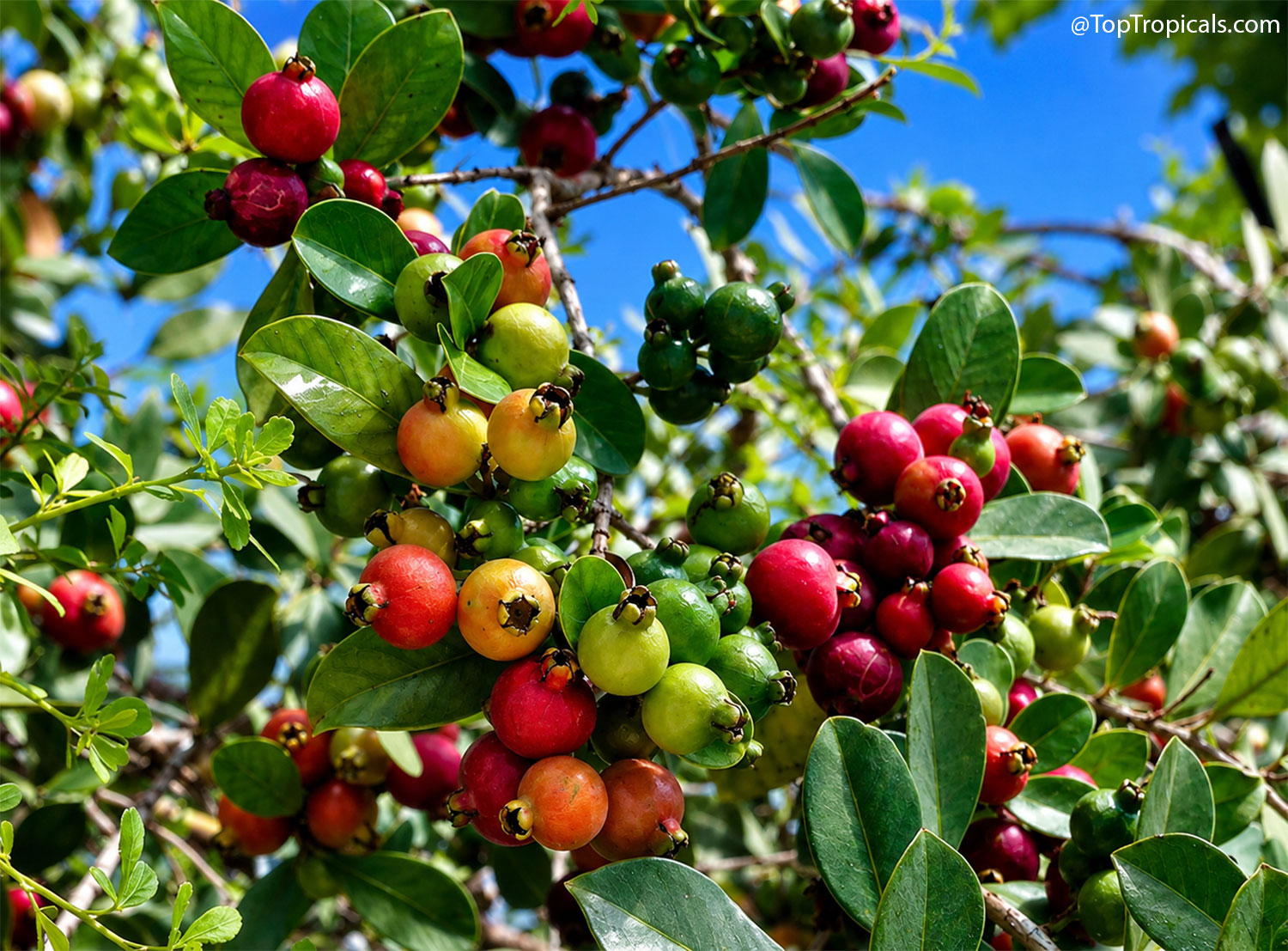
🍓 Strawberry Guava
Strawberry Guava (Psidium littorale) brings glossy foliage and sweet, perfumed fruit that tastes something like its namesake crossed with a guava.
🍓 Strawberry Dragon Fruit
Dragon Fruit Vietnamese Jaina Strawberry White (Hylocereus undatus ) produces bright pink fruit with refreshing white flesh and a flavor often described as a blend of strawberry, melon, and kiwi. Its enormous night-blooming flowers are every bit as impressive as the fruit, turning this vigorous climbing cactus into a spectacular summer showpiece.

🍓 Strawberry Ginger
Coral Ginger Borneo Strawberry Pink (Riedelia coralina) is one of the rarest gingers in cultivation, producing unusual strawberry-pink flower spikes that seem almost too exotic to be real. The edible blooms have a pleasant spicy fragrance and flavor, making this New Guinea treasure as interesting to taste as it is to admire.
Whether you came for the moon or the plants, we hope you discovered something interesting. They just happen to share a name with the moon overhead this June, and that felt like reason enough to give them a little spotlight.

🍓🌱 How to Grow Them
If you live in a frost-free climate (USDA Zones 10+), simply plant these strawberry gems in the ground and enjoy. Strawberry Guava can tolerate occasional frosts down to about 28F once established.
Not so lucky? Many gardeners successfully grow Strawberry Guava, Strawberry Dragon Fruit, and Strawberry Tree in containers, moving them indoors or to a protected location during winter. You don't need a tropical climate to enjoy tropical fruit.
🏡 See You Outside
Whether you believe in moon gardening or not, June 29 is a good night to step outside, find an open view of the southeastern sky, and watch the Strawberry Moon rise. Bring a cup of tea, walk the garden beds while there's still light, pull a few weeds, and let the evening settle in around you.
And that may be the real lesson of the Strawberry Moon.
Smokey: What does the moon calendar recommend?
Sunshine: I have no idea. I left it on the kitchen table. Both hands are full.
Smokey: Of course they are. Coffee and donuts. Let's start with the weeds.