Garden Blog - Top Tropicals

Date: 10 Feb 2026

Cold-hardy avocado varieties - what freezing they really survive
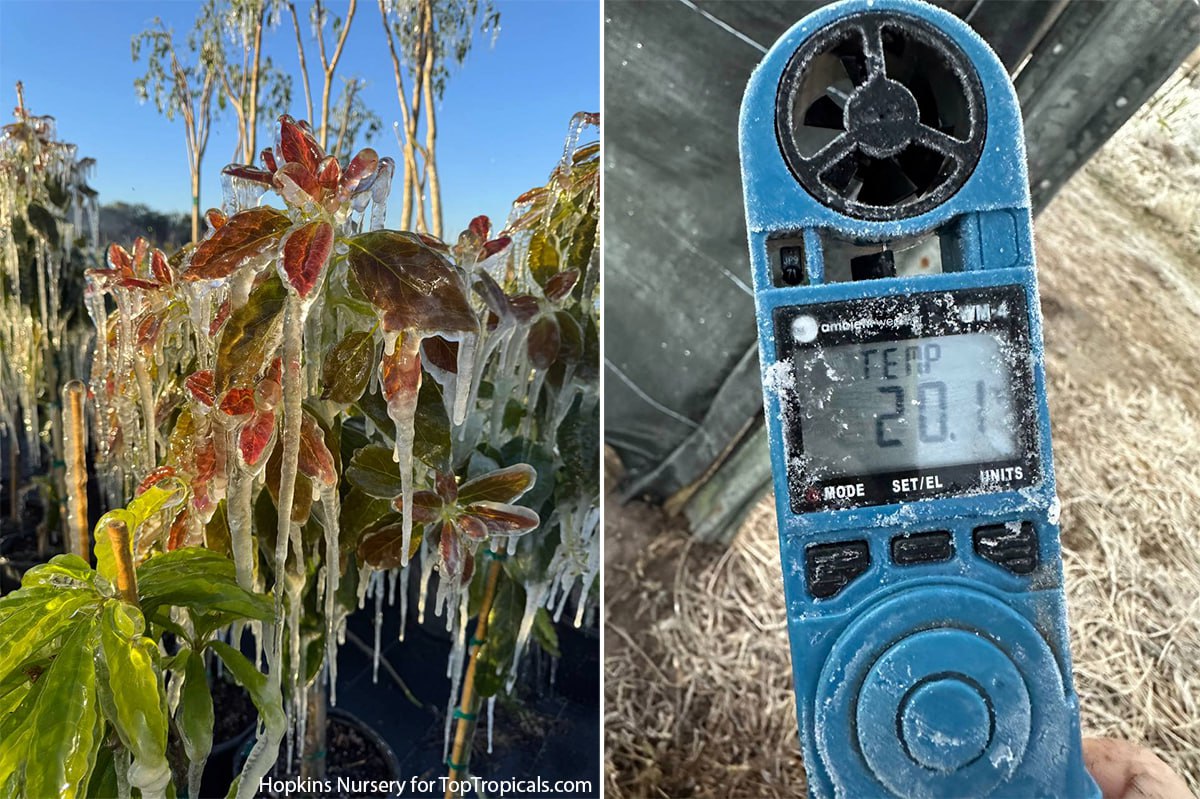
Avocado leaves covered with ice

Avocado leaves covered with ice

❄️ Cold-hardy avocado varieties - what freezing they really survive


Avocado trees are usually associated with warm, frost-free climates, so every winter freeze raises the same question - which avocados actually survive cold weather? After recent freeze events, interest spikes as gardeners look for real answers, not guesses. The truth is, avocado cold hardiness is not just about the lowest temperature. Duration, moisture, wind, and tree maturity matter just as much - sometimes more.
  • What cold hardiness really means for avocados


    Cold hardiness does not mean an avocado tree escapes winter untouched. It simply means the tree survives a freeze without being killed.
    Leaf burn, branch dieback, or temporary growth setbacks can still occur. Survival is the key distinction.
  • Cold tolerance is influenced by:


· Tree age and establishment. Young avocado trees are always more vulnerable. Once established, tolerance improves significantly.
  • · Length of the freeze
  • · Wind exposure
  • · Daytime sun and heat retention
  • · Drainage and soil moisture
  • · Overall tree health going into winter


Where cold-hardy avocados come from


The most cold-hardy avocados are of Mexican origin. These types evolved in cooler, higher-elevation regions and differ genetically from West Indian and Guatemalan avocados.
These varieties are widely grown around San Antonio, Texas (USDA Zone 8b), where trees have been damaged but not killed by temperatures near 10F. As a general rule, established Mexican-type avocados can tolerate short freezes (about 3-6 hours) down to roughly 15F with little or no permanent damage. Temperature estimates apply to established trees under favorable conditions. The best results come from combining the right genetics with smart planting, good drainage, and thoughtful winter care.
  • Why cold tolerance varies so much


    Cold ratings are never absolute. The same variety can survive very different temperatures depending on conditions such as tree maturity, freeze duration, wind, microclimate, and humidity. For example, an avocado may tolerate 10-15F in dry Texas winters but only 15-20F in wetter East Coast conditions.
  • Planting and protection tips for colder climates


· Plant in the warmest available location, ideally near a south or southeast wall
  • · Protect trees from cold wind
  • · Ensure excellent drainage; standing water during cold weather is deadly
  • · Use raised mounds in poorly drained areas
During freezes, small trees should be covered, mulched heavily, and protected with frost cloth. In severe cold, gentle heat under covers may help. Mature trees often need little to no protection.

Avocado varieties known for the best freeze survival


These varieties are among the more reliable choices for colder regions once established, reported tolerance near 15F:
  • · Brazos Belle - medium to large purple-black fruit, season October-November
  • · Fantastic - green fruit with paper-thin skin, creamy texture, the most cold tolerant
  • · Joey - selected in Uvalde, Texas; purple-black fruit, excellent flavor, heavy producer, season September-October
  • · Lila - medium green fruit, season September-October (not to be confused with Lula)
  • · Poncho - medium to large green fruit

  • Cold-hardy avocados make growing this fruit possible beyond the tropics, but expectations must stay realistic. Survival does not mean zero damage, and protection still matters during extreme weather.


🛒 Explore cold hardy Avocado varieties

📖 Our Book: Avocado Variety Guide, Snack or Guacamole?

📚 Learn more:


🎥 Avocados survived 25F hard freeze 3 nights of Florida Record Freeze

#Food_Forest #Avocado #Discover #How_to

🟢 Join 👉 TopTropicals

Date: 10 Feb 2026

These Avocados survived 3 nights of 25F hard freeze, Florida Record Freeze

Cold hardy avocados

⛄️ These Avocados survived 3 nights of 25F hard freeze, Florida Record Freeze

  • ⛄️ Recent winter freezes have once again raised the same urgent question among avocado growers - which varieties actually survive cold weather, and what does survival really look like afterward?
  • ⛄️ After widespread freeze events, trees across many regions showed very different outcomes, from minor leaf burn to complete canopy loss.
  • ⛄️ This video taken on February 4, 2026 at Top Tropicals BFarm in Sebring, FL, reflects what we observed in real conditions after 3 nights of hard freeze.
  • ⛄️ The trees in the video had no protection.


❄️Weather data

Feb 1-6, 2026, Coldest in Recorded History (132 years of observations)
Top Tropicals Farm and Nursery at Sebring FL

🌡 Min temps: 25F, wind chill 14F
⏳ Duration of cold: 3 nights of 8-10 hour hard freeze, along with 7 days of cool daytime temps around 50F
🌀 Wind: 20 mph, with 40-50 mph gusts.

🛒 Explore cold hardy Avocado varieties

📖 Our Book: Avocado Variety Guide, Snack or Guacamole?

📚 Learn more:


#Food_Forest #Avocado #Discover #How_to

🟢 Join 👉 TopTropicals

Date: 8 Feb 2026

How to grow Chinese Hat Flower

Holmskioldia sanguinea - Chinese Hat Flower

🎩 How to grow Chinese Hat Flower - when winter colors most needed

  • The Holmskioldia sanguinea, better known as the Chinese Hat Flower, gets its name honestly. Each bloom looks like a tiny hat or parasol - a little tube backed by a flat, round disc. Once you notice it, you cannot unsee it!
  • What really makes this plant special is when it blooms. While most gardens slow down, Chinese Hat Flower kicks into gear from winter through early spring. The branches fill with flowers first, and the leaves follow later. It is one of those plants that quietly steals the show when everything else is taking a break.
  • More than one color


    Most people know the classic red form, but there are several color varieties worth mentioning:

🔴 Red - the most common and bold
🟡 Yellow - Holmskioldia citrina, bright and cheerful, harder to find
🟠 Bronze / orange-bronze - warm tones that glow in winter light
Having different colors makes it easy to mix them or use just one as a winter focal point.
  • How it grows and where it works best


    Chinese Hat Flower is a fast-growing, scrambling shrub. It is not stiff or formal. Think loose, graceful branches that like support. It does great when trained on:

· Trellises
  • · Fences
  • · Arbors
  • · Large containers with a support
  • · You can also let it grow as a free-form shrub and lightly prune to keep it tidy.


Care, the practical version

  • · Light: Full sun to light shade
  • · Water: Regular watering, especially while establishing
  • · Soil: Well-drained, not picky
  • · Pruning: After flowering to shape and encourage new growth
Once established, it is easygoing and forgiving.

Bonus points

  • · Blooms when the garden needs color most
  • · Attracts butterflies and hummingbirds
  • · Works as a flowering screen or accent plant
  • · Looks tropical without being high-maintenance

If you like plants that earn their space and do something interesting in winter, Chinese Hat Flower is one to keep in your garden.

🛒 Explore varieties of winter-blooming Chinese Hats

📚 Learn more:


#Butterfly_Plants #How_to #Hedges_with_benefits

🟢 Join 👉 TopTropicals

Date: 25 Jan 2026

How to grow Winter blooms without sun, indoors or out

Clerodendrum wallichiii - Bridal Veil

✨ How to grow Winter blooms without sun, indoors or out

  • ⭐️ Clerodendrum wallichii - Bridal Veil, is one of those plants that quietly steals the show. It is a graceful shrub that drapes itself in long, hanging sprays of white, lightly fragrant flowers just when many gardens are slowing down. Around fall and into winter, it suddenly comes alive with cascading blooms that really do look like a veil.
  • ⭐️ One of the things that makes Bridal Veil really special is that it blooms beautifully in bright shade, which is rare - not many flowering shrubs are happy without direct sun. Because it tolerates lower light so well and stays elegant in a container, it also makes a surprisingly great indoor plant in a bright room or sunroom.
  • ⭐️ What you will love most is how elegant but easygoing it is. The plant grows upright with soft, arching branches, usually topping out around 6–7 feet, with narrow, pointed leaves that stay neat and refined. The green stems set it apart from some other clerodendrums, giving it a lighter, airier look even when it’s not in flower.
  • ⭐️ Bridal Veil does best when you treat it gently. It likes bright light but not harsh afternoon sun, and it really appreciates protection from wind. Give it a spot with morning sun or bright shade, keep the soil evenly moist but well drained, and it rewards you without much fuss. It’s a great choice for containers, patios, or sheltered garden beds where you can enjoy the flowers up close.
  • ⭐️ Another bonus - it blooms when you want it most. While many plants rest, Bridal Veil puts on its show from fall through spring, making it a favorite for winter-interest gardens in warm climates. Pollinators notice it too, especially when little else is blooming.
  • ⭐️ If you like plants that feel a bit romantic, bloom off-season, and don’t need constant attention, this one earns its place fast. Bridal Veil is quiet, graceful, and unforgettable once you’ve grown it.


🛒 Start your Clerodendrum collection

📚 Learn more:
#Shade_Garden #How_to #Hedges_with_benefits #Container_Garden

🟢 Join 👉 TopTropicals

Date: 25 Jan 2026

Collecting clerodendrums: big color, little effort

Clerodendrum collage

Clerodendrum collage

🎨 Collecting clerodendrums: big color, little effort

  • 🎨 Collector hook


    If you love plants that look rare, unusual, and a little dramatic - but do not want high-maintenance divas - Clerodendrums belong in your collection.
    Clerodendrums are a surprisingly diverse group of plants, ranging from flowering vines to shrubs and even small trees. What they all share is bold, colorful blooms and an easygoing nature that makes them far less fussy than they appear. This combination of exotic looks and forgiving care is exactly why collectors gravitate toward them.
    Many clerodendrums bloom repeatedly through the year in warm climates, and several tolerate lower light better than most flowering plants. That makes them flexible - happy in the garden, in containers, on patios, or even indoors near a bright window. Their flowers come in striking combinations of red, white, blue, pink, and purple, often with unusual shapes that stop people mid-walk.
  • 🎨 Why clerodendrums earn collector status


  • ✦ Uncommon, eye-catching flowers
  • ✦ Long or repeat bloom cycles in many varieties
  • ✦ Vines, shrubs, and small trees in one genus
  • ✦ Excellent performance in containers
  • ✦ More tolerant of lower light than expected


🎨 Clerodendrum care made simple


Give clerodendrums bright filtered light to partial sun, regular watering with good drainage, and light feeding during active growth. A little pruning keeps them tidy and encourages fresh blooms. That is it. No complicated routines, no constant fixing.

For collectors who want maximum visual payoff without constant effort, clerodendrums deliver exactly what the title promises - big color, very little work.

🛒 Start your Clerodendrum collection

📚 Learn more:
#Butterfly_Plants #Shade_Garden #How_to #Hedges_with_benefits #Container_Garden

🟢 Join 👉 TopTropicals