Date: 12 Apr 2016
Hot novelty plant for hot Arizona
Q: What plants would you recommend for very hot and dry spot in front of my house that gets full sun all day long? I live in AZ, we recently had a couple good rains but this is going to be it for a long time. It gets so hot during the day that every plant I tried didn't make it. We have a few nice orange trees growing well but I would like to plant something compact, colorful and hopefully fragrant if there is such plant.
A: There is a perfect small size plant for you that is extremely fragrant and yet will be thriving in these conditions. It is the famous Jasmine sambac. It will appreciate dry air of Arizona and will bloom profusely for you in full sun or in partial shade. It doesn't mind heat at all.
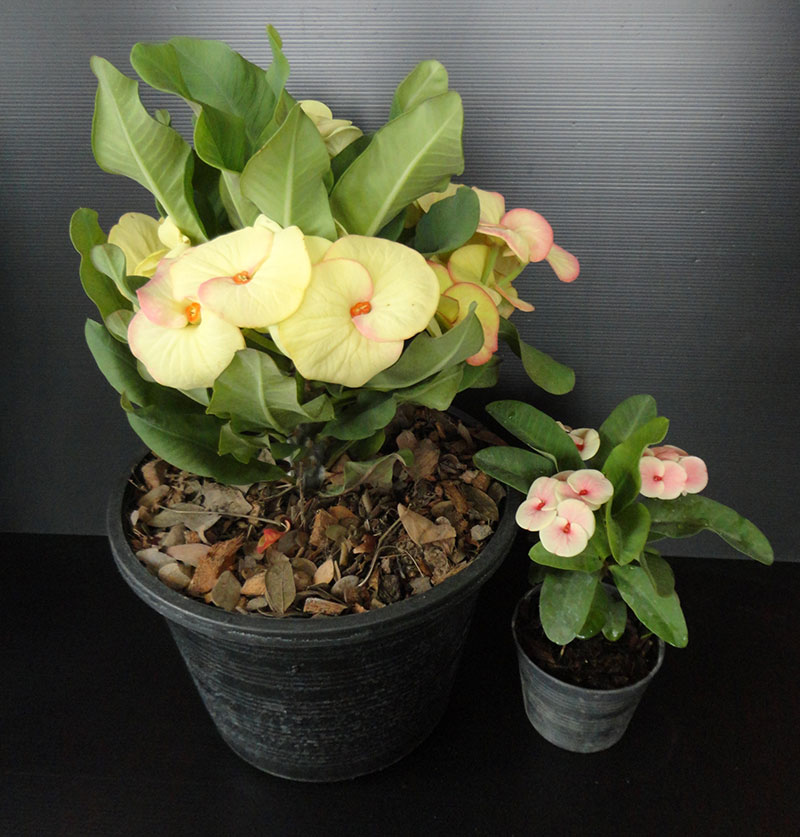
For colorful accents, a proven winner is Crown of Thorns - Euphorbia millii. New giant size flower varieties were recently selected in Thailand, and we just received a great selection, look at the colors! These plants don't mind hot sunny location at all. The more sun, the better the bloom! Small plants need regular watering until establish, then once they start developing, they will require less water.
Giant Euphorbia flowers from Thailand are 4-5 times bigger than regular flower euphorbia. Diameter of the flower is around 2". Compare giant flower to normal size - picture on the right.
Date: 2 Apr 2016
Erblichia or Flor de Fuego - Apricot fragrance and sunny color
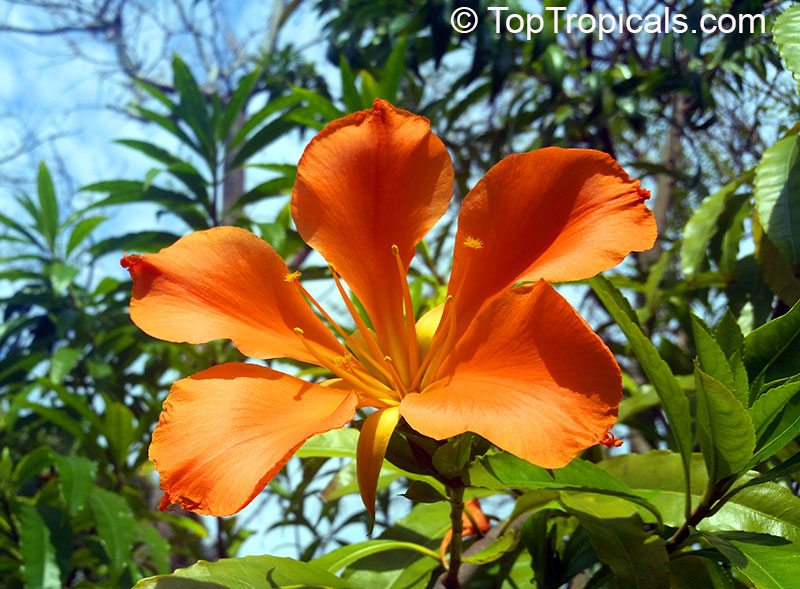
Q: I saw this wonderful flower Flor de Fuego on your website and I would like to buy this plant. I am wondering how big this tree will grow and how long will it take until I can smell the lovely flowers? I have a big garden and not much space left, but I still have a few spots available for smaller trees. Also any special care info will be appreciated.
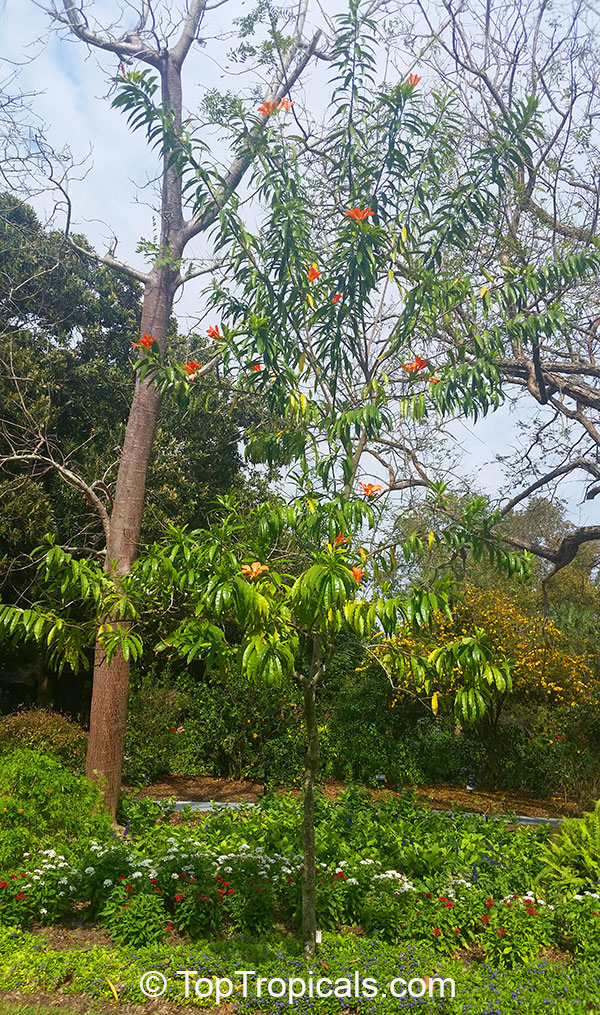
A: Flor de Fuego is a small tree and will fit in any small yard situation. It is very rare in cultivation. This is the newest, most exciting tree to be introduced in the last decade. It said to be one of the most beautiful flowering trees in Central America. It has long narrow leaves and large flowers 6-8"across that smell like apricots. It blooms from late fall through early winter and sometimes through spring. Normally it starts blooming in 2-3 years after planted in the ground. Surprisingly for such a delicate plant, it tolerates poor soils. Once established, it doesn't require any special care other than regular watering and fertilizing during hot months. It does take some effort sometimes to make the tree happy in its new habitat. After planting in the ground, keep your eye on irrigation schedule and do not let soil stay wet, young trees don't like wet feet. In natural habitat, the plant prefers to have a dry period that is beneficial for profuse blooming.
See full size picture of Erblichia tree in full bloom
Click here to buy Flor de Fuego
Date: 30 Mar 2016
Spring time fun: fertilizing and pruning
Q: When is a proper time to start fertilizing my garden in Spring? Also, when can I cut back cold damaged branches? Should I wait until end of April?
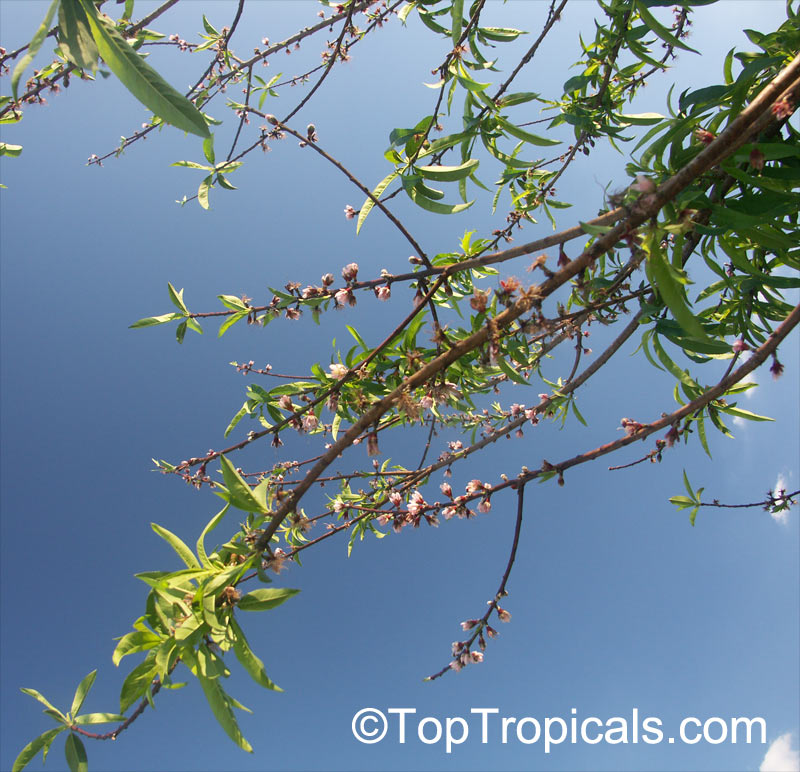
A: As a rule of thumb, fertilizer can be applied during period of active growth, when a plant needs additional nutrients. With indoor plants, you can fertilize pretty much year round as long as the plant continues growing and not dormant. For in-ground tropical plants, start fertilizing when new growth appears. In subtropical areas, with cooler winter months, most tropical plants slow down their metabolism when temperature drops below 65F. Many of them become dormant, and may even lose leaves (especially deciduous plants like Annona, or Peaches/Plums
Date: 10 Mar 2016
Do-It-Yourself Support Structure for Dragon Fruit
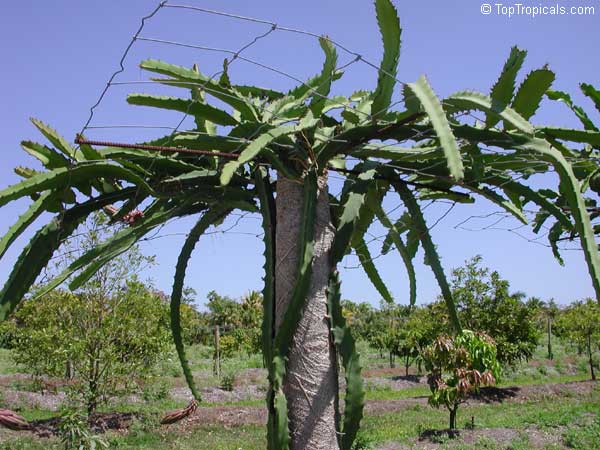
This interesting do-it yourself project was sent to us by our customer from South Florida. Many tropical gardeners want to grow fascinating Dragon Fruit, and their most common question is - what kind of support I should use for this amazing fruiting cactus? We hope you find this information very useful. Happy Gardening!
Dragon fruit is a terrestrial/epiphytic fruit baring cactus, which may grow fleshy stems up to 30 ft high, given sturdy support. However, downward hanging or horizontal branches stimulate production of flowers at the tips of the branches. Commercial groves in different parts of the world use different method to achieve this. The traditional Vietnamese way is to train the plant into a “fountainâ€, which consists of a vertical central trunk about 8ft tall and a horizontal structure, such as a wagon wheel on top of it to support the horizontal branches (see picture on the right).
This picture served as my inspiration to build my own structure. I used five 4â€x4†10ft wood beams as the trunk, shaped as a cross. I attached the beams to each other with 10†long screws.
I dug a 2 ft deep 12â€x12†hole in the ground and positioned the trunk inside, such that about 8ft are above ground. I covered it with several layers of burlap top to bottom.
The horizontal structure on top is made of four 4ft long 2â€x2†wood beams and two 12â€x12†wood plates to hold them together. I attached this structure to the top of the trunk.
I used old watering pipe to form two rings around the trunk to support the branches. Here is the result!... See step-by-step full size pictures and the rest of the article...
Date: 20 Sep 2025
How to make lots of Insulin Ginger plants quickly and get more health benefits
Costus igneus (Chamaecostus cuspidatus) - Fiery Costus or Spiral Flag
💚 How to make lots of Insulin Ginger plants quickly and get more health benefits
- Costus igneus (Chamaecostus cuspidatus) - Fiery Costus or Spiral Flag is believed to help lower blood glucose levels naturally and managing diabetes.
- Have you heard of Insulin Ginger? Everyone wants to have it in the garden!
- Gardeners in India grow it not just for its pretty spiral leaves, but for what those leaves do. People with diabetes often chew them fresh or brew them into tea, saying it helps keep their blood sugar under control.
- Researchers have found something interesting: the leaves contain an insulin-like compound, along with antioxidants and anti-inflammatory properties. In animal studies, extracts from the plant lowered blood sugar, protected the liver and kidneys, and even made the body more sensitive to insulin.
- The way folks use it is simple. You can chew a leaf right off the plant, steep dried leaves for tea, or find it in powders and capsules. It's one of those plants that shows how tradition and science sometimes meet in the garden.
- Its lush, turmeric-like leaves spiral around upright stems, with a glossy dark green top and a striking light purple underside. In warm months, it produces bright orange, cone-like flowers that stand out beautifully in the garden.
- Beyond its beauty and natural insulin effects, the insulin plant is credited with aiding digestion, reducing cholesterol, boosting energy, improving skin health, supporting weight loss, relieving stress, and promoting heart wellness. A real botanical multitasker!
🎥 In this video, we’ll show you how to multiply Insulin Ginger fast, so you’ll have plenty of plants for yourself and even extras to share with friends and family.
✅ Don’t forget to use Green Magic fertilizer for the best results. Gingers absolutely love this plant food - they thrive on it and respond better than any other plant, with vigorous growth, lush foliage and loads of leaves you’ll need for all the benefits.
🛒 Grow your own sugar-fighter - the Insulin Ginger
📚 Learn more:
#Food_Forest #Remedies #Shade_Garden #Discover
🟢 Join 👉 TopTropicals