Garden Blog - Top Tropicals

Date: 7 Mar 2017

Taking care of Guanabana (Soursop) after shipping

Q: Since I have never grown a soursop tree before I need some pro help. My tree was delivered absolutely beautiful, leaves were a pretty green. I potted it and gave it a good drink of water and put it in a shaded area outside. Then the weather here became cool so I brought it in for a few days until the weather warmed, and it lost all the leaves. Is it in shock and will come around eventually? Will I be able to grow this tree indoors during winter?

A: Soursop - Annona muricata trees are very sensitive to temperature drops. This always causes leaf loss. You seem to be doing everything right. Do not water until soil gets slightly dry; keep it in bright shade. The weather should be good now with high temperatures and humidity rising. No fertilizer until the plant shows active new growth. Be patient with your plant, it should recover soon.

Soursop is an ultra-tropical tree and doesn't take any freeze. If you live in cooler climate, keep the plant in a pot (the good news is, Annonas in general have compact nature and are perfect for container culture). Bring the tree indoors during cold period, providing bright light.

Remember that grafted trees start flowering and producing fruit right away, unlike seedlings of Soursop that may take a few years till fruiting.

We have very interesting article about growing and fruiting Soursop in apartment. Check out Tropical Treasures Magazine #7.

Date: 8 Jun 2016

How to get Clerodendrum to bloom?
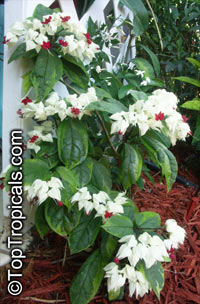
Q: My Clerodendrum thomsoniae is not blooming. Actually it is not doing much of anything except putting out weak growth and small leaves. I purchased this plant May 26. 2015. Over the winter it was in a heated sunroom, at night 60 degrees, where it received some direct sun from the skylights. I reduced the water to prevent excessive leggy growth. I don't see how this plant can take full sun or even part sun. Temps here in Raleigh NC are 80-85 degrees and 65-70 at night, at the moment. I figured I would gradually expose it to more direct sun after being in a sunroom but the leaves burn. I had this plant in San Jose many years ago where it did quite well, blooming with no special treatment. So thought I'd give it a try again. Any advice?

A: Clerodendrums are all time favorites, appreciated by both gardeners and house plant collectors, for their showy, fragrant flowers and very easy culture. When growing Bleeding Heart (Clerodendrum thomsoniae), a few things should be taken in consideration:

1) Temperature.Like most clerodendrums, this plant is semi-decidious outside of tropics and goes dormant in winter. It may lose some or all leaves if temperatures drop below 60-65F. It is not too cold sensitive, the plant can even take some light freeze. However when it is not hot and humid, it slows down metabolism. This means, water should be reduced during cooler months.

2) Light. This plant can grow in both sun and shade like most clerodendrums - this is the beauty of this genus. However like with all flowering plants, more sun promotes more bloom. In shade, it will grow beautiful dark green foliage (leaves will be bigger than in the sun) on the account of flowering; in full sun leaves turn lighter color and sometimes may even get unattractive "faded" look, but flowering will be profuse. Also remember that Arizona full sun is different than New York full sun. Here in Florida, Bleeding Heart can take some full sun, but if exposed to sun all day long, leaves often get sun burn.

3) Acclimation. Also called acclimatization - this is a process when a living organism adjusts to environment changes. Acclimation is always the case when growing plants indoors, even in a sun room. When Spring comes, and especially when we start taking outdoors those plants that have spent a few months indoors, light level increases dramatically, and this may cause leaf loss, and leaf burn. It is not necessarily a bad thing, it is just a mechanism of acclimation. Example: imagine yourself after living in a warm tropical climate, moving to a cold country. For a while your body will feel discomfort from "too much cold", while native residents may feel comfortable. We call it "My blood has thinned after living in Florida" - and this is a physiological fact. And vice versa, if you are a Northerner, moving to hot climate may be a challenge; it will take a while until you get used to hot and humid tropical summers. Same thing with plants: during cooler and darker period, their body (leaves and stems) becomes "winter type", with some serious chemical restructuring. Immediate environment change, like bright light and high temperature, causes a shock to those "winter cells", and as a defense mechanism, the plant gets rid of those useless "winter" leaves, replacing them with new "summer" leaves with completely new chemistry and metabolism.

From what you described, you know your plants, and you know what you are doing. You did everything right by reducing watering in winter and gradually moving the plant into brighter light. You still may see some stress, and this is normal. If you patiently keep changing environment slowly, eventually your plant will generate new healthy "summer" growth, it will also improve more vigorous root grown which will help the plant to establish better and to be stronger. You will see larger, thicker leaves, and definitely some flowers.
Date: 6 May 2016

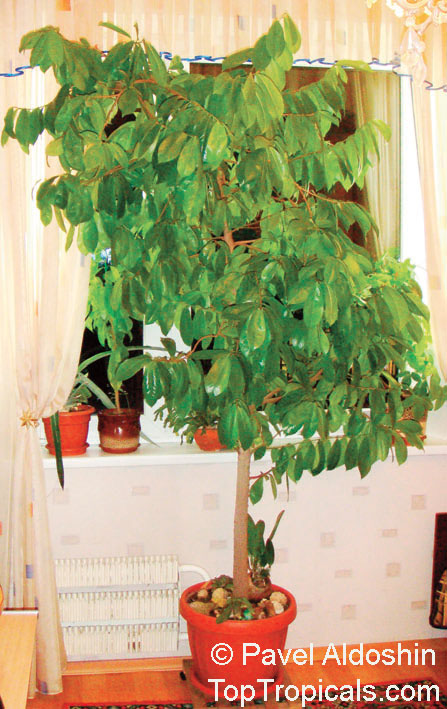
Taking care of Soursop after shipping

Q: Since I have never grown a soursop tree before I need some pro help. My tree was delivered absolutely beautiful, leaves were a pretty green. I potted it and gave it a good drink of water and put it in a shaded area outside. Then the weather here became cool so I brought it in for a few days until the weather warmed, and it lost all the leaves. Is it in shock and will come around eventually? Will I be able to grow this tree indoors during winter?

A: Soursop - Annona muricata trees are very sensitive to temperature drops. This always causes leaf loss. You seem to be doing everything right. Do not water until soil gets slightly dry; keep it in bright shade. The weather should be good now with high temperatures and humidity rising. No fertilizer until the plant shows active new growth. Be patient with your plant, it should recover soon.

Soursop is an ultra-tropical tree and doesn't take any freeze. If you live in cooler climate, keep the plant in a pot (the good news is, Annonas in general have compact nature and are perfect for container culture). Bring the tree indoors during cold period, providing bright light.

We have very interesting article about growing and fruiting Soursop in apartment. Check out 4534 Tropical Treasures Magazine # 7.

Date: 5 May 2025

🎀 Five plant gifts she'll love this Mother's Day

Q: My mother loves gardening and I am thinking to buy her a live plant to make her happy. What plant do you recommend?

A: At Top Tropicals, we have a big selection of wonderful gift plants . Below are a few suggestions for you, these plants are large, developed and ready to bloom or fruit!

1. Joy Perfume Tree

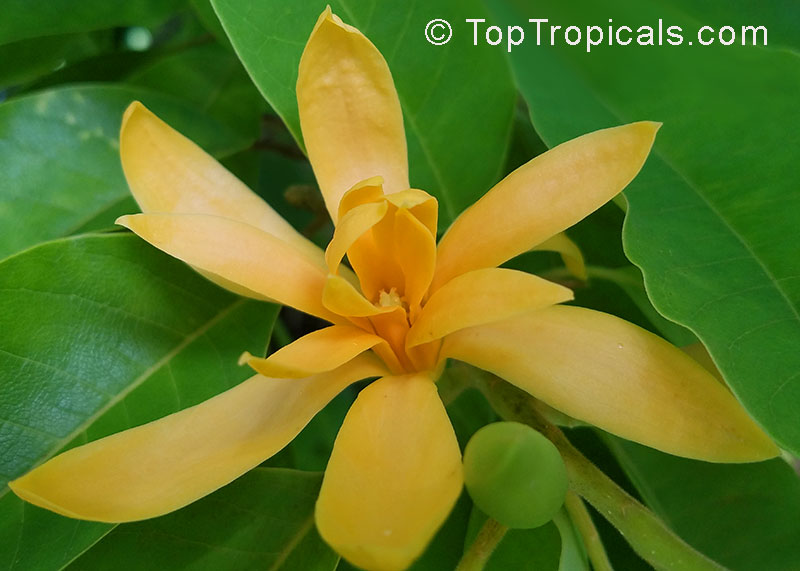
Magnolia  (Michelia)  champaca,  Joy  Perfume  Tree,  Champaka

The Champaka or Joy Perfume Tree (Magnolia champaca) - is a top choice for Southern landscapes, prized for its striking columnar shape and fragrant, fruity bubble gum-scented blooms - you won't be able to stop sticking your nose in this flower! A signature plant at Top Tropicals, it's known for producing the world's most expensive perfume, Joy. The Joy Perfume Tree blooms on and off year-round and is currently in full bloom at our farm in Sebring, FL, filling the air around with fantastic sweet scent. This tree thrives in both pots and the ground, growing bushy and full as it matures. At Top Tropicals, we have beautiful Champaka trees in all sizes, from 3-4 ft tall (ready to bloom in a year) to 6-10 ft tall (already bloomed) for local pick up or delivery.
Learn more, with a short video.

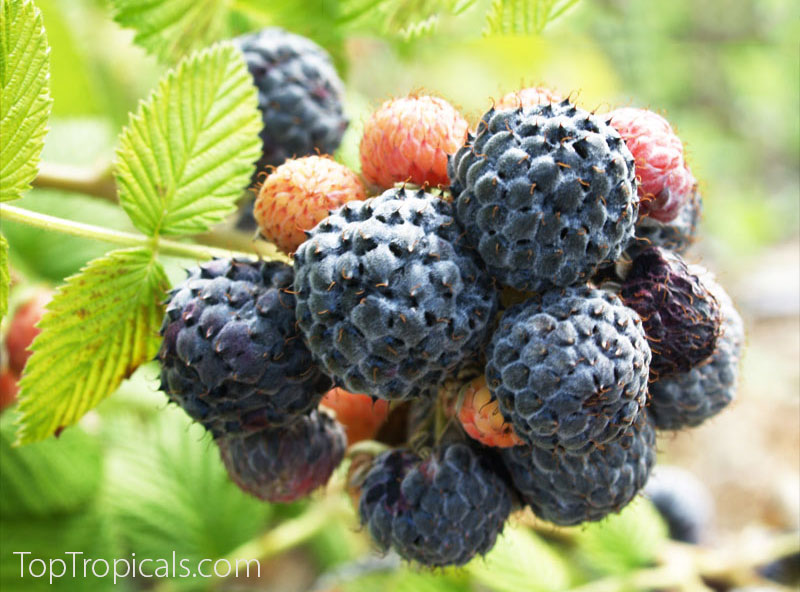
2. Tropical Raspberry Mysore

Raspberry  Mysore  Tropical,  Rubus  albescens  (niveus)

Tropical Raspberry Mysore (Rubus albescens) - is the perfect solution for those missing Northern fruit in hot climates. Unlike traditional raspberries that can't handle the heat, this fast-growing Raspberry from India thrives in humid, hot conditions and produces juicy, sweet fruit almost year-round! The clusters of purple-black fruit are packed with flavor, and the plant is perfect for large containers, producing plenty of fruit in no time. Cold-hardy to the upper 20s F, it's an easy-to-grow, fast producer. We have beautiful, fruit-ready 3 gal Raspberry bushes, ready to add a burst of sweetness to your garden!
Learn more, with a short video.

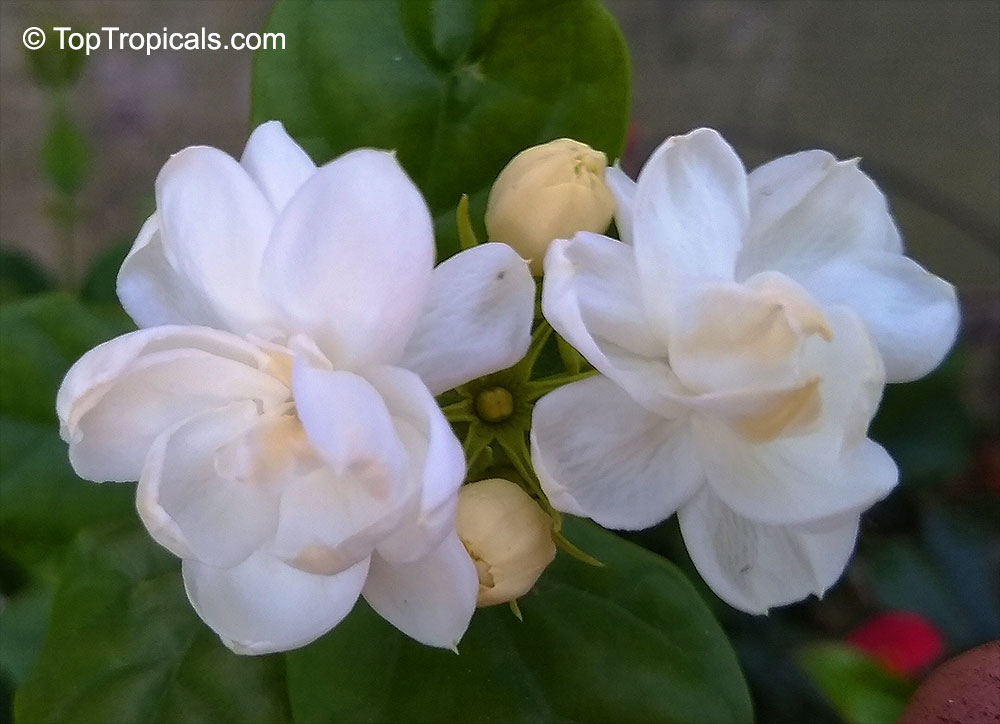
3. Fragrant Jasmine Sambac

Jasminum 
 sambac

Jasminum Sambac is widely regarded as the most fragrant jasmine, cherished by tropical gardeners and plant collectors alike. Native to India, this jasmine is the source of jasmine perfume oil and the signature ingredient in jasmine tea. With various varieties offering unique flower sizes, shapes, and growth habits, it’' perfect for both sun and shade, thriving as a container plant or indoor favorite. Its delightful fragrance fills the air, and with the help of Sunshine Pikake plant booster, you can enjoy even more blooms. Jasmine Sambac, along with Champaka, is another signature plant of Top Tropicals. Through the decades, we've collected all the available varieties in cultivation - check them out!
Learn more about Jasmine Sambac varieties, with a short video.

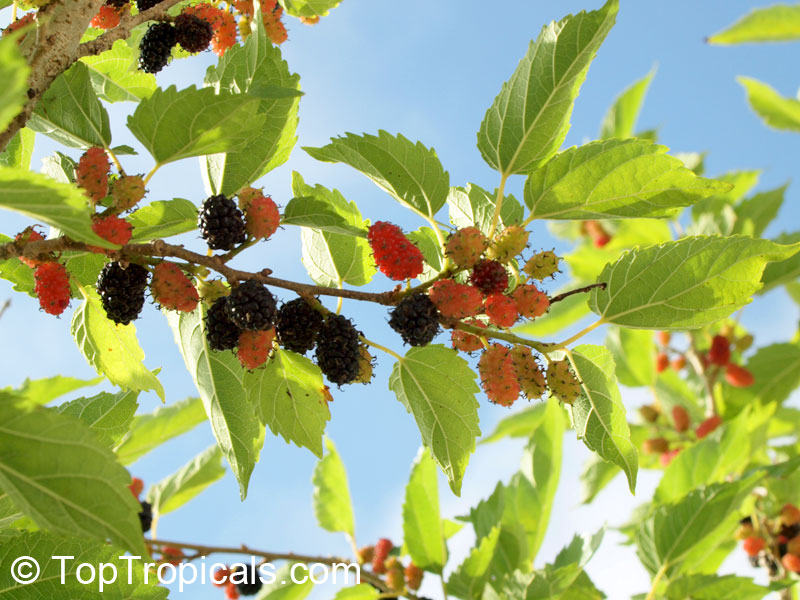
4. Everbearing mulberry

Mulberry  tree  Dwarf  Everbearing  (Morus 
 sp.)

The Dwarf Everbearing Mulberry (Morus sp.) - is the perfect way to enjoy fruit year-round! This beautiful, cold hardy bush produces sweet, juicy mulberries starting from the very first year - often the same season you plant it. With its dwarf habit (easily maintained at 4-6 ft), it's perfect for containers and small spaces. Cold-hardy and drought-resistant, this productive plant thrives in various climates, from USDA zones 5 to 10! The fast-growing Mulberry will provide fruit year-round, and with minimal care, it will flourish in almost any soil. Our Everbearing Mulberry bushes produce enough fruit for both birds and breakfast - we pick a handful every day!
Learn more, with a short video.

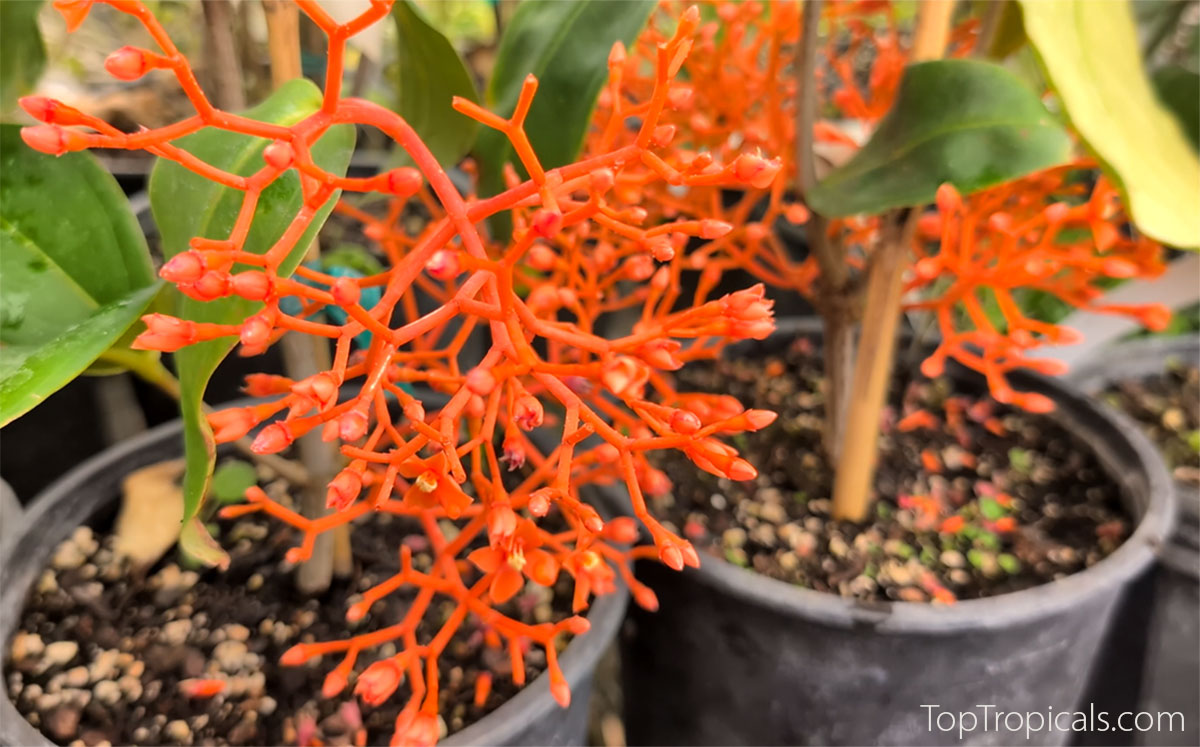
5. Medinilla Coral Spike

Medinilla  scortechinii  -  Orange  Coral  Spike

Rare Medinilla scortechinii - Orange Coral Spike - is a rare gem that brings a touch of the ocean to your garden! With bright orange stems bursting into star-shaped blooms, it looks like something straight from a coral reef. Compact and easy to grow, this plant stays under 2-3 ft tall, making it perfect for pots, hanging baskets, or as an epiphytic accent. The glossy dark leaves contrast beautifully with the vibrant orange panicles, and it thrives in bright shade. A must-have for collectors of unusual tropical plants, this coral spike adds a bold pop of orange wherever it grows - but hurry, it doesn't stay in stock for long!
Learn more, with a short video.

Date: 6 Oct 2021

Top Tropicals Top House Plants

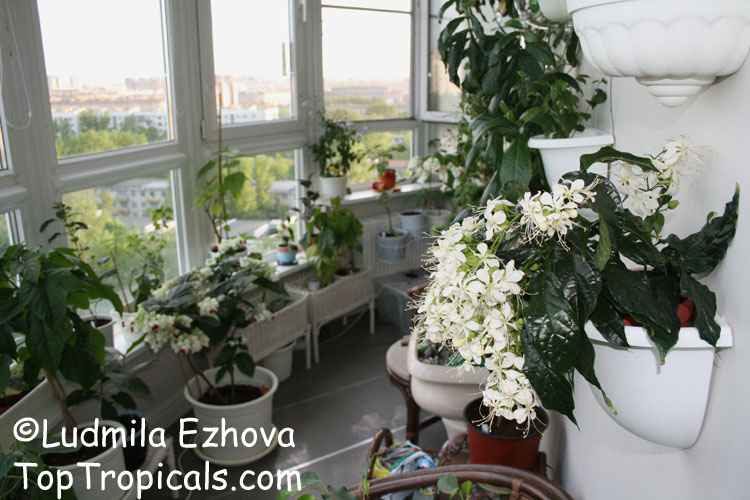
Photo above: Clerodendrum indoor garden of Ludmila Ezhova, St Petersburg, Russia.

Enjoy the Tropics Year round!
Bring them inside...

Q: I just discovered your amazing website and spent hours browsing your beautiful tropical plants! I wish I could have them all! But it's getting cold here (I live in Chicago area), too late? Can you recommend something of a small size, colorful, that I can easily overwinter indoors? Thanks for bringing this beauty into our lives!

A: Don't get discouraged even in colder climates. Yes, you can grow tropical plants indoors! Remember that all traditional houseplants are in fact tropical plants that grow in tropics in a wild habitat. Humans didn't invent them as indoor plants, they originally collected them from the rain forests and jungles! Most of tropical plants, including trees and fruit trees, can be grown in containers and even indoors. It's just a matter of space limitations and amount of time you are willing to spend caring of your exotic babies. Many gardeners up North are very successful with their tropical plant collections.
Below are a few suggestions of compact growing, easy species for your indoor collection. Enjoy the Tropics Year round!

See more plants well-suitable for indoor culture and our specials at the end of this newsletter.

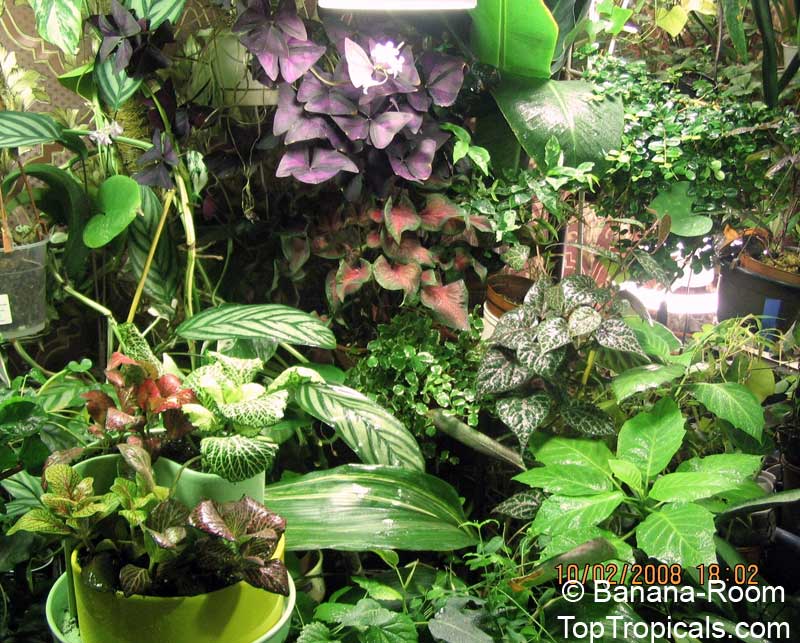
Photo above: small tropical indoor garden of Julia Nikolayeva, St Petersburg, Russia.