Garden Blog - Top Tropicals

Date: 2 Oct 2025

Blue Ice Cream banana youll never find in stores!

Blue Java Banana, Ice Cream Banana

🍌 Blue Ice Cream banana you’ll never find in stores!

  • 🔵 The Blue Java Banana, also known as the Ice Cream Banana, is the banana everyone wants - and for good reason.
  • 🔵 First of all… it's blue. Yes, really. When the fruit is unripe, it has a frosty blue-green tint - especially striking in the sun. These short, chunky bananas are only about 4 inches long and grow in beautiful bunches under mauve-colored flowers. The whole plant is a tropical showstopper.
  • 🔵But the real magic happens when the fruit ripens. The blue fades to yellow… and inside? Oh my God - it’s heaven! The texture is soft, smooth, and creamy. And the flavor? Like vanilla ice cream.
  • 🔵That’s how it got the name Ice Cream Banana. And this isn’t just a gimmick - it’s a cold-tolerant, vigorous variety that grows fast, reaches 10-15 feet tall, and produces heavy bunches (up to 60 pounds!) of sweet fruit that you can eat raw or cook with.
  • 🔵 Your store-bought bananas can’t compete with this. Add it to your edible landscape, food forest, or patio garden - this one is a must-have! Grab it while it’s in stock. Or if it’s sold out - hit that wishlist button.


🛒 Explore Banana Varieties

📚 Learn more:


#Food_Forest #Bananas

🟢 Join 👉 TopTropicals

Date: 16 Mar 2017

Up to 25% off on all green plants!

Q: Can you recommend a plant that brings a good luck?

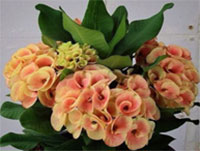
A: On St Patricks Day, they talk about lucky clover. But did you know that your odds of finding a 4-leaf clover are about 1 in 10,000? There is a much better solution - try beautiful Crown of thorns - Euphorbia millii

Date: 24 Oct 2016

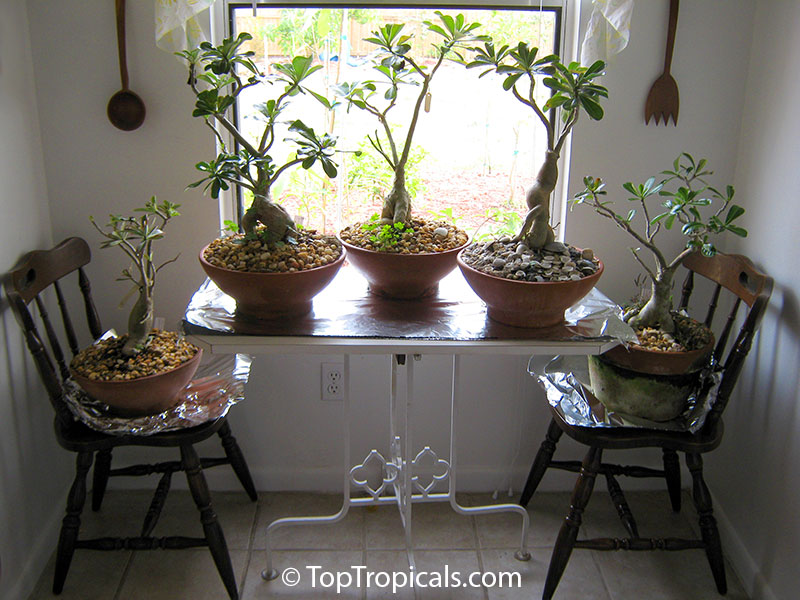
Overwintering Adeniums outside of tropics

Q: We bought several adenium plants from you. We are moving to the Denver area of Colorado. How can we make sure the plants survive? Should we use a green house?

A: Adeniums are perfect container plants, and house plants. They can be easily grown outside of tropical climate. During winter, Adeniums drop leaves and go into dormancy which makes it easy to keep these plants in a dormant stage in a warm location of your house, or possibly even in well-lit spot of garage (with a window), with temperatures above 50-60F.
Here in South Florida, during time of cold, when chances of freeze are high, we move our own Adenium collection into lanai, with plastic sheet protection around lanai.

In colder climates, Adeniums can be kept indoors as house plants during winter. There are some requirements/tips for you:

  • Temperature. Move Adeniums indoors when temperature starts dropping below 45F.
  • SUNSHINE. Use SUNSHINE boosters to improve cold resistance of Adeniums, and essure healthy plant throughout winter. SUNSHINE-BC

Date: 30 Mar 2016

Spring time fun: fertilizing and pruning

Q: When is a proper time to start fertilizing my garden in Spring? Also, when can I cut back cold damaged branches? Should I wait until end of April?

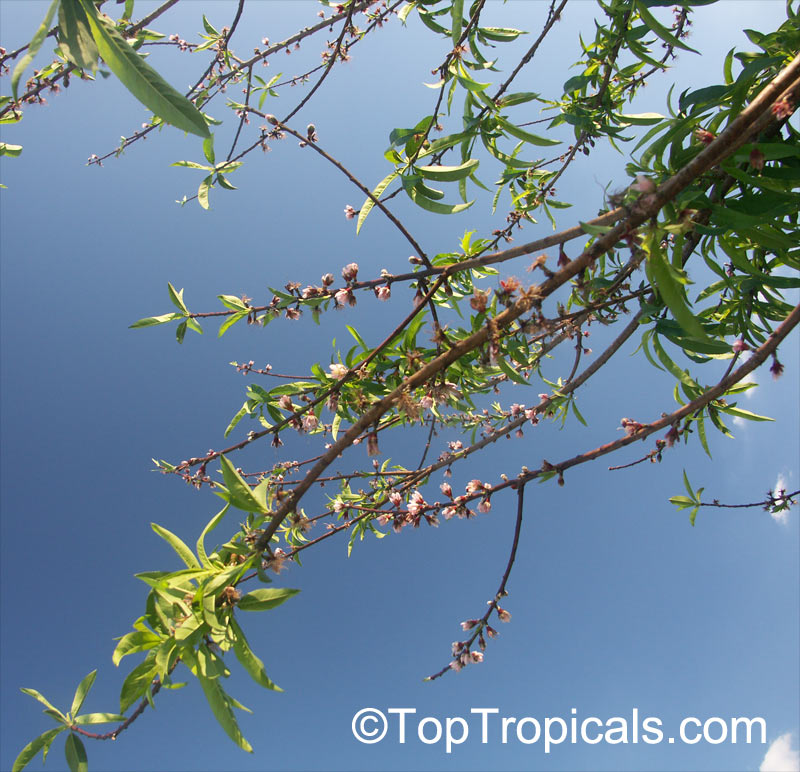
A: As a rule of thumb, fertilizer can be applied during period of active growth, when a plant needs additional nutrients. With indoor plants, you can fertilize pretty much year round as long as the plant continues growing and not dormant. For in-ground tropical plants, start fertilizing when new growth appears. In subtropical areas, with cooler winter months, most tropical plants slow down their metabolism when temperature drops below 65F. Many of them become dormant, and may even lose leaves (especially deciduous plants like Annona, or Peaches/Plums

Date: 10 Mar 2016

Do-It-Yourself Support Structure for Dragon Fruit

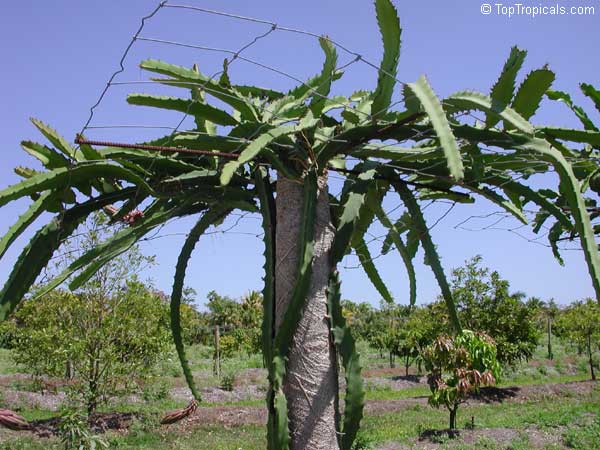
This interesting do-it yourself project was sent to us by our customer from South Florida. Many tropical gardeners want to grow fascinating Dragon Fruit, and their most common question is - what kind of support I should use for this amazing fruiting cactus? We hope you find this information very useful. Happy Gardening!

Dragon fruit is a terrestrial/epiphytic fruit baring cactus, which may grow fleshy stems up to 30 ft high, given sturdy support. However, downward hanging or horizontal branches stimulate production of flowers at the tips of the branches. Commercial groves in different parts of the world use different method to achieve this. The traditional Vietnamese way is to train the plant into a “fountain”, which consists of a vertical central trunk about 8ft tall and a horizontal structure, such as a wagon wheel on top of it to support the horizontal branches (see picture on the right).

This picture served as my inspiration to build my own structure. I used five 4”x4” 10ft wood beams as the trunk, shaped as a cross. I attached the beams to each other with 10” long screws.

I dug a 2 ft deep 12”x12” hole in the ground and positioned the trunk inside, such that about 8ft are above ground. I covered it with several layers of burlap top to bottom.

The horizontal structure on top is made of four 4ft long 2”x2” wood beams and two 12”x12” wood plates to hold them together. I attached this structure to the top of the trunk.

I used old watering pipe to form two rings around the trunk to support the branches. Here is the result!... See step-by-step full size pictures and the rest of the article...