Garden Blog - Top Tropicals

Date: 24 Jun 2018

TopTropicals

SUNSHINE-SuperFood for your plants health

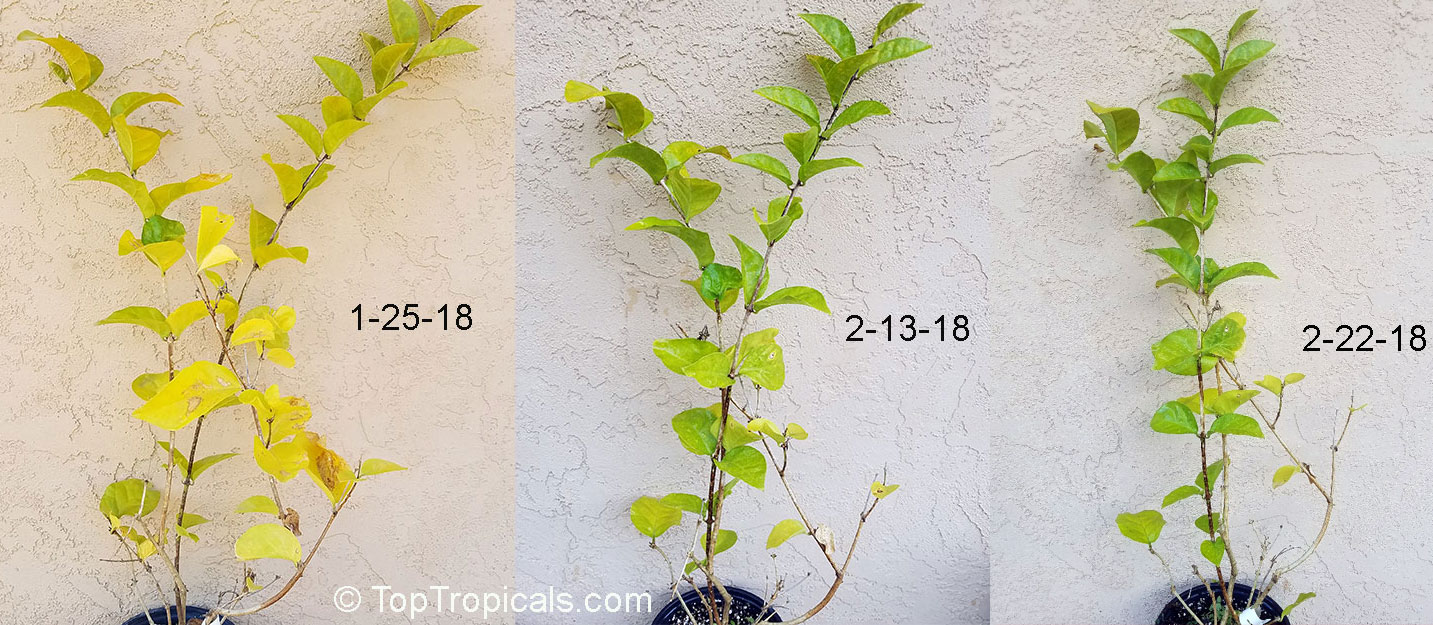
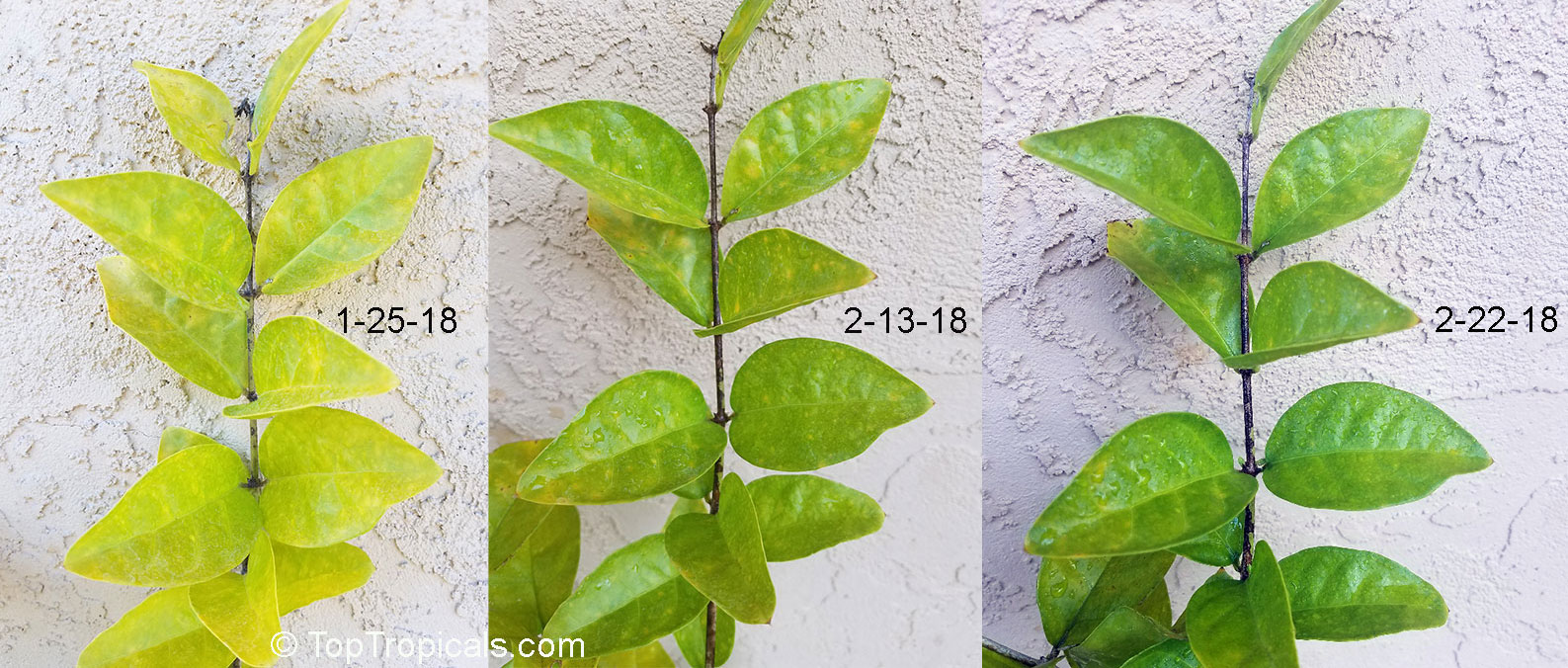
We are getting very high interest from our customers to our new plant booster SUNSHINE-SuperFood as well as many questions. We continue experimenting with the Jasmine that you saw in our previous newsletter, that had pale yellow leaves and numerous deficiencies. Right now, after only 2 applications, it looks healthy green again. Click on the picture to zoom in and see leaves turning from yellow to green within less than a month. See also full plant photo of this jasmine.

Q: Is SUNSHINE-SuperFood a fertilizer?

A: Traditionally we call a fertilizer macro-elements (NPK - nitrogen, phosphorus, and potassium). Technically, SUNSHINE-SuperFood is a complex of micro-elements that are essential for plant's health. It provides such elements as Mg, Fe, Mn, Zn, Cu, B, Mo, S, and Amino-acids that our soils are usually poor of. These elements are responsible for proper development of leaves, roots, flowers, and overall plant vigor. Read more about role of these micro elements.

Q: Can I just get these additional elements in a dry form and add to soil like a fertilizer?

A: No. Some of these elements must present in extremely low concentrations (this is why they are called micro-). SUNSHINE-SuperFood is a liquid substance with very high bioavailability that has very complicated formula; it is not just a mix of the elements. The formula is developed with the maximum efficiency for a plant to absorb through leaves and a root system.

Q: Is it better to spray leaves or water the plant with the solution?

A: Foliar applications are always most efficient in regards of seeing a quick result. However, we recommend to also drench the root ball with SUNSHINE-SuperFood solution to deliver the necessary elements evenly to all parts of the plant through its natural metabolism.

Q: My gardenia looks very sad after winter - most leaves are yellow and some have pale spots. Should I use SUNSHINE-SuperFood more often and in higher concentrations?

A: We recommend to apply SUNSHINE-SuperFood once a month to maintain a general plant health. In difficult cases like with this jasmine on the photo, you can do twice a month. However do not exceed recommended concentration. The rule of thumb is, you can apply water soluble fertilizers and supplements more often, but with lower concentrations - this way a plant will be more responsive. Plant metabolism in general is rather slow, changes take days and weeks - don't try to speed it up. Your patience will be rewarded.

Try SUNSHINE SuperFood on sick looking plants, especially with leaves that are yellowing, deformed or have spots (see photos of different deficiencies). There are no miracles, but this one works like a Miracle! All you need is a few drops of SUNSHINE SuperFood - item 6000! We also have bottles 50 ml and 100 ml for large plant collections and yard/landscape applications. Read more about SUNSHINE SuperFood...

Date: 6 May 2026

Why your plants need more than NPK

Why your plants need more than NPK


Most fertilizers focus on just three numbers - NPK. But that’s only part of the story. If your plants look okay but not amazing, or grow but don’t really thrive, they’re likely missing the smaller pieces that make a big difference.

☘️ Complete nutrition your plants actually use


Plants need more than just NPK. They also require a full range of microelements like iron, boron, magnesium, calcium, and others. These support photosynthesis, sugar movement, and internal plant processes.

Sunshine Boosters include a full spectrum of these nutrients in balanced amounts. This gives plants complete nutrition without needing extra products for basic care.

☘️ The "Potassium Pump" - how plants move water and energy


Potassium plays a central role in how plants move water and energy. You can think of plant cells as tiny rooms with doors that open and close. Potassium helps control these openings.

Where potassium goes, water follows. This movement fills plant cells, making them firm and strong. It also helps move energy through the plant, supporting fruit development and flowering.

With enough potassium, plants handle drought better, grow stronger, and produce better crops.

☘️ Calcium - the backbone of plant strength


Calcium plays a key role in building strong plant structure and keeping growth stable. It is a major part of cell walls, so it directly affects how firm and healthy the plant tissues are. When calcium is available, plants develop stronger stems, better roots, and more solid fruit with improved shelf life. It also helps regulate how nutrients move inside the plant and supports proper cell division, which is important for new growth, root tips, and developing fruit.

Calcium improves resistance to stress, including heat and disease, and helps prevent common problems like blossom end rot, weak growth points, and poor fruit quality. Because calcium does not move easily inside the plant, a steady and available supply is important throughout the growing cycle.

Calcium cannot be mixed with NPK dry fertilizers. It forms insoluble compounds with phosphates and sulfates, so it has to be dosed separately.

In Sunshine Boosters, Calcium is present along with additives - complex agents and pH regulators. This allows you to dose calcium, sulfates, trace elements and other additives in one solution without fear of fertilizer lockout.

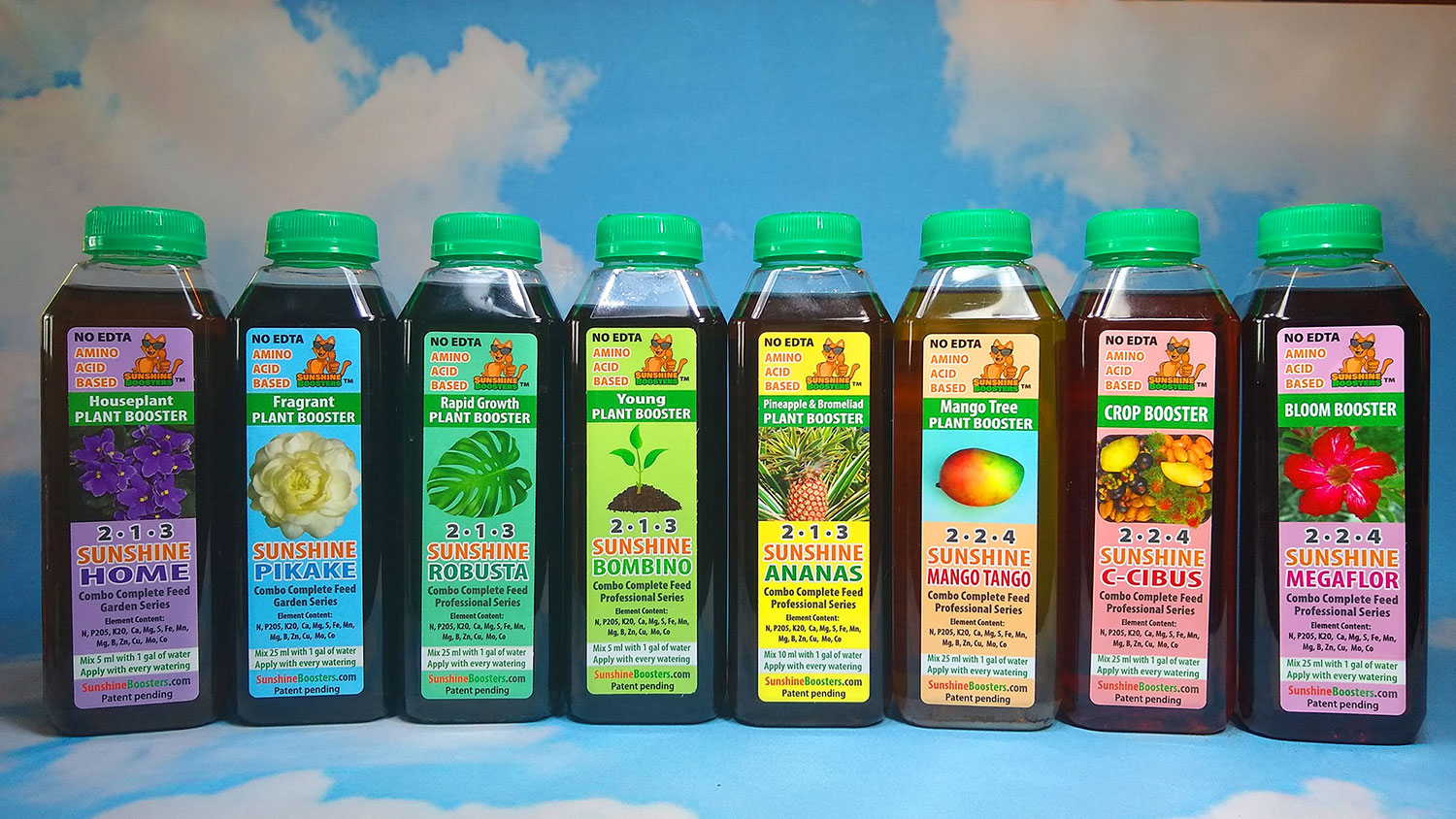
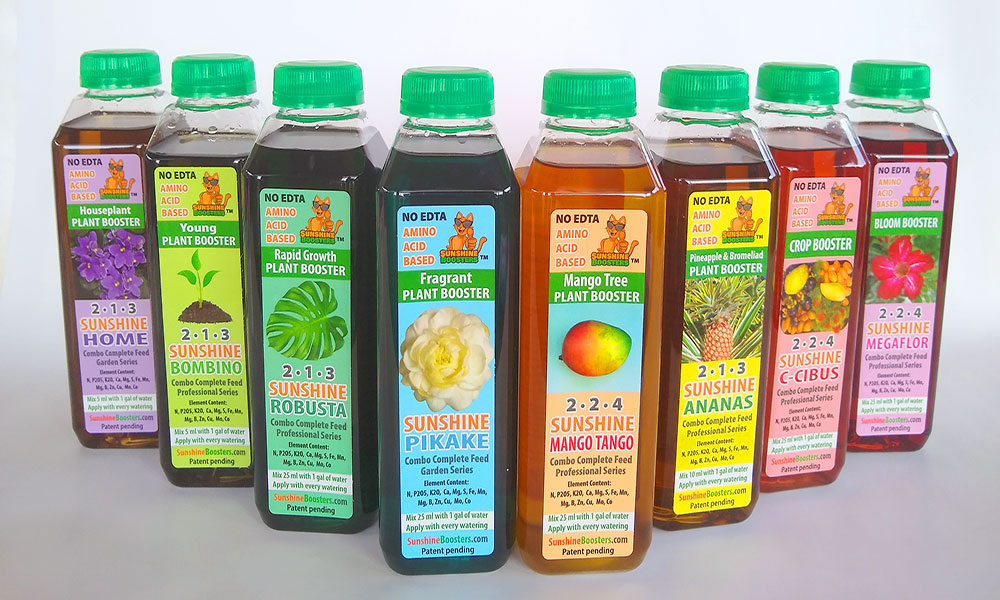
👉 To be continued - next we’ll break down the 10 main Sunshine Boosters formulas and how to match them to your plants. 👉 More...

🛒
Get your plants real food

📚
Learn more:
What makes Sunshine Boosters different
This changes how you feed your plants
Sunshine Boosters: Complete Plant Nutrition System
Frequently Asked Questions: Plant Nutrition & Fertilizer
Green Magic + SUNSHINE Boosters: A Complete System for Strong Plant Growth
Spring Nutrition Strategy: Is Your Garden Starving?
How to keep your house plants beautiful all year by feeding them right
Why do you need Sunshine Boosters?
Which dry fertilizer to use - slow release or controlled release?
Green Magic effect: before and after
The SECRET growers never tell you: simple trick how to bring plants back to life and keep green
📱 What are Sunshine Boosters

#Discover #Fertilizers #How_to

🟢 Join 👉 TopTropicals

Date: 19 Jan 2021

Healthy Plants: Q&A from Mr Booster

Fertilizing in Winter

Q: I have many tropical plants in my garden, both in the ground and in pots. I realize it is wintertime and some of them, the Hydrangea, Hibiscuses, and roses are in bloom but the rest of them seem wilty and droopy. Is it alright to fertilize them now, or should I wait for a few days? I have an all purpose tropical fertilizer and a 20-20-20 also. Please advise what to do.

A: During wintertime, tropicals may suffer from low temperatures and lack of sunshine which causes droopy leaves, and leaf loss.
Regardless of the cause and plant condition, you should NEVER apply traditional dry fertilizers during cool months. When cold, dry fertilizers (EDTA-chelated) may create nutrient lock up in soil and damage the roots. Dry fertilizers (both granulated and water-soluble) can be used only during hot season - when min temperatures stay above 65F for at least a week in a row, and daytime temperatures are over 75-80F. During hot, active growth season plant metabolism increases. This provides less chance for a chemical root burn, as the nutrients are used up quickly.

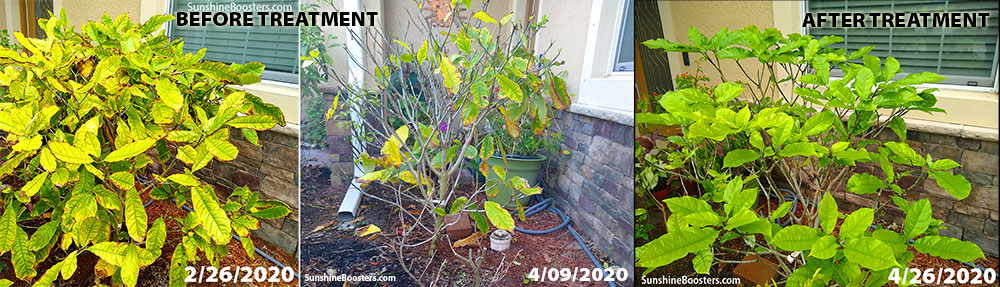
However, liquid fertilizers, as long as they are amino-acid based, can be used year round. From our own experience last winter, we discovered that fertilizing sickly looking plants (with signs of cold damage and root issues) with Sunshine Boosters actually revived those plants. Sunshine Boosters even brought back to life some hopeless specimens. Take a look at this gardenia that grows in our garden (picture above). See full article.
In your case, it would be beneficial to use a mild formula of liquid boosters in combination with Sunshine Epi -a natural plant hormone that boost their growth and helps to cope with cold-, temperature- and low-light-related stress.

These are the products we recommend:
- Sunshine Bombino - add to every watering
- Sunshine Epi - twice a month as foliage spray

Since you grow plants in pots, feeding program is especially essential, because plants are limited with a container size where roots can't reach out to more food in the outer soil. In professional nursery set up with injector irrigation systems, container plants are fed daily (depending on season, more than once a day) with every watering. This is why greenhouse plants are so healthy looking.
So feel free to give your plants Sunshine boosters with every watering, dozing according to the label. During cold period, plants need less frequent watering, so fertilizer input will be balanced accordingly, it will depend on temperature and plant metabolism.

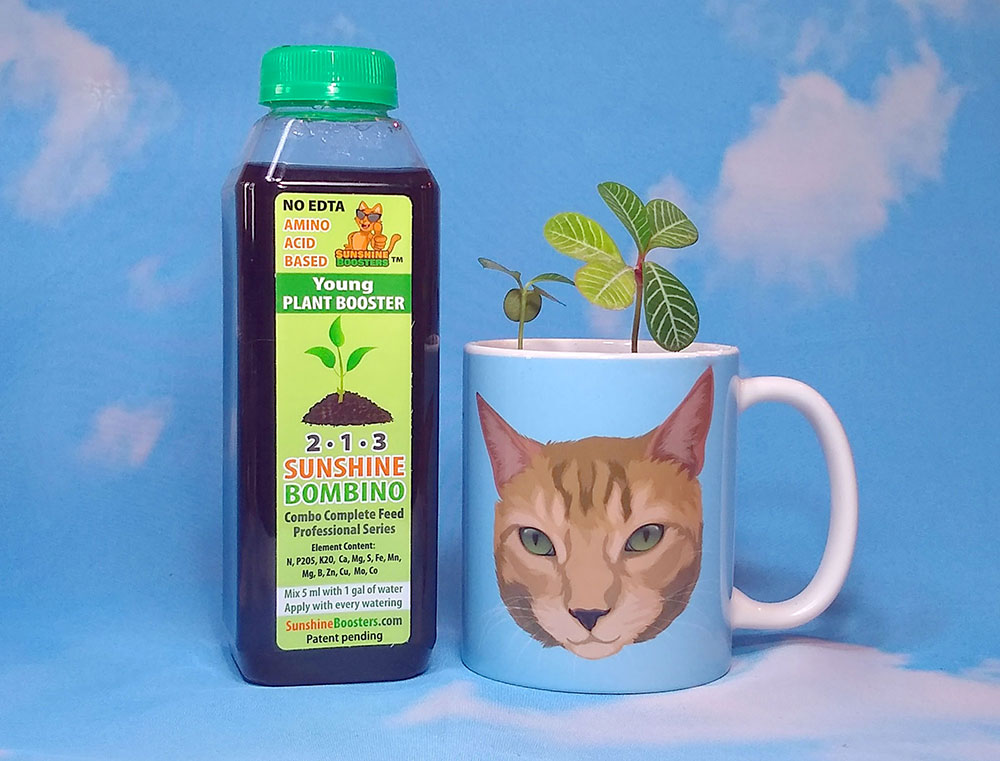
Sunshine Bombino - mild, "pampering" formula for young and tender plants, as well as plants recovering from stress and/or winter damage.

Date: 13 Jul 2023

Fertilizing during rainy season

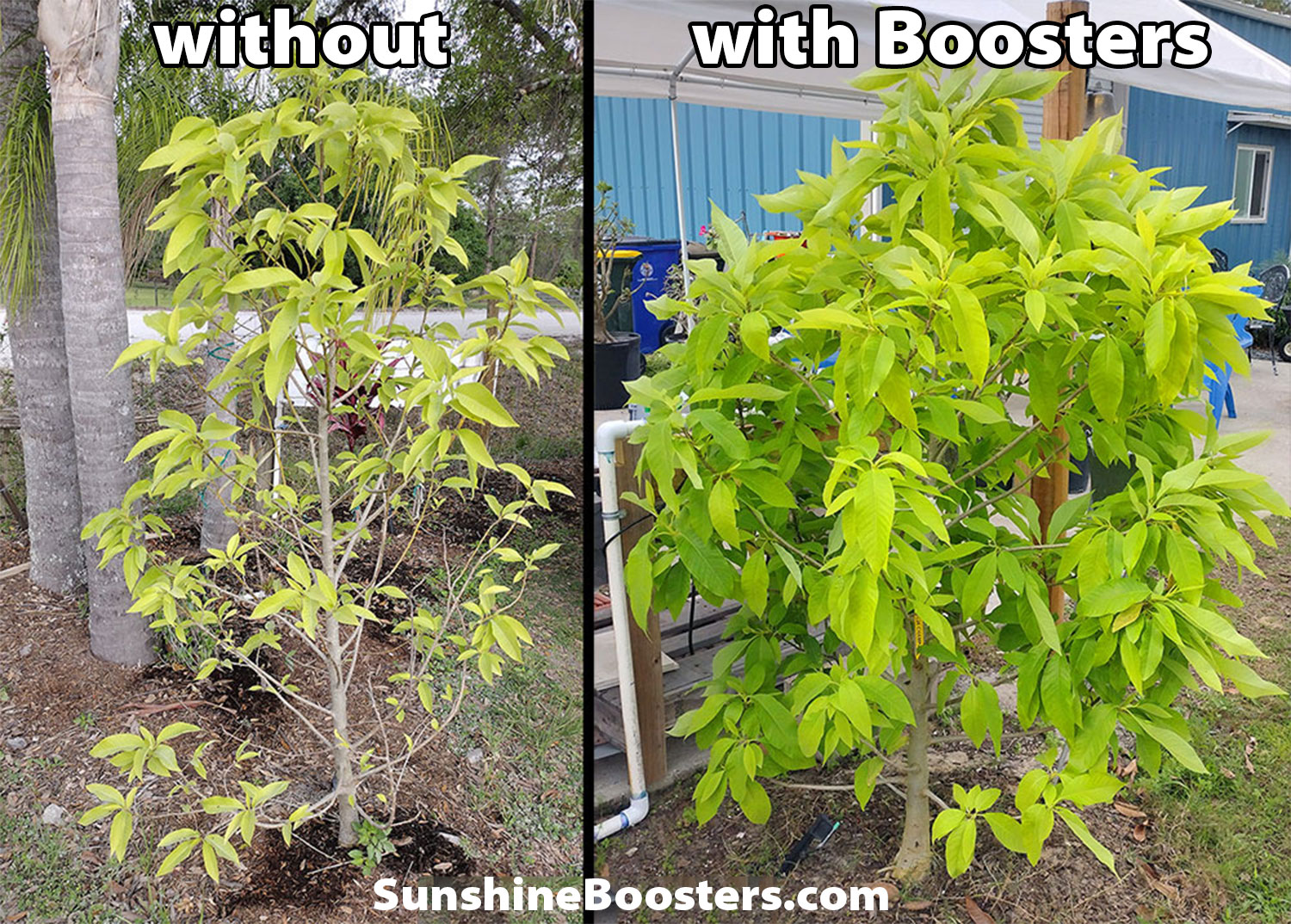
Champaka  trees  without  and  with  Sunshine  Boosters

Q: I have installed your Robuster unit to fertilize my fruit trees, but here in Florida, it is the rainy season and most of the time I do not need to irrigate during the summer. What do you recommend to keep up with fertilizing program?

A: This is what we recommend for fertilizing during rainy season:

For in the ground plants

If there are frequent rains, it's not necessary to use any fertilizers except for slowly soluble ones. During rainy periods, use a slow release fertilizer. Simply scatter 3 oz per 100 square ft. You can adjust the amount based on your specific area and number of plants.

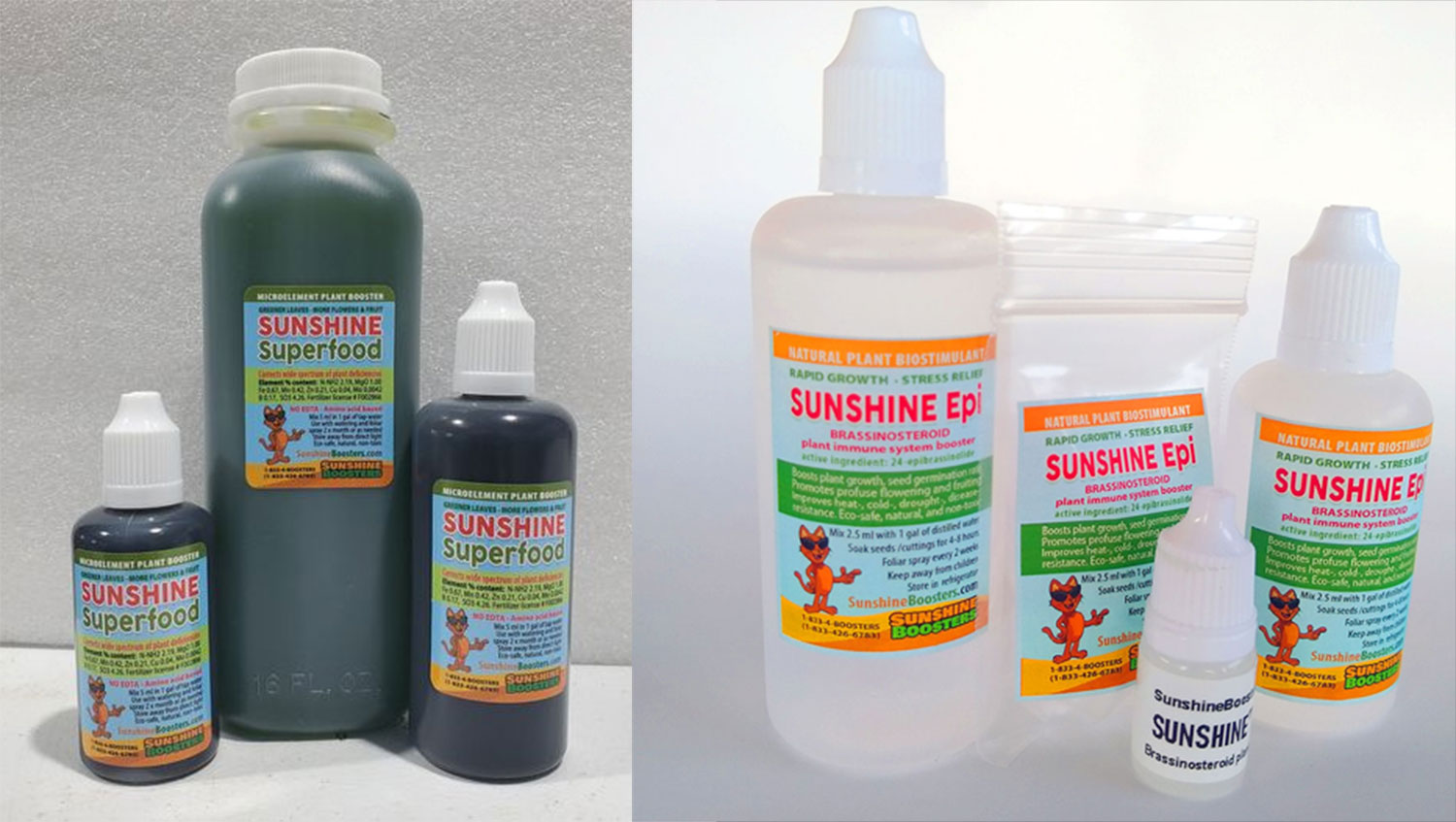
Additionally, for foliar treatments, use Sunshine SuperFood microelement supplement and Sunshine Epi biostimulator.
When you water next time, regardless of whether it rained or not, resume using liquid Sunshine Boosters.

Sunshine  Superfood  and  Epi

For potted plants

When you water your potted plants, use liquid Sunshine Boosters. Every 1 or 2 weeks (we recommend weekly), apply Sunshine Garden Series (the same type you are using when watering) for foliar treatment. Use the same dosage as you would for watering. By following these recommendations, you can ensure that your plants receive the appropriate nutrients during the rainy season.

Sunshine  Boosters  Garden  Series

the  Robuster

Date: 16 Dec 2021

Why should you use Sunshine Boosters?

by Ed Jones, the Booster guy

...You have heard it before, but I will tell you again. Sunshine Boosters are safe to use with every watering. It means that you can use Sunshine Boosters amino acid based fertilizers whenever you water your plants, even in the winter. Why is that so important?..

...We normally stop using dry, timed release, fertilizers around the first of November and not resume using them until the first part of March. This is true in many areas of the deep south where the ground stays above freezing year round...

However, it is safe to use Sunshine Boosters during these cooler months... Temperature does not play a role in the absorption of nutrients when using Sunshine Boosters...

To find out how it works, see Ed's new Article Why should you use Sunshine Boosters. If you want to learn even more in depth, check out his blog: Micronutrients Delivery Systems.

As of this writing, all Sunshine Boosters are on Holiday Sale. There are boosters for all different types of plants. Check them out and -

Give your plants a little something extra for Christmas!

CONTINUE READING >>