Date: 27 Feb 2020
7 secrets of a Happy Avocado Tree
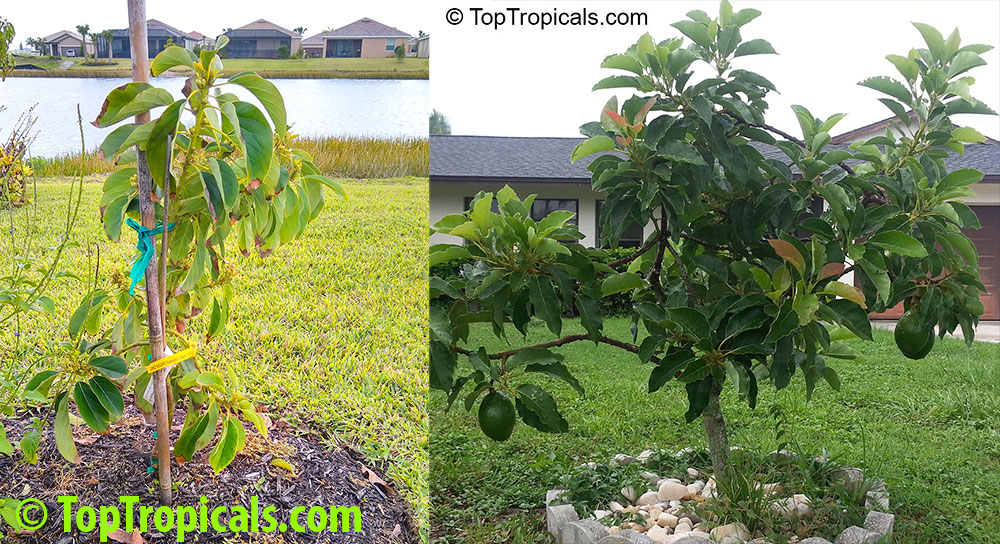
Q: I purchased an avocado tree from local garden centers three times but every time it dies on me. My neighbor has a nice tree in his yard and it grows beautifuly. I just purchased one online from you and I need to know what I was doing wrong? Are there any secrets how to make an Avocado tree happy? I have a big garden and several mango trees, but no luck with Avocado...
A: Avocado tree is famous for being such a pain to establish. But once it starts growing, it's growing! We will share a few simple tricks how to make it right.
1. Plant high and provide good drainage. Wet feet is number one
reason for failing an avocado tree. It doesn't like wet soil and won't
tolerate soggy conditions. Plant it in the highest spot of your yard and slightly on
a "hill" (3-4"higher than the surrounding ground).
DO NOT plant Avocado tree in low spots or wet spots of your yard. Save
those spots for Cannas or Black Sapote or even a Mango if you want a fruit tree there.
2. Use quality soil. Use only well-drained soil with high content of
organic matter. You may add compost to existing sandy soil, or add some professional potting mix that contains pine bark and perlite. Remove
rocks from the hole if you see any while digging. Dig a big hole and fill it
with a good soil; compact the soil in the hole very well before setting the
root ball. Reminder: plant the tree high!
3. Water regularly. After planting an Avocado tree in a nice high
spot with a good drainage, start watering it... daily! Avocado likes water,
although it doesn't like wet feet! Once you figure out this combination, you've
got the recipe of success. Water by hand daily for the first week after
planting, then twice a week for couple weeks, then once you notice new growth -
you may rely on sprinklers, but keep watching the tree and don't let the soil
over-dry. It must be slightly moist, but not soggy.
4. Fertilize. For such finicky tree, we suggest mild formulas of
fertilizers. Dry fertilizers may burn roots, especially of a young tree. Even
smart-release granulated fertilizers should be used very carefully. The best
way to feed your young avocado tree - get a complete set of Sunshine Boosters Pro system. It has all necessary elements for all
stages of plant development and never burns the roots. Sunshine Boosters Pro can
be used with every watering - no need to guess how much and when. Besides,
it is a natural fertilizer based on amino acids - exactly what you want to use
on your fruit trees and other edibles!
5. Boost immune system of the tree. Apply Sunshine Epi plant hormone every 2 weeks as a foliar spray to boost
immune system and metabolism of the tree and protect it from diseases. Epi makes
plants (especially young plants) grow twice faster! It also enhances effect
of fertilizers by increasing plant metabolism.
6. Do not prune until you see significant growth. The tree is small
and can use as many leaves and branches as possible for photosynthesis and
healthy metabolism. We suggest to avoid pruning for at least the first year. On
the second year your tree most likely will be covered with flowers (assuming
you followed fertilizer program). Let it go through the blooming stage and
setting fruit; prune in Fall after fruiting is over.
7. Keep number of fruit to minimum for the first crop. Don't let the
small tree exhaust itself. Keep just 2-3 fruit to develop. The next year, no
need to control fruit quantity, the tree will develop as many as it can
support.
P.S. If you got the tree from a mail-order, remember to establish it
in a pot before planting in the ground; move gradually from shade to sun.
Follow planting instructions.
Learn more about Sunshine Nutrition System - a Natural solution for your garden.

Date: 14 Jul 2019
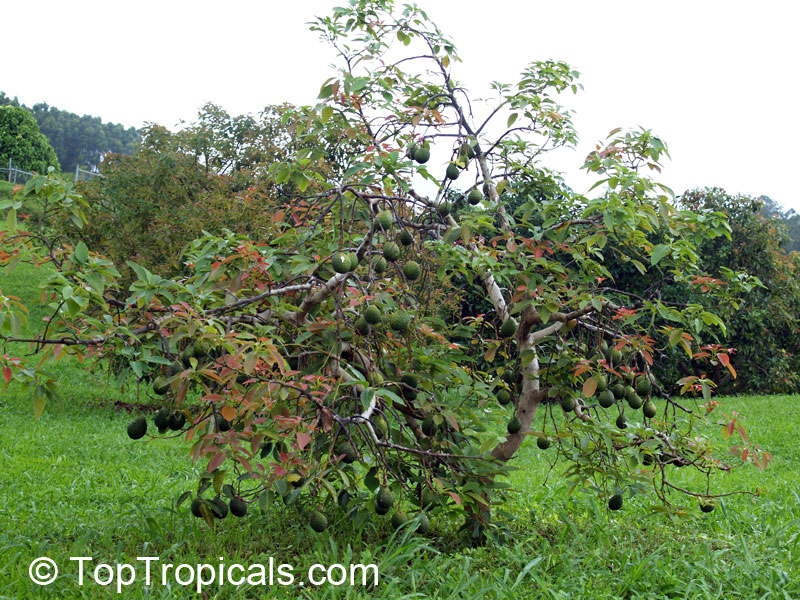
Dwarf and Condo mangoes - easy mangoes
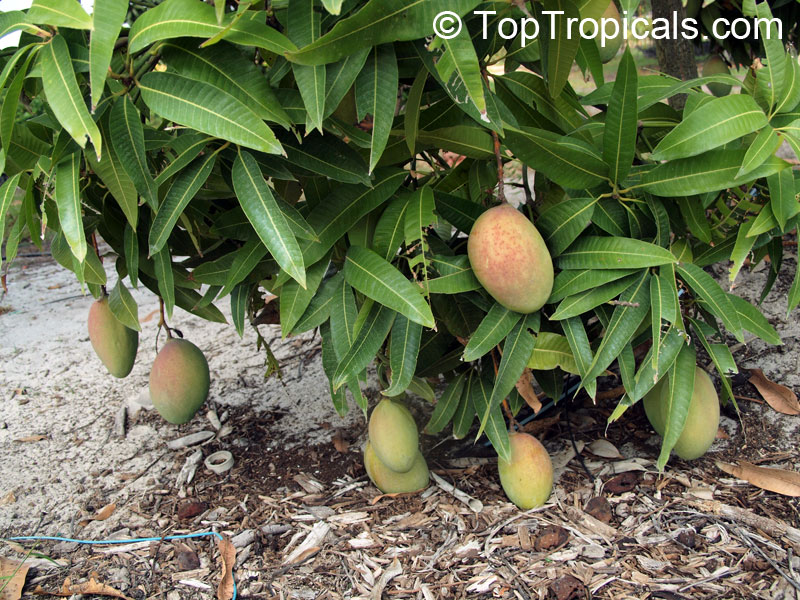
Q: We leave in zone 6a, could you tell us what is the list of different types of mango plants that could be planted indoor and that they can bear fruits?
A:There is a large group of mangoes called "Condo Mango" - they literally can be grown in your apartment! Those are dwarf varieties that can remain compact in containers with minimal pruning and successfully bear fruit providing bright light and proper care, including plant food.
The best dwarf and semi-dwarf varieties are: Carrie, Cogshall, Cushman, Fairchild, Graham, Ice Cream, Julie, Mallika, Nam Doc Mai, Pickering, Irwin, Jahangir, Juliette, Lancetilla, Little Gem, Manilita, Sia Tong, Torbert, Pim Seng Mun, Super Julie.
They produce juicy, fiberless sweet fruit. Julie is also a very popular dwarf variety, however, it is very cold sensitive and not the easiest to grow. If you get a 3 gal size mango, step it up to 7 gal when the plant reaches 4 ft; you may use a bigger container as the root system grows, up to 15 gal or even 25 gal, space permitting. Trim the tree under 6-8 ft after production season is over (summer-fall).
See more information on growing condo mangoes
RECOMMENDED FERTILIZERS:
Mango-Food - Smart Release Fruit Tree Booster
Fruit Festival Plant Food - Super Crop Booster
For sweeter fruit, use
SUNSHINE-Honey - sugar booster

Date: 25 Jan 2021

Healthy Plants: Q&A from Mr Booster
How to get Canistel tree to produce
without dropping flowers and fruit
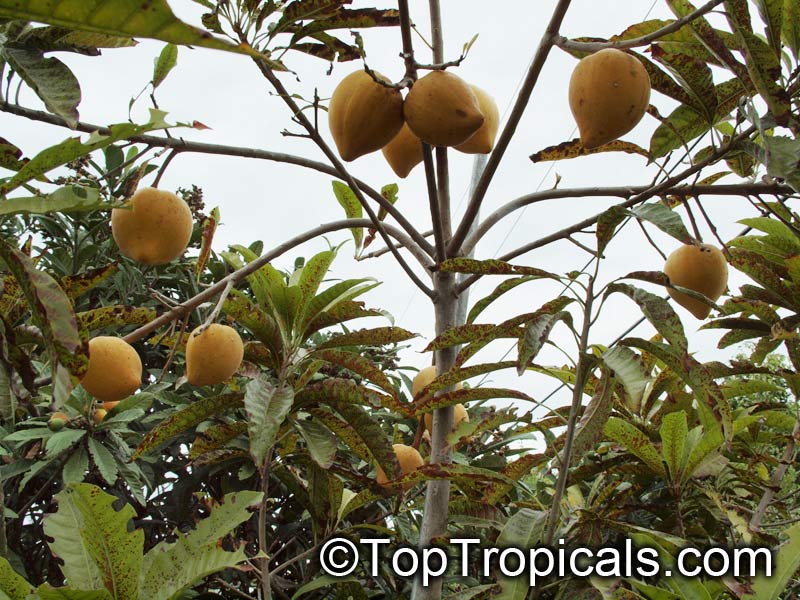
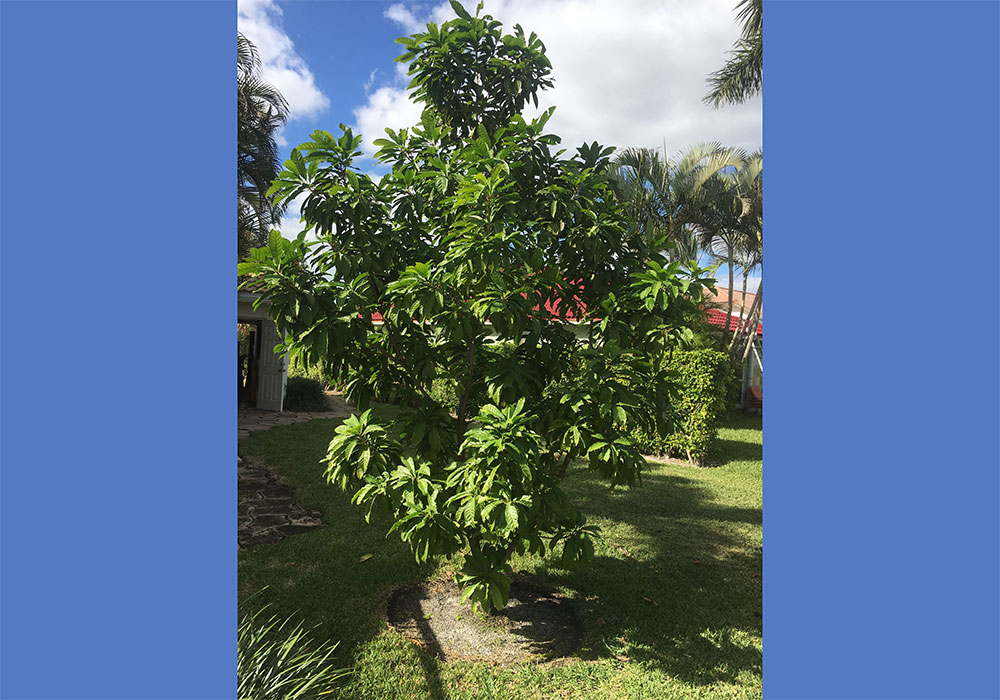
Q: My Canistel tree is 3 1/2 years old and is growing very well, see the picture below. It gets hundreds of pea sized "berries" but then they fall off. No canistel fruit. What's wrong?
A: You have such a nice looking tree, it is a shame you can't get
any fruit to ripen.
In our experience, Pouteria trees dropping fruit prematurely is a very common problem.
There may be one of the following reasons, or a combination of them:
- Cold winters may affect production, and while Canistel is generally
pretty hardy tropical plant that can easily withstand short periods of chill, the
fruit may never form properly if it had a cold winter.
- Lack of water. Canistel tree is pretty drought tolerant, but for the
proper production cycle it needs regular irrigation. Especially during hot
summer.
- The tree may be not strong enough; young trees drop fruit very often when
they don't have enough "fruiting energy" built up in their system.
Your tree looks well established and vigorous, however, flower/fruit drop
is often a sign of insufficient nutrients of particular kind, usually Boron
(B) and/or Molybdenum (Mo): either when a tree is too young and not strong
enough, or because of poor soils and lack of necessary elements.
Here is what can be done, considering you live in a warm, frost-free climate.
1. Provide regular fertilizing program. We recommend liquid
fertilizers Sunshine Boosters that are safe to use with every watering and year
around. It is beneficial to switch plants from traditional "slow-release"
fertilizer to the liquid one because it makes a huge difference in plant growth
and flower/fruit quality and quantity. See also:
- Why liquid fertilizers are better than dry
- Article about benefits of liquid fertilizers.
Use this plant food for your Canistel tree:
SUNSHINE C-Cibus - Crop Nutrition Booster
2. Apply micro-element remedies that are very effective for improving fruit production, especially when flower or fruit drop occurs:
SUNSHINE Honey - promotes more efficient blossoming and pollination, makes
flowers bigger and reduces bud drop.
SUNSHINE SuperFood - improves plant vigor and quality and size of
flowers
These are all natural, eco-friendly supplements that work great for fruit
trees and other edibles.
Date: 16 Nov 2019
When to apply super boost?
Sunshine Boosters: a breakthrough in Winter fertilizing
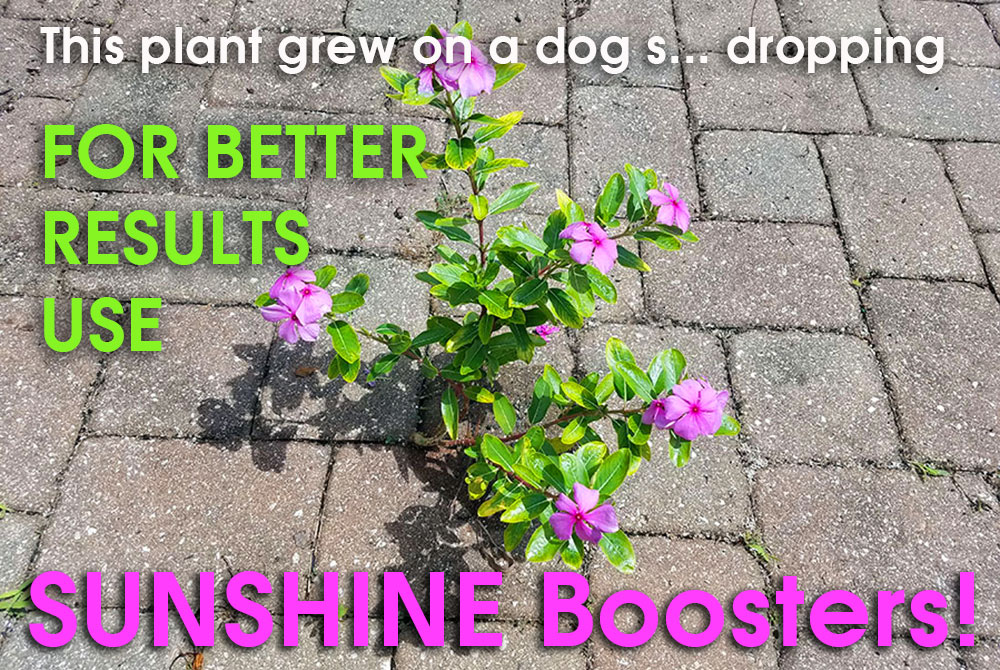
In the photo: plants are tough survivors. Life can't be stopped even by a brick road!
Q: Just wanted to know best time of day to apply super boost as spray and watering? Only listed to make sure night temp doesn't drop below 65F...
A: As a rule of thumb, plant's needs in fertilizers are very low
in the cold season because they consume less nutrients during dormancy. For
tropical plants, when minimum temperatures drop below 65F - we stop
applications of dry (granulated) fertilizers until spring, to avoid root burn.
Liquid Sunshine Boosters are exceptions from this rule to a certain extent,
for 2 reasons:
- they are amino-acid based which means, salts do not build up in the soil,
and thus will not burn the roots even with slower plant metabolism.
- concentrations/formulas are mild and designed for as frequent as daily
watering
Tips for winter fertilizing:
1) When a plant goes into full dormancy (drops leaves and does not show any new growth), you may stop fertilizing with any Macro NPK products (both dry and liquid)
2) If a plant is evergreen and continues growing during the cooler
period, and especially if it is a winter bloomer, mild liquid fertilizers can be
applied, depending on the stage of plant development.
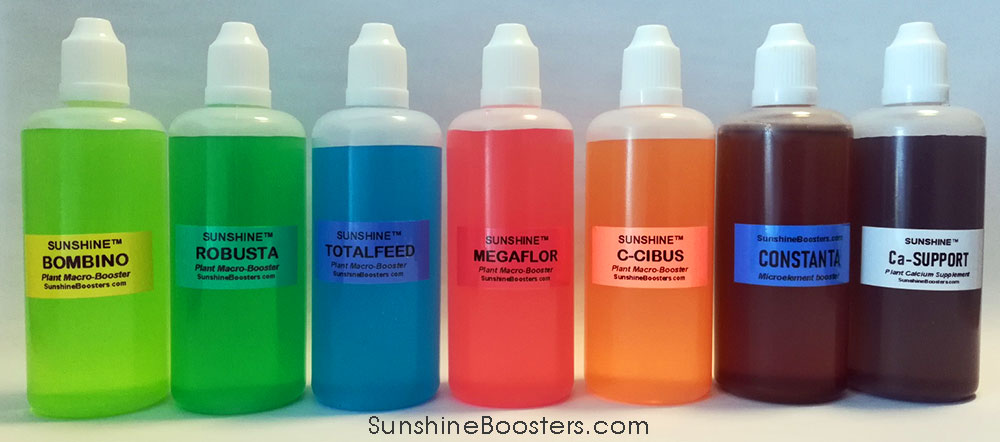
Robusta and TotalFeed are used for vegetative growth and pre-flower.
Megaflor and C-Cibus are used for winter flowering/ fruiting plants during the bloom
stage.
See full list of liquid boosters
3) Micro-elements can be used all year round for all plants that are not dormant (do not drop leaves)
4) Always use Sunshine-Epi as a foliar spray to activate immune system and unlock protective mechanisms, BEFORE applying other boosters. It is especially important during Fall-Winter for improving cold tolerance and disease resistance.
5) Always apply foliar spray and/or drench the soil with solutions in morning hours so the plant has time to process the nutrients during daylight when metabolism is the most active.
6) Avoid any dry fertilizers during winter
Date: 2 Mar 2025
What Fertilizer to Use Now and How?
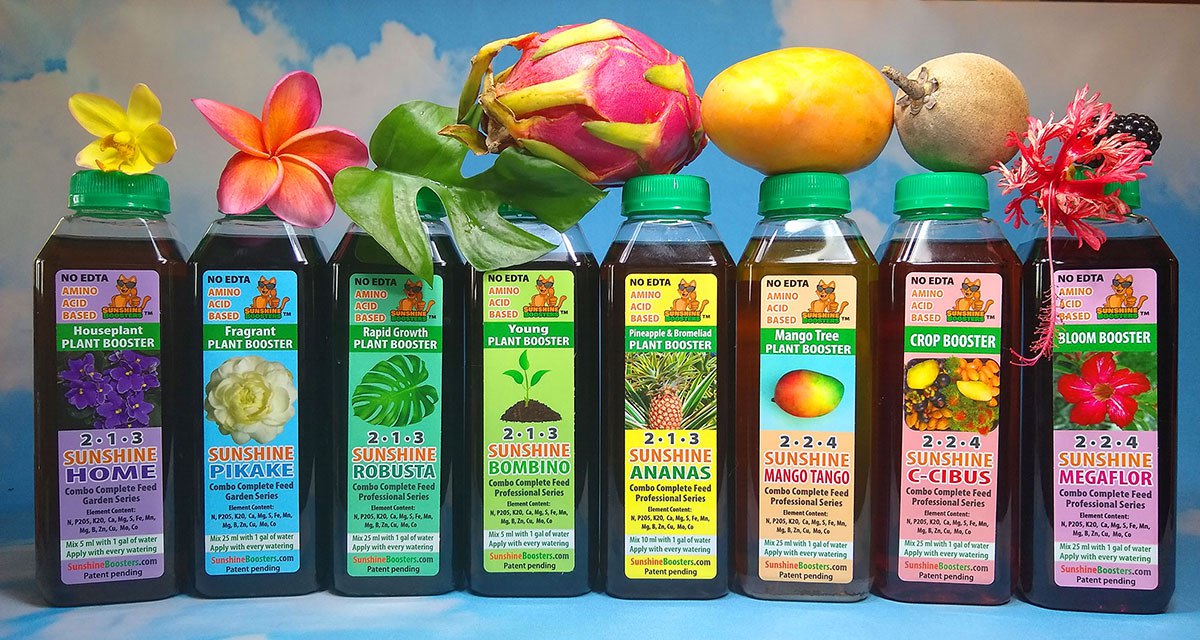
Sunshine Boosters liquid fertilizers
🍲 What Fertilizer to Use Now and How?
Part 1. What are important keys to healthy plants
❓ Q: It's early Spring this year. Should I start fertilizing my plants sooner than usual?
- ✔️ A: Most fertilizer instructions recommend fertilizing tropical plants from March to November. This is because plants don't need as much food during the cooler months when many go dormant, and excess nutrients can burn the roots if not absorbed. However, for the most effective fertilizer program and healthy plants, consider these points:
✔️ Sunshine Boosters Year-Round
Liquid amino-acid-based fertilizers like Sunshine Boosters are safe to use year-round. Since watering is reduced in cooler weather, the intake of water-soluble fertilizer is also lower, providing plants with just the essential nutrients for their minimal needs.
✔️ Dry Fertilizer Schedule
Be cautious with dry fertilizers. Apply them only during active growth in the hot season.
✔️ Temperature Is Key
If March is still cold, delay dry fertilizer use. However, if nighttime temperatures in February stay above 65F, you can start a dry fertilizer program using slow-release, granulated plant food.
✔️ What Fertilizers to Use and How
Check out our Sunshine Boosters selection for different types of plants and choose the right type for your needs. These can be applied as often as with every watering. We will explain in details about every type of fertilizer in our next post🔽
🛍 Shop Sunshine Boosters
#Fertilizers #How_to
🔴 Join 👉 TopTropicals