Garden Blog - Top Tropicals

Date: 7 Jun 2026

🌿 The Vanilla Plant That Outgrew Its 100-Gallon Container.
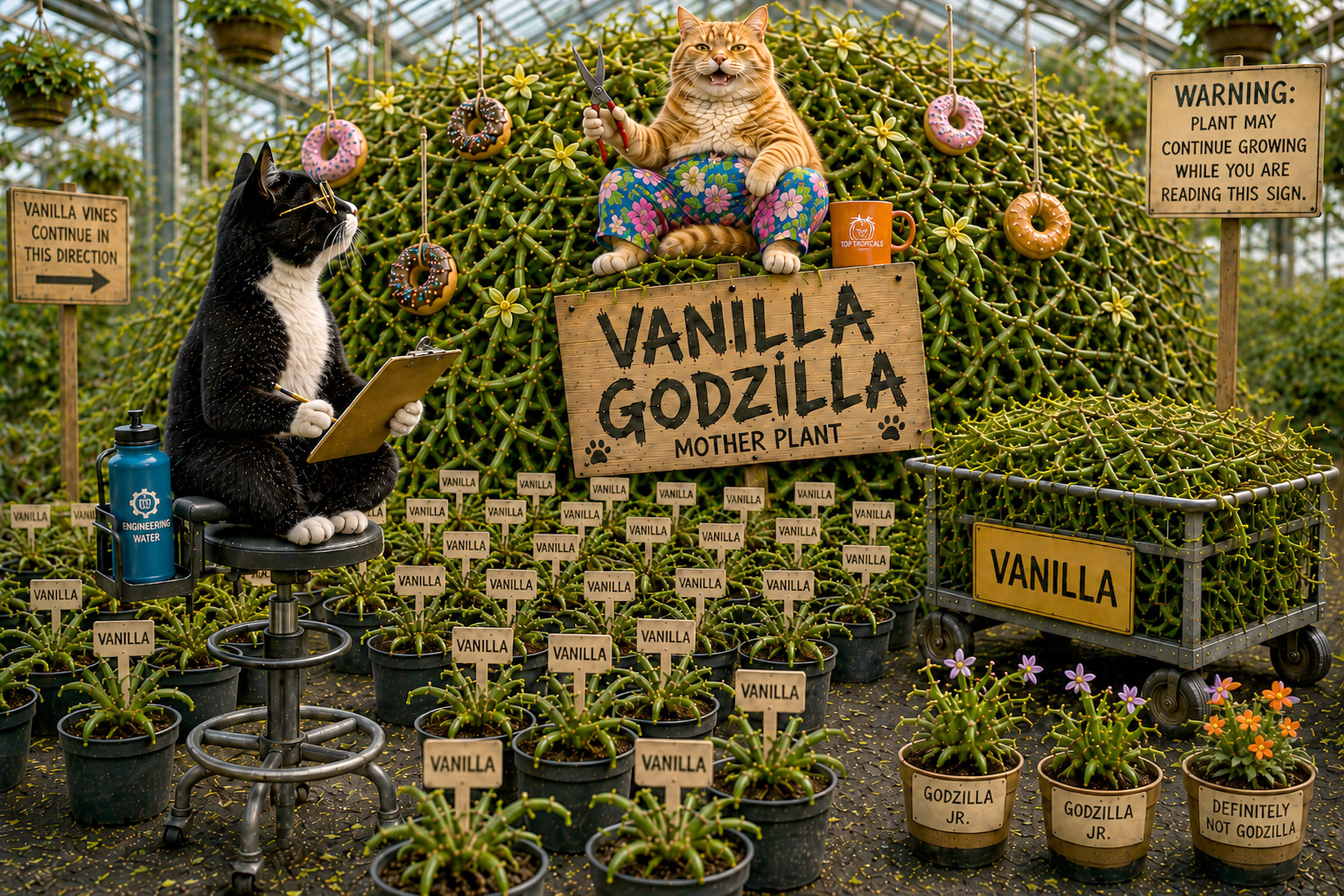
Smokey  the  tuxedo  cat  and  Sunshine  the  orange  cat  inspect  a  giant 
 Vanilla  Godzilla  mother  plant  in  a  greenhouse.  Sunshine  sits  atop  a  massive 
 mound  of  leafless  vanilla  vines  holding  pruning  shears,  while  Smokey  takes 
 notes  among  dozens  of  young  vanilla  plants  propagated  from  the  giant 
 specimen.
Smokey: Is that really the entire mother plant?
Sunshine: Most of it.
Smokey: What do you mean "most of it"? And why are there donuts hanging from the plant?
Sunshine: We still haven't found the other end. The donuts attract pollinators.
Smokey: Donuts do not attract pollinators.
Sunshine: Then explain why I keep visiting the plant.
Smokey: You work here.
Sunshine: That's what the plant wants you to think. It's called "Intelligent Design" for a reason.

The plant Sunshine is perched on is not a hedge. It is not a wall. It is a single specimen of Vanilla dilloniana, Dillon's Vanilla, and it has a name: Intelligent Design. Unlike the familiar Vanilla planifolia — the commercial vanilla of ice cream and extract — dilloniana produces no leaves. The plant is essentially a green vine, photosynthesizing entirely through its stems. It is an unusual and striking grower, and in good conditions it can develop into an impressive, multi-branched specimen. It is classified as rare, and is considered vulnerable or endangered across portions of its native range.
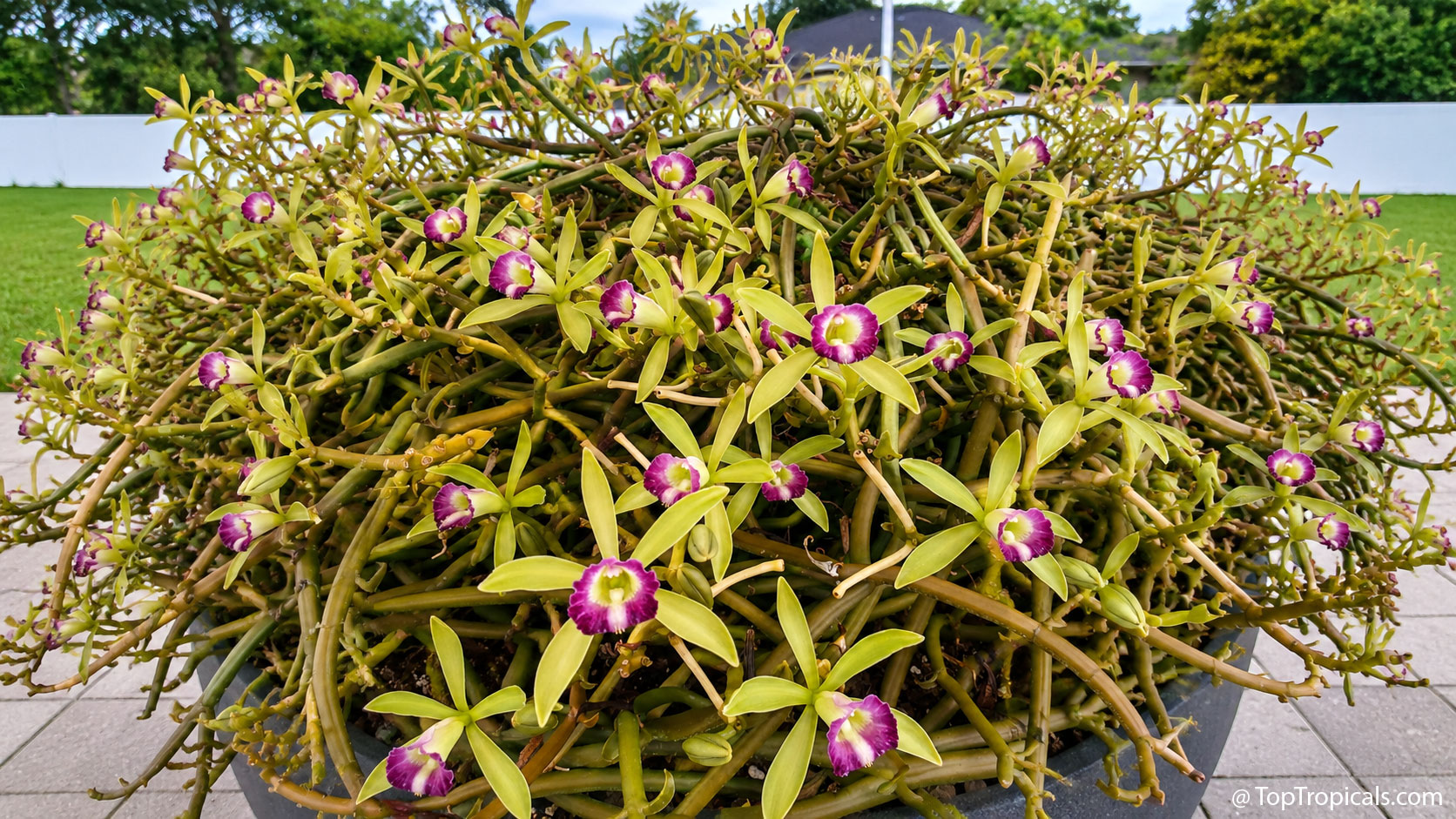
Close-up  of  the  Vanilla  dilloniana  mother  plant,  Intelligent  Design, 
 growing  in  a  100-gallon  container.  Hundreds  of  leafless  green  stems  weave 
 together  into  a  dense  mound  covered  with  pale  green  orchid  flowers  featuring
    vivid  purple  and  white 
 centers.

Vanilla dilloniana in full bloom before its next major upgrade.

Intelligent Design was grown and lovingly tended for years by Robert Riefer, a grower who is both a good friend of Top Tropicals and one of the most dedicated orchid collectors we know. The mother plant of this specimen traces its origins back to 1927 - nearly a century of continuous cultivation.

In 2011, the American Orchid Society recognized this remarkable plant with a Certificate of Horticultural Merit (CHM), one of the society's formal awards for plants of exceptional quality.

By 2017, the plant had already become well known in the orchid and tropical plant community, appearing in a video that documented Robert moving it into a 100-gallon container. That video became something of a legend among collectors.

🎥 Video: the biggest Vanilla Orchid in the world moving to 100 gal pot

Then the plant kept growing.

It outgrew the 100-gallon container. Robert eventually moved it into a 250-gallon pool on wheels - because when a plant refuses to stop, you give it room.
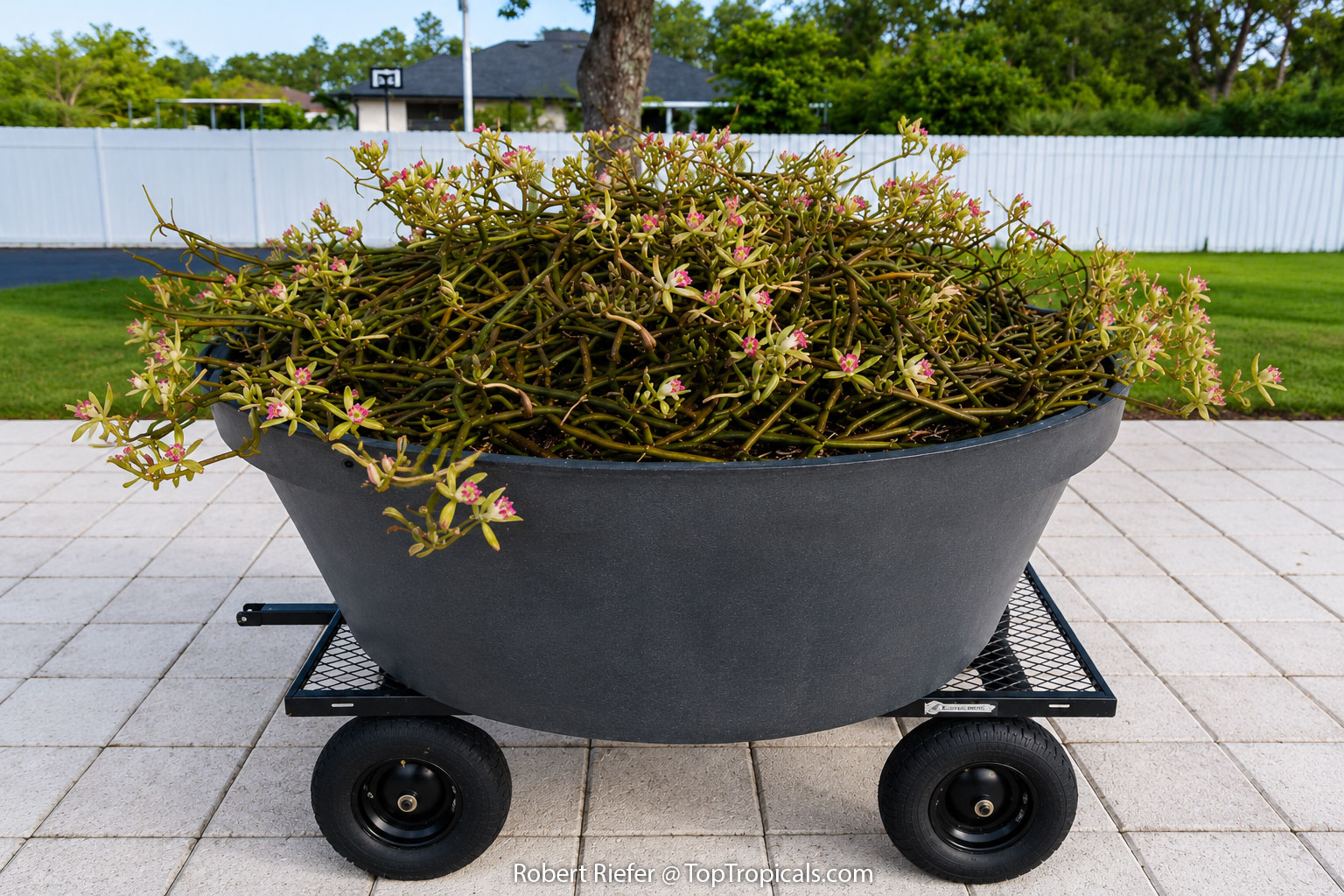
The  Vanilla  dilloniana  mother  plant,  Intelligent  Design,  growing  in  a 
 massive  250-gallon  container  on  wheels,  with  thousands  of  leafless  green 
 stems  forming  a  dense  mound  covered  in  small  orchid 
 flowers.

The move to a custom 250-gallon container allowed continued growth and flowering.

The plant is currently on display at Edison Ford Winter Estates museum and botanical garden in Ft Myers, Florida, during the month of June, where recent photographs show it larger and more floriferous than ever. It is, as best anyone can determine, the largest known cultivated specimen of Vanilla dilloniana in the world. If you are local or visiting Florida, don't miss the chance to see this world-famous orchid in person. It is expected to continue blooming through June.

And here's the remarkable part: the Vanilla dilloniana plants available from Top Tropicals are propagated directly from this exact plant - Intelligent Design itself.

🛒 Add Intelligent Design Vanilla to your collection

👉 A Piece of Living History - Direct from the Source

Young  Vanilla  dilloniana  plants  at  different  stages  of  growth,  showing 
 rooted  cuttings  trained  on  bamboo  stakes  in  1-gallon  pots  alongside  a  larger
    wrap-around  specimen  filling  a  7-gallon  container  with  thick  leafless 
 vines.

Every legendary Vanilla dilloniana starts somewhere. On the left are young Vanilla dilloniana plants. On the right is a more mature specimen in a 7-gallon pot beginning the characteristic wrap-around growth habit that eventually transforms this unusual orchid into a sprawling, sculptural giant.

Vanilla dilloniana is a rare species, considered vulnerable to endangered across parts of its native Caribbean range. Plants with documented provenance - especially provenance tied to a named, award-winning, century-old specimen - are genuinely uncommon in cultivation.

What you would be growing is a direct descendant of the famous Intelligent Design mother plant, carrying the same historic lineage recognized by the American Orchid Society.

For collectors, opportunities to acquire plants with this kind of documented history are exceptionally rare.

🛒 Start your own Vanilla Godzilla

Growing Leafless Vanilla

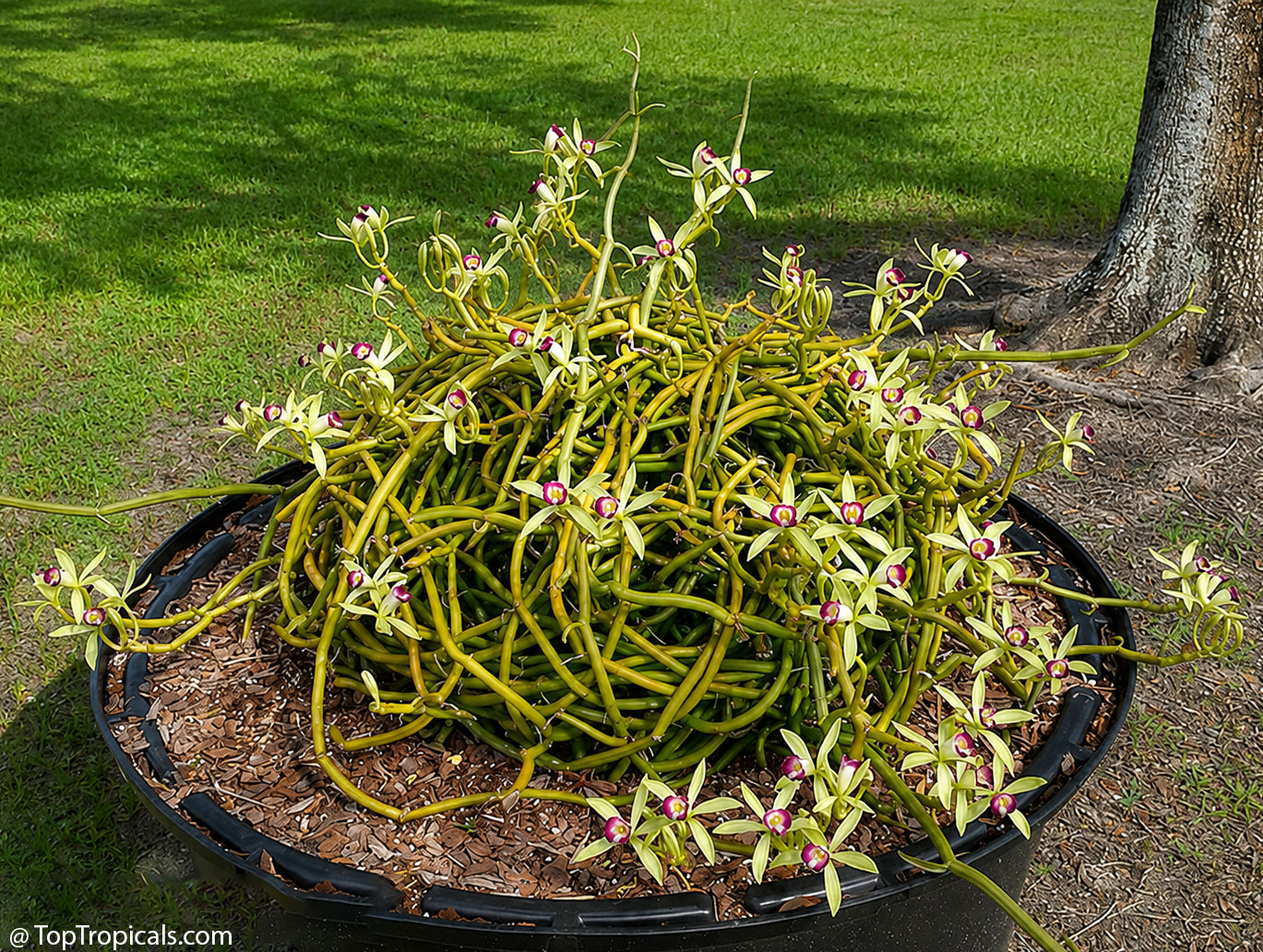
Large  specimen  of  Vanilla  dilloniana  growing  in  a  wide  container 
 beneath  a  tree,  with  a  dense  mass  of  leafless  green  vines  covered  in  unusual
    pale  green  flowers  with  purple 
 centers.

This is how the legendary Vanilla dilloniana mother plant, Intelligent Design, started its world-famous "Godzilla" journey in 50-gallon container. It's in full bloom, and its leafless stems form a living sculpture, dotted with dozens of striking orchid flowers that make this rare vanilla one of the most unusual cultivated orchids in the world.
  • Light: Bright filtered light is ideal. Morning sun is generally well tolerated. Avoid intense afternoon sun, especially during summer.
    Ideal: Dappled shade, eastern exposure, greenhouse conditions, or 30-50% shade cloth.
  • Temperature: Warm-growing tropical species.
    Best: 70-95F
    Protect below: 40F
    Not frost tolerant.
  • Cold Protection: In USDA Zones below 10, grow in a container and move indoors or to a protected greenhouse before temperatures drop below 40F.
  • Humidity: Prefers moderate to high humidity with good air circulation. Avoid cold, stagnant, damp conditions.
  • Watering: Water thoroughly, then allow the potting mix to partially dry before watering again. Do not keep constantly wet. In cool weather and winter, keep the soil on the drier side. Overwatering when temperatures are low is the most common mistake.
  • Potting Mix: Plant in a very fast-draining medium.
    Recommended: Top Tropicals Abundance Mix.
    The open structure allows excellent root aeration while retaining enough moisture for healthy growth.
  • Support & Growth Habit: Unlike most vanilla orchids that are trained vertically on posts or trellises, Vanilla dilloniana can be grown using the "Intelligent Design" method. Start with a sturdy support while the plant is young, then allow the stems to wrap around themselves in wide circles. As new growth emerges, continue guiding the vines around the container. Over time, the plant forms an impressive sculptural mound of intertwined stems.
  • Container Growing: Excellent for wide containers. The larger the mass of stems becomes, the more impressive the display and the greater the flowering potential. Unlike traditional vanilla culture, extensive vertical space is not required.
  • Repotting: Move to progressively larger containers as needed. Rather than growing upward indefinitely, the plant can continue expanding into a larger circular mass, making it well suited for long-term container culture.
  • Fertilizing: Feed lightly but consistently during active growth.
    Recommended: Sunshine Booster™ Orchidasm.
    Apply according to label directions every 2-4 weeks during warm growing weather. Reduce feeding during cool periods or when growth slows. Read our Guide to Sunshine Boosters™
  • Growth Rate: Moderate to fast under warm conditions. Established plants can branch freely and become surprisingly large over time.
  • The Flowers: Pale green to yellow-green flowers with a deeply fluted reddish-purple lip and yellow crest. Mature plants in bloom are highly prized by orchid collectors.
  • Collector Appeal: Unusual leafless growth habit. Historic provenance. Highly desirable among orchid collectors.

Why Is It Called "Intelligent Design"?
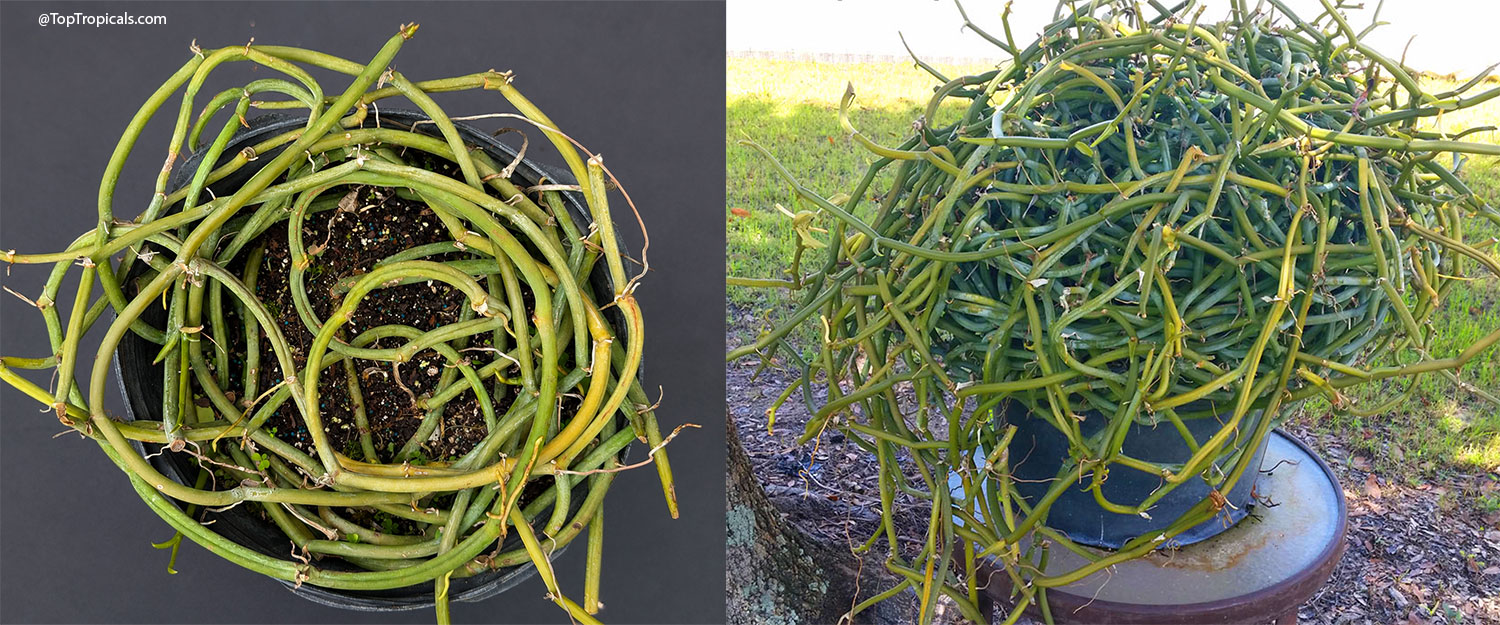
Side-by-side  comparison  of  a  young  Vanilla  dilloniana  in  a  7-gallon 
 pot.  The  left  image  shows  the  plant  beginning  to  wrap  around  the  container, 
 while  the  right  image  shows  the  same  plant  later  forming  a  dense  ball  of 
 leafless  green  vines  as  it  continues  its  characteristic  growth 
 habit.

The making of Intelligent Design. As Vanilla dilloniana grows, its long leafless stems naturally wrap around themselves, creating a dense sculptural mass of living vines. Even in a 7-gallon pot, the plant is already beginning to develop the unusual growth pattern that would eventually make its famous mother plant one of the largest cultivated specimens of its species.

The famous mother plant was named Intelligent Design by its grower, Robert Riefer. After decades of growth, countless blooms, container upgrades, and an apparent determination to occupy every available square foot of greenhouse space, the name seemed increasingly appropriate.

Unlike commercial vanilla, Vanilla dilloniana is grown primarily as a collector's orchid. Its leafless, sculptural stems create a living tangle of green architecture unlike almost any other cultivated vanilla species.

Ready to grow this remarkable Vanilla dilloniana? Start your own chapter in the story of Intelligent Design.

📚 Learn more from our Blog

🛒 Order Legendary Leafless Vanilla Dilloniana
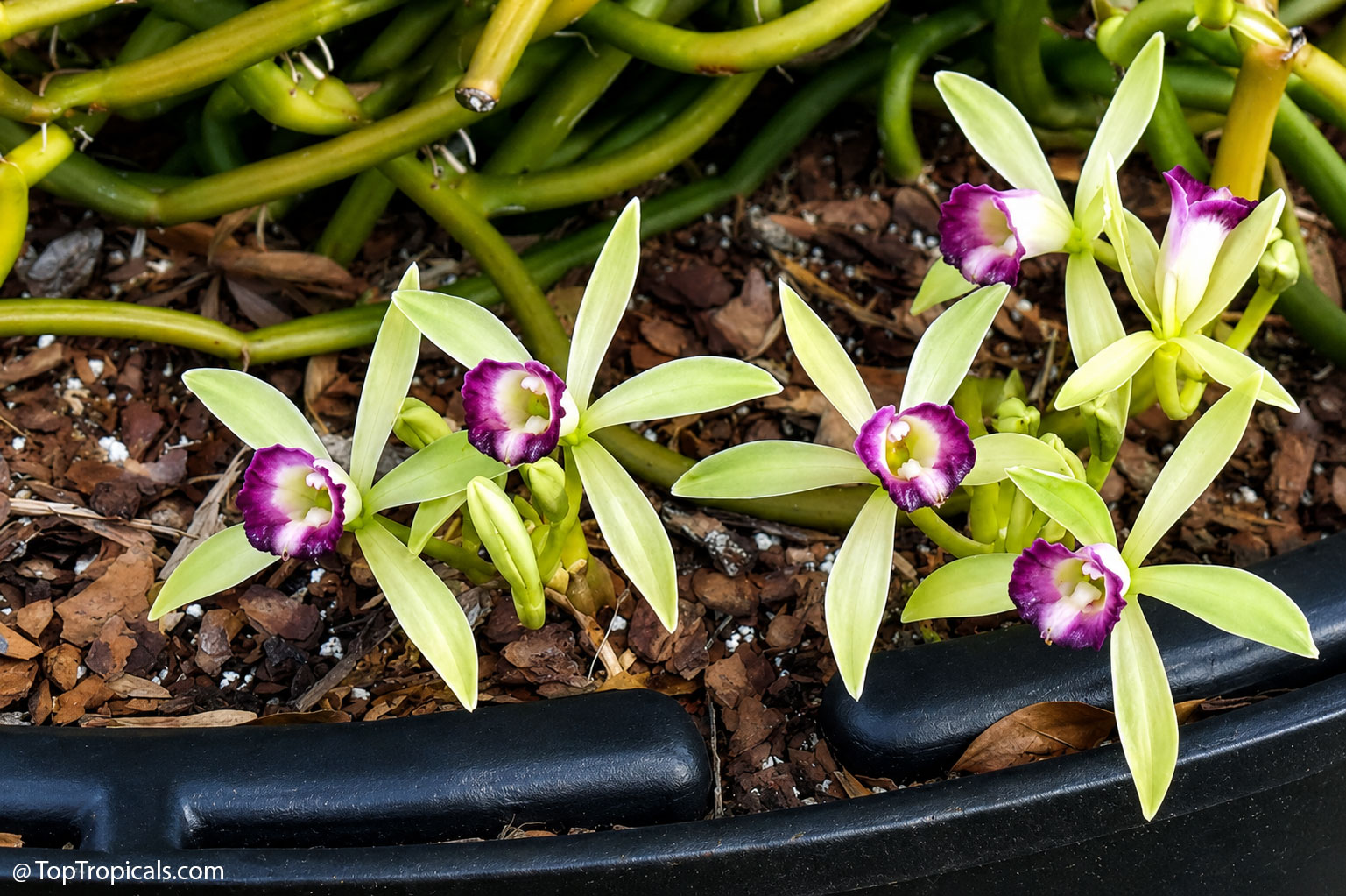
Close-up  of  Vanilla  dilloniana  flowers  blooming  along  the  edge  of  a 
 large  container,  showing  pale  green  star-shaped  petals  with  striking  purple 
 and  white  centers  against  a  tangle  of  leafless  green 
 vines.

The unusual flowers of Vanilla dilloniana emerge directly from its leafless stems, creating a stunning contrast of pale green petals and vibrant purple throats.
Smokey: We cannot guarantee that your plant will eventually require a 250-gallon pool on wheels.
Sunshine: We also cannot rule it out.
Smokey: Officially, we cannot confirm that the plant possesses intelligence.
Sunshine: The evidence is mounting.
Smokey: What evidence?
Sunshine: It convinced humans to build larger containers, move it into a 250-gallon pool on wheels, transport it to museum exhibitions, and place its agents in collections across the country.
Smokey: That's called excellent horticulture.
Sunshine: That's exactly what the Intelligent Design plant wants you to think.
Date: 18 Nov 2021

7 reasons to get an Aroid Houseplant

1. It's almost Winter... You need something tropical in your home! Aroids have the most tropical look!
2. Aroids tolerate low light conditions of indoors.
3. Aroids require almost no care. Care is easy because if you watch for the signals, the plant will tell you exactly what it needs
4. Aroids adapt to wide range of conditions. Many of them thrive in neglect and survive even in sub-optimal conditions... Unlike most tropicals, Aroids don't experience much stress when moving from indoor to outdoor settings and adapt readily to conditions inside the home.
5. Aroids are compact and easy to manage.
6. Aroids are fast growing while still being compact.
7. They are on sale now!

Check out our Philodendrons, Monsteras, Fancy Syngoniums, Alocasias, Colocasias.

Date: 14 Jul 2019

A Cup of Tea Plant

By Onika Amell, tropical plant specialist

A: I live in Ave Maria, Florida. I want to try my hand at growing my own tea. Which plant do I need?

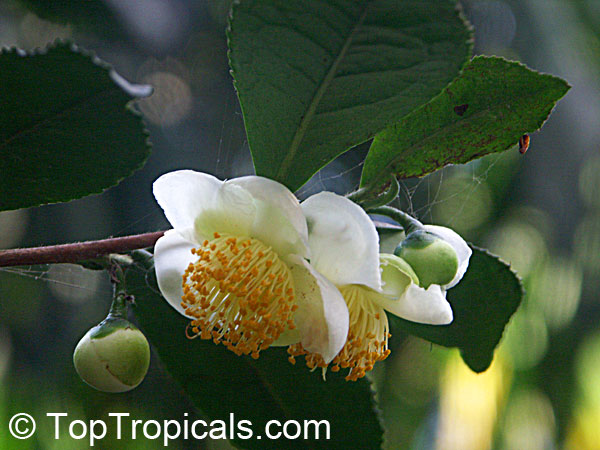
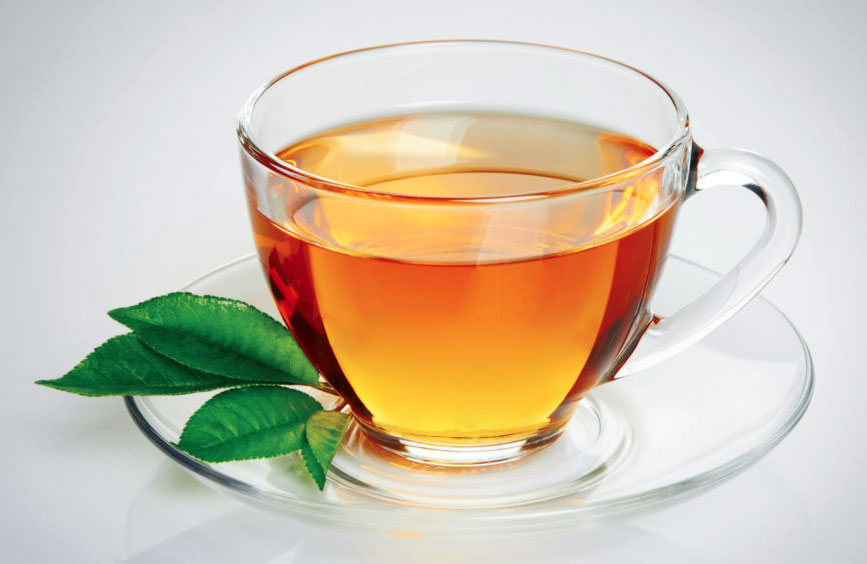
A: Most people do not realize they are actually enjoying camellias when they sip their cup of tea. True tea comes from the Camellia sinensis plant, an evergreen shrub or small tree.
In the fall and winter, the plant will produce small white flowers with a lovely fragrance. The foliage is shiny and dark green with a very nice informal and open look. Camellia sinensis (or tea plant, as it is commonly known) prefers a temperature between 65 and 86 degrees, which makes Florida an ideal area to grow them. However, if you live in colder zones, you can certainly succeed growing your own tea plants using a greenhouse. Alternatively, you can use containers which can be brought inside when temperatures start falling. Tea plants will usually survive a very slight freeze, though the leaves may be damaged or killed. It will not tolerate a hard freeze. They prefer full sun or light shade in the garden.
Tea plants will become small trees or large bushes if not pruned. Hardcore tea growers trim back the shoots repeatedly to a height of around 4 feet to encourage new growth and to contain the size.
Make sure to pick an area of your landscape where it does not flood or remain wet during our rainy season. Camellia sinensis does not like wet feet at all. They prefer well-drained, sandy and slightly acidic soil. If grown in a container, add some sphagnum moss to the potting mix. They will benefit from frequent applications of small amounts of fertilizer.
You will need some patience, too. Your plant should be around 3 years old before you start harvesting leaves.

Recommended fertilizers:

Tropical Greenhouse Plus - Plant Booster
Tropical Allure - Smart-Release Booster

Harvesting recipes

Now that you know how to grow the Tea, you need to check this out: the Harvesting recipes how to harvest and make different kinds of real tea: Green Tea, Japanese Style Green Tea, Oolong Tea, Black Tea, Orthodox Indian Tea... Continue reading...

Date: 4 Apr 2020

You are safe in your garden!

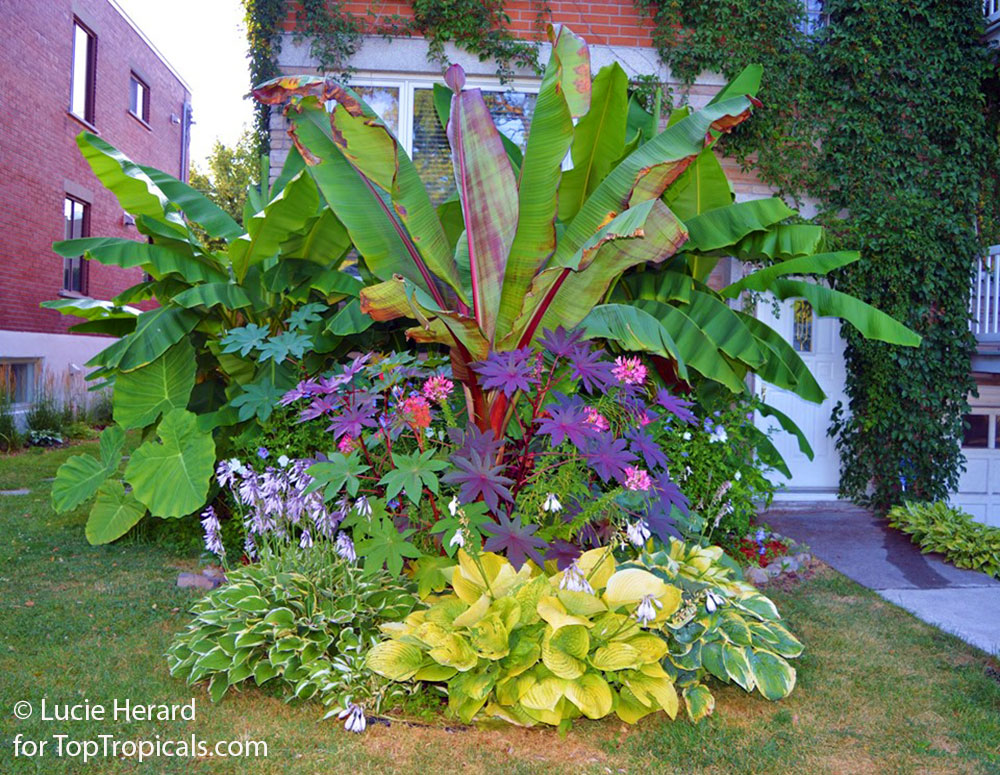
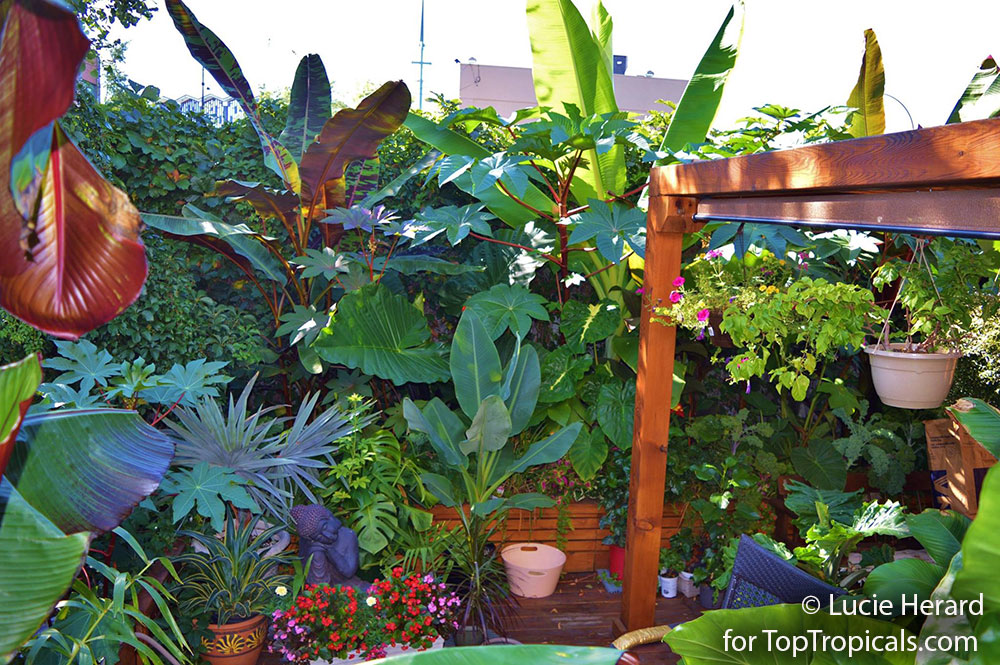
"In front of my house, banana Musa basjoo in ground since more than 12 years!"
Lucie Herard, Montreal Tropical.

Lucie's tropical garden in Montreal, Canada:
"The movement of plants fascinates me!"

Our customer Lucie Herard shared pictures of her tropical garden with us... Many of you have beautiful gardens that you are proud of... but this one is... in Canada! Believe it or not, before winter she digs everything up and brings it inside! Then in Spring, she starts again every year. Dedication? Determination? Heroism! Lucie won the Planet Bananiers photo contest for the third time.
Look at these pictures and visit Lucie's Facebook page for more photos and videos of her amazing garden. Ask yourself: and what can I do? Is my life really that hard with mowing a lawn once a week and blowing the leaves? You don't have to be a hero to make something worthwhile in your life. Just take a shovel and start... one plant a day. And you will end up living in Paradise.
Lucie reminds you: "Ornamental horticulture production activities are now considered an essential service! Add soil in a pot, water very slightly for the first two weeks and put closer to the window. That's all, the leaves will start growing again!"

Tropical Paradise Contest 2020

Share with us photos of your garden. The winner of this contest will get plants $200 worth, with FREE shipping!

Submit your photos before April 15, 2020
and win $200 in tropical plants!

Date: 24 Feb 2019

To prune or not to prune?

TopTropicals.com

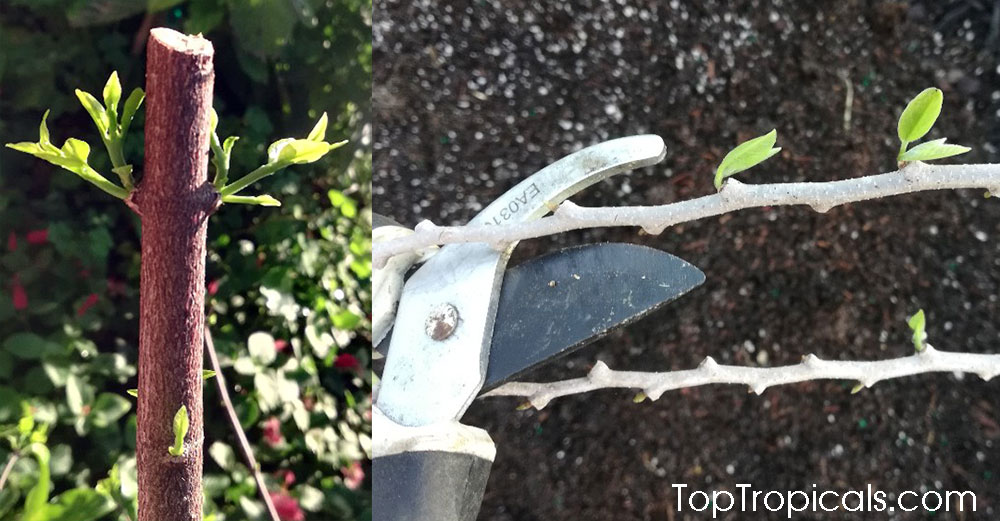
Q: We had a few nights with light frost and some of my tropical plants look sad, lost all leaves. I scratched the bark and it is green inside. Should I prune back all branches that look dead?

A: Never prune during winter time, even if some branches look dead. There is a chance you will be surprised by Spring when they sprout new leaves. Be patient and postpone all pruning until active growth starts, then cut off only damaged part, approximately 2"above new growth.

See list of deciduous plants.