Date: 15 May 2020
Harvesting from a young mango tree
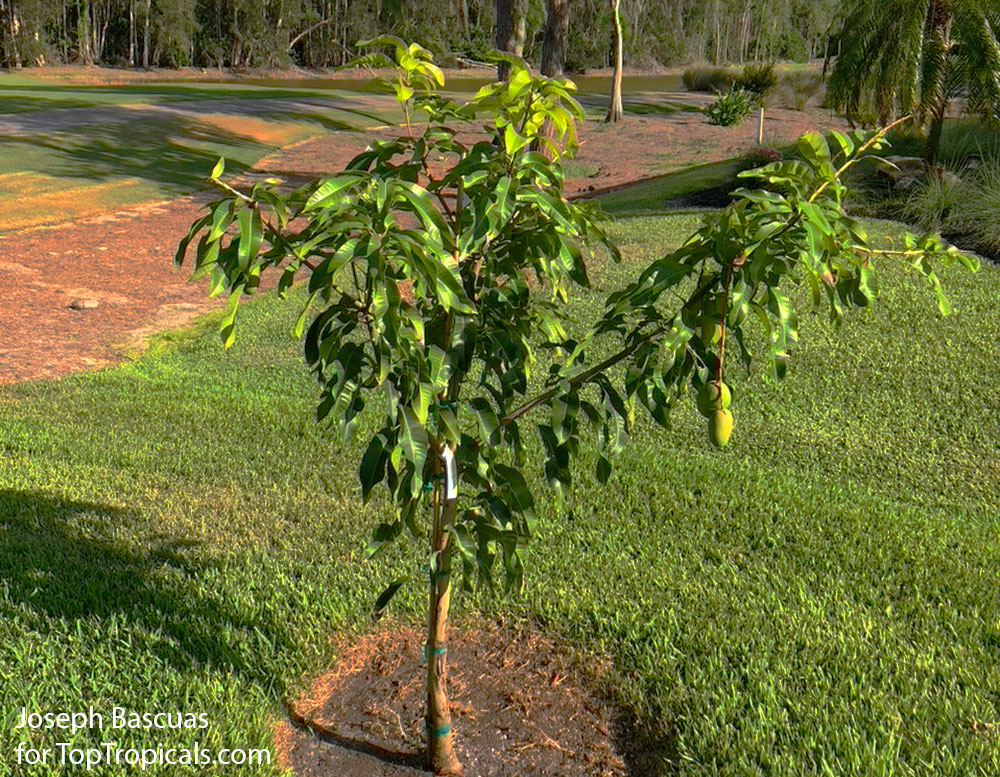
Q: About a year ago we bought a mango tree from you folks and planted it in our backyard in Estero. It has done well. It now has several mangoes and I am wondering if the tree is strong enough to support the fruit or if I should just cut off the fruit and wait until next year when the tree is a bit stronger. I am attaching some pictures. I am most concerned about the branch on the right which seems to be sagging. If you do not suggest that I cut off the fruit, can I wait until they ripen on the tree and eat them. They seem to be a bit on the small side for eating.
A: Your mango tree looks very healthy and happy, congratulation with a great job! For young mango trees, it is always recommended to minimize a number of fruit to 2-3 so
the tree has enough energy for vegetative growth rather than fruiting.
In your case, as we can see from the pictures, your tree is very well
established, has a strong root system, nice symmetrical shape, and vigorous new growth. In our opinion, you can save all
these fruit and let them ripen on the tree.
To support the plant's energy, make sure to fertilize it during summer with slow-release Mango Food, and year around - with Mango Tango booster. Use Sunshine Honey
supplement for sweeter fruit.
Secure the heavy fruit branch with a v-shape stake (a big branch may work), it can definitely use the support otherwise may break
under strong Florida winds.
You are all set to enjoy your first crop and be rewarded with fruit of your excellent work!

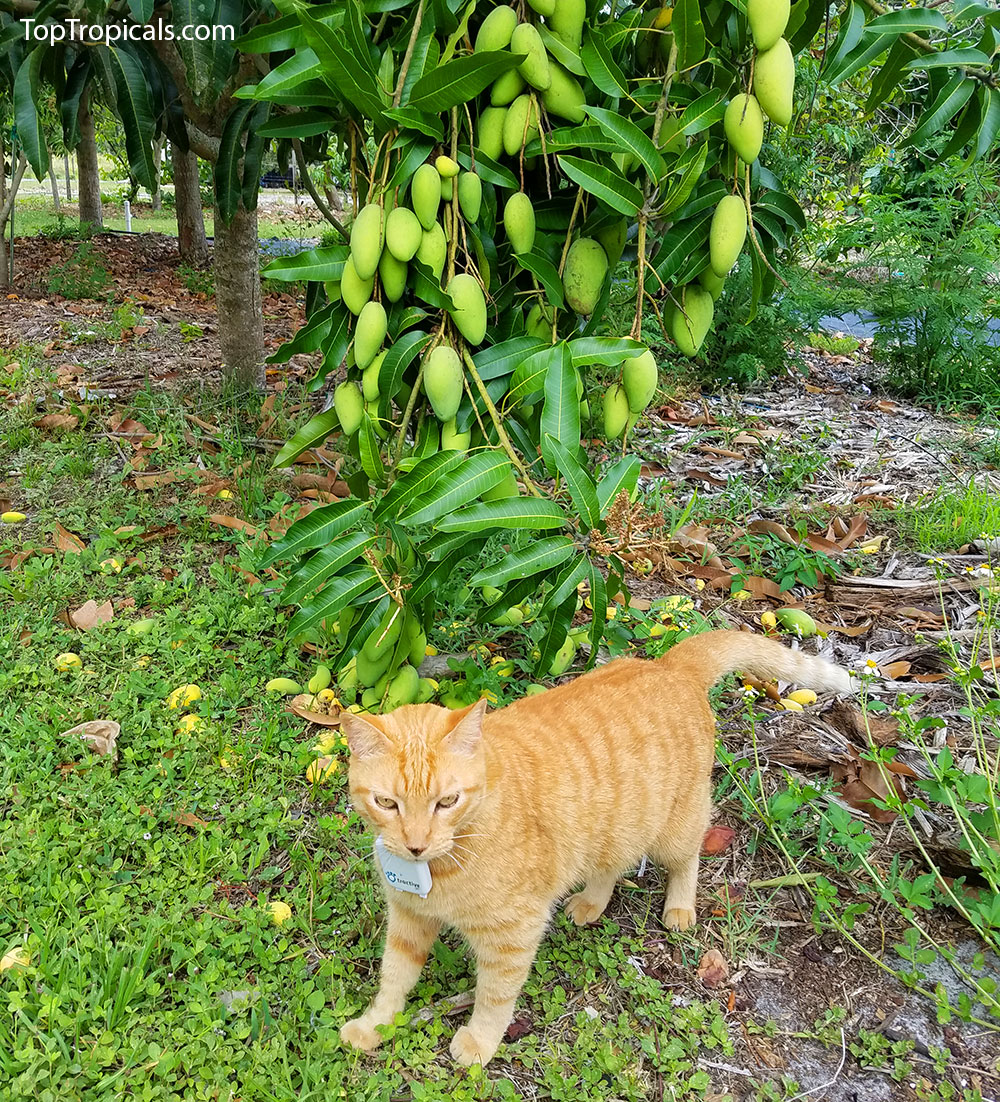
In the photo above: Mr B is harvesting Mango Pim Seng Mun after his successful Sunshine Boosters
Date: 21 May 2019
Perfecting a Mango Tree
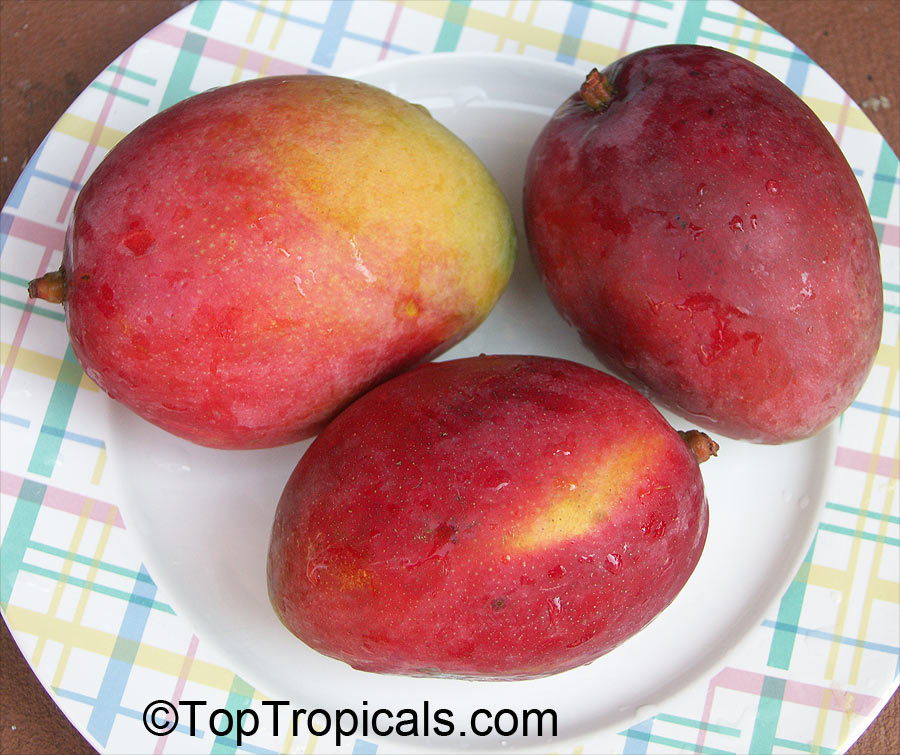
Q: I recently purchased a Mangifera indica - Coconut Cream Mango from you and would like to know if it is possible
to keep this in a large pot rather than putting it in the ground. If so, I
have a few questions:
1. How large would you expect this variety to get?
2. What are the ideal growing conditions? Full sun, partial sun,
etc...?
3. What is the ideal soil?
4. Any specific watering directions for ideal growth?
A: Coconut Cream mango tree has a moderate growth. We've planted
one in our garden 4 years ago and it is still under 10 ft tall. This variety
should be well suitable for container culture.
1. Keep the branches trimmed after fruiting is over. Mango trees can be
grown in 15 to 25 gal containers and can be trimmed under 7-8 ft high.
2. All mango trees need full sun, the more sun the better.
3. Mango needs very well draining soil, ideally with lots of bark and
perlite. We recommend our professional soilless mix or a similar formula.
4. Mango trees hate wet feet, and prefer to stay on a dry side: make
sure soil in a pot doesn't stay wet; allow it to dry a little between the
waterings.
Remember to apply Mango Food fertilizer during warm season for vigorous growth and heavy
crop!

Date: 20 Apr 2019
More about Mulberries
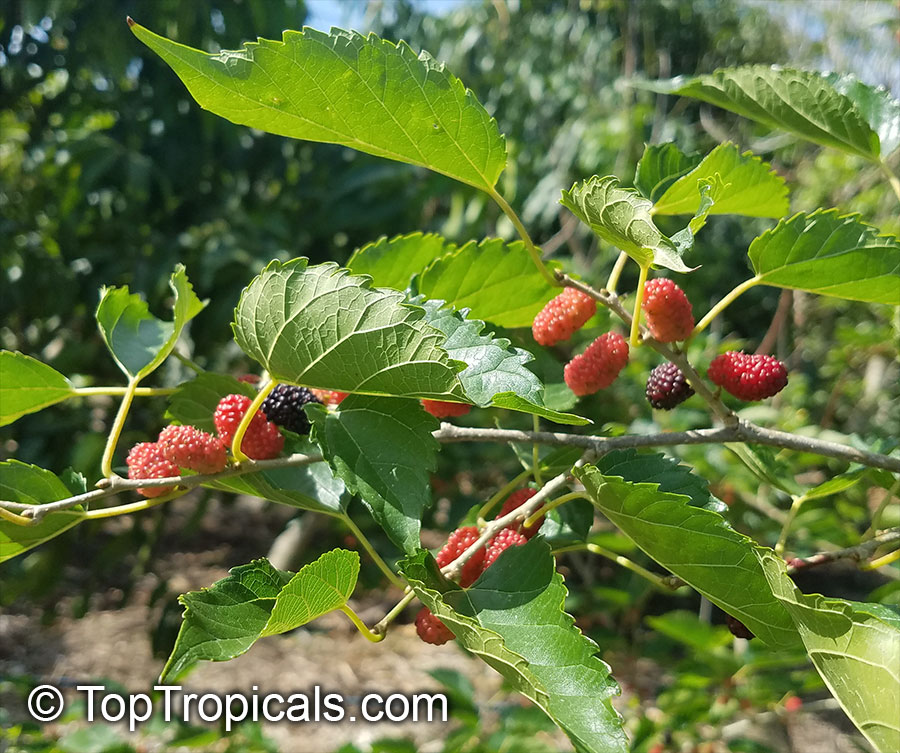
Customer comment on our Mulberry column in the previous newsletter:
...I planted a Himalayan mulberry, Morus macroura, about six years ago.
For several maddening years, it shot only very long, un-branching tentacles
out there, and it resisted my efforts to force some branching by pruning. It
would send another long, reaching shoot from the tip of the pruned branch,
with NO laterals. Several times, it did this. Finally, two years ago, it broke
buds that looked like they meant it all along those long branches, and in one
season, it fluffed out. The next season it elaborated on this, acting much
more like a proper tree. The fruit is fabulous, three or more inches long, very
sweet, with a rich berry flavor that's more raspberry than mulberry. I
guess it just needed more time. My understanding is that mulberries don't
really like to be pruned, but it needed to happen in this case, along a driveway,
so I reigned it in, and now it's a treasure. Be patient.
Cheers, your admirer, C
Check out our Mulberry trees.
Date: 17 Apr 2019
Mulberries - biggest, sweetest, and compact...
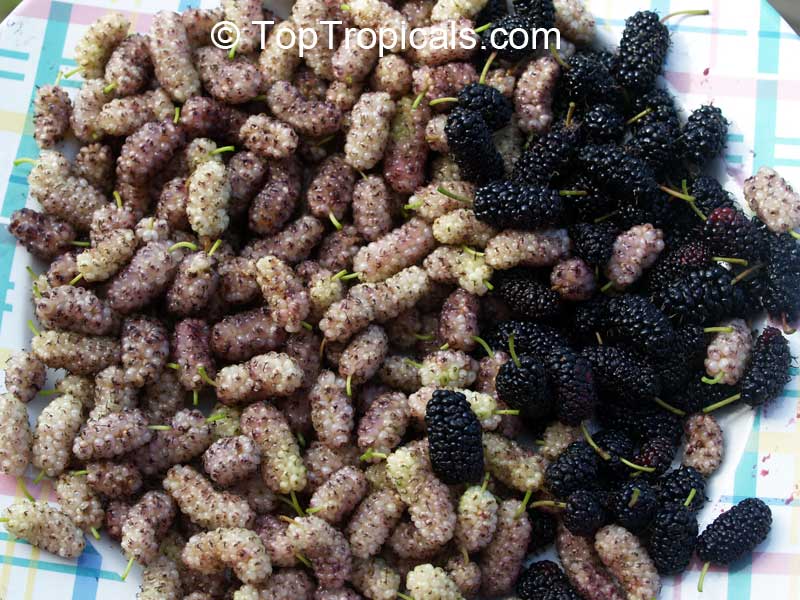
Q: What is the difference between Pakistani and Australian Mulberry plants? Would one be better suited for South Florida backyard? Can one be maintained/pruned to be a tall shrub vs a large tree? Which one has the sweetest fruit? Thank you for the previous plants we've purchased from you. They're all doing great.!
A: These two varieties are very similar indeed.
Both fruit are very large. Var. Pakistani fruit is a little longer than var. Australia and the tree is a more vigorous grower, but they both are
very sweet, even before the fruit fully ripen. Both trees are a good choice and
start fruiting at a young age.
We've had Australia in the ground in our garden for 4 years by now and
for some reason, it has been very slow growing which is normally not the case
with Mulberries. Maybe it is not fully happy with FL humid conditions.
There are two Mulberry varieties that can be maintained as bushes: Issai
and Dwarf
Everbearing. However, even vigorous Mulberry trees respond well to
pruning and can be kept compact for easy harvesting. Just make sure to prune before
the flowering season starts; here in S Florida Mulberries start flowering in
March, and fruit start ripening during April-May.
Check out our Mulberry trees.
Date: 11 Jan 2019
Growing plumeria from seed
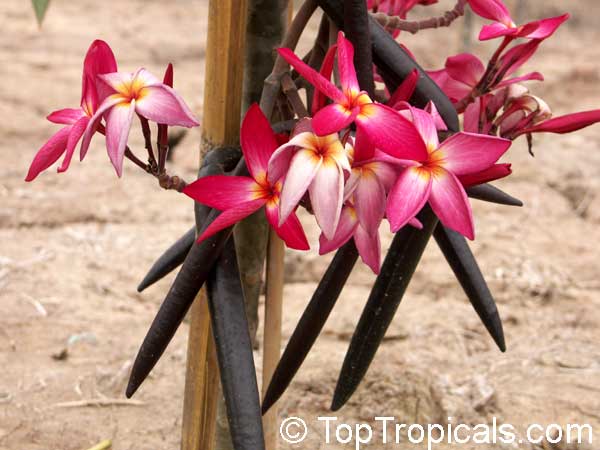
Q: I purchased a Plumeria from your company. It has done quite nicely and now has produced a seed pod. Please forward me information on how to care for it and use the seeds that may be inside to propagate another plant.
A: Wait until seeds are ripe (seed pod turns brownish). Soak seeds overnight. Use only well-drained soil. The ideal mix is Adenium mix that we use for desert roses and Plumerias. Insert the heavy end of seed 1/4" into the soil, leaving feathered end exposed. Place the pot in direct sunlight. Don't allow the soil to completely dry out, but don't let it be soggy. Germination occurs usually within three to four weeks. Do not overwater.
Click for Plumeria and Adenium quick sale - 50% OFF with FREE shipping! Exp. 1/15/19.
Check out our full selection of plumerias - all with FREE shipping!