Date: 4 Jun 2016
Desert rose winter care
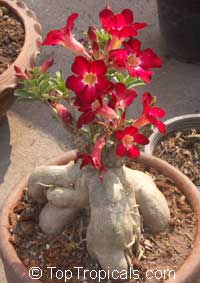
Q: I purchased several packets of desert rose seeds last year. I now have 45 very healthy seedlings some of them in bud. Almost all of my seeds grew but I lost most of them when I rook them in during winter. I did not water them for a month , kept them in their pots and set them by the window. they either dried up and died or rotted and died. I noticed when you send me grafted specimens that you bareroot them. Is this a better way to keep them inside in winter, bareroot? I hate to lose these plants come winter time. Pls advise me. I live in Houston, Tx. where we get temps below 40 degrees and sometime a day or more of freezing temps.
A: Thank you for your question. Rot is pretty common problem with Desert Roses. We monitor our Adeniums closely and have a special set up of watering environment and schedule, in dedicated greenhouses just for them. Nevertheless - every now and then we see a rotten caudex and can't help it to say "oops! over-watered!" These plants are very sensitive to environment changes, especially when it comes to a combination of water and temperature. These are a few tips that should help you to reduce risk of plant loss to a minimum:
1) Use only well drained mix with much higher content of perlite than you would use for most tropical plants. For adeniums, we use mix with 30-40% of perlite in it, while regular mix has 10-15%.
2) Adeniums like alkaline soil, unlike most of tropical plants (hard to say what else likes alkaline... Ficus for sure!). This means, regular mix with high content of peat moss may cause root rot. To increase alkalinity, you may add dolomite. Here in Florida where we have natural supply of shell rock handy, it is easy to add some shell to a potting mix (shell sand, rather than quartz sand). We always add a few large shells on top of a pots with a big specimen. Besides increasing soil pH (making it more alkaline), shells look very decorative.
3) Water very carefully during cooler months. When it is hot (85-100F), excessive water usually won't harm adeniums: it will be partially used by a plant, and partially will evaporate. Especially be careful with water when temperatures drop below 65F - then tropical plants simply stop growing process and go dormant. Once adeniums start losing leaves, this is a sign to reduce watering to once a week to once a month, and in very small quantity (couple tablespoons per pot).
4) We do not bareroot adeniums for winter storage. They are not bulbs. Barerooting of this plant is recommended only during shipping. Adeniums can stay without soil for up to a week without hardly any stress, sometimes even longer.
5) We keep our big collection specimens on a roofed porch during winter, where level of light is very low. Last winter we haven't lost a single plant due to low light. They take shade pretty well considering minimum or no water. However bright light is always better - it creates healthier environment for a plant. We all know about space limitations for our large collections, especially in winter. So if you can afford a bright spot for adenium during winter - the plant will be lucky!
Date: 22 Mar 2016
Plant Horoscope. Aries Zodiac lucky plants: Aloe and Erythrina

Aries - 3/21-4/19. Aries is a FIRE sign ruled by the planet Mars. Plants associated with this element and planet very often have thorns or prickles. They can be also spicy or bitter in flavor, or red in color.
Because Aries rules the head, eyes and face, the plants for Aries purify the blood, stimulate the adrenal glands, and/or are high in iron (Mars rules the mineral iron). Mars-ruled Aries is assertive, energetic and fearless. Mars rules the red blood cells, the muscles, and metabolic processes, as well as the motor nerves and the head. These plants help you when you want more get-up-and-go and the courage to take on the world.
Aries Zodiac lucky plants - Governors plum, Hibiscus Karkade, Tapioca, Mamey Sapote, Ruda, Baobab, Euphorbia, Acanthus, Aloe, Caesalpinia, Erythrina, Opuntia, Dragon Fruit, Pachypodium, Pomegranate, Chilli peppers, Syngonium, Begonia, Geranium, Red Sandalwood, Jamiaca pepper (Pimenta, Allspice), Camphor, Jujube, Anise, Red Roses, Tiger Lily, Impatiens, Calendula, Tarragon, Ginger, Coriander, Basil, Ruda, Amaryllis, Wild Indigo, Gooseberries, Sesbania, Campsis, Red Oleander, Maple, Schotia brachypetala, Momordica, Coffee, Amla , Ephedra, Red Kapok.
For other signs information, see full Plant Horoscope.
Date: 9 Dec 2023
Sunshine supplement kit for cold hardiness
Video by Scott Riddle
Discover the cool story of Scott Riddle, a well-known plant enthusiast with a
popular YouTube channel dedicated to his tropical plant collection. In this video, Scott shares his firsthand experience with our Sunshine micro-element kit, designed to enhance the cold hardiness of
plants.
Living in the unpredictable climate of the California mountains, where he
cultivates tropical plants in a zone higher than recommended, Scott faced the challenge of unexpected freezes. The boosters hopefully will
be a game-changer for him, reinforcing his plants for the winter season. This insightful and
detailed video is a valuable resource for anyone engaged in zone-pushing, aiming
to fortify their tropical plants against the rigors of challenging weather conditions.
Here at Top Tropicals, we have already applied two pre-winter treatments of Sunshine Power-Si formula, in combination with the bio-stimulant Sunshine Epi and micro-elements. One in November, the second one in the beginning of December. So far, after a couple of cold nights, the plants still look happy. Stay warm and get prepared!"

Date: 17 Nov 2022
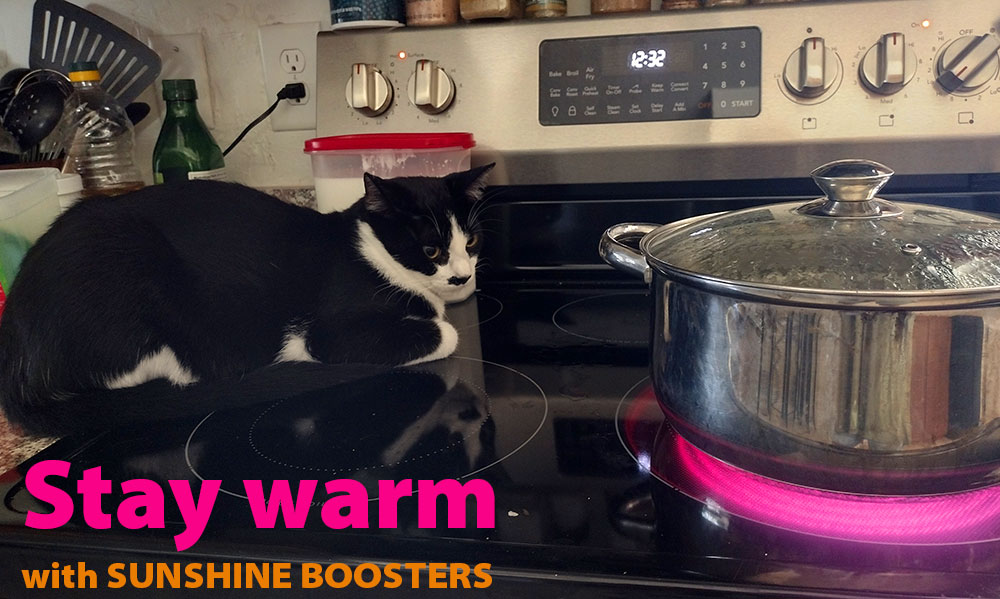
Get your plants ready for winter:
Just spray this to improve cold hardiness...
How to improve plant cold hardiness?
Pland cold hardiness depends on several factors,
including:
1) genetics of specific species
2) maturity of the plant, size of root system, stems and branches
3) plant health and vigor which is supported by proper nutrition program
and adding special plant hormones.
While 1) and 2) may be out of our control, the 3rd factor is something
that can be easily improved! It is important to feed plants during the season
of active growth on regular basis by applying macro- and micro- elements.
Liquid fertilizers and especially natural plant food like Sunshine Boosters can be applied year around to keep plants healthy and
strong.
Besides the routine fertilizing program, just a few applications of special
plant hormones can increase tropical plant hardiness big time! Before the
cold is coming, spray your plants with these 3 magic potions and they will gain
a few degrees in low temperature tolerance! It is recommended to make 2-3
applications.
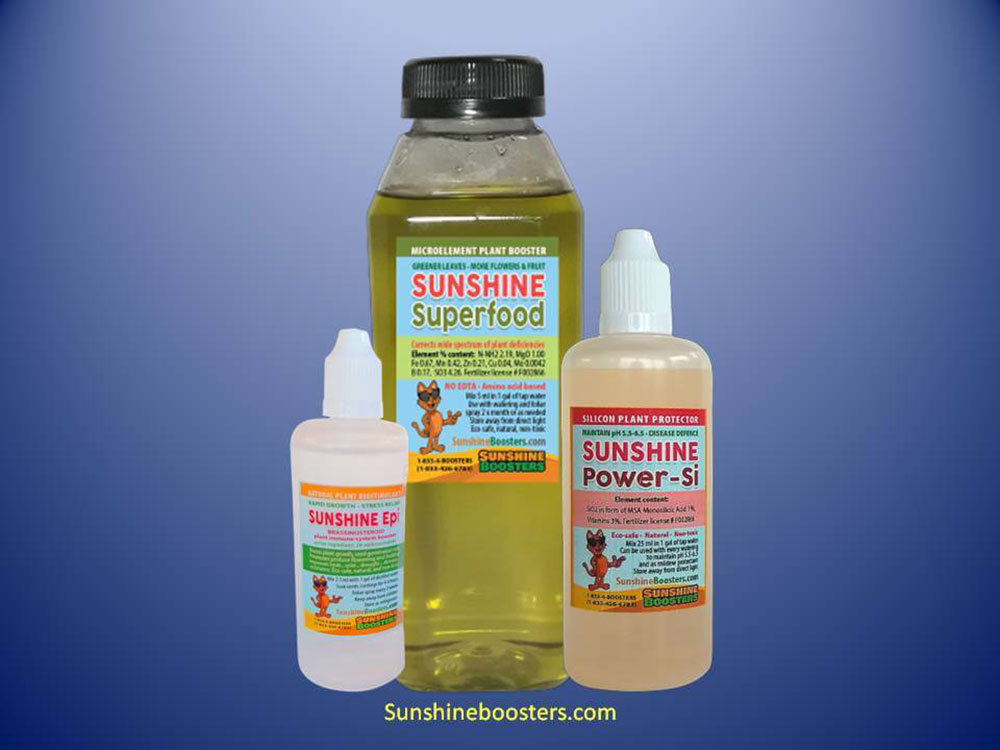
- Sunshine Superfood
- Sunshine Epi
- Sunshine Power-Si
Date: 3 Nov 2022
Plant Horoscope - Scorpio
What is your lucky Zodiac Plant?
By Alex Butova, the Witch of Herbs and Cats

...Scorpio is the "hottest" among aquatic...
...Scorpio loves plants very much, they can provide invaluable assistance
to this sign. Plants are able to calm Scorpio, transfer his attention and
passionate energy to himself and transform it, directing it into a creative
direction....
Scorpio is an aesthete. He loves flowers - unusual, bright, large - and
lovingly grows them if he has such an opportunity. Their favorite plants,
despite all their effectiveness, are often unpretentious and can grow in the most
unfavorable conditions...
Of particular importance in the sensual relationships of Scorpio with
plants is the smell to which this sign is extremely sensitive. Aromas of some
plants can affect Scorpio as an aphrodisiac...
CONTINUE READING >>