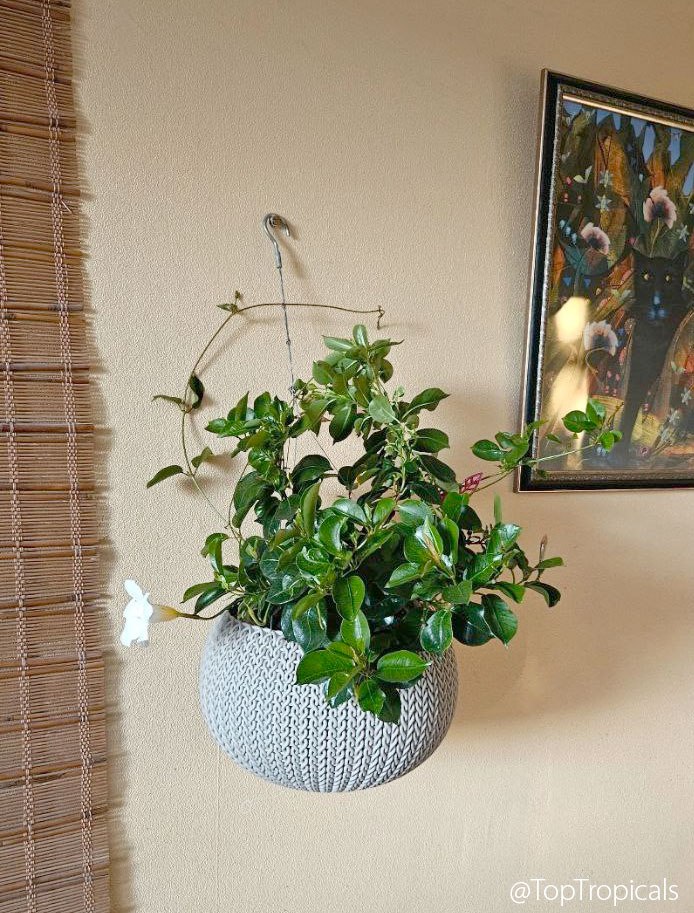
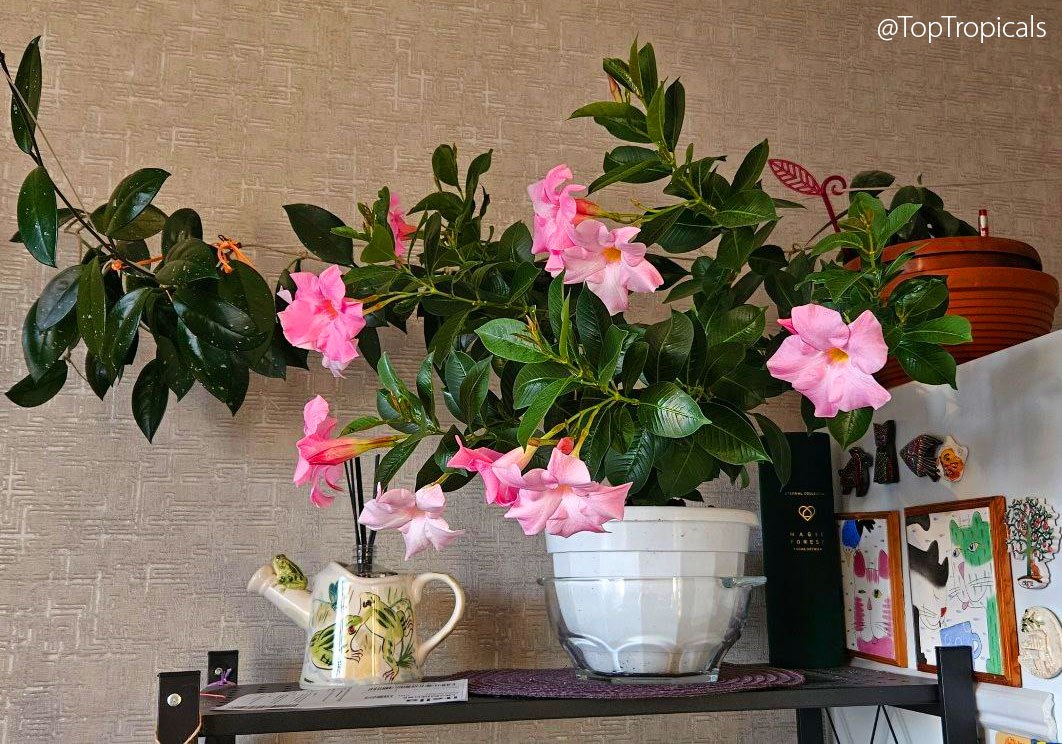
❓ I have two Mandevillas that thrived on my balcony all summer. Now that cold weather is approaching, I've moved them indoors to bright spots, but they're dropping and wilting leaves. How can I keep them healthy until spring? Should I fertilize them? Can Mandevillas grow indoors year-round?
✔️ First, keep in mind that the plants we call "indoor plants" or "house plants" are all tropical. However, not all tropical plants are suitable for indoor living. Some, especially shade-loving ones, thrive in indoor conditions, which is why we refer to them as "house plants" (philodendrons, monsteras, calatheas, peperomias, and many others, including some succulents). Others are less adaptable to the lower light and humidity typical of indoor spaces, but with a little extra care, you can overwinter them inside and move them back outdoors in spring. Mandevillas are no exception! Even tropical trees, including fruit trees, can tolerate a few months indoors if given the right conditions for semi-dormancy. Below are the 10 key tips for successfully overwintering tropical plants indoors.
Find out the secrets of overwintering in our next post ⬇️
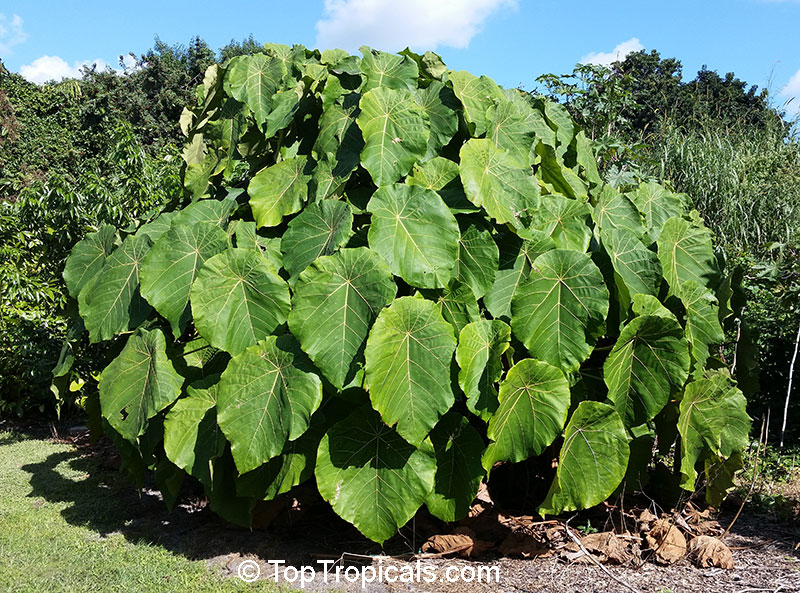
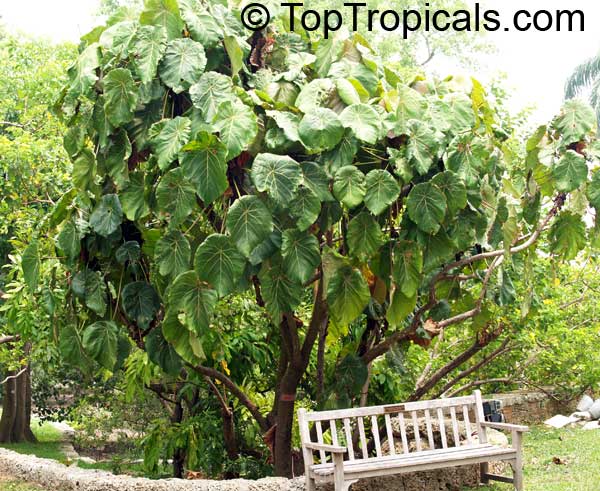
Why is this wonderful little tree so unknown here in Florida? I can only
guess it's because people don't see them, and therefor don't know about
them, and that basically no nurseries grow them. Yet it's one of the most utterly
spectacular foliage plants conceivable... Provided with an appropriately
warm climate such as South Florida or elsewhere, there is no reason they should
not be seen more often (for purposes of utter awe).
Macaranga's genuinely grand foliage much more resembles the ears of actual elephants (esp. the Asian species) than do the leaves of the much more commonly known and grown "elephant ears" meaning certain
Alocasia and Colocasia
Date: 14 Oct 2019
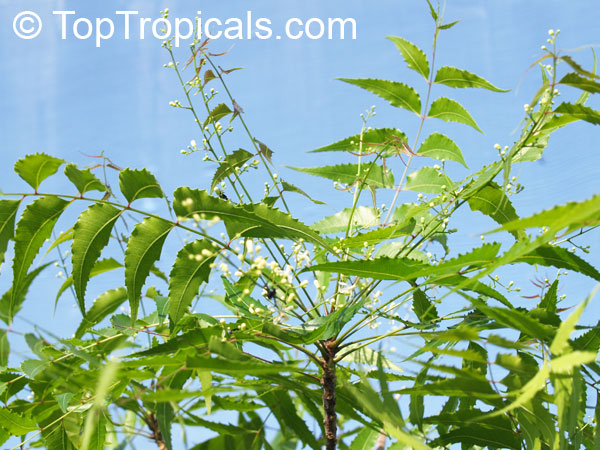
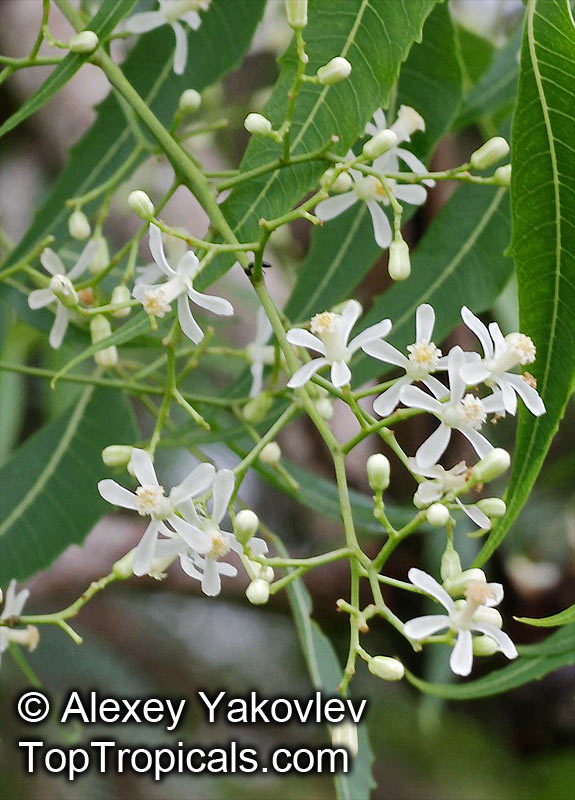
NEEM - The Free Tree of India
By Onika Amell, tropical plant specialist
Q: What is Neem oil and tree, and and can we grow the Neem tree
here in the US?
A: Neem! What an extraordinary, fascinating tree! I'm personally
convinced every garden should have one, if your climate allows it. Neem tree
- Azadirachta indica - will very quickly become a valuable shade tree in
your garden. They can grow up to eight feet per year! Neem trees are also
known to grow very well in areas with infertile soil and under very dry
conditions, which makes them perfect for xeriscaping. Not only is Neem fast-growing,
but it's a beautiful tree with wide-spreading branches and dark green leaves.
It will form a dense, round canopy, up to 60 ft wide.
This wonderful tree has been used by humans for thousands of years. Did
you know Neem has more than 100 unique bioactive compounds? Surprisingly, a
lot of gardeners are still unfamiliar with it!..
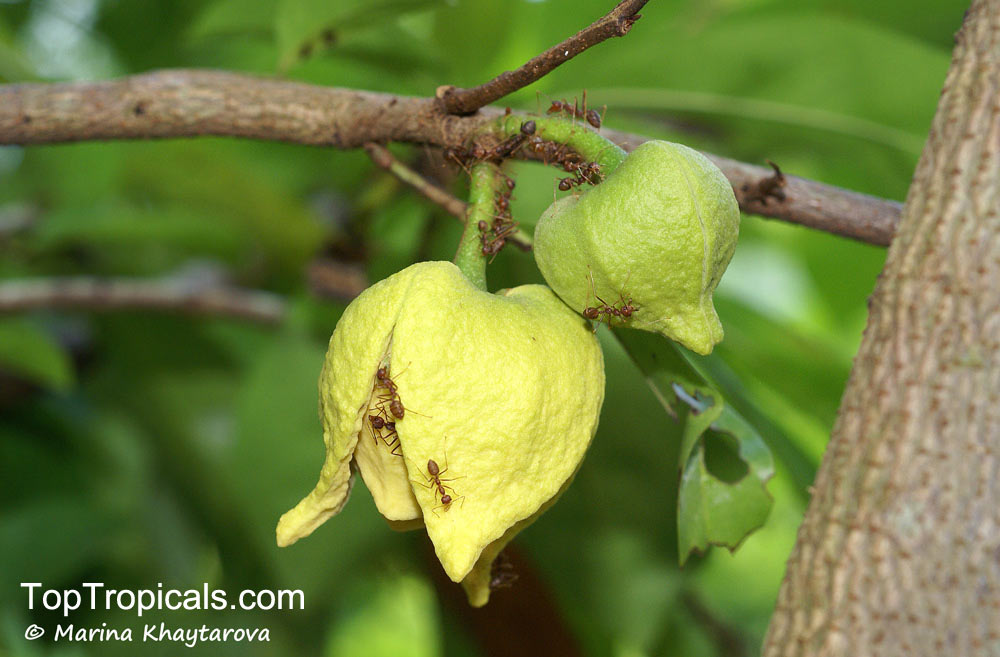
Q: I have ordered dozens of trees from you and have a question
about Soursop. I have a Soursop in a container and ants and aphids are under
new leaves. Do Soursop like little water? I water almost everyday living in
southern Los Angeles it's been around 76-80F. I spray the aphids and ants off
with a mist setting on my hose. They come back every day. They're only on new
leaves...
A: First of all, you don't have to remove the ants iа they
don't bother you. Ants are good insects, they do not harm plants; most likely
they are attracted by a sweet sap - aphid by-product. Ants clean up a plant,
and they may even take care of some bad insects.
It is not difficult to get rid of aphids. Use a safe treatment: in a
small spray bottle, mix 1 cup of warm water, 1 teaspoon of dish soap and 2
tablespoons of any cooking oil (if you have Neem oil or Horticultural oil - even
better, but prepare, they are pretty stinky). Spray the leaves with this
solution to a dripping point. Repeat in a few days if needed. This simple remedy
will take care of the aphids.
Daily water may be ok for the plant during hot weather, as long as the
soil is not constantly moist. Let the surface of the soil get a little dry
between waterings.
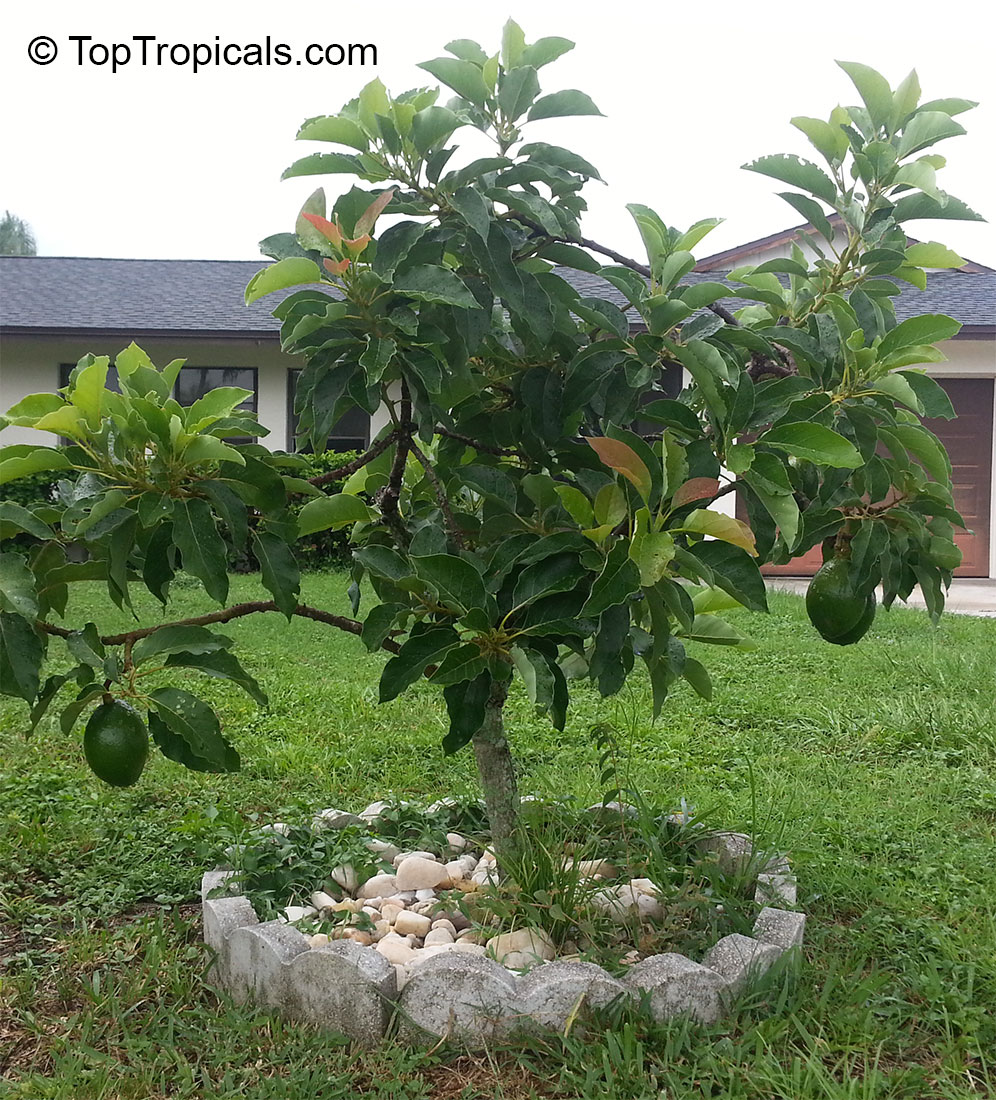
Q: I
intend to gift three avocados, at least one type A and one type B, to a friend who
lives in an area where the temperature never goes below 25F. The idea is to
give them a ripening season as long as possible. Which combinations do you
suggest, and which are the A and B?
A: When
talking about "A" type and "B" type in Avocados, we are referring to the
flowers. An avocado will produce both male and female flowers on the same plant.
"A" type means that the flowers are female in the morning and male at
afternoon. "B" type means that the flowers are male in the morning and female in the
afternoon. If you plant to start a commercial growth, then it's important to
create a proper mix of both types. However, in hot and humid climate a single
tree produces flowers of both types, so it is NOT necessary to have both A-
and B- types planted together in the backyard. Even a single tree produces
enough fruit for a home gardener.
It is also important to know that while there are "more cold hardy"
avocados (hardy to as low as 15F), it refers to a full grown established tree.
Young trees still need protection from the cold until they are bigger and more
established. One can not expect a small tree planted in June to survive the
first winter with a hard freeze. It'll take a few years until the tree is
strong enough.
These a few rare varieties that may be of your interest.
Poncho Avocado Very cold hardy variety. Produces medium to large green fruit. It
survived temperatures around 10F near San Antonio, Texas (Zone 8b). Mature trees
can take temperatures down to 15F for short period of time without significant
damage.
Anise Avocado This avocado has strongly scented leaves that smell like Anise. Very
rare variety. Fruit is of excellent quality, creamy and buttery.
Catalina Avocado Catalina is a very nice mid-season pear-shaped fruit that is especially
rich and creamy. It is an extremely popular variety in South Florida in the
Cuban Community. The Story of this variety says...
...Catalina is an amazing avocado floated across from Cuba, 60 years
ago just before Fidel Castro took over the Island Nation. Wise Cubans jumped
into the ocean to escape the Castro regime and tossed in some favorite scions
for us to enjoy here in the States. We owe a great debt to poor old Don Miguel
Cruz de la Santa Maria Espinoza Sanchez Alvarez Jr. who sadly was lost at
sea. His amazing scion wood, wrapped in cellophane and aluminum foil floated
over, washing ashore on Miami Beach. His shiny little package was miraculously
picked up on the shoreline and immediately grafted and cared for by keen-eyed
avocado lovers in Miami...
So be sure to think about this story every time you eat a Catalina!
These three Avocados will provide you with fruit ripening during the
whole warm season.
See more information on avocado varieties and the most cold hardy
cultivars.