Date: 25 Feb 2024
Avocado pollinating and crops
Photo above: Avocado Joey - very buttery fruit, cold hardy variety.
Q: I bought an anise leaf-scented avocado from you, and it is finally quite large and doing great. I live in California, the coldest temperatures we seem to get in some winters is around 25 to 28F, and it never lasts long. The tree might get a bit of frost nipping on the new growth, but it has done very well. It has flowered profusely for the last two years but hasn't set any fruit. What variety you might recommend to help with pollinating?
A: We are glad your avocado is doing great. Anise is one of our favorite varieties, with the wonderful smell of leaves and tasty fruit.
Cold hardiness and flower quality
It is true that cold damage may affect avocado production, especially in setting fruit. To improve the tree's cold hardiness, make sure to provide balanced plant food, especially during the season of active growth. For our avocado trees, we use Sunshine C-Cibus year-round.
If you prefer to use dry (granulated, slow-release) fertilizers, make sure they contain micronutrients, or apply Sunshine Superfood microelement complex once a month.
To improve flower quality (including the ability to set fruit), we recommend a special micronutrient supplement called Sunshine Honey. It contains Boron and Molybdenum - elements that are responsible for setting fruit and for developing fruit (meaning not dropping at the early stage of development).
Cross-pollination and crop
In general, every avocado tree is self-fertile, meaning it can produce some fruit with its own pollen and doesn't necessarily require a second tree for pollination. So even if you don't do anything, sooner or later your tree will set fruit. However, it is also true that the amount of fruit and crop reliability depends on pollination factors. One type of avocado classification is by flowering and pollination behavior - type A or B.
When both types of trees are grown in proximity to each other, their overlapping flowering patterns significantly enhance the chances of cross-pollination. This can lead to improved fruit set and higher yield, making it especially important for commercial production and, to a lesser extent, for home growers.
Therefore, it's advisable to plant different varieties of avocado in your garden - the more, the merrier! The greater the diversity of avocado trees with overlapping flowering periods, the better your crop is likely to be. If you're growing an avocado tree without other avocados nearby, it becomes helpful to have more than one tree with different flowering patterns (A and B) to increase yield in your garden.
Anise Avocado is type B. So to increase your crop, you may consider planting type A variety from the list: Bernecker, Black Prince, Catalina, Choquette, Day, Donnie, Fantastic, Florida Hass, Lila, Loretta, Lula, Mexicola, Mexicola Grande, Red Russell, Reed, Russell, Simmonds, Ulala , Waldin .
To learn more about avocado types, fruit characteristics, cold hardiness and much more, refer to our Avocado Variety Guide - a page with very convenient interactive chart allowing you to quickly sort types of avocado by requirements of your choice (just click on column header to sort data). You may also buy a Book or download a PDF.
Photo above: 15 gal Avocado trees for local pick up. Delivery and installation available!
Date: 31 Jul 2025
Shady spots aren't a problem - they're an opportunity
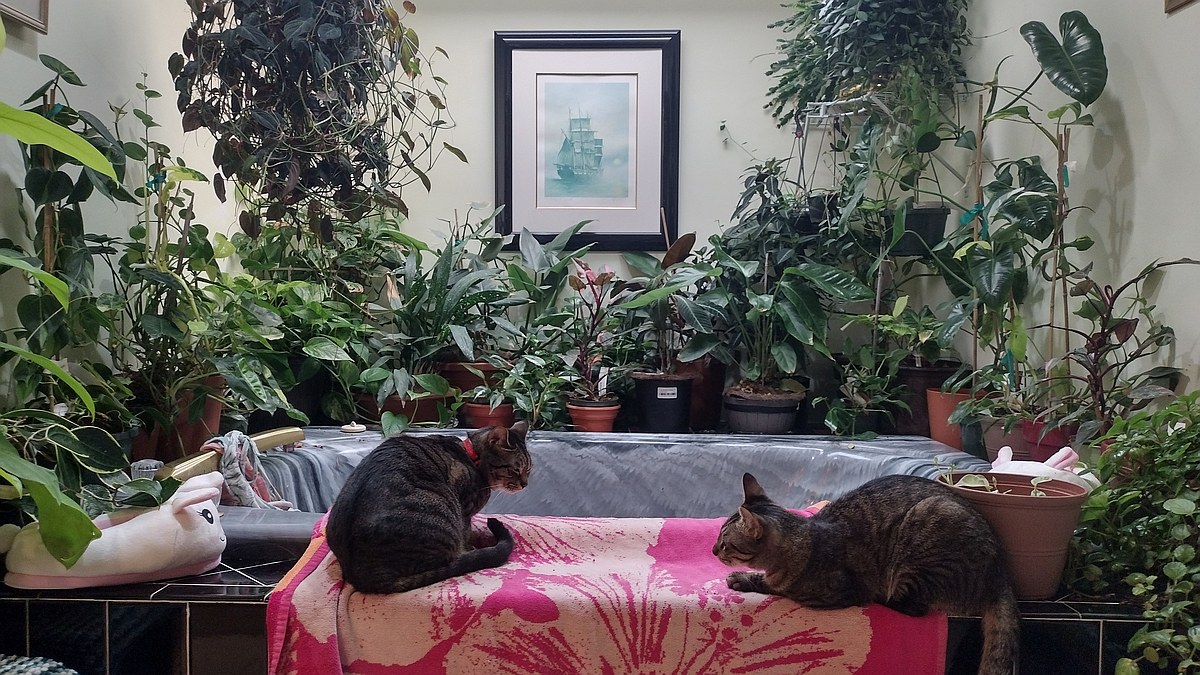
Photo above: Niki and Cash, the Top Tropicals PeopleCats-in-residence, lounging in a lush indoor jungle
Most tropical gardens have at least one corner that gets morning light, filtered sun, or just bright shade - and that's exactly where Anthuriums thrive, along with many other shade-loving plants. That makes them ideal for spaces where other tropicals struggle.
Don't have a greenhouse? You don't need one. Anthuriums do beautifully on a shaded porch, in a screened lanai, or even indoors near a north or east-facing window. They're perfect for:
- Bathrooms with natural light
- Bright kitchens with indirect sun
- Shaded entryways or under eaves
- Hanging baskets under tree cover
- Mounting on cork or wood in humid areas
Even a small space can feel like a tropical conservatory with the right plant - and Anthuriums bring that look without being demanding. They grow slowly, stay manageable, and don't need constant pruning or repotting.
Best of all, they reward consistency. Keep them warm, give them some humidity, water when the top inch feels dry, and they'll stay healthy for years. No drama - just quiet, lasting beauty. If you've never grown tropicals in the shade, this is where to start.
Date: 31 Oct 2025
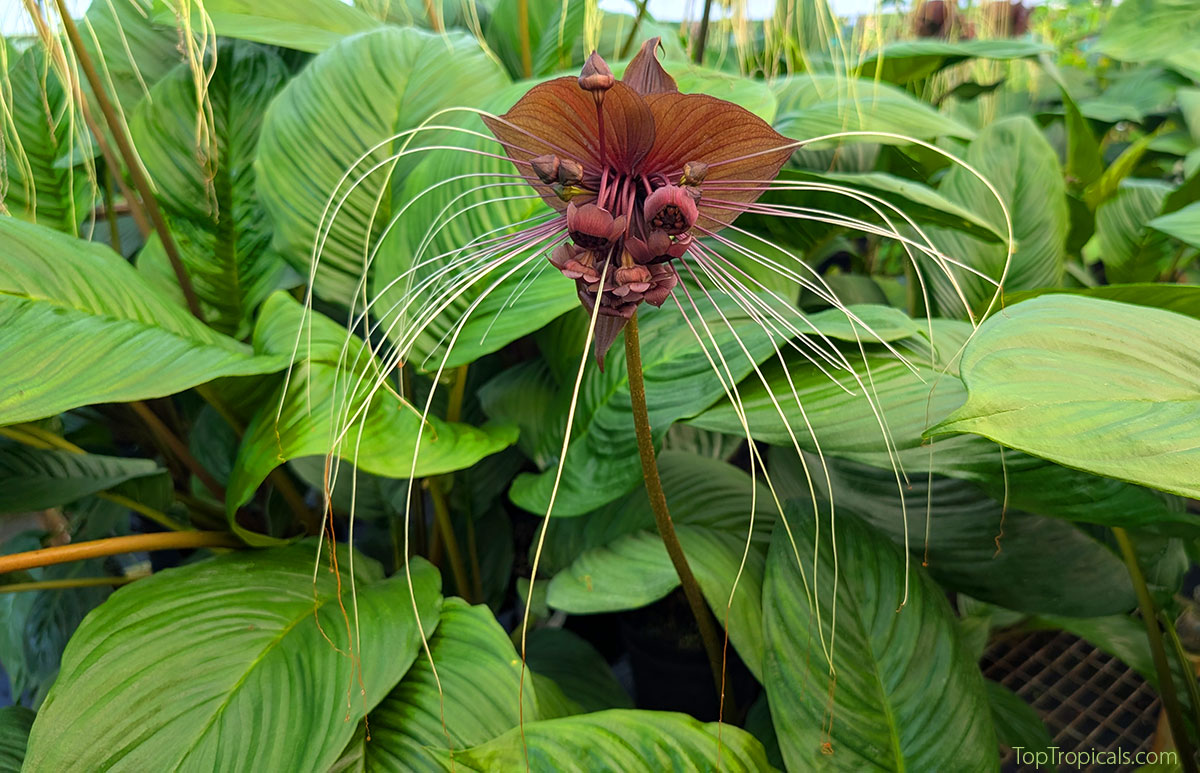
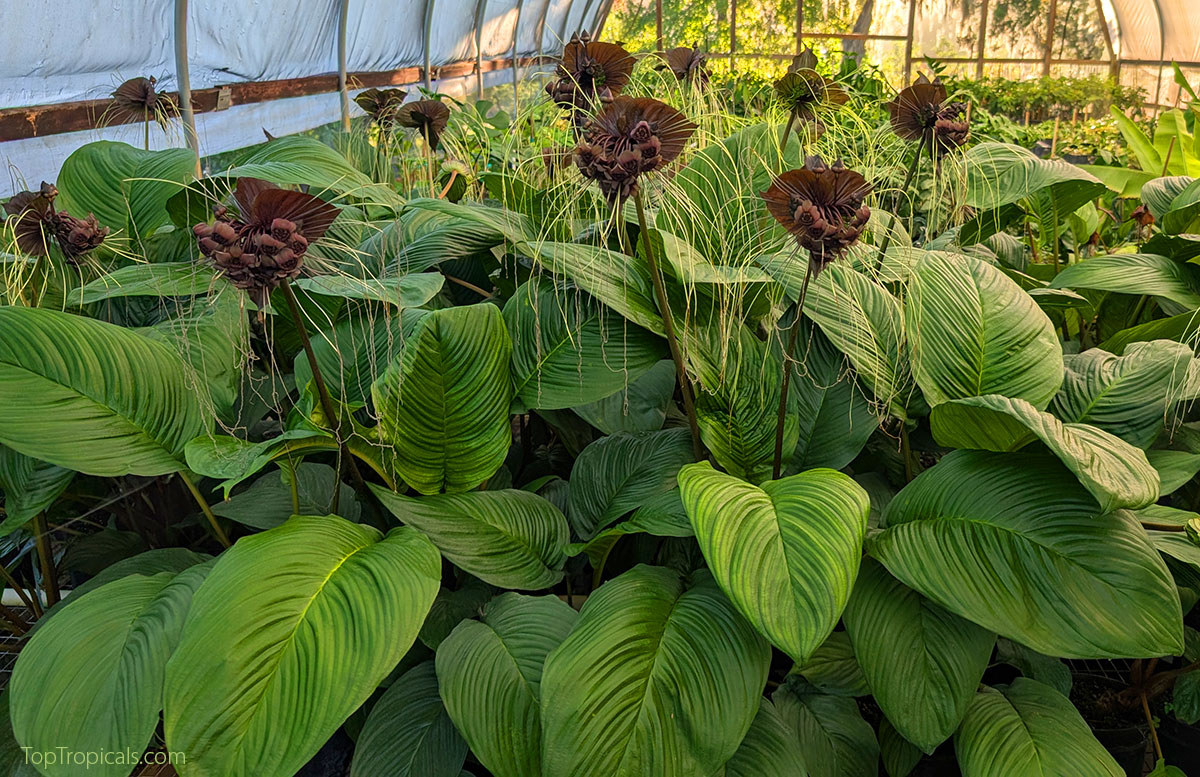
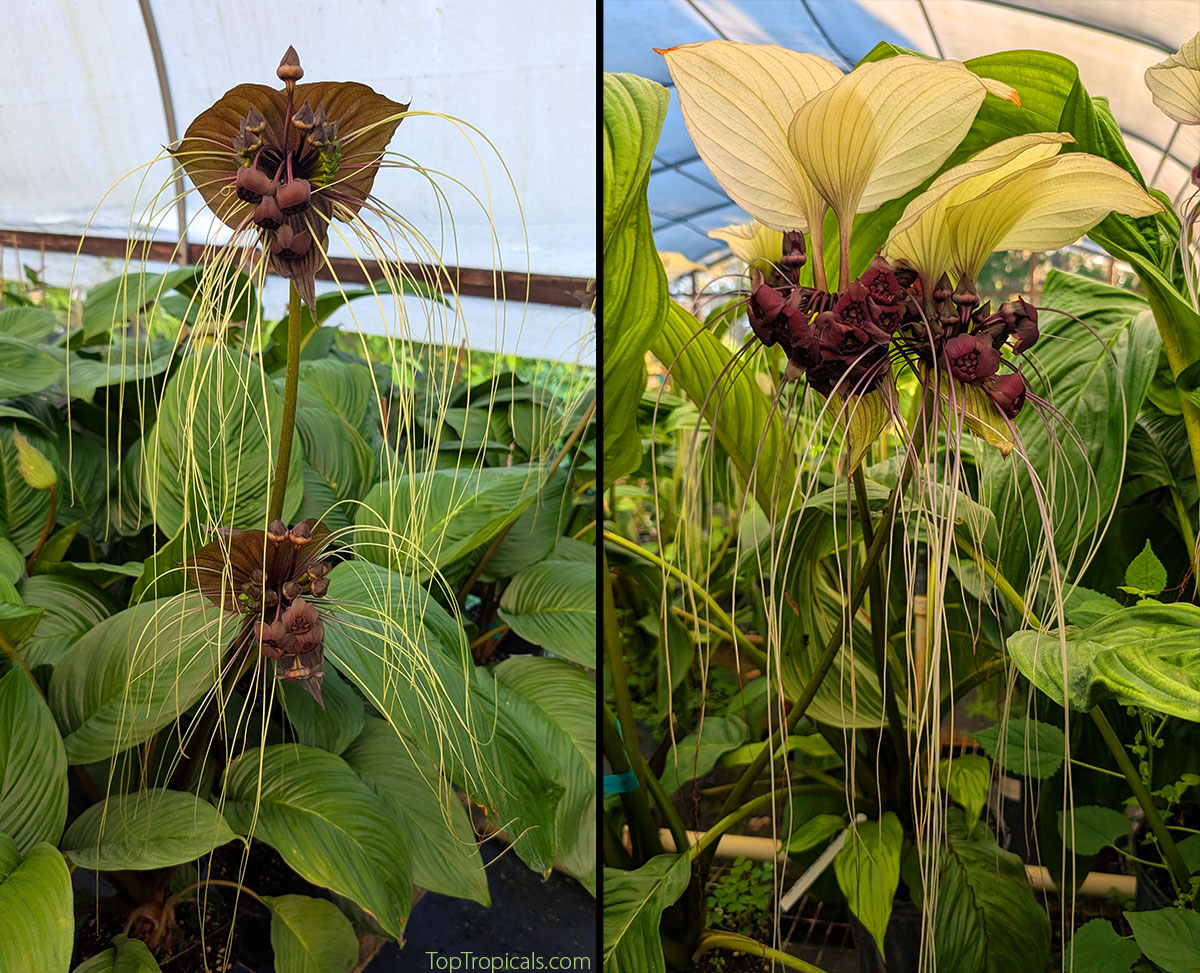
Black and White Bat Lilies (Tacca chantrieri and Tacca nivea) side by side in bloom
How to Care for Bat Lilies
by Top Tropicals Plant Expert Tatiana Anderson
🌞 Light
- Bright, filtered light. Morning sun or dappled shade is perfect.
- Avoid direct midday sun outdoors — it can scorch the leaves.
- Indoors, place near a bright window with sheer curtains or use a grow light.
🌡️ Temperature
- Warm and stable, ideally 70-85 F during the day.
- Protect from cold drafts or sudden chills.
- Ideally, do not let temperature drop below 45 F, although Taccas can tolerate short period of upper 30's.
💧 Watering
- Keep soil evenly moist but not soggy.
- Water when the top inch feels barely dry.
- Use lukewarm water.
- Avoid letting the pot sit in water.
💨 Humidity
- High humidity (60-80%) is key.
- Mist leaves often, use a humidity tray, or keep near a humidifier.
- In greenhouses or bathrooms with a skylight, it thrives naturally.
🌱 Soil
- Use rich, loose, well-draining mix
- Combine bark, peat, and perlite for ideal airflow around the roots.
- Best mix for growing tropical Tacca in pots - soilless potting mix Abundance . It provides perfect drainage and has a texture similar to a jungle rainforest media.
🍽️ Feeding
- During growth season (Spring through Fall), feed with Green Magic controlled release fertilizer every 6 months. For even better results, you may apply liquid fertilizer Sunshine Boosters Rubusta.
- Stop feeding dry fertilizer in cooler months when growth slows. Liquid Sunshine Boosters are safe to use with every watering, year around.
🏡 Indoor Growing
- Great for bright bathrooms, sunrooms, or any warm, humid corner.
- Rotate pot occasionally for even growth.
- Keep away from heating vents and AC drafts.
🌴 Outdoor Growing (in warm climates)
- Partial shade or filtered light under trees.
- Excellent in large containers that can be brought inside for winter.
- Shelter from heavy rain and wind.
Sunshine: "So… it’s a diva?"
Smokey: "Exactly. But take care of it - and it rewards you with wings!"
Smokey and Sunshine: "Happy Halloween!"
🎥 Watch Short Videos:
🛒 Grow your own gothic masterpiece:
Shop Bat Head Lily Tacca
Date: 20 Feb 2026
Florida freeze damage - what to replant after a record cold winter
❄️ Florida freeze damage - what to replant after a record cold winter
🌱 A record freeze changed Florida gardens
After the recent record cold across Florida, many gardeners are now seeing the real damage - browned leaves, split stems, collapsed shrubs, and fruit trees that may not recover.
Some plants surprised us with new growth. Others are clearly gone.
The practical question is simple: what should you replant so it does not happen again next winter?
The good news - you can build a more frost-resilient garden without giving up beauty or fruit.
🌱 First - do not rush to rip everything out
Before replacing anything, check carefully:
Scratch the bark lightly - green underneath means the branch is alive.
- Wait for consistent warm weather - some plants re-sprout weeks or even months later.
- Look for growth higher on the stem, not just at the base.
🌱 Why some plants survived and others did not
Freeze survival depends on several factors:
Duration of cold - 2 hours vs 8 hours makes a major difference
- Microclimate - south-facing walls, wind protection, canopy cover
- Plant maturity - established roots handle stress better
- Pre-freeze health - overfertilized, soft growth freezes faster
🌱 What to replant for a frost-resilient garden
Instead of replacing losses with the same tender species, consider:
Cold-hardy fruit trees
- Proven freeze survivors from this winter
- Shrubs that tolerate brief dips below freezing
- Layered planting for wind protection
- Plant tender species closer to structures.
- Use hardy trees as windbreaks.
- Avoid low frost pockets.
- Improve drainage - wet roots freeze faster.
When redesigning:
✍️ Check the list of freeze survivors:
What tropical plants survived Florida's historic freeze without protection
🌱 Rebuild with strategy, not emotion
After freeze damage, many gardeners replant quickly - only to repeat the same losses.
A better approach:
Identify what truly died.
- Learn which species survived locally.
- Choose varieties proven in your climate zone.
- Design with cold in mind.
🌱 Spring Equinox - a natural reset
The Spring equinox marks equal day and night and the astronomical start of spring. From this point forward, daylight increases and active growth accelerates.
For Florida gardeners, it is a natural reset.
New growth begins. Roots wake up. Replacement planting becomes safer.
This is the right time to rebuild.
🛒 Explore cold tolerant tropical plants and cold hardy Avocados
- 🎥 What tropical plants survived Florida's historic freeze without protection
- 🎥 These Avocados survived 3 nights of 25F hard freeze, Florida Record Freeze
📚 Learn more:
- · Top Ten Fruit Tree Winners of Florida 2026 Record Freeze
- · Top Ten Flowering Tree Winners of Florida 2026 Record Freeze
- · To trim or not to trim? When and how to trim damaged plants after winter
- · Cold-hardy avocado varieties - what freezing they really survive
- · Cold-hardy avocado survival groups - what the numbers really mean
#Discover #How_to
🟢 Join 👉 TopTropicals
Date: 23 Feb 2026
❄️ The Hardiness Report: February 2026 ❄️
🐾 Smokey & Sunshine’s real-world survival data from our Sebring, Florida Research Gardens. Smokey analyzed the data. Sunshine just stayed happy. Here is what they found.

Smokey: This is macadamia strength.
Sunshine: I should put a macadamia nut in my coffee and borrow some of that strength.
Smokey: Do not get too nutty yet. It still needs curing and cracking.
📊 Weather Data – February 1–6, 2026
Sebring, Florida – 132 years of recorded observations
This was not a light frost. It was a prolonged, windy, penetrating hard
freeze.
- 🌡 Minimum temperature: 25F
- ❄️ Wind chill: 14F
- ⏳ Duration: 3 nights of 8–10 hour hard freeze
- ☀️ Daytime temperatures: around 50F for 7 days
- 🌀 Wind: sustained 20 mph, gusts 40–50 mph
While all our plants in pots were protected in greenhouses, our in-ground plantings faced the freeze outdoors. We covered what we could. Even so, some plants were damaged, some died, and some surprised us by surviving.
In the next few newsletters, we will share the real survivors - the plants that proved themselves in the ground, under real conditions. Smokey and Sunshine have been out in the fields assessing the damage from the February 1–6 freeze. While many plants struggled, the Macadamia proved to be a true standout. This is how we grow them to handle the tough years.
Why does this matter? Because we have gotten used to warm winters, and this freeze was a rude awakening. Not everyone lives in Miami. If you garden in places where a real cold event can happen, you have to be prepared - and you have to plant what can take it.
🌰 Macadamia: Freeze Tested and Standing
When temperatures dropped to 25F with wind chill near 14F, our established macadamia trees remained upright, green, and structurally intact. Leaves held. Branches stayed firm. No collapse, no panic.
That is not luck. That is macadamia hardiness.
Often considered a "tropical luxury nut," macadamia proved it can handle more than many gardeners expect. In USDA Zones 9b-11, with proper drainage and site selection, it is not just ornamental - it is a long-term food tree with real resilience.
In a winter that reminded us not to take warmth for granted, macadamia earned its place on the survivor list.
The nut itself is famous for its strength. The shell is among the hardest in the nut world, requiring serious pressure to crack. Inside, the kernel is creamy, buttery, rich, and deeply satisfying. High in monounsaturated fats and naturally low in sugar, macadamias have long been valued both for flavor and for nutrition.
The tree is equally impressive. An evergreen with tough leaves and elegant spring flowers, it matures into a productive, manageable canopy. Nuts develop slowly over six to seven months. Production begins in a few years and increases steadily as the tree matures. Plant it once, and it can reward you for decades.
Cold will come again. It always does. The question is not whether winter will test your garden. The question is whether your trees are ready. Macadamia proved it is. If you are building a garden that feeds you for decades, this is a tree worth planting.