Garden Blog - Top Tropicals

Date: 24 Oct 2016

Overwintering Adeniums outside of tropics
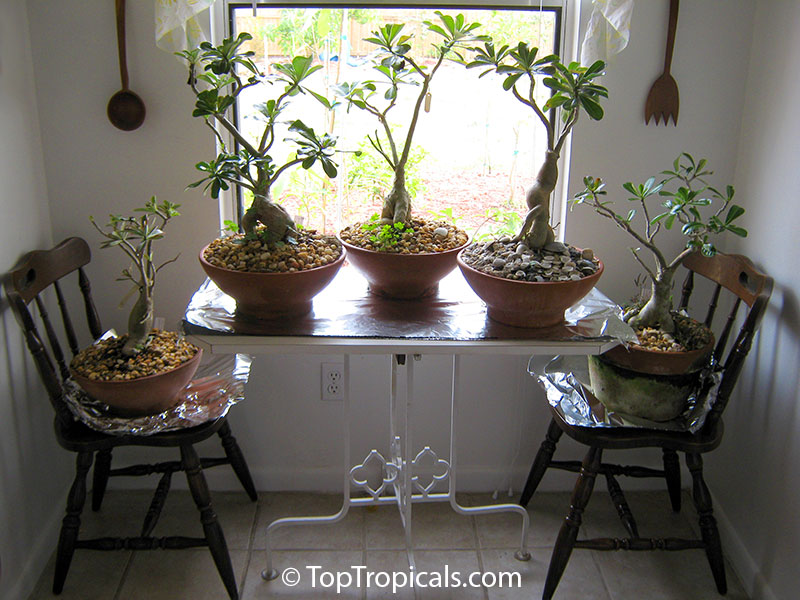
Q: We bought several adenium plants from you. We are moving to the Denver area of Colorado. How can we make sure the plants survive? Should we use a green house?

A: Adeniums are perfect container plants, and house plants. They can be easily grown outside of tropical climate. During winter, Adeniums drop leaves and go into dormancy which makes it easy to keep these plants in a dormant stage in a warm location of your house, or possibly even in well-lit spot of garage (with a window), with temperatures above 50-60F.
Here in South Florida, during time of cold, when chances of freeze are high, we move our own Adenium collection into lanai, with plastic sheet protection around lanai.

In colder climates, Adeniums can be kept indoors as house plants during winter. There are some requirements/tips for you:

  • Temperature. Move Adeniums indoors when temperature starts dropping below 45F.
  • SUNSHINE. Use SUNSHINE boosters to improve cold resistance of Adeniums, and essure healthy plant throughout winter. SUNSHINE-BC formula is specifically designed for plants with caudex, and bonsai.
  • Water. Reduce watering to minimum, especially when plants drop leaves - this means they went into dormancy. Once a week light watering is enough. Water very carefully during cooler months. When it is hot (85-100F), excessive water usually won't harm adeniums: it will be partially used by a plant, and partially will evaporate. Especially be careful with water when temperatures drop below 65F - then tropical plants simply stop growing process and go dormant. Once adeniums start losing leaves, this is a sign to reduce watering to once a week to once a month, and in very small quantity (couple tablespoons per pot).
  • Light. Bright light is not necessary, but do not keep them in dark either, even if all leaves dropped. Good light is necessary to maintain healthy stems and caudex. Keep in mind, the less light, the less watering too. Ideal spot is a windowsill, however if your space is limited and all windows occupied by other "leafy" plants, location close to window will be enough as long as watering is reduced, to avoid rot. We keep our big collection specimens on a roofed porch during winter, where level of light is very low. Last winter we haven't lost a single plant due to low light. They take shade pretty well considering minimum or no water. However bright light is always better - it creates healthier environment for a plant. We all know about space limitations for our large collections, especially in winter. So if you can afford a bright spot for adenium during winter - the plant will be lucky!
  • Soil. Use only well drained mix with much higher content of perlite than you would use for most tropical plants. For adeniums, we use mix with 30-40% of perlite in it, while regular mix has 10-15%. Adeniums like alkaline soil, unlike most of tropical plants (hard to say what else likes alkaline... Ficus for sure!). This means, regular mix with high content of peat moss may cause root rot. To increase alkalinity, you may add dolomite. Here in Florida where we have natural supply of shell rock handy, it is easy to add some shell to a potting mix (shell sand, rather than quartz sand). We always add a few large shells on top of a pots with a big specimen. Besides increasing soil pH (making it more alkaline), shells look very decorative.
  • Fertilizer. No fertilizer until Spring when plants start showing new growth and new leaves.
  • Move your Adeniums outside in Spring, when chances of freeze are zero. More sunlight and air circulation is beneficial for breaking the dormancy and providing plants with a quick growth start.
Date: 7 Jul 2016

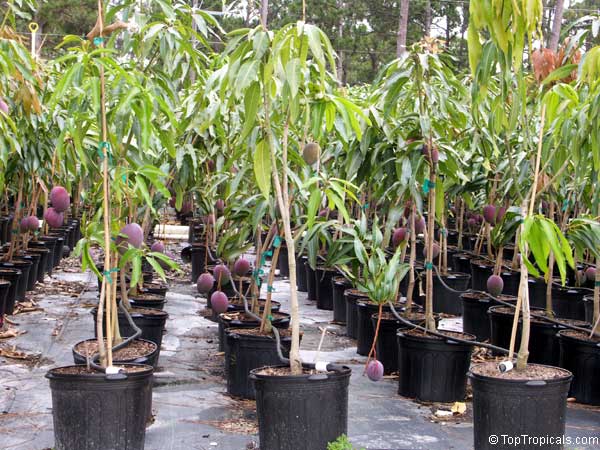
Growing fruit trees in containers

Will it fruit in a pot? YES! Many tropical fruit trees can be grown in a pot. We get many calls from customers in cooler climates asking if our tropical trees can grow and fruit in a pot. The answer is yes!

Several plants fruit well in pots. Blackberries and raspberries, barbados cherries, blueberries and many more start fruiting even in their 1 gallon containers. We are especially excited about our new Pixie grapes, which are heavily laden with grapes even at only a foot long!

While some plants are small and will fruit easily in a container, others are large trees. For the tree type fruits, we recommend growing only non-seedling plants for pot culture. We have cuttings, air layers and grafted plants that are great options. These have the ability to fruit right away, as they are the same age as the parent tree. Some horticulturists recommend removing the first year fruit to allow the plant to focus on growth and establishing. If the plant is being kept in a pot, this is not necessary.

We also have several dwarf varieties of fruit trees that will thrive in a pot. For avocados, we carry the Wurtz variety which is a dwarf tree... read more...

Date: 6 May 2016

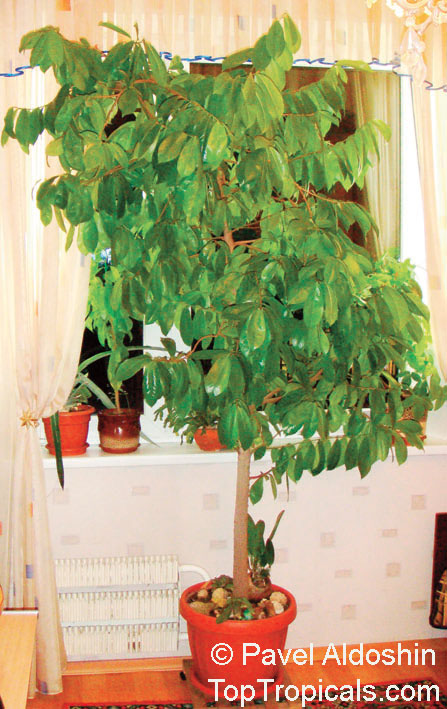
Taking care of Soursop after shipping

Q: Since I have never grown a soursop tree before I need some pro help. My tree was delivered absolutely beautiful, leaves were a pretty green. I potted it and gave it a good drink of water and put it in a shaded area outside. Then the weather here became cool so I brought it in for a few days until the weather warmed, and it lost all the leaves. Is it in shock and will come around eventually? Will I be able to grow this tree indoors during winter?

A: Soursop - Annona muricata trees are very sensitive to temperature drops. This always causes leaf loss. You seem to be doing everything right. Do not water until soil gets slightly dry; keep it in bright shade. The weather should be good now with high temperatures and humidity rising. No fertilizer until the plant shows active new growth. Be patient with your plant, it should recover soon.

Soursop is an ultra-tropical tree and doesn't take any freeze. If you live in cooler climate, keep the plant in a pot (the good news is, Annonas in general have compact nature and are perfect for container culture). Bring the tree indoors during cold period, providing bright light.

We have very interesting article about growing and fruiting Soursop in apartment. Check out 4534 Tropical Treasures Magazine # 7.

Date: 25 May 2026

Why Gardeners Are Secretly Obsessed With This Rare Brazilian Giant Walking Iris

Iris Regina - Neomarica caerulea

🔤 Why Gardeners Are Secretly Obsessed With This Rare Brazilian Giant Walking Iris


Meet Iris Regina - Neomarica caerulea: the rare, salt-tolerant Brazilian walking iris that blooms in under a year and thrives in shady, sandy soil where other tropicals fail.

One look at Iris Regina - and it's easy to see why tropical plant collectors quietly become obsessed with it. It pairs elegant, hand-painted blue-violet flowers with arching, sword-like leaves that instantly give your garden a lush, structural look.
But the real magic of this unusual Brazilian species isn't just its beauty - it's the fact that it thrives exactly where other tropicals fail.

The Plant That Thrives on Neglect (and Salt Air)


Originally discovered growing near the ocean in Brazil, Iris Regina naturally adapted to conditions that would frustrate most gardeners. Thriving in sandy soil, deep shade, and coastal salt spray, this plant is remarkably easygoing. While most flowering tropicals demand rich soil and perfect drainage, Iris Regina handles difficult planting zones with absolute grace.

👉 Quick Care Tip: While it loves moist, well-drained soil, overfeeding is a mistake. Too much fertilizer will give you massive leaves but fewer flowers!

Blooms in Less Than a Year


One of the most surprising traits of Iris Regina is how quickly it matures. Many rare ornamental plants test a gardener's patience for years before ever showing a bud. Fresh seedlings of this species, however, can reach blooming size in less than a year - an absolute rarity for a tropical perennial with such exotic flowers.

The blooms look like a cross between a rare orchid and a delicate iris. While individual flowers are short-lived, mature clumps continuously push out new blooms throughout the warm season, especially when kept evenly moist.

Light and Cold Tolerance: What You Need to Know


· Light: For the best foliage color and maximum blooming power, give it morning sun and afternoon shade. It can handle more sun, but only if you keep up with watering.
· Cold Hardiness: Iris Regina is comfortable down to about 30F. In warmer parts of Florida (Zones 9b-11), it performs beautifully outdoors year-round.
· Cold Climates: If you live in a freeze-prone zone, it makes an exceptional container plant. Just wheel it to safety when a freeze threatens.
Propagation: It's incredibly easy to divide, or you can grow it reliably fast from fresh seed.

25 Years of History: The Top Tropicals Connection


For us at Top Tropicals, Iris Regina isn't just another botanical listing - it carries a piece of our history. This specific variety was introduced by the legendary tropical plant collector Sid Gardino, who named it after his wife, Regina.

Sid and Regina have been longtime friends of Top Tropicals for over a quarter of a century. In fact, some of the very first plants in our nursery’s collection came from them more than 25 years ago. Plants like Iris Regina represent the early, passionate era of Florida plant collecting - treasures shared between friends long before rare plants became viral internet trends.

Today, Iris Regina still feels like a hidden gem compared to flashy orchids or massive aroids. But if you are looking for something elegant, salt-tolerant, and surprisingly easy to grow, this Brazilian walking iris might just become your favorite plant in the garden.

🛒 Get Iris Regina for a low-maintenance, always-blooming showstopper

📚 Learn more:

Walking Iris Plant Facts

Botanical name: Neomarica caerulea
Also known as: Walking Iris, Twelve apostles, Apostle Plant, Iris Regina
USDA Zone: 8 - 11
Highligths Small plant 2-5 ftSemi-shadeShadeFull sunWatering: Regular. Let topsoil dry slightlyBlue, lavender, purple flowersSubtropical plant. Mature plant cold hardy at least to 30s F for a short timeFlood tolerant plantSeaside, salt tolerant plant
Get personalized tips for your region

· Neomarica caerulea - Iris Regina in Plant Encyclopedia
· What flower is perfect for coastal gardens
· What is the best plant for a carefree flower border

#Container_Garden #Shade_Garden #How_to #Discover


🟢 Join 👉 TopTropicals

Date: 20 May 2026

Why in Thailand Wrightia religiosa is near all temples and homes

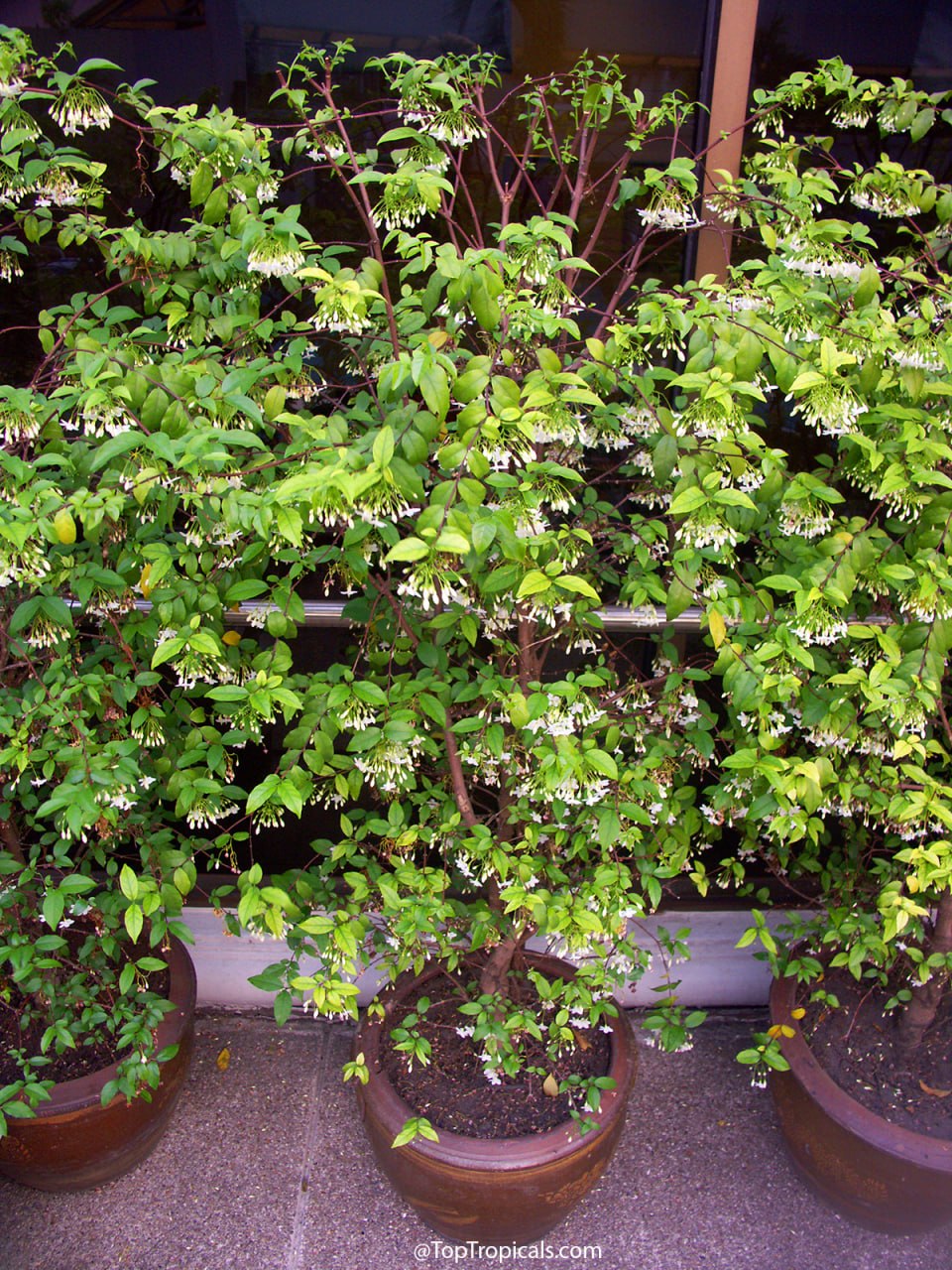
Wrightia religiosa - Sacred Buddhist, plant

Wrightia religiosa - Sacred Buddhist, plant

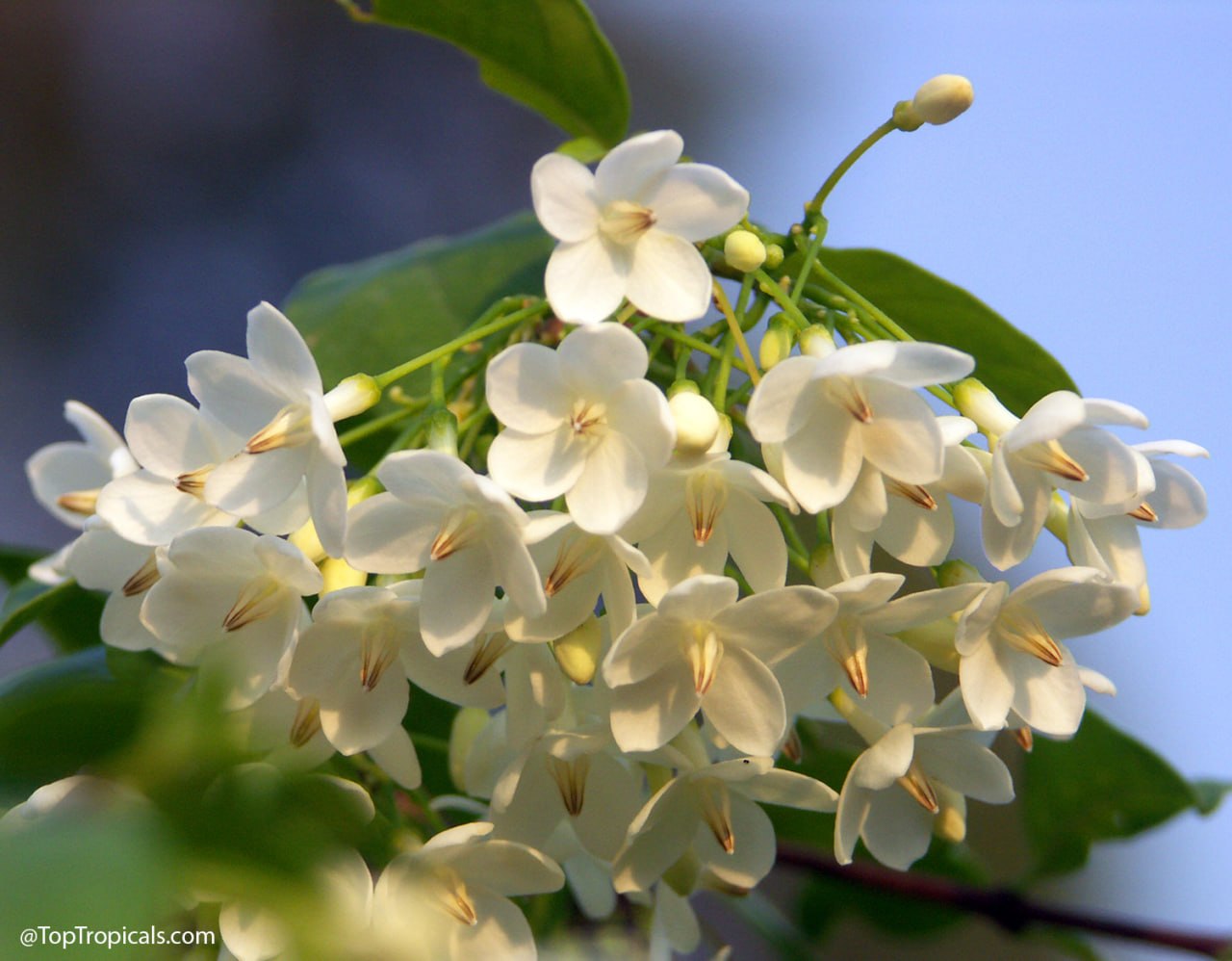
Wrightia religiosa - Sacred Buddhist, flowers

Wrightia religiosa - Sacred Buddhist, flowers

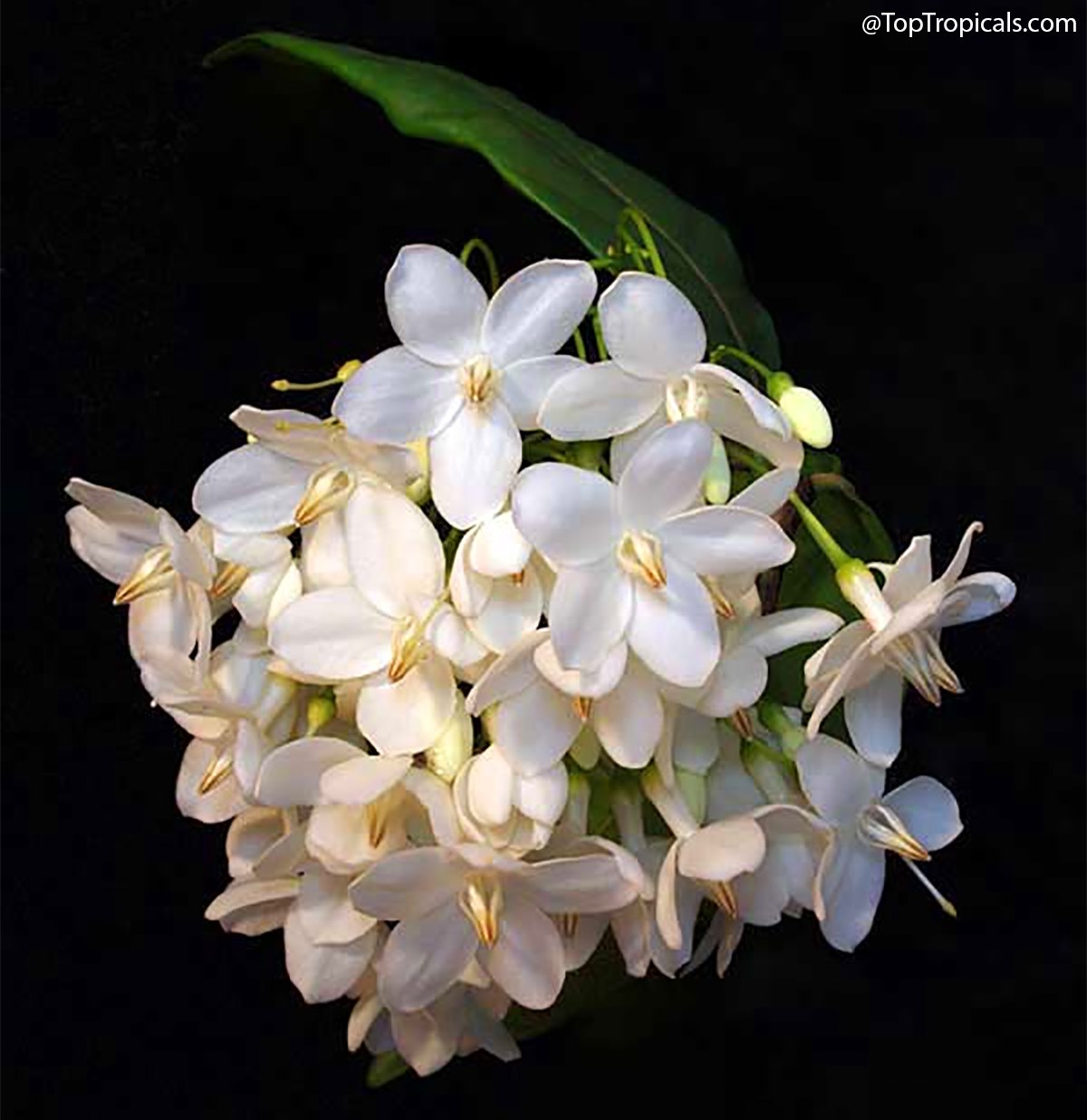
Wrightia religiosa - Sacred Buddhist, flower close up

Wrightia religiosa - Sacred Buddhist, flower close up

🏯 Why in Thailand Wrightia religiosa is near all temples and homes


In Thailand, you will smell the Water Jasmine before you see it. Trace that soft, fruity, jasmine-like fragrance and you'll find Wrightia religiosa - an unassuming tropical shrub with tiny white flowers hanging like pendants. Also called Sacred Buddhist, this beloved plant is everywhere in Southeast Asia, cherished for its rich cultural history and old-world charm rather than loud colors.

Sacred Buddhist Plant Facts

Botanical name: Wrightia religiosa, Echites religiosa
Also known as: Sacred Buddhist, Wondrous Wrightia, Wild Water Plum, Water Jasmine
USDA Zone: 9 - 10
Highligths Plant used for bonsaiLarge shrub 5-10 ft tallSmall tree 10-20 ftSmall plant 2-5 ftSemi-shadeFull sunWatering: Regular. Let topsoil dry slightlyWhite, off-white flowersPlant attracts butterflies, hummingbirdsEthnomedical plant.
Plants marked as ethnomedical and/or described as medicinal, are not offered as medicine but rather as ornamentals or plant collectibles.
Ethnomedical statements / products have not been evaluated by the FDA and are not intended to diagnose, treat, cure, or prevent any disease. We urge all customers to consult a physician before using any supplements, herbals or medicines advertised here or elsewhere.Fragrant plantSubtropical plant. Mature plant cold hardy at least to 30s F for a short timeFlood tolerant plantSeaside, salt tolerant plant
Get personalized tips for your region


💮 The Shrub of Buddhist Symbolism that Thai Temples Have Been Planting for Centuries

The species name religiosa is no accident. It literally refers to the plant’s long association with religious, spiritual, and cultural traditions across Thailand, Vietnam, Malaysia, and Singapore.

While the flowers themselves are visually simple, their unique growth habit has inspired generations of Buddhist symbolism. Unlike many flowers that point proudly toward the sky, the blooms of the Water Jasmine hang downward. In Thai culture, this downward-facing habit became a beautiful symbol of modesty and humility - a physical representation of bowing down rather than standing in pride.

Furthermore, many gardeners and monks associate the flower’s five distinct petals with foundational Buddhist virtues: wisdom, compassion, patience, kindness, and generosity. Whether ancient legend or folk interpretation, this cultural meaning has earned the plant a reputation as something sacred, making it a staple near homes and temple grounds.

💮 The Fragrance People Fall in Love With


Visually, Wrightia religiosa does not try to dazzle you with giant petals or wild, neon colors. Instead, its magic lies entirely in its scent.

The perfume it throws into the air is the real reason people become obsessed with it. It is a clean, intoxicating fragrance that drifts gracefully through the evening air. For anyone living in a warm climate, the best part is that the Water Jasmine is not a "one-and-done" bloomer. When the plant is happy, it flowers repeatedly and almost continuously throughout the year, meaning that incredible scent becomes a permanent fixture in your garden.

💮 From Temple Gardens to Bonsai Pots


Part of what makes Wrightia religiosa so widespread is its sheer versatility. It is an incredibly agreeable plant that adapts beautifully to whatever form a gardener desires. In Southeast Asia, you will see it styled as:
· A standalone specimen shrub
· A dense, fragrant privacy hedge
· A patio accent in containers
· A small, sculptural tree

It has also become an absolute classic in the tropical bonsai world. Because its branches are flexible, fast-growing, and highly responsive to pruning, even beginners can easily wire and shape young plants into twisted, artistic forms. Left to grow naturally, older plants develop a graceful, twiggy, and airy structure that looks naturally sculptural.

💮 The Fake-Dead Winter Quirk


Wrightia is easy to care for with standard sun and water, but it hates the cold (although survives it well). Below 65F, it abruptly drops all its leaves and looks completely dead. Many gardeners panic and throw it away - but it’s just resting. Simply bring container plants indoors for the winter. Once the warmth returns, it wakes up, flushes green, and resumes blooming.

💮 Subtle Beauty with Deep Roots


Some tropical plants impress with sheer size, but Wrightia religiosa does the opposite. Its beauty is quiet - thin branches, dangling white pendants, light green foliage, and a fragrance that gently fills a yard.

It is a plant with a few centuries of cultural history carried in its branches, and it is one of those rare garden gems you cannot truly appreciate until you experience its scent in person.

🛒 Plant the Sacred Buddhist and enjoy the magical aroma

📚 Learn more:


Wrightia religiosa and other wrightias in Plant Encyclopedia

#Discover #Perfume_Plants

🟢 Join 👉 TopTropicals