Date: 9 Nov 2019
Saving Fallen Papaya Tree
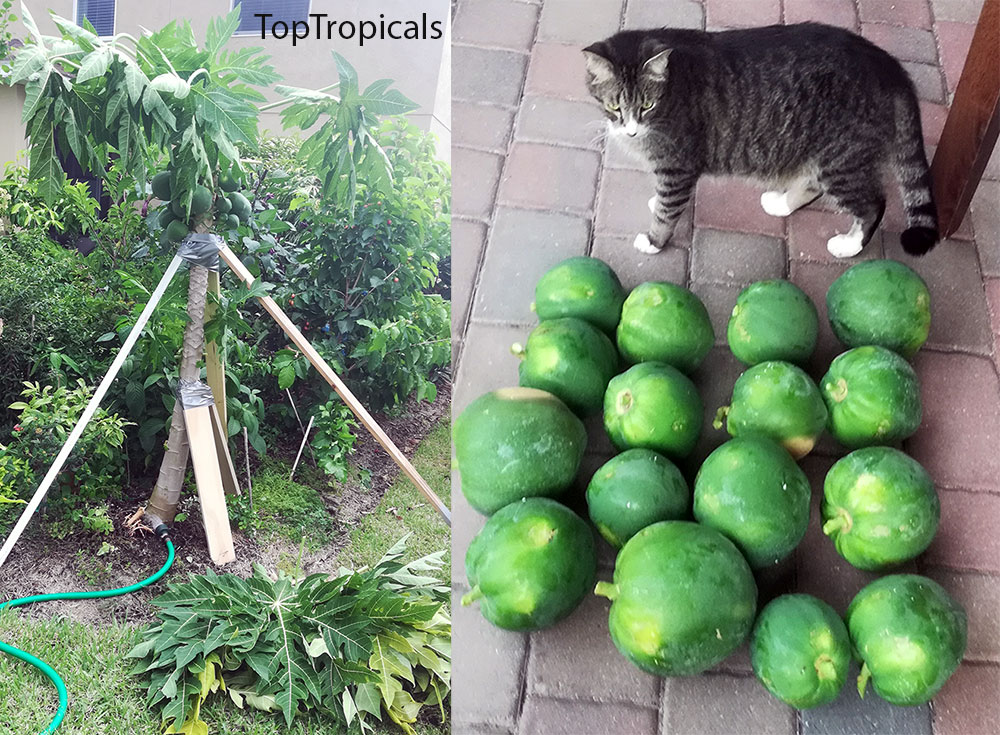
Q: Hope there is help for my beautiful amazing papaya tree! There where a loooooooot of fruits on it, but it broke! First of all, it was leaning and friends tried to straight my beautiful tree. What can I do? Will it get fruits again?
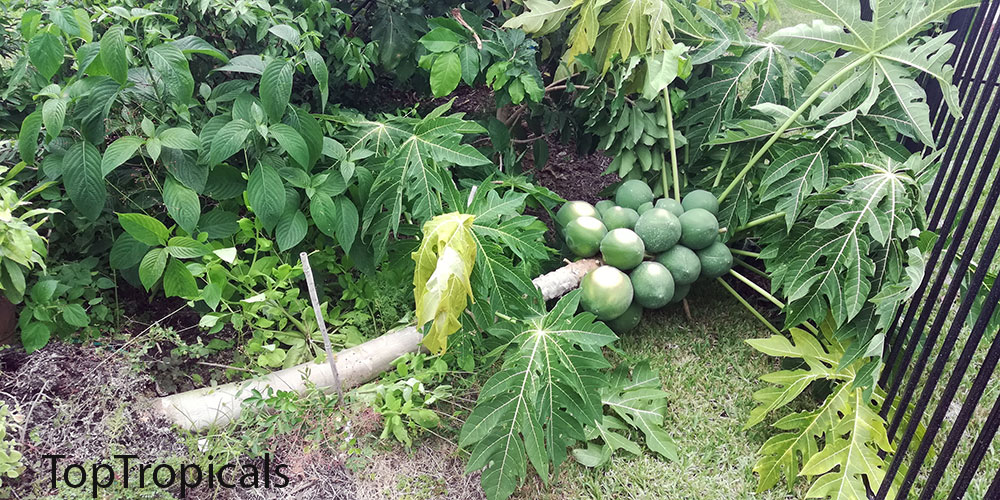
A: A couple months ago we also had a Papaya tree loaded with
fruit that fell down (see photos). It was heart-breaking. We secured it and it
continued growing for a couple of weeks but unfortunately, at the end the tree
still died, leaving us a million fruit.
The Papaya tree has a very sensitive root system and is hard to
re-establish once the roots are damaged.
However, if it just has a broken top, it has a good chance to grow back
from the side shoots.
Of course, remove all the fruit so they don't take energy from the
recovering tree.
When a tree is loaded with fruit, it is important to provide support for
heavy branches and for the trunk if needed. Always support the fruiting tree to
prevent from possible falling BEFORE it starts leaning down and may become
broken by even a light wind.
In the photo, you can see how we fixed boards around, but it was already
after the tree fell. Unfortunately, it was too late since the roots got
damaged. Always need to stake the tree up before the branches get too heavy!
RECOMMENDED FERTILIZERS:
Fruit Festival Plant Food - Super Crop Booster
Mango-Food - Smart Release Fruit Tree Booster
SUNSHINE-Honey - sugar booster
Maradol Papaya $10 Hot Sale
Only local pick up from our
Garden Center
Hurry up, while supply lasts!

Date: 8 Nov 2019
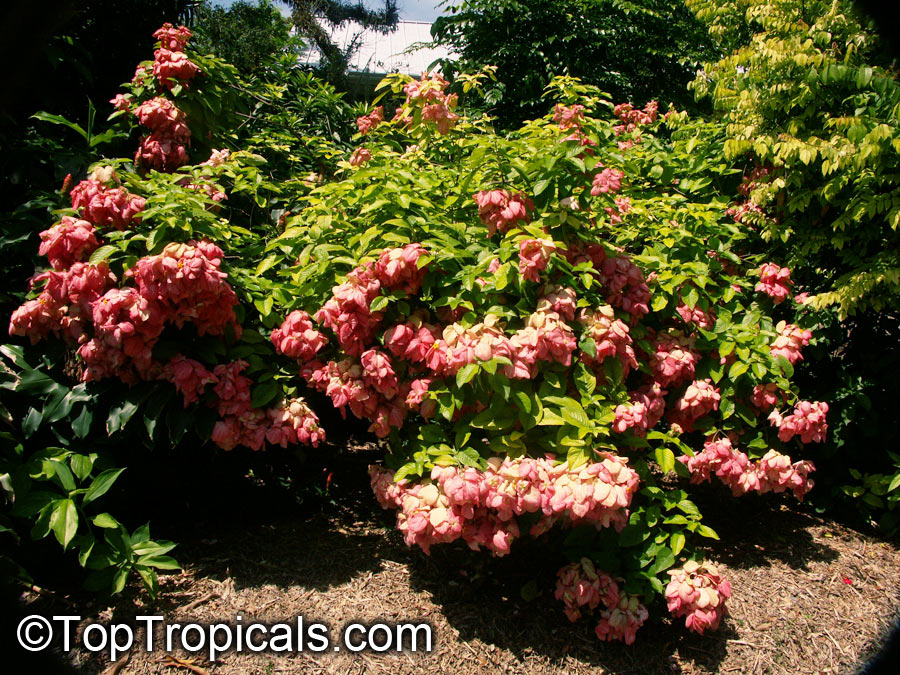
Trimming Mussaenda bush
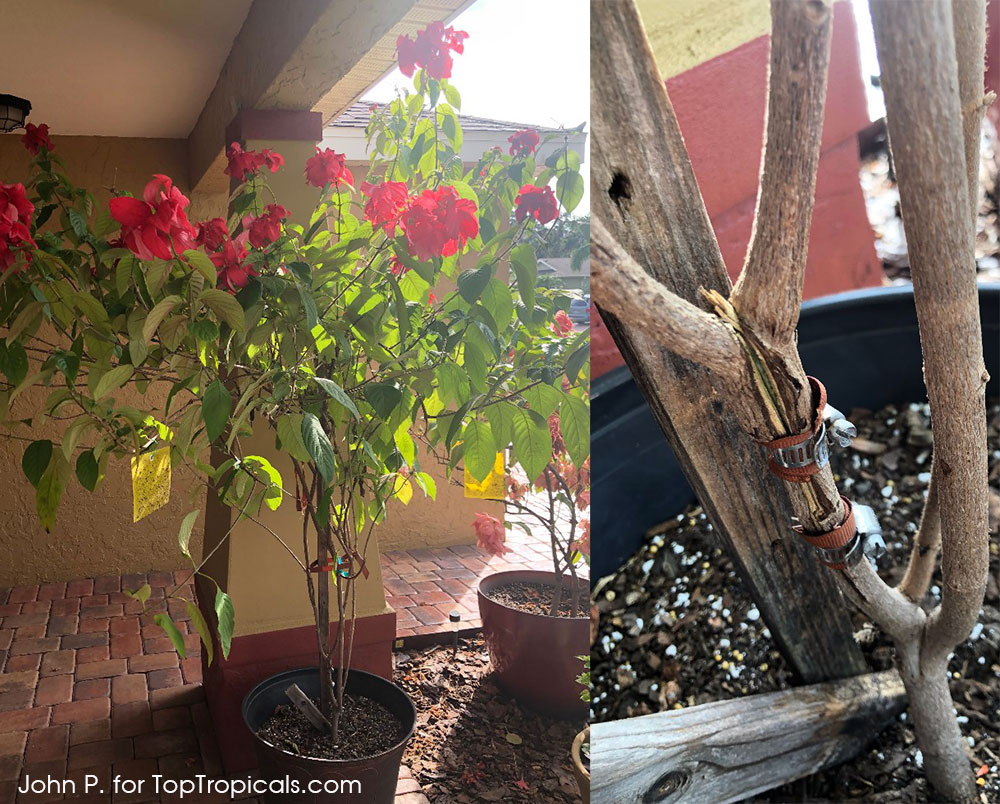
Q: My wife and I bought a Dona Evangelina from you this year. It thriving and has grown to 6-8 ft. It has become top-heavy and in wind, it falls over. Main stems have split twice but still continues to grow. I usually prune Dona Luz back to 3-4 ft and am wondering how much you would advise me to lop off your plant. Any advise will be appreciated.
A: Mussaendas, indeed, have very fragile stems that break often,
especially in Florida wind storms. The good news is, these plants grow
vigorously once established.
You did a good job trying to tie together the split stems and in fact,
cracks do grow back together as long as the dressing is tight. Try to use green
tape or even electric tape to tighten the broken spot.
However, do such repairs only if it is critical for a plant. When possible,
simply cut off the broken branch and give the plant a chance to grow a new
stronger branch. You may trim the bush pretty short. Mussaendas respond well
to pruning which promotes more side growth and makes the plant bushier.
Keep in mind that during cold weather, Mussaenda may drop all leaves and go
into dormancy until spring.
RECOMMENDED FERTILIZERS:
Pink N Good Daily Plant Food - Flower Booster
Tropical Allure - Smart-Release Booster
Date: 4 Nov 2019
Hardy Plumeria Pudica
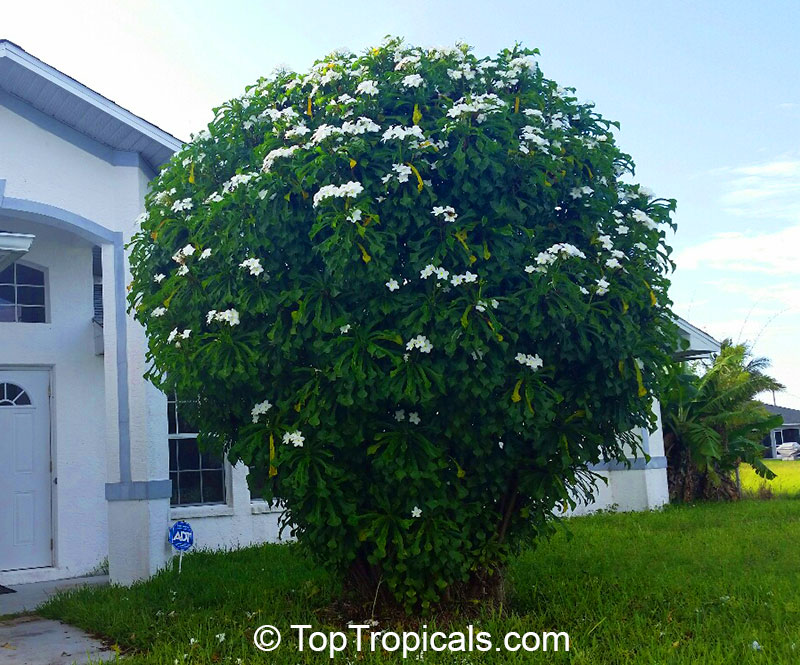
Q: I have ordered plumeria pudica from you in March and it is thriving really well here in Rancho Cordova, California. The current temperatures are ranging from 68 to 32 degrees Fahrenheit. My USDA zone is 9b. Does this plumeria pudica survive outside with temperatures dropping in coming winter in CA?
A: From our experience, Plumeria pudica is pretty cold hardy and takes some cold spells in
spite of being a tropical species.
Our trees (well-established) took a few hours of freeze with no
significant damage.
Potted plants are less hardy than in-ground plants. However, their
advantage is, they are easy to move indoors or inside warmer place like garage,
etc. If the temperature stays borderline around 32F for a few hours, the plant
should be safe as long as warm day temperatures follow a cold night. For
longer periods of cold, move the plant inside.
Make sure do not overwater and keep Plumeria on a dry side during
winter, since cold and wet is a bad combination and may cause root problems.
Above is the picture of Plumeria pudica tree growing in Cape Coral, FL
where low temperatures in winter sometimes go down to upper 20's for a few
hours.
To improve cold hardiness of Plumerias and other tropical plants, use SUNSHINE-Epi-T for plant thermal protection and immune system boost.
Make sure to fertilize plants on regular basis to keep them strong and
vigorous. The stronger and bigger the plant, the hardier it is!
RECOMMENDED FERTILIZERS:
Plumeria Top Dress - Smart-Release Booster
Pink N Good Daily Plant Food - Flower Booster
Tropical Allure - Smart-Release Booster

Date: 30 Oct 2019
Fragrant Gold Leaf Orchid Vine
By Onika Amell, tropical plant specialist
Q: I am absolutely thrilled to see you have this vine. I've tried for years to get this plant! It is so, so rare. It just seemed impossible to find in this country. How do I make it thrive? I am ordering two.
A: We are happy to confirm that indeed we do have this rare vine!
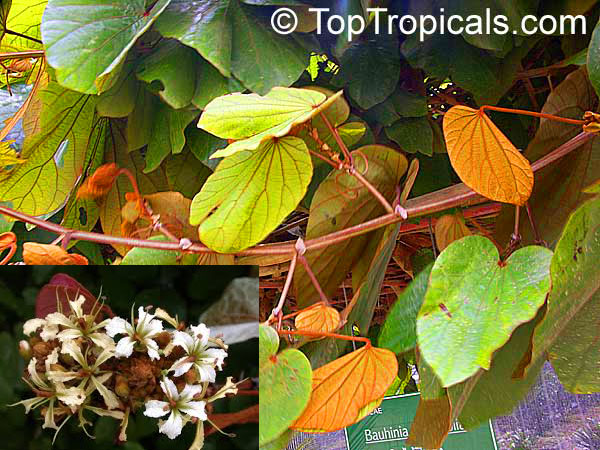
Bauhinia aureifolia - Gold Leaf Orchid Vine - was discovered in Thailand in
1983. It is endemic to Pattani, Narathiwat, and Yala in Southern Thailand.
Danish botanist Kai Larsen named this plant and hailed it as one of the rarest
plant species of the world when it was discovered in the eighties.
The Thai people call this vine Bai Mai Si Thong. It is a beautiful
climber with large, bi-loped leaves (7 inches or more!) and good branching.
Young leaves are a stunning burnt orange to terracotta color for about
a week and as they reach full size, they turn green over a couple of days.
This is a very rare color for Bauhinia. It produces leaves all the time and
this means this vine is always full of beautiful color. With its golden leaves,
it sure is reminiscent of Autumn.
This vine blooms from May to November. It bears bunches of small
flowers that are delicately fragrant in the evenings. The cultivated plants range
flower color from pure white to purple and pink, while the wild ones have
often white petals with pinkish patches.
Bauhinia aureifolia needs well-drained soil, full light and good humidity
to thrive. It will tolerate a light freeze once established and it is very
important to protect young plants.
Gold Leaf Orchid Vine also makes a wonderful container plant with staking
or support. It is a must for every rare plant collection!
RECOMMENDED FERTILIZERS:
Pink N Good Daily Plant Food - Flower Booster
Tropical Allure - Smart-Release Booster
Date: 18 Oct 2019
Using SUNSHINE Complete Nutrition System
For hydroponics and potted plants
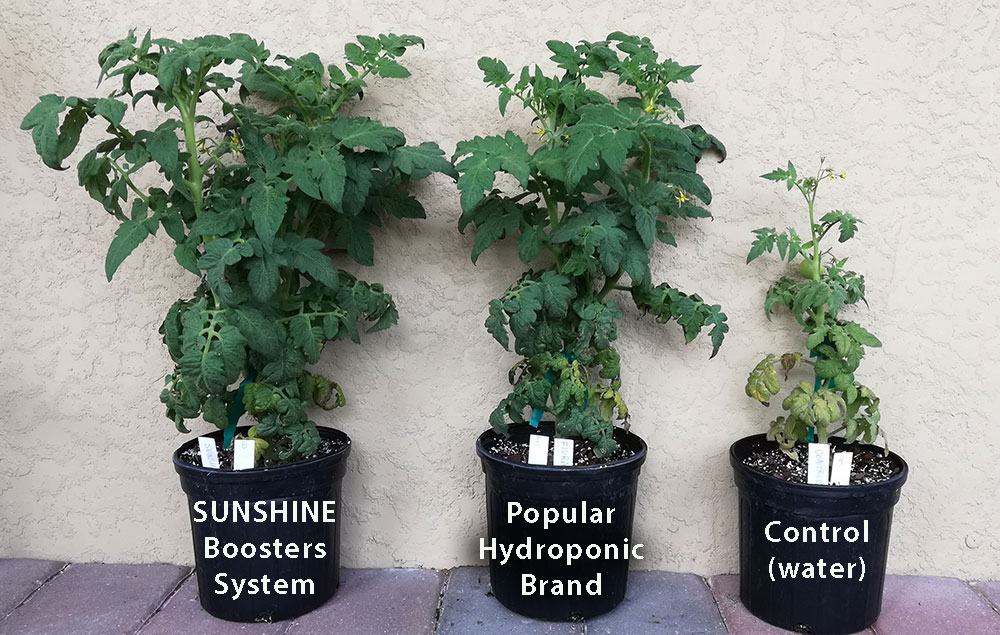
Q: I recently bought both the 5ml of the sunshine epi and the 100 ml advanced nutrition kit. I read on the paper for the Epi not to use any other strong fertilizers along with this but I was wondering if it'd be alright to use both this foliar spray and nutrition watering together?
A: All solutions in SUNSHINE Booster Nutrition System (NPK-macro and micro-boosters) are
compatible.
The only exception is Sunshine-Epi - brassinosteroid bio-stimulant. Epi
should be mixed with distilled water separately from other boosters. The
reason is, it is very bio-active, and if mixed with other compounds, oxidizes
quickly which may affect its performance.
Sunshine-Epi solution must be prepared using distilled water and applied as foliar spray only (it only works on contact with leaves and not through the root system). Epi shows extremely impressive results when you apply it before the application of other nutrients because it increases plant metabolism; so all boosters become even more effective if you spray Epi the day before.
When using Micro- and Macro-boosters, you may mix all components in one watering can/tank (except for Epi), using regular tap water. Besides watering root ball, the macro-micro solution can be also used for foliar spray. It is optional, as in some circumstances growers prefer to keep leaves dry at all times: to stay away from mold, fungus and other issues caused by the wet environment.
Here is an example of Sunshine Boosters Nutrition System application:
1. Daily watering in one can: NPK 25 ml/gal (one of 5, depending on growth stage) + Constanta 5 ml/gal + Ca-Support 5 ml/gal, mixed in tap water
2. Every 2 weeks: spray Sunshine-Epi 2.5 ml/gal - to boost the immune system and growth rate,
mixed in distilled water
3. From daily to every 2 weeks: Sunshine-Power-Si 25 ml/gal to protect from diseases and keep pH at
5.5-6.5. Can be used as often as daily and mixed with a daily watering solution
(1)
4. As needed: Sunshine SuperFood and GreenLeaf - for correcting deficiencies. Can be also mixed with the
daily solution (1)
Make sure to prepare a solution right before use and do not store solution for more than 1 day. Keep concentrates and solutions protected from bright sunlight.
Here is also advanced information on Sunshine Boosters compatibility.