Garden Blog - Top Tropicals

Date: 7 Feb 2026

How to grow an Avocado tree on your patio
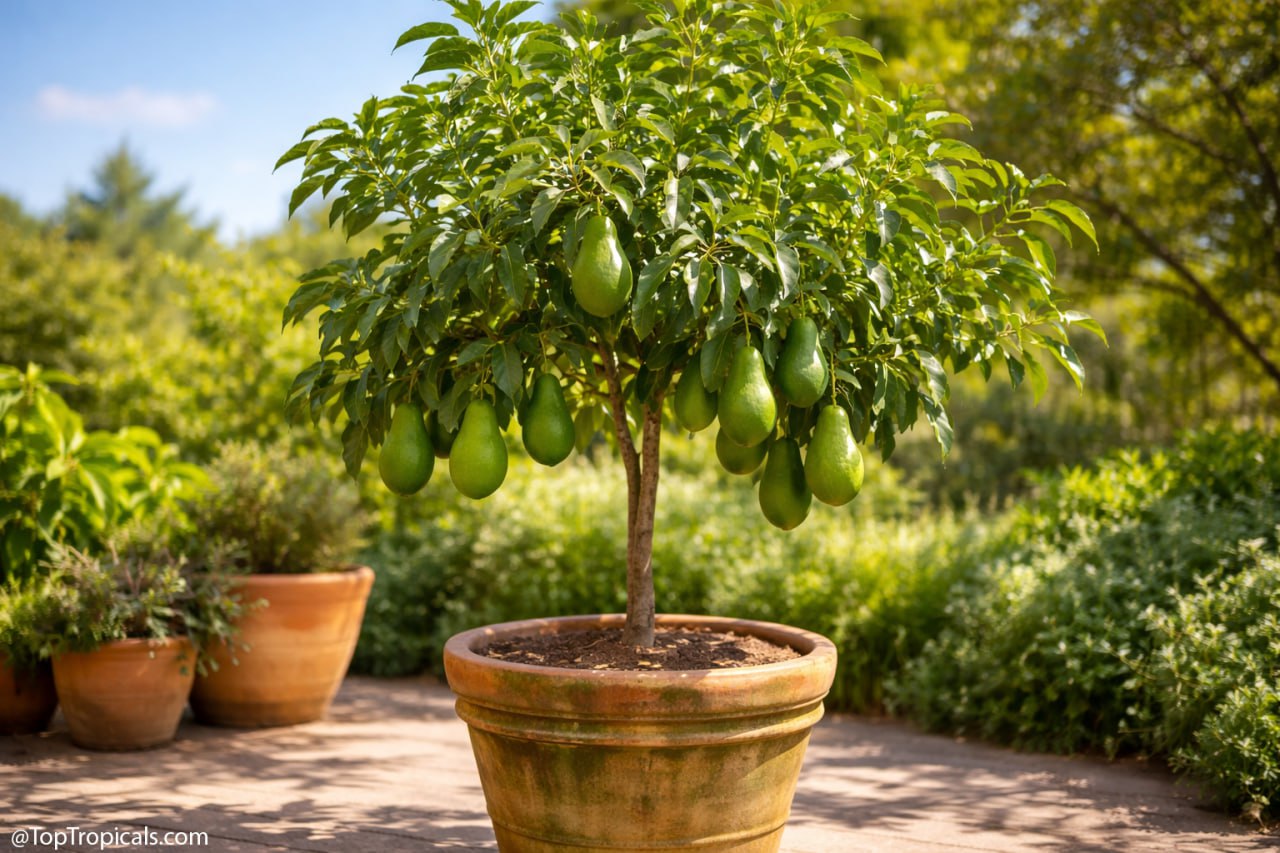
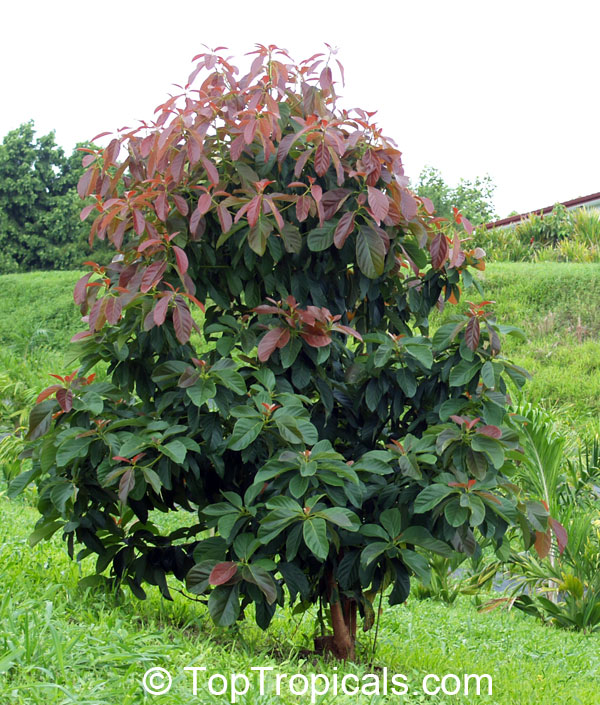
Avocado tree fruiting

Avocado tree fruiting

Yes, you can grow an Avocado tree on your patio - here is how to do it right


If you would love to grow your own avocado but don’t have a big yard, good news - avocado trees can grow very well in containers. Compact or dwarf varieties, often called condo avocados, are especially suited for pots, patios, balconies, and even indoor growing near a sunny window.

Avocado Plant Facts

Botanical name: Persea americana, Persea gratissima
Also known as: Avocado, Alligator Pear, Aguacate, Abacate
USDA Zone: 9 - 11
Highligths Large tree taller than 20 ftSmall tree 10-20 ftFull sunWatering: Regular. Let topsoil dry slightlyEdible plantSubtropical plant. Mature plant cold hardy at least to 30s F for a short time
Get personalized tips for your region

Growing avocados in pots is also a smart choice in cooler climates, since you can move the tree indoors when temperatures drop. With the right variety and basic care, potted avocado trees are easy to manage.

Pick a compact avocado variety


Choosing the right variety is the most important step. Standard avocado trees grow very large, but condo or compact varieties stay much smaller and adapt well to containers.
Good choices for pots include:
· Wurtz (Little Cado) - a true dwarf, perfect for containers
· Fuerte - a semi-dwarf that stays manageable with pruning
· Joey - naturally compact and easy to keep smaller
Dwarf avocado trees usually grow 6 to 10 feet tall. Fruit size is normal, but yields are smaller than on large trees.

Choose the right pot


Start with a pot about 12 inches wide (around 5 gallons). This size is easier to water correctly and helps prevent root rot. Avoid planting a small tree into a very large pot too soon.
As the tree grows, move up gradually. A mature potted avocado will need an 18- to 24-inch container. Repot every couple of years when roots show through drainage holes.
Always use a pot with excellent drainage.

Use well-draining soil


Avocados love water but hate wet feet. Use a loose, fast-draining mix, such as Abundance Professional Soilless Mix. You can improve drainage by adding perlite or coarse sand. Avoid heavy garden soil.
Water deeply, but not too often.
Water thoroughly, then let the soil dry before watering again. Always check moisture first. In summer, watering may be needed once or twice a week; in cooler weather, much less.
Overwatering is the fastest way to kill a potted avocado.

Give plenty of sun


Avocado trees need at least 6 to 8 hours of full sun daily. Outdoors is best, but indoors place the tree near a bright south- or west-facing window. Grow lights can help if light is limited.

Fertilize and prune


Feed during the growing season with a balanced fertilizer such as Green Magic (every 6 months) or liquid Sunshine Boosters (safe to use with every watering, year-around). Prune lightly to keep the tree compact and well-shaped.

Protect from cold


Most Avocados are sensitive to hard freeze. When temperatures drop below 35F, move the pot indoors or into a protected space. Reduce watering in winter as growth slows.
Cold hardy varieties can take cooler temperatures down to 18F once established. For example, Joey is both cold hardy and dwarf - perfect choice.

Final thoughts


Growing an avocado tree in a pot is practical and rewarding. With good drainage, sun, careful watering, and the right variety, you can enjoy homegrown avocados even without a yard.
Small space? No problem. Just think condo avocado. According to Southern Living, Lemons can be grown in pots - and so can Avocados!

✔️ Check out
Avocado Variety Guide interactive chart. Sort them by flower type A or B, tree habit, fruit shape and quality, cold hardiness, origin, season and more!

🛒 Explore Avocado varieties and Dwarf Avocado

📖 Our Book: Avocado Variety Guide, Snack or Guacamole?
·
Hard copy · PDF File Download

📚 Learn more:


· Avocado Variety Guide
· Posts about #Avocado
· Avocado tree (Persea americana) in Plant Encyclopedia
· How to grow tropical fruit outside the Tropics
· What is so unique about Wurtz avocado?
· How to protect Avocado from cold and how hardy is it?
· Avocado that laughs at frost: Mexicola Grande for cooler climates
· Cold hardy Avocado Joey - you eat it with the skin
· Cold-hardy avocados: how cold-hardy are they?

🎥 What is a Dwarf Condo Avocado that fruits at 3 ft tall? 📱

#Food_Forest #Avocado

🟢 Join 👉 TopTropicals

Date: 10 May 2026

🍑 From the Garden: Why I Always Recommend Growing Your Own Peaches

by Tatiana Anderson, Top Tropicals Garden Expert

A  peach  tree  growing  outdoors  under  a  blue  sky  with  ripe  red-orange 
 peaches  hanging  among  long  green  leaves.  The  image  also  shows  a  close-up 
 view  of  several  fuzzy  peaches  ripening  on  a 
 branch.

Peach trees are beautiful long before harvest day - glossy green leaves, colorful fruit, and that classic fuzzy peach look straight from the branch.

I'll be honest with you. The first time I bit into a peach straight off the tree, still warm from the afternoon sun, I understood why people get obsessed with this fruit. There is no comparison to what you find in a grocery store. Store peaches are picked hard, shipped cold, and by the time they reach you, something important is already gone. A tree-ripened peach is soft, fragrant, juicy, and sweet in a way store peaches rarely are. Eat it fresh, slice it into a cobbler, throw it on the grill - it holds up beautifully either way.

Peach Plant Facts

Botanical name: Prunus persica, Amygdalus persica
Also known as: Peach
USDA Zone: 5 - 10
Highligths Small tree 10-20 ftFull sunWatering: Regular. Let topsoil dry slightlyWhite, off-white flowersPink flowersEdible plantDeciduous plantSubtropical plant. Mature plant cold hardy at least to 30s F for a short time
Get personalized tips for your region

So let's talk about how to actually get there.

Planting

Peaches are not difficult. Give them sun, drainage, and room for air movement, and they will usually tell you very quickly that they are happy.

  • Full sun is essential - 8 hours minimum, and more is better.
  • Drainage matters - peach roots do not like sitting wet.
  • If your soil stays wet, plant on a mound - simple fix, big difference.
  • Water deeply, then pause - let the soil partially dry before watering again.
  • Prune every year - it keeps the tree open, improves airflow, and helps the tree put energy into fruit instead of tangled growth.

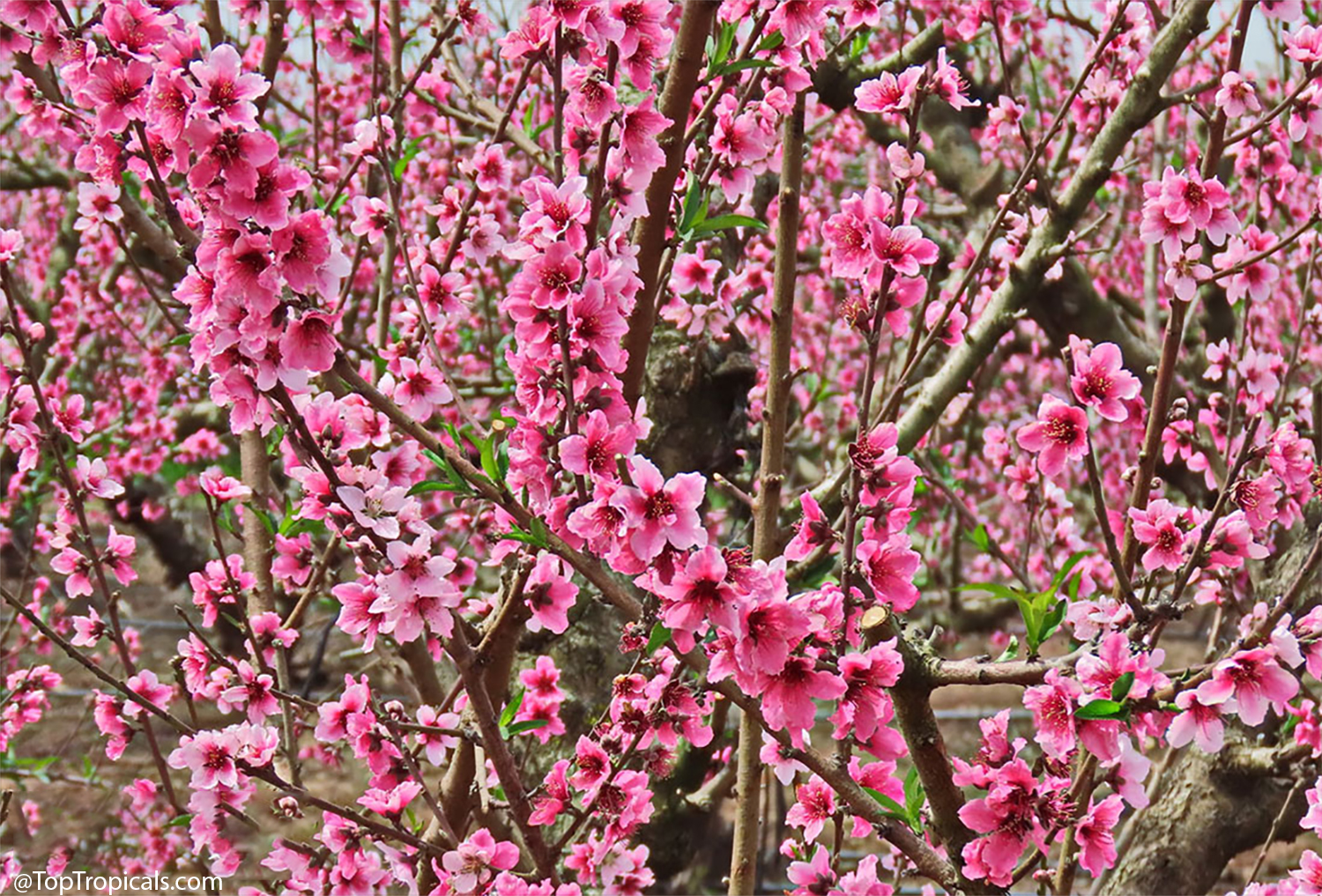
Branches  of  a  peach  tree  covered  in  masses  of  bright  pink  blossoms 
 during  spring  bloom.  The  flowers  densely  fill  the  tree,  creating  a  colorful 
 display  of  pink  petals  against  the  brown 
 branches.

Peach trees put on one of spring's prettiest shows - clouds of pink blossoms before the fruit season even begins.

What If You Do Not Have Room?

You can still grow peaches in a large container. This is a great option for patios, small yards, renters, or gardeners who want better control over soil and drainage.

  • Use a large pot with drainage holes.
  • Choose a fast-draining potting mix, not heavy garden soil. We recommend Sunshine Abundance potting mix.
  • Place the container in the sunniest spot you have.
  • Water more often than in-ground trees, but never let the pot stay soggy.
  • Prune to keep the tree compact and easy to manage.

Fertilizing

Peach trees are generous plants, but producing vigorous growth and a heavy crop of sweet fruit takes energy. Regular feeding makes a noticeable difference in tree health, flowering, and fruit quality.

I prefer a simple two-part approach that provides both steady background nutrition and quick, readily available nutrients when the tree is actively growing.

  • Green Magic controlled-release fertilizer provides a steady supply of nutrients for months and serves as the foundation of the feeding program.
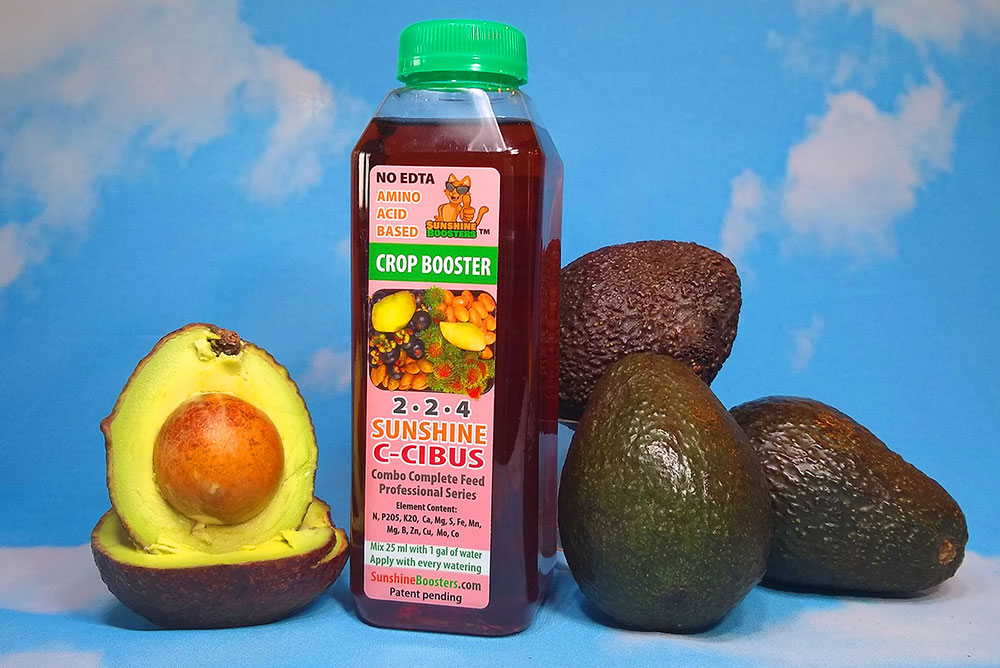
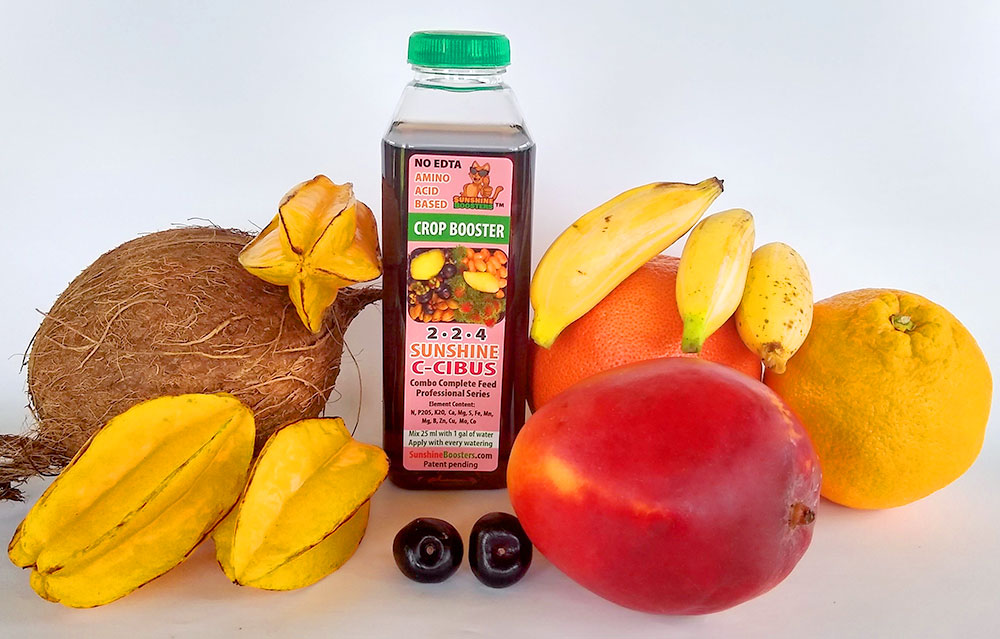
  • Sunshine Boosters liquid fertilizers deliver amino acid-based nutrients that are quickly absorbed and especially useful during periods of active growth, flowering, and fruit development. Sunshine C-Cibus formula is the best for fruit trees.

During the growing season, this combination helps build stronger branches, healthier leaves, better flowering, and sweeter, higher-quality fruit.

If your tree shows yellowing leaves or weak growth, consistent feeding often makes a dramatic difference within a few weeks.

📚 More about low-chill peaches from our garden Blog

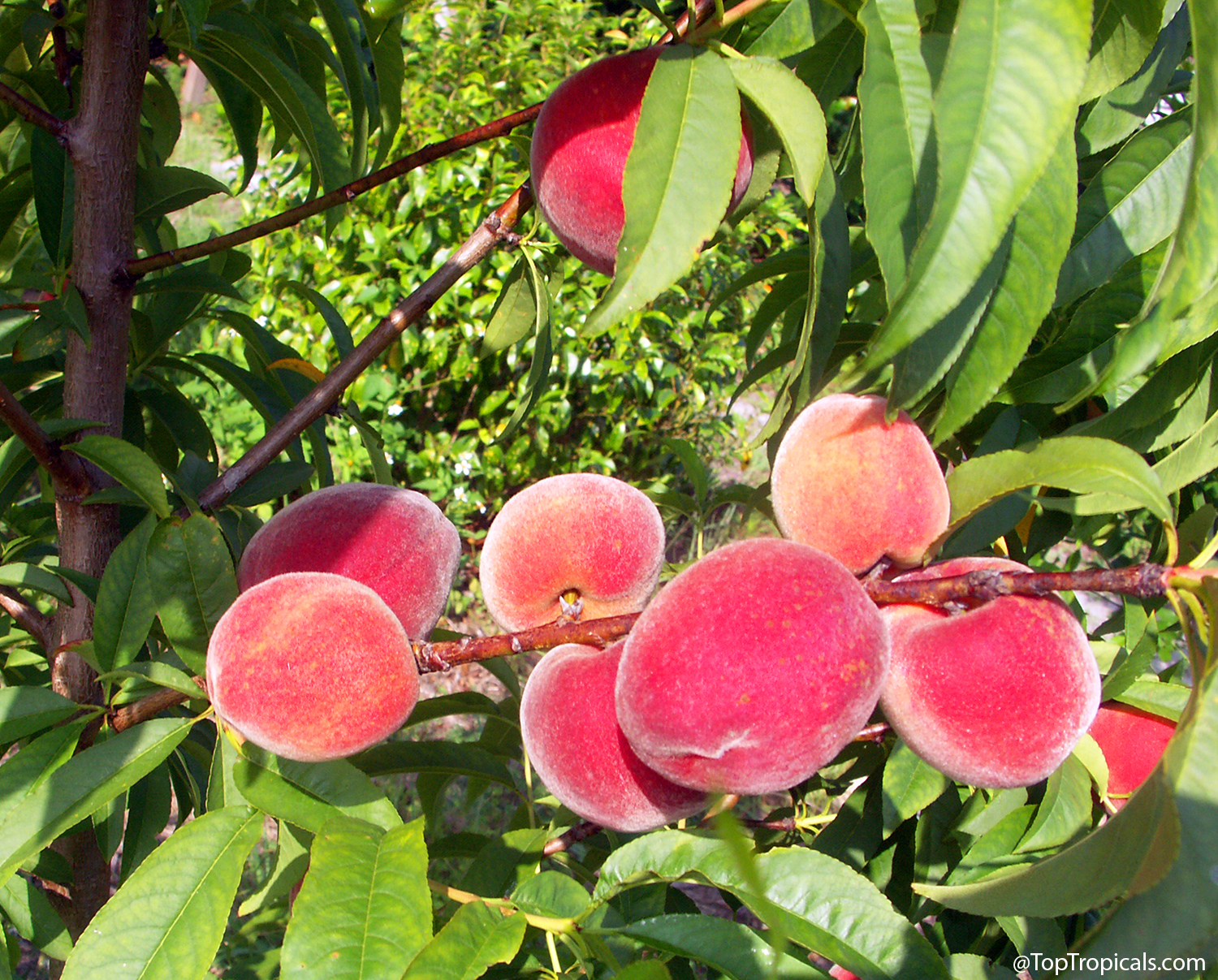
Clusters  of  ripe  fuzzy  peaches  growing  on  tree  branches  surrounded  by 
 long  green  leaves  in  bright  sunlight.  The  peaches  show  shades  of  pink,  red, 
 and  soft  yellow  as  they  ripen  on  the 
 tree.

Tree-ripened Tropic Beauty peaches warming in the sun - fuzzy, colorful, and almost ready to pick straight from the branch. Tropic Beauty variety is one of the most colorful and sweet.

📚 More about Tropic Beauty Peach

🛒 Shop Low-Chill Peach trees

Sunshine’s Philosophy: Lazy Peach Sundae 😺

Sunshine absolutely loves peach cobbler, especially when someone else does all the peeling, slicing, mixing, and baking. But when he is left to prepare dessert on his own, his standards become much more practical. Why turn on the oven when perfectly ripe peaches already taste amazing? His philosophy is simple: if a recipe takes less than five minutes and ends with peaches and vanilla ice cream in the same bowl, it is a masterpiece.

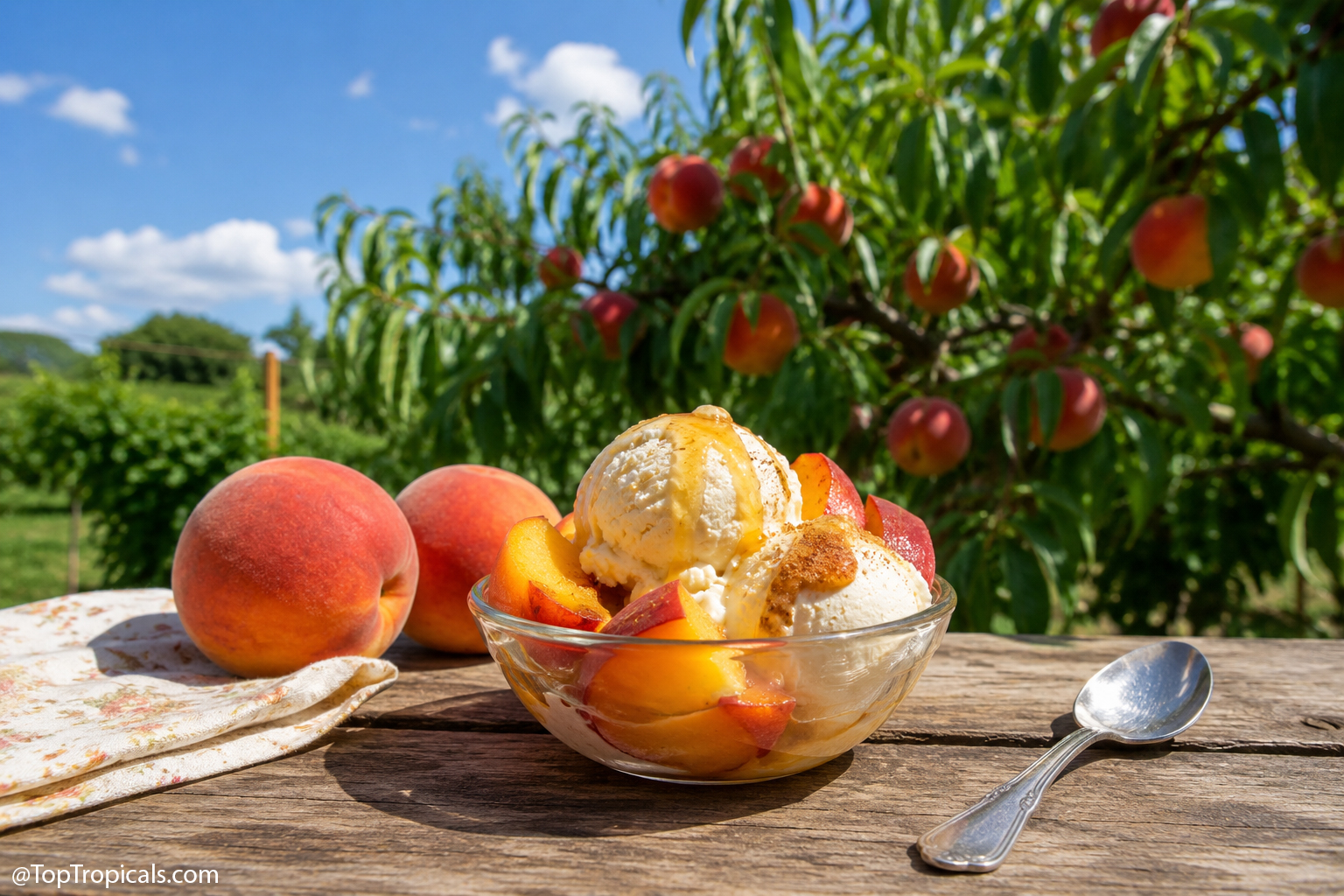
A  bowl  of  sliced  ripe  peaches  topped  with  two  scoops  of  vanilla  ice 
 cream,  drizzled  with  honey  and  lightly  sprinkled  with  cinnamon,  sits  on  a 
 rustic  wooden  table  outdoors.  Fresh  whole  peaches  rest  nearby,  with  a  sunny 
 peach  orchard  full  of  fruit  and  a  bright  blue  sky  in  the 
 background.

Sunshine's Lazy Peach Sundae - fresh peaches, cold ice cream, and zero effort on a perfect sunny day.

Sunshine's Lazy Peach Sundae

This is not cooking. This is assembly.

Ingredients

  • 2 ripe homegrown peaches
  • 2 big scoops of vanilla ice cream
  • A drizzle of honey (optional)
  • A pinch of cinnamon (optional)

Instructions

  1. Slice the peaches.
  2. Put them in a bowl.
  3. Add vanilla ice cream.
  4. Drizzle with honey and sprinkle with cinnamon if you feel ambitious.
  5. Eat immediately while smiling.

Sunshine's Review

"I peeled exactly nothing and still got dessert. This is my kind of gardening."

Want this?
Start with a low-chill peach tree. That is usually how it begins.

🛒 Plant your own Peach tree

Date: 13 Apr 2021

Healthy Plants: Q&A from Mr Booster

Why my Avocado is not flowering?

Q: I have 5 avocados. Three of your cold hardy varieties and two others that have all flowered and set fruit in the past. The last two years including this year, not a single one of them has put out any flowers. I am getting lots of new growth like one would expect on a tree too young to flower. The last two years have been very mild with out any damaging frost where in previous years they lost all their leaves due to frost yet started putting out flowers once winter was over. I am confused because they have all flowered and set fruit previous years. Any ideas would be appreciated.

A: From information you provided, and considering the trees get lots of full sun and cold was not an issue, the only explanation is - lack of nutrients. Here is an example.
Very common situation: you get a small 2-3 ft Avocado or Mango tree in 3 gal pot (or even smaller) from a nursery, full of flowers, and sometimes even a small fruit. You bring it home, plant it in the ground or a bigger pot, it looks happy and grows like crazy. Then next year - oops, no fruit, sometimes not even flowers. What happened?
When the tree lived in a nursery, it was provided with all necessary nutrients through the injector systems (continuous feed); or some nurseries may use top dress smart release on regular schedule. Regardless of fertilizer type, professional grower's set up delivers plant food non-stop, on regular basis, with balanced formulas. Plants are not only growing fast but also ready to produce, since nutrients are always available for a full growth cycle.
When you plant a tree in the ground (or larger pot), conditions change. They may be beneficial for the plant: lots of room for roots to establish, hence lots of vegetative growth. Even if you planted it using good quality fertile soil, this soil may contain mostly nutrients responsible for vegetative growth (branches and leaves). Chances are, your soil may be rich in Nitrogen (good for green growth), but poor in other elements responsible for flowering and fruiting (Phosphorous, Potassium, and many important micro-elements such as Molybdenum, Boron, Iron, etc.). Besides, existing soil gets exhausted quickly, and within a year a two, if you don't add fertilizer, flowering and fruiting may be reduced or even stopped. This is why fertilizing program is very important for fruit trees that are expected to bring a crop soon.

We recommend:

- SUNSHINE C-Cibus - Crop Nutrition Booster - balanced food for fruit trees
- SUNSHINE-Honey - sugar booster - promotes more efficient blossoming and pollination, makes flowers bigger and reduces bud drop
- SUNSHINE SuperFood - for improving fruit trees production

Also keep in mind that some fruit trees have a habit of "skipping" a year and may either produce less or not produce at all every other year. In any case, balanced nutrition program can help to fix this "bad habit".

Date: 7 Aug 2020

Healthy Plant Food

Q&A from Mr Booster

Plant food for a Star Fruit

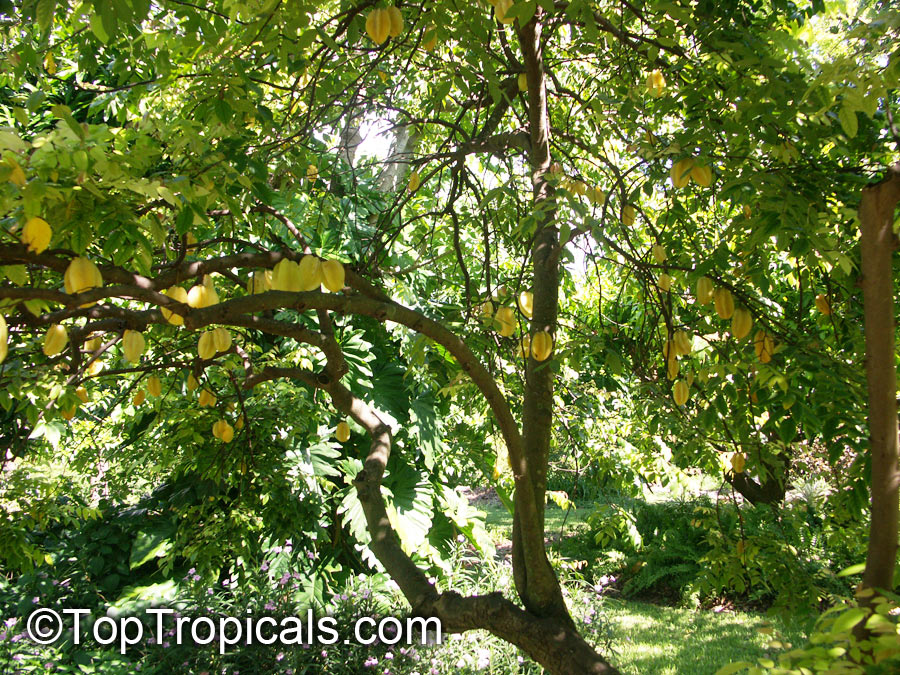
Q: I have 2 Starfruit plants from you. One on the left is B10 has a lot of flowers but no fruit is developing. On the rite is Kenjeng. This one has no flowers at all. Both plants are growing very well. Plenty of sun and water. I am located in Boynton Beach Florida. So what to do?

A: Your trees on the pictures look very healthy, congratulations with a great care!
Starfruit, as well as other grafted fruit trees (like mango, avocado, etc) usually flower/fruit easily and readily while in pots in the nursery. Sometimes, once planted in the ground, they may reduce flowering or even stop flowering. What happened?
The answer is simple. In pots, we fertilize them on regular basis. In our nursery, we have fertilizer injector inline with irrigation system that dozes plant food with EVERY watering. In other nurseries, they may also use slow-release fertilizers, but it is still a regular routine to provide plant food to potted plants.
In the ground, especially in Florida poor soils, fruit trees may stop flowering or delay fruiting due to lack of nutrients, or dis-balance of elements in the ground. Without fertilizer, a tree may take extra time to develop bigger root system to reach out for necessary elements, and eventually will start fruiting anyway.
But we want it to fruit soon! The only way to fix the problem is to provide fertilizer on regular basis for a young tree. It is especially important during hot summer months when plant metabolism is fast due to high temperatures, plus nutrients may get washed away with frequent summer rains (like we have in Florida) even if you've added some fertilizer at time of planting.

You can use smart release fertilizer once a month during hot season, this one or similar:
Mango-Food - Smart Release Fruit Tree Booster.

But the most effective way to get a tropical tree to flowering and fruiting, is frequent applications of liquid fertilizer. We use Sunshine Boosters with every watering on our plants. They work great even on hard cases and weak plants, and you see the difference in a matter of weeks, sometimes even days.
We recommend the following fertilizer that contains all necessary elements for young fruit trees: SUNSHINE C-Cibus - Crop Nutrition Booster

SUNSHINE C-Cibus - Crop Nutrition Booster from Garden Series, or Combo Total Feed Collection - all nutrients in just one bottle, for fruit trees and edibles.

Date: 30 May 2019

Triple Sec Mango

TopTropicals.com

By Onika Amell, tropical plant specialist

Q: I live in Mesa, Arizona. I am considering purchasing two of you Triple Sec Mango trees. Can you please give me some information on this variety and how to grow it successfully here in hot and arid Arizona, if at all?

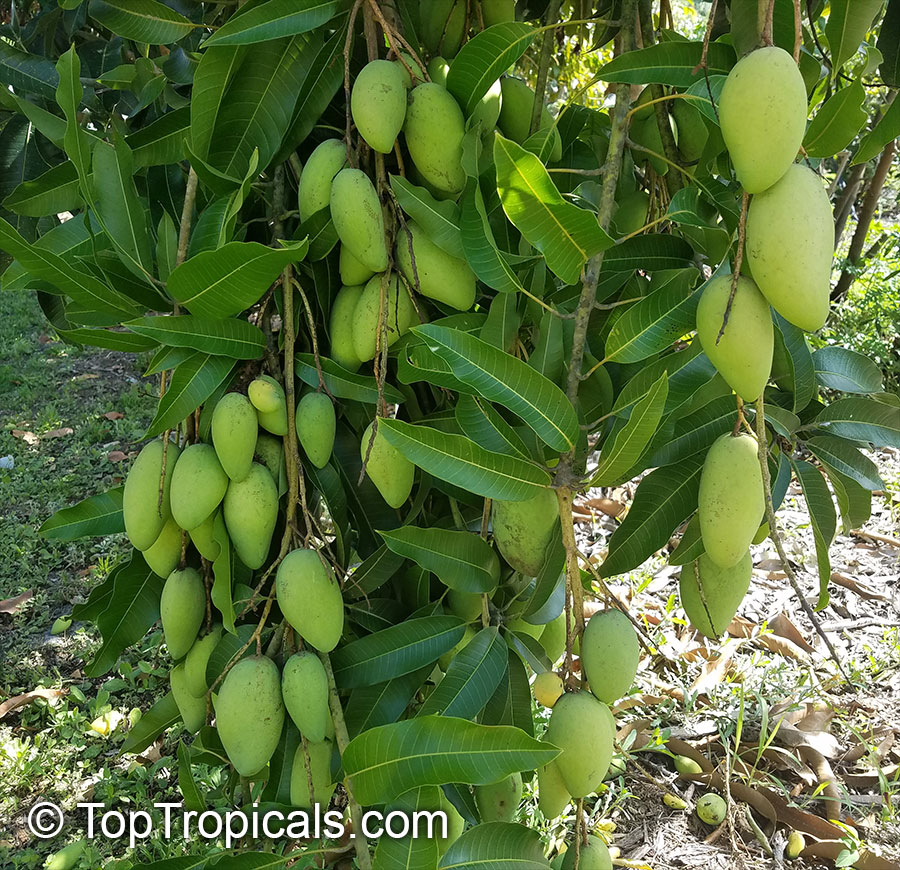
A: Triple Sec Mango is a new name for the superior variety Seacrest. The aroma of this fruit resembles Triple Sec - an orange liqueur. It's a juicy, mid-season variety that has good disease resistance.
Mango has pretty good heat and drought tolerance. It loves sun, but there are a lot of factors to consider when growing Mango in your area.
Check your soil. Soil quality is always first and foremost: when you live in an area of Arizona with hardpan (extremely compacted desert soil) or caliche (layers of soil cemented by calcium carbonate) you will have to learn how to deal with such soil types. Amend the soil as needed.
The best time to plant is spring or fall to give your Mango a chance to get established before the really intense Summer heat starts. Alternatively, protect the tree with a shade cloth. Tender, new growth will not stand a chance unprotected, especially newly planted and/or young trees.
Mangoes are tropical and sensitive to frost and freeze damage. Young trees especially will also need winter protection when temperatures go near or below freezing. Always plant trees in a location where they will be protected from cold wind. Consider staking your newly planted Mango trees for the first year. It's never a bad idea to even stake during periods of high winds.
Make sure your planting site has very good drainage. Always use a good quality mulch around your tree as it helps to trap moisture, keeping the ground and the roots beneath it cool. Keep mulch a couple of inches from the trunk of the tree. Avoid a location that gets full day sun. Morning sun, afternoon shade is ideal. Give regular watering until the tree is established. Once established, water only when the soil feels dry.
Fertilizer with a Mango-Food. A foliar spray of micronutrient solution is always recommended during the active growing period. Use plant stimulants and microelements to improve cold hardiness and vigor.

See more info on growing mango in hot climate and container grown mangoes in Arizona.