Garden Blog - Top Tropicals

Date: 26 Mar 2026

🌸 How to Grow Adeniums Without Overthinking It

By Tatiana Anderson, Horticulture Expert at Top Tropicals with Smokey & Sunshine help

Adenium  desert  roses  blooming  in  greenhouse  during  winter  freeze,  rows 
 of  potted  plants  with  colorful 
 flowers

Adeniums blooming inside the Top Tropicals greenhouse during the record freeze of February 2026 - protected from the cold, kept above 40F, and fed with liquid Sunshine Megaflor. They responded with a spectacular, synchronized winter bloom. Quite a surprize!

✅ Simple rules that actually make them bloom and grow well

  • Light - The more light, the better the growth and flowering. Full sun is ideal, but in very hot climates, filtered bright light keeps plants looking healthier.
  • Water - Water well, then let soil dry on the surface. Sitting in wet soil damages roots, but letting plants dry out too often can push them into early dormancy.
  • Pot and shaping - Use a shallow pot with excellent drainage. To develop a sculptural caudex, lift the plant slightly each time you repot and remove some of the top soil so upper roots become exposed. Over time, this creates a thicker, more prominent base.
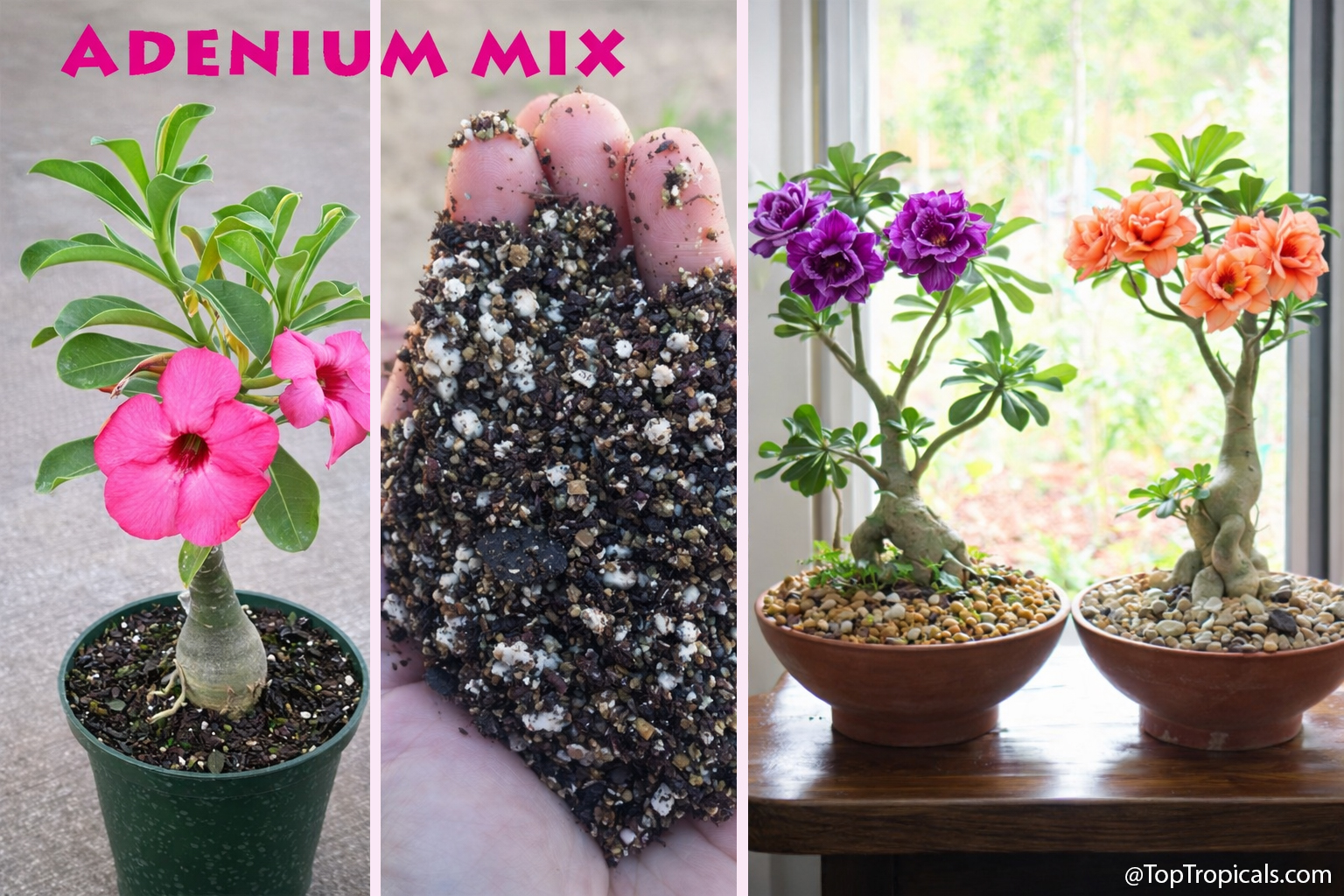
  • Soil - Use a fast-draining Adenium potting Mix.
  • Adenium  desert  rose  plant,  fast  draining  soil  mix  in  hand,  and  bonsai 
 style  adeniums  blooming  indoors

    Healthy adeniums start with the right foundation - a fast-draining soil mix and careful watering only when dry to avoid caudex rot.

  • Cold hardiness - Adeniums are tropical and do not tolerate frost. Keep above 40 F. Brief drops to mid 30s may be tolerated if dry, but cold and wet conditions can damage or kill the plant. In cooler climates, bring indoors or protect during cold nights.
  • Indoor winter care - Move plants indoors before cold nights. Place in the brightest spot possible, ideally a south-facing window. Or use additional lighting. Water very lightly and less often, as growth slows. Do not fertilize during dormancy. Some leaf drop is normal in winter.
  • Freshly  grafted  Adenium  desert  rose  plants  in  dormancy  arranged  in 
 greenhouse  rows  with  bare  branches

    Freshly grafted adeniums in dormancy - a crucial resting phase. Keep watering low (once a month) and avoid overcare; this is the time to let them rest and etablish.

  • Feeding - Adeniums respond best to liquid fertilizer. We apply Sunshine Megaflor Booster with each watering throughout the year. During dormancy, watering is reduced, so fertilizer use decreases accordingly. Consistent, light feeding promotes strong roots, a thicker caudex, and improved flowering.
  • Pruning - For multiple blooms, regular pruning is essential. After flowering, cut back long or leggy growth to stimulate branching. Each new branch can produce more buds, leading to a much fuller bloom in the next cycle.
Pruned  and  unpruned  Adenium  desert  rose  plants  showing  difference  in 
 branching  and  flowering

Pruned vs. unpruned - the difference is clear. The four plants on the left were trimmed 6 months ago, while the two on the right were not. Same species, very different results.

✍️ Learn more about Adeniums from our Blog

🎥 Watch videos of Adenium Rainbow

Free Shipping on Adeniums
Add bold color and unique forms to your collection with no extra shipping cost.

🛒 Explore Exotic Adenium varieties
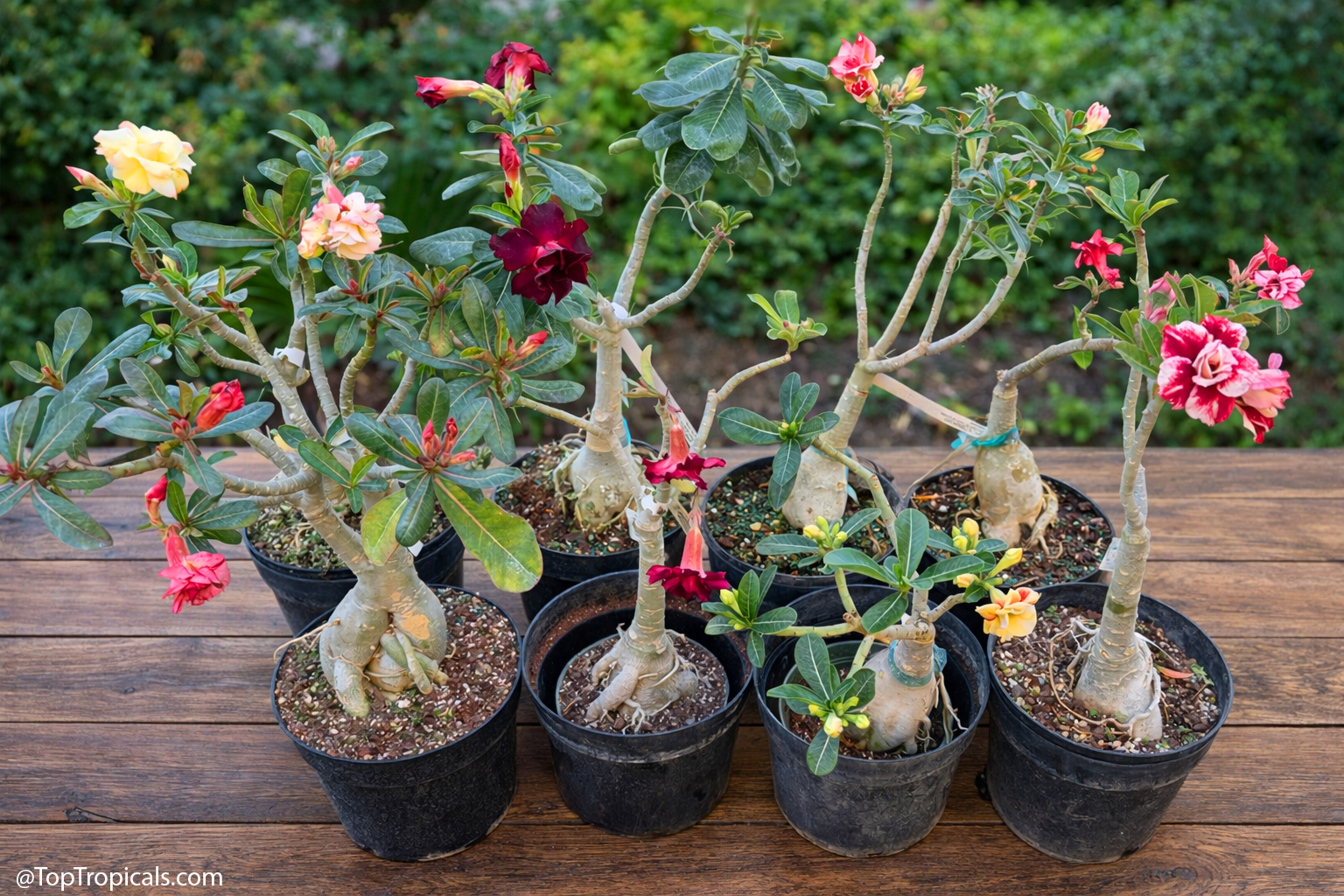
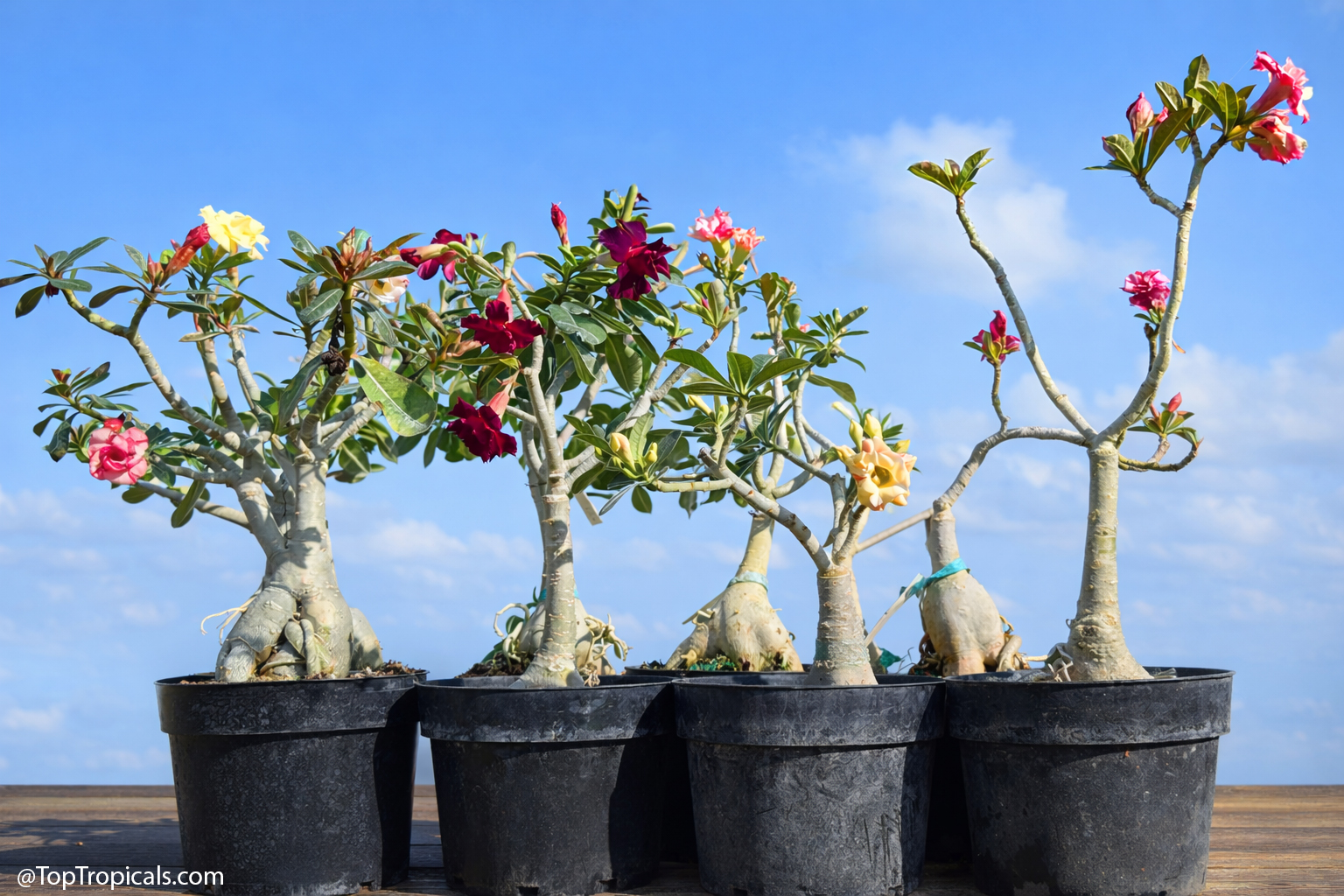
Leggy  Adenium  desert  rose  plants  with  sparse  branching  and  flowers, 
 ready  for 
 pruning

These Adeniums are screaming for pruning so they can bush out and produce more blooms
Date: 23 Jun 2024

The best tropical fruit tree for container growing, and the fastest to fruit:

Rollinia (Rollinia deliciosa) - the biggest Annona fruit

Rollinia (Rollinia deliciosa) - the biggest Annona fruit

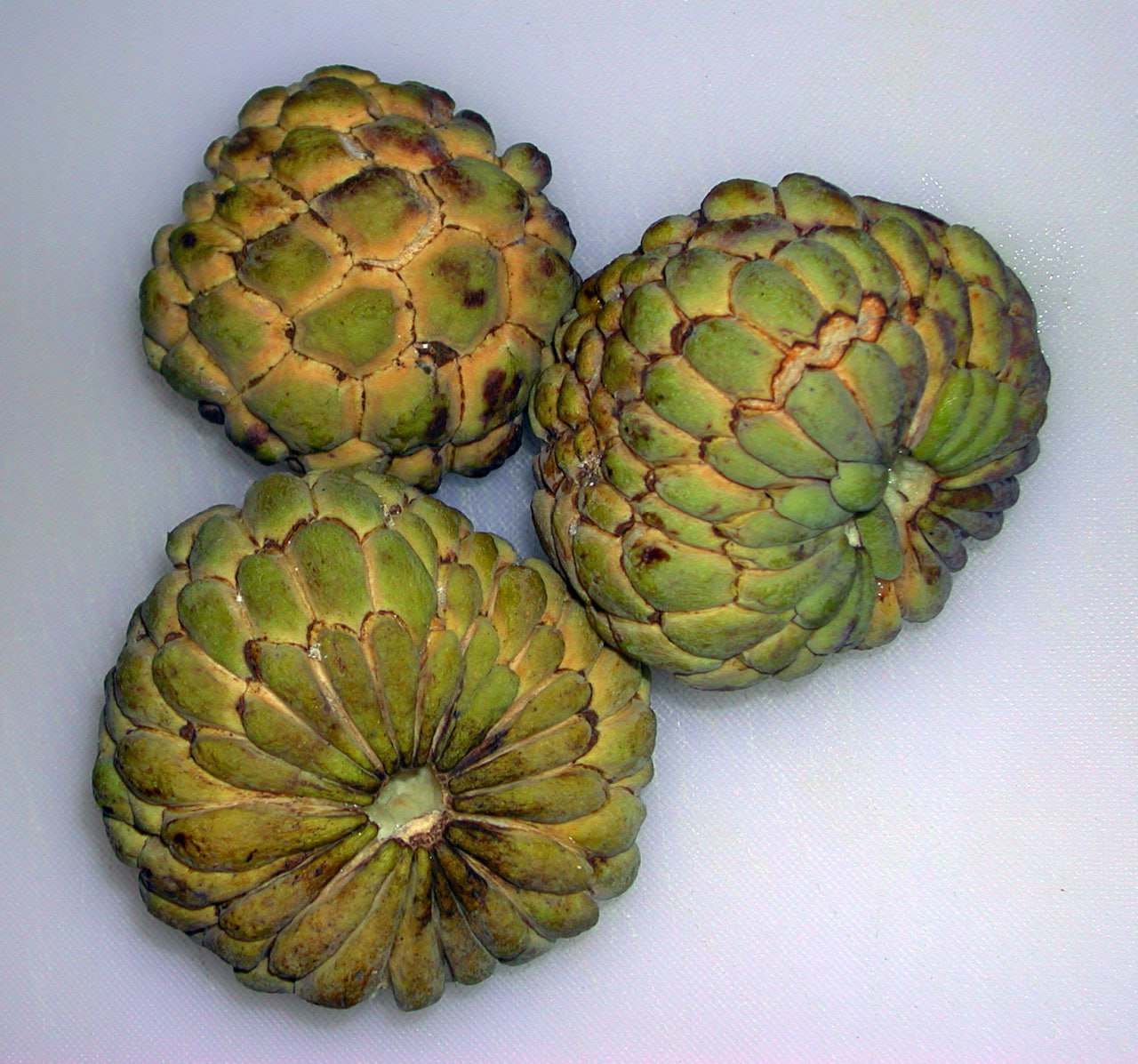
Sugar Apple (Annona squamosa)

Sugar Apple (Annona squamosa)

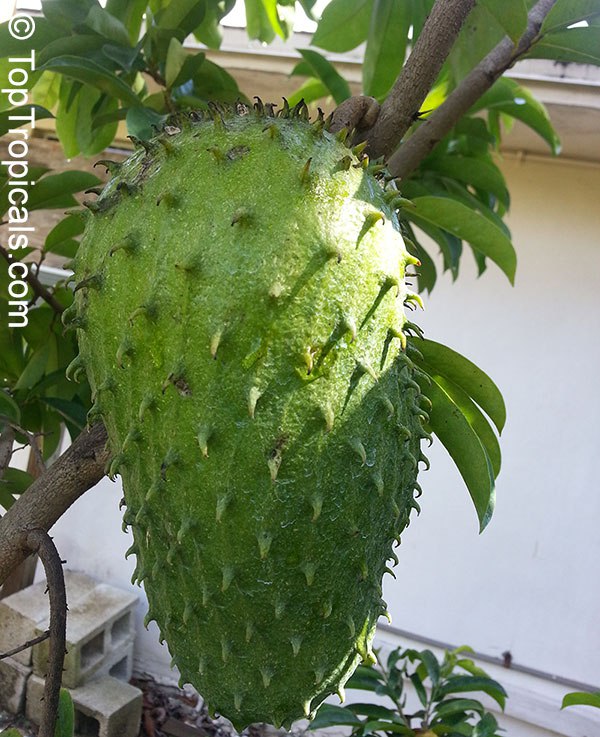
Guanabana (Annona muricata)

Guanabana (Annona muricata)

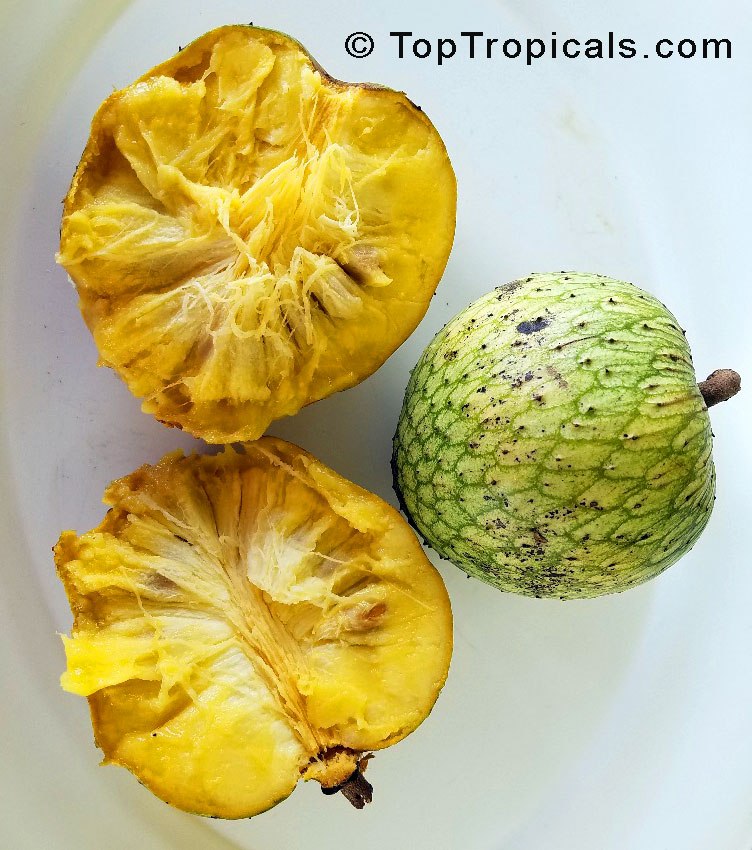
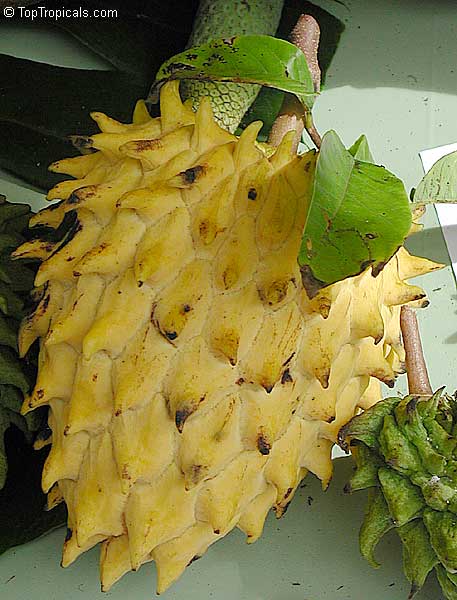
Pineapple Annona Golden (Annona costaricana)

Pineapple Annona Golden (Annona costaricana)

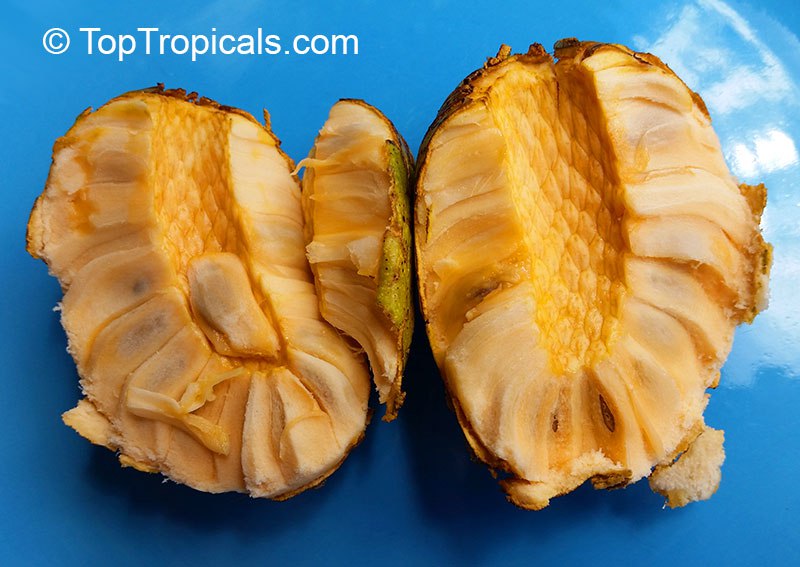
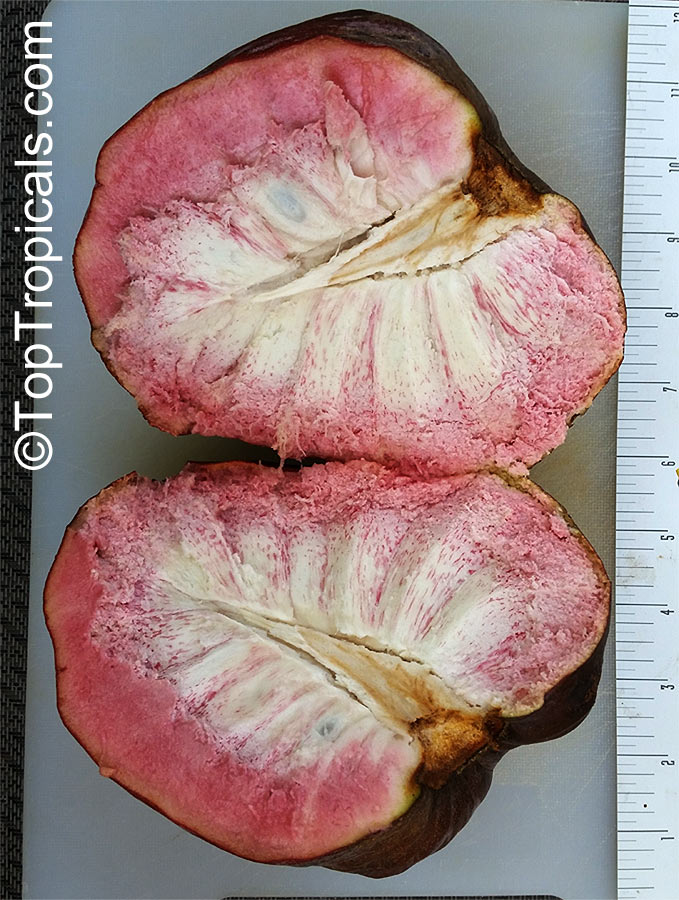
Custard Apple (Annona reticulata)

Custard Apple (Annona reticulata)

Mountain Soursop or Hedgehog (Annona montana)

Mountain Soursop or Hedgehog (Annona montana)

🏆 The best tropical fruit tree for container growing, and the fastest to fruit: Annona.

🍏 Annonas (Annona sp) are very much loved tropical fruit. The fruit has smooth, creamy flesh, just like a natural custard - hence one of the common names - "Custard Apple". Growing an Annona tree is a rewarding experience, its a small compact tree that will let you enjoy its creamy and exotic fruit right away.

The best tropical tree suited for container growing, due to its small height. It can be maintained within 6-8 ft tall.

The fastest fruiting tree: 2-3-4 years from seed to fruit, depending on species.

Most species are deciduous: drop leaves during winter-spring.

Thrives in frost-free climate. Some species are cold hardier than others. Container culture is a good way to cold protect these beautiful small trees.

❤️ 6 top most popular Annonas:

  • ▪️ Rollinia (Rollinia deliciosa) - the biggest Annona fruit and the most showy
  • ▪️ Sugar Apple (Annona squamosa) - the most popular
  • ▪️ Guanabana (Annona muricata) - the most cold sensitive but the fruit is so tasty!
  • ▪️ Pineapple Annona Golden (Annona costaricana) - cold hardy and easy to grow
  • ▪️ Custard Apple (Annona reticulata) - with red flesh
  • ▪️ Mountain Soursop or Hedgehog (Annona montana) - mentioned earlier, cold hardy


📚 Learn more:
Horoscope for Guanabana tree
Hedgehog Mountain Soursop - Annona montana
How to grow and hand-pollinate Guanabana Tree indoors (PDF)

🛒 Shop Annona varieties

#Food_Forest

🏵 TopTropicals

Date: 4 Sep 2022

Avocado Black Prince

Grow Your Own Food
Avocado variety - what's the taste?

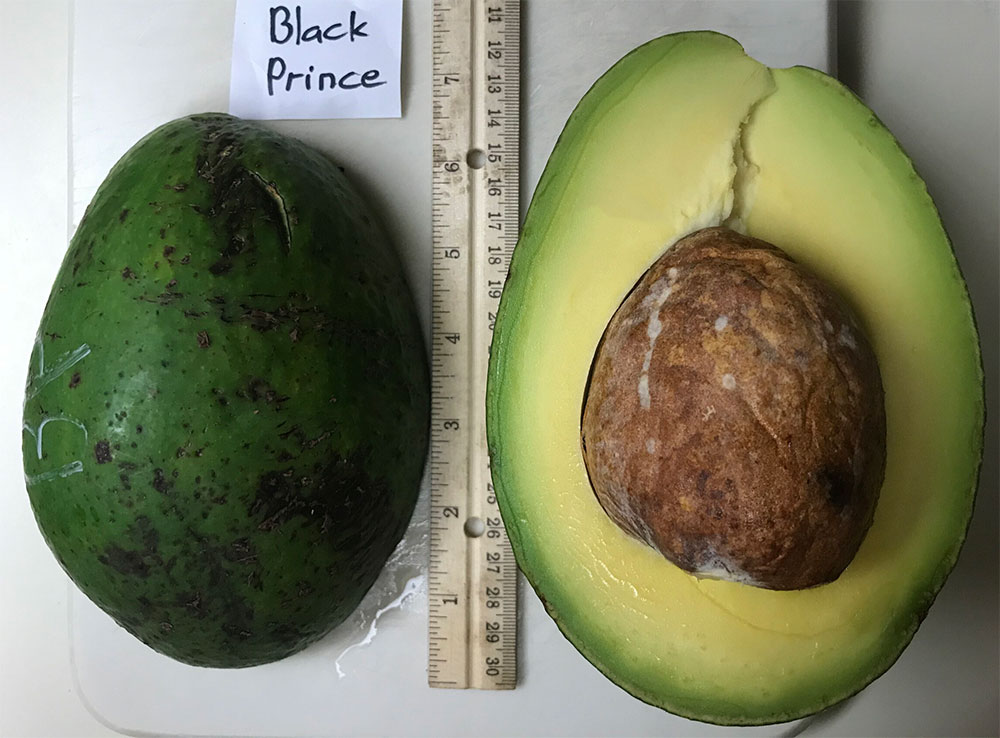
Avocado  Black  Prince

We obtained Black Prince Avocado variety this year and at first didn't know much about it. Until we tried the first fruit! The fruit was large, oval, green and slightly pebbly. We were not sure if it would taste like some green avocados - watery and less buttery? The fruit turned black couple days after it was picked, ripened and softened. We were pleasantly surprised, Black Prince deserves its title! The fruit pulp is thick, and has a rich, nutty flavor. The little trees grew this year vigorously and didn't show any bug or deficiency problems. Superior variety for a backyard grower! Giving it 5 stars! *****
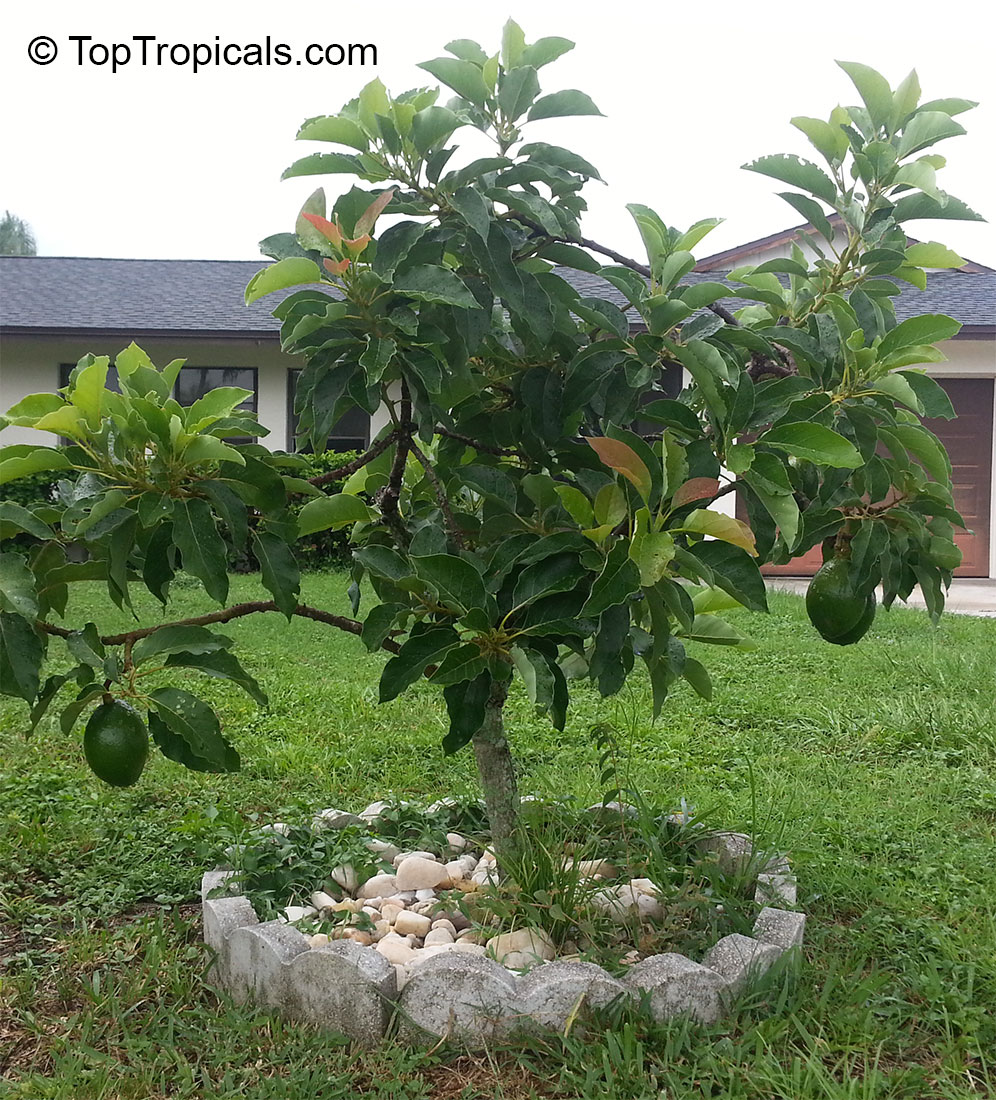
We have Black Prince Avocado in 3 gal pots, as well as in XX-Large size for local pick up - for those who want a large fruiting size tree, please contact our Garden Center to pre-order from our Growing Farm (B-Farm). It can be delivered and installed for you!

Why grow your own Avocado tree?

Why grow your own Avocado tree? This is why. Now we import 89% of the U.S. avocado from Mexico. How much of a difference we could make if we were all growing our own avocados? Support our own horticulture, help Avocado to become grown in the USA!

Avocado  Varieties

Date: 26 Dec 2025

Is it deadly snake? 2025 was the Year of the Snake

Black garden snake

🐍 Is it deadly snake? 2025 was the Year of the Snake...


That scary-looking black garden snake? Totally harmless.
In Florida, most black snakes you see around gardens are Black racer or Black rat snake. They are not poisonous, not deadly, and actually great neighbors.
Black racer - Coluber constrictor
Black rat snake - Pantherophis alleghaniensis
Both are non-venomous, common in Florida gardens, and often mislabeled as "deadly" just because they look bold and move fast.
  • ▪️They are actually shy - would rather run than fight
  • ▪️Excellent pest control - they eat rats, mice, frogs, and insects
  • ▪️Often mistaken for dangerous snakes because they are fast and jet black
  • ▪️If you see one, it means your garden ecosystem is healthy

So no, this is not a deadly snake - just a free garden helper doing its job. Let it pass, and it will disappear as fast as it showed up!

📚 Learn more about the passed Year of the Snake:


🐈📸 Black garden snake at TopTropicals Bfarm PeopleCats.Garden

#PeopleCats #Horoscope

🟢 Join 👉 TopTropicals

Date: 17 Jan 2026

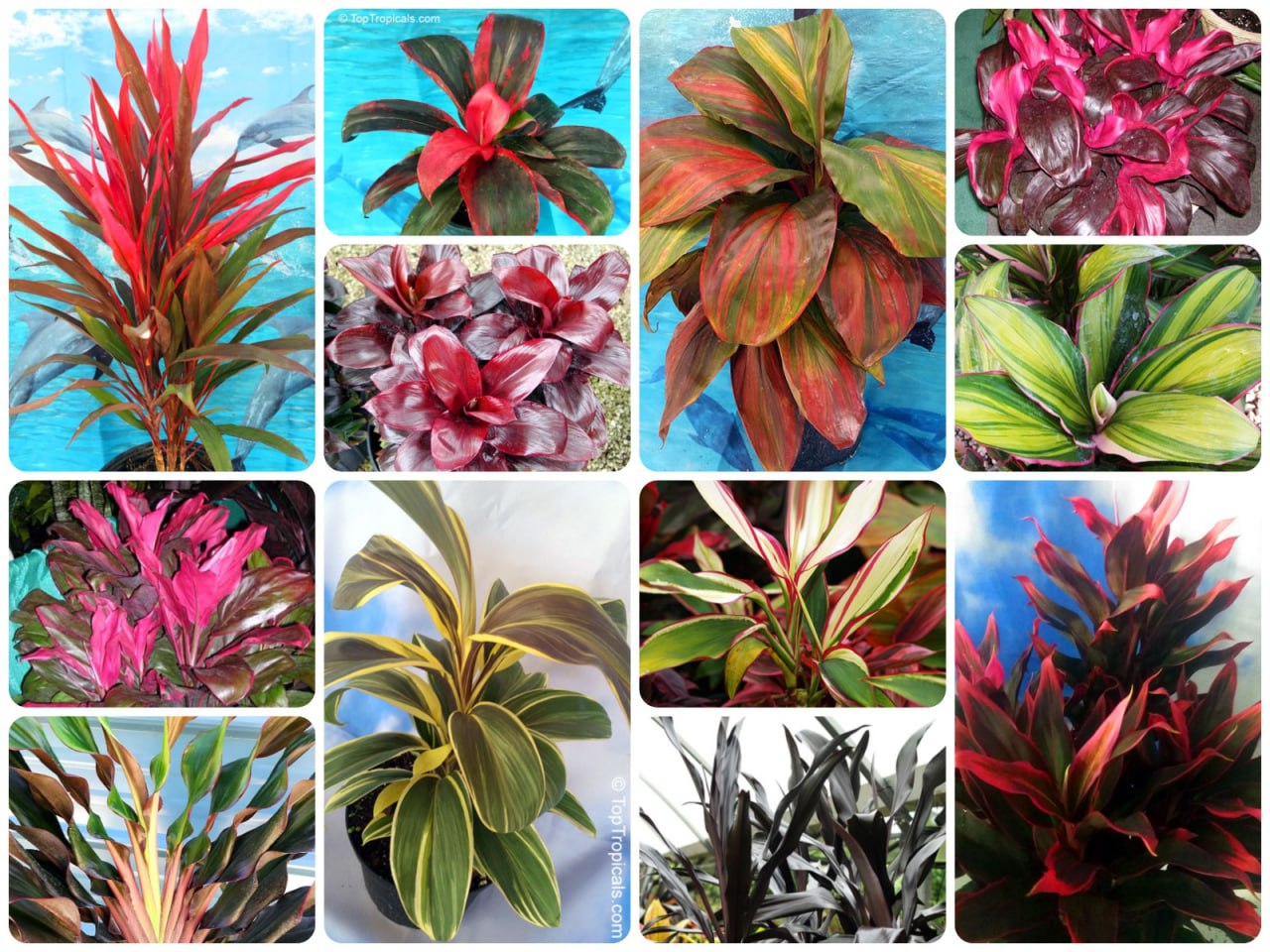
Ti plant leaf color meaning

Hawaiian Ti plant (Cordyline fruticosa)

Hawaiian Ti plant (Cordyline fruticosa)

🌈 Ti plant leaf color meaning


The Hawaiian Ti plant (Cordyline fruticosa) is more than just a colorful tropical accent. Across Polynesian, Hawaiian, and Southeast Asian cultures, the color of ti plant leaves has long been associated with different meanings, moods, and uses - both symbolic and practical.
  • 🌈 Green leaves
  • Green ti plants are linked to peace, balance, and steady growth. Traditionally, they were planted around homes for protection and good fortune. In the garden, green varieties are usually the toughest and most shade-tolerant.
  • 🌈 Red and deep burgundy leaves
  • Red ti plants are associated with strength, power, and protection. In Hawaiian tradition, red ti leaves were believed to ward off negative energy and were often used in ceremonies. Garden-wise, deeper reds usually mean more sun exposure and stronger pigmentation.
  • 🌈 Pink, magenta, and multicolor leaves
  • These colorful ti plants symbolize joy, celebration, and creativity. They are often used as ornamental focal points and in festive plantings. Variegated and pink types tend to prefer brighter light to keep their colors sharp.
  • 🌈 Purple and dark-toned leaves
  • Purple ti plants are linked to mystery, spirituality, and transformation. Their dramatic color comes from high anthocyanin levels and usually intensifies in bright light with good nutrition.
  • 🌈 Yellow or light variegation
  • Yellow tones often represent optimism and new beginnings. Plants with lighter variegation may grow a bit slower and need protection from harsh sun, but they add a softer contrast in tropical landscapes.
  • 🌈 One practical note
Leaf color is influenced not just by variety, but also by light, temperature, and nutrition. Fading color usually means too little light or depleted soil, while rich, bold tones signal a happy plant.

Ti plant colors tell a story - part cultural tradition, part plant health, and part personal style in your garden.

🛒 Ti plants rainbow: collect them all

📚 Learn more:

Plant Facts

Cordyline fruticosa, Cordyline terminalis
Hawaiian Ti Leaf
USDA Zone: 9-11
Large shrub 5-10 ft tallSmall plant 2-5 ftSemi-shadeShadeFull sunRegular waterOrnamental foliageUnusual colorPink flowersSubtropical plant. Mature plant cold hardy at least to 30s F for a short time

#Container_Garden #Hedges_with_benefits #Shade_Garden #Discover #Horoscope

🟢 Join 👉 TopTropicals