Garden Blog - Top Tropicals

Date: 17 Nov 2025

❄️Cold Night Survival Guide
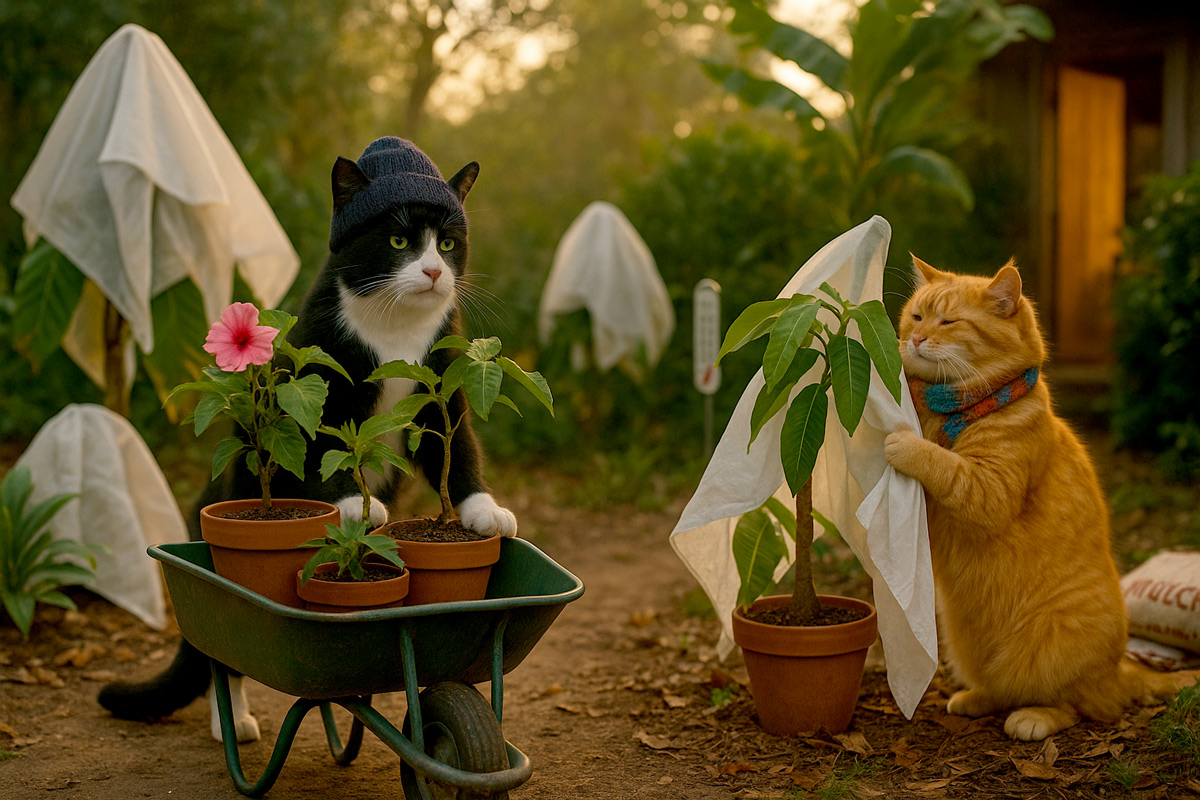
Smokey,  a  black-and-white  tuxedo  cat,  loads  a  wheelbarrow  with  potted 
 tropical  plants  while  Sunshine,  a  fluffy  orange  tabby,  pretends  to  cover  a 
 mango  tree  with  frost  cloth  as  evening  light  warms  the  tropical  garden.

Smokey and Sunshine Prepare Plants for the Cold Night.

Smokey: Come on, Sunshine, help me move these plants inside before it gets dark!
Sunshine: I am helping... see? I’m supervising the mango tree.
Smokey: You call that supervising? The frost cloth’s upside down!

When the forecast drops into the 30s, panic is not a plan. This is your simple, clear checklist to protect every tropical in your garden. Think of it as the quick emergency manual that goes hand in hand with the previous cold-weather newsletter.

"We all love our tropical flowers, mangoes, bananas, and rare fruit trees. A single cold night does not have to be a disaster. The key is knowing what to do, when to do it, and what mistakes to avoid." - Tatiana Anderson, Top Tropicals Plant Expert

🌡️ FROST AND FREEZE

A frost and a freeze are not the same. A frost is when you see ice crystals on leaves or grass, while a freeze is when the air temperature drops below 32 F. The tricky part is that you can get frost even when the air is above freezing, and you can have a freeze with no frost at all. It all depends on humidity and the dew point. If the dew point is below freezing, the ground can cool faster than the air, letting frost form even when your thermometer reads 35 or 36 F. And once the air itself drops below 32 F, even for an hour, tender tropicals can be damaged. For plants, a freeze is far more dangerous, because freezing air pulls heat out of stems, branches, and roots. Frost usually burns leaves, but a true freeze can injure wood, kill buds, and damage the entire plant.
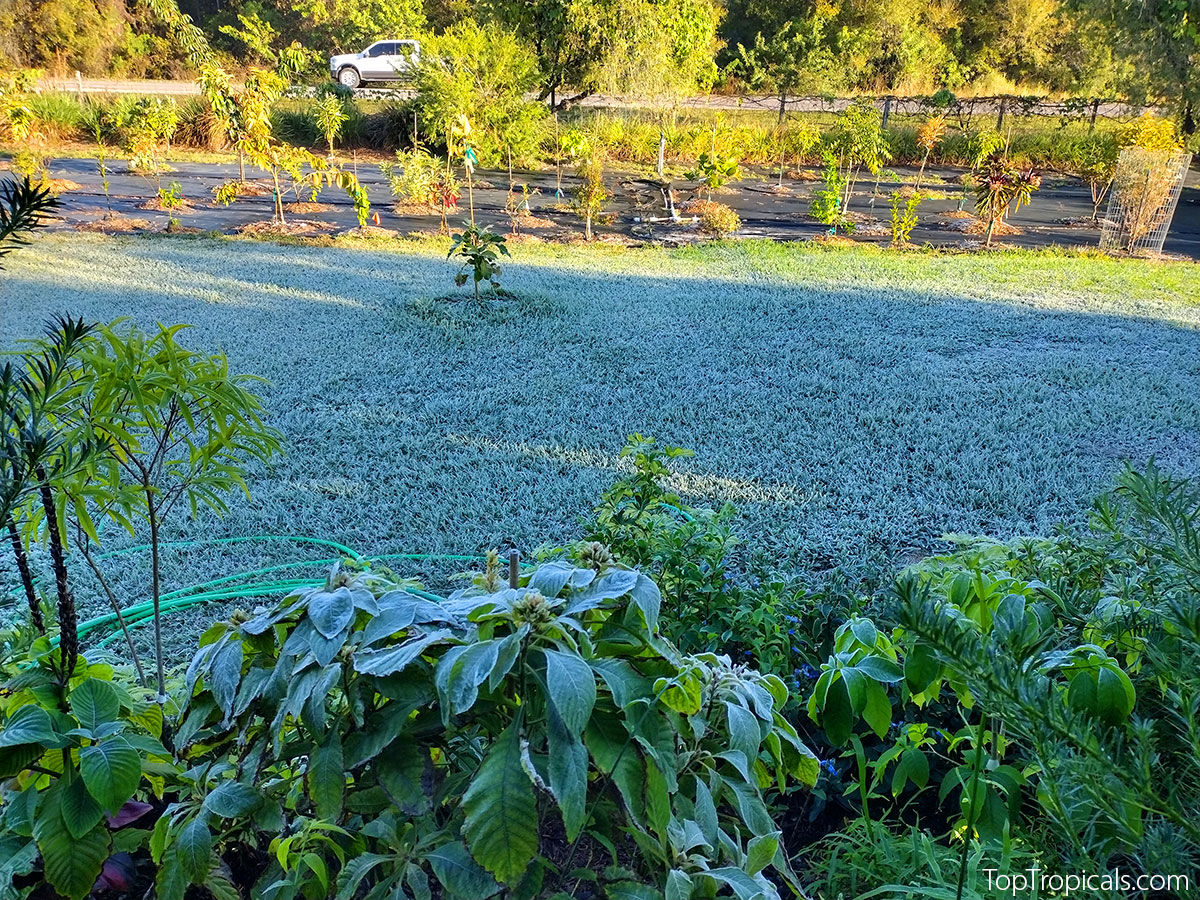
Frost  on  grass  and  leaves

Frost on the grass and leaves on Winter morning in Central Florida

WHAT TO DO AND NOT TO DO BEFORE A COLD SNAP

✔️ 5 THINGS TO DO:

  1. Water well. Hydrated plants tolerate cold better than dry, stressed ones.
  2. Add mulch. A thick layer around the base keeps roots warm.
  3. Block the wind. Move pots to a sheltered corner or patio.
  4. Cover at night, uncover in the morning. Let plants breathe and get light.
  5. Add gentle heat if needed. Non-LED Christmas lights or a small old style 15-20W light can raise temps a few degrees.

❌ 5 THINGS NOT TO DO:

  1. Do not prune or trim. Fresh cuts freeze first.
  2. Do not overwater. Wet, cold soil invites root rot.
  3. Do not let plants dry out either. Wilted plants freeze more easily.
  4. Do not use dry fertilizer. Gentle liquid feeds like Sunshine Boosters are safe to use with every watering: its intake naturally slows down as watering decreases.
  5. Do not look only at the thermometer. A long, windy night can be worse than a short freeze.

TEMPERATURE ACTION GUIDE (40 to 25 F)

  • 40 to 38 F: Move potted plants to shelter, water soil, and cover tender tropicals.
  • 37 to 33 F: Use frost cloth and anchor it down so the wind does not lift it.
  • 32 to 30 F: Add a heat source like non-LED lights.
  • 29 to 25 F: Double-cover sensitive plants, wrap trunks, and protect roots heavily.

COLD TOLERANCE BY PLANT TYPE

Before a cold night, it really helps to know your plant’s exact cold limits. Every species is different, and young plants are always more sensitive than mature ones. Take a few minutes to look up your varieties in our Tropical Plants Encyclopedia — it will tell you the safe temperature range, how much protection each plant needs, and which ones must be covered or moved before the next cold snap hits.

  • Bananas: leaf burn below 37 F
  • Mango, Annona: hurt around 32 F
  • Cold hardy avocados: Mature tree can take about 25 F. Young trees must be protected
  • Olives, Citrus, Guava, Jaboticaba: usually OK outside with mulch

QUICK-ACTION TABLE

Before the cold arrives, make yourself a quick list of every plant and what action each one needs. It saves time when temperatures start dropping and keeps you from scrambling in the dark. Check that you have enough frost cloth, blankets, and supplies on hand so you can cover everything without rushing. Planning ahead makes cold nights much less stressful.

  • Bring Indoors: Cacao, Bilimbi, Coffee. They need warm, bright light.
  • Cover Outdoors: Mango, Jackfruit, Banana, Annona. Use frost cloth, not plastic on leaves.
  • Leave Outside: Eugenias, Peaches, Persimmons, Longan, Lychee, Papaya, Citrus, Loquat, Hardy Avocado. Add mulch and monitor overnight lows.

🛒 Check out cold tolerant tropicals
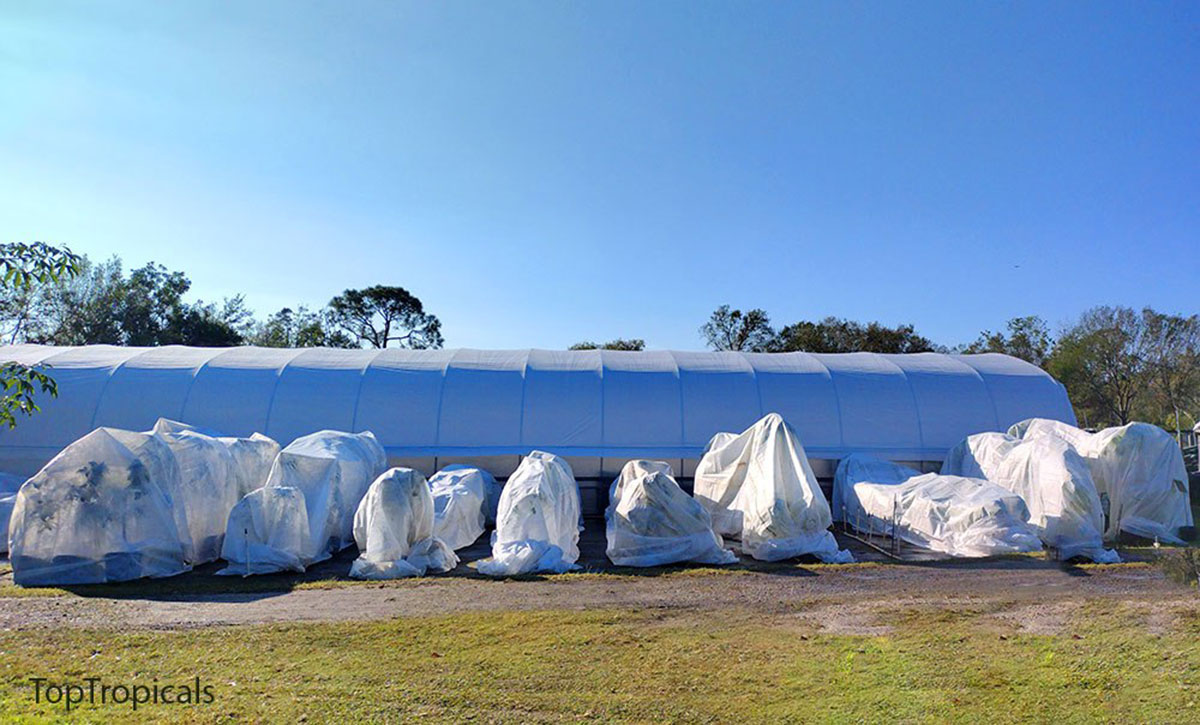
Covering  large  mango  and  avocado  trees  in  pots

Covering large mango and avocado trees in pots at TopTropicals during cold nights

GADGETS AND TOOLS THAT HELP

  • Indoor helpers: LED lights, small heaters, bottom-heat mats, timers.
  • Outdoor helpers: frost cloth rolls, mini greenhouses, non-LED Christmas lights or small incandescent lights, smart thermometers.

Always keep electrical safety in mind, especially if you are using extension cords outdoors. Use only weather-rated cords, keep all connections off the ground, and protect plugs from moisture. Make sure heaters and lights are stable, secured, and never touching fabric covers. A few minutes of safety check can prevent a dangerous situation on a cold, wet night.

And if you want to keep plants strong through winter, add Sunshine Boosters to your watering routine. It is gentle, safe in cold weather, and gives plants an extra edge.

AFTER THE COLD PASSES

In the morning, uncover plants. Leaving covers on during the day can trap heat and cook the tender new growth, especially under the sun. The only exception is true frost cloth designed for all-day use, which allows air, light, and moisture to pass through. Regular blankets, sheets, and plastic must come off as soon as the sun rises.

Do not cut anything yet. A plant can look completely dead after a freeze, but many branches are still alive under the bark. Cutting too soon removes wood that would recover on its own. Wait until new growth begins in spring. That is when you can see exactly which branches are truly dead.

Use the scratch test. Gently scratch the bark with your nail or a small knife. If the layer underneath is green, the branch is alive. If it is brown and dry, it is likely dead. But even then, wait until warm weather to be sure, because sometimes only the tips die back while the lower part of the branch survives.

Once the weather stabilizes, resume light feeding. Plants coming out of cold stress need gentle support, not heavy fertilizer. A mild liquid feed like Sunshine Boosters helps them rebuild roots and push new growth without burning tender tissue.
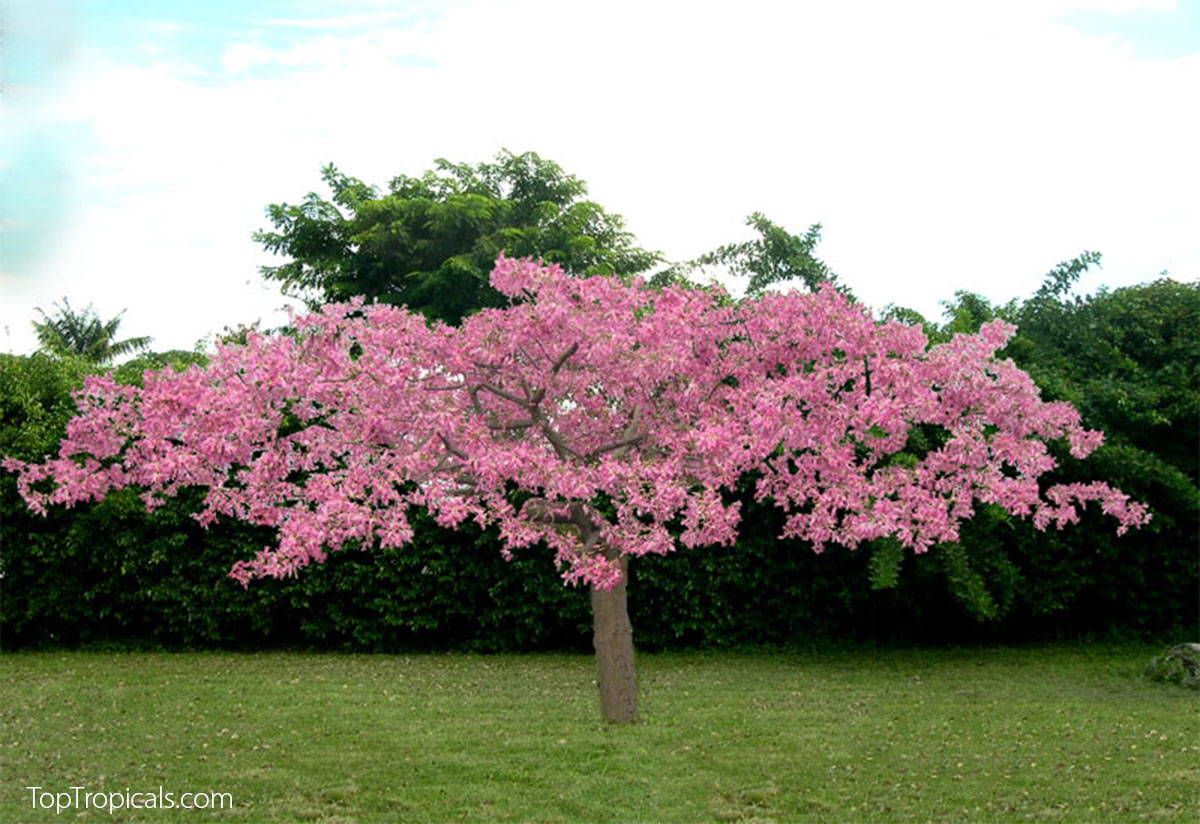
Dwarf  Ceiba  Pink  Princess  in  full  bloom

Dwarf Ceiba Pink Princess (Grafted) - a unique compact cultivar covered with pink flowers in Winter. Watch short video: How this breath-taking flowering tree stays so compact.

WHAT NOT TO DO

  • Do not prune right after a freeze.
  • Do not overwater cold soil.
  • Do not fertilize heavily until spring.
  • Do not leave covers on in full sun.

CLOSING THOUGHT

Your tropical garden can survive any cold night if you prepare right. Cold snaps always feel stressful in the moment, but once you know your plants, have the right supplies, and follow a simple plan, it becomes routine. A few minutes of preparation before dark can save months of growth and keep your collection healthy all winter.

Frost cloth is the true workhorse of cold protection: it keeps heat in, keeps frost off, and will not suffocate plants the way plastic or blankets can. Having a few rolls ready means you never have to scramble at the last minute. Sunshine Boosters give your plants gentle support during the colder months so they stay strong enough to bounce back quickly when warm weather returns.

A little planning now will pay off in spring, when your mango, banana, citrus, and all your favorite tropicals come back happy and ready to grow.

🛒 Shop Garden Supplies

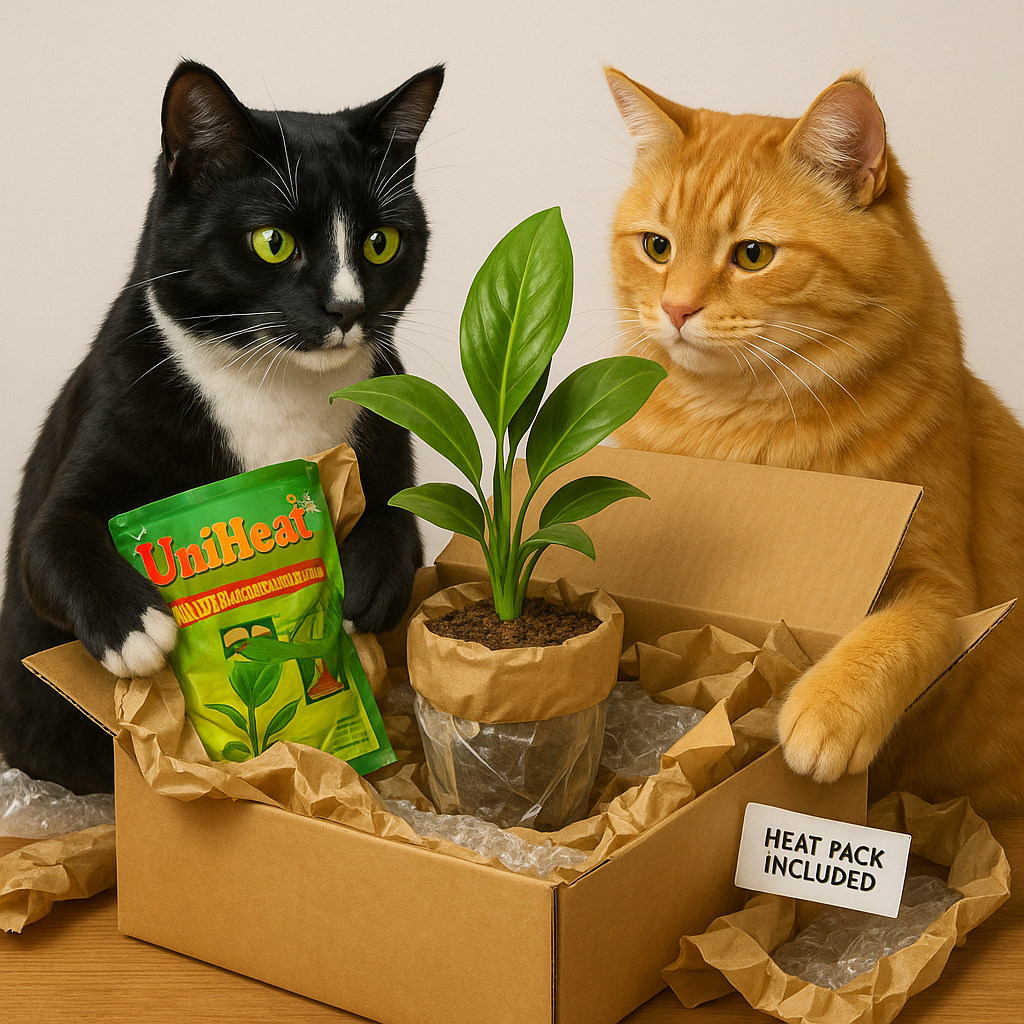
Add Heat Pack to your plant order
Cats  adding  heat  pack  to  plant  shipment

Date: 15 Jan 2021

Healthy Plants: Q&A from Mr Booster

New Boosters for the New Year!
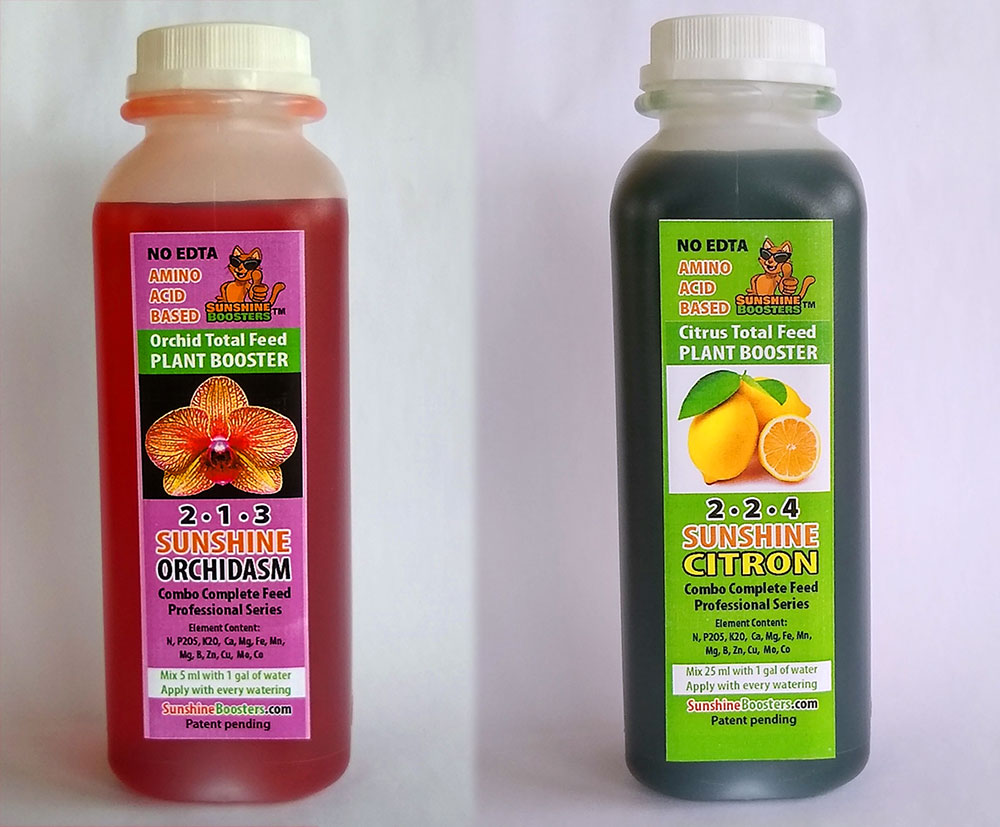
Sunshine Total Feed: Orchidasm and Citron

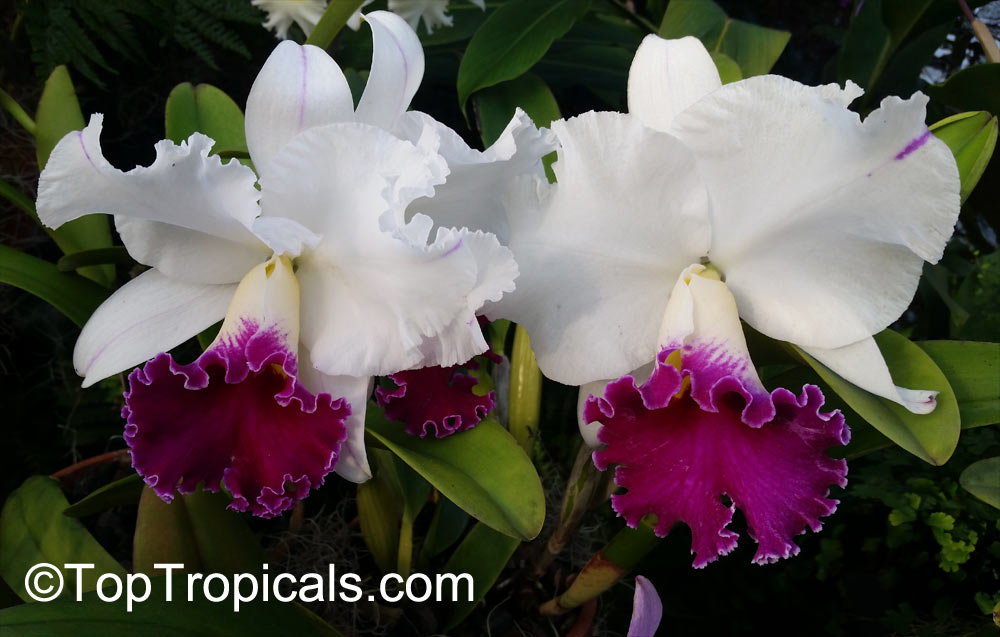
How to grow everblooming orchids?

Q: I ended up with a large collection of orchids that I was given as presents... They grow well but unfortunately after the showy blooms were gone, I don't see any more flowers, just green leaves. What do I need to do to make them bloom again? Should I fertilize them with Azalea bloom booster?

A: Orchids culture is different from garden ornamental plants. First big difference, they are epiphytes, growing in a loose bark medium rather than soil, and benefit from daily mist. Second difference is a type of fertilizer. You can not use a regular garden fertilizer on orchids, because they are very sensitive to salts. Orchids need special, acidic type of fertilizer, very mild in action.
Luckily, Sunshine Boosters formulas are exactly what orchids need! They are amino-acid based, have very mild formulas, and do not create nutrient lock up (building up salts is one of the biggest enemies of tender orchids).
A new Sunshine Boosters Orchidasm TotalFeed is scientifically balanced orchid food that contains all necessary nutrients, including micro-elements, for healthy, happy, vigorous orchids. It can be used as often as daily with every foliage spray. From our testing experience, after using Orchidasm Booster, orchids not only got happy and thriving - they also bloom more often - up to several times a year, shooting new flower spikes one after another! (while normal blooming cycle for most orchids is once a year). It gets even better - the flower display lasts twice longer!
To enjoy these beautiful flowers year around - treat them with Love, give them some Orchidasm!

See more information with pictures in Sunshine Boosters Orchid Blog

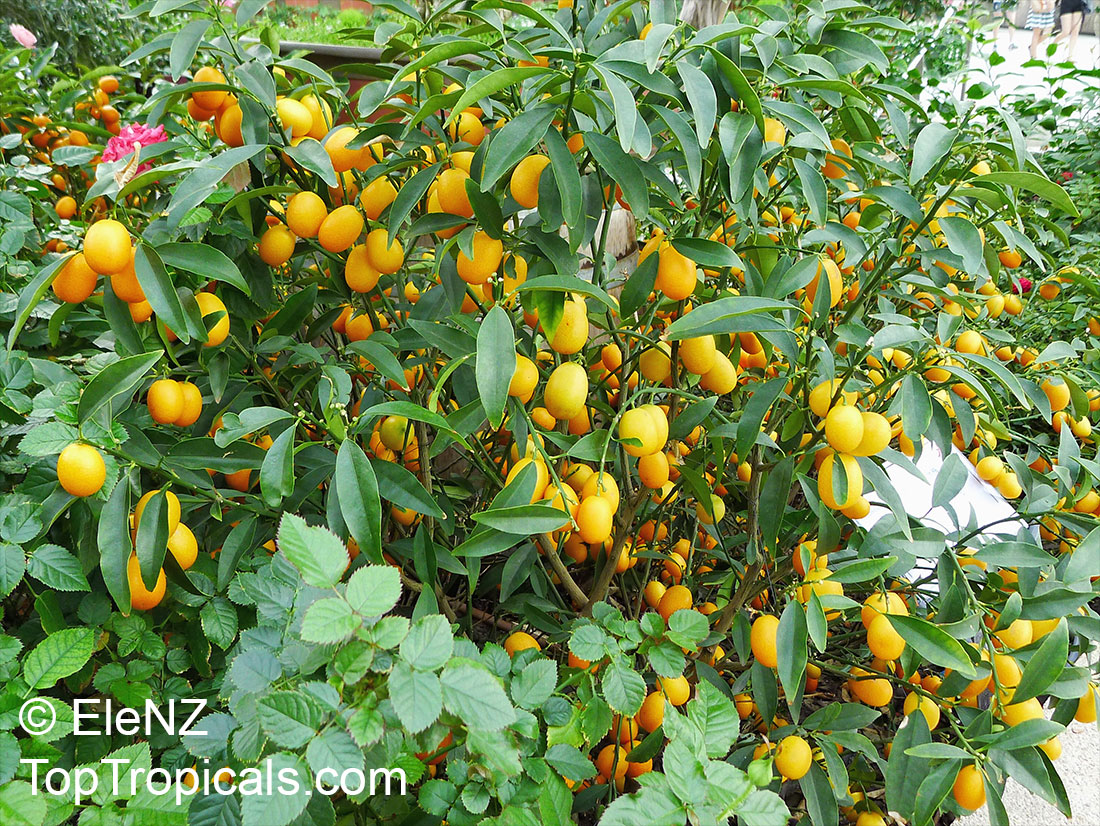
Secrets of a healthy Citrus tree

Q: We planted several citrus trees in our yard - Meyer Lemon, Grapefruit and Blood Orange. The trees came from the store full of flowers and even had a few fruit, but a year after planting - no more flowers! The old leaves are green, but new growth doesn't look healthy, leaves are yellowish and have spots, maybe eaten by bugs (?), and how do we get them to fruit?

A: Citrus plants are not the easiest trees to grow; they are susceptible to various diseases, pests, and deficiencies, especially in areas with high humidity/rainfall like Florida. Fungi, viruses, leaf minors, chlorosis - this is not a complete list of citrus common problems. In commercial groves, these conditions are kept under control by using harsh chemicals on solid schedule.
For home gardeners, growing citrus trees may become a challenge. Many people don't want to use harsh chemicals on their edibles; and those who do, may not always have time to apply treatments on a professional schedule. So as much as we all love a fresh juicy orange, growing your own may become quite a pain!
Sunshine Citron TotalFeed is your simple, eco-safe solution to a healthy looking, productive citrus tree with organic fruit! Amino-acid based formula provides all necessary elements to strengthen the tree and make it resistant to possible problems.
Did you know that treatment of leaf chlorosis (yellow leaves with dark green veins), commonly treated with iron supplements, in fact requires a complex combination of nutrients - both balanced NPK and micro-elements?
Use Sunshine Citron in combination with Sunshine GreenLeaf and Sunshine SuperFood and never see yellow chlorotic leaves again!
Apply Sunshine Epi on regular basis (every 2 weeks) and help your tree boost its immune system and stay virus-free.
Add Sunshine Honey, and you will have large, juicy fruit that are much sweeter and more flavorful than those from the store! All these boosters are compatible with each other, and perfectly natural. Eat your fruit safely and enjoy...

Read more about treating citrus tree defficiencies in Sunshine Boosters Citrus Blog.

Date: 21 Feb 2020

When plants are ready for a meal?

Q: We have an early Spring here in Florida. All plants in my garden flushing out new leaves and buds opening. Can I start fertilizing? I have Mango, Avocado, Peach trees, many medicinal herbs and flowering shrubs: Angel trumpets, plumerias, bromeliads. I prefer mild organic fertilizers; can you suggest something that is safe for edibles and butterflies?

Q: As a rule of thumb, tropical gardeners start regular fertilizing when the minimum temperatures (at night) go above 65F. Keep in mind that Sunshine Boosters fertilizers can be applied year around because they have mild formulas and used with every watering; during cooler period, you water less frequently, so feeding is reduced accordingly. Another advantage of Sunshine Boosters - they are natural (derived from organic amino acids which is the basics of Life). They are safe for edibles as well as pollinating insects.

Here is the feeding plan for your plants:
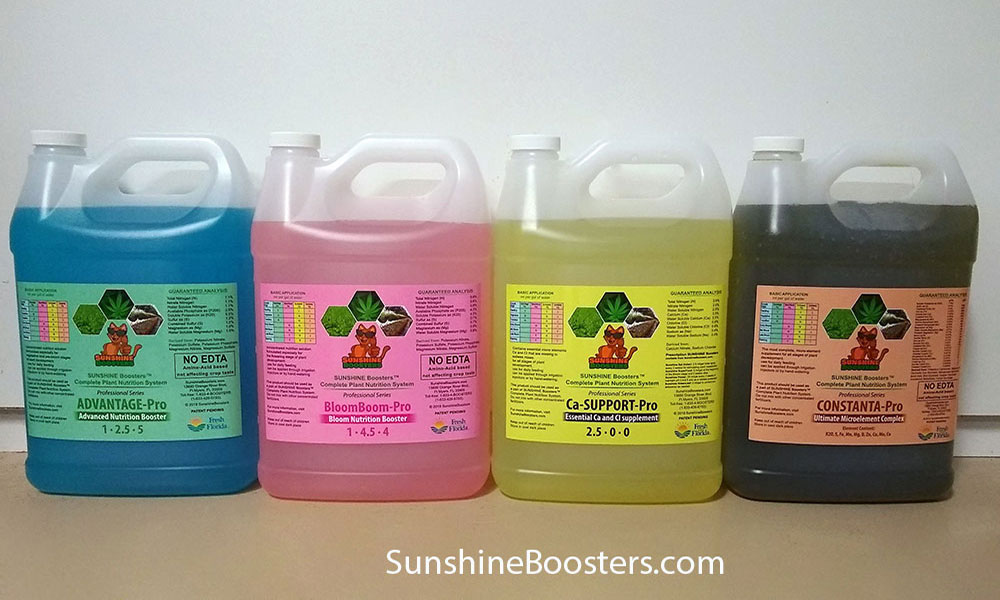
1. The most universal solution for all plants (both potted and in-ground): get a complete set of Sunshine Boosters Pro system: Advantage-Pro for vegetative growth, BloomBoom Pro for flowering stage, and Ca-Support-Pro + Constanta-Pro as necessary daily supplements. You will need all these 4 components for your garden.
2. Start adding these liquid boosters with every watering according to dozing directions and you will notice amazing growth boost within a week.
3. Apply Sunshine Epi plant hormone every 2 weeks as a foliar spray to boost immune system and metabolism of plants and protect them from diseases. Epi makes plants (especially young plants and those "waking up" from dormancy) grow twice faster! It also enhances effect of fertilizers by increasing plant metabolism.
4. After cool winter temperatures, some plants may develop element deficiencies like chlorosis (yellowing leaves). Additional microelement boost can be provided with Sunshine Greenleaf (iron supplement) and Sunshine Superfood (micro-elements).
5. For additional boosting of flowering and setting fruit, use the following individual boosters:
Sunshine Robusta - for foliage plants and when you need rapid vegetative growth
Sunshine TotalFeed - for Plumerias and other fragrant plants
Sunshine Megaflor - for Brugmansias and other flowering heavy feeders
Sunshine C-Cibus - for improving fruit production and quality
Sunshine Honey - for sweeter fruit (must be applied 4-5 times a year)
6. For young/small plants (seedlings, rooted cuttings) as well as tender tropicals like bromeliads, and orchids - Sunshine Bombino is a perfect choice due to its mild formula.
7. To save money, order complete sets rather than individual boosters; you will be able to safe up to 40%! Sunshine Complete Nutrition System Kits: Combo Kit, and Pro Kit.

If you are a fan of organic gardening, do not use dry fertilizers. While water-soluble and granulated (smart-realease) fertilizers are popular choice in plant nurseries due to their convenience, they are not as safe as liquid boosters because they create salt build-up in soil and have a high risk of overdosing/burning plant roots, especially potted plants, plants at breaking dormancy, at establishing, and at early stages of plant development. Besides, dry fertilizers may affect the taste of your fruit and herbs. See advantages of liquid boosters over dry fertilizers.

Learn more about Sunshine Nutrition System - a Natural solution for your garden.

Date: 7 Oct 2019

Fertilizing in Winter?

Q: I'm a bit confused about what winter fertilization schedule I should follow in South Florida. For blooming plants, usually, I use a monthly granular bloom booster fertilizer as well as a liquid fertilizer every 10 days or so. Should I continue that schedule in the winter as well? Should I stop fertilizing altogether in the winter? How about fruit trees? What fertilization schedule should I follow in the winter?

A: Here is a general fertilizing schedule for established plants that we follow here in SW Florida.
The rule of thumb is, do not fertilize (with macro- NPK elements) when minimum temperatures drop below 65F and stay at that level for more than 7 days. At this temperature point, most of the tropical and subtropical plants slow down their metabolism and some of them going into dormancy. This means, nutrients are not consumed as much as during active growth period, and built-up nutrient supply within a plant plus whatever is available in the soil is just enough to get by through the winter. So additional fertilizing is not necessary. You may continue micro-element supplements and bio-stimulants throughout the year. In fact, it is highly recommended to do so, to help the plant survive cold spells. These are very effective tropical plant protectors:
SUNSHINE-Epi - Brassinosteroid plant hormone
SUNSHINE-Power-Si - Advanced plant protector with Silicon
SUNSHINE SuperFood - Complex microelement supplement

This rule is applied to both flowering and fruiting plants, in general. However, some species are winter-flowering and winter-fruiting. For those, you can make an exception and provide extra nutrients for flowering and fruiting, as long as the weather stays warm. During cold spells, avoid any NPK fertilizers and use only bio-stimulants and micro-elements. If you apply NPK during cold, it won't be consumed by a plant, build up in the soil, and may create a root burn situation.

In simple words, fertilize from March to October. Give plants some rest from November to February.

Date: 17 Mar 2026

Green Magic - 15% Off This Week!

Smokey and Sunshine running a sale of fertilizers at Top Tropicals

Smokey and Sunshine running a sale of fertilizers at Top Tropicals

Green Magic - 15% Off This Week!💲

Give Your Plants a Strong Start This Spring:
  • 🟢Green Magic - 15% OFF 🟢

  • Build the foundation for the entire growing season with a steady, long-lasting nutrient base!

    No coupon needed. The discount is automatically applied at checkout.
    Offer valid through 03/21/2026.
    Discount applies to Green Magic products only.


🛒 Get your plants some food
  • 🐈 Sunshine: So Green Magic feeds the plant for months. Does that mean I can forget about Sunshine Boosters?
  • 🐈 Smokey: Not quite. Green Magic is the steady base diet. Sunshine Boosters are the weekly power drink during active growth.
  • 🐈 Sunshine: Ah. Like my regular meals and donuts on top.
  • 🐈 Smokey: Exactly. Plants eat slowly from Green Magic, and once a week they get a fresh boost.
  • 🐈 Sunshine: Sprinkle once, then boosters every week. The plant grows, I drink coffee, and nobody forgets anything important.
  • 🐈 Smokey: Except where you left the donuts.
  • 🐈 Sunshine: Smokey... nobody forgets donuts. Ever!
  • 🐈🐈 More about Smokey & Sunshine


📚 Learn more about plant food:
📱 What are Sunshine Boosters

#Fertilizers #PeopleCats
🟢 Join 👉 TopTropicals