Garden Blog - Top Tropicals

Date: 25 Jun 2020

Plant of the Month: Golden Dewdrop - Duranta erecta
Stevie's Pick: what's in bloom?

Our exotic plant grower Steven Gowdy is featuring the most interesting plants he discovers and recommends today while working in TopTropicals greenhouses.

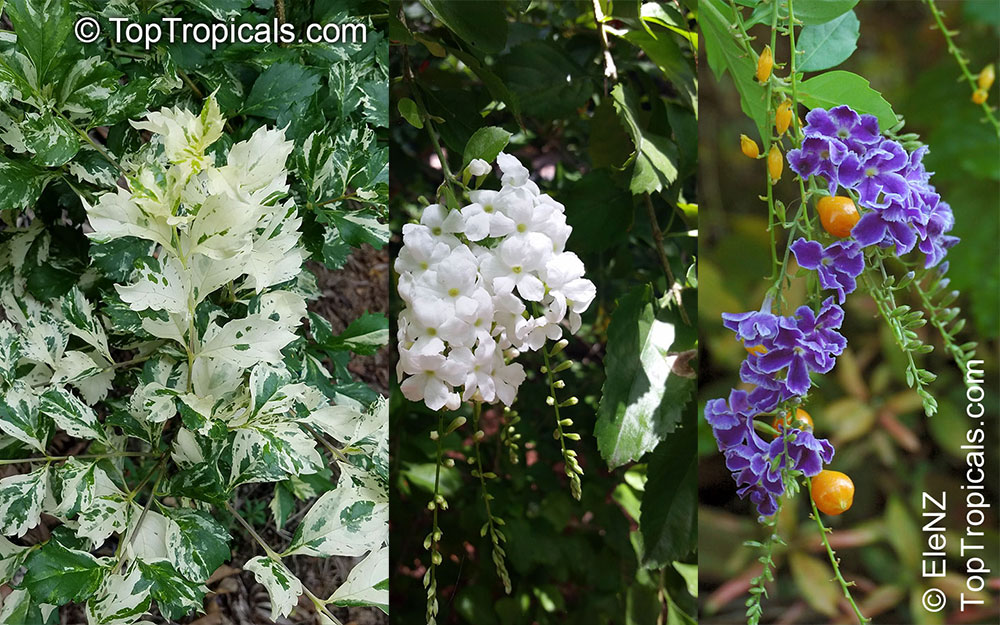
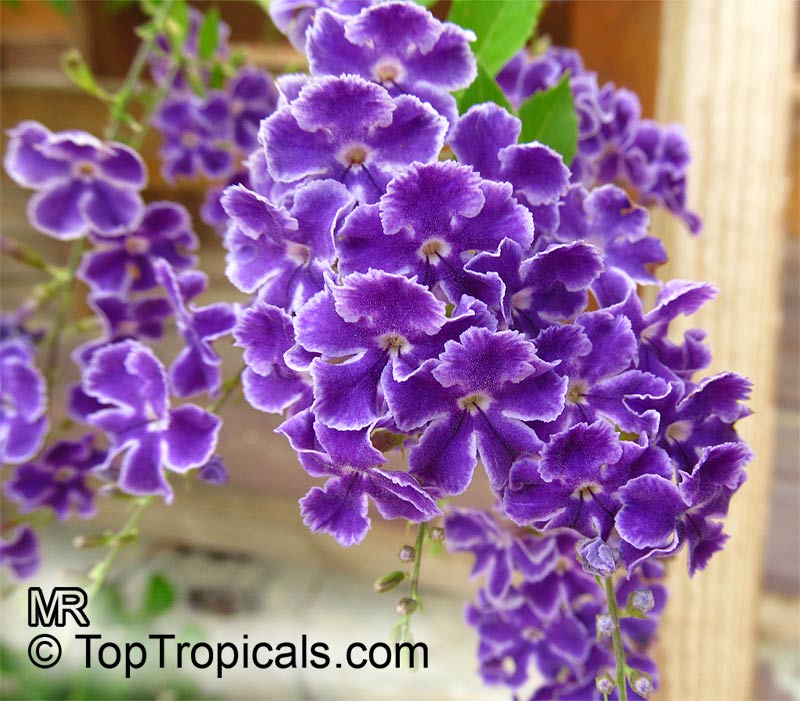
Duranta - Golden Dewdrop - is simply stunning with cascading flowers in abundance. Either it has lavender, blue, or solid white flowers, it is a sight to behold. The popular name Golden Dewdrop is inspired by the clusters of bright orange-yellow berries that follow the flowers, in such quantities that they often cause the slender branches to droop gracefully.
Duranta erecta blooms off and on all year and can be pruned to size as a bush or a standard tree. If let go, it can grow up to 20 feet tall and wide.
Durantas are excellent butterfly and hummingbird attractors. They will complement your tropical garden or a stand alone in your Southern landscape. Great for providing a color contrast in the landscape, they are especially well-suited as a bright-colored background or screening.
White Golden Dewdrop has pure white flowers that appear in loose clusters, and both berries and blossoms are often seen on a plant. This evergreen fast growing shrub spreads and arches to 10 feet tall and wide and is great for live hedges and covering fences and corners.
Variegated variety, also called Variegated Sky Flower, is grown for its summer flowers, and very showy leaves that are dark green with bright white variegation and creamy-yellow margins around the one inch long serrated leaves.. In the summer, cascading clusters of blue tubular flowers appear followed by wonderfully contrasting orange-yellow berries.
In mild climates, Durantas can be in flower nearly year round with flowers and fruit appearing at the same time. It does best in full sun with frequent deep watering and is pretty hardy, to about 20-25F. It is a good choice for espaliers, as a small tree or large bush; all forms benefit from frequent selective pruning. Prune back in late-winter to encourage a more compact shape and strong flush of fresh spring foliage. Requires moderate watering in a well-drained soil.

Date: 4 Jun 2020

Plant of the Month: Tecomaria capensis Apricot

Stevie's Pick: what's in bloom?

Today we are starting a new column about the most spectacular specials that are in bloom or in fruit today. Our exotic plant grower Steven Gowdy will spotlight the most interesting plants he discovers and recommends today while working in TopTropicals greenhouses.

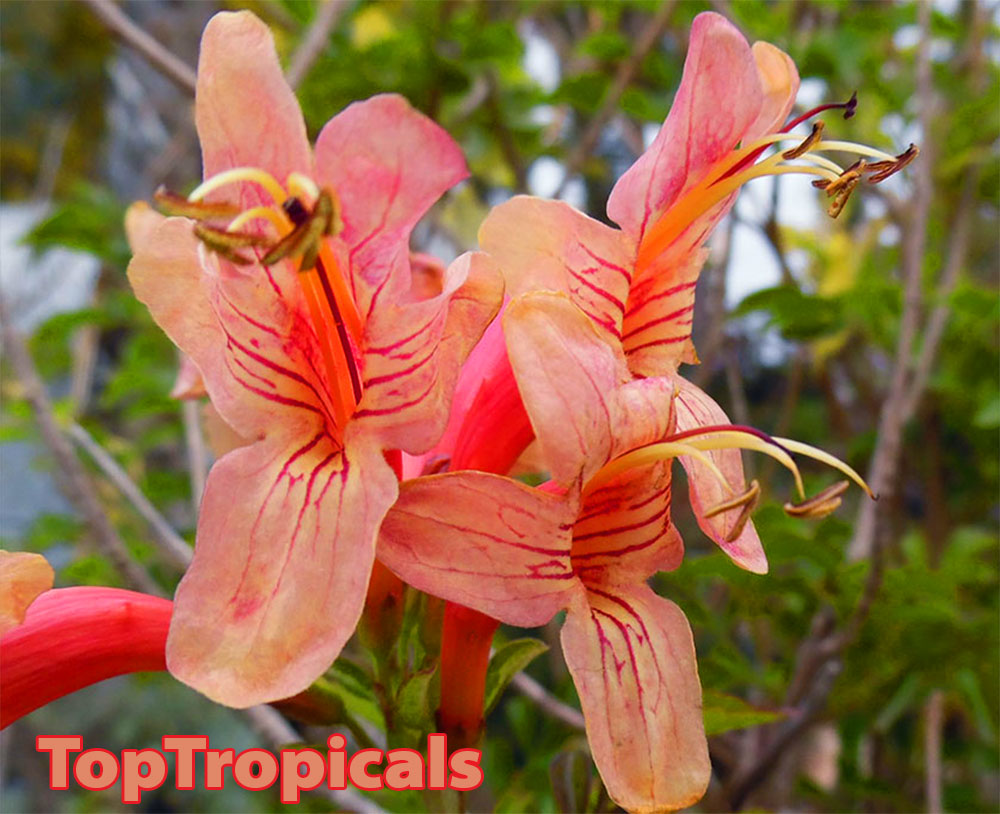
Summer is in full bloom and everyone is wanting dirt under there nails after being quarantined for two months! Enjoy warm tropical breezes with Apricot flowers of this showy African Tecomaria in your garden.
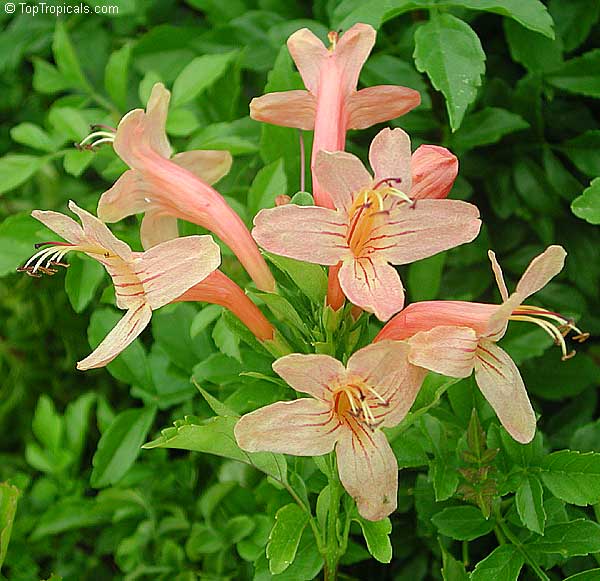
Tecomas and Tecomarias make a wonderful splash of color in any garden, and apricot is no exception. Tecomaria Apricot has pretty unusual color of flowers, ranging from bright apricot color to light-salmon. Ever blooming in warmer climates, it can grow 3-4 feet high and a whopping 4-5 feet wide. In addition to its beautiful flowers, this plant has many medicinal benefits. An easy fast growing addition to any landscape, it is a great hummingbird and butterfly attractor. It is pretty cold hardy and can tolerate light frost which is a great benefit for gardeners living in subtropical climates with cooler winters.

Date: 20 Oct 2018

Featured Plant. Bilimbi, Cucumber tree, Tree Sorrel

TopTropicals.com

Bilimbi, Cucumber tree, Tree Sorrel

Ethnic names are: Kamias, Belimbing Asam, Belimbing Buloh, Bimbiri. This rare exotic fruit is very popular in Thailand, Malaya and Singapore. In India, where it is usually found in gardens, the bilimbi has gone wild in the warmest regions of the country. Outside native habitat, Bilimbi is hard to find plant, very few growers produce them, although it is not so hard in cultivation.
The bilimbi is closely allied to the carambola but quite different in appearance, manner of fruiting, flavor and uses. The only strictly English names are"cucumber tree"and"tree sorrel"."Bilimbi"is the common name in India and has become widely used. Many people are more familiar with the close ralative - Averrhoa carambola - Star Fruit, which foliage looks very similar to bilimbi. The bilimbi leaves and taste of fruit are quite similar to those of the Phyllanthus acidus - Otaheite Gooseberry), although these plants are not related. Continue reading...

Check out this plant...

Date: 7 Mar 2026

🌞 Spring Nutrition Strategy: How to Identify and Fix Plant Nutrient Starvation

Smokey  and  Sunshine  PeopleCats  diagnose  a  starving  coffee  plant  and 
 revive  it  using  Sunshine  Robusta  boosters,  turning  a  weak  yellow  plant  into 
 a  healthy  green  coffee  tree  after  one  month..
Sunshine: I'm trying to fight rising coffee prices. So I planted my own coffee plant. But it's dying.

Smokey: It's not dying. It's starving. Classic nutrient collapse. Imagine going two days without donuts.

Sunshine: Two days? That's a PeopleCats rights violation. Catstitution First Amendment: food, including donuts, must remain available.

Smokey: Exactly. Plants feel the same. Let's feed it. Sunshine Robusta. Robusta is coffee, you know.

Sunshine: Obviously they named Sunshine Boosters after my charm. And since it's coffee, it should work perfectly.

One month later

Sunshine: Holy whiskers! You're a magician.

Smokey: No magic. Just boosters.

Sunshine: Great. Coffee is on me when this tree starts producing. You bring the donuts.

Read more about Smokey & Sunshine

Fellow gardeners,

Spring has arrived, and plants are coming back to life. New shoots are appearing, fresh leaves are unfolding, and roots are beginning to grow actively again. As plants enter this important stage of the season, they need more than just water to support their growth. Proper nutrition is essential for strong development and healthy plants. SUNSHINE Boosters provide the balanced nutrition plants need to start the growing season strong.

A simple rule we follow in our nursery: new growth responds best to foliar feeding. When nutrients are sprayed directly on the leaves, plants can absorb them quickly and efficiently.

  • Immediate action – nutrients are absorbed through the leaves and start working right away.
  • No delay traveling through soil – plants do not need to wait for nutrients to move down to the roots.
  • Avoids soil lockout – micronutrients can become unavailable in high pH soils, but foliar feeding bypasses this problem.
  • Supports stressed plants – when roots are cold, damaged, or newly transplanted, foliar feeding helps plants recover faster.

However, sometimes plants begin to show visible nutrient deficiencies. Yellow leaves, slow growth, brown leaf edges, or distorted new leaves are often early signs that the plant is missing essential elements needed for healthy development.

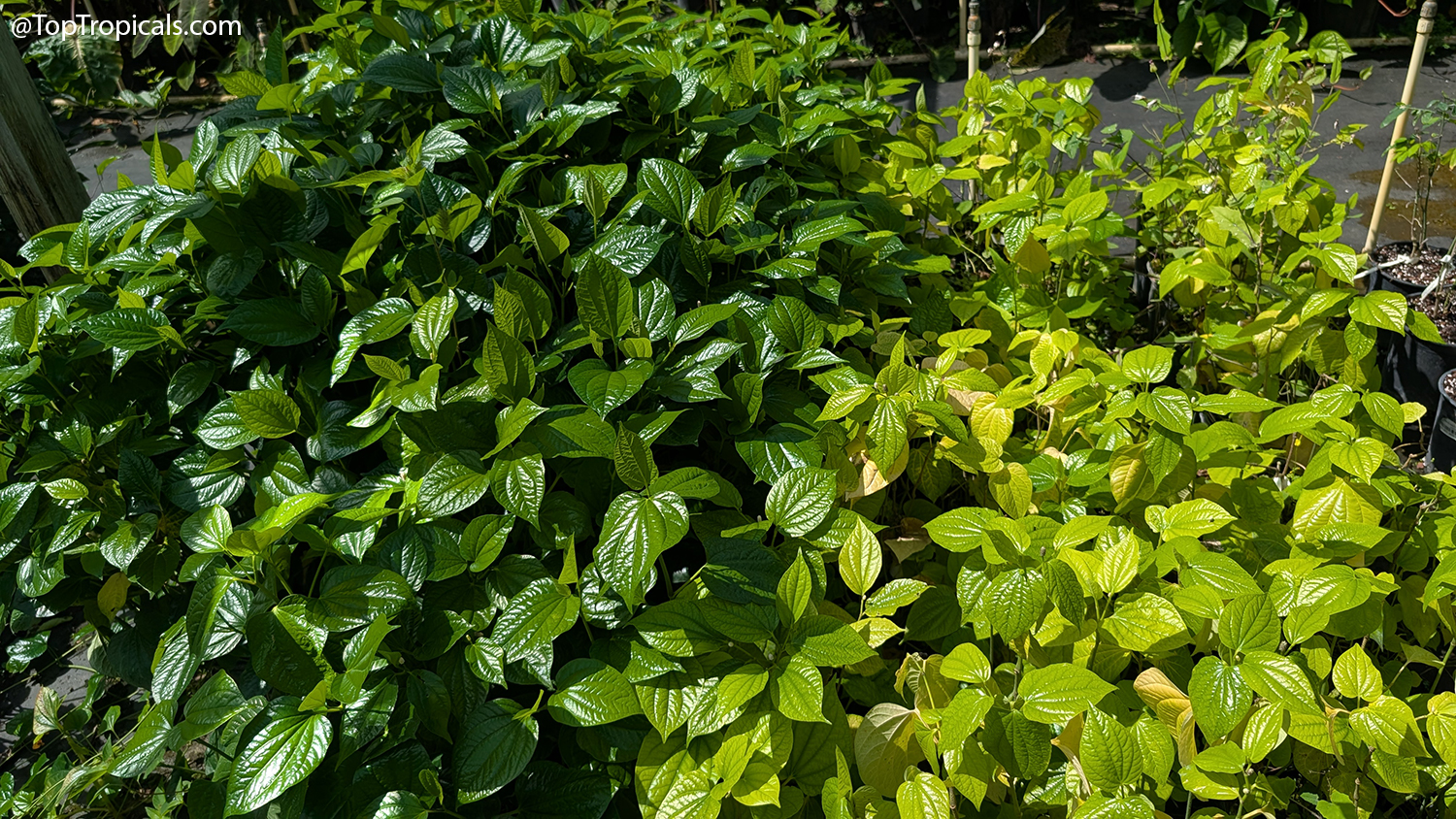
Piper  sarmentosum  Vietnamese  pepper  plants  comparison  with  fertilizer 
 on  the  left  and  without  fertilizer  on  the 
 right

Piper sarmentosum - Vietnamese Pepper - with fertilizer (left) and without (right)

These symptoms are especially common in container plants, where nutrients can be quickly depleted or become unavailable due to soil pH and watering conditions.

Use the quick reference table below to identify common nutrient-related symptoms and the recommended SUNSHINE solution to correct them.

Symptom you see What to do
Pale leaves, slow growth, weak new shoots
(often nitrogen related)
Spray SUNSHINE Robusta to stimulate strong vegetative growth.
Brown leaf edges or weak plant vigor
(often potassium related)
Apply SUNSHINE Robusta to restore nutrient balance.
Yellow leaves with green veins
(iron or manganese deficiency)
Apply SUNSHINE Superfood to correct micronutrient deficiency.
Small distorted leaves or poor flowering
(zinc or boron deficiency)
Use SUNSHINE Superfood during active growth period.

🌿Foliar Feeding: How Much and How Often

For most plants, foliar feeding works best when applied lightly and regularly during active growth.

  • Regular feeding (maintenance): Mix with tap water according to the ratio on the label. For SUNSHINE Robusta use 25 ml (5 tsp)per gallon of water and spray leaves every 5-7 days during active growth.
  • Correction feeding ("medicine" dose): if plants show visible nutrient deficiencies, combine SUNSHINE Robusta with SUNSHINE Superfood and spray every 5–7 days until new growth appears healthy. All SUNSHINE Boosters products are compatible and can be mixed with water in the same sprayer.
  • Best time to spray: early morning or evening when temperatures are cooler and leaves can absorb nutrients efficiently.
  • Important: spray both the top and underside of leaves for maximum absorption.

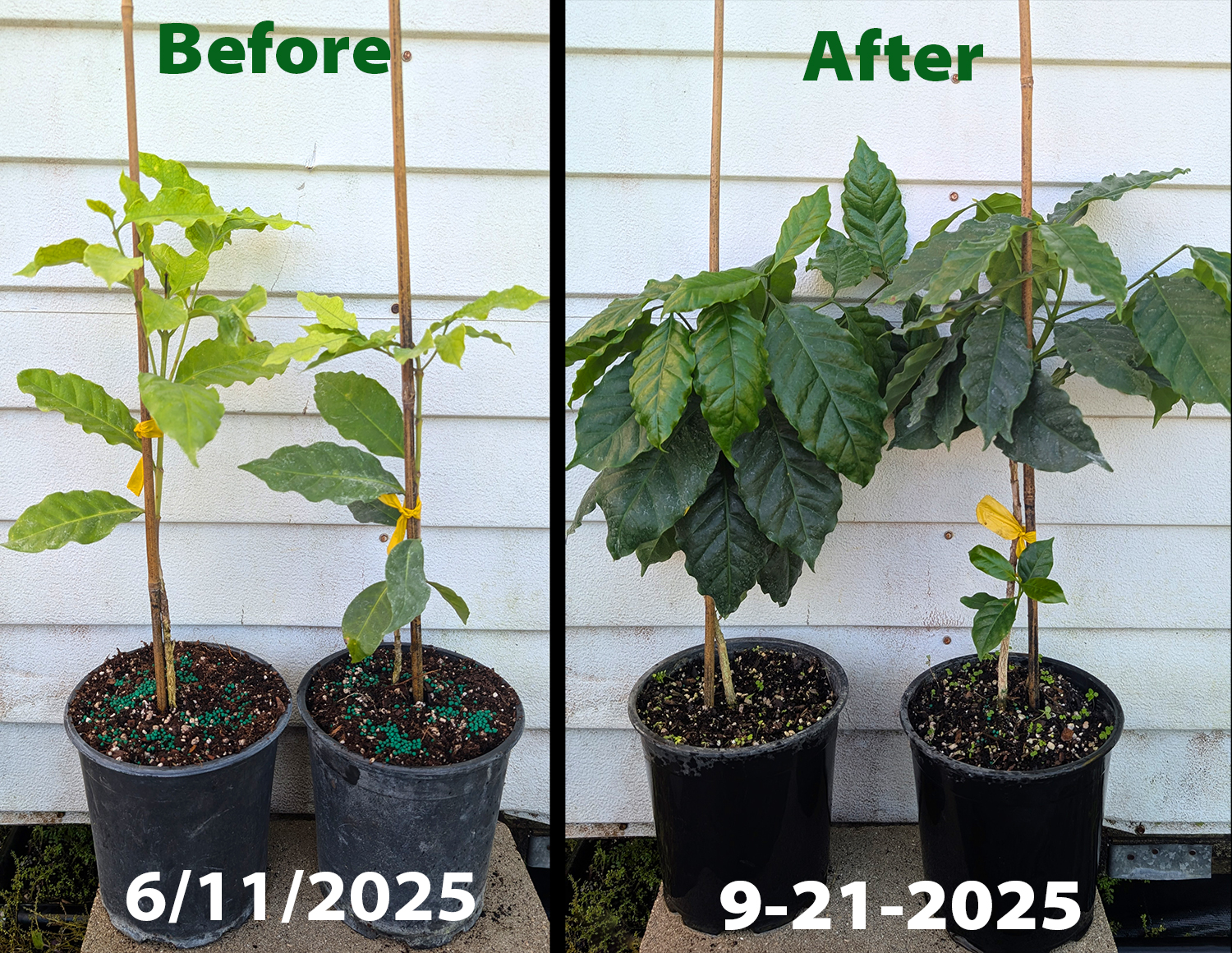
Coffee  plants  before  and  after  regular  Sunshine  Robusta  fertilizer 
 applications  showing  darker  leaves  and  stronger 
 growth

Coffee plants before and after regular Sunshine Robusta applications

🛒 Feed your plants

Date: 17 Nov 2023

Hedges with Benefits
Reference Chart

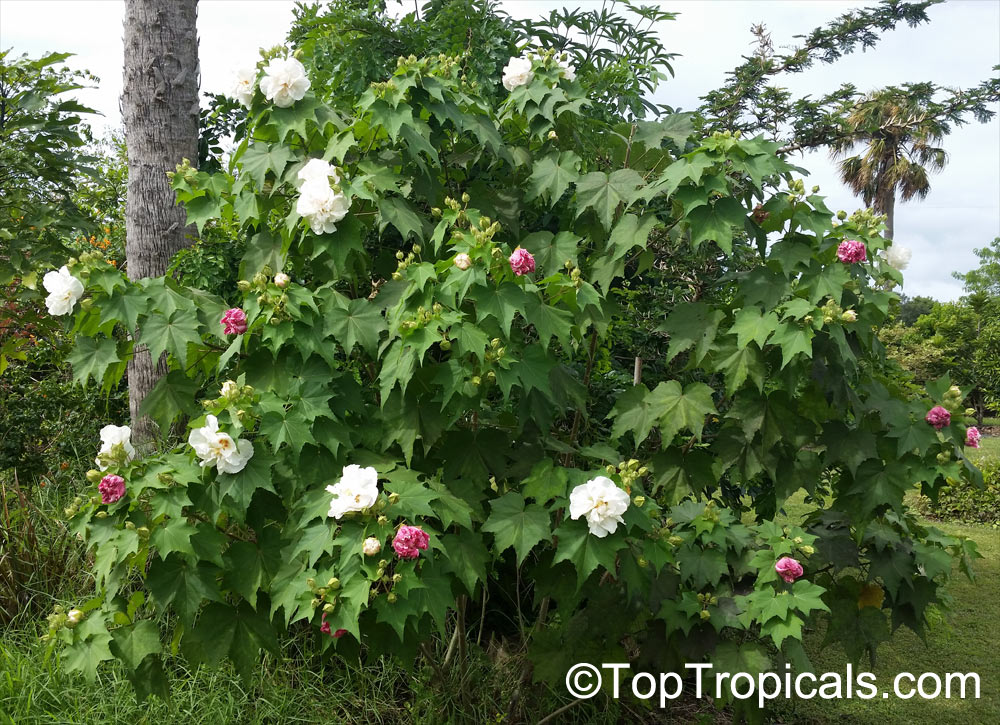
Hibiscus  mutabilis  flowering  hedge

Large and fast growing

Tithonia diversifolia - Sunflower tree
Acacia farnesiana - Sweet Mimosa
Calliandra surinamensis - Powderpuff
Aloysia virgata - Almond Bush
Dombeya x wallichii - Tropical Hydrangea
Cornutia grandifolia - African lilac
Gmelina philippensis - Parrots Beak
Hibiscus mutabilis Cotton Candy - Mallow Hibiscus
Senna alata - Empress Candle, Candelabra Plant

Medium or easy-trim

Acalypha hispida - Cat tail, Chenille plant
Bauhinia galpinii - Pride of De Kaap
Cestrum nocturnum - Night blooming jasmine
Dombeya seminole - Tropical Rose Hydrangea
Gardenia thunbergia - Forest gardenia
Hamelia patens - Fire Bush
Hibiscus variegated Snow Queen
Jasminum sambac Maid of Orleans
Ochna integerrima - Vietnamese Mickey Mouse, Hoa Mai
Odontonema callistachyum - Lavender Butterfly Bush
Odontonema cuspidatum - Firespike, Red
Rondeletia leucophylla - Panama Rose
Tecoma stans - Yellow Elder

Short or slow growing

Aglaia odorata - Chinese Perfume Plant
Allamanda schottii - Dwarf Allamanda Bush
Brunfelsia pauciflora Compacta - Dwarf Yesterday-Today-Tomorrow
Clerodendrum incisum - Musical Note
Calliandra schultzii - Dwarf calliandra
Gardenia vietnamensis - Vietnamese Gardenia
Leonotis leonurus - Lions Ears
Neea psychotrioides - Pigeon Plum, Hoja de Salat
Plumbago auriculata Imperial Blue

Garden Specimens

Combretum constrictum Thailand, Ball of Fire
Caesalpinia pulcherrima - Red Dwarf Poinciana, Bird of Paradise
Clerodendrum quadriloculare - Winter Starburst
Euphorbia leucocephala - Snows of Kilimanjaro, Pascuita
Gardenia nitida - Shooting Star Gardenia
Hibiscus schizopetalus - Coral Hibiscus
Jatropha integerrima compacta
Kopsia fruticosa - Pink Gardenia
Malvaviscus x penduliflorus Variegata - Summer Snow
Mussaenda philippica x flava - Calcutta Sunset (Marmelade)
Plumeria pudica - Bridal Bouquet

Semi-Shade to Shade

Clerodendrum bungei - Glory Bower
Clerodendrum paniculatum - Pagoda Flower
Eranthemum pulchellum - Blue Sage, Lead Flower
Clerodendrum speciosissimum - Java Glorybower Mary Jane
Justicia carnea - Pink Brazilian Plume, Jacobinia
Magnolia figo - Banana Magnolia
Megaskepasma erythrochlamys - Brazilian plume
Thunbergia erecta - Kings Mantle
Tibouchina lepidota - Ecuador Princess, Jules Dwarf

Edible Hedges

Eugenia uniflora - Black Surinam Cherry Lolita
Camellia sinensis - Tea Leaf
Hibiscus sabdariffa - Flor de Jamaica, Karkade Sorrel
Laurus nobilis - Bay Leaf
Manihot esculenta - Yuca Root
Nashia inaguensis - Moujean Tea, Bahamas Berry
Sauropus androgynus - Katuk, Tropical Asparagus
Sauropus Variegata - variegated Katuk