Garden Blog - Top Tropicals

Date: 26 Mar 2026

🌸 How to Grow Adeniums Without Overthinking It

By Tatiana Anderson, Horticulture Expert at Top Tropicals with Smokey & Sunshine help

Adenium  desert  roses  blooming  in  greenhouse  during  winter  freeze,  rows 
 of  potted  plants  with  colorful 
 flowers

Adenium Plant Facts

Botanical name: Adenium sp.
Also known as: Adenium, Desert Rose, Impala Lily
USDA Zone: 9 - 10
Highligths Plant with caudexLarge shrub 5-10 ft tallSmall tree 10-20 ftFull sunWater Requirement: Low. Allow soil to dry out between wateringsWatering: Moderate. Water when top soil feels dryYellow, orange flowersRed, crimson, vinous flowersUnusual colorBlue, lavender, purple flowersWhite, off-white flowersPink flowersToxic or Poisonous
Get personalized tips for your region
Adeniums blooming inside the Top Tropicals greenhouse during the record freeze of February 2026 - protected from the cold, kept above 40F, and fed with liquid Sunshine Megaflor. They responded with a spectacular, synchronized winter bloom. Quite a surprize!

✅ Simple rules that actually make them bloom and grow well

  • Light - The more light, the better the growth and flowering. Full sun is ideal, but in very hot climates, filtered bright light keeps plants looking healthier.
  • Water - Water well, then let soil dry on the surface. Sitting in wet soil damages roots, but letting plants dry out too often can push them into early dormancy.
  • Pot and shaping - Use a shallow pot with excellent drainage. To develop a sculptural caudex, lift the plant slightly each time you repot and remove some of the top soil so upper roots become exposed. Over time, this creates a thicker, more prominent base.
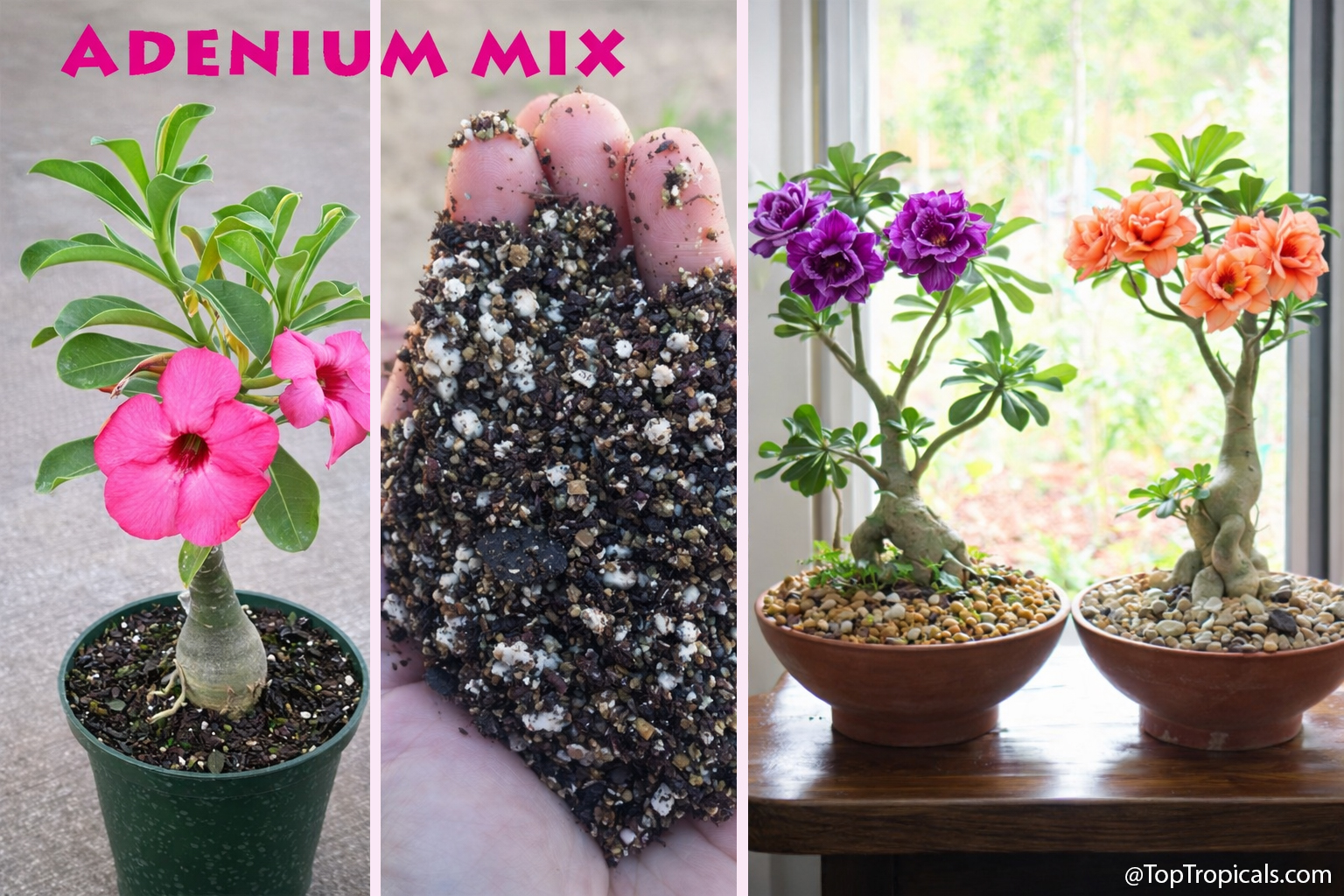
  • Soil - Use a fast-draining Adenium potting Mix.
  • Adenium desert rose plant, fast draining soil mix in hand, and bonsai 
style adeniums blooming indoors

    Healthy adeniums start with the right foundation - a fast-draining soil mix and careful watering only when dry to avoid caudex rot.

  • Cold hardiness - Adeniums are tropical and do not tolerate frost. Keep above 40 F. Brief drops to mid 30s may be tolerated if dry, but cold and wet conditions can damage or kill the plant. In cooler climates, bring indoors or protect during cold nights.
  • Indoor winter care - Move plants indoors before cold nights. Place in the brightest spot possible, ideally a south-facing window. Or use additional lighting. Water very lightly and less often, as growth slows. Do not fertilize during dormancy. Some leaf drop is normal in winter.
  • Freshly grafted Adenium desert rose plants in dormancy arranged in 
greenhouse rows with bare branches

    Freshly grafted adeniums in dormancy - a crucial resting phase. Keep watering low (once a month) and avoid overcare; this is the time to let them rest and etablish.

  • Feeding - Adeniums respond best to liquid fertilizer. We apply Sunshine Megaflor Booster with each watering throughout the year. During dormancy, watering is reduced, so fertilizer use decreases accordingly. Consistent, light feeding promotes strong roots, a thicker caudex, and improved flowering.
  • Pruning - For multiple blooms, regular pruning is essential. After flowering, cut back long or leggy growth to stimulate branching. Each new branch can produce more buds, leading to a much fuller bloom in the next cycle.
Pruned  and  unpruned  Adenium  desert  rose  plants  showing  difference  in 
 branching  and  flowering

Pruned vs. unpruned - the difference is clear. The four plants on the left were trimmed 6 months ago, while the two on the right were not. Same species, very different results.

✍️ Learn more about Adeniums from our Blog

🎥 Watch videos of Adenium Rainbow

Free Shipping on Adeniums
Add bold color and unique forms to your collection with no extra shipping cost.

🛒 Explore Exotic Adenium varieties
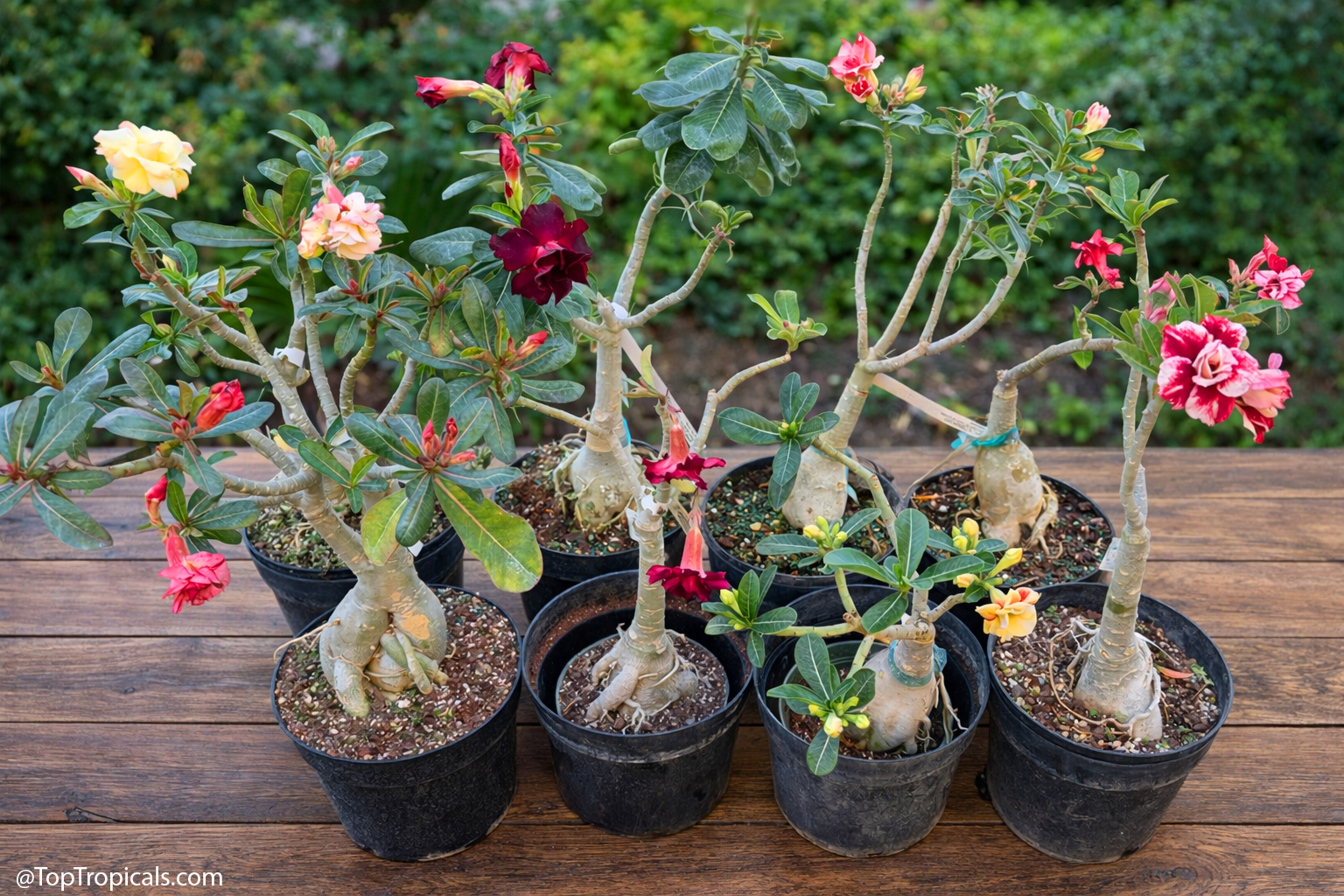
Leggy  Adenium  desert  rose  plants  with  sparse  branching  and  flowers, 
 ready  for 
 pruning

These Adeniums are screaming for pruning so they can bush out and produce more blooms

Date: 20 Dec 2025

☃️ Winter is choosing season

Smokey  the  tuxedo  cat  plans  spring  planting  on  a  laptop  plant 
 encyclopedia  while  Sunshine  the  ginger  cat  relaxes  by  a  fireplace  in  a  cozy 
 Christmas  living  room  with  tropical 
 plants.

Smokey: "December is for planning, not planting."
Sunshine: "Gift card now. Perfect plants later."
Smokey: "You surprise me sometimes. Must be the donuts."

This time of year always feels special to us. The days are shorter, the garden slows down, and we finally have a moment to pause, look at our wish lists, and dream a little about spring.

As gardeners, we know winter is not really planting season. It is choosing season.

It is when ideas take shape. When we think about what we want to grow next, what we want to add, and what we want to do differently when warm days return. That is why, in winter, the best plant gift is not a plant itself. It is the promise of one.

Cold weather and holiday shipping can make winter plant deliveries stressful, especially for tropical plants traveling north. A gift card lets plants wait for the right moment, and lets the gardener enjoy the fun part now: planning, choosing, and imagining.

It also solves something we all know too well. Every gardener is wonderfully different. Some dream of fruit trees, others of flowers, rare collectors, or easy growers. Some plant in containers, some in the ground. Guessing is hard. A gift card lets them choose exactly what fits their garden and their vision.

🎁 Holiday Gift Card Bonus

To make the season a little brighter, we are offering a holiday gift card bonus through 12/31/2025.

When you purchase a gift card, we add 15% extra value. Just add Christmas greeting in gift card message field. For example, a $100 gift card becomes $115 to spend.

The bonus value is not valid with other promotions or discounts. Gift cards cannot be used to purchase other gift cards. Bonus value is added at the time of purchase.

🎁 Get a gift card

Date: 6 Dec 2025

🌿 Bring the Jungle Inside: Winter Survival Guide Part 1: Lighting ❄️

Smokey  the  taxedo  cat  adjusts  an  indoor  grow  light  while  Sunshine  the 
 ginger  tabby  sits  holding  a  hygrometer  he  does  not 
 understand.

Smokey: "Winter lighting must be precise. I need this light exactly at 14 inches."
Sunshine: "Sure. I am holding this… little number thing."
Smokey: "It reads humidity. Your main job is to look cute."

🌞 LIGHT, TEMPERATURE, PLACEMENT

Winter indoors is a different kind of battlefield. Dark rooms. Dry air. Cold windows. Random drafts. Weak light. Sad plants. We've been talking about keeping your tropicals alive outdoors previously. But some of you have no choice this time of year. You have to bring the jungle inside.

If that is you, then this is your plant survival guide.

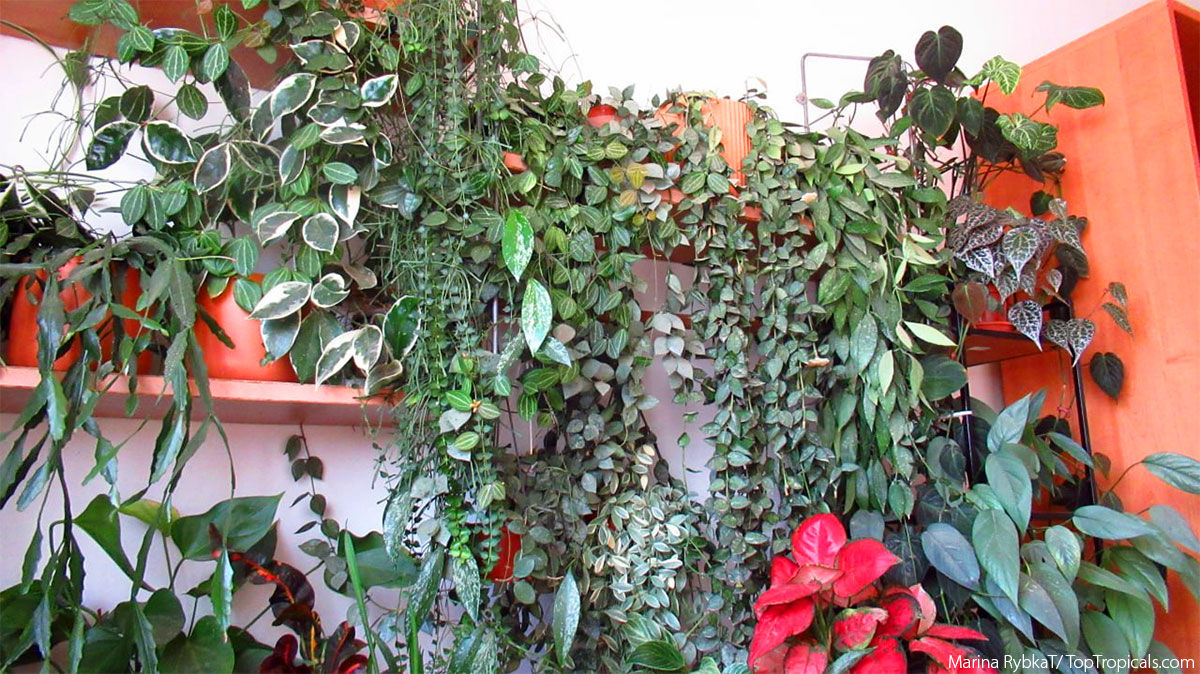
Indoor  wall  of  tropical  houseplants,  including  cascading  vines,  variegated  foliage,  and  mixed  aroids  arranged  on  shelves.

☀️ LIGHT: THE WINTER LIFELINE

Light advice here comes straight from our in-house expert, Michael Dubinovsky, a high-tech lighting engineer with over 30 years of hands-on experience. If he says brightness beats hours, trust him.

Here is the truth: Indoor light in winter is 10 to 50 times weaker than outdoors. Short days. Low-angle sun. Windows filtering half the useful light. It all adds up.

Tropicals need 10 to 12 hours of real brightness. Winter sun cannot do that on its own. Not even in a big window. So we help them.

Use bright LED shop lights or utility lights. 5000K to 6500K CCT. High lumen output. Skip decorative bulbs. Skip purple grow fancy toy lights. If you want a single plant light, even a clamp lamp is fine if you screw in a bright daylight LED bulb.

Panels work best for plant clusters. Bars for shelves. Bulbs for single plants. And grouping plants under one bright panel always beats spreading them out.

Distance matters: keep LEDs about 12 to 18 inches above the leaves. Too close: leaf burn. Too far: stretching, weak stems.

Leaves reaching up? Light is too high or too weak. Leaves curling down? Light is too close.

If you want a reality check, download any smartphone lux meter app. Most indoor corners are 50 to 200 lux without supplemental light. Tropicals want much more

And a quick tip about windows: winter sun comes in sideways. A spot that looks bright at noon can go dull by 2 PM. Don't count of window light

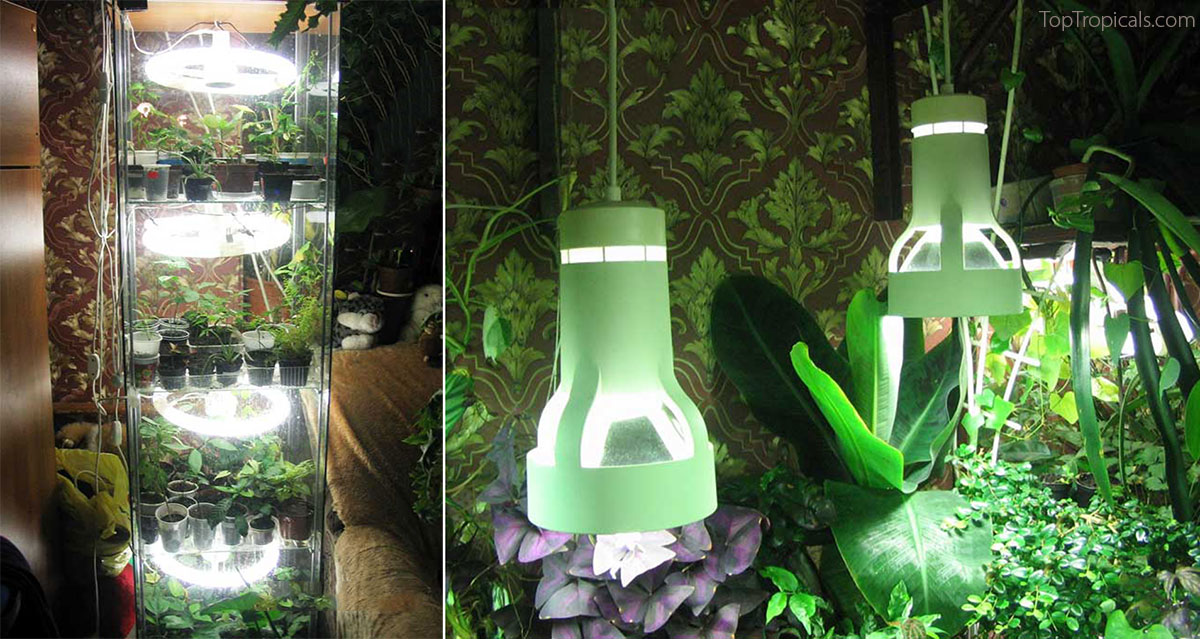
Indoor  grow  setup  with  bright  LED  lights  illuminating  shelves  of  tropical  plants.

Bright light or long hours

People try to fix weak light by running it for 16 or 18 hours. That does not work. Plants care more about light intensity. A few hours of strong light beats all-day dim light. If the light is weak, adding more hours will not change anything except your electric bill.

Simple rule: Short duration but bright is always better than long duration but weak. - by Michael, Top Tropicals lighting expert

No need for fancy horticultural panels

You do not need purple grow lights. You do not need special horticultural fixtures. You do not need expensive panels unless you want real winter growth.

For winter plant holding till spring, the inexpensive solution works great:

  • Bright LED daylight bulbs (5000K to 6500K) from hardware store
  • High lumen output
  • Inexpensive clamp lamps
  • Aim directly at the plant from 12 to 18 inches

This setup keeps tropicals happy until spring without buying anything fancy. Save the money for soil, pots, or your next plant.

Indoor plant lighting safety note:

  • Use timers. Keep cords dry. Do not overload outlets.
  • Do not hang lights over humidifiers.
  • And do not put fixtures on piles of books to raise them. People do this.

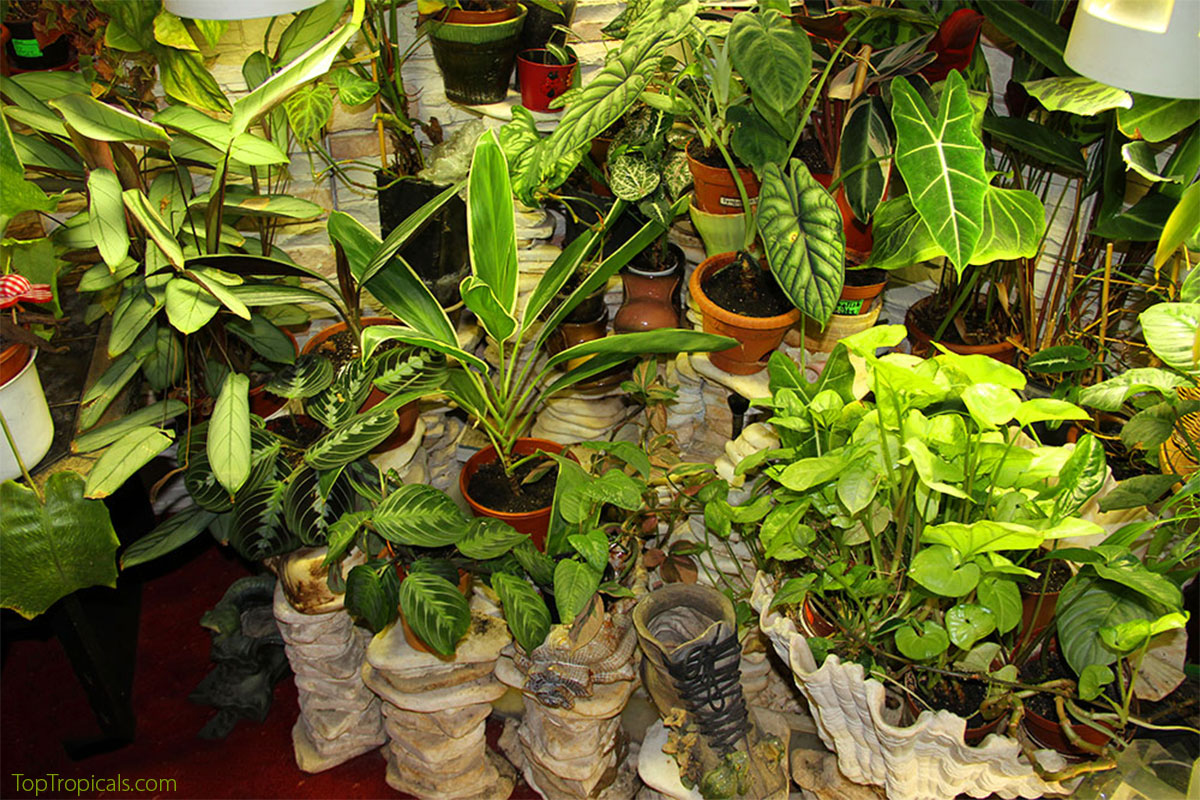
Indoor  plants


✔️ WINTER INDOOR FAQ: TEMPERATURE AND PLACEMENT

Q: I am in Home Depot. Which light do I buy?
A: LED shop light, daylight color (5000K to 6500K), high lumens. Skip fancy plant bulbs.

Q: Can I use clamp lamps or floor lamps for plants?
A: Yes. Clamp lamps with a bright daylight LED bulb work great for winter holding.

Q: Do I need special horticultural grow lights?
A: No. A bright LED daylight bulb works fine for winter. Save the fancy lights for real growth projects.

Q: How far should the light be from the plant?
A: About 12 to 18 inches above the leaves. Too close burns. Too far stretches.

Q: Can I run weak lights for 18 hours to compensate?
A: No. Weak light plus long hours still equals a weak plant. Brightness matters more than hours.

Q: How do I know if a spot is bright enough?
A: Use a free phone lux app. Most indoor corners are much too dim for tropicals.

Q: I have a huge window. Why do I still need LEDs?
A: Indoor winter light is weak, short, and filtered by glass. Plants want intensity, not just a big window.

Q: My window faces north. Now what?
A: North windows are decorative only. Use supplemental lighting or move the plant.

📚 Learn more:


Date: 20 Nov 2024

Sunshine Boosters Winter Use

The magic fertilizer in action

Crazy  banana  with  Sunshine  boosters

Do you remember that Sunshine Boosters fertilizers can be applied year-round?

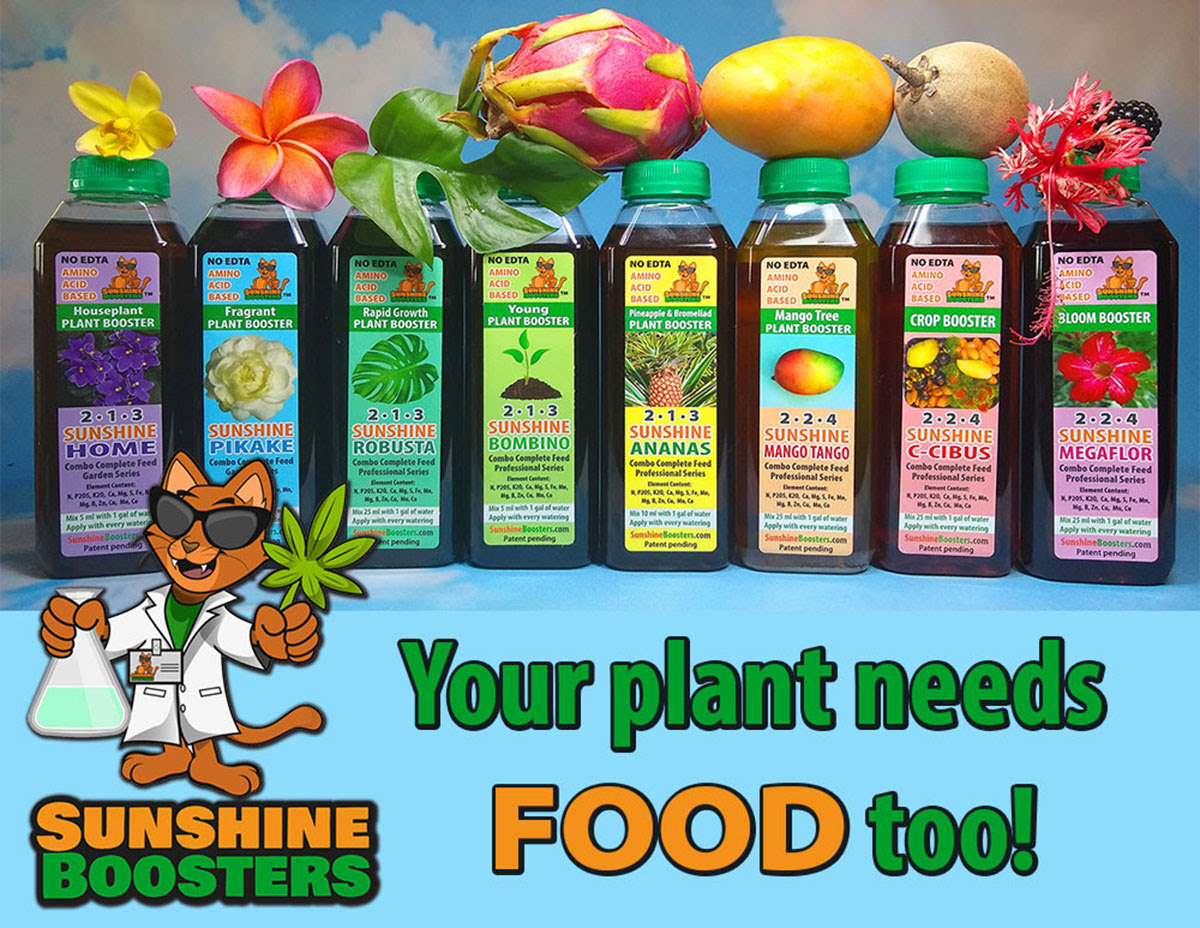
As natural fertilizers, their scientifically created formulas provide perfectly balanced nutrition for your plants throughout the year. Follow the instructions on the labels and apply Sunshine Boosters with every watering. Give your plants extra boost during winter months! The fertilizer amount is balanced, adjusting proportionally to the water amount, which is tailored to the plant's winter needs. Unlike dry fertilizers, Sunshine Boosters can be used all year without fear of burning plants with excessive nutrient lockup.

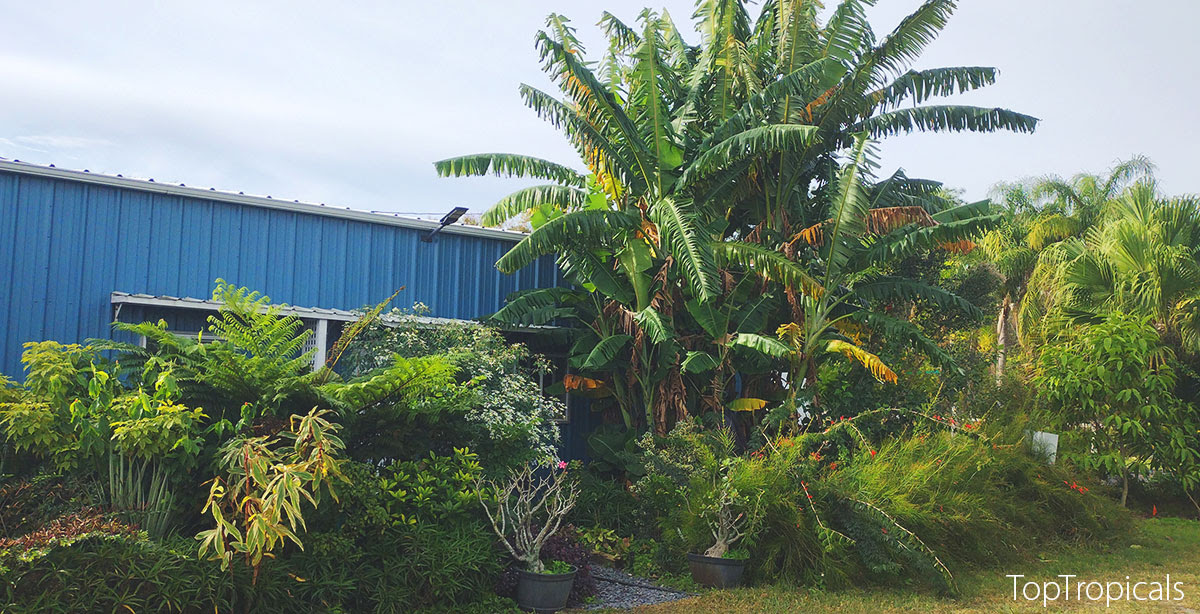
Those who visited on B-Farm in Sebring, have noticed our little garden by the office, with plants that are always happy and vigorous - year around. They are irrigated automatically with Sunshine Boosters using the Robuster injector. We are proud of our "crazy banana", it is taller than the building, we honestly have never seen a banana of that size! The solution we are using there is Sunshine Robusta (also available for pick up in 2.5 gal jugs).

Save on Sunshine Boosters with the discount code above!

your  plant  needs  food  -  sunshine  boosters

Date: 24 Jun 2018

TopTropicals

Spring is coming, plants need food! Time to fertilize...

Last winter was long and snowy in the most part of our country. Hold on fellow gardeners up North, it is almost over!
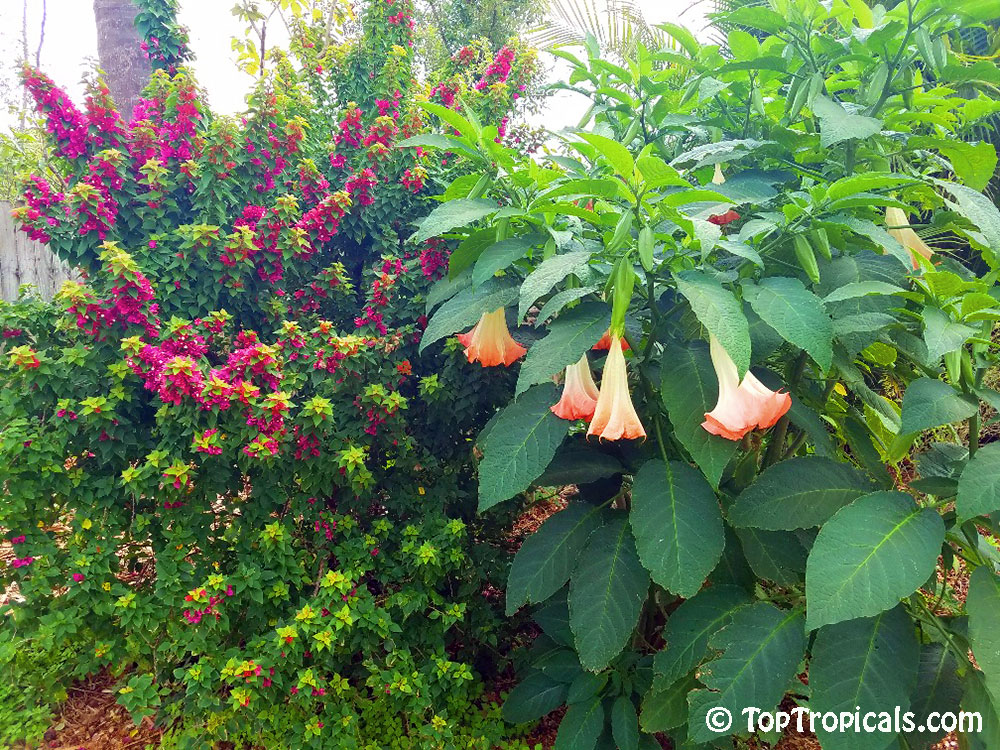
Here in Florida we have been blessed again with a mild winter without serious cold snaps. Early Spring that is already in the air. Look at this picture of flowers in our front yard now.
If the weather is already warm in your area (low temperatures above 55), it is time to start fertilizing. We are sending our love and support to tropical Puerto Rico suffered from hurricane last year, and will be happy to help you guys to restore your lost gardens!

CHECK LIST

what to do to give your garden a good kick start:

1. Slow release granulated food. Apply Slow Release Fertilizer and continue once a month. 1 tsp per gallon of pot, or a handful for in-ground plants. This will provide essential macro elements (NPK) required for a plant growth.

2. Water soluble micro-elements. Besides macro-elements, plants need many other elements that most of the time missing in soil. A lack of micro-elements causes different deficiencies, resulting in weak root systems, slow growth, deformed leaves, leaves yellowing, lack or no flowers/fruit. Apply these supplements as a foliar spray once a month to induce healthy growth and flower/fruit development. We recommend the following micro-element products to keep your plants healthy and vigorous year round:
a) SUNSHINE SuperFood - plant health booster. This revolutionary new liquid complex contains ALL microelements needed and can fix all possible problems occuring to your tropical plants - from roots to flowers and fruit. We have convenient dropper bottles of 5 ml for small plant collections, 50 ml for larger gardens, and 100 ml for professional landscape applications.
b) SUNSHINE-Micro - Microelement booster - for common iron deficiency (pale leaves)
c) SUNSHINE-Super-Iron - Microelement booster - for severe iron deficiency (severe yellowing leaves)

3. SUNSHINE plant boosters - SUNSHINE-E, -BC (caudex plants and bonsai), -H (house plants). Apply these natural plant stimulants to help plants recover from cold, dormancy, increase plant's metabolism and make a plant more readily absorb both Macro- and Micro-elements. SUNSHINE boosters also will help plants grow vigorously, withstand Summer heat and drought, and produce bigger and better flowers and fruit.

4. Kickstart a sweeter fruit. To get a better and sweeter crop in Summer and Fall, you need to start first application now. SUNSHINE Honey - is natural, Amber-colored, honey-like liquid microelement product for fruiting and edible plants that will make them sweeter, tastier and more flavorful! Very effective for tropical fruits, tubers, vegetables. Great for tropical fruit trees: Mango, June Plum, Annonas, Tropical Cherries, Carambola, Citrus; subtropical fruit trees: Peaches, Apricots, Loquat and berry plants (blackberry, mulberry, etc.)

5. SUNSHINE-S. Don't forget to plant seeds! It's a perfect timing now to start your tropical garden indoors even if it is still cold outside. Soak them in SUNSHINE-S solution to increase germination rate.

See full list of SUNSHINE boosters. All these products are essential plant elements. They are not toxic and can be used safely for edible landscapes.