Garden Blog - Top Tropicals

Date: 16 Jun 2019

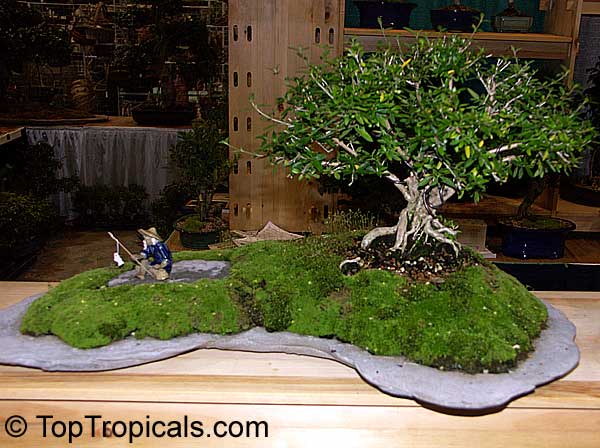
Horned Holly - a cool bonsai plant
By Onika Amell, tropical plant specialist

Q: I live in Chickasaw, Alabama. I am a beginner bonsai grower. I received a lovely little Horned Holly as a birthday present and I want to know if it is a suitable plant to bonsai?

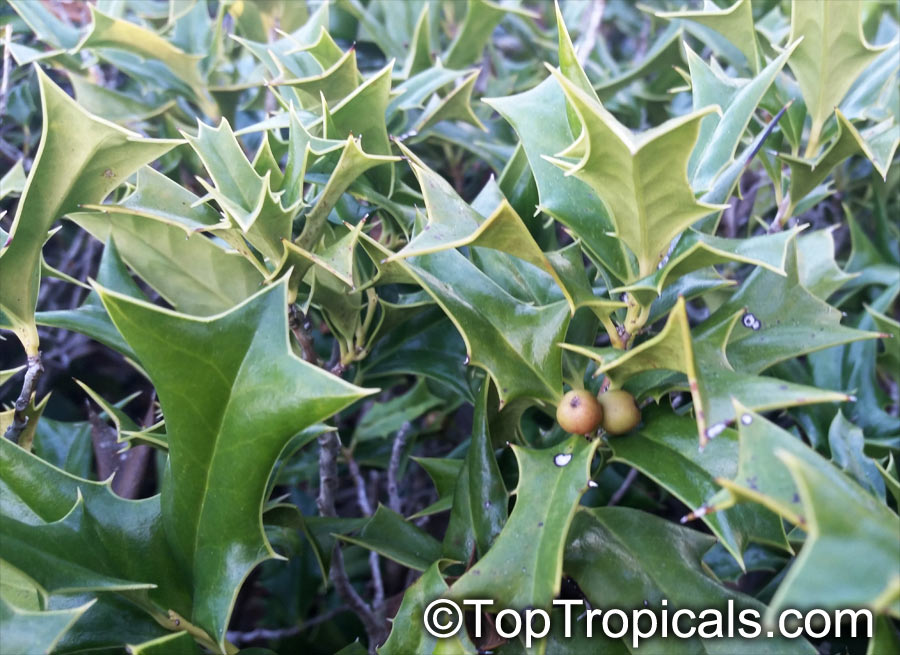
A: The Ilex cornuta - Horned Holly, or Chinese Holly, is very popular as a bonsai species. It is loved for its very beautiful and distinctive rectangular foliage and for its small, white flowers which give way to large, red berries. The berries are larger than those of the European Holly. The leaves are rectangular and unusually shaped with three large spines at the apex. This bonsai will take both sun and shade, but semi-shade is preferred in midsummer. If indoors, give it plenty of bright light. When kept outdoors, your Horned Holly bonsai will need some frost protection and should be sheltered from strong or cold winds. It will need a fair amount of water and should not be allowed to completely dry out. Watering during the heat of summer is especially important, as well as in spring right before the fruit production, and should be reduced during winter. This species will also appreciate regular misting of the foliage. Repot this bonsai every 1 to 2 years in early spring, using bonsai soil - TopTropicals Adenium Soilless Mix. Fertilize the holly every two weeks throughout the growing season using either a balanced fertilizer diluted to half strength. We recommend for this purpose Tropical Greenhouse Plus - Plant Booster. Pruning should be done in early spring.
Horned Holly is also very popular as a hedge plant as it grows dense and compact. It will grow to between 3 and 5 feet tall and will spread to an equal distance, giving it a round, shrubby form. It is cold hardy! Zones 6 through 9. It will tolerate a wide variety of soils as long as it is well-drained. It likes sun or part shade. It is heat and drought tolerant once established, and are often used in xeriscaping. Its branches produce dark olive-green foliage that is often cut for indoor decorations during the holidays.

Limited time special offer:
buy 1 get 1 free for only $10!

Date: 13 Jun 2019

Millingtonia hortensis - Tree Jasmine

By Onika Amell, tropical plant specialist

Q: Q: How fragrant is the Tree Jasmine (Millingtonia) and how tall does it grow?

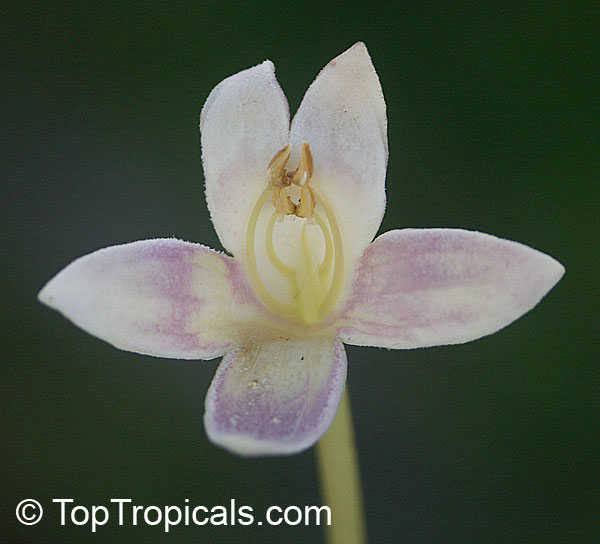
A: Millingtonia hortensis, or Tree Jasmine, is such a beautiful flowering tree with long, white, slender and trumpet-shaped flowers with a perfume that wafts through the air. These trees are very sought after because they are so highly fragrant. They are fast-growing trees that in Nature (Burma) can easily reach a height of 40-50 feet, however here in SW Florida we have them growing about 20-25 ft. The tree flowers at night and then shed the flowers in the morning. The flowers are waxy and stay fresh for a long time. In India the flowers are picked up and braided for rituals. It flowers from October until the end of December. The tree is also known as the Cork Tree, as an inferior cork is processed from the corky bark. It is a fast growing, tall, straight tree with few branches and its popularity lies in its ornamental value and not in its shade-giving properties. Yet, once you've witnessed the profusion of white flowers, you will understand why. It is a sight to behold! Cork tree is very easy and can grow in a variety of soils. It requires full sunlight.

Date: 8 Jun 2019

Chosing a good avocado tree

TopTropicals.com

Q: I'm in coastal Broward County. I'm putting together an order on your web site, and one thing that I would like is an avocado tree. I'd like to have something as close to true "Hass" as possible. Which cultivar does well here in SE Florida, and is most like Hass in texture, creaminess, and flavor? I'm not a big fan of the yellow watery Florida avocados.

A: Mexican type of Avocado have dark skin and buttery texture, while Florida green fruit types (West Indian type, with smooth skin), have lots of delicious melting pulp, so it is a matter of preference.
In coastal Broward county you can grow a wide range of varieties since your climate is very mild, so you don't have select cold-hardy varieties like Winter Mexican, Brazos Belle or Joey, etc. Yet there are many interesting varieties that rare and much more exclusive than Hass, with the same, or even better, quality buttery fruit.

One of the most popular varieties - Brogdon, with red-purple colored pear-shaped fruit, very thin skin, and yellow buttery flesh. It is also very cold hardy.

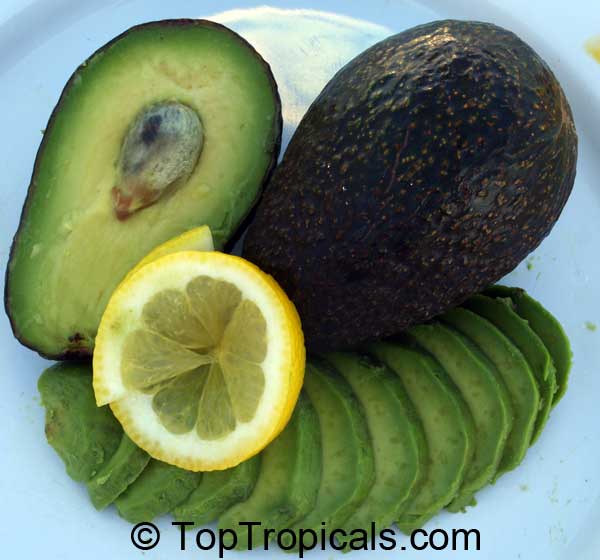
Very interesting exotic avocado is Kampong - Sushi Avocado - see photo above. The flavor of this fruit very nice, oily, creamy, nutty, reminds of almonds. At the same time, it has solid consistency and if you cut a square it remains a shape of the square. It is the best Sushi Avocado! It tastes great as an appetizer when cut in squares with some shrimp cocktail sauce.

Three collectible varieties:
Anise - leaves that smell like Anise, very rare, the fruit is of excellent quality, creamy and buttery.
Bacon - a large Mexican variety with dark-skinned medium-sized fruits, and a rich creamy flavor. It has exceptional fruit that ripen in late fall and into spring, they are easy to peel and have a light, subtle flavor. Another outstanding feature of the Bacon avocado tree is its angelic sweeping branches which helps keep the tree shorter and easier to pick its fruit.
Nishikawa is a very hot seller! Oval fruit somewhat resembles Hass, but larger, and has very high oil content.

See all Avocado trees from our store


Recommended fertilizers:
Fruit Festival Plant Food - Super Crop Booster
Mango-Food - Smart Release Fruit Tree Booster

Date: 17 May 2019

Persimmons - seedlings or grafted?

TopTropicals.com

Q: Do all persimmons take roughly 6 years to fruit if grown from seed?

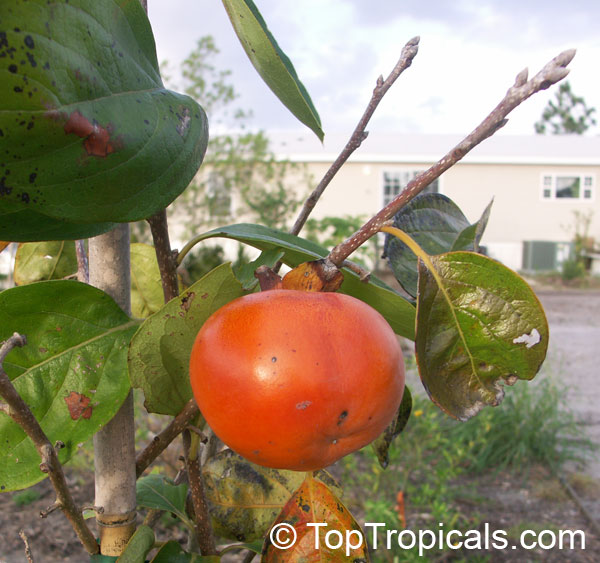
A: Persimmons, like most of the cultivated fruit trees, are recommended to be grafted to ensure a certain variety, although they may also come true to seed. And unfortunately, you are right - it will take a few years (depending on growing conditions) until the seedling will start fruiting. So your best bet to get a quality fruit right away is to obtain a grafted plant. You may check out persimmons (tropical and subtropical) that we carry in stock. If you are interested in any of the varieties that are currently sold out, just add your email to wishlist by clicking on link Notify me when available and you will be notified as soon as we have it back in stock.

Date: 27 Apr 2019

Impossibly exotic Chalice Vine

TopTropicals.com

By Onika Amell, our flower specialist

Q: I live on Sanibel Island, Florida and I'm looking for an exotic vine to cover the side of my house. A friend suggested Chalice vine. What can you tell me about it and will it tolerate the salty soil and salt spray of the island?

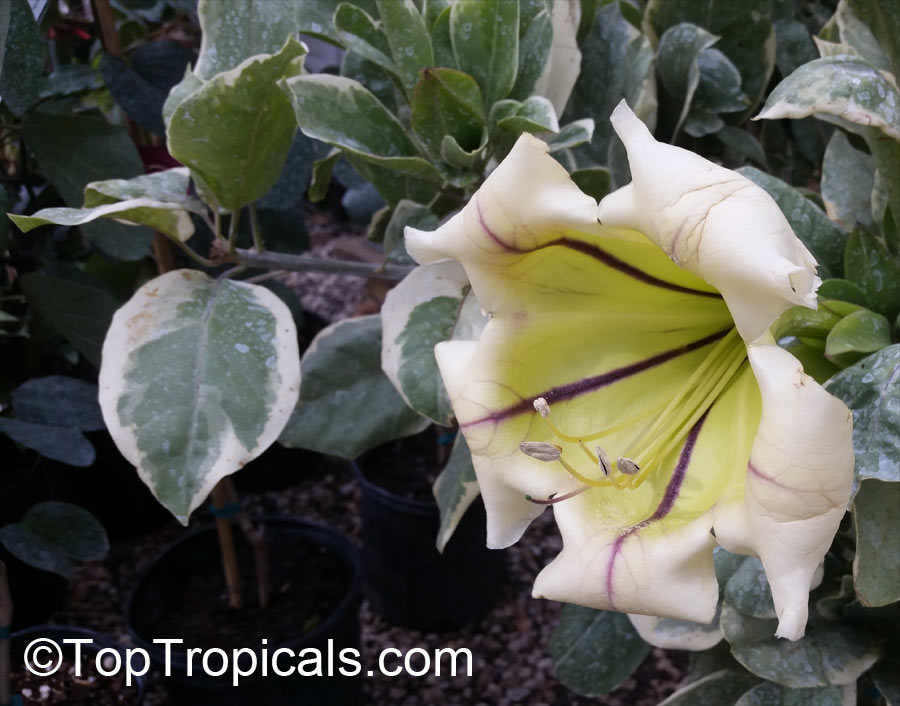
A: Chalice vine, or Cup of Gold - Solandra maxima - is a large, woody, scrambling tropical vine with huge, cup-shaped flowers. Variety Variegata has also amazing cream and green variegated foliage. The flowers are fragrant, especially in the evenings, with a lovely coconut-like aroma. This unusual vine will give you intermittent waves of large, wide flaring golden trumpets.
Even when not in flower, it is beautiful as new growth is bright and purple-bronze in color. It has a large and loose spreading habit. As this vine ages, flowers will appear along the entire length of branches off the main vine. So, just think about it - up to 100 feet vine and you will have about 500 flowers at the same time! They are very fast growing and usually bloom from February until May. Plant them... Sit back and wait... Four months of heaven!
They are great for seaside gardens as they are very tolerant of salt spray and salty soils. Will, in fact, thrive in most any well-drained soil.
Give it a large, sturdy pergola or trellis, or train it to grow up the side of a house where it will spill down over windows and doorways to take your breath away... Chalice vine is impossibly exotic!