Date: 28 Sep 2025
Guava: The Healthiest Fruit You Can Grow
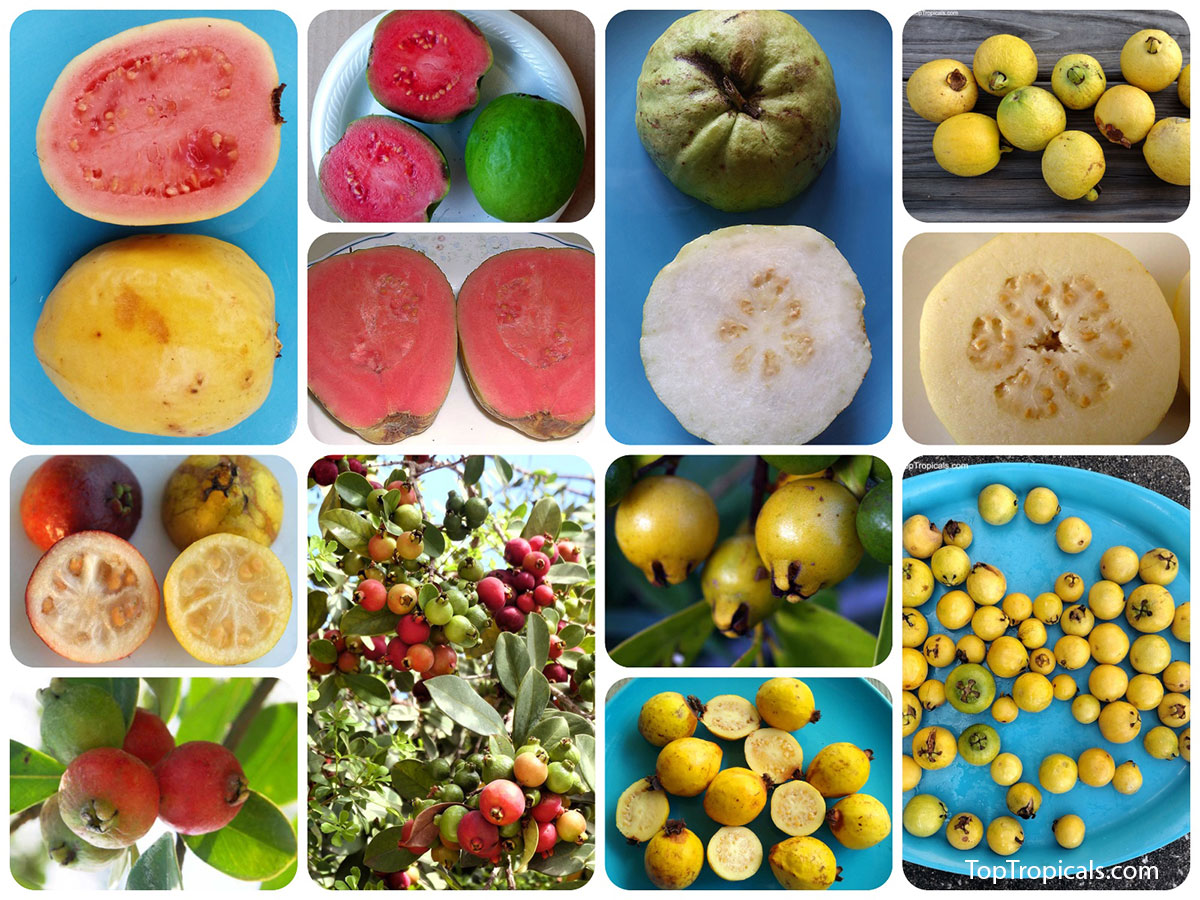
Guava varieties: Pink flesh (upper left quarter), White flesh and Cas (upper right quarter), Red Cattley Guava (bottom left quarter) and Golden Cattley (bottom right quarter).
Let’s talk Guava. Few fruits check as many boxes: flavor, productivity, health, and adaptability. We’ve grown guava trees at Top Tropicals for years here in Florida, and it never fails to surprise people with how easy it is — and how quickly it rewards you.
🌿 Health Benefits
We know the first question:"Why guava in addition to all the other fruit trees I could plant?"Because guava is one of the healthiest tropical fruits you can eat and grow — and it produces faster than almost anything else.
- Vitamin C powerhouse — guava has four times more vitamin C than oranges. One fruit covers your daily needs and then some.
- Potassium and fiber — good for balancing blood pressure and keeping your heart strong.
- Antioxidants like lycopene and vitamin C — these keep your skin glowing and help protect your cells from damage.
- Dietary fiber — aids digestion and helps keep blood sugar steady.
- Guava is a true"food as medicine"tree you can plant right in your backyard or in pot.
♥️ Our Favorite Varieties are Available Now
We currently have a DOZEN excellent guava varieties in stock selected by our plant expert Tatiana Anderson — something special for every garden. Our top picks are:
Pink Guavas
- Barbie Pink – Yellow pear-shaped fruit with thick pink flesh, sweet and juicy. Cold hardy for a tropical fruit. The best seller.
- Hong Kong – Large, round, smooth pink fruit. Sweet flavor, very few seeds, and very productive.
- Tikal – Our top pick. Fast-growing, disease-resistant, and produces the sweetest pink guavas with very few seeds.
White Guavas
- Indonesian White – Aromatic, classic white-fleshed guava with an excellent tropical flavor.
- Kilo White – Giant fruit up to 2 lbs (1 kilo) each! Few seeds, creamy white flesh, and fruits even in containers.
Compact/Dwarf
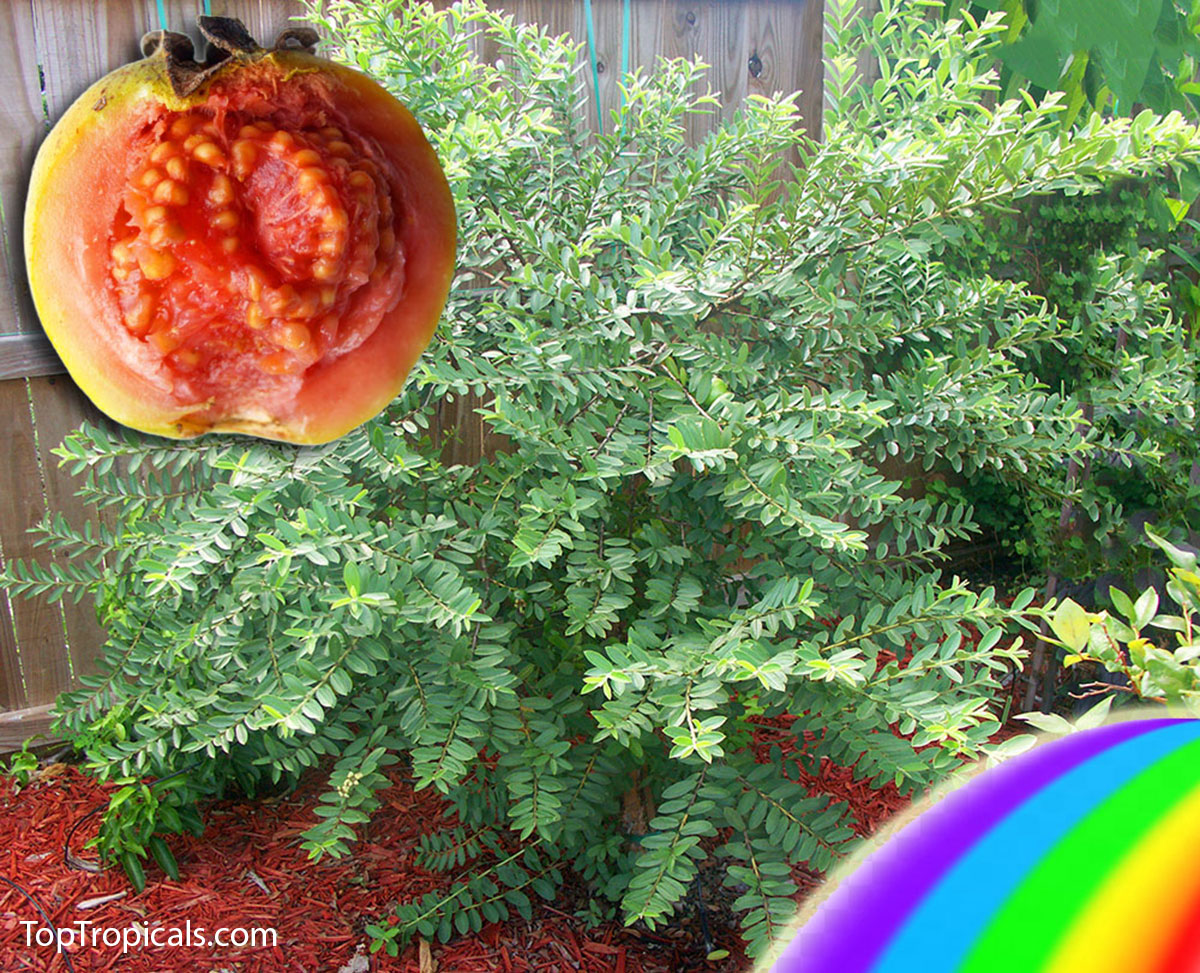
Dwarf Guava Hawaiian Rainbow
- Dwarf Hawaiian Rainbow – Stays under 6 ft, perfect for patios and pots, yet produces full-sized fruit.
Specialty Varieties
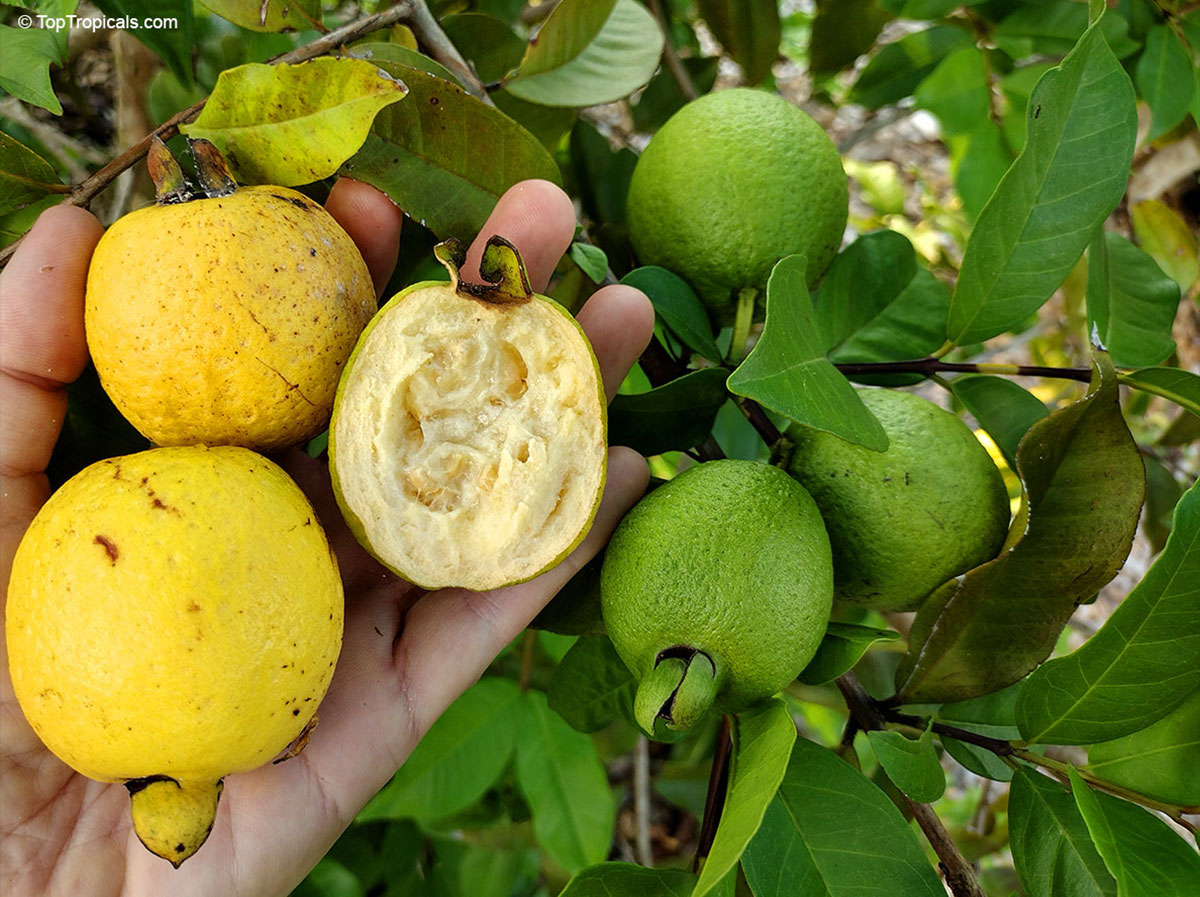
Cas Guava with zero sugar for Costa Rican Agua de Cas drink
- Cas Guava – Bold, tangy, almost zero sugar. The traditional Costa Rican Agua de Cas drink comes from this fruit. Cold hardy.
- Hawaiian Gold, Yellow Strawberry Guava – The sweetest Strawberry Guava, golden fruit, great for fresh eating and drinks.
- Brazilian Araca Pera – Rare hybrid used for Guava Wine in Brazil. Tart, concentrated juice makes excellent wine, sorbet, or jelly. Learn more...
- Pineapple Guava, Guavasteen – Feijoa sellowiana. Strongly perfumed fruit, best enjoyed when the pulp is mixed with sugar – like forest strawberries. Cold-hardy, tolerates freeze, and doubles as a great windbreak. Learn more...
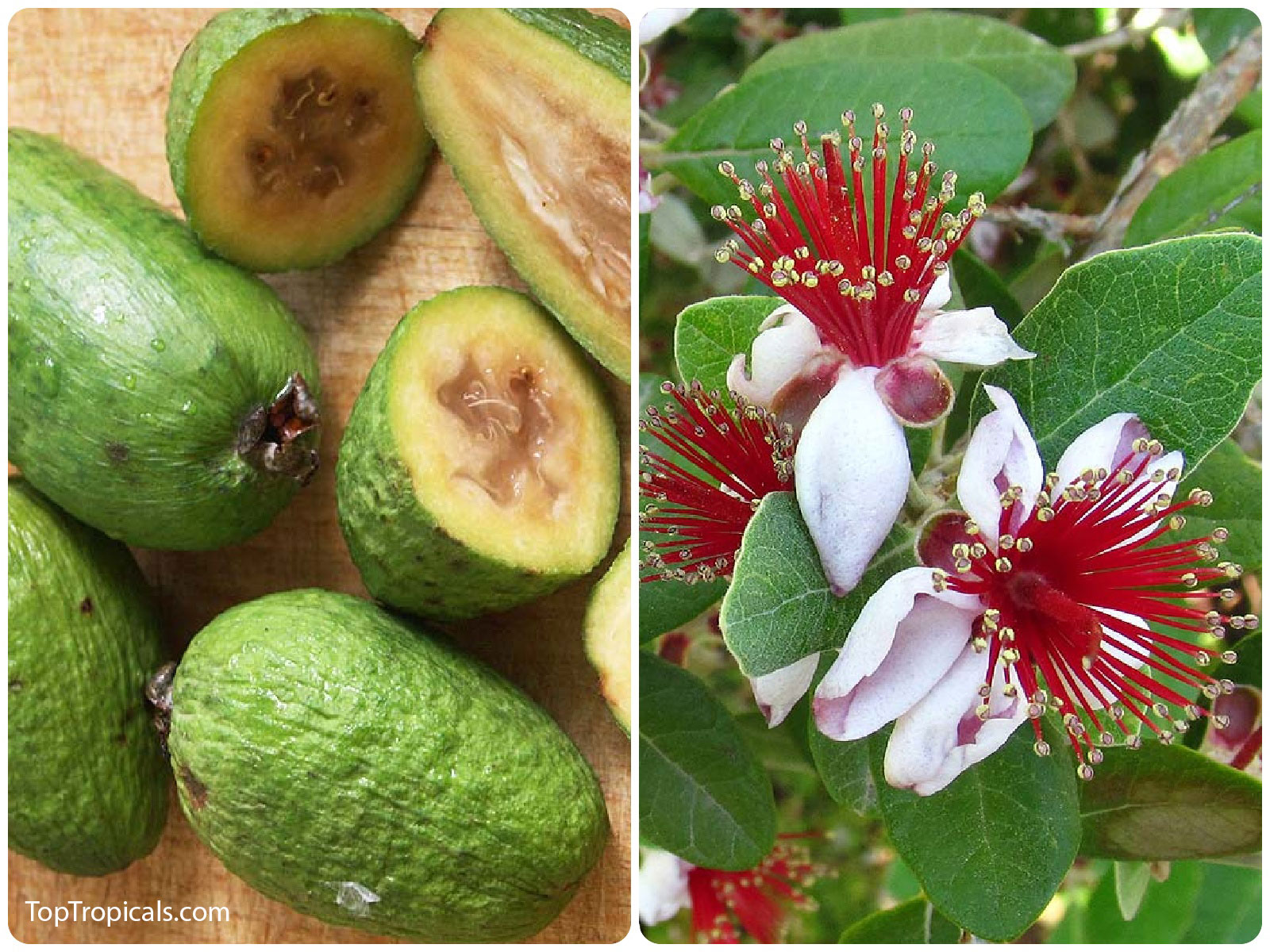
Pineapple Guava, Guavasteen – Feijoa sellowiana
Every one of these thrives here in Florida or in warm climate. Some are better in pots, some as landscape trees, but all produce generously.
🎥 Watch short videos about Guava:
💲 Special Offer – 20% off Guava Fruit Plants!
Get 20% OFF already discounted Guava plants with code
GUAVA2025
Min order $100. Excluding S/H, valid online only, cannot be combined with other offers.
Hurry, offer expires October 02, 2025!
Date: 31 Oct 2018
Lighting for overwintering tropical plants indoors
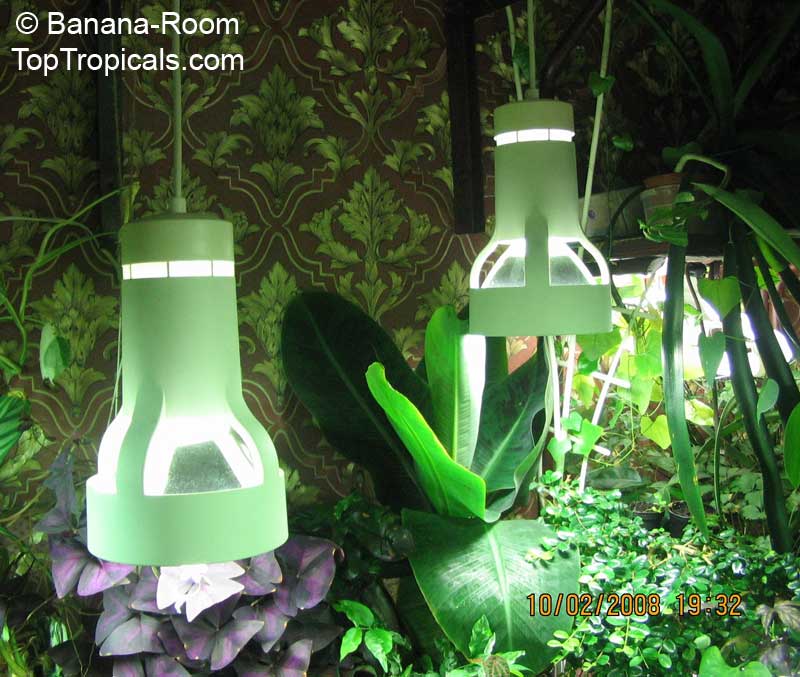
Q: Days are getting shorter and darker... I brought my tropical plants indoors for overwintering (I live in Atlanta, GA). Could you give me some advice on what lamps should I use for additional lighting of my plants?
A: Indoor
plants are very unlucky: they have to grow in"caves,"and everybody knows
that plants don't grow in the caves. The luckiest plants win sunny windowsills,
but even there they dwell rather like in underbrush under tall trees, where
the sun illuminate them only early in the morning or in the evening, and its
light is diffused by foliage.
Usually domestic plants are in desperate lack of illumination not only
in winter, but also in summer. No light - no growth, no flowering. So, plants
need extra light to compensate the lack of illumination in the"room-cave"
conditions.
Before you will start any practical actions to help your plants, you
need first to decide whether you are going to set an additional illumination,
or provide full lamplight. In the case of just additional illumination, rather
inexpensive luminescent lamps will do, and you don't have to think about
their spectrum. Continue reading...
Date: 7 Sep 2018
6 reasons to buy tropical plants in Fall

1) Easy planting. No sweat. Enjoy your gardening fun during cooler weather!
2) Easy shipping. With cooler weather, there are less chances for the mail order plants to get overheated in transit or at your doorstep in case you miss the delivery. But don't wait too long, another few weeks and too much cold will put another restriction for deliveries up North.
3) Easy establishing. Stress-free roots = stress-free plants = happy gardeners. Cooler weather is always better for planting and quick establishing.
4) Easy maintenance. Plant growth rate slows down during cool period, so your garden maintenance will be minimal.
5) Winter bloomers will brighten your days! Look at these winter-flowering plants that create a spectacular show during Fall-Winter in subtropical climates. If you grow them as houseplants, this is your chance to have flowers in Winter!
6) House plants Many tropical species suitable for indoor cultivation are available year round, but when you buy them in Fall - they are in their fullest and best shape after Summer vigorous growth.
One the photo: Barleria cristata Striped Lavender Lace
Date: 24 Jun 2018
Tropical Planting Breaks the Rules. Should I plant in the ground before Winter?
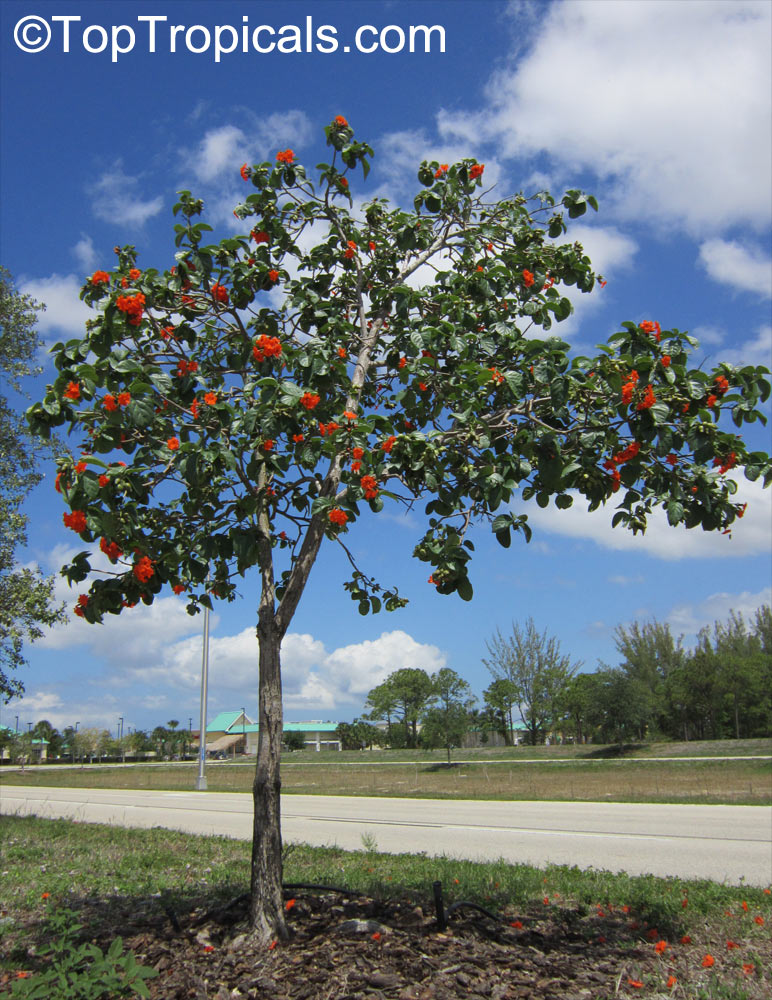
Q: Winter is coming and I still have a few plants I want to plant in the ground. Should I keep them in pots and wait till spring?
A: In subtropical areas, if temperatures don't drop below freezing, you can continue planting in the ground. In fact winter planting has some unique advantages - less heat stress on a plant and root system, mild environment - help the plant to establish better. Besides, no-sweat garden work is much more enjoyable, and you can get done a lot!
To learn more about winter planting, see article Tropical Planting Breaks the Rules by Murray Corman (Garden Of Delights
Date: 24 Jun 2018

Florida winters and gardening
From
Anna Banana, our Garden Center customer advisor.
Cool weather - no sweat. Here in Florida we are
blessed to have warm winters. We just went to the beach
for Christmas! Winter time is not only a good beach time,
but also the best planting time here. Why? I always refer
my customers to Murray Corman's article Tropical Planting Breaks the
Rules. "...Wintertime does not just mean hard work
for tropical gardeners. It is also a time to enjoy the
fruits of our labor. Winter-blooming plants and the
visitors they attract - birds, bats and butterflies - make
the garden as enjoyable in winter as any other time of
year. Tasks performed during the spring and summer up
north have to be done during the fall and winter here.
Why? The answer is elementary: It's too hot! Taking
advantage of the coolest months of the subtropical year
for heavy chores like planting trees has a twofold
benefit: The gardener can make hay while the sun shines
without getting heat stroke and the plants appreciate the
moderate temperatures, enjoying a break from the stress of
93 degrees in the shade..."
Continue reading...
Winter flowering plants - are a blessing for a tropical gardener. See below what's blooming now! See our recommendations for winter flowering and fruiting plants (PDF)