Date: 24 Jun 2018
Our honest advise on Holiday Gift Plants
Q: Any suggestions on gift plants? With Holidays around the corner, I've been thinking of getting a present for my grandma, she lives in FL and is an experienced gardener. I also have a friend that lives in CA, also warm climate, but she doesn't have a green thumb. Any "easy" plants I can try for her?
A:
Live plant is a perfect gift, as we all know. However when
ordering a plant online as a present, for a happy
experience, you should have three things to consider:
1) Gardener's experience. Planting instructions are
included with every order, and usually success is there if
you follow them. But all plants go through shipping stress
(some more, others less) and need time, patience and love
to recover. Also, a plant will need a new home after
shipping: a pot and a good soil mix. It would be wise if
you add potting mix with a gift
order; the plant should be planted in a permanent pot as
soon as possible, but normally can wait a day in a packing
bag until its new owner gets a pot, if it is not ready
yet.
2) How easy the plant is? If buying a plant for a
beginner, chose something easy, as well as showy. Adeniums - Desert Roses, Jasmines, Clerodendrums, Cordylines are always a good
choice. Calatheas, Gingers and
Heliconias are always showy, even when not in bloom.
Spice trees and herbs are
fun, easy to grow and one can enjoy their aroma right away
without waiting on them growing bigger. Miracle Fruit is an awesome
present, it comes with detailed instructions how to grow
the Miracle!
3) How easy the plant ships? Some plants can be
easy in cultivation, but they don't take shipping well.
After being in a dark box for a few days, most plants
usually recover well in experienced hands. When making a
present, you want something showy, not just a stick to
arrive. Besides Adeniums and Jasmines, many fruit trees
usually take shipping without a problem - such as Mango or Sapote trees. You may not
want to start with Avocado, Papaya, Carambola, or Cacao - unless they go to
an experienced grower - these may take some time and skill
to etanblish. Fig trees are super easy in
shipping, but figs may drop leaves in Winter - for this
same reason, you may think twice about deciduous plants
like Sugar Apples, Grapes, Mulberries or Persimmons to be sent as
gifts. On the other hand, if you are sending a deciduous
tree to a gardener who can appreciate the variety, this
may be a good choice - dormant plants take shipping with
less stress!
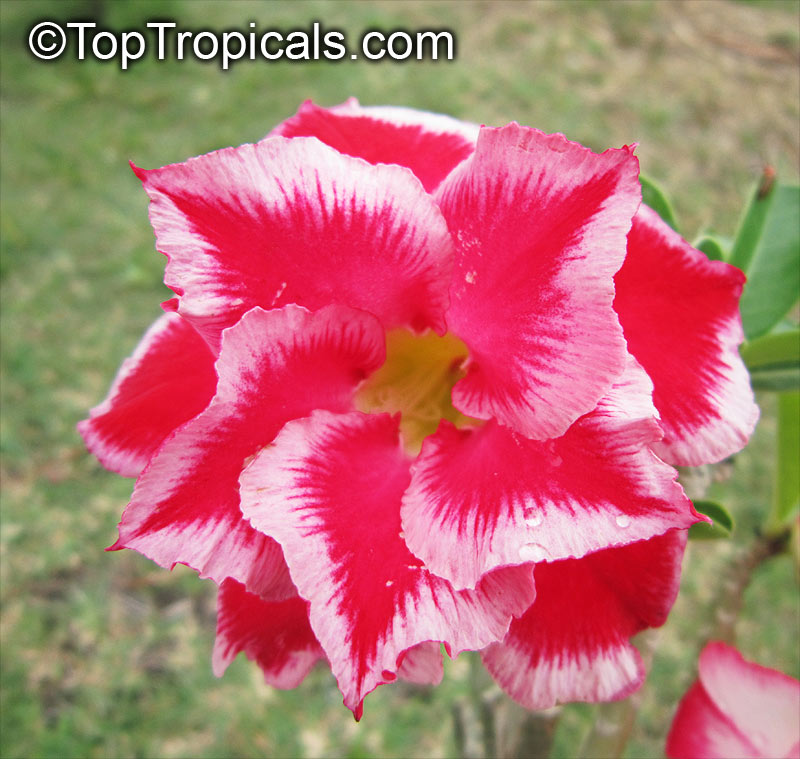
Holiday special: On the picture: Adenium Xmas Santa. A Holiday Special Desert Rose with Christmas-colored flowers - deep-red and white.
Still not sure which plant to choose? You may buy a Top Tropicals Gift Certificate
Date: 5 Sep 2016
Planting instructions for bare-rooted succulent plants
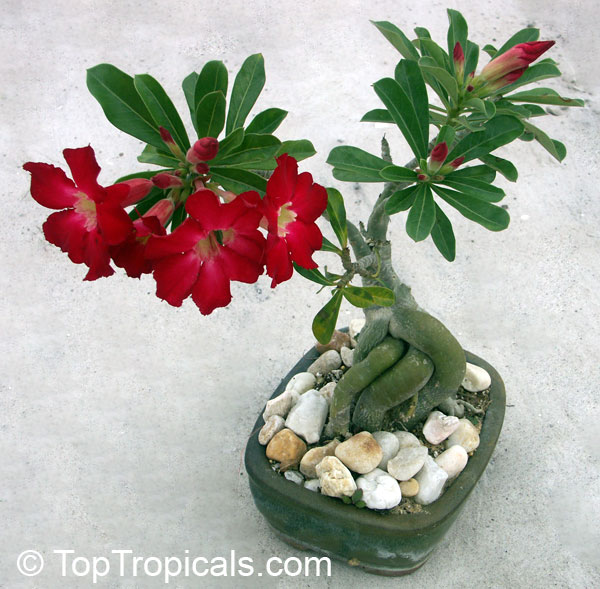
Q: I would like to order a few Adeniums from your selection. You website says "shipped barerooted". What do I need to know about potting these plants before I order?
A: Adeniums do not require much soil; large 4-5"wide caudex plant can be grown in 1 gal pot. After unpacking the plants, position it in a pot, size of root system. Use only well-drained soil with high content of perlite and/or sand. Cactus mix can be used too, although we recommend using our special TopTropicals professional soilless potting mix. Water once and keep in warm (75-80F) place in filtered light. Do not water again until soil dries on surface. Once the plant is established and starts growing new leaves (may take a few weeks), gradually move it into brighter light. Then you can start fertilizing it. You may place shells and lime rocks on top of adenium planting, as these plants benefit from slightly alkaline soils.
See Info sheet on Adenium care.
See full list of Adeniums.
See full list of Plumerias.
See full list of Euphorbias
Date: 24 Oct 2016
Overwintering Adeniums outside of tropics
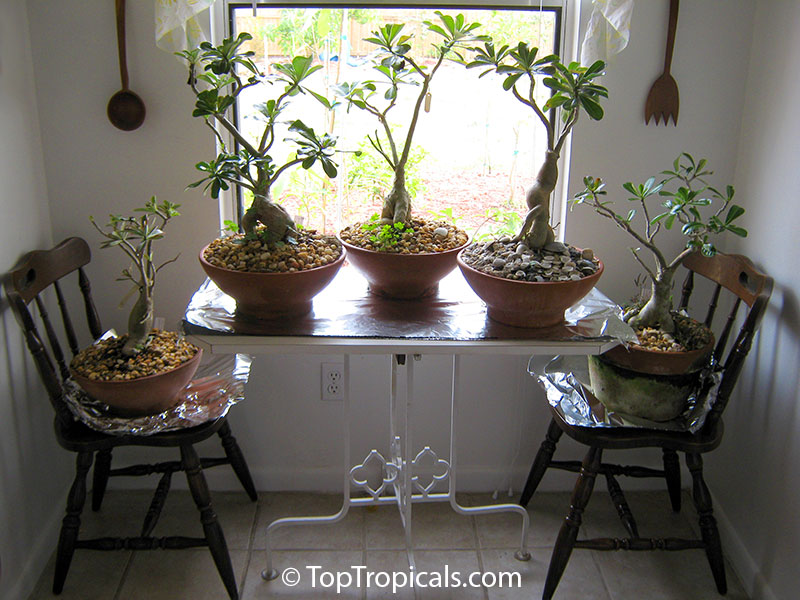
Q: We bought several adenium plants from you. We are moving to the Denver area of Colorado. How can we make sure the plants survive? Should we use a green house?
A: Adeniums are perfect container plants, and house plants. They can be easily grown outside of tropical climate. During winter, Adeniums drop leaves and go into dormancy which makes it easy to keep these plants in a dormant stage in a warm location of your house, or possibly even in well-lit spot of garage (with a window), with temperatures above 50-60F.
Here in South Florida, during time of cold, when chances of freeze are high, we move our own Adenium collection into lanai, with plastic sheet protection around lanai.
In colder climates, Adeniums can be kept indoors as house plants during winter. There are some requirements/tips for you:
- Temperature. Move Adeniums indoors when temperature starts dropping below 45F.
- SUNSHINE. Use SUNSHINE boosters to improve cold resistance of Adeniums, and essure healthy plant throughout winter. SUNSHINE-BC
Date: 4 Jun 2016
Desert rose winter care
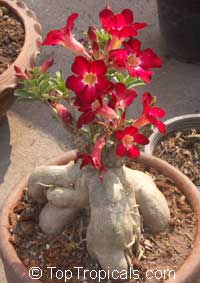
Q: I purchased several packets of desert rose seeds last year. I now have 45 very healthy seedlings some of them in bud. Almost all of my seeds grew but I lost most of them when I rook them in during winter. I did not water them for a month , kept them in their pots and set them by the window. they either dried up and died or rotted and died. I noticed when you send me grafted specimens that you bareroot them. Is this a better way to keep them inside in winter, bareroot? I hate to lose these plants come winter time. Pls advise me. I live in Houston, Tx. where we get temps below 40 degrees and sometime a day or more of freezing temps.
A: Thank you for your question. Rot is pretty common problem with Desert Roses. We monitor our Adeniums closely and have a special set up of watering environment and schedule, in dedicated greenhouses just for them. Nevertheless - every now and then we see a rotten caudex and can't help it to say "oops! over-watered!" These plants are very sensitive to environment changes, especially when it comes to a combination of water and temperature. These are a few tips that should help you to reduce risk of plant loss to a minimum:
1) Use only well drained mix with much higher content of perlite than you would use for most tropical plants. For adeniums, we use mix with 30-40% of perlite in it, while regular mix has 10-15%.
2) Adeniums like alkaline soil, unlike most of tropical plants (hard to say what else likes alkaline... Ficus for sure!). This means, regular mix with high content of peat moss may cause root rot. To increase alkalinity, you may add dolomite. Here in Florida where we have natural supply of shell rock handy, it is easy to add some shell to a potting mix (shell sand, rather than quartz sand). We always add a few large shells on top of a pots with a big specimen. Besides increasing soil pH (making it more alkaline), shells look very decorative.
3) Water very carefully during cooler months. When it is hot (85-100F), excessive water usually won't harm adeniums: it will be partially used by a plant, and partially will evaporate. Especially be careful with water when temperatures drop below 65F - then tropical plants simply stop growing process and go dormant. Once adeniums start losing leaves, this is a sign to reduce watering to once a week to once a month, and in very small quantity (couple tablespoons per pot).
4) We do not bareroot adeniums for winter storage. They are not bulbs. Barerooting of this plant is recommended only during shipping. Adeniums can stay without soil for up to a week without hardly any stress, sometimes even longer.
5) We keep our big collection specimens on a roofed porch during winter, where level of light is very low. Last winter we haven't lost a single plant due to low light. They take shade pretty well considering minimum or no water. However bright light is always better - it creates healthier environment for a plant. We all know about space limitations for our large collections, especially in winter. So if you can afford a bright spot for adenium during winter - the plant will be lucky!
Date: 18 Apr 2020
Fast-fruiting trees
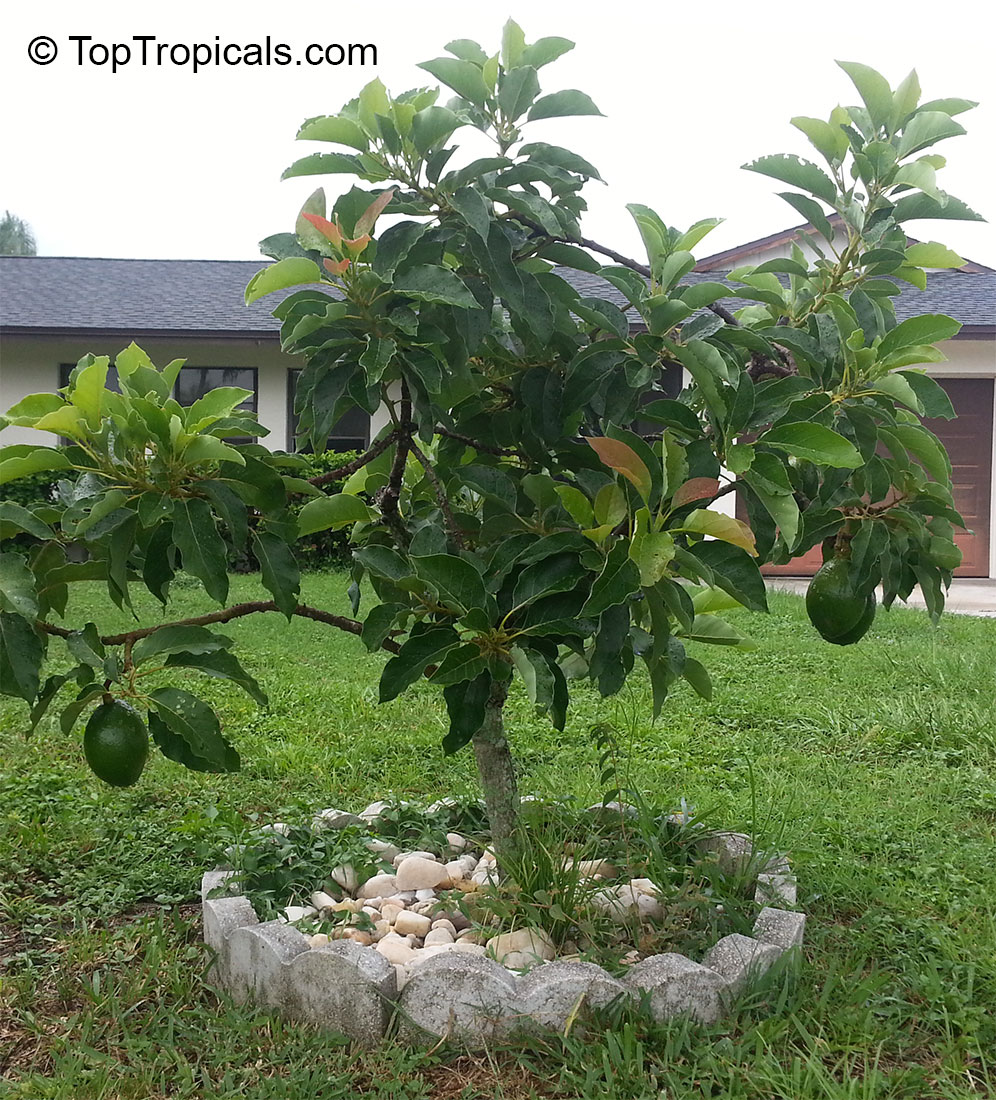
Q: It would be easier for us buyers, if we could search for plants that produce fruit in 2 years or less... I don't have the patience to wait longer than that for fruit. I'm trying to buy for a fairly good sized garden but want some fast growers and fruit produced in 2 yrs. Can you help me out?
A: Fruiting time depends on many factors (growing conditions,
fertilizing, and even specific variety), this is why we can not just put a
simple icon "will fruit within 2 years".
However, most grafted and air-layered fruit trees, including all Mango, Avocado, Loquat, Sapote, Sapodilla, Longan, Peaches and Nectarines - will fruit right away.
If you see in our store "grafted" or "air-layered" in plant description
- these trees will fruit soon. Some of them are already flowering and
fruiting!
Some non-grafted trees will fruit within a couple of years or even sooner (those from cuttings, root division or even seedlings) - such as: Annona, Artocarpus (Jackfruit), Eugenia, Guava, Banana, Dragon fruit, Mulberry, Blackberry/Raspberry. Banana, Mulberry, Dragon fruit, Blackberry-Raspberry - usually fruit within a year. You may refer to our store directory page for fruit specials.
Also, all spice trees like Bay Leaf, Bay Rum, Allspice and many more - will produce spice for you right away, so you don't need to wait at all!