Garden Blog - Top Tropicals

Date: 24 Jun 2018

TopTropicals

Multi-grafted "fruit cocktail" trees

Q: We love your website and products. Do you have mango trees with different types grafted on one? We live in Hawaii and have space for an interesting mango.

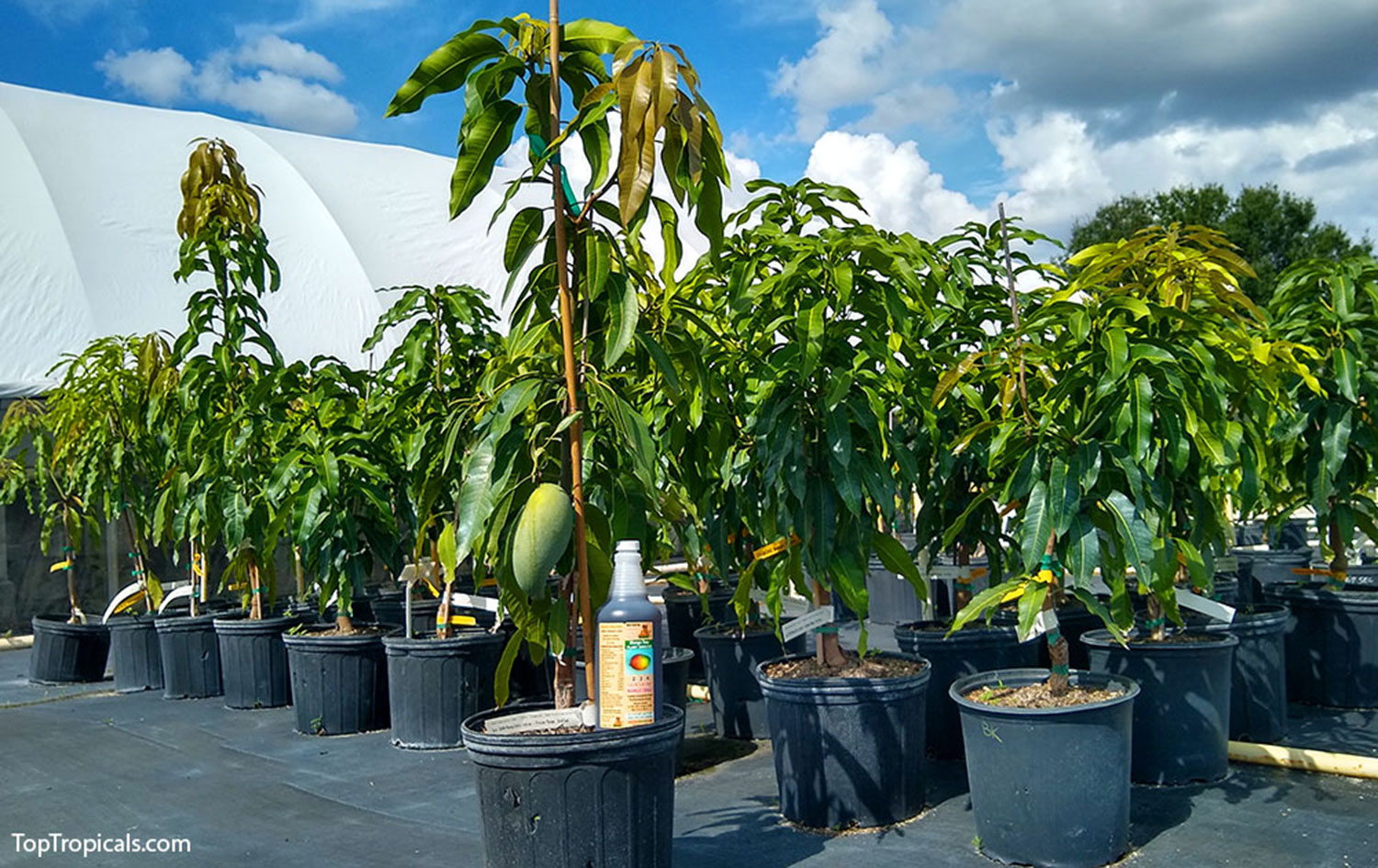
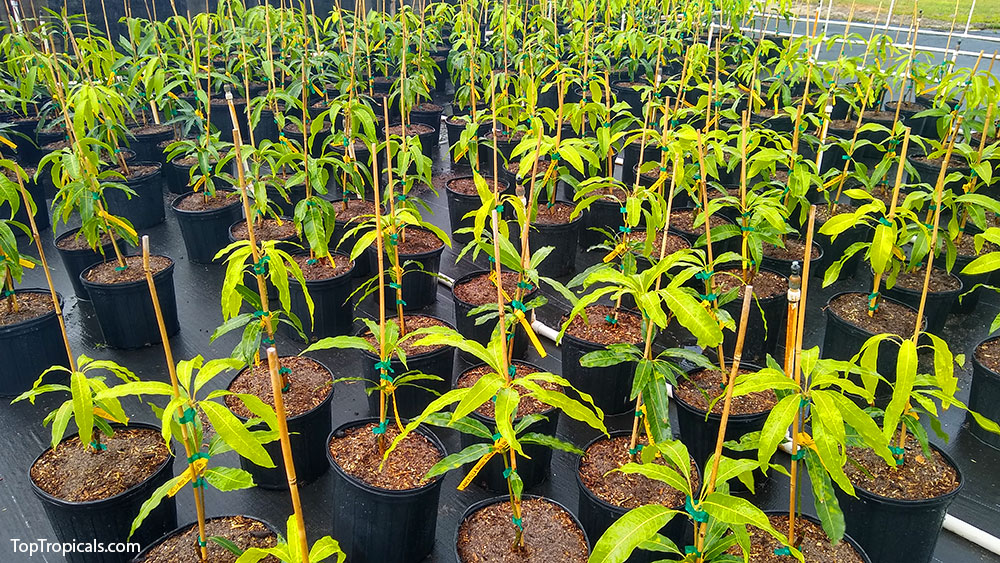
A: Here is the truth about multi-grafted mangos. It is the same issue as with multi-grafted citrus (so-called "fruit cocktail trees"). In most cases, multi-grafted fruit trees look beautiful and healthy for the first couple years if that long. What happens next - the most vigorous variety will take over others and eventually all other grafts will die off or those branches stay retarded without sufficient production. There is a solution though, if you have limited space and still want to have several varieties to enjoy. Plant 2-3-4 desired varieties into 1 hole! Of course production of each tree will reduce due to the crowded situation, but overall crop will be as much as from one big tree. And you will have all kinds of tastes to enjoy! Very often trunks of such trees grow in together, but because of having separate root systems, all trees will remain equally strong and vigorous.

Check out our Mango varieties.

Date: 24 Jun 2018

TopTropicals

Fruitful Fruit and SuperFood...

Q: I have a large fruit garden here in Florida with many mango trees, avocadoes, guavas, and other tropical fruit. Last year hurricane Irma and flooding killed a few avocado trees, but mangos and guavas survived OK, but the sad part is, very few flowers this year and almost no fruit setting. I noticed on your website your Superfood and Sunshine-Honey boosters that supposedly help fruiting? But I am afraid it is too late now as your instructions say first application must be in early Spring? I wish I discovered earlier that my trees wouldn't want to fruit this year...

A: First of all, it is never late to give the food! You may start applications of SUNSHINE products at any time of the year. The best results will be achieved once you treat your plants on regular basis throughout the whole year cycle of metabolism.
Couple weeks ago we started harvesting our 2 guava trees. These two are the same variety (Variegated Honeymoon), planted within 20 ft from each other and growing in the same conditions. The only difference was, one was treated with SUNSHINE-Honey and SUNSHINE-SuperFood, and another one didn't get any treats in order to have a control plant.
Results are very interesting, see the picture. Both trees were heavily covered with fruit. However the one with treatments developed fruit that is much larger, much sweeter and juicier, and the most interestingly - with less seeds, almost no seeds!
To answer your question: yes, you can start feeding your fruit trees right now. It is still a Springtime. Many mango varieties have late season; even early varieties may delay their fruiting if flowering triggered by miscro-elements. Guavas have very long season and most varieties can have multiple crops throughout Summer-Fall.
Here is a simple and affordable feeding schedule to help your fruit garden recover from last year hurricane stress, and establish reliable production:
1) SUNSHINE-E - for boosting metabolism - once a month
2) SUNSHINE-Honey - for bringing sugars to the heart of the tree and boosting fruit sweetness and quality - now and in 2 weeks
3) SUNSHINE-SuperFood - for overall health, recovering from hurricane and fixing root damage from flood - now and every 2 weeks throughout warm season.
4) You may apply regular balanced fertilizer NPK as usual (we apply once a month, a handful per in-ground tree)
It's that simple. Just try and watch your trees produce again!

Check out all SUNSHINE boosters... We offer FREE shipping on them, so you can make your plants happy!

Date: 10 Feb 2026

Cold-hardy avocado varieties - what freezing they really survive

Avocado leaves covered with ice

Avocado leaves covered with ice

❄️ Cold-hardy avocado varieties - what freezing they really survive


Avocado trees are usually associated with warm, frost-free climates, so every winter freeze raises the same question - which avocados actually survive cold weather? After recent freeze events, interest spikes as gardeners look for real answers, not guesses. The truth is, avocado cold hardiness is not just about the lowest temperature. Duration, moisture, wind, and tree maturity matter just as much - sometimes more.
  • What cold hardiness really means for avocados


    Cold hardiness does not mean an avocado tree escapes winter untouched. It simply means the tree survives a freeze without being killed.
    Leaf burn, branch dieback, or temporary growth setbacks can still occur. Survival is the key distinction.
  • Cold tolerance is influenced by:


· Tree age and establishment. Young avocado trees are always more vulnerable. Once established, tolerance improves significantly.
  • · Length of the freeze
  • · Wind exposure
  • · Daytime sun and heat retention
  • · Drainage and soil moisture
  • · Overall tree health going into winter


Where cold-hardy avocados come from


The most cold-hardy avocados are of Mexican origin. These types evolved in cooler, higher-elevation regions and differ genetically from West Indian and Guatemalan avocados.
These varieties are widely grown around San Antonio, Texas (USDA Zone 8b), where trees have been damaged but not killed by temperatures near 10F. As a general rule, established Mexican-type avocados can tolerate short freezes (about 3-6 hours) down to roughly 15F with little or no permanent damage. Temperature estimates apply to established trees under favorable conditions. The best results come from combining the right genetics with smart planting, good drainage, and thoughtful winter care.
  • Why cold tolerance varies so much


    Cold ratings are never absolute. The same variety can survive very different temperatures depending on conditions such as tree maturity, freeze duration, wind, microclimate, and humidity. For example, an avocado may tolerate 10-15F in dry Texas winters but only 15-20F in wetter East Coast conditions.
  • Planting and protection tips for colder climates


· Plant in the warmest available location, ideally near a south or southeast wall
  • · Protect trees from cold wind
  • · Ensure excellent drainage; standing water during cold weather is deadly
  • · Use raised mounds in poorly drained areas
During freezes, small trees should be covered, mulched heavily, and protected with frost cloth. In severe cold, gentle heat under covers may help. Mature trees often need little to no protection.

Avocado varieties known for the best freeze survival


These varieties are among the more reliable choices for colder regions once established, reported tolerance near 15F:
  • · Brazos Belle - medium to large purple-black fruit, season October-November
  • · Fantastic - green fruit with paper-thin skin, creamy texture, the most cold tolerant
  • · Joey - selected in Uvalde, Texas; purple-black fruit, excellent flavor, heavy producer, season September-October
  • · Lila - medium green fruit, season September-October (not to be confused with Lula)
  • · Poncho - medium to large green fruit

  • Cold-hardy avocados make growing this fruit possible beyond the tropics, but expectations must stay realistic. Survival does not mean zero damage, and protection still matters during extreme weather.


🛒 Explore cold hardy Avocado varieties

📖 Our Book: Avocado Variety Guide, Snack or Guacamole?

📚 Learn more:


🎥 Avocados survived 25F hard freeze 3 nights of Florida Record Freeze

#Food_Forest #Avocado #Discover #How_to

🟢 Join 👉 TopTropicals

Date: 2 Mar 2026

😼😺 The Story Behind Smokey and Sunshine 🐾

Smokey  and  Sunshine  in  office  presentation  about  Cherry  of  the  Rio 


Grande  freeze  survival,  with  Sunshine  pointing  at  polar  bear  and  penguin 


marketing  poster,  coffee  and  donuts  on  table,  tropical  plants  on  shelves  in 


background.
Sunshine: You know, February 27 was International Polar Bear Day. I just learned about it and got a brilliant marketing idea. Cherry of the Rio Grande survived 25F. With wind. Real wind. That means we go north. Let them taste this magic. I even have a donut recipe with the fruit. It’s a bomb, Smokey. We expand. Trust me. Finally you can afford that new watering timer.

Smokey: Not so fast, genius. Twenty five degrees is not the North Pole. And polar bears and penguins do not share zip codes.

Sunshine: You always pour cold water on my brilliance. Fine. Where do we start?

Smokey: Well, first you go talk to Tatiana. She graduated from the Geography Department. She can explain climate zones. Cherry of the Rio Grande can grow in North Florida, Texas, and similar climates. Let’s master that before we conquer Arctic.

Sunshine: So… Phase One: Geography?

Smokey: Exactly.

Some stories are easier to tell with a little humor. Smokey and Sunshine were never just mascots. They represent the two forces behind every decision we make here: bold ideas and careful reality. One dreams big. The other checks the climate zone map. Together, they remind us that growing plants is part science, part optimism, and always personal. If you have ever wondered why they keep appearing in our newsletters, you can read their full story on the Smokey and Sunshine page. They have been with us longer than most people realize.

🐾 Learn the Story of Smoky and Sunshine

Freeze Testing of Grumichama and Cherry of Rio Grande 🍒❄️

Grumichama  tree  (Eugenia  brasiliensis)  showing  white  flowers  and  ripe 


red  fruits  in  tropical  garden 


conditions

Eugenia brasiliensis - Grumichama tree flowering and fruiting

When temperatures dropped to 25F, with wind chill near 14F, winter made it clear which tropical trees were truly resilient. Some plants burned back. Tender growth collapsed. But our established Eugenia cherries stood steady. Leaves held. Branches stayed flexible. The canopy remained intact.

Cherry of the Rio Grande (Eugenia aggregata) and Grumichama (Eugenia brasiliensis) are among the most cold-hardy tropical cherries for Southern gardens. Both are native to Brazil and thrive in USDA Zones 9b–11, and even protected 9a sites.

Cherry of the Rio Grande produces dark ruby fruit that ripens almost black, with a rich, full cherry flavor. It flowers early in spring and can fruit well into summer. Mature trees can tolerate brief drops into the low 20s once established. Trees typically grow 8 to 15 feet tall, remain naturally compact, and often begin fruiting within 2 to 3 years.

Grumichama is an evergreen tree known for both beauty and productivity. In spring, it covers itself in white starburst flowers that attract pollinators. Within about four weeks, glossy purple-black fruit develops. Established trees tolerate temperatures into the upper 20s and grow well in the ground or in 5–10 gallon containers. Mature trees can produce hundreds of fruits per season.

Across the Eugenia group, strengths are consistent: early bearing, compact growth, heat tolerance, light freeze endurance, and low pest pressure. They are adaptable to different soils, need modest water once established, and perform in full sun or partial shade. Birds enjoy the fruit, but there is usually plenty to share.

Nutritionally, Eugenia cherries provide Vitamin C, fiber, antioxidants, and notable Vitamin A that supports eye health. They offer sweetness with real dietary value.

In the kitchen, they are simple and rewarding. Cherry of the Rio Grande makes an easy compote. Simmer the fruit with a small amount of water until soft, mash lightly, and spoon over pancakes or warm bread. Grumichama turns into a deep red jam with sugar and lime, or can be blended into a bright spoon drizzle over vanilla ice cream.

Even when not fruiting, both trees remain attractive year-round with glossy evergreen foliage and clean structure. They fit well into edible landscapes, small yards, and container gardens.

Winter will return. The difference lies in planting fruit trees that can handle heat, humidity, and the occasional cold snap. If you are building a food forest for lasting harvests, cold-hardy tropical cherries like Cherry of the Rio Grande and Grumichama deserve a place in your garden.

Ripe  Grumichama  fruits  (Eugenia  brasiliensis)  hanging  on  a  branch  with 


glossy 


leaves

Ripe Grumichama (Eugenia brasiliensis) fruits developing on the tree, turning deep red to nearly black when fully mature.

Cherry  of  the  Rio  Grande  (Eugenia  aggregata  cv.  Calycina)  fruits 


ripening  from  green  to  dark  purple  on  the 


branch

Eugenia aggregata (cv. Calycina), Cherry of the Rio Grande

🛒 Plant hardy Eugenia cherries

Date: 25 Feb 2024

Avocado pollinating and crops

Avocado  fruit

Photo above: Avocado Joey - very buttery fruit, cold hardy variety.

Q: I bought an anise leaf-scented avocado from you, and it is finally quite large and doing great. I live in California, the coldest temperatures we seem to get in some winters is around 25 to 28F, and it never lasts long. The tree might get a bit of frost nipping on the new growth, but it has done very well. It has flowered profusely for the last two years but hasn't set any fruit. What variety you might recommend to help with pollinating?

A: We are glad your avocado is doing great. Anise is one of our favorite varieties, with the wonderful smell of leaves and tasty fruit.

Cold hardiness and flower quality

It is true that cold damage may affect avocado production, especially in setting fruit. To improve the tree's cold hardiness, make sure to provide balanced plant food, especially during the season of active growth. For our avocado trees, we use Sunshine C-Cibus year-round.

If you prefer to use dry (granulated, slow-release) fertilizers, make sure they contain micronutrients, or apply Sunshine Superfood microelement complex once a month.

To improve flower quality (including the ability to set fruit), we recommend a special micronutrient supplement called Sunshine Honey. It contains Boron and Molybdenum - elements that are responsible for setting fruit and for developing fruit (meaning not dropping at the early stage of development).

Cross-pollination and crop

In general, every avocado tree is self-fertile, meaning it can produce some fruit with its own pollen and doesn't necessarily require a second tree for pollination. So even if you don't do anything, sooner or later your tree will set fruit. However, it is also true that the amount of fruit and crop reliability depends on pollination factors. One type of avocado classification is by flowering and pollination behavior - type A or B.

When both types of trees are grown in proximity to each other, their overlapping flowering patterns significantly enhance the chances of cross-pollination. This can lead to improved fruit set and higher yield, making it especially important for commercial production and, to a lesser extent, for home growers.

Therefore, it's advisable to plant different varieties of avocado in your garden - the more, the merrier! The greater the diversity of avocado trees with overlapping flowering periods, the better your crop is likely to be. If you're growing an avocado tree without other avocados nearby, it becomes helpful to have more than one tree with different flowering patterns (A and B) to increase yield in your garden.

Anise Avocado is type B. So to increase your crop, you may consider planting type A variety from the list: Bernecker, Black Prince, Catalina, Choquette, Day, Donnie, Fantastic, Florida Hass, Lila, Loretta, Lula, Mexicola, Mexicola Grande, Red Russell, Reed, Russell, Simmonds, Ulala , Waldin .

To learn more about avocado types, fruit characteristics, cold hardiness and much more, refer to our Avocado Variety Guide - a page with very convenient interactive chart allowing you to quickly sort types of avocado by requirements of your choice (just click on column header to sort data). You may also buy a Book or download a PDF.

PAvocado  Variety  Guide  Book

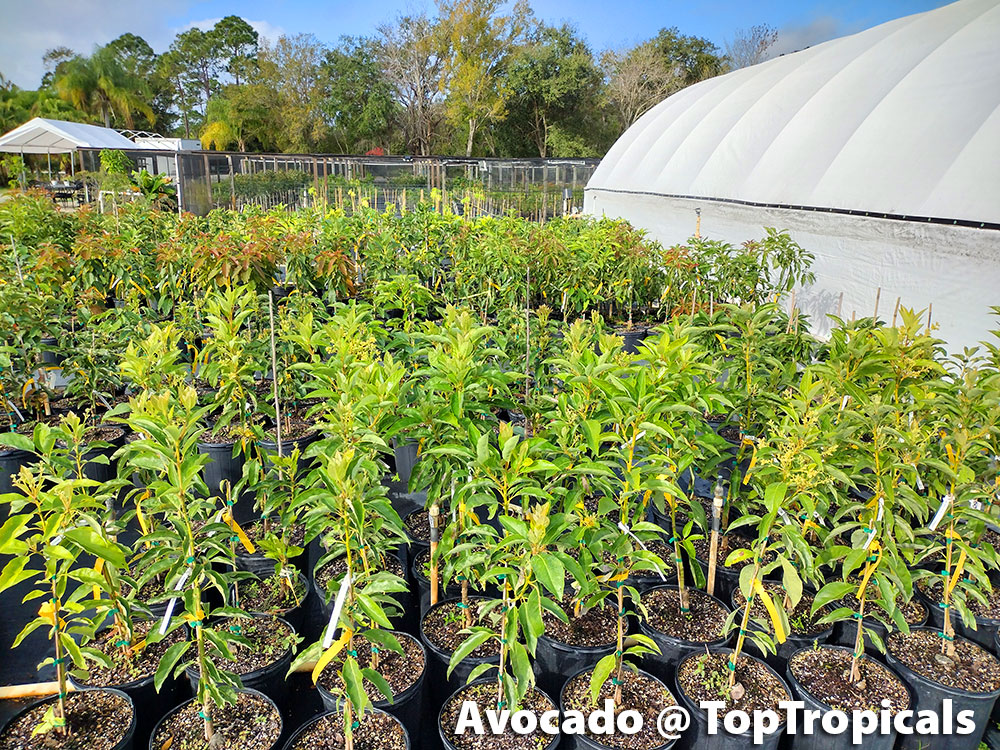
Avocado  trees  in  pots

Photo above: 15 gal Avocado trees for local pick up. Delivery and installation available!