This Tropical Tree Has Leaves Bigger Than Your Head
This Tropical Tree Has Leaves Bigger Than Your Head
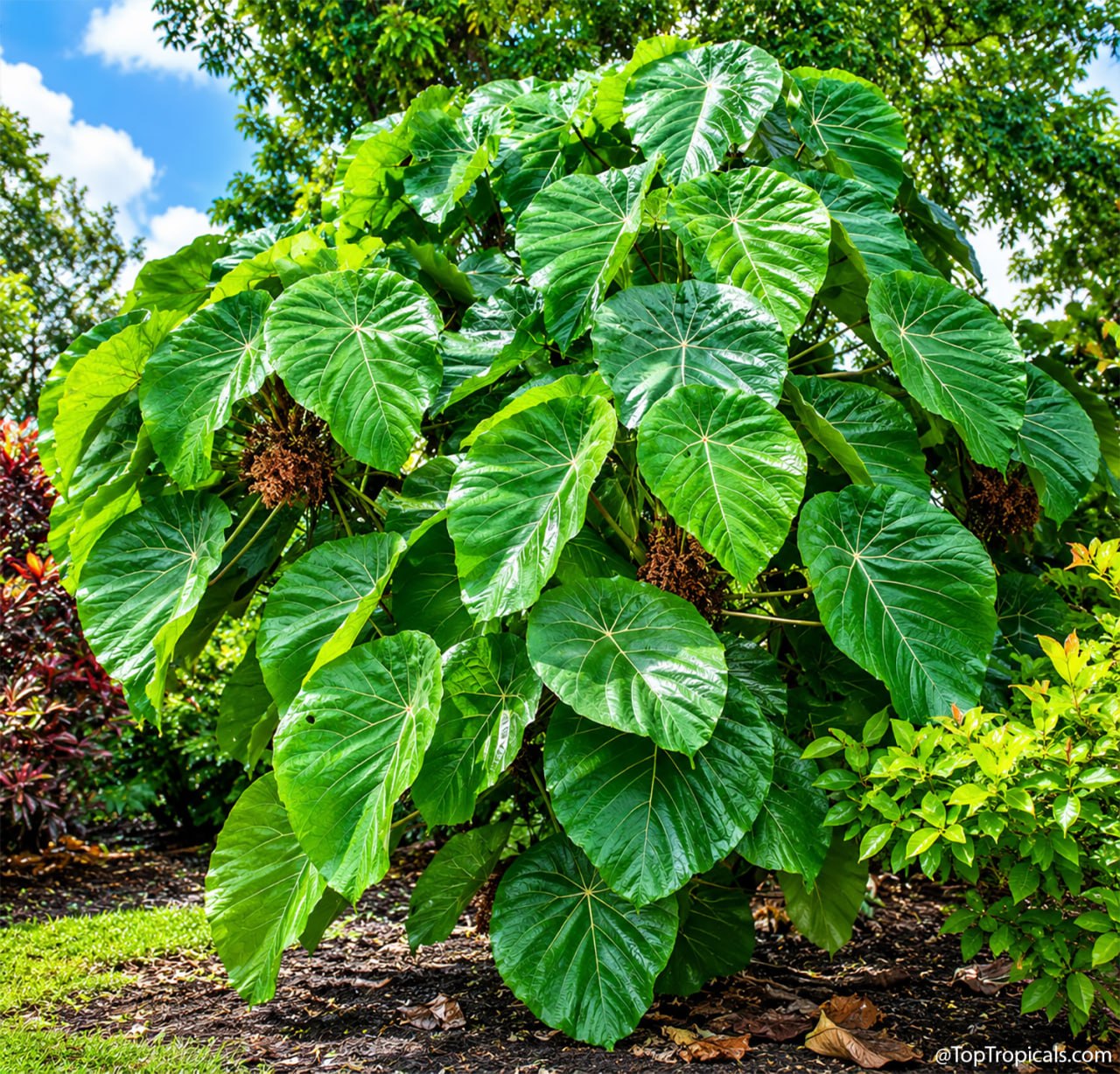
One look at Macaranga grandifolia and most gardeners have the same reaction: "What is THAT?" Nicknamed the Elephant Ear Tree, this rare tropical beauty produces enormous, glossy leaves that can easily grow larger than a person's head. The effect is dramatic, bold, and impossible to ignore.
☂️ A Living Jungle Umbrella
Native to tropical regions of Southeast Asia and grown widely in Hawaii, Macaranga forms a small upright tree with huge rounded leaves stacked along its stems like giant green shields.
Unlike many tropical plants that rely on colorful flowers, Macaranga's foliage is the entire show. The leathery leaves create an unmistakable rainforest look that instantly transforms a garden into something exotic.
☂️ Why Gardeners Fall in Love With It
· Massive elephant-ear-shaped leaves · Fast enough to make an impact quickly · Rare and hard to find · Surprisingly easy to grow · Few serious pest or disease problems · Excellent for creating a lush tropical effect
Even a young plant becomes a conversation piece.
☂️ Bigger Than Most Elephant Ears
Despite its nickname, the leaves often resemble real elephant ears more than many of the plants commonly sold as "elephant ears."
The tree grows upright and relatively narrow, making it useful where space is limited but a bold tropical statement is desired. Mature specimens create a striking column of giant foliage that looks almost prehistoric.
☂️ Easy Tropical Luxury
Macaranga thrives in warm, frost-free climates and appreciates rich, moist soil. It can grow in nearly full sun with adequate water, but the largest and most attractive leaves usually develop with some protection from intense afternoon sun.
It also performs well in large containers, making it an excellent choice for patios and tropical plant collectors.
☂️ The Plant Nobody Knows About
Perhaps the biggest mystery about Macaranga is why it isn't grown more often. It combines spectacular foliage, easy care, and a truly unique appearance, yet remains surprisingly uncommon in Florida gardens and nurseries.
If your goal is to create instant tropical drama, few plants deliver more impact than the Elephant Ear Tree. One glance at those gigantic leaves and you'll understand why collectors become obsessed with it.
🌿 The Vanilla Plant That Outgrew Its
100-Gallon Container.
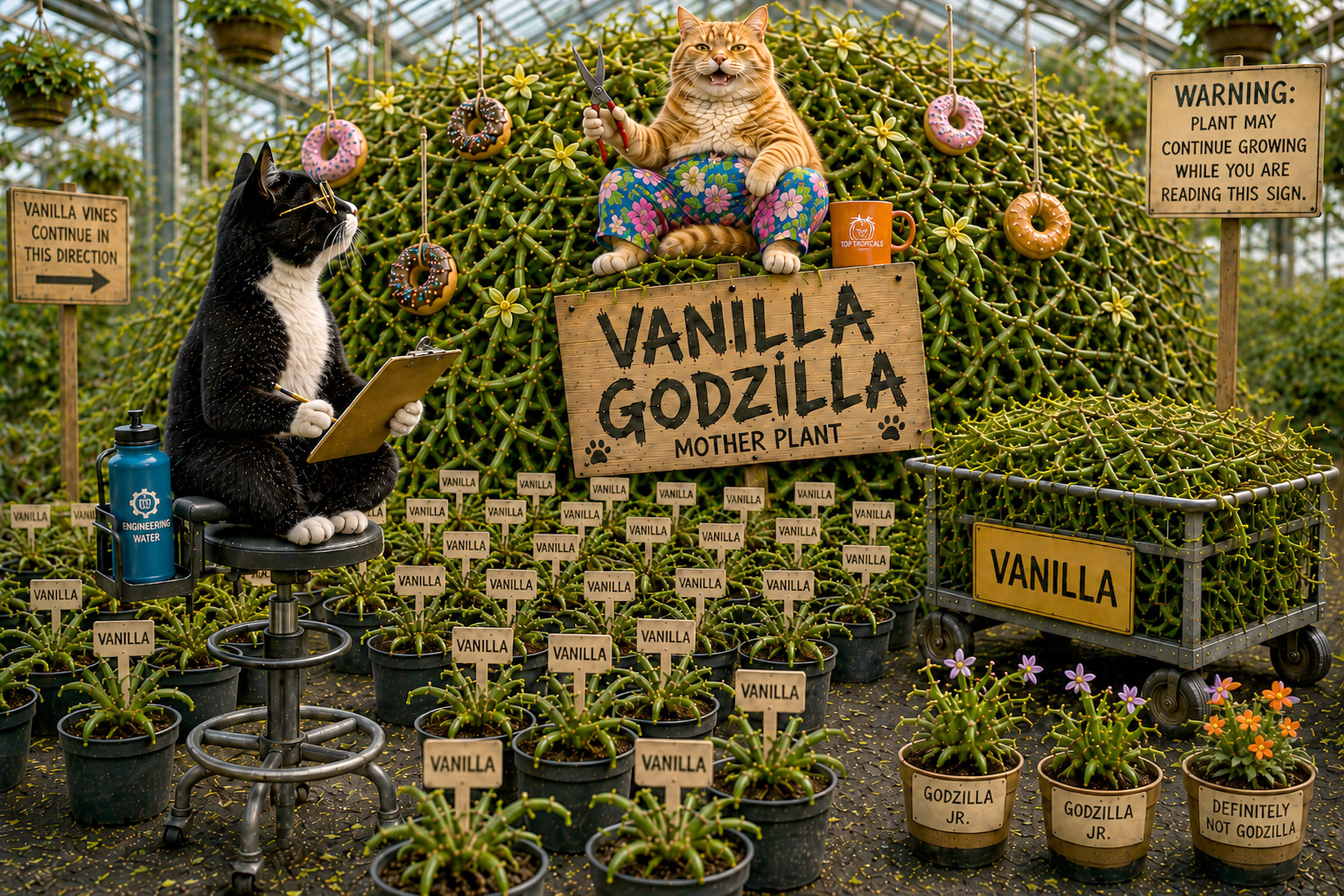
Smokey: Is that really the entire mother plant? Sunshine: Most of it. Smokey: What do you mean "most of it"? And why are there
donuts hanging from the plant? Sunshine: We still haven't found the other end. The donuts
attract pollinators. Smokey: Donuts do not attract pollinators. Sunshine: Then explain why I keep visiting the plant. Smokey: You work here. Sunshine: That's what the plant wants you to think. It's
called "Intelligent Design" for a reason.
The plant Sunshine is perched on is not a hedge. It is not a wall. It is a
single specimen of Vanilla
dilloniana, Dillon's Vanilla, and it has a name:
Intelligent Design. Unlike the familiar Vanilla planifolia
— the commercial vanilla of ice cream and extract — dilloniana
produces no leaves. The plant is essentially a green vine, photosynthesizing
entirely through its stems. It is an unusual and striking grower, and in
good
conditions it can develop into an impressive, multi-branched specimen.
It is classified as rare, and is considered vulnerable or endangered across
portions of its native range.
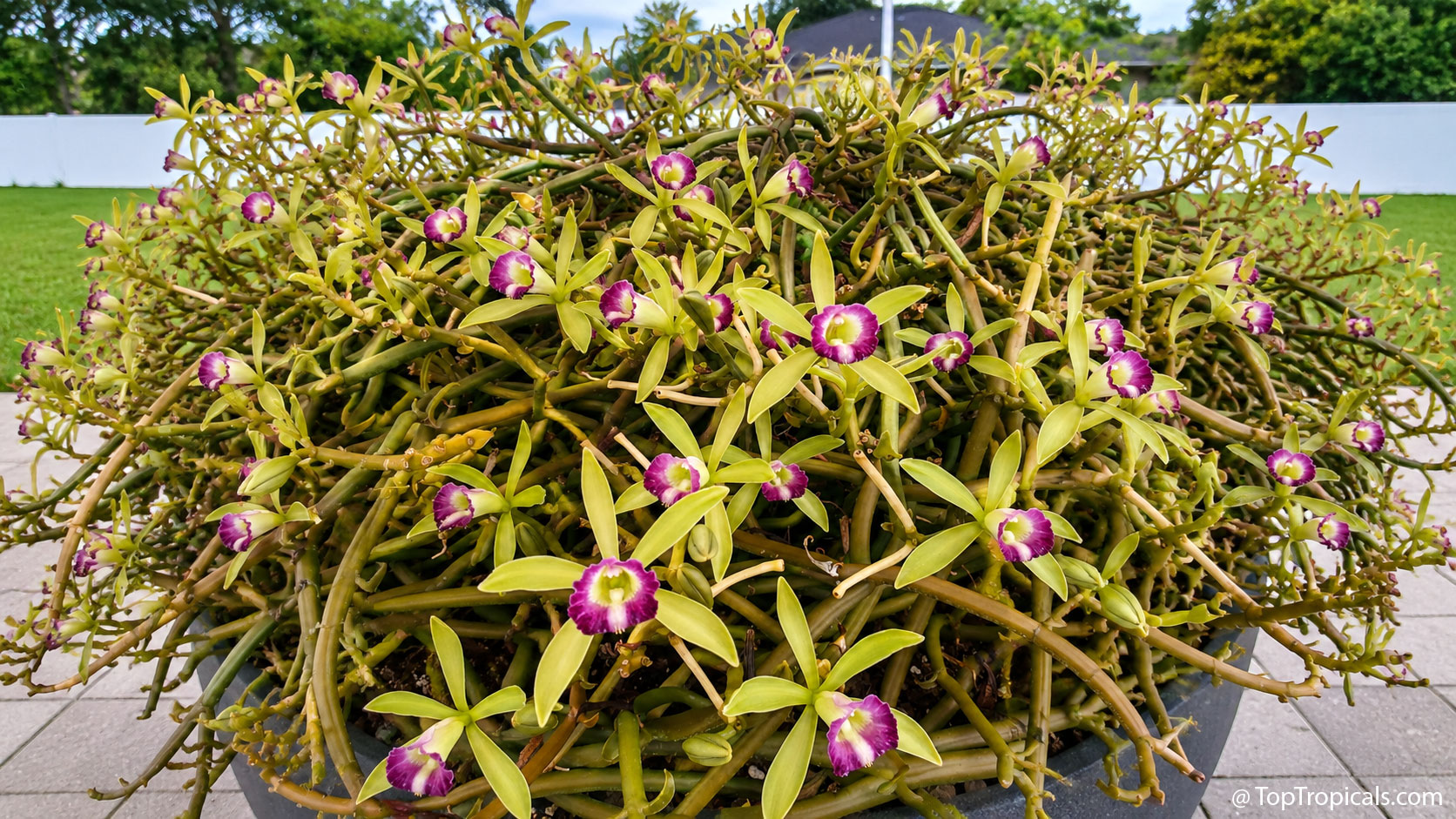
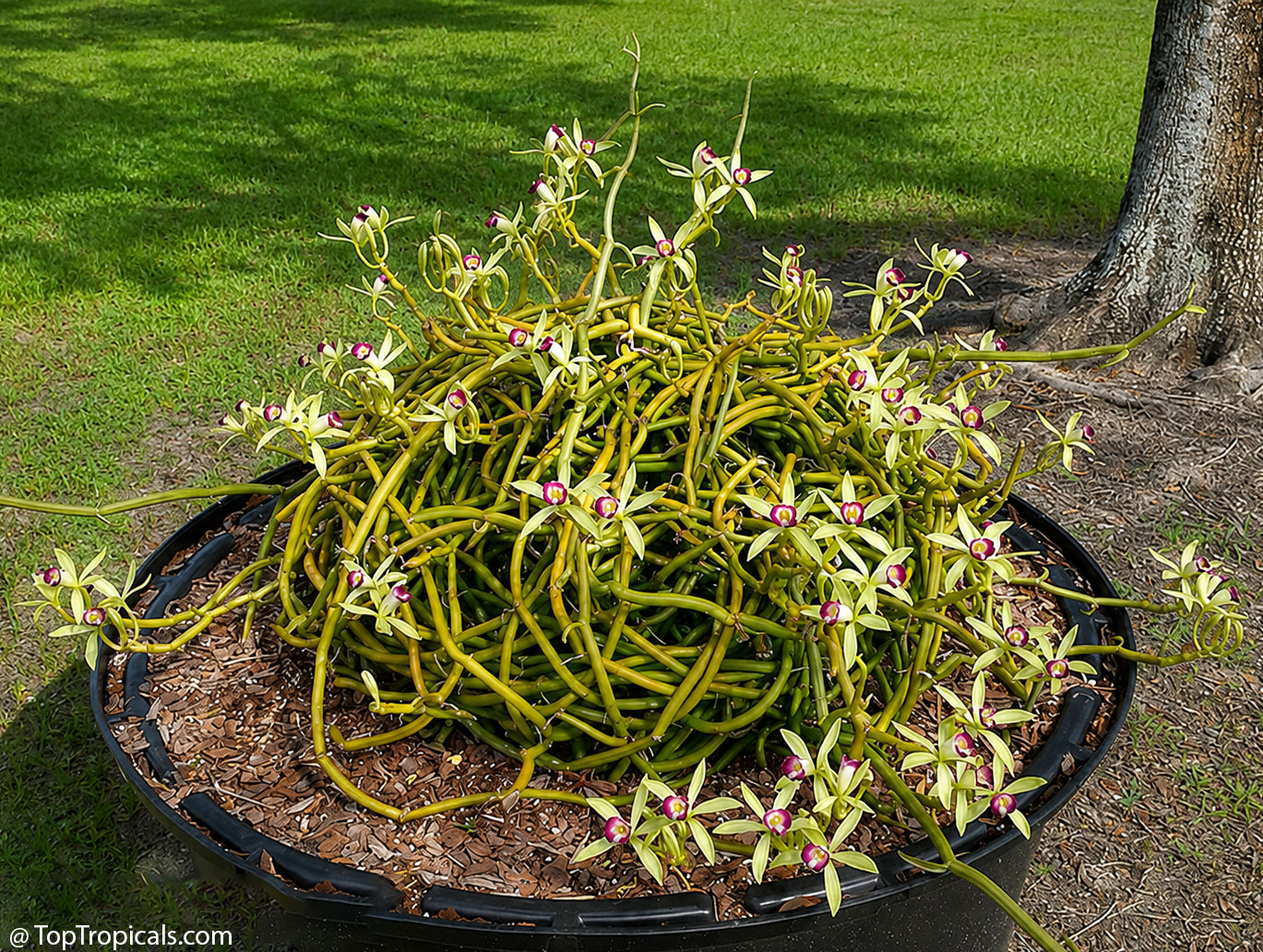
Vanilla dilloniana in full bloom before its next major
upgrade.
Intelligent Design was grown and lovingly tended for years by Robert
Riefer, a grower who is both a good friend of Top Tropicals and one of the
most
dedicated orchid collectors we know. The mother plant of this specimen
traces
its origins back to 1927 - nearly a century of continuous cultivation.
In 2011, the American Orchid Society recognized this remarkable plant with
a Certificate of Horticultural Merit (CHM), one of the society's formal
awards for plants of exceptional quality.
By 2017, the plant had already become well known in the orchid and tropical
plant community, appearing in a video that documented Robert moving it into
a 100-gallon container. That video became something of a legend among
collectors.
🎥 Video: the biggest Vanilla Orchid in the world moving to 100
gal pot
Then the plant kept growing.
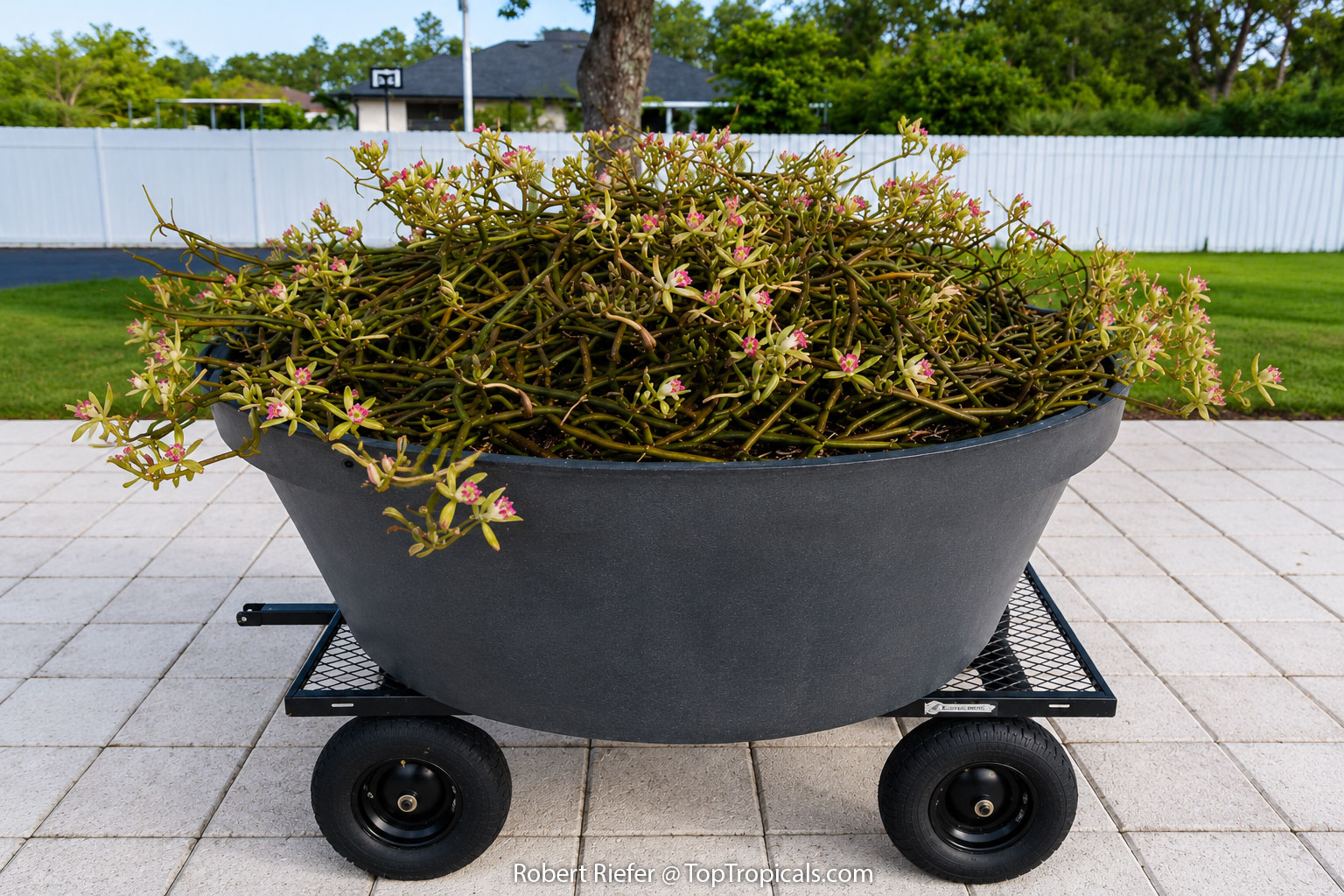
It outgrew the 100-gallon container. Robert eventually moved it into a
250-gallon pool on wheels - because when a plant refuses to stop, you give
it
room.
The move to a custom 250-gallon container allowed continued growth and
flowering.
The plant is currently on display at Edison Ford Winter Estates museum and botanical garden in Ft Myers,
Florida, during the month of June, where recent photographs show it larger
and
more floriferous than ever. It is, as best anyone can determine, the largest
known cultivated specimen of Vanilla dilloniana in the world. If you
are local or visiting Florida, don't miss the chance to see this
world-famous
orchid in person. It is expected to continue blooming through June.
And here's the remarkable part: the Vanilla
dilloniana plants available from Top Tropicals are
propagated directly from this exact plant - Intelligent Design itself.
👉 A Piece of Living History - Direct from the Source
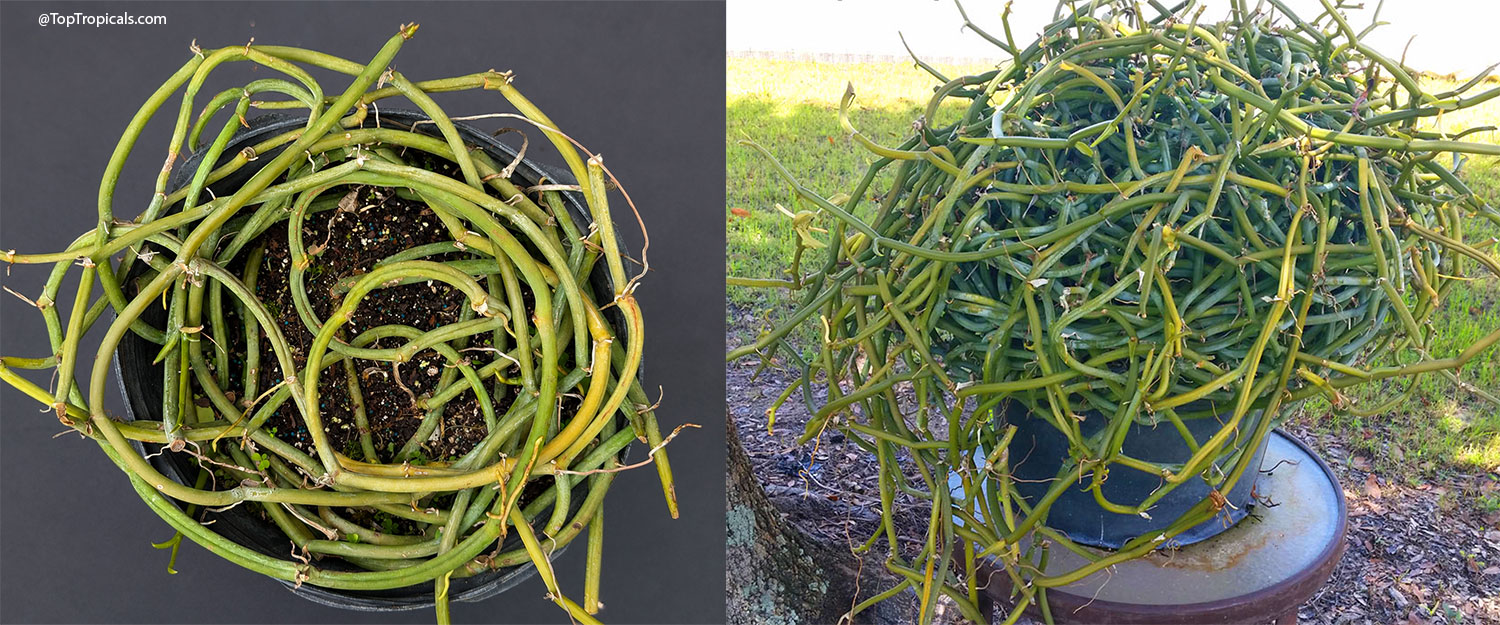
Every legendary Vanilla dilloniana starts somewhere. On the
left are
young Vanilla dilloniana plants. On the right is a more mature specimen in a
7-gallon pot beginning the characteristic wrap-around growth habit that
eventually transforms this unusual orchid into a sprawling, sculptural
giant.
Vanilla dilloniana is a rare species, considered vulnerable to
endangered across parts of its native Caribbean range. Plants with
documented
provenance - especially provenance tied to a named, award-winning,
century-old
specimen - are genuinely uncommon in cultivation.
What you would be growing is a direct descendant of the famous
Intelligent Design mother plant, carrying the same historic lineage
recognized by
the American Orchid Society.
For collectors, opportunities to acquire plants with this kind of
documented history are exceptionally rare.
This is how the legendary Vanilla
dilloniana mother plant, Intelligent Design, started its
world-famous "Godzilla" journey in 50-gallon container. It's in full bloom,
and
its leafless stems form a living sculpture, dotted with dozens of striking
orchid flowers that make this rare vanilla one of the most unusual
cultivated
orchids in the world.
Light:
Bright filtered light is ideal. Morning sun is generally well tolerated.
Avoid intense afternoon sun, especially during summer.
Ideal: Dappled shade, eastern exposure, greenhouse conditions, or
30-50% shade cloth.
Cold Protection:
In USDA Zones below 10, grow in a container and move indoors or to a
protected greenhouse before temperatures drop below 40F.
Humidity:
Prefers moderate to high humidity with good air circulation. Avoid cold,
stagnant, damp conditions.
Watering:
Water thoroughly, then allow the potting mix to partially dry before
watering again. Do not keep constantly wet.
In cool weather and winter, keep the soil on the drier side. Overwatering when temperatures are low is the most common
mistake.
Potting Mix:
Plant in a very fast-draining medium.
Recommended:Top Tropicals Abundance Mix.
The open structure allows excellent root aeration while retaining enough
moisture for healthy growth.
Support & Growth Habit: Unlike most vanilla orchids that
are trained vertically on posts or trellises, Vanilla dilloniana can be
grown
using the "Intelligent Design" method. Start with a sturdy support while the
plant is young, then allow the stems to wrap around themselves in wide
circles. As new growth emerges, continue guiding the vines around the
container.
Over time, the plant forms an impressive sculptural mound of intertwined
stems.
Container Growing:
Excellent for wide containers. The larger the mass of stems becomes, the
more impressive the display and the greater the flowering potential. Unlike
traditional vanilla culture, extensive vertical space is not required.
Repotting:
Move to progressively larger containers as needed. Rather than growing
upward indefinitely, the plant can continue expanding into a larger circular
mass, making it well suited for long-term container culture.
Fertilizing:
Feed lightly but consistently during active growth.
Recommended:Sunshine Booster™ Orchidasm.
Apply according to label directions every 2-4 weeks during warm growing
weather. Reduce feeding during cool periods or when growth slows.
Read our Guide to Sunshine Boosters™
Growth Rate:
Moderate to fast under warm conditions. Established plants can branch
freely and become surprisingly large over time.
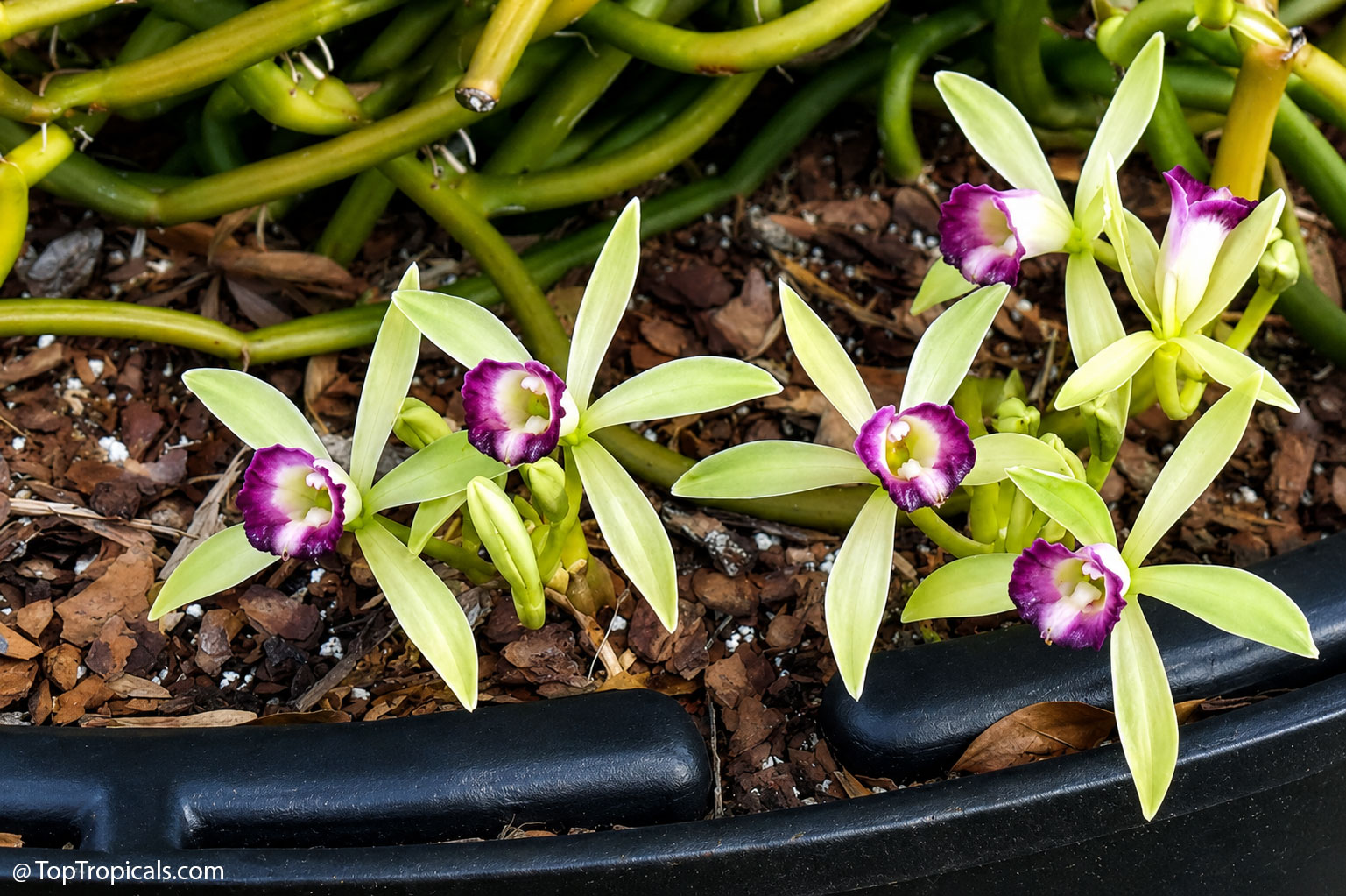
The Flowers:
Pale green to yellow-green flowers with a deeply fluted reddish-purple lip
and yellow crest. Mature plants in bloom are highly prized by orchid
collectors.
The making of Intelligent Design. As Vanilla
dilloniana grows, its long leafless stems naturally wrap
around themselves, creating a dense sculptural mass of living vines. Even in
a
7-gallon pot, the plant is already beginning to develop the unusual growth
pattern that would eventually make its famous mother plant one of the
largest
cultivated specimens of its species.
The famous mother plant was named Intelligent Design by its
grower, Robert Riefer. After decades of growth, countless blooms, container
upgrades, and an apparent determination to occupy every available square
foot of
greenhouse space, the name seemed increasingly appropriate.
Unlike commercial vanilla, Vanilla dilloniana is grown primarily as a
collector's orchid. Its leafless, sculptural stems create a living tangle of
green
architecture unlike almost any other cultivated vanilla species.
Ready to grow this remarkable Vanilla dilloniana? Start your own chapter
in the story of Intelligent Design.
The unusual flowers of Vanilla
dilloniana emerge directly from its leafless stems,
creating a stunning contrast of pale green petals and vibrant purple
throats.
Smokey: We cannot guarantee that your plant will
eventually require a 250-gallon pool on wheels. Sunshine: We also cannot rule it out. Smokey: Officially, we cannot confirm that the plant
possesses intelligence. Sunshine: The evidence is mounting. Smokey: What evidence? Sunshine: It convinced humans to build larger containers,
move it into a 250-gallon pool on wheels, transport it to museum
exhibitions,
and place its agents in collections across the country. Smokey: That's called excellent horticulture. Sunshine: That's exactly what the Intelligent Design
plant wants you to think.