Garden Blog - Top Tropicals

Date: 16 Feb 2026

Yes, you can grow a mango tree on your patio - here is how to do it right
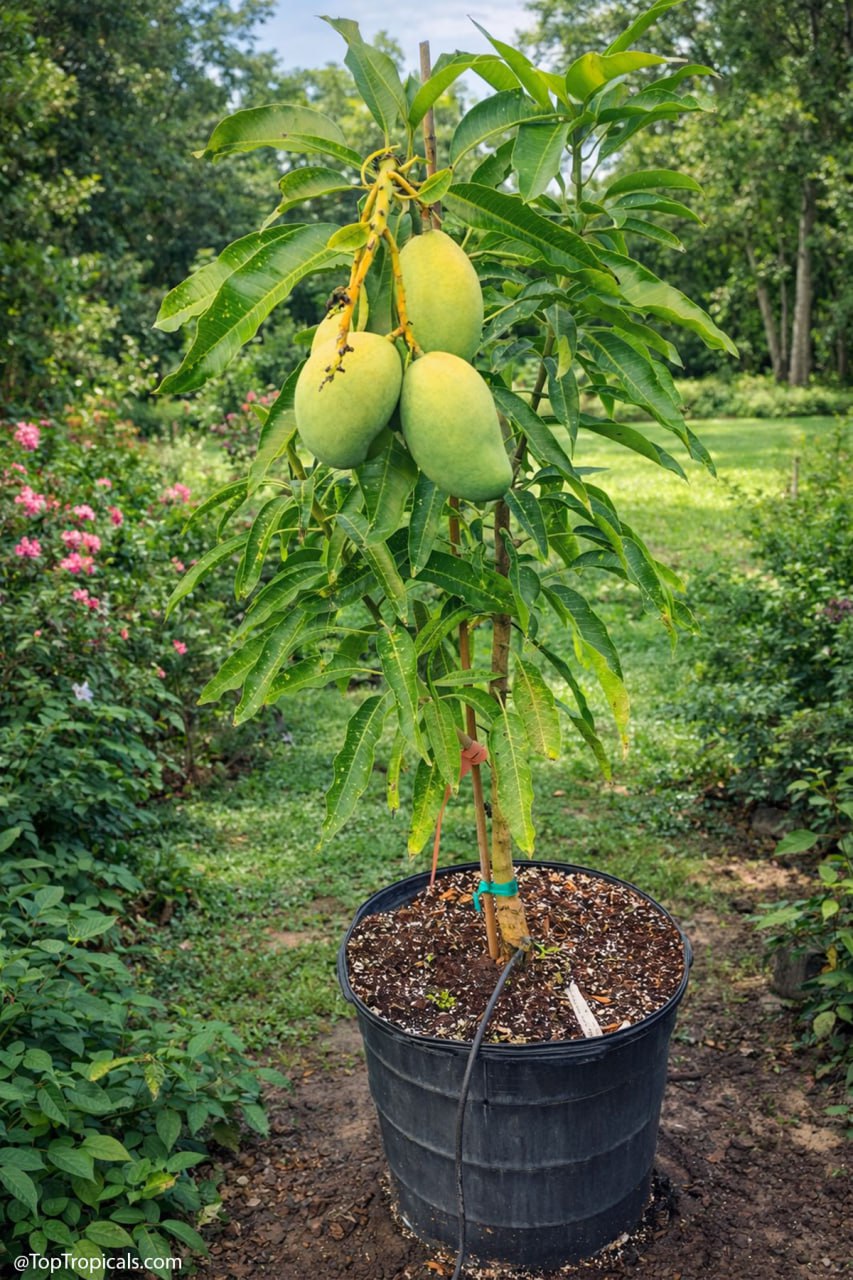
Mango fruiting in container

Mango fruiting in container

🥭 Yes, you can grow a container mango tree on your patio - here is how to do it right


Think you need a backyard orchard to grow mangoes? You don't. Mango trees grow very well in containers. Compact varieties, often called condo mangoes, stay naturally smaller and are well suited for pots, patios, and small yards. We grow and ship mango trees nationwide and have seen which varieties perform best in containers.

Growing mangoes in pots is also practical in cooler climates. The tree can be moved to protection during cold weather while still producing real fruit. Here is how to do it right.

🥭 Pick the right condo mango tree variety


Choose condo or semi-dwarf mango varieties that stay smaller and respond well to pruning. These mango trees usually stay 6 to 10 feet tall in containers with light pruning. Fruit size is full-size, just fewer than on large trees.

Good mango choices for pots include:
  • · Cogshall - compact and productive
  • · Pickering - naturally small and reliable
  • · Carrie - manageable size, great flavor
  • · Ice Cream - slow growing, narrow canopy
  • · Julie - classic Caribbean type
  • · more condo varieties...


🥭 Choose the right pot


Start small. Young mango trees do best in a 5- to 7-gallon pot. Oversized containers too early often cause overwatering and root issues.

Increase size gradually:
First pot: 5-7 gallons
Next size: 10-15 gallons
Mature container: 20-25 gallons

The pot must drain well. Mango roots dislike wet soil. Add holes if needed. Plastic, ceramic, and fabric pots all work.
  • 🥭 Use fast-draining soil


    Mango trees need air around their roots.
    Use a loose, fast-draining mix, such as Abundance Professional Soilless Mix. Improve drainage with perlite, pine bark, or coarse sand. Avoid heavy or water-holding soils. Drainage matters more than fancy ingredients.
  • 🥭 Water carefully


    Mango trees prefer a wet-dry cycle.
    Water deeply, then allow the top few inches of soil to dry before watering again. Always check with your finger first.
    In warm weather, water once or twice a week. In winter, much less. Overwatering is the most common container mistake.
  • 🥭 Give plenty of sun


    Mango trees love sun and heat.
    Place the pot in full sun with at least 8 hours daily. More sun improves growth and flowering.
    If overwintered indoors, use the brightest window possible. Grow lights help, but outdoor sun is best when weather allows.
  • 🥭 Fertilize lightly but consistently


    Potted mango trees benefit from regular feeding during active growth.
    Use a balanced mango or fruit tree fertilizer such as Sunshine Mango Tango (safe to use with every watering, year-around). Controlled-release fertilizer Green Magic (every 6 months) work well too. Avoid excess feeding, which promotes leaves over flowers.
    If leaves pale, check watering first, then nutrition.
  • 🥭 Prune to stay compact


    Pruning is essential for mangoes in pots.
    Light tipping and trimming control size, encourage branching, and increase flowering points. Keep the canopy open and balanced. Watch how simple tipping works in real life: .
    Avoid heavy pruning before flowering. Most pruning is best right after harvest.
  • 🥭 Protect from cold


    Mango trees are tropical and cold-sensitive.
    When temperatures drop below 40F, move the pot to protection or indoors. Young trees are especially vulnerable.
    During winter, reduce watering and stop fertilizing. Growth slows and the tree rests.
    When warm weather returns, reintroduce the tree to sun gradually to prevent leaf burn.
  • 🥭 Final thoughts


    Growing a mango tree in a pot is practical and rewarding. With the right variety, good drainage, full sun, and careful watering, a potted mango can thrive and fruit for years, even in small spaces. Ready to start? Choose a compact mango variety.


🛒 Discover Condo Mango

📚 Learn more:
#Food_Forest #How_to #Discover #Mango

Plant Facts

Mangifera indica
Mango
USDA Zone: 9-11
Large tree taller than 20 ftSmall tree 10-20 ftFull sunModerate waterYellow, orange flowersPink flowersEdible plantSeaside, salt tolerant plant
🟢 Join 👉 TopTropicals

Date: 5 Feb 2026

How to get three colors on the same plant: Yesterday, Today, and Tomorrow

Brunfelsia grandiflora - Yesterday, Today, and Tomorrow

🌸 How to get three colors on the same plant: Yesterday, Today, and Tomorrow

  • 💜 Brunfelsia is one of those plants that makes people stop mid-sentence.
  • It blooms in shade, smells incredible at night, and then does something unexpected - the flowers change color over just three days.
  • 💜 Purple. Lavender. White.
  • All at the same time, on one plant.
  • 💜 It is easy to grow, loves warm weather and part shade, and turns any garden path or patio into an instant conversation starter. Once it starts blooming, it just keeps going.
  • 💜 These are the most interesting varieties known as Yesterday-Today-Tomorrow for their magical color transformation from purple to lavender to white over three days: B. grandiflora, B. paucifolia, B. australis.


🛒 Explore Brunfelsias - the ultmate shade flowers

📚 Learn more:

Plant Facts

Brunfelsia grandiflora
Yesterday -Today -Tomorrow, Kiss-me-quick, Royal Purple Brunfelsia
USDA Zone: 9-11
Large shrub 5-10 ft tallSmall plant 2-5 ftSemi-shadeShadeRegular waterBlue, lavender, purple flowersWhite, off-white flowersPink flowersToxic or PoisonousPlant attracts butterflies, hummingbirdsFragrant plantSubtropical plant. Mature plant cold hardy at least to 30s F for a short time
  • Brunfelsias in Plant Encyclopedia
  • When Brunfelsia is in bloom? Yesterday, Today and Tomorrow!
  • The number one flower for shady spots
  • Yesterday-Today-Tomorrow, Brunfelsia from Brazil

  • #Perfume_Plants #Hedges_with_benefits #Container_Garden #Shade_Garden

    🟢 Join 👉 TopTropicals

    Date: 21 Aug 2025

    🍒 Tropical Cherries – Eugenias

    Two  cats  enjoy  Grumichama  fruit  indoors  —  a  tuxedo  cat  picks  berries  from  a  potted  tree  while  an  orange  fluffy  cat  smiles,  sitting  by  tea  cups  and  plates  of 
 fruit.

    Tropical Tea Time with Grumichama

    Eugenias have earned a spot in many Southern gardens because they’re easy, dependable, and surprisingly versatile. These small trees and shrubs grow well in the ground or in containers, and they don’t waste time before setting fruit.

    15% Off Eugenias – Limited Time

    Use code EUGENIA15 at checkout.
    Excluding S/H. Offer expires 08/28/2025

    👍 Popular Choices:

    What Makes Eugenia Cherries Stand Out

    • Start producing fruit in just a couple of years
    • Compact size — easy to keep 6–12 ft tall, smaller in pots
    • Low-care — tolerant of most soils and resistant to common pests
    • Strong in hot weather, yet can handle a light frost down to the mid-20s °F
    • Plenty of fruit for people and birds alike

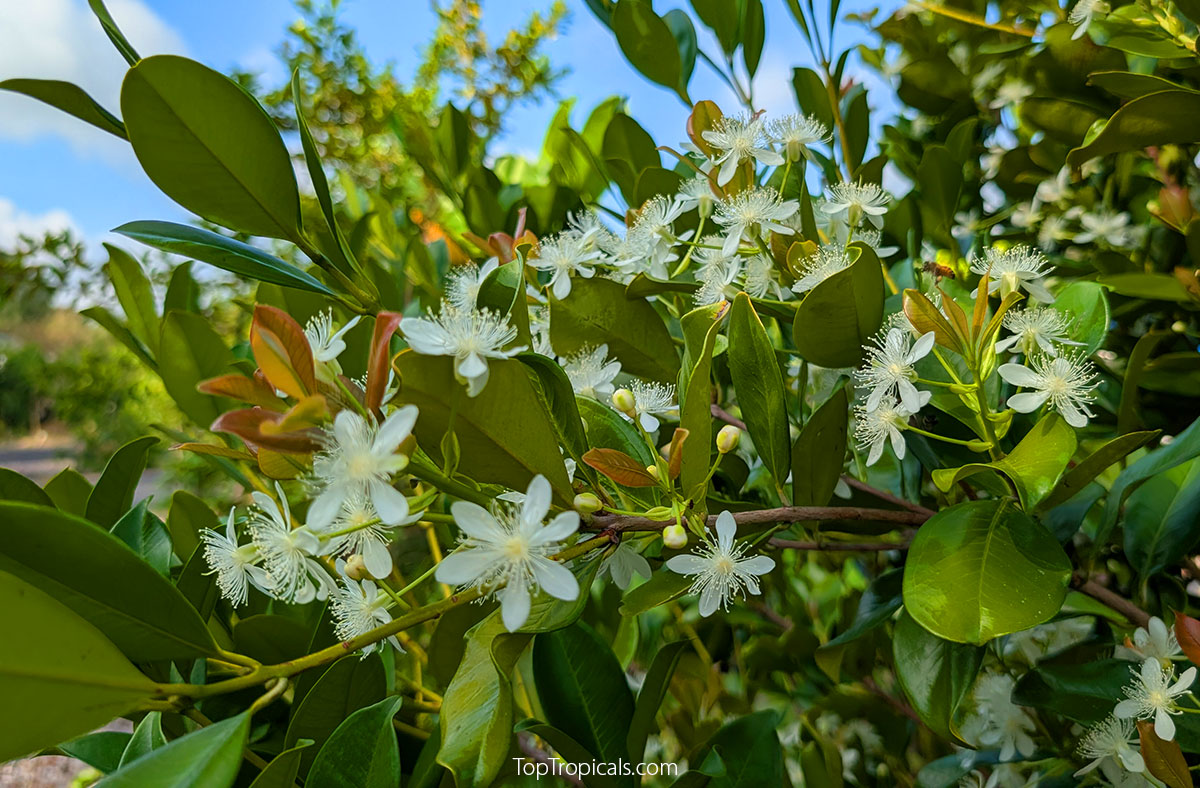
    Close-up  of  Grumichama  tree  branches  with  clusters  of  small  white  flowers  among  glossy  green 
 leaves. Grumichama Tree in Bloom – Eugenia brasiliensis

    Growing & Care

    Outdoors

    • Best in USDA Zones 9–11
    • Sun or partial shade; more sun usually means sweeter fruit
    • Plant in well-drained soil; avoid heavy, wet spots
    • Withstands summer heat and humidity, and can take a light freeze

    Container / Indoor

    • Do well in 5–10 gallon pots on patios or balconies
    • Need bright light indoors — a sunny window or grow lights
    • Can flower and fruit in containers if kept warm and well lit
    • In cooler zones, bring plants indoors for winter and back out in spring

    General Care

    • Water: Keep soil evenly moist; drought-tolerant once established but best yields with regular watering
    • Soil: Use good potting mix - LINK TO SOIL
    • Fertilizer: Balanced slow-release LINKL TO FERTILIZER Sunshine Boosters
    • Pruning: Light trimming keeps plants bushy and productive
    • Pollination: Self-fertile; one plant will fruit on its own

    Read Garden Blog about Tropical Cherries

    Shop Tropical Cherries

    Date: 18 Mar 2026

    The Alien Lily: why this rare Peruvian bulb is taking over garden feeds

    Eucrosia bicolor - Peruvian lily

    The Alien Lily: why this rare Peruvian bulb is taking over garden feeds 🔥

    Most bulbs are predictable, but Eucrosia bicolor is a total showstopper. Discover why this rare Peruvian lily looks like a firework and how to grow it.
    • 💥 I planted a simple, nondescript bulb and honestly? I wasn’t prepared for what came out of the soil. This one feels like it belongs in a museum, or on a tiny stage with spotlights!
    • 💥 Eucrosia bicolor is not your typical garden plant - it’s a rare bulb from the dry regions of Peru, and when it blooms, it puts on a theatrical performance. It’s rare, it’s a bit dramatic, and it looks like something designed for a sci-fi movie set.
    Picture this: you’ve got a simple tulip-like bulb sitting quietly for months. Then suddenly, a flower stalk shoots up, and out comes this wild bloom - bright red base with long, thin golden “whiskers” sticking out like fireworks frozen mid-burst. It doesn’t even look real at first glance.
    • 💥 Move over, Orchids: why Peruvian Lily is the ultimate conversation starter


      The Eucrosia bicolor is a rare bulb from the dry forests of Peru. For months, it sits quietly in its pot, looking like a plain onion. But then, the magic happens:

    • · The "Fireworks" Bloom: A tall stalk shoots up, topped with bright red flowers and impossibly long, golden-tipped "whiskers.
    • · The"Museum"Look: The stamens are so long and delicate they look like frozen explosions or a tiny botanical chandelier.
    • · Lush Foliage: Even when it isn't blooming, its broad, soft leaves offer a"Lily of the Valley"elegance that keeps your shelf looking green.


    💥 The"introverted"bulb: why you should stop watering this plant to make it bloom


    Being part of the Amaryllis family, Peruvian Lily has a unique quirk: it craves a"disappearing act."
    It requires a dry dormancy period where it completely dies back.
    It’s essentially a"don't call me, I'll call you"plant.
    But when it decides it's time? It comes back stronger every year.

    💥 Quick Care Guide for Collectors


    How to Master the"Peruvian Performance"? Caring for this rarity is actually quite simple once you understand its rhythm.
    • · Light. Yes, it blooms in shade! To get those museum-quality blooms, you’ll want to place it in a spot with warmth and bright, indirect sunlight - a sunny windowsill is usually its happy place.
    • · Water. During its active growing season, keep the soil moist, but here is the"secret sauce": once the leaves begin to yellow, stop watering entirely. This mimics the dry season in Peru and allows the bulb to rest.
    • · Placement. Because of this specific"on/off"cycle, it’s best kept in a container where you can easily control its environment and move it to a place of honor the moment those firework-like stalks appear.
    • · The Verdict: It’s not a constant bloomer, and that’s exactly why it's special. When that stalk finally appears, it feels like an event. It’s the kind of plant that makes you run to the living room every morning just to see if"today is the day."


    🛒 Find the Peruvian Lily here

    🎥 Close-up of Eucrosia bicolor flower with long golden stamens
    📚 Eucrosia bicolor in Plant Encyclopedia

    #Container_Garden #How_to #Discover

    Plant Facts

    Eucrosia bicolor
    Peruvian Lily
    USDA Zone: 9-11
    Groundcover and low-growing 2ft plantSmall plant 2-5 ftSemi-shadeFull sunModerate waterRed, crimson, vinous flowersSubtropical plant. Mature plant cold hardy at least to 30s F for a short time
    🟢 Join 👉 TopTropicals

    Date: 7 Mar 2017

    Taking care of Guanabana (Soursop) after shipping

    Q: Since I have never grown a soursop tree before I need some pro help. My tree was delivered absolutely beautiful, leaves were a pretty green. I potted it and gave it a good drink of water and put it in a shaded area outside. Then the weather here became cool so I brought it in for a few days until the weather warmed, and it lost all the leaves. Is it in shock and will come around eventually? Will I be able to grow this tree indoors during winter?

    A: Soursop - Annona muricata trees are very sensitive to temperature drops. This always causes leaf loss. You seem to be doing everything right. Do not water until soil gets slightly dry; keep it in bright shade. The weather should be good now with high temperatures and humidity rising. No fertilizer until the plant shows active new growth. Be patient with your plant, it should recover soon.

    Soursop is an ultra-tropical tree and doesn't take any freeze. If you live in cooler climate, keep the plant in a pot (the good news is, Annonas in general have compact nature and are perfect for container culture). Bring the tree indoors during cold period, providing bright light.

    Remember that grafted trees start flowering and producing fruit right away, unlike seedlings of Soursop that may take a few years till fruiting.

    We have very interesting article about growing and fruiting Soursop in apartment. Check out Tropical Treasures Magazine #7