Date: 5 Sep 2019
How to get Jasmines to flower
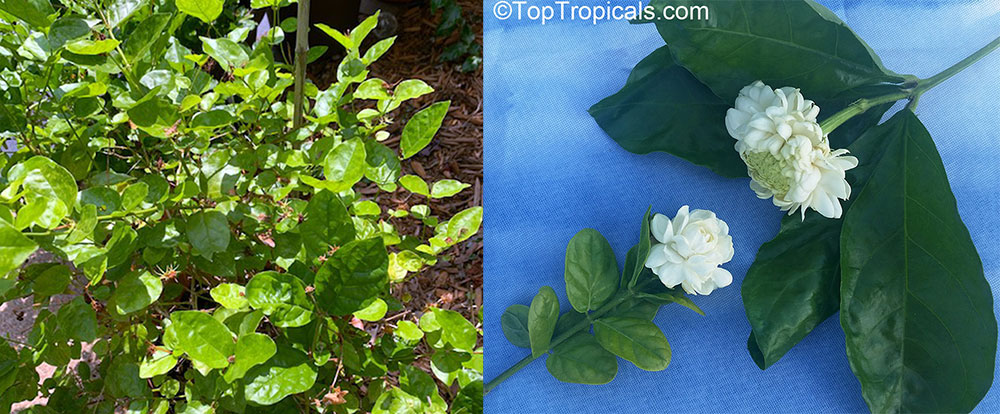
Q: On the picture, these are a few of the jasmine plants that I have from Top Tropicals. I have bought so many plants from you over the years, not just jasmine. I have several varieties of jasmine. They were all doing very well. However this year I didn't get a single flower. There are a lot of buds... But before the buds open they become brown and withered. I bought fertilizer from you. Fertilized the plants once a month like I always do. I water the plants once a week. I repotted the plants hoping that would take care of this problem. Some of the jasmine plants I pruned... the plants came back vigorous growth with a lot of buds... BUT it is the same problem! Please help.
A: One of the possible reasons why they have flower issues is - maybe they don't have enough sunlight. They need to be in full sun all day long for profuse blooming and proper flower forming. However since the buds are forming, there may be just enough light. In this case, dropping buds may be a sign of overwatering.
Important steps - how to make Jasmine Sambac flower:
1. Soil. Use only well-drained soil
2. Water. Keep plants on a dry side and never over water. If the top of the soil is still moist, do not water.
3. Sun. Keep in full sun all day long. The more sun, the more flowers.
4. Bloom booster. Use Flower booster fertilizers:
Pink N Good Daily Plant Food - Flower Booster
Fragrant Plant Special booster, this 90-day Smart-Release container
plant food:
Plumeria Top Dress - Smart-Release Booster
Do not use fertilizers with high Nitrogen (1st number in NPK formula)
- those will promote more leaves instead of flowers.
5. Micro-elements. Use Apply micro-elements, they will help the
plant to develop healthy and long-lasting flowers:
SUNSHINE SuperFood - plant booster
Here is more information on growing Jasmine
Date: 29 Aug 2019
How to establish a Mango Tree
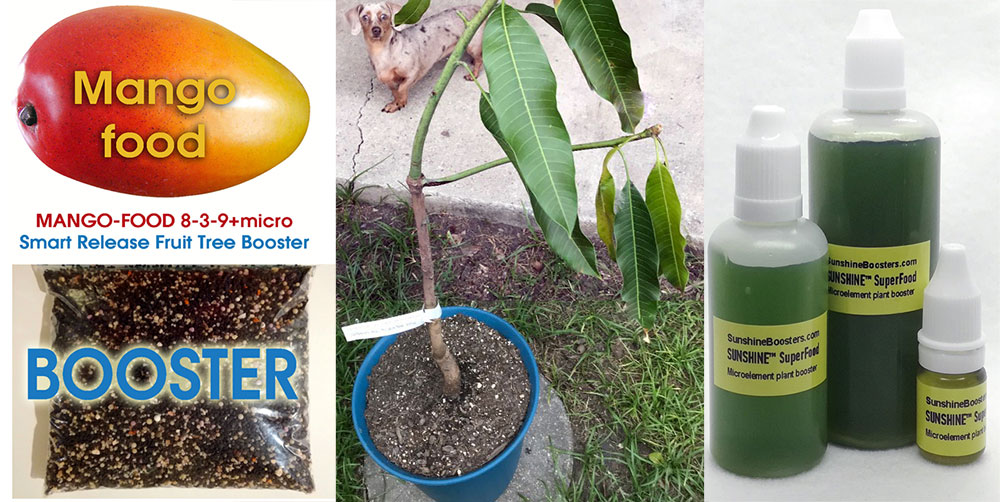
Q: I received my mango tree from you on Monday and it looked beautiful. I followed the instructions and kept it out of direct sun. I watered it a little each day when the potting mix was dry to the touch. But the leaves are turning yellow and brown then falling off. Should I have removed the tree from the soil it was packed in?
A: Leaf drop and dry/yellow leaves are normal symptoms of shipping stress. Your mango tree looks healthy overall. Considering you have high humidity now in Louisiana, the plant should recover soon under proper care. These are important tips:
- Keep the plant in bright shade, away from direct sun - at least for a
week, then you may start moving it gradually to semi-shade, then to full sun
within a few days.
- Do not over-water. If the top of the soil is still moist, do not
water until it dries a little bit. Mango prefers to stay on a dry side. From this
point, over-watering is more dangerous than under-watering. You may skip a
watering if in doubt.
- If it rains every day, make sure to keep the pot under the roof to
protect from excessive water.
- Do not remove original soil and do not disturb roots.
- You used the right container size and looks like you have a quality soil with good drainage. Keep the plant in this container at
least for a few months. You may step it up only when you see a lot of active
growth of branches and leaves - this means, the root system is developing fast
too.
- do not fertilize until you see new growth. Then use Mango Food Smart release.
- to help the plant recover from stress, you may use SUNSHINE-E booster and micro-element foliar spray with SUNSHINE-Superfood
Date: 8 Aug 2019
Tabernaemontana africana - a bush or a tree?
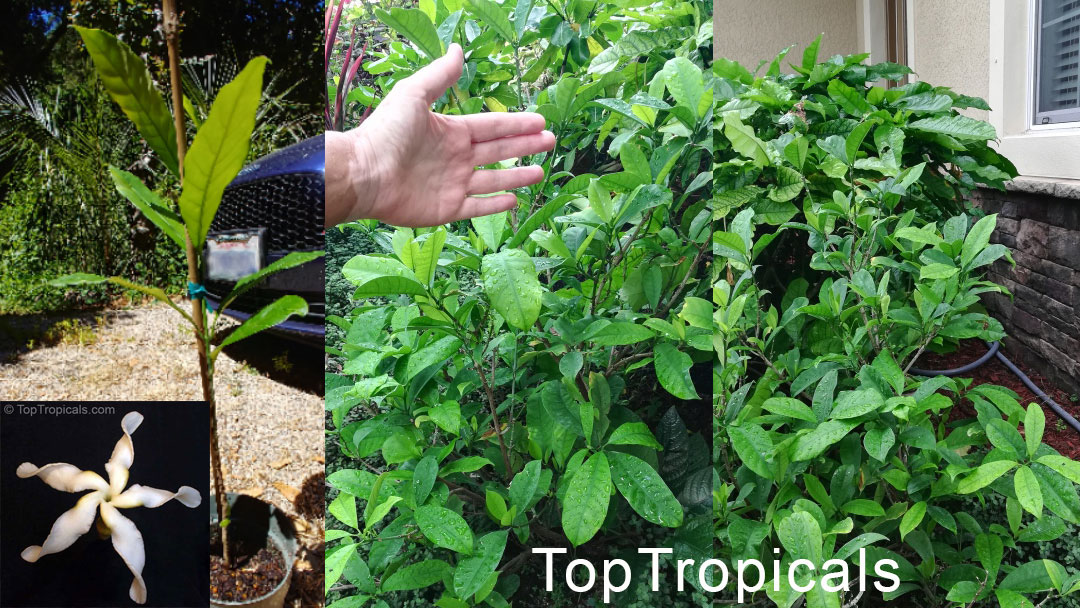
Q: I received a Tabernaemontana africana, but it is not the compact cultivar, from the photo, this is definitely the tree version, not the compact version?
A: The plant in your picture is Tabernaemontana africana and it is a shrub version, not a tree. The
plants we have in stock are smaller size but very vigorous so they can be
trained into standards.
We have this plant in our garden in the ground (3 years old) and by now
it bushed out and remains under 4 ft without any pruning. Just keep in mind
this plant requires regular applications of micro-elements, because the
species is very susceptible to iron deficiency.
The supplement we use, in case you notice any leaf yellowing, is Sunshine-Superfood
Date: 29 Jul 2019
Monster hybrids of Monstera: juvenile and mature
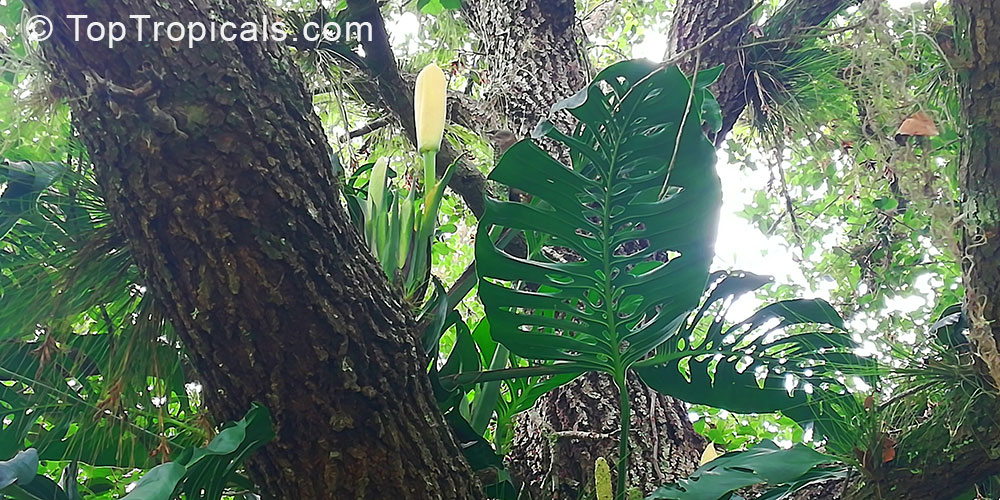
by Mark Hooten, the Garden Doc
Q: I am a rare plant collector and obtained a very interesing cultivar of Monstera from you that says it's a hybrid Monstera adansonii x obliqua. Is there a named hybrid? The leaves on this specimen that came in 1 gal pot are much larger than the plant I have grown in a 3 gal pot for a few years, under name of Monstera friedrichsthalii.
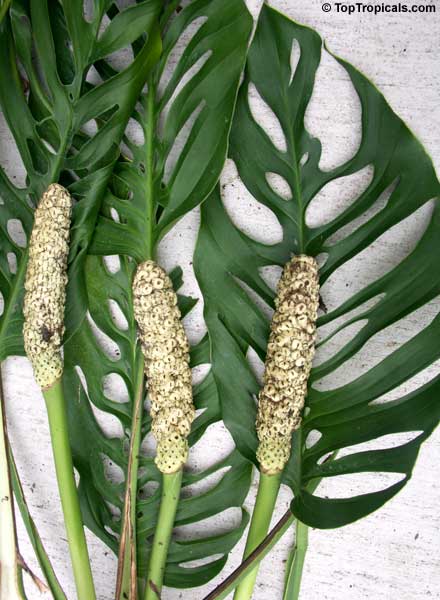
A: Due to their diversity, it is hard to find verified hybrids in the genus Monstera. M. friedrichsthalii is apparently an old Florida name for what is actually technically M. adansonii. The "primitive" juvenile growth is very different from the much larger more robust form that only occurs when it is allowed time to climb a tree, in which case the foliage becomes very different and much larger with many many more fenestrations (holes) of various sizes. If you visit our Garden Center, you can see the mature form climbing the oak tree in our Shade Garden in front of our office - we use this mature plant for propagation. If you take a cutting and don't let it attach to a bark/trunk and climb upwards, it will quickly revert to the wimpy juvenile form. Seems that even climbing a pole indoors, it never actually develops into the truly mature more complex adult stage. Some juvenile forms growing on a tree if given too much shade, do not develop into the larger mature form. Move it in more light and allow it to climb, and it will look very different, but still is the same plant under different conditions.

Date: 25 Jun 2019
True love of Night Blooming Jasmine
By Onika Amell, tropical plant specialist
Q: I live in New Cumberland, West Virginia. I love the smell of Night-Blooming jasmine. Is it possible to grow it in the northern panhandle of West Virginia? Do I have to plant it every year or do I keep it in a pot and take it inside during the winter months?
A: Technically, Night Blooming Jasmine is not a true jasmine
(those plants belong to Oleaceae, or Olive family). Night Blooming Jasmine
belongs to the Solanaceae family, also known as the Nightshade or "Potato" family
of plants. Yes, this sweet fragrant flower called Jasmine for its perfume is
related to potatoes and tomatoes!
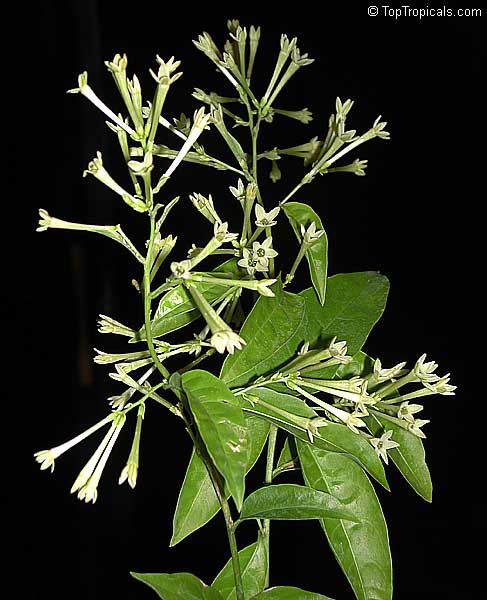
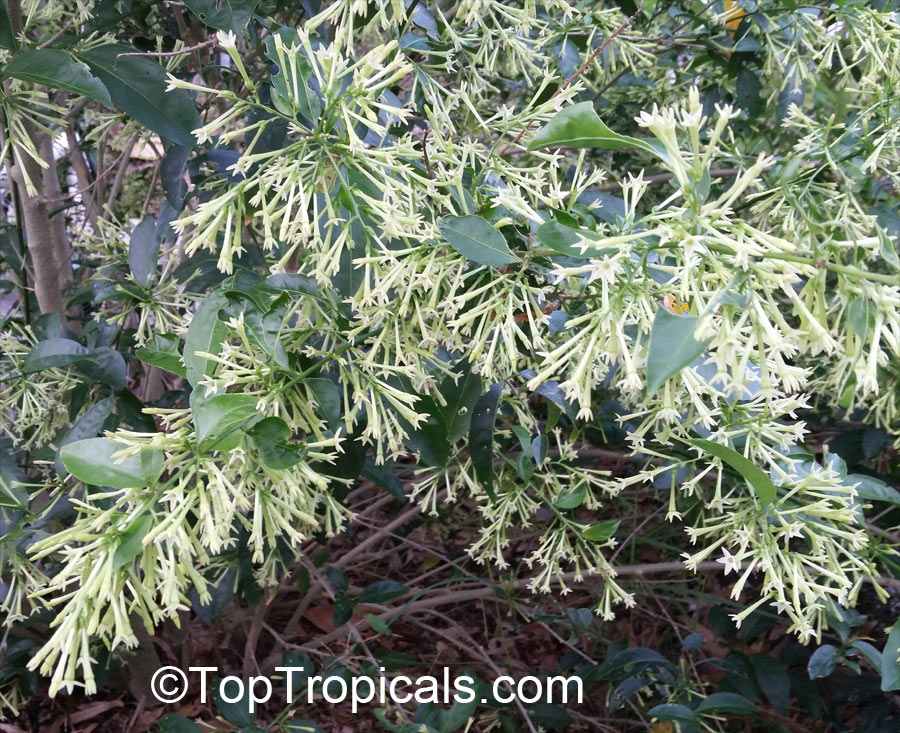
Night Blooming Jasmine - Cestrum nocturnum - is loved by many gardeners for its beautiful
fragrance at night. It is one of the most fragrant tropical evergreen shrubs
available. Cascading clusters of tiny, tubular pale yellow to white flowers open at
night and release a heavenly fragrance throughout the garden, especially on
warm summer evenings. The fragrance is much lighter during the day.
Night Blooming Jasmine is grown year-round in zones 9-11. It is at its
happiest in a sunny to a partially sunny spot in your garden in well-drained soil
but can be grown in cooler climates as a container or greenhouse plant.
You would absolutely be able to enjoy this plant during the warm months
in West Virginia, but it will most certainly not survive outside during the
winter. You will have to bring it inside. Take it outside again only once you
are confident there is no more possibility of frost. When grown indoors, be
sure to give it the sunniest, South facing window in your home. When grown in
a container, you will need to re-pot it every two to three years so it
doesn't become root-bound.
For those who are lucky to live in frost-free areas, in ideal growing
conditions outside, it can easily reach 8 feet with a spread of 5 feet. It has
a lovely informal look that can soften a more manicured garden. Add organic
matter to the planting hole when you plant to enrich the soil around the root
ball. Water well in the summer, but allow them to dry out a bit between
watering in the winter. Plant this Jasmine near pools, porches, doors, windows,
and walkways where its lovely fragrance can be enjoyed. The shrub is also an
excellent plant for privacy hedges and screens. When grown as a hedge, plant 3
feet apart.
Trim lightly after a bloom cycle to shape and then do a hard pruning in
fall or spring to control the size of this plant. Fertilize 3 times a year -
in spring, summer, and autumn - with a good quality granular fertilizer.
Recommended fertilizers:
Pink N Good Daily Plant Food - Flower Booster
Tropical Allure - Smart-Release Booster
Interesting facts:
Night-blooming jasmine is an excellent mosquito repellent. The powerful
scent of the flowers attracts moths and bats that feed on mosquitoes and
other small insects.
The flowers of the Night Blooming jasmine are widely used in India and
other countries of South Asia for perfumery, medicinal applications and in
religious ceremonies.
Limited time special offer:
Instant $5 off Night Blooming Jasmine