Date: 22 Jun 2026
Carambola Starfruit FAQ: how dwarf is a seedling?
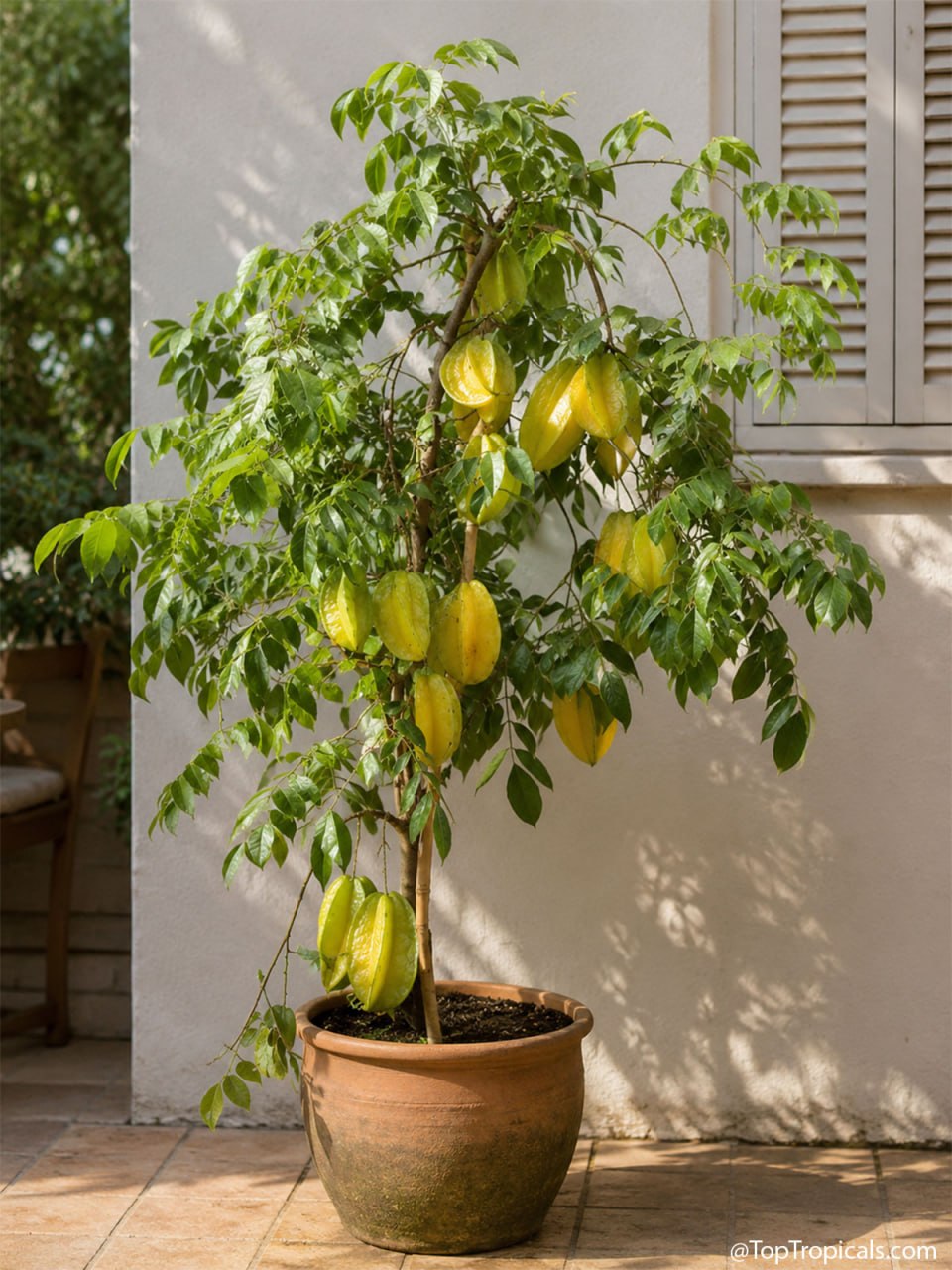
🌟 Carambola Starfruit FAQ: how dwarf is a seedling?
❓ I recently ordered a dwarf Hawaiian star fruit seedling from your glorious stock of tropical trees, however upon doing further research it seems like grafted trees guarantee fruit results while seedlings may vary from what the parent plant was. I was planning on putting it in a planter since it’s a dwarf but I’m worried about the quality of fruit since it’s a seedling. Could you elaborate on that a bit?
✅ You are correct that grafted trees provide the greatest certainty because they are clones of a known variety. Seedling trees can show some variation from their parents.
In this case, however, your seedling is not from an unknown or mixed genetic background. The seeds were collected from a true Dwarf Hawaiian cultivar that was growing among other selected dwarf carambola cultivars, primarily Dwarf Hawaiian and a few Fwang Tong trees. Because both the seed parent and the surrounding pollen parents were dwarf, we expect the offspring to retain many of the desirable dwarf characteristics.
While we cannot guarantee that every seedling will be identical to the parent tree, the chances of obtaining a compact, productive tree with good fruit quality are quite favorable. In fact, seedlings sometimes combine the best qualities of both parents and may even produce fruit that is equal to or better than either parent.
The main difference between a grafted tree and a seedling is predictability. A grafted tree gives you a known result. A seedling introduces some genetic variation, but in this case the variation comes from a pool of carefully selected dwarf varieties rather than from unknown parents.
For container growing, we would still expect your tree to be well suited to pot culture, especially with periodic pruning to maintain size and shape. Many growers actually enjoy growing seedlings because there is always the possibility of discovering an exceptional individual. Carambola is a quick fruit tree: 3-4 years from seed to fruit.
We believe your Dwarf Hawaiian seedling has excellent potential and should make a rewarding container-grown fruit tree.
🛒 Plant Star Fruit Carambola Tree
📚 Learn more:


✦ Averrhoa carambola in Plant Encyclopedia
✦ Star fruit chili relish: quick-n-fun exotic recipes
✦ Grilled star fruit slices: quick-n-fun exotic recipes
✦ How to gets lots of Star Fruit Carambola
✦ Star Fruit from our garden
✦ Grow your own Carambola
✦ Top 10 fast-fruiting trees: #8. Carambola - Starfruit
✦ Carambola Banana Whip
✦ Carambola Jam recipe
✦ When young Carambola trees are covered with fruit
✦ Carambola tree is the Star of the orchard
#Food_Forest #Discover #How_to
🟢 Join 👉 TopTropicals