Garden Blog - Top Tropicals

Date: 12 Sep 2019

Helping Citrus and other fruit trees with Nutritional Supplements
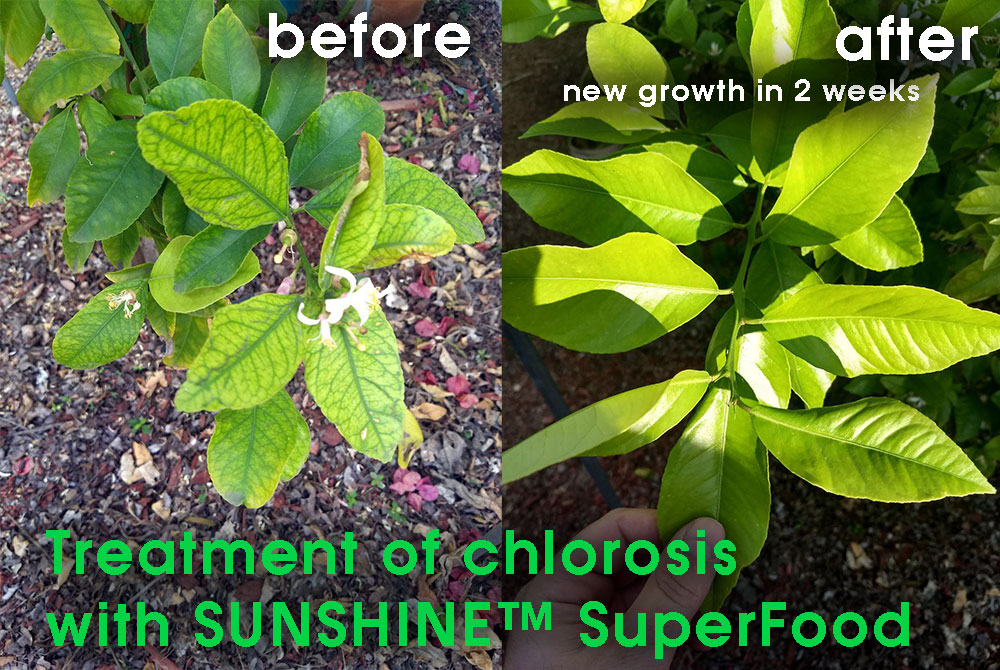
Q: Can you recommended a product to help with my citrus? Combating greening and chlorosis.

A: Citrus greening is spread by an insect called the Asian citrus psyllid. The psyllid feeds on the stems and leaves of the trees, infecting the trees with the bacteria that causes citrus greening. Florida Citrus growers dedicated the last decade to researching citrus greening. Officially, currently there is still no cure, however, some Nutritional solutions have shown promising results. To slow the progression of citrus greening in infected trees, nutrients are applied to the leaves and to the roots. Providing better nutrition helps trees fight against citrus greening and enables them to continue to produce quality fruit.

We recommend the following products for use on regular basis:

SUNSHINE Epi is a natural Brassinosteroid plant hormone and a bio-stimulant that may be very effective as citrus greening treatment. It works through plant's immune system and shows amazing results of recovery of weak and sick plants.

SUNSHINE Superfood, a complex micro-element supplement, maintains plant's health and provides vigorous growth.

SUNSHINE-Honey is a basic nutritional complement, it contains essential plant micronutrients Boron (B) and Molybdenum (Mo). These elements are essential to vegetative and reproductive growth, cell expansion, tissue growth, and fertility. A very common problem for most unimproved garden soils is lack of Molybdenum and Boron as soil micro-component. This results in underdeveloped / low quality fruit and/or premature fruit drop. Applying SUNSHINE Honey on your fruit trees will fill that gap and help a fruit tree to form a healthy fruit.

Macro-nutrients should be applied in combination with micro-nutrients on regular basis:

Mango-Food - Smart Release Fruit Tree Booster (works great for all tropical fruit trees)
Fruit Festival Plant Food - Ideal blend designed to improve fruit trees health and vigor, and increase crop yield.

See SUNSHINE Boosters page for the complete list of plant boosters.

Date: 20 Oct 2023

How to help a weak tree to recover and thrive?

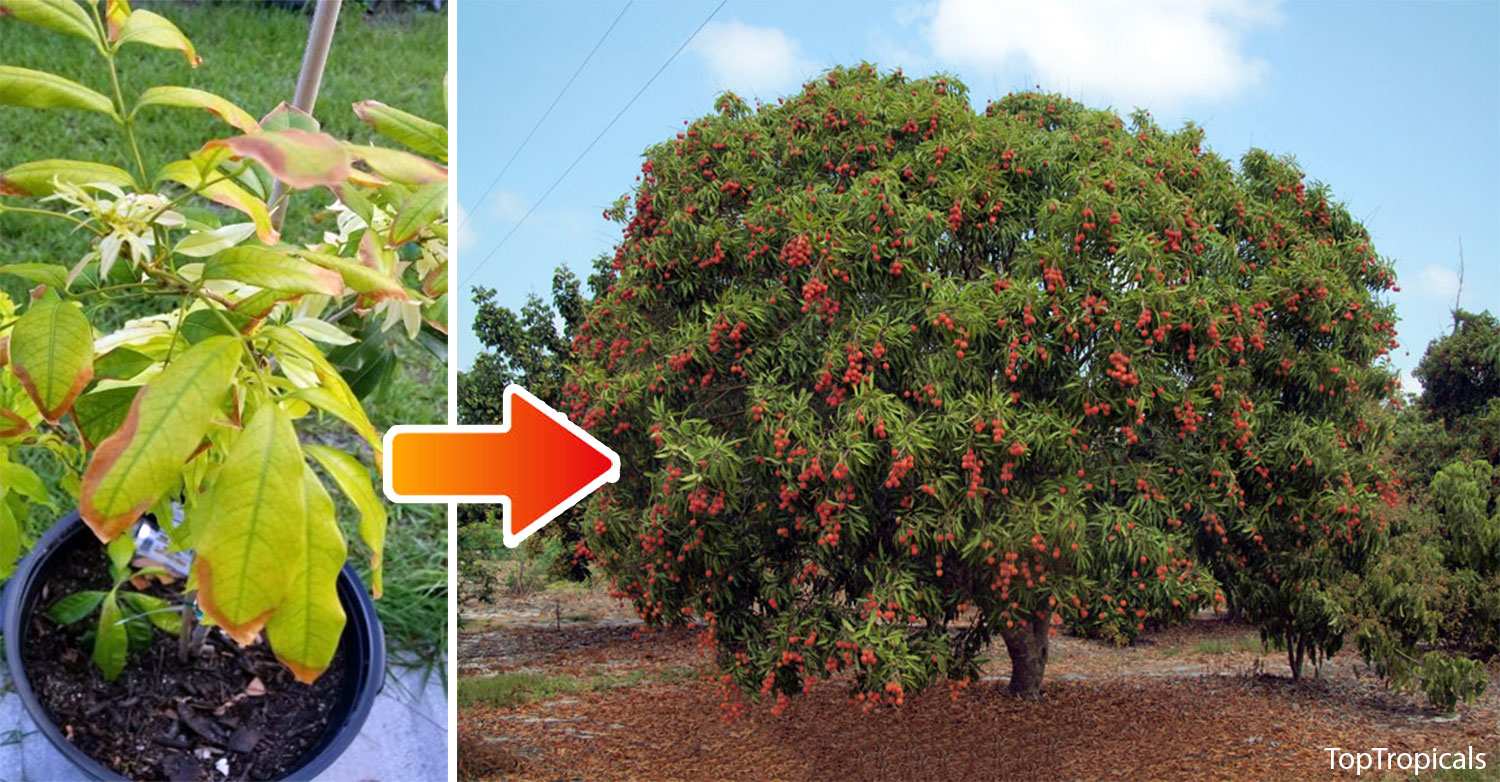
small  and  large  lychee  tree

Q: Look at my sad looking Lychee tree. Can you share with me any ideas about this tree condition?

A: From the photo (left), we see a few potential issues. The problem might be due to a combination of factors such as a heavy potting mix with poor drainage, over-watering, an underdeveloped root system sensitive to these conditions, leaf burn, and a lack of nutrients.

Suggestions for fixing the problem

1. Soil mix. First, assess the quality of the soil. If the plant has been in the same pot for a while, the soil at the bottom may have become compacted, leading to poor drainage. If this is the case, carefully remove the root system from the existing soil (by removing excess soil around the roots without disturbing the roots themselves). Repot the tree into fresh, well-draining potting mix with good drainage characteristics, which typically contains materials like bark and perlite. Ensure that the new pot is exactly the size of the root ball; using a significantly larger pot can lead to soggy conditions that harm the roots.

2. Light. Place the potted tree in an area with filtered light, avoiding direct sunlight throughout the day.

3. Water. Control the watering. During this recovery period, your plant will need very limited water until it shows signs of improvement and new growth. After repotting, water it thoroughly just once, and avoid watering again until the top layer of soil becomes dry. Then, water as needed. Avoid keeping the soil consistently wet, especially during rainy periods. Protect the plant from excessive rain.

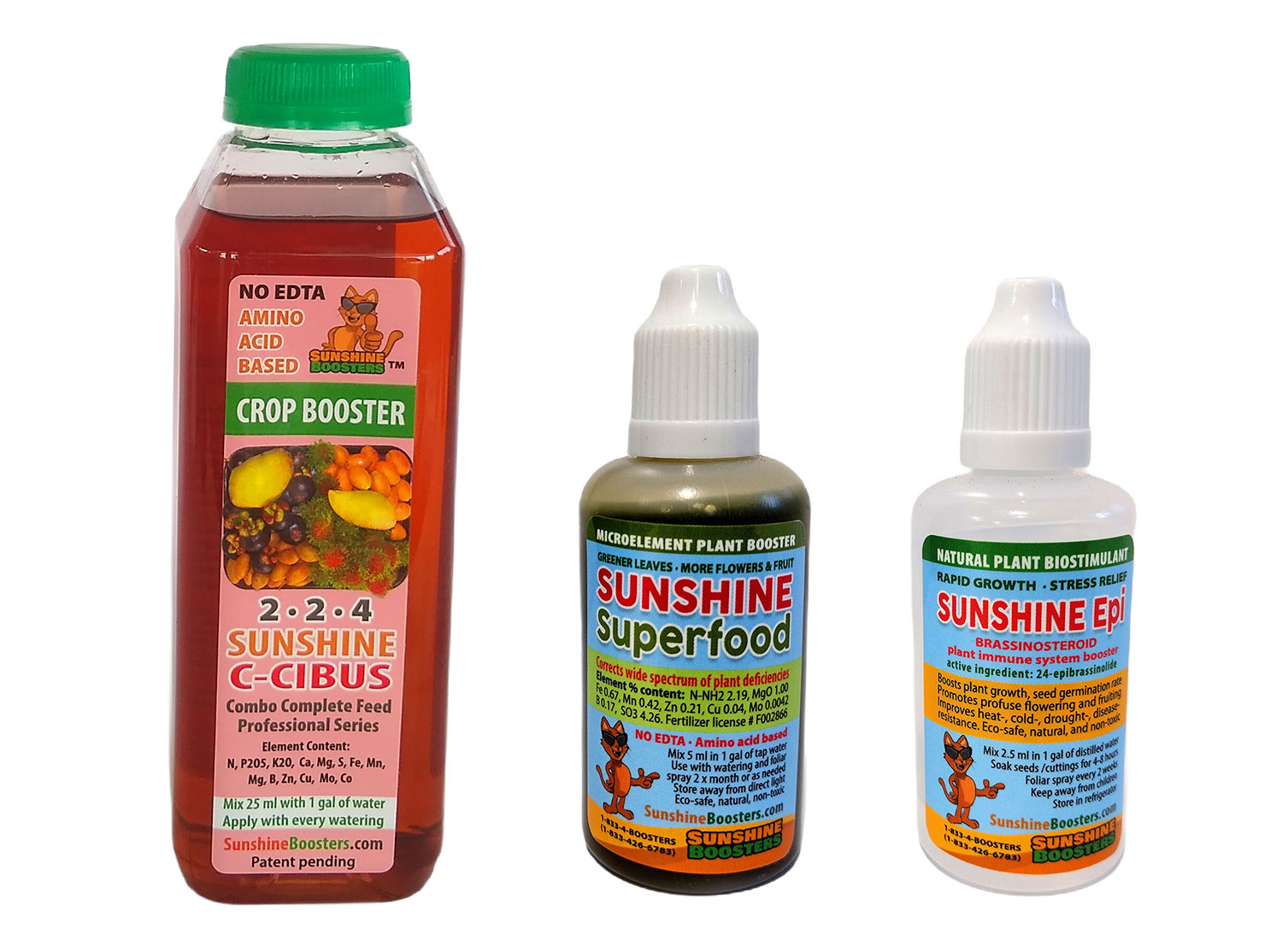
4. Supplements. Consider applying Sunshine Superfood micro-elements following the label instructions, once a month. Additionally, using Sunshine Epi bio-stimulant, sprayed every other week, can help the plant recover from stress and encourage growth. You can also use Sunshine C-Cibus at half the recommended concentration with each watering. Hold off on any other fertilizers until the plant has sufficiently recovered and begins to show signs of new growth.

5. Transplanting. If you plan to transplant the tree into the ground, it's advisable to wait until spring when nighttime temperatures consistently stay above 65F for at least two weeks.

6. Temperature. Keep the tree in a warm environment. When temperatures drop below 50F, bring it indoors.

These steps should help the tree recover, grow healthy leaves, and establish a better root system, preparing it for successful transplantation into the ground or a larger container, ensuring a happy and productive life ahead.

Sunshine  Boosters:  C-Cibus,  Superfood,  Epi

Date: 31 Oct 2025

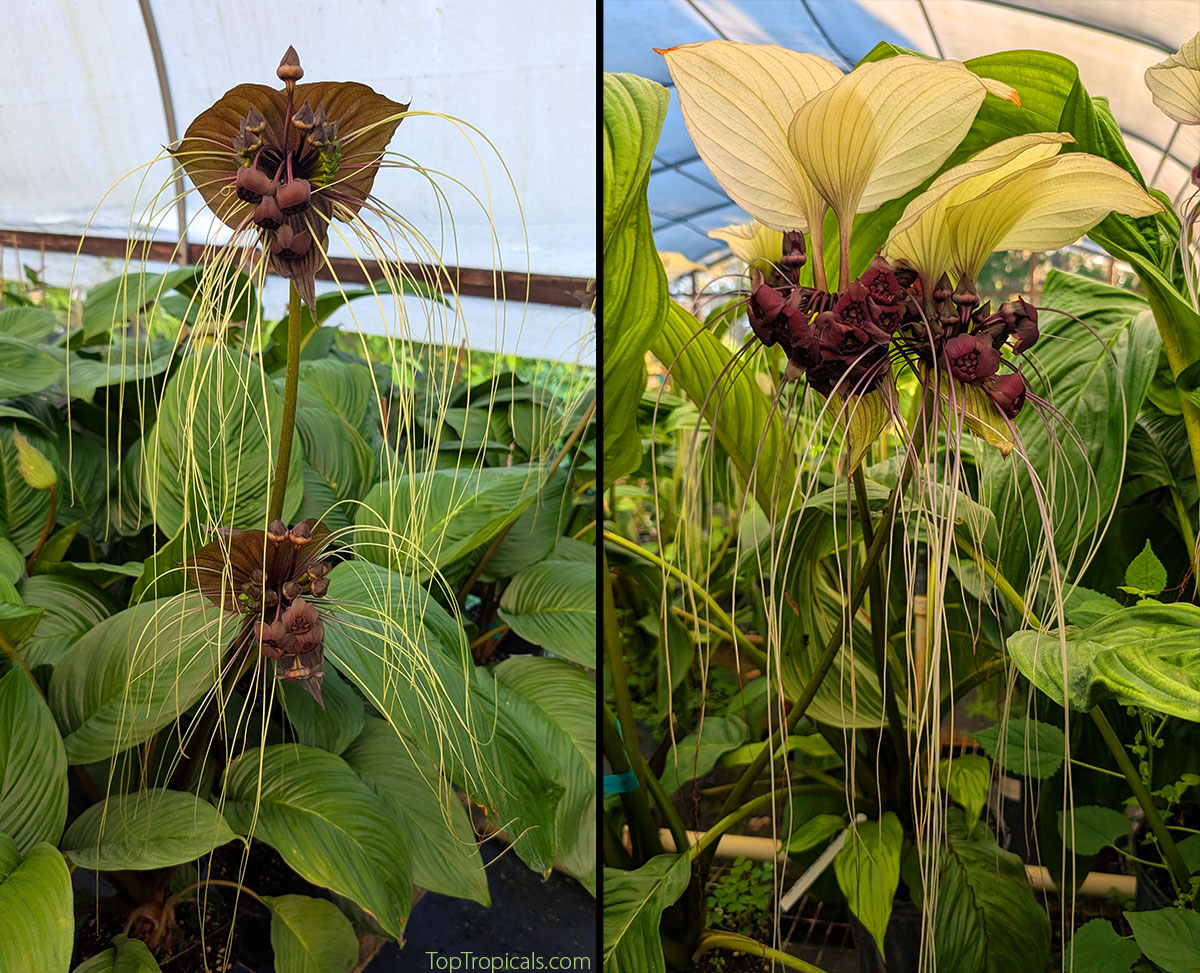
Black  Bat  Lily  and  White  Bat  Lily  plants  blooming  together  in  the  Top 
 Tropicals  greenhouse,  showing  contrast  between  dark  maroon  and  ivory  bracts 
 with  long  trailing 
 whiskers.

Black and White Bat Lilies (Tacca chantrieri and Tacca nivea) side by side in bloom

How to Care for Bat Lilies

by Top Tropicals Plant Expert Tatiana Anderson

🌞 Light

  • Bright, filtered light. Morning sun or dappled shade is perfect.
  • Avoid direct midday sun outdoors — it can scorch the leaves.
  • Indoors, place near a bright window with sheer curtains or use a grow light.

🌡️ Temperature

  • Warm and stable, ideally 70-85 F during the day.
  • Protect from cold drafts or sudden chills.
  • Ideally, do not let temperature drop below 45 F, although Taccas can tolerate short period of upper 30's.

💧 Watering

  • Keep soil evenly moist but not soggy.
  • Water when the top inch feels barely dry.
  • Use lukewarm water.
  • Avoid letting the pot sit in water.

💨 Humidity

  • High humidity (60-80%) is key.
  • Mist leaves often, use a humidity tray, or keep near a humidifier.
  • In greenhouses or bathrooms with a skylight, it thrives naturally.

🌱 Soil

  • Use rich, loose, well-draining mix
  • Combine bark, peat, and perlite for ideal airflow around the roots.
  • Best mix for growing tropical Tacca in pots - soilless potting mix Abundance . It provides perfect drainage and has a texture similar to a jungle rainforest media.

🍽️ Feeding

  • During growth season (Spring through Fall), feed with Green Magic controlled release fertilizer every 6 months. For even better results, you may apply liquid fertilizer Sunshine Boosters Rubusta.
  • Stop feeding dry fertilizer in cooler months when growth slows. Liquid Sunshine Boosters are safe to use with every watering, year around.

🏡 Indoor Growing

  • Great for bright bathrooms, sunrooms, or any warm, humid corner.
  • Rotate pot occasionally for even growth.
  • Keep away from heating vents and AC drafts.

🌴 Outdoor Growing (in warm climates)

  • Partial shade or filtered light under trees.
  • Excellent in large containers that can be brought inside for winter.
  • Shelter from heavy rain and wind.

Sunshine: "So… it’s a diva?"
Smokey: "Exactly. But take care of it - and it rewards you with wings!"
Smokey and Sunshine: "Happy Halloween!"

🎥 Watch Short Videos:

🛒 Grow your own gothic masterpiece:
Shop Bat Head Lily Tacca

Date: 27 Nov 2025

Happy Thanksgiving from all of us at Top Tropicals!

Smokey  the  tuxedo  cat  holding  a  Thanksgiving  sign  while  Sunshine  the 
 ginger  tabby  smiles  beside  him  on  a  potting  table.

Smokey: "We made a list of everything we are thankful for this year."
Sunshine: "I helped. Mostly by napping next to it."
Smokey: "And that is exactly why sunshine naps are on the list."

Smokey and Sunshine wanted to share a short Gardener Thanksgiving Message about what they are thankful for this year:

"We are thankful for warm laps during cold mornings.
Thankful for every gardener who stopped to scratch our heads between loading carts.
Thankful for the smell of fresh soil, new plants, and boxes that make perfect cat forts.
Thankful for mango season (even though humans never let us eat the fruit).
Thankful for sunshine naps on potting tables and shade naps under benches.
Thankful for all the tiny moments when gardens and people slow down together.
And thankful that we get to share this tropical adventure with you."

From the whole Top Tropicals Team and PeopleCats, we wish you a warm, peaceful, plant-filled Thanksgiving 🙏 ♥️

🛒 Shop Tropical plants

Date: 22 Apr 2026

When Mango Ripens on the Tree, Everything Changes

Smokey  and  Sunshine  enjoying  fresh  homegrown  mango  harvest  in  garden
Sunshine: Never understood the passion for mango. I tried store mangoes. I really tried. Just disappointment. So this is what real mango is supposed to taste like?

Smokey: Now you know.

There is a moment when a mango is perfectly ripe — soft to the touch, warm from the sun, fragrant before you even cut it open. The skin gives way, and suddenly there is color, juice, and a sweetness that feels almost unreal. Not sugary, but deep and layered, like something that took its time to become what it is. In that moment, it feels less like fruit and more like something truly given, exactly as it should be.

What you find in most supermarkets is something else entirely. Picked early so it can survive shipping, it never gets the chance to finish ripening process. It softens, it turns yellow, but the depth never comes. The flavor stays thin, and the texture often turns fibrous — strings in the flesh that get stuck in your teeth instead of melting away. That fiber is not an accident. It helps the fruit stay firm enough to handle transport without damage. It looks like a mango, but it never becomes one.

The only way to close that gap is simple — let the fruit ripe where it belongs. On the tree. When you grow your own mango, you control that moment. You pick it when it is actually ready, not when it has to survive a truck ride across the country. And that one difference is everything you taste.

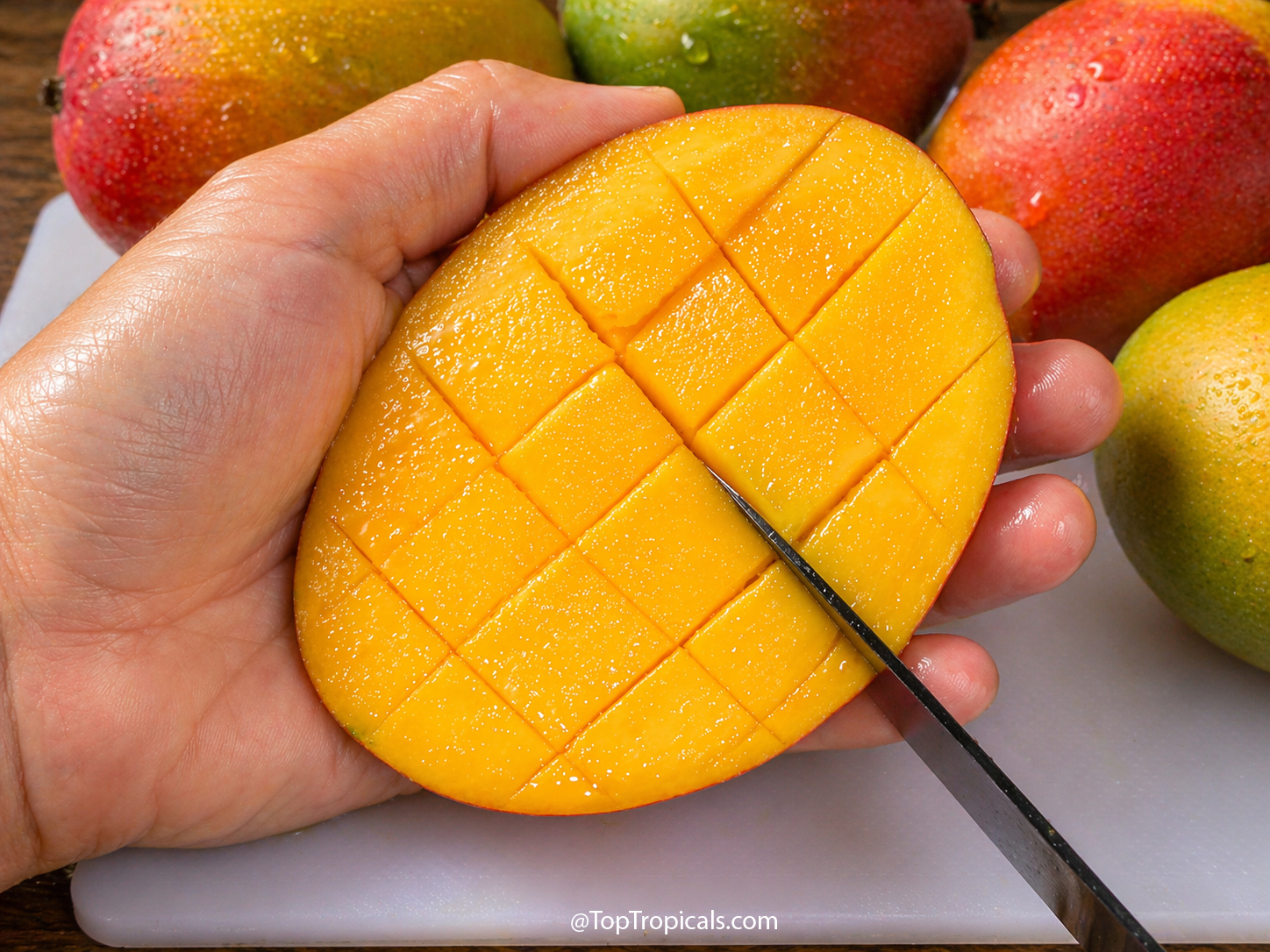
Close-up  of  a  hand  holding  a  mango  cheek  while  scoring  the  bright 
 orange  flesh  into  a  grid  pattern  with  a  knife,  with  whole  mangoes  in  the 
 background.

Scoring a mango cheek into cubes - the easiest way to prepare clean, ready-to-eat pieces.

📚 Learn more about mango varieties

🛒 Shop Mango Trees

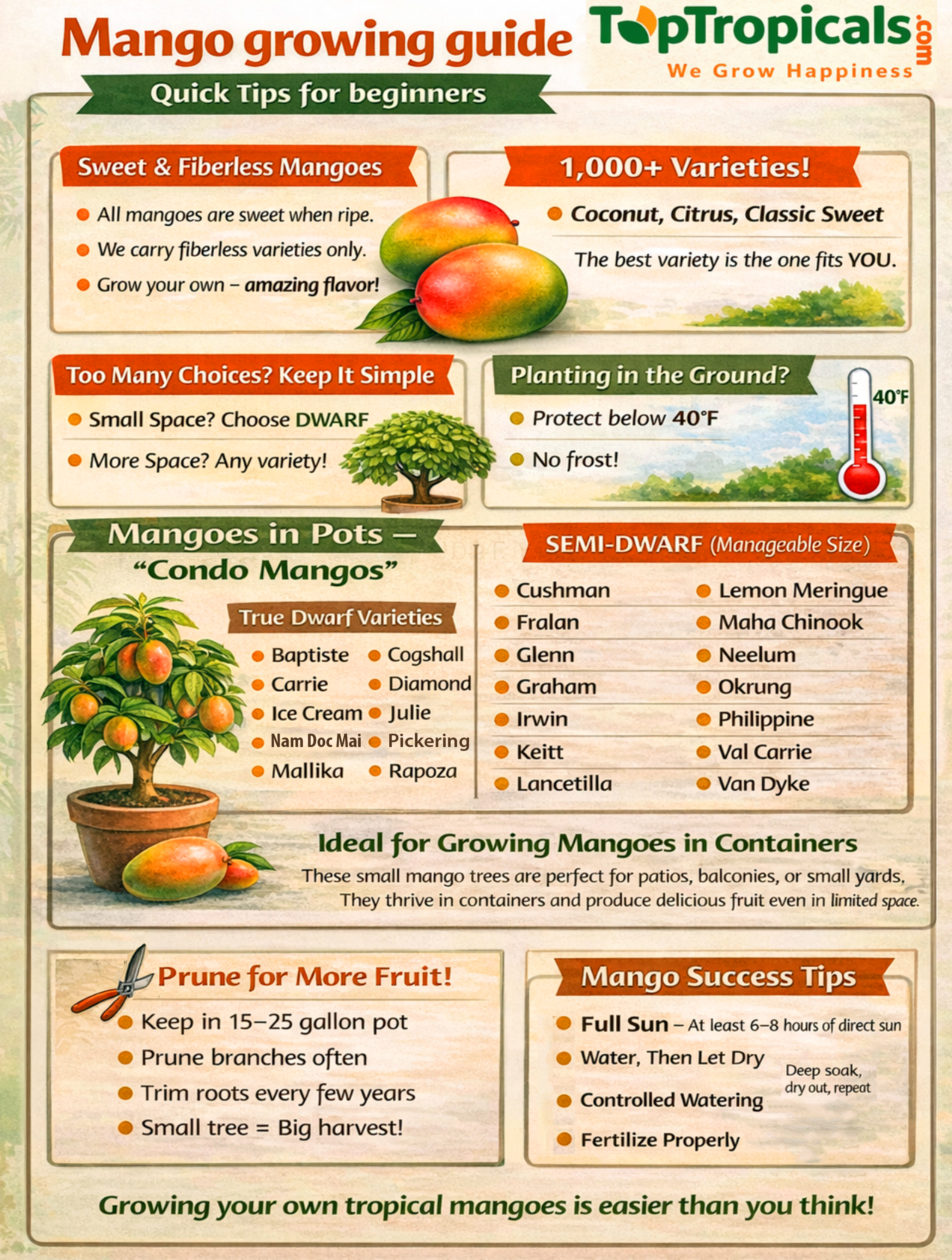
Educational  infographic  titled  mango  growing  guide  showing  beginner 
 tips  for  growing  mango  trees,  including  sweet  fiberless  varieties,  dwarf  and
    semi-dwarf  options  for  containers,  planting  tips,  pruning  advice,  watering,
    sunlight,  and  fertilizing  recommendations,  with  illustrated  mango  trees  and
    fruit.

Quick beginner guide to growing mango trees - from choosing the right variety to pruning, watering, and container growing tips.