Date: 26 Sep 2021
Edible Landscape: fruit bearing hedge
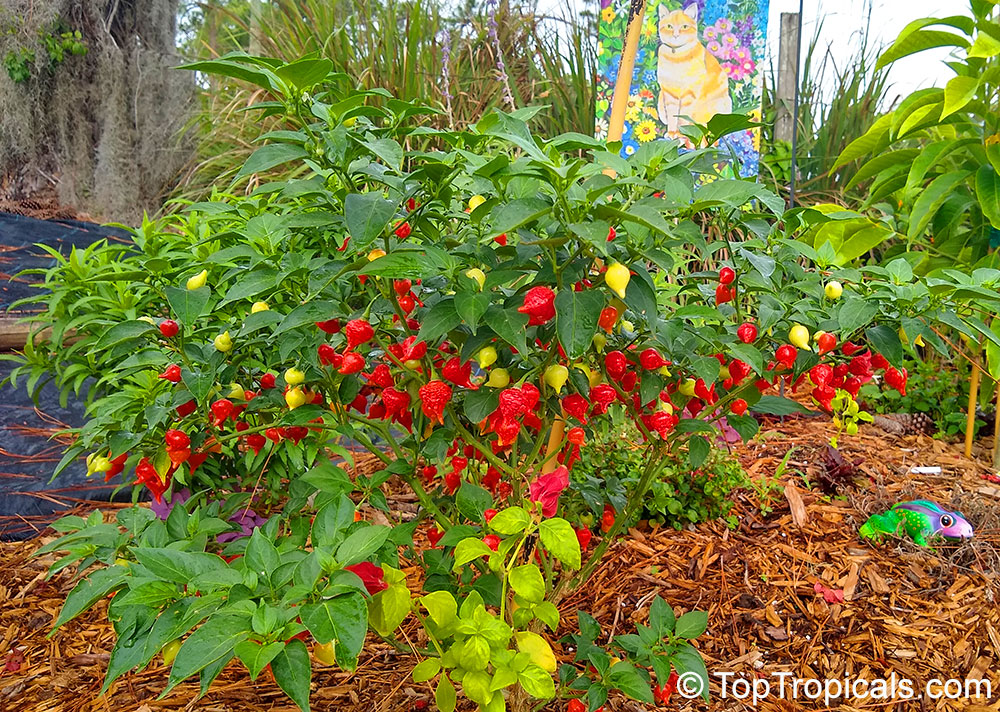
Photo above: Biquinho Pepper (2 months old plant)
Q: My mom had to remove a hedge for some renovations and after being heartbroken about losing my little bird haven, I've decided to plan on a fruit bearing hedge that offers some privacy and places for the little fledgling to wait for food. Any suggestions? I was thinking blueberries or citrus but open to any ideas.
A: Below are a few suggestions for a fruit bearing hedge planted with fast-growing, tropical species. They will contribute to a nice edible landscape for both your family and the birds - they will be very happy!
Larger size hedge (small trees), grows full-size within 1
season:
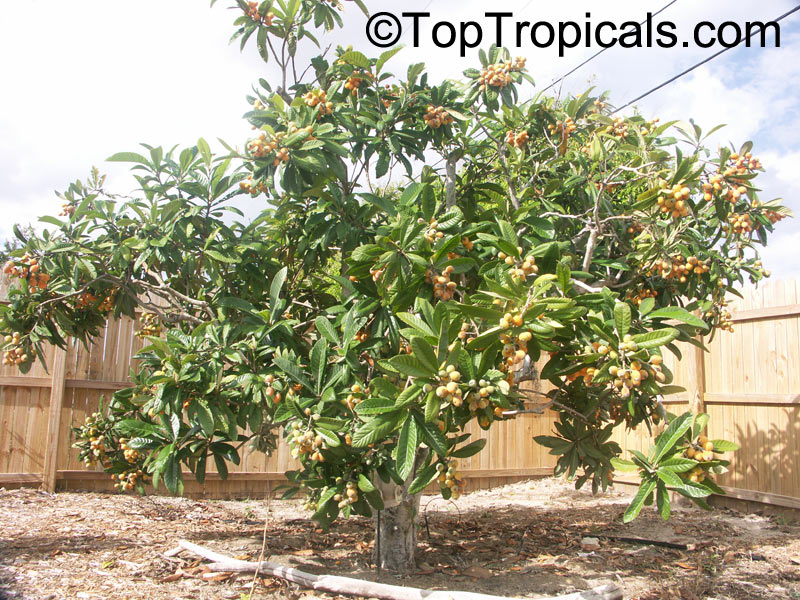
- Loquats
- Dwarf Mulberries (very cold hardy too) such as Dwarf Everbearing
Medium size hedge (shrubs or vines), 2-3 seasons to grow full
size:
-
Black Surinam Cherry Lolita
- Blackberries and raspberries
Low hedge (4-5 ft tall, 1 season, fast growing):
-
Biquinho Pepper
- Wiri
Wiri Pepper
Citrus is probably not a good idea, not bird's favorite, and blueberries require a special acidic soil here in Florida, so they will need extra maintenance, special soil, and heavy mulching.


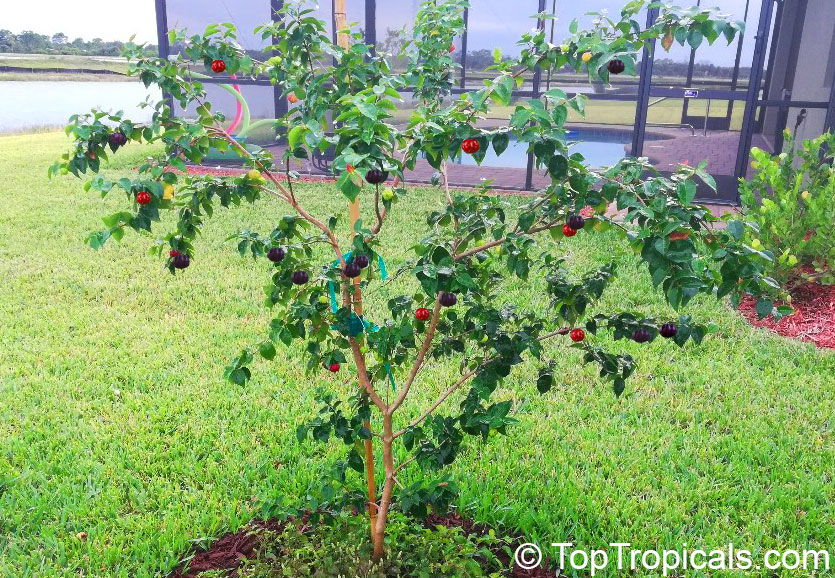
Surinam Cherry Lolita, 2 year old plant
Date: 25 Nov 2019
Flavor of Feijoa Superfood
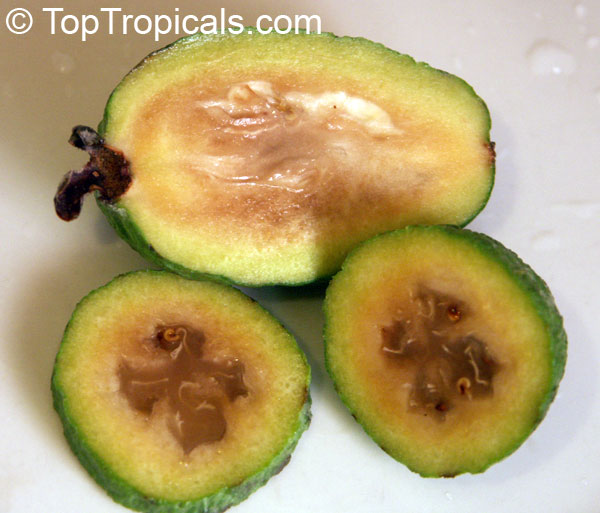
by Onika Amell, tropical plant specialist
Q: What exactly is Feijoa - Pineapple Guava? Does the fruit really taste like pineapple? I am curious to know if it is easy to grow.
A: Feijoa is certainly one of the easiest fruit trees to grow as it does
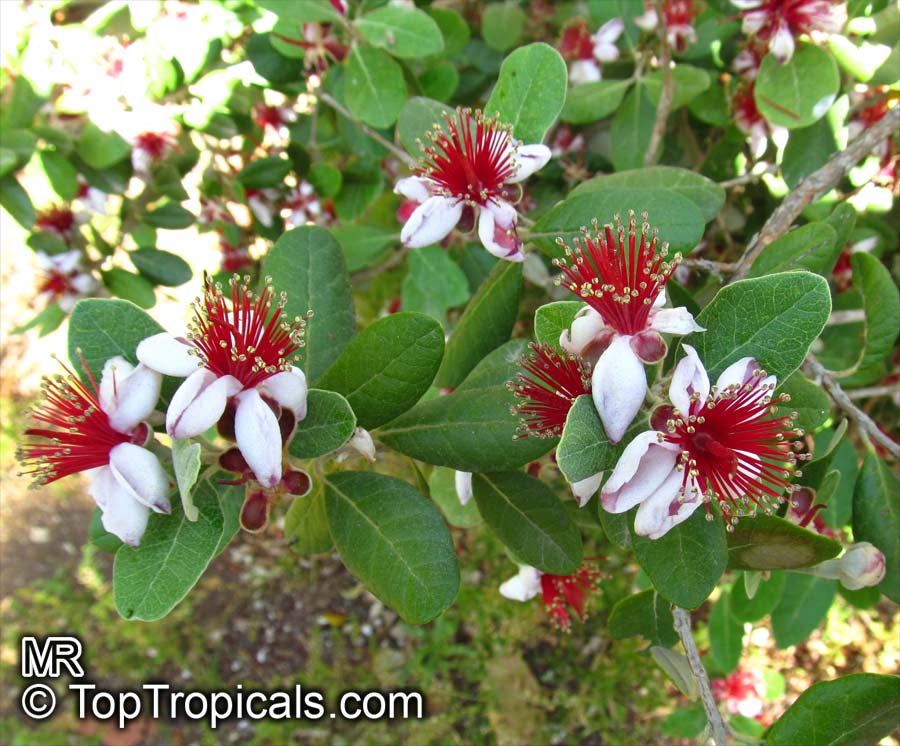
not require much care. It is an attractive, evergreen tree or large shrub with
dark green, oval, leathery leaves. It has an abundance of uses in the garden
and produces lovely edible flowers and fruit! The fruit is eaten fresh,
added to smoothies or fruit salad and is also commonly used to make delicious
jams and wicked chutneys. Feijoa fruit go a long way in flavor.
This plant is drought tolerant and will grow in almost any soil type. It
loves full sun or partial shade and is wind resistant. A lot of gardeners like
to grow it as a wind barrier for this reason. It can easily be shaped into a
dense, informal hedge or screen that needs very little pruning. Because of
this density, it provides excellent shelter for all kinds of wildlife.
Butterflies, birds, and butterflies will all love you for growing Feijoa!
Space the plant five feet apart to create a wind barrier hedge. Heat does
no not bother it at all and it will also withstand temperatures to 10 degrees
F.
The plant gets its names from the delicious perfume it emits. Some folks
seem the fruit taste like pineapple, with a slight minty undertone. Others feel
the flavor reminds them of juicy fruit gum! The texture is described as
smooth and slightly gritty - almost like a pear, but firmer.
If you prefer to grow this plant as a tree rather than a large shrub,
simply remove the lower branches up to one-third of the tree's height over a
period of time. The Pineapple Guava can grow up to 15 feet wide and tall. They
also do really well as a container plant on patios where you can truly enjoy the
lovely fragrance of the fruit. It prefers rich, organic, well-drained soil
and will need light fertilization every other month in most soils.
We recommend:
Fruit Festival Plant Food - Super Crop Booster
Mango-Food - Smart Release Fruit Tree Booster
SUNSHINE-Honey - Sugar booster
SUNSHINE C-Cibus - Crop Nutrition Booster
Pretty, pink, edible flowers will wow you from May to June, followed in late summer or fall by the delicious and fragrant fruit. An interesting thing about this fruit is that you don't pick it. It falls to the ground when it is ripe. Or simply place something under your tree, like a tarp, and shake the tree. The ripe fruit will fall off. You can store the fruit in your refrigerator for up to a week. And remember! The fruit of the Feijoa is not only a very rich source of soluble dietary fiber, but also an excellent source of Vitamin C, and very rich in antioxidants. They are also low in calories. Each fruit only holds 55 calories.
Date: 12 Sep 2019
Helping Citrus and other fruit trees with Nutritional Supplements
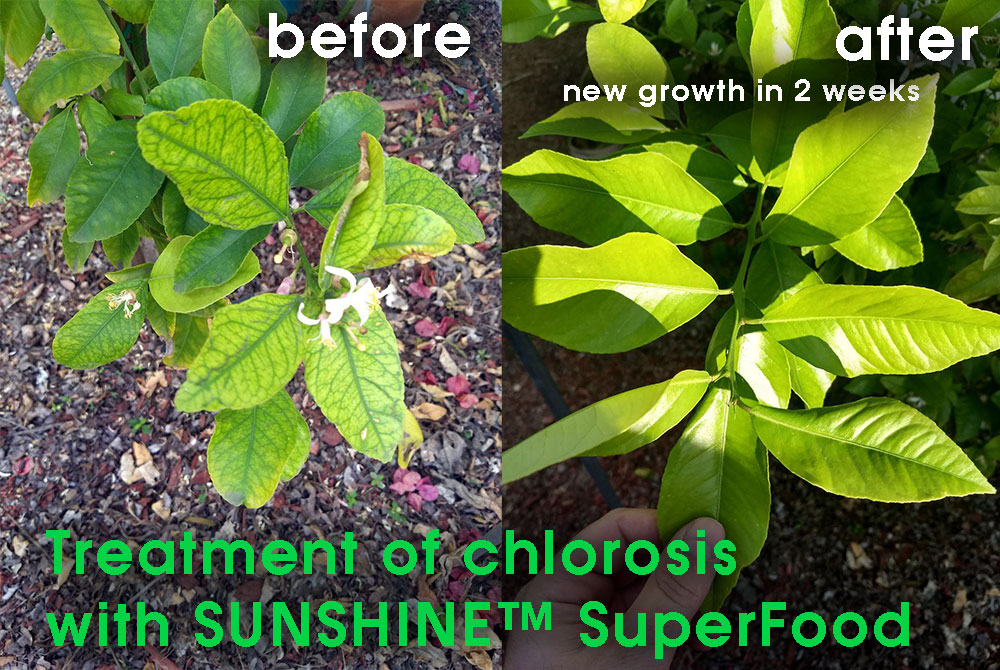
Q: Can you recommended a product to help with my citrus? Combating greening and chlorosis.
A: Citrus greening is spread by an insect called the Asian citrus psyllid. The psyllid feeds on the stems and leaves of the trees, infecting the trees with the bacteria that causes citrus greening. Florida Citrus growers dedicated the last decade to researching citrus greening. Officially, currently there is still no cure, however, some Nutritional solutions have shown promising results. To slow the progression of citrus greening in infected trees, nutrients are applied to the leaves and to the roots. Providing better nutrition helps trees fight against citrus greening and enables them to continue to produce quality fruit.
We recommend the following products for use on regular basis:
SUNSHINE Epi is a natural Brassinosteroid plant hormone and a bio-stimulant that may be very effective as citrus greening treatment. It works through plant's immune system and shows amazing results of recovery of weak and sick plants.
SUNSHINE Superfood, a complex micro-element supplement, maintains plant's health and provides vigorous growth.
SUNSHINE-Honey is a basic nutritional complement, it contains essential plant micronutrients Boron (B) and Molybdenum (Mo). These elements are essential to vegetative and reproductive growth, cell expansion, tissue growth, and fertility. A very common problem for most unimproved garden soils is lack of Molybdenum and Boron as soil micro-component. This results in underdeveloped / low quality fruit and/or premature fruit drop. Applying SUNSHINE Honey on your fruit trees will fill that gap and help a fruit tree to form a healthy fruit.
Macro-nutrients should be applied in combination with micro-nutrients on regular basis:
Mango-Food - Smart Release Fruit Tree Booster (works great for all
tropical fruit trees)
Fruit Festival Plant Food - Ideal blend designed to improve fruit trees
health and vigor, and increase crop yield.
See SUNSHINE Boosters page for the complete list of plant boosters.

Date: 28 Dec 2020

Healthy Plants: Q&A from Mr Booster
How to grow a happy Red Jade Vine?
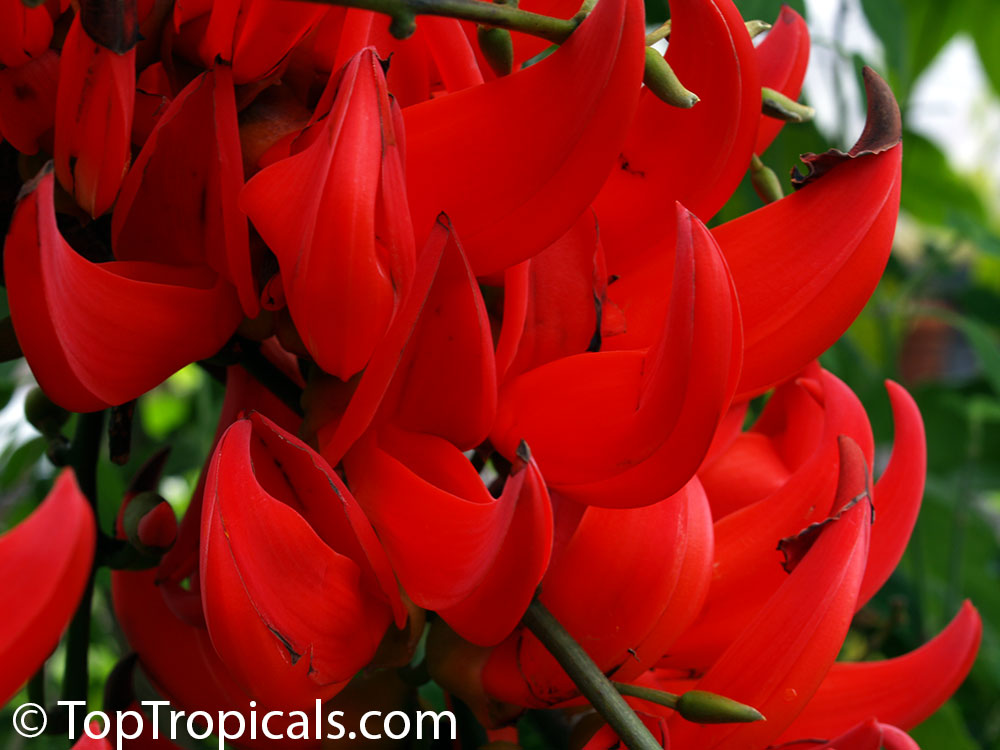
Q: My Red Jade Vine has the leaf tips turning brown. I water this plant four times a week and I am using a half a teaspoon of miracle grow bloom booster 15-30-15 per 2 gallons, every two weeks. In the beginning I had to water this plant off city water in South Fort Myers. Over the last two months I picked up a dechlorinator buggy plus threw that on my hose and I've been watering it with that but it didn't seem to make a difference. I put this plant in the ground last September. It has three shoots that run into the top of the tree, so it is growing but leaves seem to drop off down low at the base of the vine and the brown tipping running into the top of the plant. But not the newest shoot its leaves are solid green all the way at the top. Thanks for any advice.
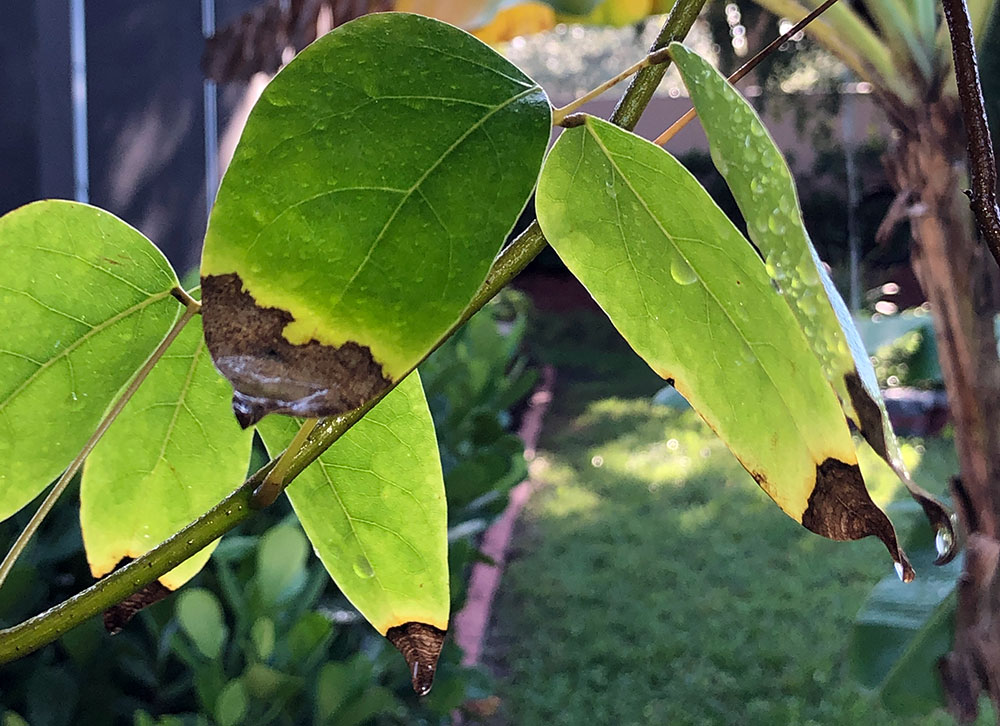
A: Mucuna benettii - Red Jade vine - is not the easiest plant to grow, and
we are glad your vine is growing well. For those who love this plant but not
ready to face all challenges, we recommend its cousin - Camptosema grandiflora - Dwarf Red Jade Vine, which is much hardier and
easier plant.
We looked at the photos and these are our thoughts.
1) The top of the plant with green fresh leaves definitely indicates
that the plant is generally healthy and vigorous.
2) Dry tips of the old leaves may indicate excess salts in soil, in
combination with the summer heat that it went through. Based on your feeding program
description, that fertilizer may create a problem. Water soluble traditional
fertilizers are EDTA-chelated which often causes nutrients lock up in soil
and leaf drop. Try to stay away from that fertilizer for a month and let the
rains and/or irrigation water flush the soil for a couple of weeks.
3) Red Jade vine is a very sensitive species. Normally, during hot season
it is safe to use traditional fertilizers, especially slow-release granulated.
However, with this plant we recommend you to switch to more delicate formula
and use only liquid fertilizer.
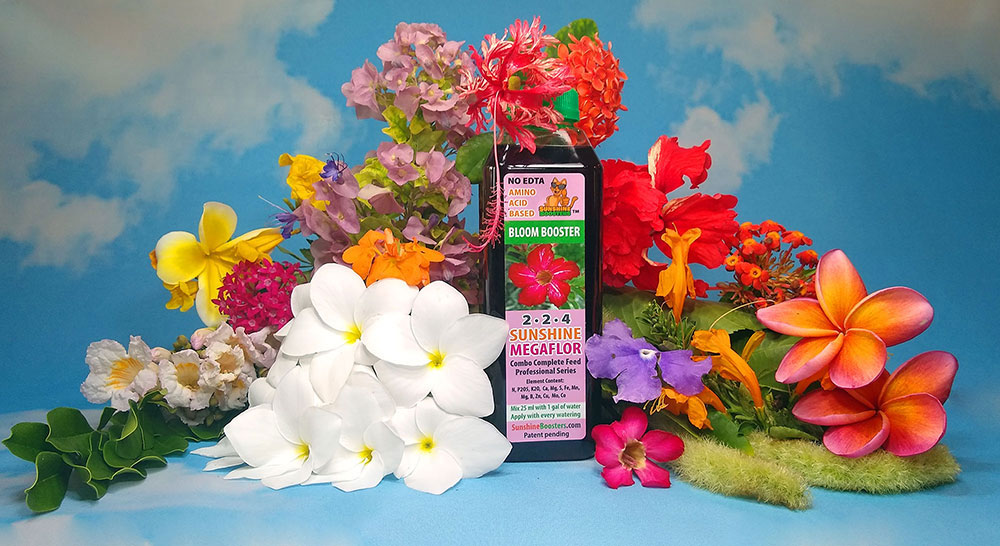
SUNSHINE Megaflor - Bloom Nutrition Booster will be the best. It is
safe to use it as frequent as with every watering! It is amino-acid
based, and will be totally consumed by the plant without nutrient lockup.
4) Another cause of dry leaf tips may be micro-element deficiency.
Megaflor booster already has all necessary micro-nutrients in it, plus you
may apply some extra: SUNSHINE Superfood.
5) You may continue using regular water for watering (including city water)
as long as you use amino-acid based plant food and supplements: they improve
soil acidity (what tropical plants like is acidic soil, and Florida soils
are alkaline). Additionally, to improve soil acidity which can be critical for
this Mucuna species, you may add 1"layer of pure peat moss on top of the
soil around the plant. Please keep us in loop how the plant is doing. It is
pretty rare species in cultivation and we will be happy to help you to keep it
thriving.
Date: 26 Mar 2026
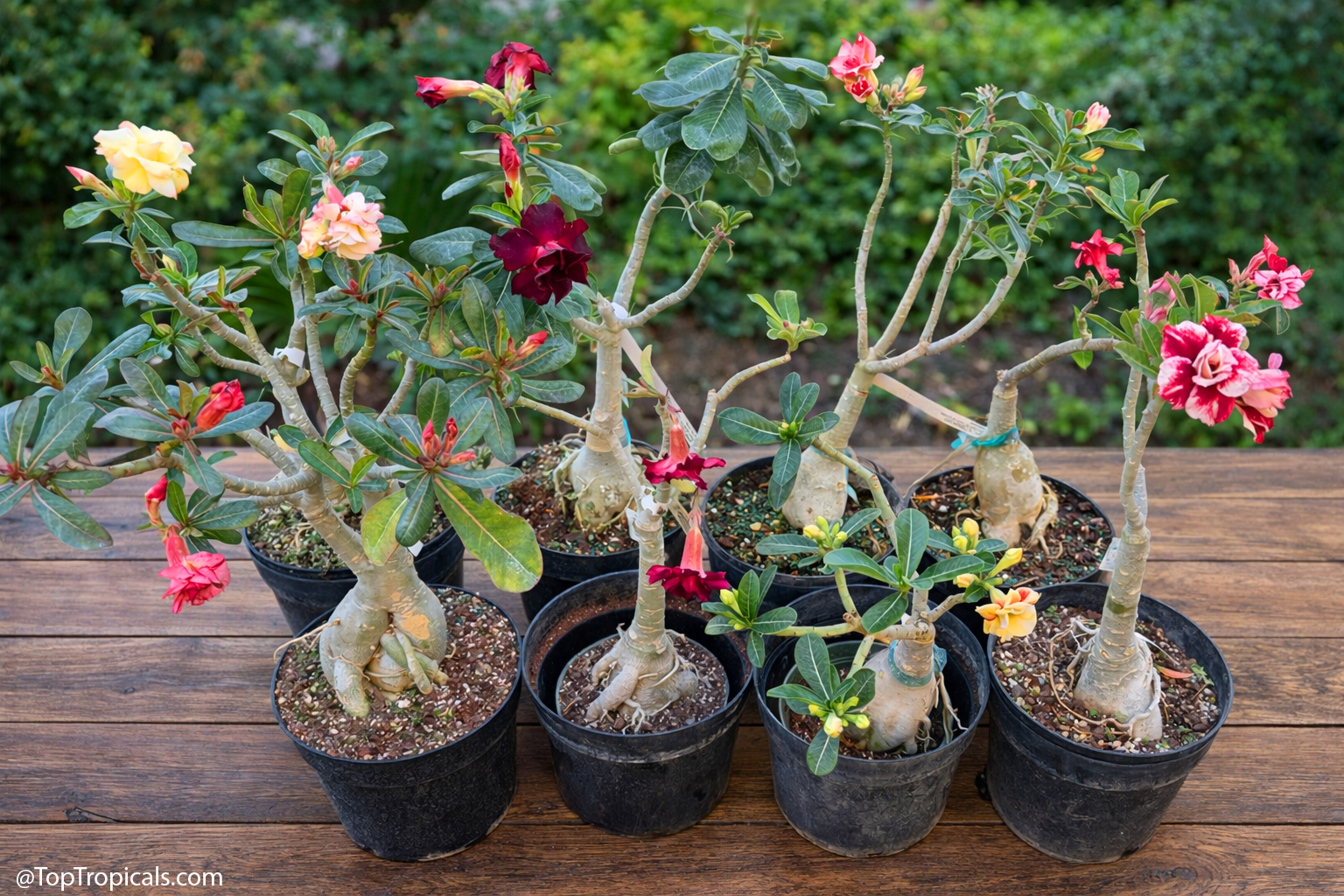
🌸 How to Grow Adeniums Without Overthinking It
By Tatiana Anderson, Horticulture Expert at Top Tropicals with Smokey & Sunshine help

✅ Simple rules that actually make them bloom and grow well
- Light - The more light, the better the growth and flowering. Full sun is ideal, but in very hot climates, filtered bright light keeps plants looking healthier.
- Water - Water well, then let soil dry on the surface. Sitting in wet soil damages roots, but letting plants dry out too often can push them into early dormancy.
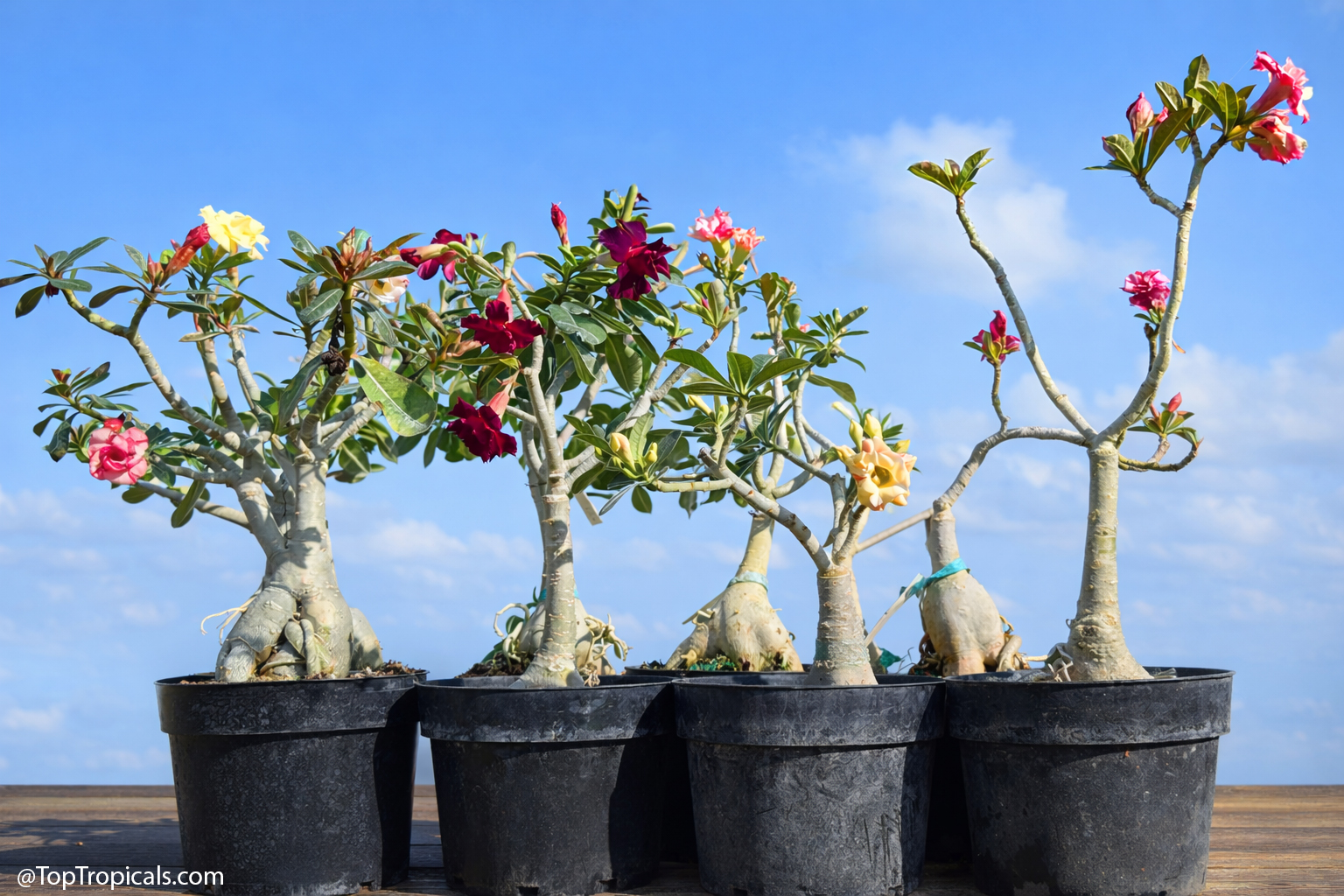
- Pot and shaping - Use a shallow pot with excellent drainage. To develop a sculptural caudex, lift the plant slightly each time you repot and remove some of the top soil so upper roots become exposed. Over time, this creates a thicker, more prominent base.
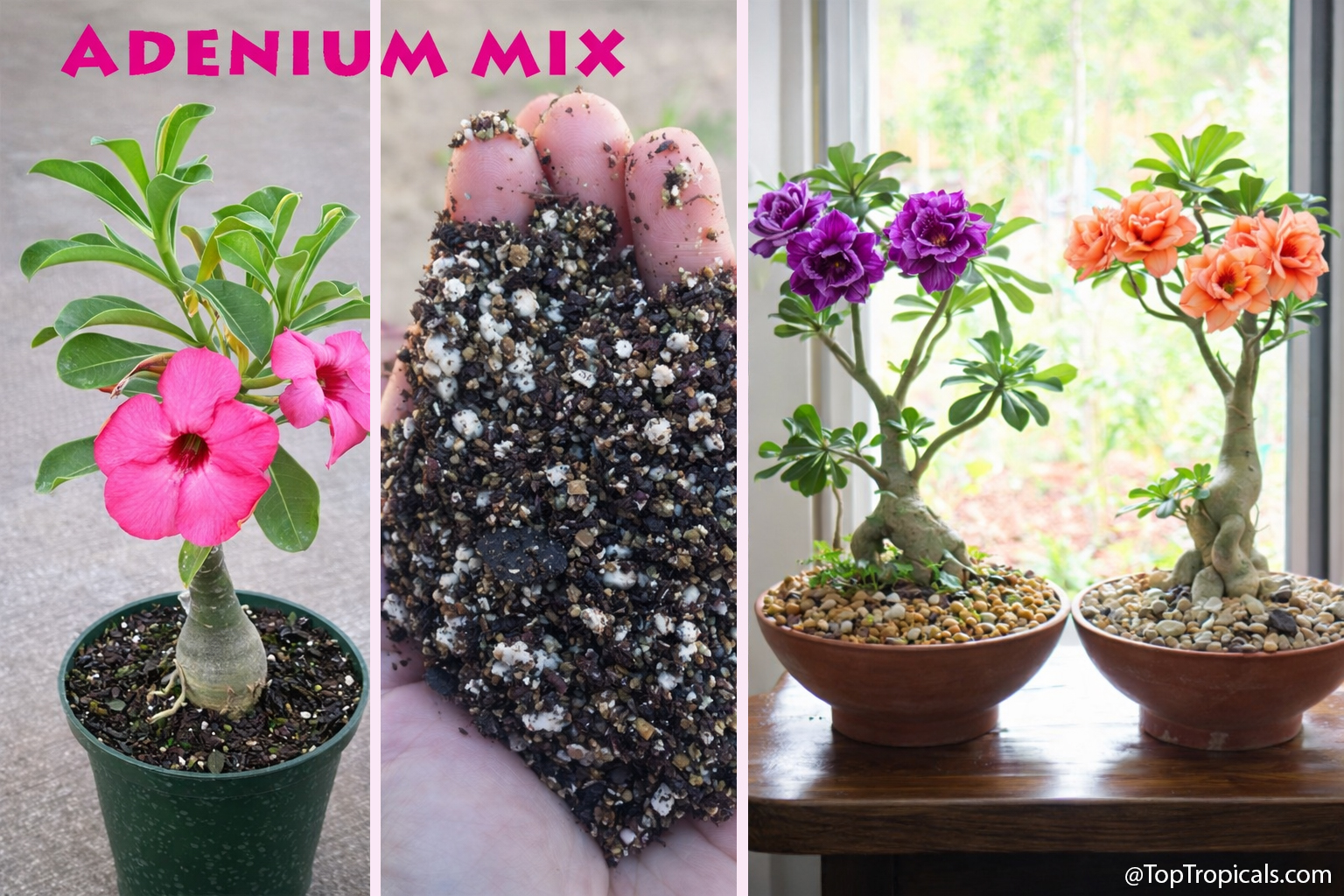
- Soil - Use a fast-draining Adenium potting Mix.
- Cold hardiness - Adeniums are tropical and do not tolerate frost. Keep above 40 F. Brief drops to mid 30s may be tolerated if dry, but cold and wet conditions can damage or kill the plant. In cooler climates, bring indoors or protect during cold nights.
- Indoor winter care - Move plants indoors before cold nights. Place in the brightest spot possible, ideally a south-facing window. Or use additional lighting. Water very lightly and less often, as growth slows. Do not fertilize during dormancy. Some leaf drop is normal in winter.
- Feeding - Adeniums respond best to liquid fertilizer. We apply Sunshine Megaflor Booster with each watering throughout the year. During dormancy, watering is reduced, so fertilizer use decreases accordingly. Consistent, light feeding promotes strong roots, a thicker caudex, and improved flowering.
- Pruning - For multiple blooms, regular pruning is essential. After flowering, cut back long or leggy growth to stimulate branching. Each new branch can produce more buds, leading to a much fuller bloom in the next cycle.

✍️ Learn more about Adeniums from our Blog
🎥 Watch videos of Adenium Rainbow
🛒 Explore Exotic Adenium varieties