Garden Blog - Top Tropicals

Date: 2 Oct 2025

Blue Ice Cream banana youll never find in stores!

Blue Java Banana, Ice Cream Banana

🍌 Blue Ice Cream banana you’ll never find in stores!

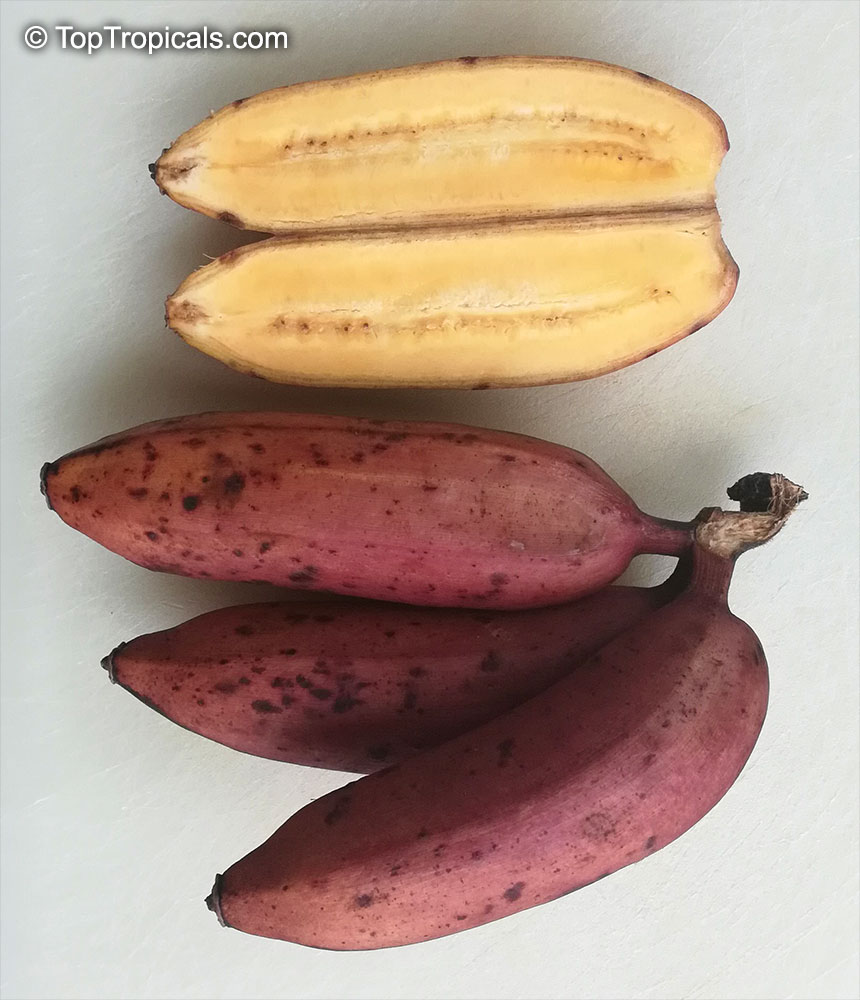
  • 🔵 The Blue Java Banana, also known as the Ice Cream Banana, is the banana everyone wants - and for good reason.
  • 🔵 First of all… it's blue. Yes, really. When the fruit is unripe, it has a frosty blue-green tint - especially striking in the sun. These short, chunky bananas are only about 4 inches long and grow in beautiful bunches under mauve-colored flowers. The whole plant is a tropical showstopper.
  • 🔵But the real magic happens when the fruit ripens. The blue fades to yellow… and inside? Oh my God - it’s heaven! The texture is soft, smooth, and creamy. And the flavor? Like vanilla ice cream.
  • 🔵That’s how it got the name Ice Cream Banana. And this isn’t just a gimmick - it’s a cold-tolerant, vigorous variety that grows fast, reaches 10-15 feet tall, and produces heavy bunches (up to 60 pounds!) of sweet fruit that you can eat raw or cook with.
  • 🔵 Your store-bought bananas can’t compete with this. Add it to your edible landscape, food forest, or patio garden - this one is a must-have! Grab it while it’s in stock. Or if it’s sold out - hit that wishlist button.


🛒 Explore Banana Varieties

📚 Learn more:


#Food_Forest #Bananas

🟢 Join 👉 TopTropicals

Date: 9 Oct 2025

Surprising Miniature Gardenia

Gardenia radicans - Dwarf Miniature Creeping Gardenia

Gardenia radicans - Dwarf Miniature Creeping Gardenia

Gardenia radicans - Dwarf Miniature Creeping Gardenia

Gardenia radicans - Dwarf Miniature Creeping Gardenia

Gardenia radicans - Dwarf Miniature Creeping Gardenia

Gardenia radicans - Dwarf Miniature Creeping Gardenia

💮 Surprising Miniature Gardenia

  • Gardenia radicans - Dwarf Miniature Creeping Gardenia - can surprise even longtime gardenia fans. It has all the charm of the classic shrub - glossy green leaves, pure white flowers, and that unforgettable fragrance - but in a smaller, easier form.
  • Natural bonsai. This little plant grows low and wide, staying under 1-2 feet tall and spreading up to 3-4 feet. It forms a dense mound or creeping groundcover that looks great along walkways or spilling from a pot. The leaves are tiny and shiny, giving it a neat, polished look all year.
  • The flowers are about an inch across, double or semi-double, and smell just like the full-size gardenia. They bloom in spring and often return through summer, filling the air with perfume.
  • Easier than other gardenias. Gardenia radicans isn’t as fussy as most gardenias. It can handle clay, sandy, or loamy soil as long as it drains well. Once established, it’s fairly drought-tolerant and can even handle some cold, down to around 15F in protected spots.
  • Where to plant. It's perfect for small gardens, patios, or as a bonsai. You get the luxury fragrance of a gardenia without needing a big space. Use it as a groundcover, edging plant, or container specimen. It's one of those plants that stays tidy, looks refined, and keeps blooming. For anyone who loves gardenias but wants something compact and low-maintenance, Gardenia radicans is a great find.


🛒 Add unique Mini-Gardenia to your collection

#Perfume_Plants #Container_Garden

🟢 Join 👉 TopTropicals

Date: 22 Mar 2017

Condo Mango

Q: I was curious about indoor fruiting mango trees. I live in upstate New York and was thinking about trying to grow an indoor tree for fruit. I have a small heated greenhouse. Is there a variety that can be grown from seed that would suit my purposes and if not what is the most economical way I could obtain a cutting or small grafted plant? I keep my greenhouse around 60F in the winter and have no supplemental lighting. Are there any varieties that may work in a sunroom or other well lit indoor location?

A: There are many dwarf varieties of mango suitable for container culture. They are called "condo mangoes".
The most popular condo varieties are: Carrie, Cogshall, Cushman, Fairchild, Graham, Ice Cream, Julie , Mallika, Nam Doc Mai, Pickering. You may read more about them in our online catalog. You may also look into variety Lancetilla which is also a compact tree, and produces one of the biggest size fruit, up to 5 pounds. If you want some rare variety that hardly anyone else has - try Baptiste, an exotic Haitian dessert mango.

Your greenhouse should work for the winter time. Mango trees can take as low as mid 40s during winter and even lower as long as that cold is occasional. If you keep the temperature around 60, this should work well for over wintering. Just make sure to reduce watering to a minimum, because cool temperatures, low light and wet soil - is a bad combination for tropical plants, especially for mango trees which prefer to be kept on a dry side.

Many indoor gardeners have fruiting mango trees in their collection. However, keep in mind that the most important requirement for a mango is full sun. While you may over winter the plant for a few months in a low light conditions, in order for it to flower and produce fruit it needs lots of light. If moving the tree into full sun your yard during the summer is possible, this would be the best solution.

We always recommend SUNSHINE boosters for both over wintering tropical plants in colder climates, and for indoor gardening. SUNSHINE applications will help your tree to cope with cool temperatures and low light conditions. This will also dramatically increase flowering and fruiting performance. Another important factor for keeping your container plant healthy is quality of your potting soil. We offer a special professional mix that contains lots of good stuff: coconut fiber, peat moss, pine bark, and perlite. Fertilizing potted plants is also very important during the warm season, because this is the only way for them to get nutrients (which in the ground can be reached by spreading root system).

As far as seedlings vs. grafting - the only way to have a nicely fruiting mango tree is to plant a grafted variety. Seedlings start producing only after 8-15 years, and the quality of such fruit may be questionable. Only grafted plants can guarantee the desired taste of a variety. Besides, grafted mangoes start producing immediately - you may see fruit forming on plants as small as 3 ft, in 3 gal containers. However, during the first 1-2 years you will need to remove extra fruit and leave only 1-2 fruit so the plant doesn't get exhausted and has enough energy to establish strong root system.

For fun stories about growing mango, check out our Radio Show recording YO Tango Mango!

Date: 6 Jan 2024

Ten New Year Resolutions:
Diversity in Tropical Garden

Cat  diversity  in  the  garden

1. Diversity. Grow different plants. Add more types of tropical plants to your garden for a colorful and diverse look.

2. Save Water. Use water wisely by installing drip systems, collecting rainwater, and using mulch to keep the soil moist.

3. Improve Soil. Make your soil healthier by adding compost or manure regularly. Healthy soil promotes robust plant growth and enhances overall garden resilience.

4. Deal with Pests Smartly. Keep pests in check with a plan - use natural solutions and check your plants often. Preventing program is easier than dealing with infestations.

5. Right Fertilizing. Feed your plants with Eco-frintdly fertilizer such as Sunshine Boosters (safe to use year around). If you use slow-release fertilizers - apply in right amounts, from March to November.

6. Trim Regularly. Keep your garden tidy and healthy by pruning and removing dead or sick parts of the plants.

7. Companion Planting. Explore which plants work well together to enhance nutrient uptake, fight pests and provide shade for those species that need it.

8. Right Climate and Zone Pushing. Pick plants that love your climate, considering sunlight, temperature, and humidity. For more sensitive tropical plants, work on a plan for cold protection: grow them in pots or set up temporary covers.

9. Teach Others. Share your gardening knowledge with the community. Propagate your plants from seeds, cuttings, divisions - and share them with friends and neighbors. Remember: live plant is the best gift, and love is sharing!

10. Make a Relaxation Spot. Create a cozy corner in your garden with comfy seating or hammock, shade, and maybe a water feature for a peaceful retreat.

Cat  in  hammock

Date: 31 Oct 2023

Cat of the day:
Shaka. The Tail of Two Kitties...

By Kristi VanBenschoten

New  born  kitten

For those of you who have been following the Cat of the Day stories, you may remember the heartbreaking story about Little Raja... When Raja passed, I was heartbroken and vowed, "No more new cats." Well, wouldn't you know, I would eat those words...

One of our shipping experts, Rob, came in and said that a feral cat around his house had just given birth to a kitten on his front porch, but the mother had left and not returned. I immediately asked him to go get me the kitten, knowing it was going to be cold and hungry and could not be left without warmth and food for long...
Rob rushed off to get the kitten and, within what felt like the blink of an eye, returned with the tiniest (about 4 inches), yet astonishingly vocal, kitten I had ever met.

And this is what happened next...

New  born  kitten