Date: 24 Jun 2018
SUNSHINE-SuperFood for your plants health
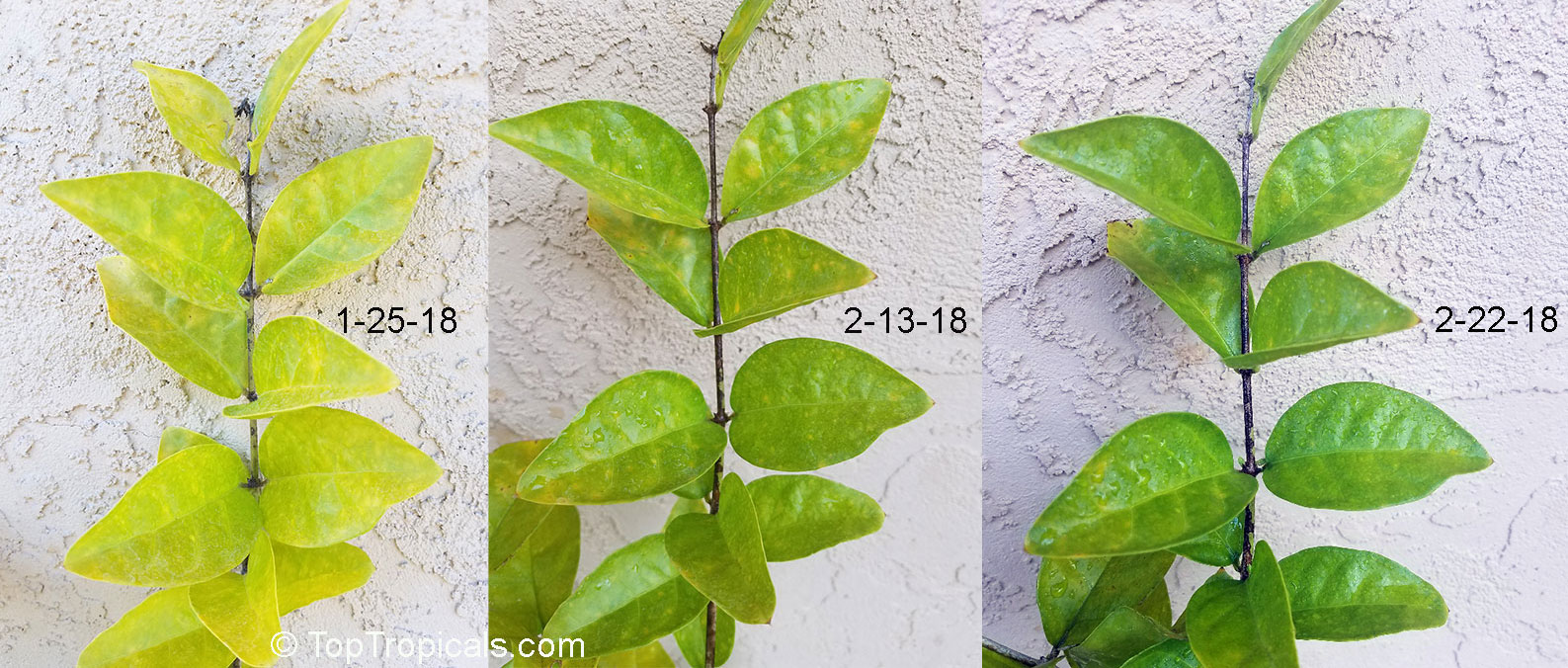
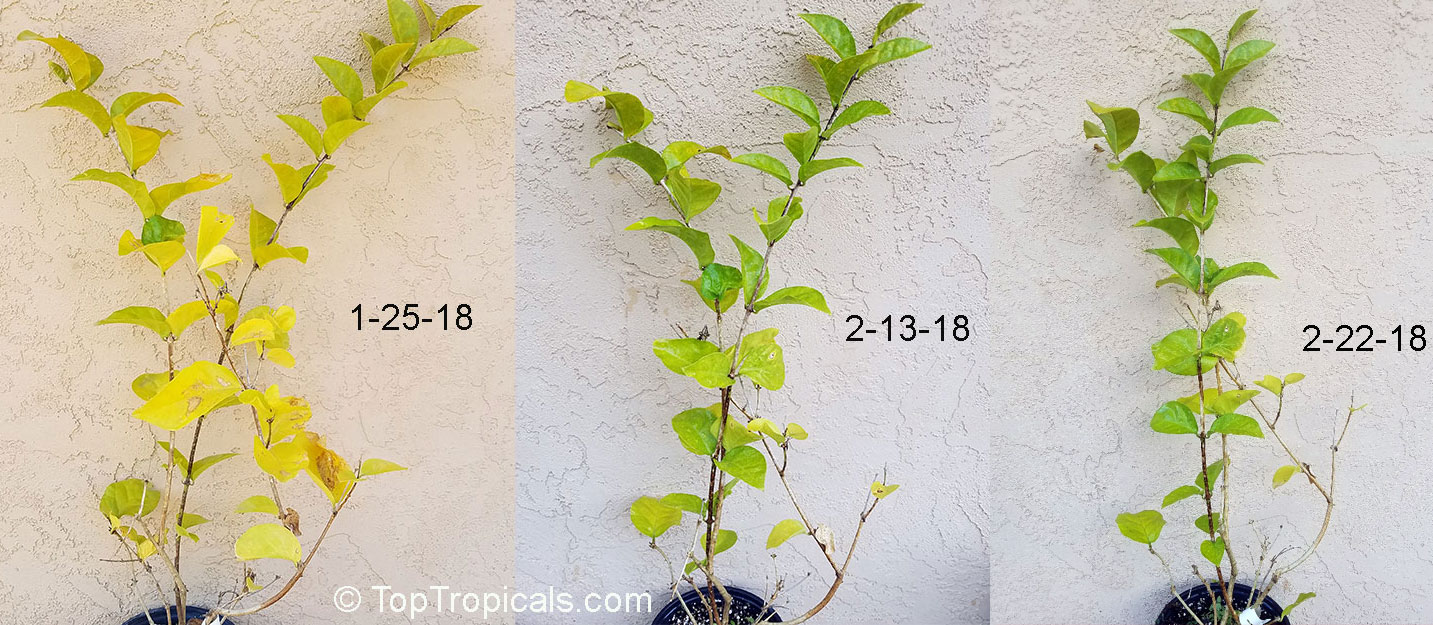
We are getting very high interest from our customers to our new plant booster SUNSHINE-SuperFood as well as many questions. We continue experimenting with the Jasmine that you saw in our previous newsletter, that had pale yellow leaves and numerous deficiencies. Right now, after only 2 applications, it looks healthy green again. Click on the picture to zoom in and see leaves turning from yellow to green within less than a month. See also full plant photo of this jasmine.
Q: Is SUNSHINE-SuperFood a fertilizer?
A: Traditionally we call a fertilizer macro-elements (NPK - nitrogen, phosphorus, and potassium). Technically, SUNSHINE-SuperFood is a complex of micro-elements that are essential for plant's health. It provides such elements as Mg, Fe, Mn, Zn, Cu, B, Mo, S, and Amino-acids that our soils are usually poor of. These elements are responsible for proper development of leaves, roots, flowers, and overall plant vigor. Read more about role of these micro elements.
Q: Can I just get these additional elements in a dry form and add to soil like a fertilizer?
A: No. Some of these elements must present in extremely low concentrations (this is why they are called micro-). SUNSHINE-SuperFood is a liquid substance with very high bioavailability that has very complicated formula; it is not just a mix of the elements. The formula is developed with the maximum efficiency for a plant to absorb through leaves and a root system.
Q: Is it better to spray leaves or water the plant with the solution?
A: Foliar applications are always most efficient in regards of seeing a quick result. However, we recommend to also drench the root ball with SUNSHINE-SuperFood solution to deliver the necessary elements evenly to all parts of the plant through its natural metabolism.
Q: My gardenia looks very sad after winter - most leaves are yellow and some have pale spots. Should I use SUNSHINE-SuperFood more often and in higher concentrations?
A: We recommend to apply SUNSHINE-SuperFood once a month to maintain a general plant health. In difficult cases like with this jasmine on the photo, you can do twice a month. However do not exceed recommended concentration. The rule of thumb is, you can apply water soluble fertilizers and supplements more often, but with lower concentrations - this way a plant will be more responsive. Plant metabolism in general is rather slow, changes take days and weeks - don't try to speed it up. Your patience will be rewarded.
Try SUNSHINE SuperFood on sick looking plants, especially with leaves that are yellowing, deformed or have spots (see photos of different deficiencies). There are no miracles, but this one works like a Miracle! All you need is a few drops of SUNSHINE SuperFood - item 6000! We also have bottles 50 ml and 100 ml for large plant collections and yard/landscape applications. Read more about SUNSHINE SuperFood...
Date: 24 Jun 2018
Elephant Foot, Turtle Shell - back in stock!
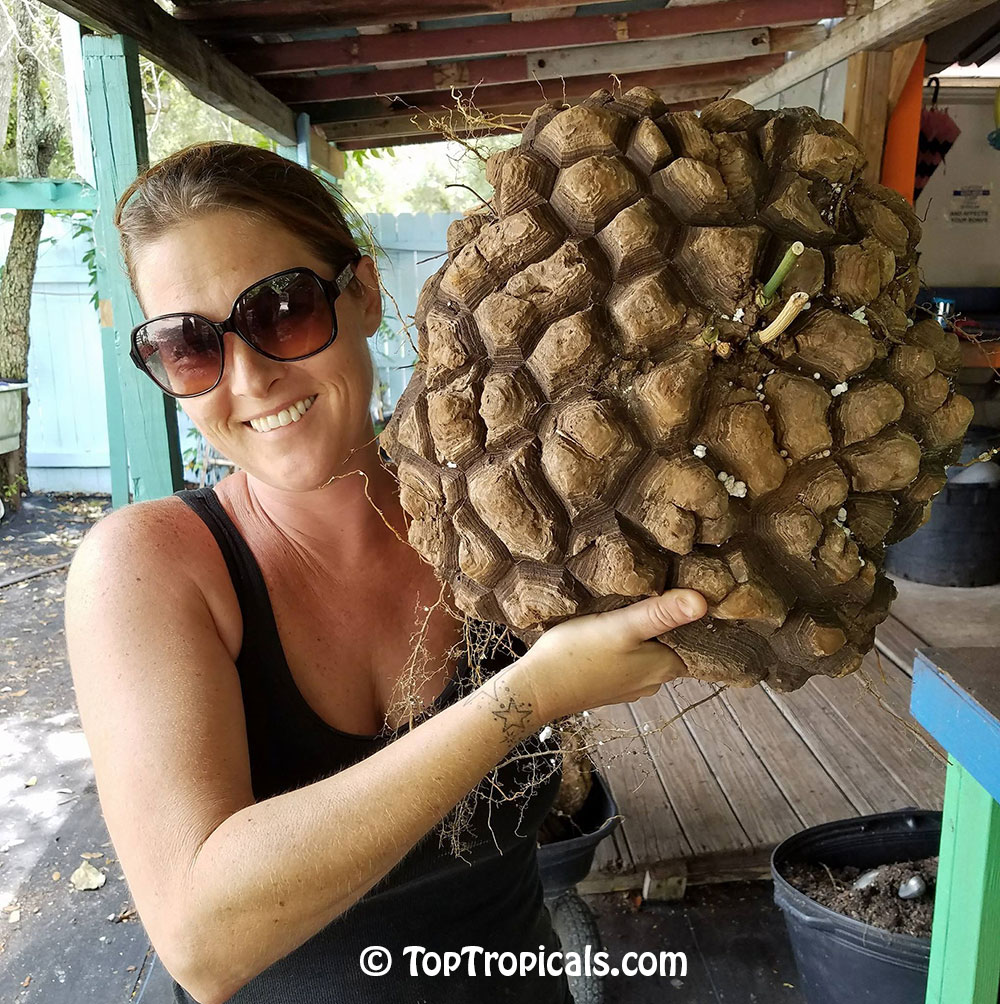
Dioscorea
elephantipes.
Dioscorea is a curious plant
with tuber above ground level covered with layers of corky
bark, resembling a caudex. It is a slow growing, very
unusual succulent. Tuber contains saponins, originally
cooked and eaten as a famine food by the Hottentots.
Caudex that grows up to 6' in nature, resembling an
elephant's foot and looks as if it is segmented into
geometric patterns (smaller plants look like tortoises)
and looks dead but is actually a living tuber. A plant
with 18"caudex can be almost 100 years old! The plant
grows into a vine with attractive heart-shaped leaves and
small yellow flowers. Culture is relatively easy. The
vines may die back and regrow several times a year,
depending on the particular plant and your region. The
plant doesn't send down deep roots, so plant in a shallow
pot about 1" larger than the diameter than the caudex. Potting soil should be very
porous/loose so that there is easy drainage. Water
well around the edges. Keep in a warm area and wait for
the first shoots of the vine to appear. Water regularly
from that point on. The plant should not be kept damp as
with other tropical plants. Allow it to dry before
watering again. Many books will say that they are winter
growers, because they are native to the southern
hemisphere. In fact, they grow in all seasons! Let the
plant be your guide. You cannot force them to grow, and
over watering will simply cause them to rot.
Elephant Foot is a collectors item, but remarkably easy to
grow. It will be with you for years with no effort. It is
a wonderful conversation piece! See more info about Dioscorea
elephantipes.
We have limited stock, while supply lasts, hurry up!
*** 4-6"caudex *** 6-8" caudex *** 10-12"caudex *** Seeds. Don't forget special TopTropicals Adenium Soilless Mix
Date: 19 Jan 2022
Avocado Q & A
Sensation: Avocado 2.5 y.o seedling just bloomed!
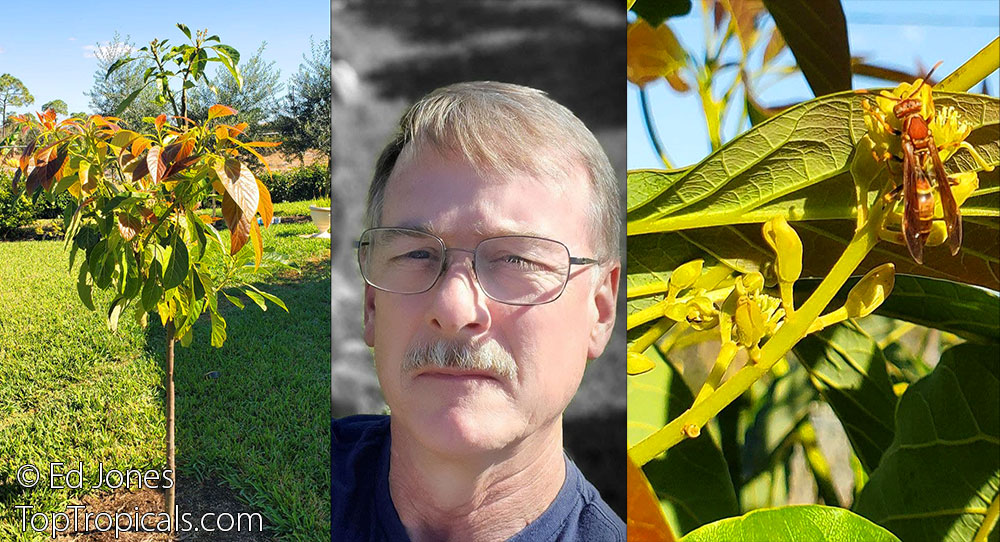
Ed's Avocado seedling blooming at age 2.5 years old... Go figure!
Q: Can I plant a seed from a store bought avocado and expect it to bear fruit?
A: Avocados grown from seed do not always come true, meaning being the same as the avocado that produced the seed being planted. Also, avocados grown from
seed will take upwards of 8 years to flower and bear fruit unless grown by Ed Jones and his witchcraft. Ed Jones, the Avocado Guy... Yes,
he is also the Mango Guy, and the Booster Guy... We don't know how he does it. He grows the most beautiful fruit trees, many of them from seed and they all
seem to flower within two years! (See his blogs about his Star Fruit, Olive trees, and video about Shaping Mango Trees). All we know for sure, he uses
Sunshine Boosters for all his plant experiments.
As far as Avocado
, we recommend a grafted variety, where a scion, or branch tip, of a known cultivar is grafted to good rootstock. These trees will usually flower right away and bear good amount of fruit within a couple
of years of being planted in the ground.
It's a good chance now to get a good grafted Avocado on our special Happy Value Sale
Date: 12 Jul 2022
The Milkweed and the Monarch, how to raise your own
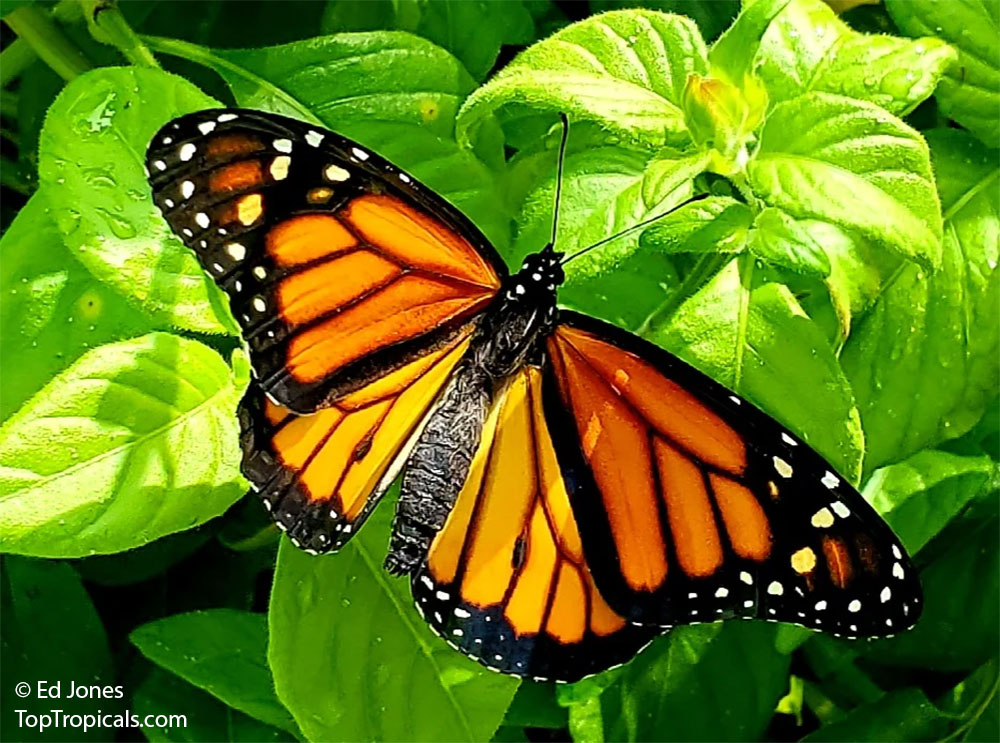
by Ed Jones, the Booster Guy
...How to attract butterflies in your garden? What plants do butterflies
love? How to grow those plants when butterfly larvae keep eating them?...
Many gardeners ask these questions and butterfly attracting plants always
have been very popular. But did you know that you could actually turn your
garden into a little butterfly farm?...
Find out from Ed and Juvonda's butterfly mini-farm experience!
CONTINUE READING >
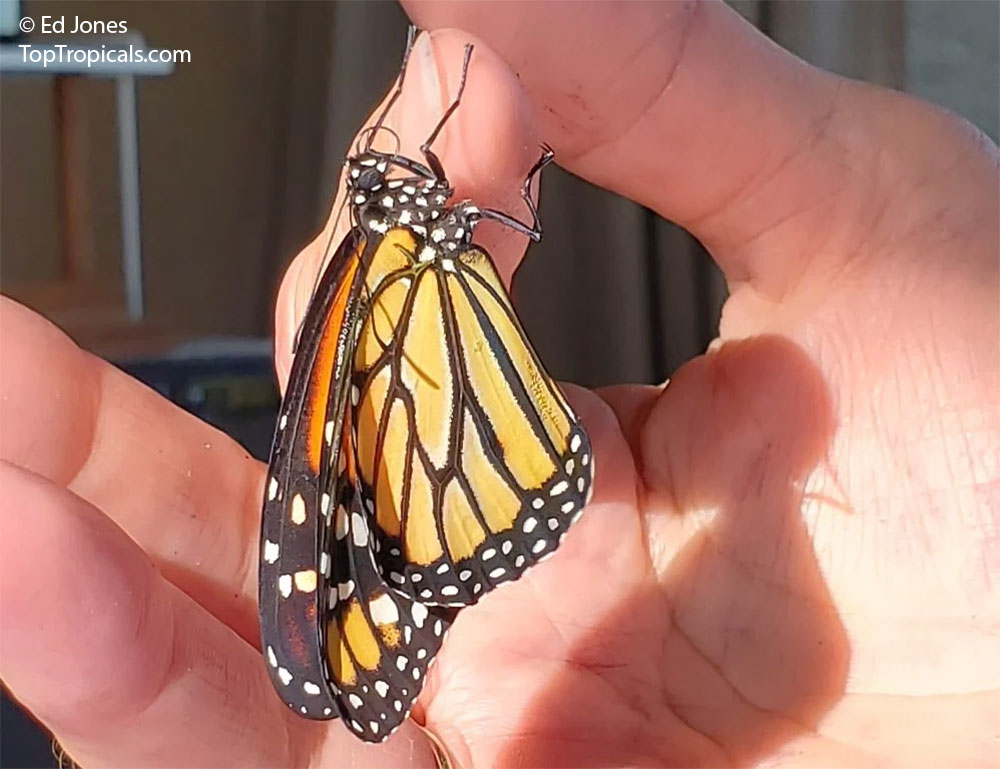
See full list of butterfly attractors
Date: 21 Oct 2025
Cassia vs Bauhinia: which is better as an everblooming container tree?
Cassia vs Bauhinia: which is better as an everblooming container tree?
- 🌸 Cassia (Senna) trees are very popular flowering trees - fast growing, free-flowering, relatively cold hardy, and they love the summer heat. Cassias come in several colors: yellow, orange, pink, red, and rainbow. Rainbow varieties (which are hybrids between yellow and pink cassias) are the most popular thanks to their multicolor blooms with swirls of yellow, pink, red, and orange. But while Rainbow Cassia is a spectacular flowering tree for southern gardens, is it a good choice for a container when you want color on your patio or pool deck?
- 🌸 Some yellow-flowering cassias make attractive bushes that bloom most of the year and stay compact, so they can be grown as container specimens: Cassia didymobotrya- Popcorn Cassia
- 🌸 When it comes to Rainbow or pink cassias such as Cassia javanica - Apple Blossom Tree or Cassia grandis- Red Cassia and other species and hybrids (Cassia marginata - Rainbow Shower Tree, Cassia roxburghii - Ceylon Senna, Cassia x nodosa - Pink Shower), these are usually more vigorous trees that may take several years to bloom. Their flowering season lasts from a few weeks to a couple of months. These trees grow moderately fast but typically need to reach about 10 feet before they start flowering.
- 🌸 So, the answer is: if you want rich, deep color year-round from a container tree, go with Bauhinias - Orchid Trees. Most varieties grow well in pots, stay compact, and reach blooming maturity within just one season. The following varieties are everblooming and can produce flowers for up to 10 months of the year:
Senna alata - Empress Candles
Cassia fistula - Golden Shower (a compact size winter blooming tree)
- Bauhinia madagascariensis - Red Dwarf Orchid Tree. Blooms from winter through fall, up to 10 months a year. The most cold-hardy of all.
- Bauhinia blakeana - Hong Kong Orchid Tree. A large tree in the ground, but compact in pots if trimmed. Grafted trees flower right away. Winter bloomer, cold hardy to light frost.
- Bauhinia tomentosa - Yellow Orchid Tree. Flowers from Winter through Summer, cold hardy to light frost.
- Bauhiniamonandra - Napoleon's Plume Orchid Tree. Almost everblooming with the longest flowering period (less cold hardy than the first three).
- Bauhinia acuminata - Dwarf White Orchid Tree. Blooms from summer through winter (also less cold hardy than the first three).
🛒 Explore Cassia trees and Bauhinias (Orchid Trees)
📚 Learn more:
- ✦ How to add color to your yard with Cassias
- ✦ Rainbow Cassias and Why they are called "Rainbow"
- ✦ Napoleons Plume - Orchid Tree that blooms in a pot
- ✦ Bauhinia madagascariensis, or Red Butterfly Orchid Tree that NEVER Stops Blooming
- ✦ Rare Red Orchid Tree you may never find again but everyone wants
- ✦ Bauhinia acuminata, Dwarf Orchid tree - white and elegant
- ✦ 5 small tropical trees that bloom all summer or year around
- ✦ How to grow Orchid Trees in pots
#Container_Garden #Trees #How_to
🟢 Join 👉 TopTropicals