Garden Blog - Top Tropicals

Date: 24 Jun 2018

TopTropicals

Avocado, Lychee and Mango setting fruit... give them some FOOD!

Q: Do I need to fertilize tropical fruit when they set fruit?

A: It is traditionally believed that mango and other tropical fruit shouldn't be fertilized during fruiting period. It is true to an extent: you don't want fruit to burst from fast excessive growing. Instead, try to feed fruit trees wisely, because they still need proper nutrition to produce flowers and fruit.
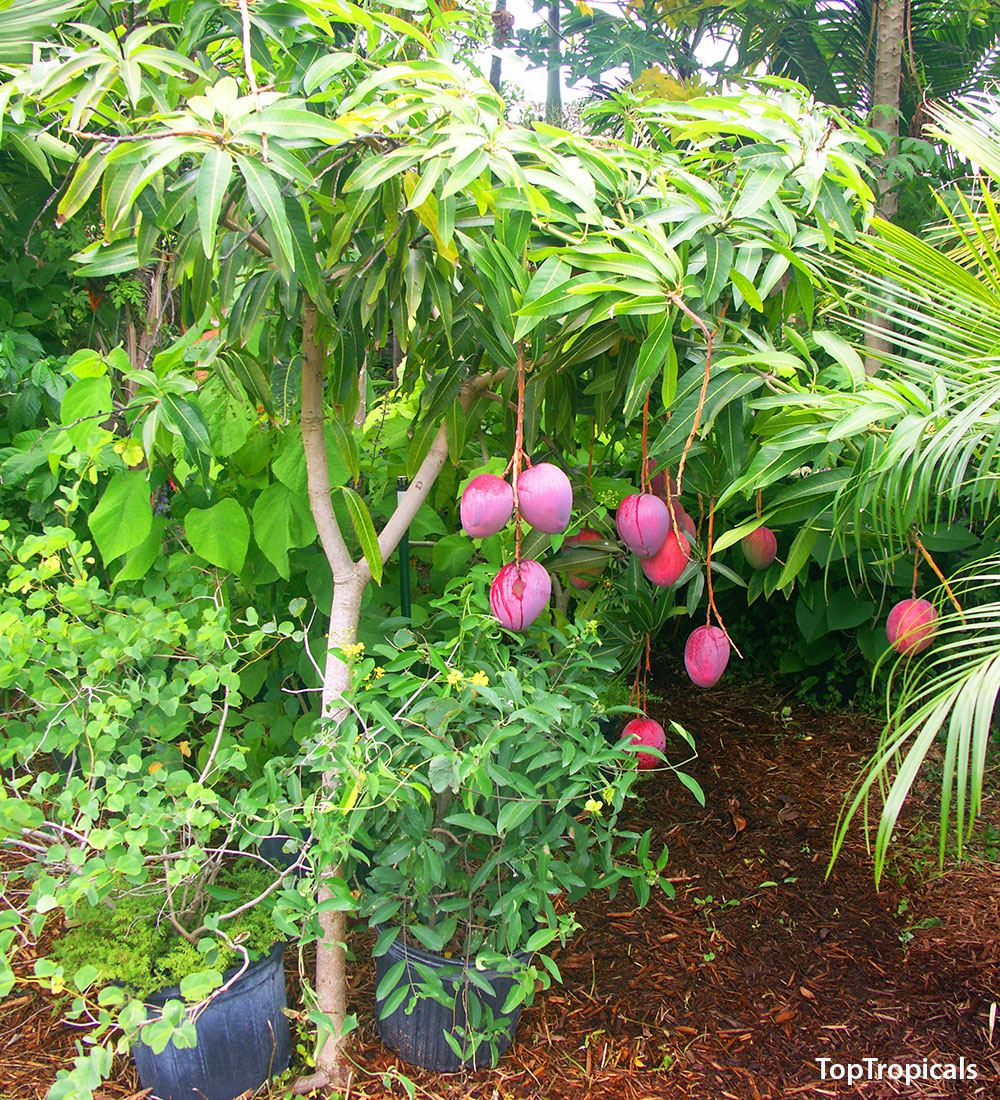
Our spring specials of Lychee, Avocado and Mango are full of buds and some already set tiny fruit (see examples on the photo). Here is the feeding plan for these plants once you receive your mail order:
1) Once received the plant, pot it into container size of the root ball and let establish for couple weeks. Use SUNSHINE-E to help the plant recover from shipping stress and establish root system.
2) Apply SUNSHINE-Honey right before flowering, and next time at setting fruit, to provide sweeter and bigger fruit, eliminate fruit cracks and help resist fungus and other fruit diseases.
3) Use balanced granulated fertilizer, 1 tsp per each gallon of soil. Apply once a month during Spring-Summer season. This gives the plant balanced macro-elements (NPK) necessary for overall plant health. Do not use on fruit trees fertilizers with high Nitrogen content.
4) Apply SUNSHINE SuperFood micro-element booster to keep fruit trees vigorous, develop strong root system and avoid deficiencies.
5) In case of signs of chlorosis (yellowing leaves with darker veins), give the tree SUNSHINE-GreenLeaf and watch the leaves turning green quickly.
After harvesting, don't forget to make another treatment of SUNSHINE-Honey as a preparation for the next year flowering and fruiting season.

Date: 29 Jan 2026

How to make Sapodilla fruit profusely?

Sapodilla - Manilkara or Achras zapota, the Brown Sugar Fruit

🍊 How to make Sapodilla fruit profusely?


Sapodilla - Manilkara or Achras zapota), the Brown Sugar Fruit is a warm-climate evergreen fruit tree that can produce a lot of fruit once conditions are right. So why do so many sapodilla trees grow beautifully, flower heavily, and still refuse to set fruit?

Sapodilla Fruit Production - What Really Matters

1. 🌳 Choose the Right Tree
Grafted or air-layered trees fruit much sooner - typically in 1-2 years - and more reliably than seedlings, which may take 6–8+ years.
Some varieties are more profuse producers than others. For example, Silas Woods is virtually everbearing, Hasya is commercial prolific producer, Oxkutzcab (or Ox) -is also heavily productive (learn more about varieties).

2. ☀️ Environment: Heat, Sun & Water Balance

Temperature and Humidity
Excessive heat above 90F and low humidity can cause flowers to dry up and fall before setting fruit.
Solution: Provide filtered light or shade during the hottest part of the day to reduce heat stress on blossoms.

Water
Sapodillas are drought tolerant, but consistent moisture during flowering and fruit set improves fruit retention.
Avoid waterlogged conditions - soggy soil can stress roots and reduce yield.

Sun Exposure
Full sun is best for growth and flowering - but for hot climates, protection during peak afternoon heat helps reduce flower drop.
Young trees can also suffer sunburn.

3. Fertilization: Feed for Fruit, Not Just Foliage
Good nutrition is critical for flowers to turn into fruit. Apply a routine feed through the growing/flowering season - contolled-release (Green Magic) or liquid (Sunshine C-Cibus) both work.
Balanced fertilizer with trace elements like Boron (B), Molybdenum (Mo), Iron (Fe), and Copper (Cu) is essential for fruit set and development. Boron & Molybdenum deficiency as a frequent cause of flower/fruit drop in container-grown trees (nutrients get depleted quickly in pots).
Micro-nutrient sprays 2-3 times per year help improve fruit retention and quality. Some growers use sugar boosters (Sunshine Honey) or micronutrient blends that include Mo & B to help fruit set (Sunshine Superfood).

4. 🐝 Pollination - Often Overlooked
Sapodilla flowers are small and often require pollinators for best fruit set.
In some regions, small insects like thrips are key pollinators.
In places with low insect activity, hand pollination dramatically increases fruit set - brushing pollen from one flower to another with a small paintbrush during peak bloom times can help.
Placing fruit scraps (apple peels/banana peels) under the tree to attract beetles is an inexpensive way to boost insect activity.

5. ✂️ Pruning and Tree Structure
Moderate pruning can help open the canopy for better light penetration and air circulation, which supports flowering and reduces stress. Training young trees promotes a strong branch structure that can carry more fruit later. Sapodilla flowers on young growth (tips of the branches).

6. Pot vs Ground: Size Matters
If your sapodilla is in a container, root bound trees struggle with fruit set because roots run out of space and nutrients - stepping up to a larger container or planting in the ground can help.
Root-bound trees often bloom but fail to develop fruit.

7.

📅 Patience & Timing


Even healthy trees can take years to start fruiting well.
Trees often flower repeatedly but only set fruit when environmental conditions and pollination align - especially important for young or newly planted trees.

📌 Summary Checklist for Better Sapodilla Fruiting

  • ✔️ Choose a grafted variety (faster, more reliable fruit).
  • ✔️ Manage heat & humidity - shade during hot hours.
  • ✔️ Water consistently but avoid waterlogging.
  • ✔️ Fertilize balanced NPK + micronutrients (include B & Mo).
  • ✔️ Encourage pollination


🛒 Grow your own Sugar Fruit

📚 Learn more:


#Food_Forest

🟢 Join 👉 TopTropicals

Date: 19 Jan 2021

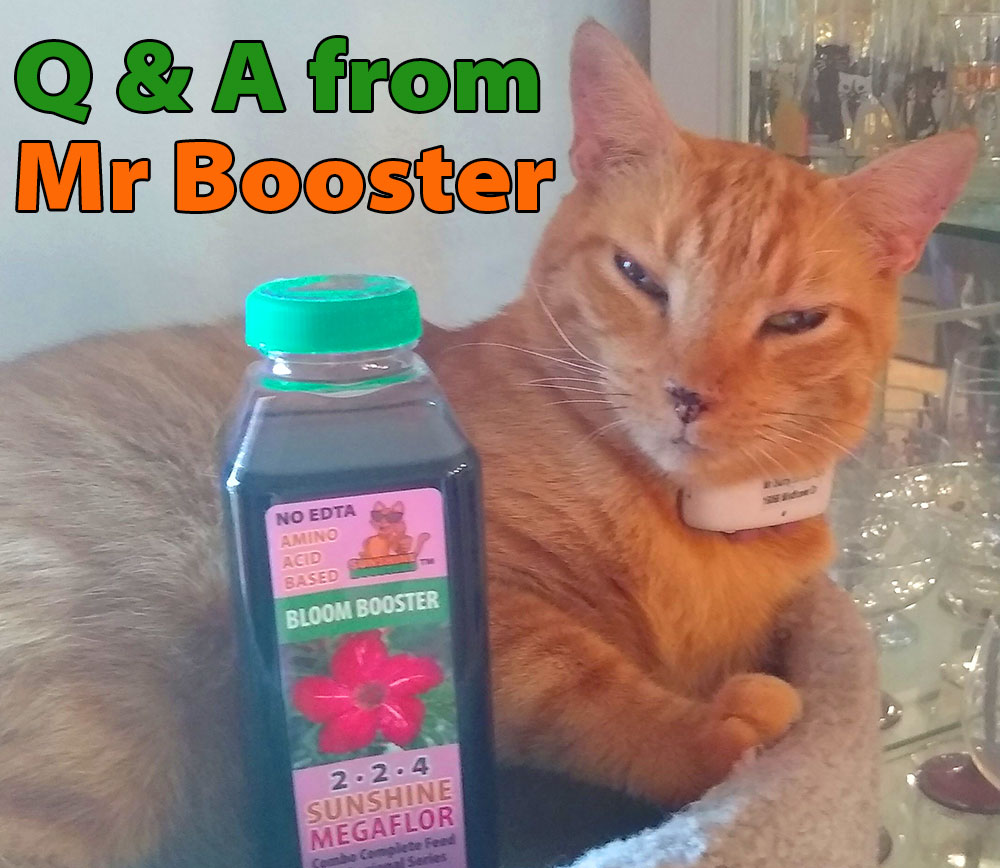
Healthy Plants: Q&A from Mr Booster

Fertilizing in Winter

Q: I have many tropical plants in my garden, both in the ground and in pots. I realize it is wintertime and some of them, the Hydrangea, Hibiscuses, and roses are in bloom but the rest of them seem wilty and droopy. Is it alright to fertilize them now, or should I wait for a few days? I have an all purpose tropical fertilizer and a 20-20-20 also. Please advise what to do.

A: During wintertime, tropicals may suffer from low temperatures and lack of sunshine which causes droopy leaves, and leaf loss.
Regardless of the cause and plant condition, you should NEVER apply traditional dry fertilizers during cool months. When cold, dry fertilizers (EDTA-chelated) may create nutrient lock up in soil and damage the roots. Dry fertilizers (both granulated and water-soluble) can be used only during hot season - when min temperatures stay above 65F for at least a week in a row, and daytime temperatures are over 75-80F. During hot, active growth season plant metabolism increases. This provides less chance for a chemical root burn, as the nutrients are used up quickly.

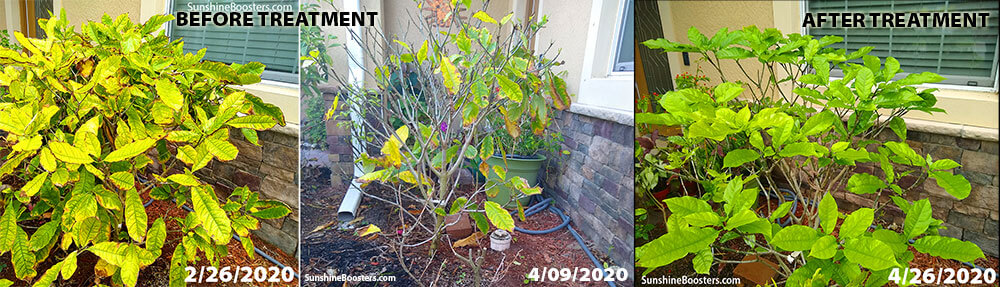
However, liquid fertilizers, as long as they are amino-acid based, can be used year round. From our own experience last winter, we discovered that fertilizing sickly looking plants (with signs of cold damage and root issues) with Sunshine Boosters actually revived those plants. Sunshine Boosters even brought back to life some hopeless specimens. Take a look at this gardenia that grows in our garden (picture above). See full article.
In your case, it would be beneficial to use a mild formula of liquid boosters in combination with Sunshine Epi -a natural plant hormone that boost their growth and helps to cope with cold-, temperature- and low-light-related stress.

These are the products we recommend:
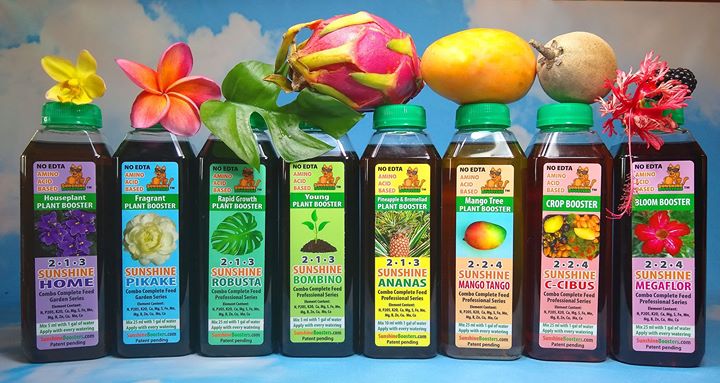
- Sunshine Bombino - add to every watering
- Sunshine Epi - twice a month as foliage spray

Since you grow plants in pots, feeding program is especially essential, because plants are limited with a container size where roots can't reach out to more food in the outer soil. In professional nursery set up with injector irrigation systems, container plants are fed daily (depending on season, more than once a day) with every watering. This is why greenhouse plants are so healthy looking.
So feel free to give your plants Sunshine boosters with every watering, dozing according to the label. During cold period, plants need less frequent watering, so fertilizer input will be balanced accordingly, it will depend on temperature and plant metabolism.

Sunshine Bombino - mild, "pampering" formula for young and tender plants, as well as plants recovering from stress and/or winter damage.

Date: 16 Dec 2021

Why should you use Sunshine Boosters?

by Ed Jones, the Booster guy

...You have heard it before, but I will tell you again. Sunshine Boosters are safe to use with every watering. It means that you can use Sunshine Boosters amino acid based fertilizers whenever you water your plants, even in the winter. Why is that so important?..

...We normally stop using dry, timed release, fertilizers around the first of November and not resume using them until the first part of March. This is true in many areas of the deep south where the ground stays above freezing year round...

However, it is safe to use Sunshine Boosters during these cooler months... Temperature does not play a role in the absorption of nutrients when using Sunshine Boosters...

To find out how it works, see Ed's new Article Why should you use Sunshine Boosters. If you want to learn even more in depth, check out his blog: Micronutrients Delivery Systems.

As of this writing, all Sunshine Boosters are on Holiday Sale. There are boosters for all different types of plants. Check them out and -

Give your plants a little something extra for Christmas!

CONTINUE READING >>

Date: 28 Dec 2025

🎉 2026 Gardening Resolution That Actually Works

According to our experts: Smokey and Sunshine. When we say experts, we do not mean consultants or trend writers. We mean two real gardeners. Smokey watches patterns. Sunshine notices when people rush. Together, they explain what actually works.

Smokey  the  tuxedo  cat  writes  gardening  plans  for  2026  at  a  table  while 


Sunshine  the  ginger  cat  rides  a  hobby  horse  holding  coffee,  with  donuts, 


plants,  and  a  fireplace  in  a  winter 


room.
Sunshine: Smokey, thank you for the Christmas present. I am riding this hobby horse straight into the Year of the Horse!
Smokey: I am making the plans for 2026. Planning makes gardening successful.
Sunshine: Coffee and donuts help too, so please include them in your plan.

Smokey: Hello gardeners. 2026 is the Year of the Horse.

Sunshine: Horses do not garden.

Smokey: Please do not interrupt me. No, they do not. That is just the calendar. What matters is what gardeners do at the start of every new year. They often rush and repeat the same mistakes.

Sunshine: The biggest one is rushing the garden before morning coffee.

Smokey: Correct. Rushing looks like effort, but it is usually just impatience. Gardens punish impatience very reliably.

Most early-season problems come from doing things too soon:
- watering before roots are active
- fertilizing before growth begins
- planting before conditions settle
- poking plants daily to check how the roots are growing

Sunshine: If you are poking the roots, the plant was fine until you started poking it.

Smokey: Good gardening is not constant action. It is knowing when to act and when to stop interfering.
- Plant when the timing is right.
- Let roots work quietly.
- Leave resting plants alone.

Sunshine: Coffee first. Donuts optional, but highly recommended.

Smokey: One last thing, while you are not rushing.

Our gift cards are still on promotion. They do not need planting, watering, or timing decisions today.

A gift card is a symbol of patience. Buy it now. Use it when the moment is right.

Smokey and Sunshine:
Our resolution for 2026 is simple: stop rushing the garden. Wishing you a calm, steady, coffee-fueled 2026 garden 🐾🌿