Garden Blog - Top Tropicals

Date: 9 Dec 2023

Sunshine supplement kit for cold hardiness

Video by Scott Riddle

Discover the cool story of Scott Riddle, a well-known plant enthusiast with a popular YouTube channel dedicated to his tropical plant collection. In this video, Scott shares his firsthand experience with our Sunshine micro-element kit, designed to enhance the cold hardiness of plants.
Living in the unpredictable climate of the California mountains, where he cultivates tropical plants in a zone higher than recommended, Scott faced the challenge of unexpected freezes. The boosters hopefully will be a game-changer for him, reinforcing his plants for the winter season. This insightful and detailed video is a valuable resource for anyone engaged in zone-pushing, aiming to fortify their tropical plants against the rigors of challenging weather conditions.

Here at Top Tropicals, we have already applied two pre-winter treatments of Sunshine Power-Si formula, in combination with the bio-stimulant Sunshine Epi and micro-elements. One in November, the second one in the beginning of December. So far, after a couple of cold nights, the plants still look happy. Stay warm and get prepared!"

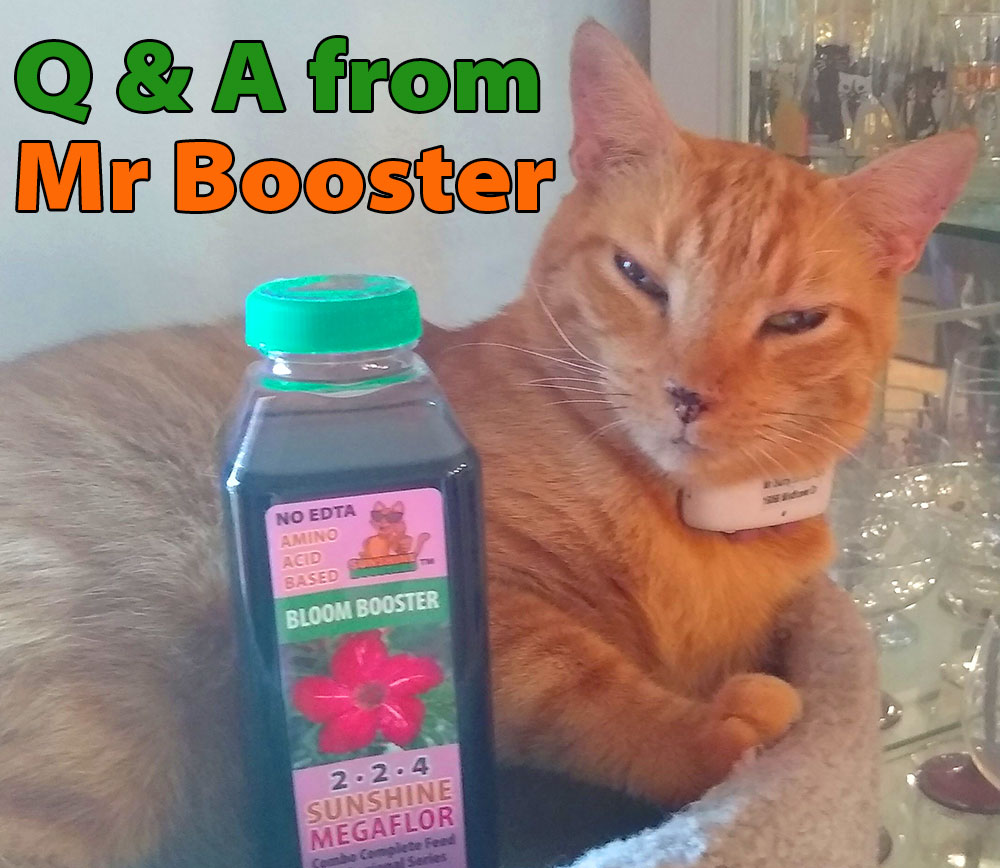
Cozy  cat  with  sunshine  boosters  hardiness  kit

Tropical  landscape  with  Red  Lipstick  Palm

Date: 7 Jul 2023

Fertilizing a Mango tree in container

Mango  trees  in  pots  and  fertilizer

Q: I live in the area with cooler winters so I am keeping my mango tree in a pot. What fertilizer do you recommend for the best growth and fruit production?

A: If you're growing fruit trees in pots, using liquid fertilizers is a great choice. And when it comes to liquid fertilizers, ones that are based on amino acids are super cool because they're natural and plants can gobble up all the good stuff without any problems. So, if you have a mango tree, the absolute star in amino acid-based fertilizers is -

Sunshine Boosters Mango Tango

Your tree will be doing a happy dance with this stuff!

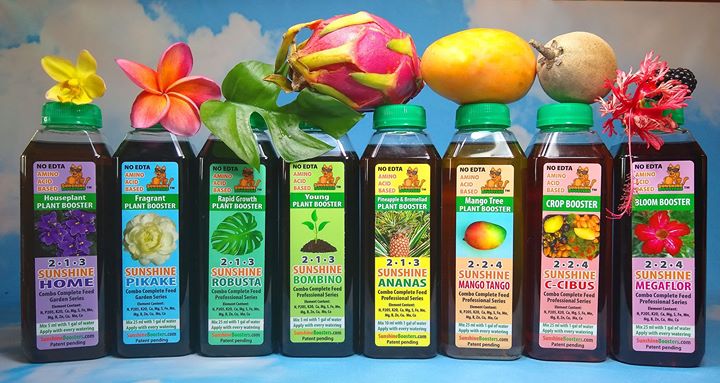
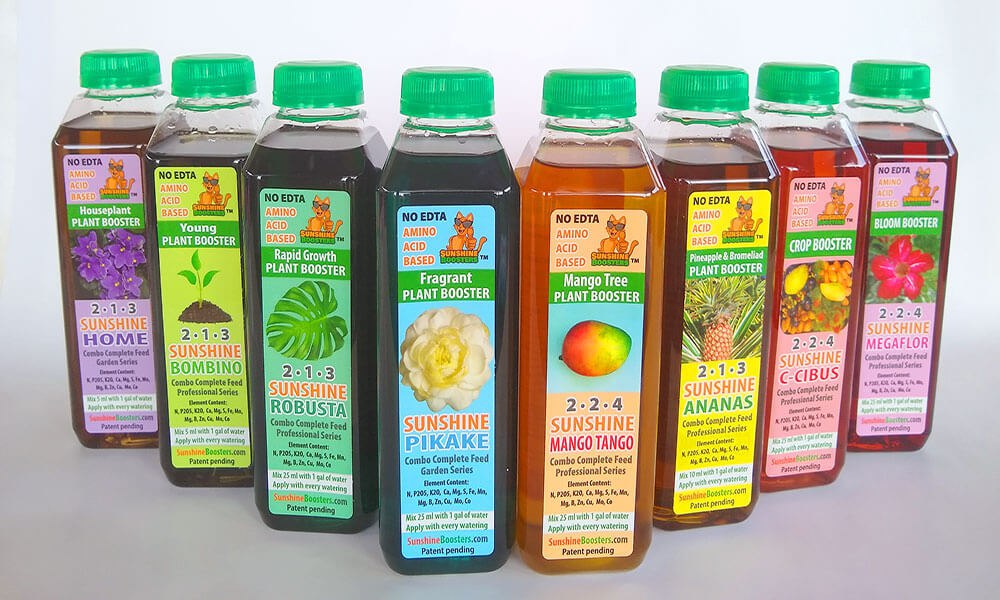
Sunshine  booster  mango  tango  fertilizer

Why Sunshine Boosters liquid fertilizers are so popular?

Here are a few awesome reasons:

1. Speedy nutrients: Sunshine Boosters liquid fertilizers are like a fast pass for plants. They get absorbed by the roots super quick, giving your fruit tree a speedy delivery of all the nutrients it needs. This is especially great for potted plants with limited soil space, like those yummy fruit trees.

2. Nutrients for all: Sunshine Boosters are like the fairy godmothers of nutrients. When you pour them around the base of your tree, they spread out evenly, making sure every bit of the tree gets its fair share of the good stuff. No nutrient deficiencies allowed!

3. The power of precision: Sunshine Boosters liquid fertilizers and other cool plant supplements let you become a master mixologist for your plant. You can measure and mix them just right, giving your tree the exact nutrients it craves. It's like creating a customized cocktail for your tree's taste buds. Try adding the magic works of SUNSHINE Microelement Supplement Kit - that improves hardiness, vigor, and production.

4. Leafy goodness: Sunshine Boosters have a secret talent - they can be sprayed directly on the leaves! It's like giving your tree a refreshing nutrient-packed spa treatment. The leaves slurp up those nutrients, bypassing any soil limitations. Talk about a VIP treatment!

Remember, while liquid fertilizers are awesome, they work best when you team them up with other good plant care practices. So don't forget to water properly, keep that soil in tip-top shape, and give your tree plenty of sunshine. With this dream team, your potted mango tree will thrive and grow like a champ!

mango  trees  in  containers

Date: 27 Jan 2026

🌸 Adenium, Coffee, and Donuts

Smokey  and  Sunshine  with  a  blooming  adenium  desert  rose  on  a  worktable,
 
 
  surrounded  by  potted  adeniums  in  the  background.
Smokey: Desert rose. One caudex. Multiple grafts. Different flowers.
Sunshine: So it is a team plant. Everyone blooms, nobody agrees.
Smokey: Yet it grows just fine.
Sunshine: That is the secret. Coffee and donuts.

🌸Featured Adeniums

Recommended by our Horticulturist, Tatiana Anderson

Moung Kusuma Moung  Kusuma  adenium  flower  with  deep  magenta  velvety  petals  and  dark 


edging

Deep magenta flowers with a velvety look and a darker, almost black edge. A bold, elegant adenium that stands out immediately.

Sunshine Adenium  Sunshine  flower  with  pink  and  white  petals  and  bright  color 


contrast

Bright yellow and mauve swirls across layered petals create a warm, cheerful bloom that lives up to its name.

White Rabbit Adenium  White  Rabbit  flower  with  white  petals  and  bright  pink  streaks. Clean white petals brushed with playful pink streaks. A reliable bloomer with soft ruffled flowers.
Thong Samsee Adenium  Thong  Samsee  flower  with  creamy  yellow  petals  and  soft  pink 


edges

Known for its three-color effect, shifting from yellow to pink to nearly white on the same plant.

Candy Adenium  Candy  flower  with  creamy  white  petals  and  soft  pink  edges

Cheerful yellow petals dipped in cherry red with bold ruffled layers. Bright, playful, and impossible to miss.

Black Sheep Adenium  Black  Sheep  flower  with  nearly  black  petals  and  deep  red 


highlights

Nearly black petals with a glowing red center. Dark, dramatic, and different.

Free Adenium (Desert Rose) Shipping
Plant now, bloom soon. Get select Adenium (Desert Rose) varieties shipped to you with FREE S&H.
Offer valid through 02/06/2026. Limited quantities. While supplies last.
Free shipping applies to qualifying Adenium items only. Excludes other items and prior orders.

✍️ Learn About Adeniums

🎥 Watch Adenium Videos

🛒 Shop Adeniums

Date: 25 Nov 2019

Flavor of Feijoa Superfood

by Onika Amell, tropical plant specialist

Q: What exactly is Feijoa - Pineapple Guava? Does the fruit really taste like pineapple? I am curious to know if it is easy to grow.

A: Feijoa is certainly one of the easiest fruit trees to grow as it does not require much care. It is an attractive, evergreen tree or large shrub with dark green, oval, leathery leaves. It has an abundance of uses in the garden and produces lovely edible flowers and fruit! The fruit is eaten fresh, added to smoothies or fruit salad and is also commonly used to make delicious jams and wicked chutneys. Feijoa fruit go a long way in flavor.
This plant is drought tolerant and will grow in almost any soil type. It loves full sun or partial shade and is wind resistant. A lot of gardeners like to grow it as a wind barrier for this reason. It can easily be shaped into a dense, informal hedge or screen that needs very little pruning. Because of this density, it provides excellent shelter for all kinds of wildlife. Butterflies, birds, and butterflies will all love you for growing Feijoa!
Space the plant five feet apart to create a wind barrier hedge. Heat does no not bother it at all and it will also withstand temperatures to 10 degrees F.
The plant gets its names from the delicious perfume it emits. Some folks seem the fruit taste like pineapple, with a slight minty undertone. Others feel the flavor reminds them of juicy fruit gum! The texture is described as smooth and slightly gritty - almost like a pear, but firmer.
If you prefer to grow this plant as a tree rather than a large shrub, simply remove the lower branches up to one-third of the tree's height over a period of time. The Pineapple Guava can grow up to 15 feet wide and tall. They also do really well as a container plant on patios where you can truly enjoy the lovely fragrance of the fruit. It prefers rich, organic, well-drained soil and will need light fertilization every other month in most soils.

We recommend:

Fruit Festival Plant Food - Super Crop Booster
Mango-Food - Smart Release Fruit Tree Booster
SUNSHINE-Honey - Sugar booster
SUNSHINE C-Cibus - Crop Nutrition Booster

Pretty, pink, edible flowers will wow you from May to June, followed in late summer or fall by the delicious and fragrant fruit. An interesting thing about this fruit is that you don't pick it. It falls to the ground when it is ripe. Or simply place something under your tree, like a tarp, and shake the tree. The ripe fruit will fall off. You can store the fruit in your refrigerator for up to a week. And remember! The fruit of the Feijoa is not only a very rich source of soluble dietary fiber, but also an excellent source of Vitamin C, and very rich in antioxidants. They are also low in calories. Each fruit only holds 55 calories.

Date: 24 Jun 2018

TopTropicals

URBAN TROPICAL GARDENING:
10 secrets of successful Container Mango growing on a balcony.

Q: I live in Miami in apartment on a second floor, and I have a balcony with SE exposure. I wonder if I can grow a mango tree in a pot? Will it fruit for me? I recently moved to South Florida and I don't know much about tropical plants; but I tasted real fiberless mangos from someone's garden - it was so delicious and different from those in the grocery store. I wonder if I can have a fruiting tree on my balcony? And if yes, how do I plant and take care of it?

A: Yes, you can! Here is what you need to do:
1) Temperature. You are lucky to live in Tropics, keep it on a balcony year round.
2) Light. Position the pot in a spot with the most sun exposure. Mango trees can take filtered light too, but the less sun, the less fruit you will get.
3) Soil and Container. Use only well drained potting mix. Step up the purchased plant into next size container (3 gal into 7 gal, 7 gal into 15 gal). When transplanting, make sure to keep growth point (where roots meet the trunk) just at the top of the soil. Covering base of the trunk with soil may kill the plant.
4) Water. Water daily during hot season, but only if top of soil gets dry. If it still moist, skip that day. Mangoes (unlike Avocados!) prefer to stay on a dry side.
5) Fertilizer. Use balanced fertilizer once a month, 1 tsp per 1 gal of soil. Do not fertilize during fruiting - this may cause fruit cracks.
6) Microelements. Apply SUNSHINE-Superfood once a month. This will help your mango healthy, vigorous, and resistant to diseases. Use SUNSHINE-Honey to make your fruit sweeter.
7) Insect control. Watch for scales and mealybugs, clean with solution of soapy water + vegetable oil (may need to repeat 2-3 times with 10 days interval), or with systemic insecticide like imidacloprid only as needed (if non-harsh treatment didn't help). Most Flea shampoo for dogs contain that chemical, you may try that shampoo solution.
8) Trimming. Once potted, do not remove leaves that are discolored or have spots until new growth appears. Dark dots on mango leaves, especially in humid climate like Florida, may be signs of fungus. Treat with fungicide according to label, and remove only badly damaged leaves. Trim crown as needed after flowering and fruiting (by Fall). Train into a small tree, and you may remove some lower branches eventually.
9) Flower and fruit. Mangoes are winter bloomers with bunches of tiny flowers coming in thousands. Many of them set fruit (if pollinating insects present). Keep in mind that young trees can only bare a few fruit. Normally a tree will drop excessive fruit and keep only a few that it can manage. To save the young tree some energy, remove fruit if too many and leave only 2-3 for the first year. It will pay you next year with more abundant crop.
10) Variety. Last but not least: Choose the right variety for container culture! Pick from "condo" dwarf varieties such as Icecream, Nam Doc Mai, Carrie, Cogshall, Julie, Fairchild, Pickering, Graham, Mallika, and a few others - check out Mango Chart pdf and full list of our Mango varieties.