Garden Blog - Top Tropicals

Date: 20 Jan 2025

How to Grow Jackfruit: Practical Guide

Jackfruit (Artocarpus heterophyllus) tree

Jackfruit (Artocarpus heterophyllus) tree

Jackfruit (Artocarpus heterophyllus) fruit
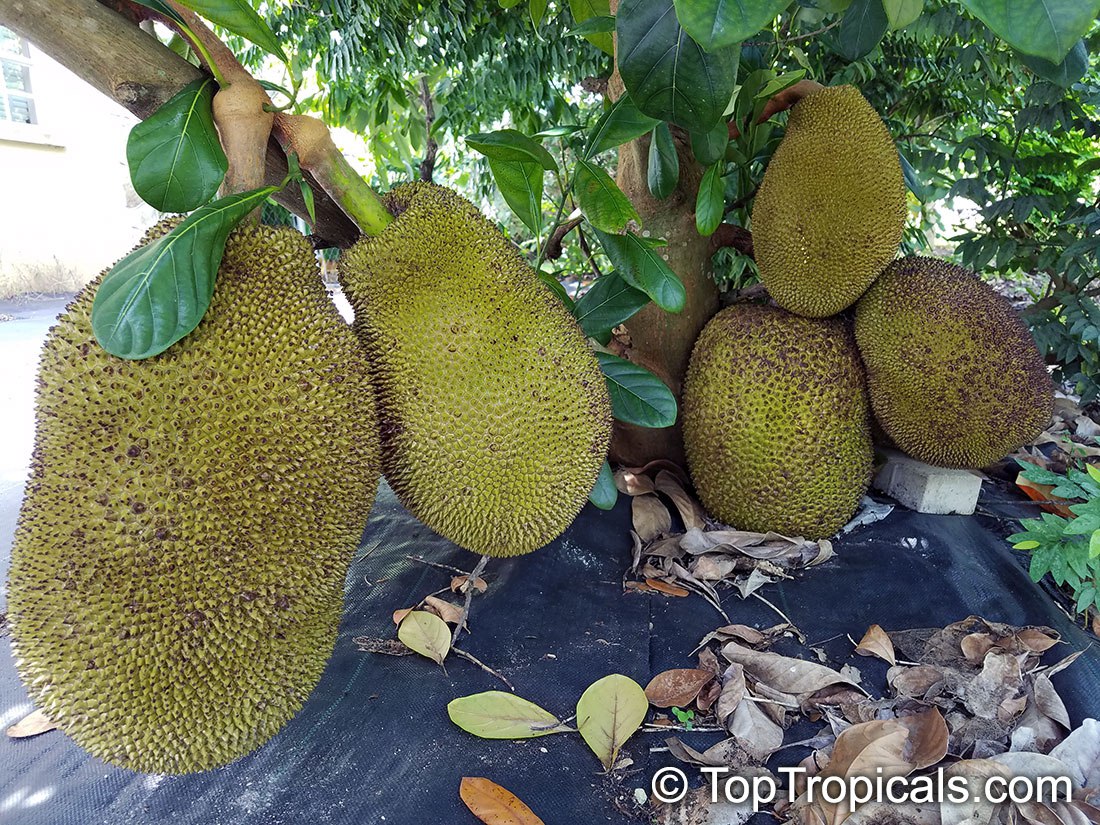
Jackfruit (Artocarpus heterophyllus) fruit

Jackfruit (Artocarpus heterophyllus) fruit at the base of the tree
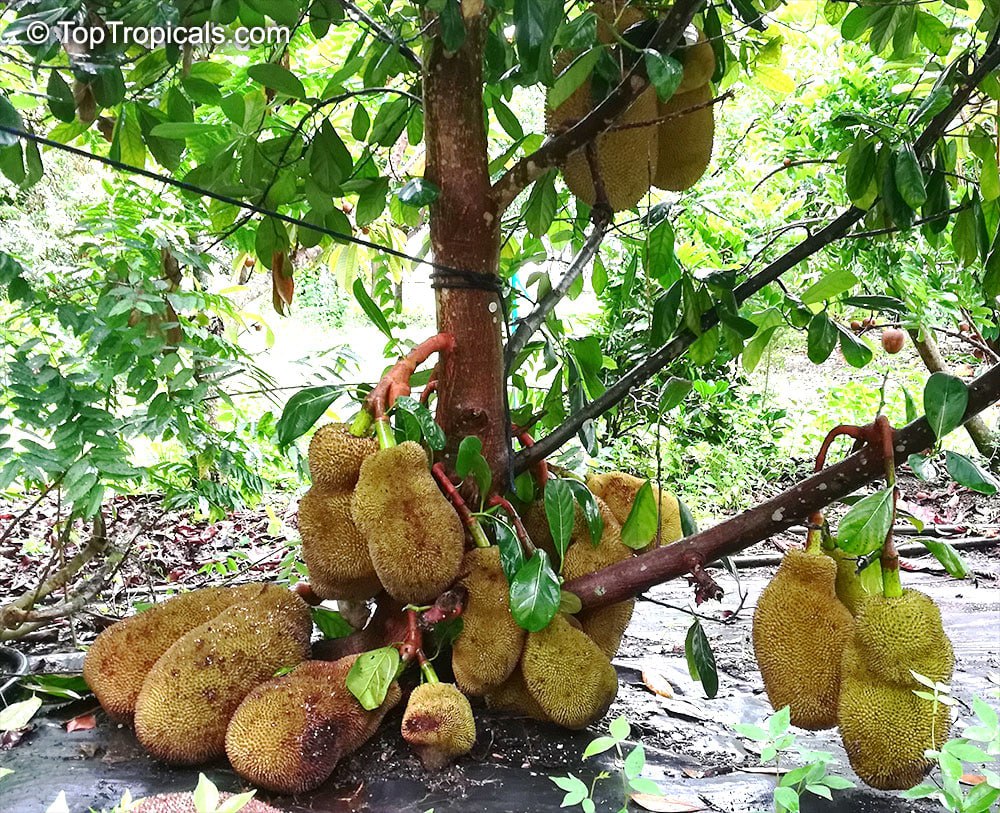
Jackfruit (Artocarpus heterophyllus) fruit at the base of the tree

Jackfruit (Artocarpus heterophyllus) fruit at the base of the tree

Jackfruit (Artocarpus heterophyllus) fruit at the base of the tree

How to Grow Jackfruit: Practical Guide

  • 🍈 Jackfruit (Artocarpus heterophyllus) is a tropical tree that produces the largest fruit in the world, weighing up to 80 pounds and reaching 36 inches in length. The trees thrive in frost-free, humid climates with plenty of sunlight. They require well-draining soil rich in organic matter and regular watering to flourish. Despite their reputation as ultra-tropical, mature Jackfruit trees can tolerate light frost for a few hours without significant damage. Additionally, they can be grown in containers in colder areas with proper care and pruning.
  • 🍈 What Climate is Essential for Growing Jackfruit Trees?


    Jackfruit trees require a tropical or subtropical climate, with temperatures ideally between 60-95°F. While young trees are frost-sensitive, mature trees can withstand light frost for short periods. However, cold winters can reduce fruit production. Frost-free temperatures are crucial for optimal growth and fruiting.
  • 🍈 How Often Do Trees Need Fertilizing, and What is the Best Type of Feed?


    Jackfruit trees are heavy feeders. Fertilizing them regularly is key to their health and productivity. During the active growing season (spring to fall), apply a balanced dry fertilizer once a month. Liquid amino-acid-based fertilizers, such as Sunshine Boosters, can be used year-round with every watering. These fertilizers help maintain healthy growth and encourage abundant fruiting. Supplement with organic matter like compost, manure, or peat moss to enrich the soil.
  • 🍈 How Important is Pruning, and When is the Right Time to Prune?


    Pruning is essential for maintaining a manageable tree size and promoting healthy fruit production. Jackfruit trees produce fruit at the base of the trunk, allowing them to be pruned annually to a height of 7-12 feet. This practice not only makes harvesting easier but also encourages more fruiting. Prune after the fruiting season or in late fall to remove excess growth and shape the tree. Regular pruning also improves air circulation and reduces the risk of disease.
  • 🍈 Key Tips for Successful Jackfruit Production


  • · Climate: Ensure frost-free temperatures and adequate humidity.
  • · Soil: Use well-draining soil enriched with organic matter.
  • · Watering: Maintain consistent soil moisture without waterlogging.
  • · Pruning: Keep the tree under 7-10 feet for easier management and better yield.
  • · Fertilizing: Apply balanced fertilizers and supplements regularly.


🍈 Jackfruit facts

  • · The fruit consists of large, edible bulbs of yellow, sweet, banana-pineapple-flavored aromatic flesh.
  • · Seedlings start fruiting within 3-4 years, with fruit ripening 4-6 months after flowering.
  • · A mature tree can produce up to 200 pounds of fruit annually.
  • · For colder regions, growing Jackfruit in containers is an option, provided the tree is regularly pruned and topped.


👍 Jackfruit trees grow fast and fruit abundantly with proper care, making them an exotic addition to tropical fruit collections.

📚 From previous posts:


The largest tree-borne fruit in the world
How to grow the biggest fruit on Earth

🛒 Plant your own Jackfruit

#Food_Forest #How_to

🔴 Join 👉 TopTropicals
Date: 29 Oct 2024

How to overwinter tropical plants indoors

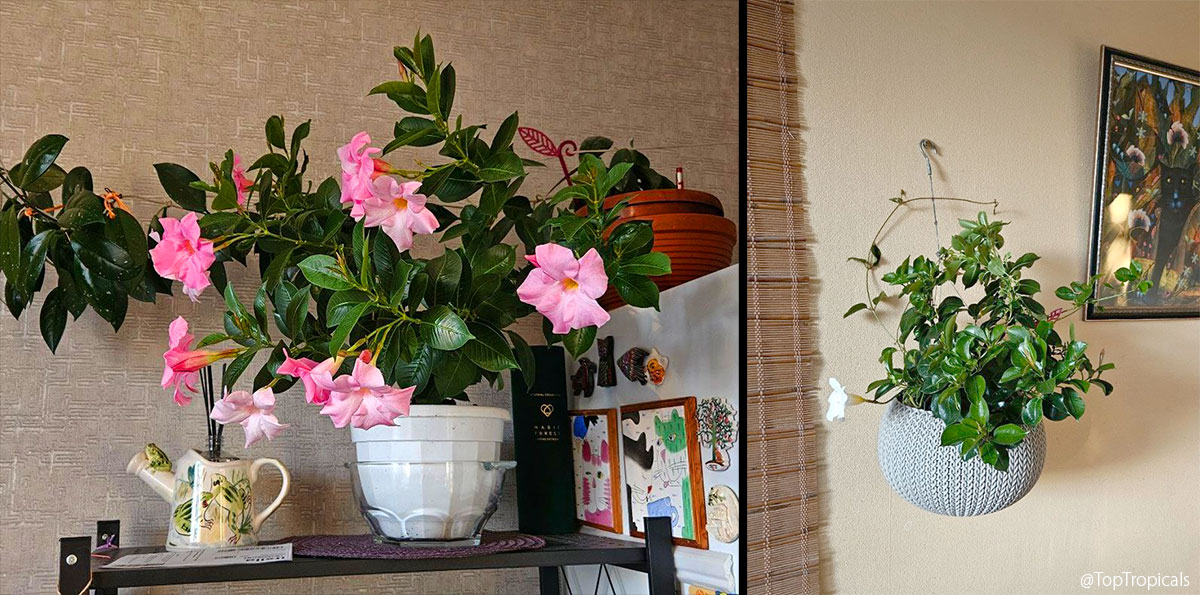
Mandevillas  indoors

10 key tips for successful overwintering

Q: I have two Mandevillas that thrived on my balcony all summer. Now that cold weather is approaching, I've moved them indoors to bright spots, but they're dropping and wilting leaves. How can I keep them healthy until spring? Should I fertilize them? Can Mandevillas grow indoors year-round?

A: First, keep in mind that the plants we call "indoor plants" or "house plants" are all tropical. However, not all tropical plants are suitable for indoor living. Some, especially shade-loving ones, thrive in indoor conditions, which is why we refer to them as "house plants" (philodendrons, monsteras, calatheas, peperomias, and many others, including some succulents). Others are less adaptable to the lower light and humidity typical of indoor spaces, but with a little extra care, you can overwinter them inside and move them back outdoors in spring. Mandevillas are no exception! Even tropical trees, including fruit trees, can tolerate a few months indoors if given the right conditions for semi-dormancy. Below are the 10 key tips for successfully overwintering tropical plants indoors.

1. Maximize Light: The more light, the better. There's no such thing as too much indoor light. If windows aren't enough, use LED grow lights, which stay cool and won't dry the air. Rotate plants every few days to prevent uneven leaf loss.

2. Reduce Watering: Less light and cooler temperatures mean plants need less water. Allow the soil to dry between waterings, and avoid overwatering - combination of cold + wet is especially harmful.

3. Maintain Moderate Temperatures: Most tropicals are happy with daytime temperatures around 75F and nights at 50-60F. In sunrooms or greenhouses, some can handle 45F if watering is kept to a minimum.

4. Boost Humidity: Avoid placing plants near heaters or vents that dry the air. Misting daily helps, or place pots on trays filled with water and pebbles to raise humidity around them.

5. Monitor for Pests: Check leaves weekly to catch insect problems early, as pests can cause serious damage or even kill the plant indoors.

6. Fertilize Smart: Use ONLY liquid, amino-acid-based fertilizers like Sunshine Boosters throughout winter; they won't burn roots since their dosage adjusts with reduced watering. Avoid dry, granulated, and EDTA-based fertilizers during winter and dormancy.

7. Use Micro-Nutrients: Along with macro-elements (fertilizers), supplement with micro-elements like Sunshine Superfood and bio-stimulants such as Sunshine Epi to build strong plants with robust immune systems, better able to withstand unfavorable conditions and resist diseases.

8. Hold Off on Pruning: Leaf drop and leggy growth are normal responses to winter. Wait until spring to prune, when new growth starts, to encourage branching and healthy foliage.

9. Don't Repot Yet: During dormancy, roots slow their growth. Repotting too soon risks root rot. Wait until spring when new growth appears to transplant into a larger container. Typically, roots grow in proportion to the above-ground parts.

10. Let Them Rest: Winter is a natural resting period. Avoid forcing growth - your plants will reward your patience with vibrant leaves and flowers when spring returns.

Cat  Indoor  Garden

Date: 27 Feb 2025

What Fertilizer to Use Now and How?
Five important keys to healthy plants

Sunshine  Boosters  Selection

Q: It's early Spring this year. Should I start fertilizing my plants sooner than usual?

A: Most fertilizer instructions recommend fertilizing tropical plants from March to November. This is because plants don't need as much food during the cooler months when many go dormant, and excess nutrients can burn the roots if not absorbed. However, for the most effective fertilizer program and healthy plants, consider these points:

1. Sunshine Boosters Year-Round

Liquid amino-acid-based fertilizers like Sunshine Boosters are safe to use year-round. Since watering is reduced in cooler weather, the intake of water-soluble fertilizer is also lower, providing plants with just the essential nutrients for their minimal needs.

2. Dry Fertilizer Schedule

Be cautious with dry fertilizers. Apply them only during active growth in the hot season.

3. Temperature Is Key

If March is still cold, delay dry fertilizer use. However, if nighttime temperatures in February stay above 65F, you can start a dry fertilizer program using slow-release, granulated plant food.

4. What Fertilizers to Use and How

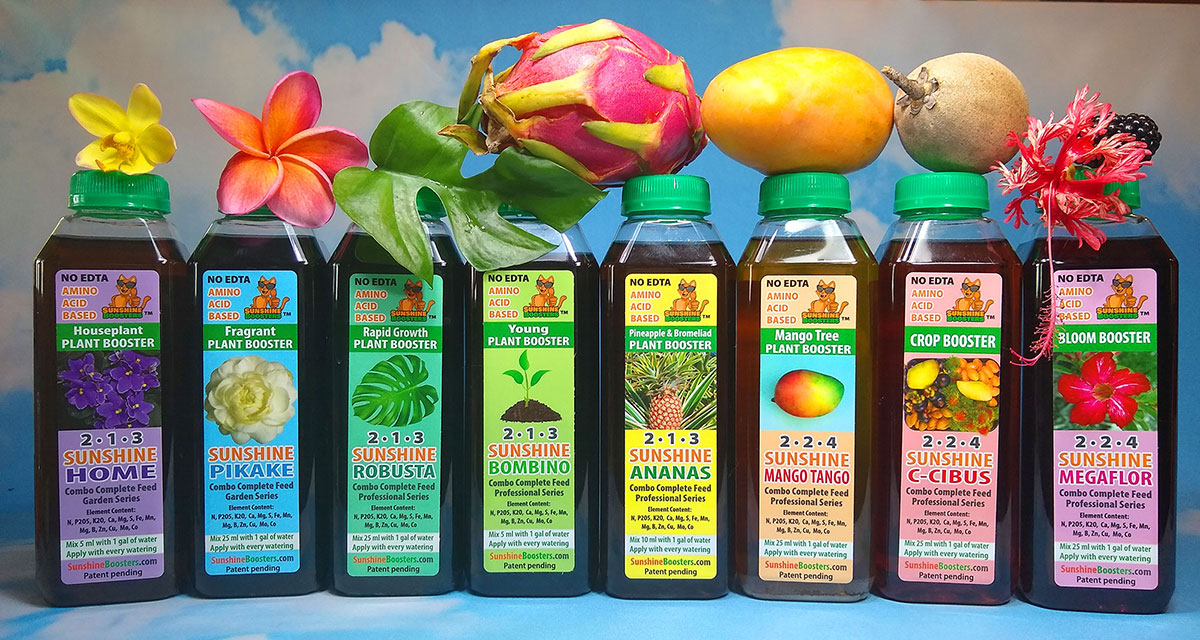
Check out our Sunshine Boosters selection for different types of plants and choose the right type for your needs. These can be applied as often as with every watering:

For Rapid Growth
Sunshine Robusta - Rapid Growth Booster: general fertilizer for both foliage plants and small starters that need an extra boost.

For Flowers
Sunshine Megaflor - Bloom Booster: boosts flowers on established plants; and Sunshine Pikake - Fragrant Plant Booster: best for fragrant flowers.

For Fruit Trees
Sunshine C-Cibus - Crop Booster: contains all necessary elements for fruit trees and their production. Sunshine Mango Tango - specifically formulated for Mango and Avocado trees, and Sunshine Citron - ideal for citrus trees.

For Tender Perennials
Sunshine Orchidasm - Orchid Total Feed and Sunshine Ananas - Pineapple and Bromeliad Booster: mild formulas for these tender perennials.

5. Microelement Supplements Are a Must

Besides macronutrients, plants need additional microelements, just like humans need vitamins. Be sure to apply these supplements along with your regular plant food:

For Green Leaves and Health
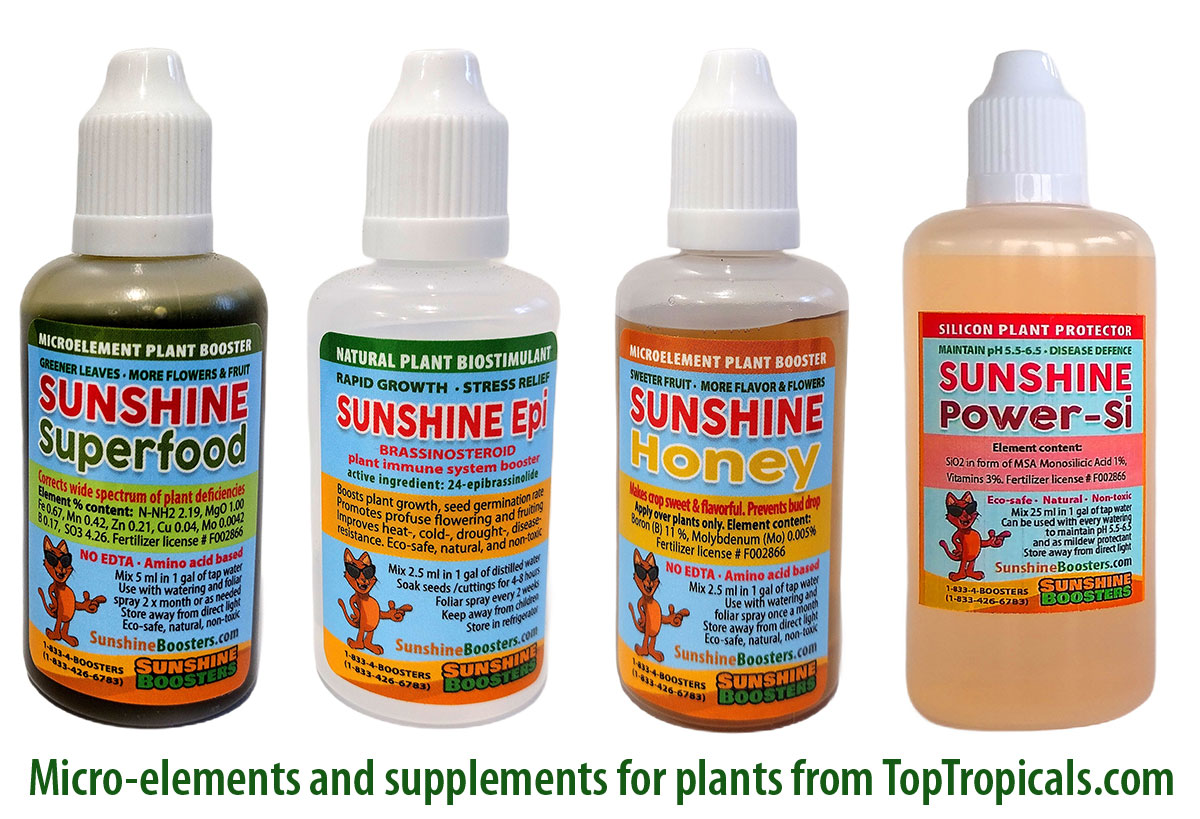
Sunshine SuperFood - Complex Microelement Supplement: a must for healthy plants. Apply once a month.

For Stress Relief
Sunshine-Epi - Brassinosteroid Plant Hormone: essential for plants recovering from stress (shipping, transplanting, drought, insect damage, cold stress, etc.). Apply as needed.

For Sweeter, Bigger Fruit
Sunshine Honey - Fruit Sugar Booster: application on fruit trees will make fruit bigger and sweeter by directing sugars to the fruit from other plant parts, and helps to prevent bud drop. Apply 4 times a year: at bud setting, flowering, fruit setting, and after harvesting.

For Better Resistance
Sunshine Power Si - Silicon Protector - enhances resistance to insects, diseases, drought, and frost, while boosting growth. Apply once a month, along with Sunshine SuperFood.

Need Help? Our Plant Experts Are Ready to Assist!

Microelements  and  supplements  for 
 plants

Date: 1 May 2026

This changes how you feed your plants

Smokey and Sunshine with Sunshine Boosters

Smokey and Sunshine with Sunshine Boosters

This changes how you feed your plants


Stop messing with fertilizers - you’re probably feeding your plants wrong. Keep it simple. Let your plants do the work.
Most gardeners don’t have a plant problem - they have a fertilizer problem. If feeding your plants feels confusing, expensive, or inconsistent, there’s a reason. The way most fertilizers are designed doesn’t match how plants actually grow today. Here’s what’s really going on - and why a simpler system works better.
  • ☘️ A simple way to feed your plants right


    Feeding plants shouldn’t feel like a chemistry class. But somehow it always does. Too many products. Too many formulas. Too many schedules. And somehow - still not sure if you’re doing it right.
    The truth is, growing healthy plants is simple. Good soil. Enough light. Proper care. And the right nutrients.
    That last part is where most people get stuck.

    Sunshine Boosters were made to fix exactly that. It’s a complete nutrition system that gives your plants what they actually need - without all the extra steps and guesswork.
  • ☘️ What Sunshine Boosters are and how they work


    So what is it, really?
    Sunshine Boosters is a new generation of plant nutrients based on amino acids. It includes the main nutrients plants need - nitrogen, phosphorus, and potassium - plus all the microelements, already balanced in one formula.

    No extra bottles. No missing pieces.
    It dissolves completely in water, so plants can take it in right away. No buildup in the soil, no leftovers sitting there doing nothing.
    You just mix it with water and use it during regular watering. That’s it. It works through the roots, and even through the leaves if you spray it.
    Instead of trying to manage a whole feeding system - you just feed and grow.
    Less work, better plants.

  • 👉 Stay with us - this is just the start. We’ll break it down step by step so you really understand what your plants need and how to give it to them. 👉 More...


🛒
Get your plants real food

📚
Learn more:
📱 What are Sunshine Boosters

#Discover #Fertilizers #How_to
🟢 Join 👉 TopTropicals

Date: 6 May 2026

Why your plants need more than NPK

Why your plants need more than NPK


Most fertilizers focus on just three numbers - NPK. But that’s only part of the story. If your plants look okay but not amazing, or grow but don’t really thrive, they’re likely missing the smaller pieces that make a big difference.

  • ☘️ Complete nutrition your plants actually use


Plants need more than just NPK. They also require a full range of microelements like iron, boron, magnesium, calcium, and others. These support photosynthesis, sugar movement, and internal plant processes.

Sunshine Boosters include a full spectrum of these nutrients in balanced amounts. This gives plants complete nutrition without needing extra products for basic care.

  • ☘️ The "Potassium Pump" - how plants move water and energy


Potassium plays a central role in how plants move water and energy. You can think of plant cells as tiny rooms with doors that open and close. Potassium helps control these openings.

Where potassium goes, water follows. This movement fills plant cells, making them firm and strong. It also helps move energy through the plant, supporting fruit development and flowering.

With enough potassium, plants handle drought better, grow stronger, and produce better crops.

☘️ Calcium - the backbone of plant strength


Calcium plays a key role in building strong plant structure and keeping growth stable. It is a major part of cell walls, so it directly affects how firm and healthy the plant tissues are. When calcium is available, plants develop stronger stems, better roots, and more solid fruit with improved shelf life. It also helps regulate how nutrients move inside the plant and supports proper cell division, which is important for new growth, root tips, and developing fruit.

Calcium improves resistance to stress, including heat and disease, and helps prevent common problems like blossom end rot, weak growth points, and poor fruit quality. Because calcium does not move easily inside the plant, a steady and available supply is important throughout the growing cycle.

Calcium cannot be mixed with NPK dry fertilizers. It forms insoluble compounds with phosphates and sulfates, so it has to be dosed separately.

In Sunshine Boosters, Calcium is present along with additives - complex agents and pH regulators. This allows you to dose calcium, sulfates, trace elements and other additives in one solution without fear of fertilizer lockout.

🛒
Get your plants real food

📚
Learn more:
📱 What are Sunshine Boosters

#Discover #Fertilizers #How_to
🟢 Join 👉 TopTropicals