Date: 23 Sep 2020
Fast-fruiting trees?
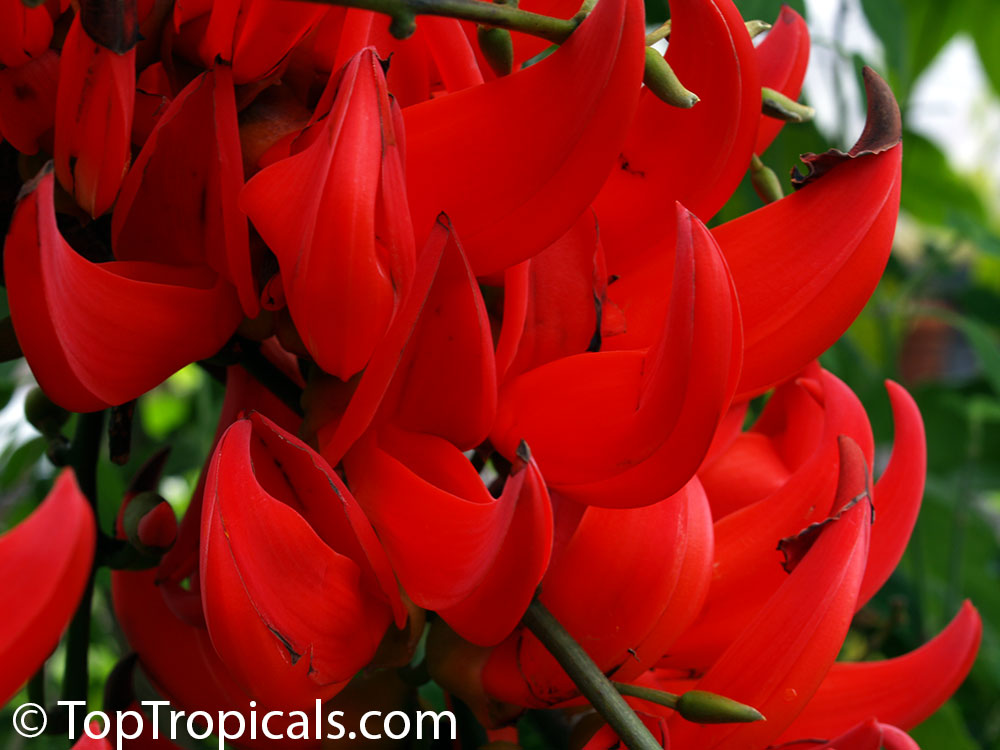
Photo above: Annona reticulata - Red Custard Apple
Q: More of a question than a review, but a review regarding your catalog, it would be easier for us buyers, if we could search for plants that produce fruit in 2 years or less, I don't have the patience to wait longer than that for fruit. I'm trying to buy for a fairly good sized garden but want some fast growers and fruit produced in 2 yrs. Can you help me out?
A: Fruiting time depends on many factors (established size,
growing conditions, fertilizing, and even specific variety), this is why we can
not just put a simple icon "will fruit within 2 years".
However, most grafted and air-layered fruit trees, including all Mango, Avocado, Loquat, Sapote, Sapodilla, Lychee/Longan, Peaches and Nectarines - will fruit right away. If you see in our store
"grafted" or "air-layered" in plant description - these trees will fruit
soon. Some of them already flowering and fruiting.
Some non-grafted trees or seedlings like Annona, Artocarpus (Jackfruit), Eugenia, Guava, Banana, Dragon fruit, Mulberry, Blackberry/Raspberry - will fruit within 3-4 years from seed or even
sooner (Banana, Mulberry, Dragon fruit, Blackberry-Raspberry - within a year).
Usually it says in description that this plant can produce fruit soon.
Bigger size plants are more established and have more energy to produce, so
try to get larger size plants if your budget permits, and especially if you can
pick up bigger plants rather than shipping them - obviously, shipping has size
limitations.
In addition, all spice trees like Bay Leaf, Bay Rum, Allspice and many more - they will
produce spice for you right away, so you don't need to wait at all!
If you have questions about fruiting time on any specific plant you put
your eye on, don't hesitate to ask!
Photo above: Pimenta dioica - Allspice
Date: 24 Jun 2018
URBAN TROPICAL GARDENING:
10 secrets of successful Container Mango growing on a
balcony.
Q: I live in Miami in apartment on a second floor, and I have a balcony with SE exposure. I wonder if I can grow a mango tree in a pot? Will it fruit for me? I recently moved to South Florida and I don't know much about tropical plants; but I tasted real fiberless mangos from someone's garden - it was so delicious and different from those in the grocery store. I wonder if I can have a fruiting tree on my balcony? And if yes, how do I plant and take care of it?
A:
Yes, you can! Here is what you need to do:
1) Temperature. You are lucky to live in Tropics,
keep it on a balcony year round.
2) Light. Position the pot in a spot with the most
sun exposure. Mango trees can take filtered light too, but
the less sun, the less fruit you will get.
3) Soil and Container. Use only
well drained potting mix. Step up the purchased
plant into next size container (3 gal into 7 gal, 7 gal
into 15 gal). When transplanting, make sure to keep growth
point (where roots meet the trunk) just at the top of the
soil. Covering base of the trunk with soil may kill the
plant.
4) Water. Water daily during hot season, but only
if top of soil gets dry. If it still moist, skip that day.
Mangoes (unlike
Avocados!) prefer to stay on a dry side.
5) Fertilizer. Use
balanced fertilizer once a month, 1 tsp per 1 gal of
soil. Do not fertilize during fruiting - this may cause
fruit cracks.
6) Microelements. Apply
SUNSHINE-Superfood once a month. This will help your
mango healthy, vigorous, and resistant to diseases. Use SUNSHINE-Honey to make your
fruit sweeter.
7) Insect control. Watch for scales and mealybugs,
clean with solution of soapy water + vegetable oil (may
need to repeat 2-3 times with 10 days interval), or with
systemic insecticide like imidacloprid only as needed (if
non-harsh treatment didn't help). Most Flea shampoo for
dogs contain that chemical, you may try that shampoo
solution.
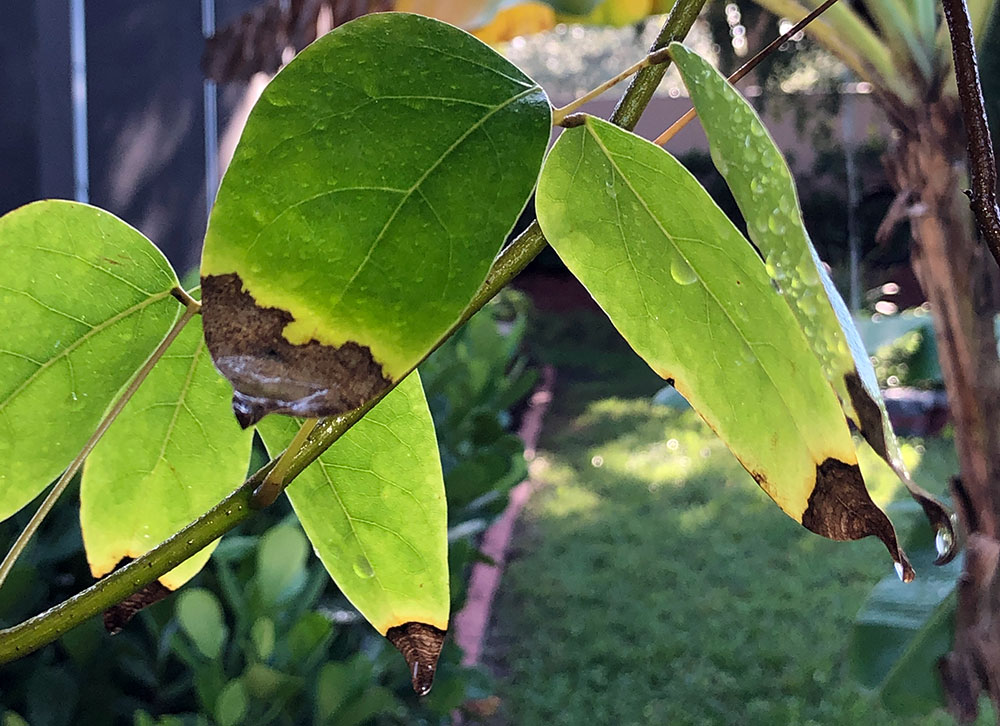
8) Trimming. Once potted, do not remove leaves
that are discolored or have spots until new growth
appears. Dark dots on mango leaves, especially in humid
climate like Florida, may be signs of fungus. Treat with
fungicide according to label, and remove only badly
damaged leaves. Trim crown as needed after flowering and
fruiting (by Fall). Train into a small tree, and you may
remove some lower branches eventually.
9) Flower and fruit. Mangoes are winter bloomers
with bunches of tiny flowers coming in thousands. Many of
them set fruit (if pollinating insects present). Keep in
mind that young trees can only bare a few fruit. Normally
a tree will drop excessive fruit and keep only a few that
it can manage. To save the young tree some energy, remove
fruit if too many and leave only 2-3 for the first year.
It will pay you next year with more abundant crop.
10) Variety. Last but not least: Choose the right
variety for container culture! Pick from "condo" dwarf
varieties such as Icecream, Nam Doc Mai, Carrie, Cogshall, Julie, Fairchild, Pickering, Graham, Mallika, and a few others -
check out Mango Chart pdf
and full list of our Mango varieties
Date: 6 Jan 2024
Sunshine
Boosters
Winter use... and discount!
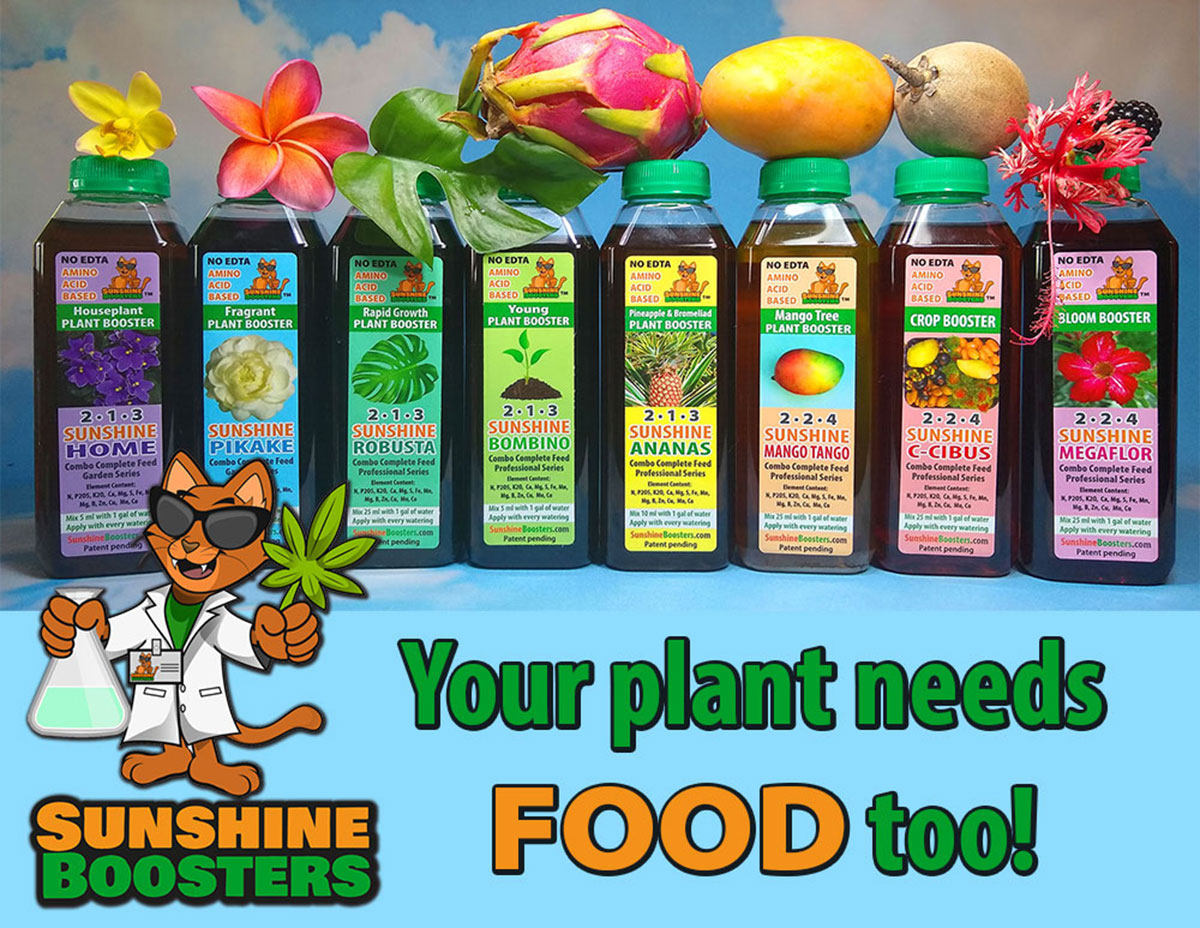
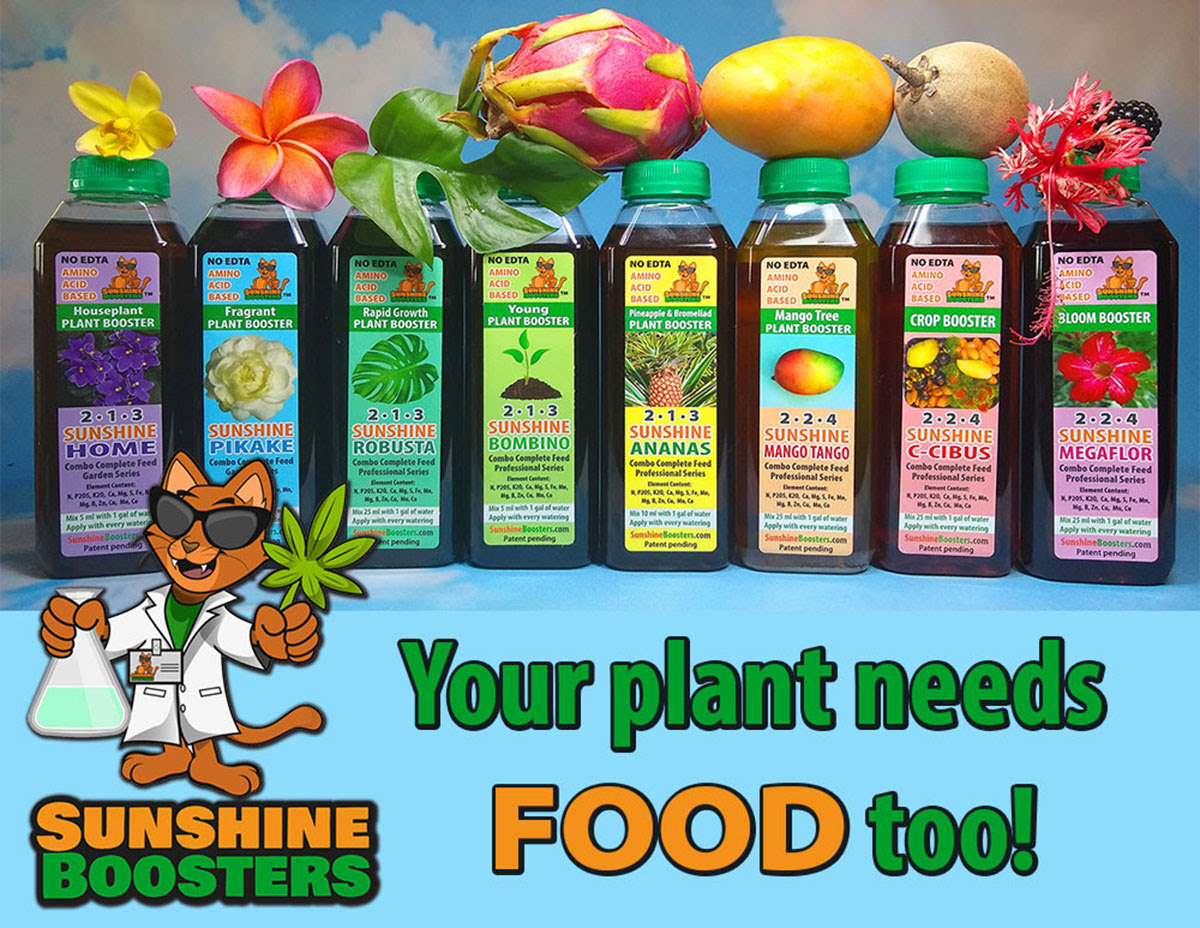
Do you remember that Sunshine Boosters fertilizers can be applied year-round?
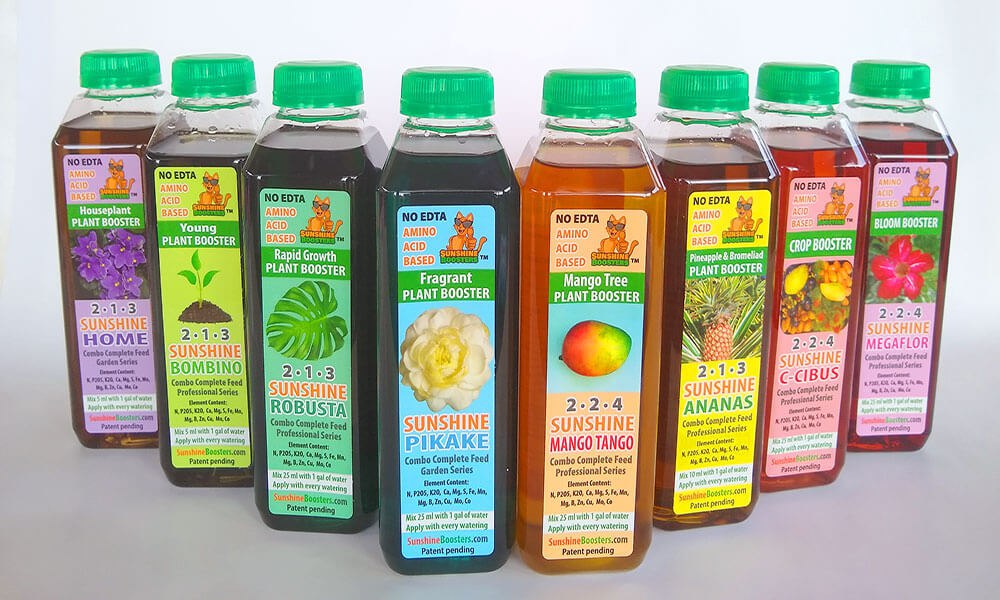
As natural fertilizers, their scientifically created formulas provide perfectly balanced nutrition for your plants throughout the year. Follow the instructions on the labels and apply Sunshine Boosters with every watering. Give your plants extra boost during winter months! The fertilizer amount is balanced, adjusting proportionally to the water amount, which is tailored to the plant's winter needs. Unlike dry fertilizers, Sunshine Boosters can be used all year without fear of burning plants with excessive nutrient lockup.
Take advantage of the winter sale and stock up on this perfect plant food. You'll need plenty by Spring when your plants begin active growth! Use the code below for 20% off all Sunshine Boosters products. Hurry up, the sale will end in a few days!
SBOOSTERS20
Min order $20, excluding S/H. Exp. 1-12-24
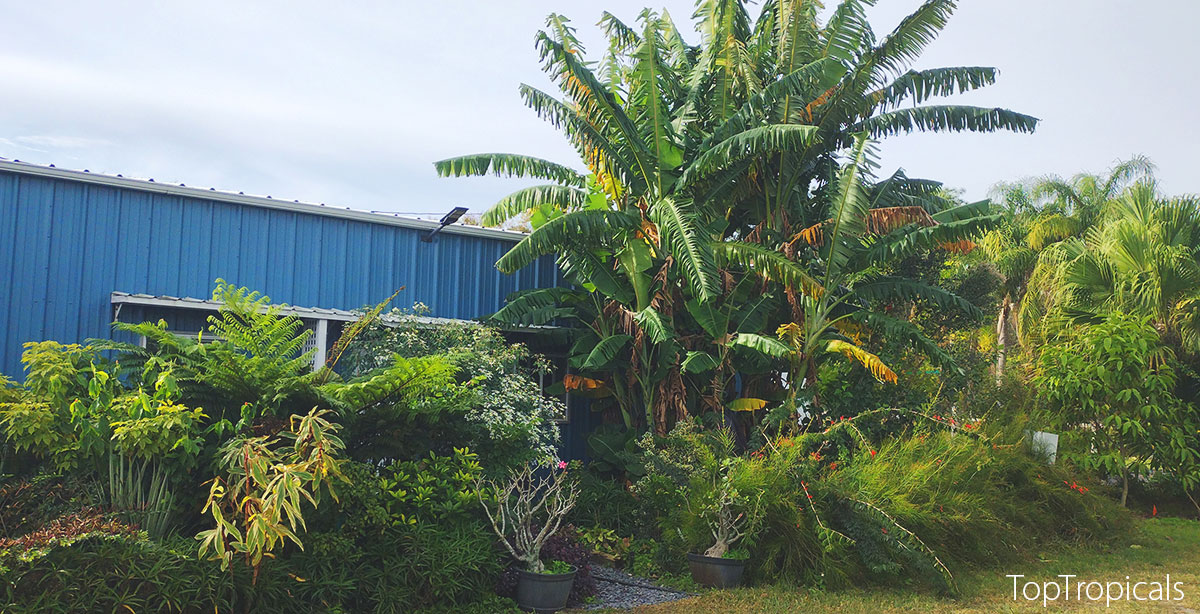
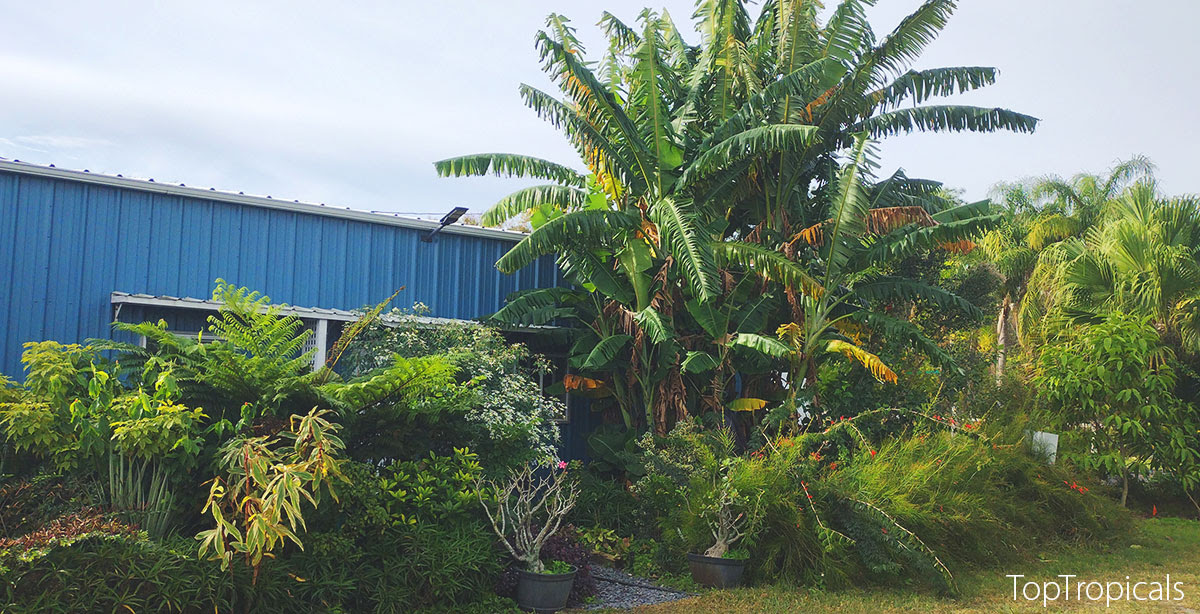
In the photo above: This picture was taken on Christmas Eve, December 24, 2023. The little garden by our B-farm office, irrigated automatically with Sunshine Boosters using the Robuster injector, is thriving in spite of cool nights. Look at this crazy banana, it is taller than the building, we honestly have never seen a banana of that size! The solution we are using there is Sunshine Robusta; now available for pick up in 2.5 gal jugs
Date: 8 Oct 2024
Why Should I Use Sunshine Boosters?
😎 Why Should I Use Sunshine Boosters?
⚠️ Plants need nutrients to grow strong and healthy. Nutrients help plants develop roots, leaves, flowers, and fruits. Sunshine Boosters fertilizers provide all key nutrients.
Sunshine Boosters are specially made to give plants everything they need to thrive. They work for both indoor and outdoor plants.
😼 Why Sunshine Boosters are better than other fertilizers?
- 🟡Easy to use: Just mix with water and feed your plants.
- 🟡Balanced nutrients: They contain the right mix of essential nutrients like nitrogen, phosphorus, and potassium, as well as trace minerals.
- 🟡No harmful chemicals: Sunshine Boosters are safe for your plants, pets, and the environment.
😎 Benefits of using Sunshine Boosters:
- 🟡Plants grow faster and produce more flowers and fruits.
- 🟡Stronger plants can resist diseases, pests, and tough weather.
- 🟡Sunshine Boosters help plants recover from stress, like after being moved or pruned.
- 🟡For all types of plants: whether you have tropical plants, vegetables, fruit trees, or flowers, Sunshine Boosters help them grow better.
Sunshine Boosters make your plants stronger, healthier, and more beautiful. By using Sunshine Boosters, you’re giving your plants everything they need to grow fast, resist stress, and produce lots of flowers or fruits. It’s the best way to keep your plants happy and thriving!
📚 Learn in more details from the article:
Why should you use Sunshine Boosters
🛒 Shop Sunshine Boosters
#Fertilizers
🔴 Join 👉 TopTropicals
Date: 4 Nov 2024
10 key tips for successful overwintering of tropical plants indoors
1. Maximize Light: The more light, the better. There's no such thing as too much indoor light. If windows aren't enough, use LED grow lights, which stay cool and won't dry the air. Rotate plants every few days to prevent uneven leaf loss.
2. Reduce Watering: Less light and cooler temperatures mean plants need less water. Allow the soil to dry between waterings, and avoid overwatering - combination of cold + wet is especially harmful.
3. Maintain Moderate Temperatures: Most tropicals are happy with daytime temperatures around 75F and nights at 50-60F. In sunrooms or greenhouses, some can handle 45F if watering is kept to a minimum.
4. Boost Humidity: Avoid placing plants near heaters or vents that dry the air. Misting daily helps, or place pots on trays filled with water and pebbles to raise humidity around them.
5. Monitor for Pests: Check leaves weekly to catch insect problems early, as pests can cause serious damage or even kill the plant indoors.
6. Fertilize Smart: Use ONLY liquid, amino-acid-based fertilizers like Sunshine Boosters throughout winter; they won't burn roots since their dosage adjusts with reduced watering. Avoid dry, granulated, and EDTA-based fertilizers during winter and dormancy.
7. Use Micro-Nutrients: Along with macro-elements (fertilizers), supplement with micro-elements like Sunshine Superfood and bio-stimulants such as Sunshine Epi to build strong plants with robust immune systems, better able to withstand unfavorable conditions and resist diseases.
8. Hold Off on Pruning: Leaf drop and leggy growth are normal responses to winter. Wait until spring to prune, when new growth starts, to encourage branching and healthy foliage.
9. Don't Repot Yet: During dormancy, roots slow their growth. Repotting too soon risks root rot. Wait until spring when new growth appears to transplant into a larger container. Typically, roots grow in proportion to the above-ground parts.
10. Let Them Rest: Winter is a natural resting period. Avoid forcing growth - your plants will reward your patience with vibrant leaves and flowers when spring returns.
🛒 Shop Indoor plants
#How_to
🔴 Join 👉 TopTropicals