Garden Blog - Top Tropicals
Date: 19 Sep 2026
Daily Cat Lesson: Why Must Cats Inspect Everything You Make?
🐾 Daily Cat Lesson: Why Must Cats Inspect Everything You Make?
A new pot appears. Something smells interesting.
🐾 Inspection is mandatory
Cats experience much of their world through smell, and warm food can be especially interesting because heating releases more aromatic compounds into the air.
And there's another reason your drink suddenly matters:
You are interested in it.
Cats learn our routines remarkably well. Something you're preparing, stirring, carrying or drinking becomes an object worth investigating - even if they have absolutely no intention of eating it!
🐈📸 Top Tropicals rescued cat Niki is inspecting freshly made Bignay Drink at PeopleCats.Garden.
🛒 Order exotic Bignay Fruit Tree (Antidesma bunius)
🐈 Stay with us for your Daily Dose of Cat! #DailyCatLesson #PeopleCats #Food_Forest
🟢 Join 👉 TopTropicals
Date: 19 Sep 2026
What to Do With a Bignay Harvest: Juice, Jam
🍷 What to Do With a Bignay Harvest: Juice, Jam & Homemade Liqueur
So your Bignay tree is suddenly covered with hundreds of red, purple and black berries.
Now what?
That's exactly what happened to me. I asked our friend Murray Corman who gave us the tree what to do with all that fruit.
His answer was short: "MAKE WINE!"
So I started researching - and experimenting.
Bignay (Antidesma bunius) has a tart flavor, abundant juice and gorgeous deep-red color, making it perfect for drinks, preserves, wine and liqueur.
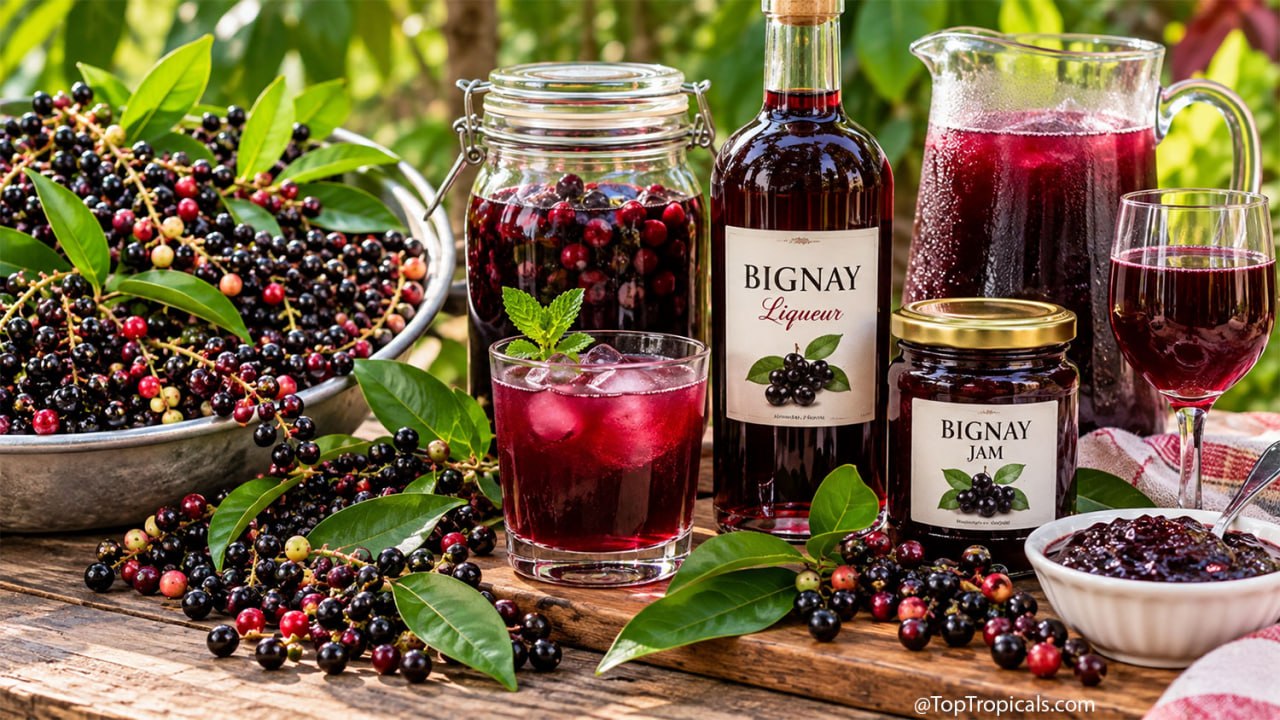
🍷 Easy Bignay juice
Use fully ripe, dark berries.
Put berries in a saucepan with just enough water to prevent scorching.
Simmer until soft and juicy.
Mash lightly and strain through a fine sieve or cheesecloth.
Sweeten with sugar or honey to taste.
Serve chilled over ice, dilute with sparkling water for a Bignay spritzer, or freeze the concentrate for later.
🍷 Homemade Bignay liqueur
This was my favorite experiment.
Fill a clean jar halfway with ripe berries and lightly bruise them without crushing the seeds. Cover completely with vodka or another neutral spirit.
Add ½–1 cup sugar per 2 cups of berries as a starting point. Keep the closed jar in a cool, dark place for several weeks, gently turning occasionally.
Strain and adjust sweetness if needed.
The result is a beautiful jewel-red, sweet-tart Bignay liqueur. Serve over ice, with sparkling water or in cocktails.
🍷 Bignay jam & jelly
Bignay's tart flavor and intense color are also perfect for preserves.
Cook ripe berries until soft. Mash and strain for jelly, or keep more pulp for jam. Add sugar and pectin according to your preferred recipe.
The result is a gorgeous dark-ruby preserve for toast, biscuits or soft cheese.
🍷 One tree, hundreds of experiments
Bignay can also become syrup or wine, and ripe berries can be frozen for later - handy because they don't all ripen at once.
That's what I love about unusual fruit trees.
Sometimes you plant something simply because you've never grown it before.
A couple of years later, you're standing in the kitchen with buckets of berries, making your own liqueur.
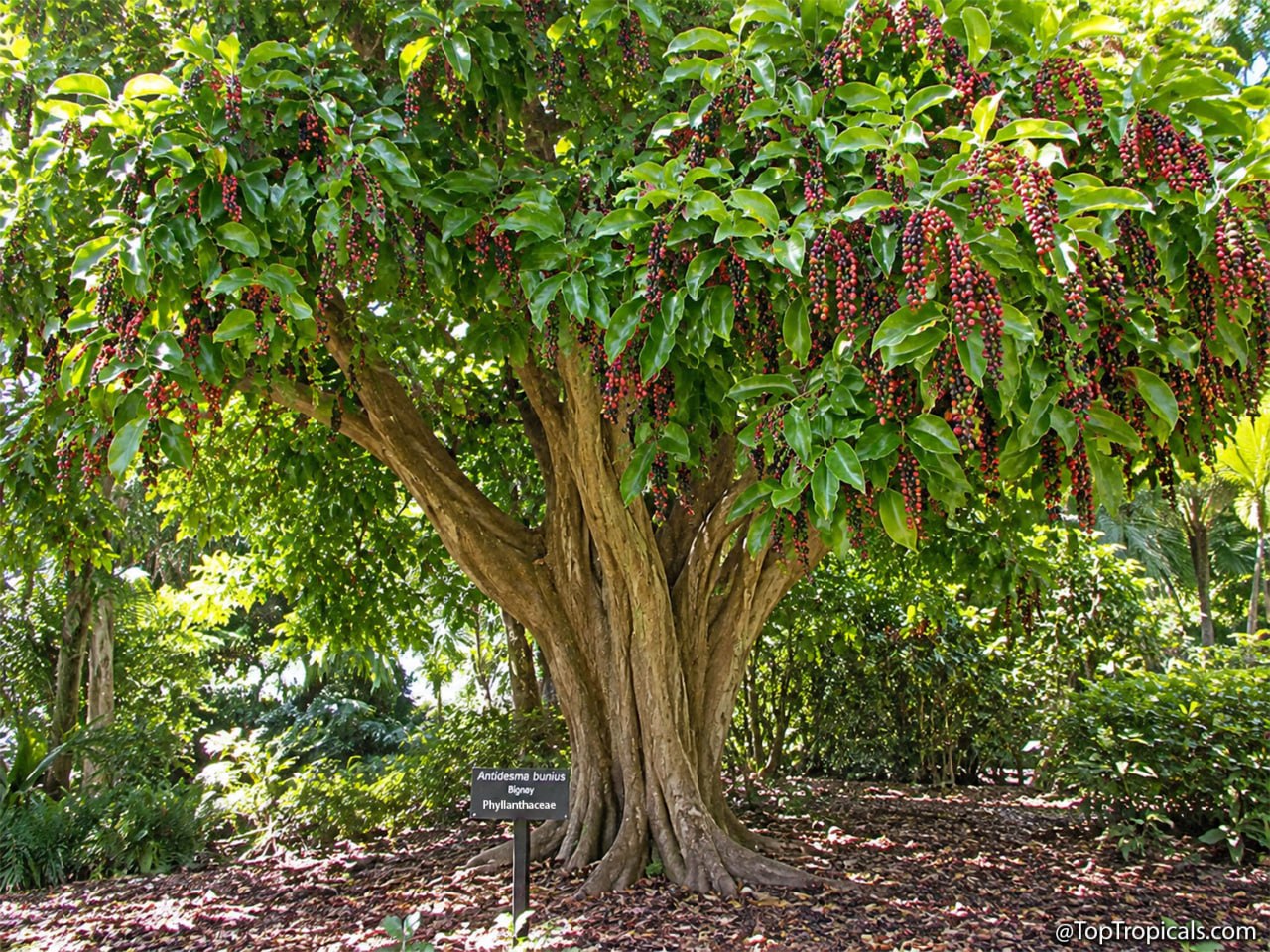
📸 In the photo: The tree that started our Bignay story!
This is the famous old Antidesma bunius at Fairchild Tropical Botanic Garden. We took this picture in 2005. Years ago, Murray Corman collected seeds from this very tree, grew his mother plant, and our Bignay came from his - a direct descendant of this remarkable Florida tree.
🛒 Grow Your Own Bignay Harvest
📚 Learn more:
• Antidesma bunius in Plant Encyclopedia
• Bignay: the rare fruit tree that gave me more berries than I knew what to do with
#Food_Forest #Recipes #Discover


Date: 19 Sep 2026
Bignay: the rare fruit tree that gave me more berries than I knew what to do with
Bignay: the rare fruit tree that gave me more berries than I knew what to do with
I walked up to our Bignay tree and couldn't believe my eyes.
The branches were weighted down with long, cascading clusters of vibrant red, deep purple and almost-black berries. Our Antidesma bunius, given to us by our friend Murray Corman, had only been in the ground for about two years - and suddenly, we had a massive harvest on our hands!
It seemed like the berries had ripened almost overnight. I hadn't even noticed them coming, which made the discovery even more exciting.
Of course, I asked Murray what I was supposed to do with all this fruit. His answer was short: "MAKE WINE!"
So I started researching - and that's when things got interesting.
Meet Bignay: The Gem of Southeast Asia
Bignay (Antidesma bunius) is an unusual fruit tree native to Malaysia, Southeast Asia. It is especially popular in the Philippines, where its berries are prized for making fresh juices, preserves, and traditional fruit wines.
What makes the tree so striking is how the fruit ripens. The berries hang in dense, grape-like strands, but they don't ripen all at once. A single cluster displays a gradient of color - from lime green and bright coral red to deep violet and glossy black.
For fresh eating: Wait for the berries to turn completely black. Unripe red berries are sharply acidic, but fully ripe black fruits deliver a complex, pleasantly sweet-tart flavor.
Bignay at a glance and basic care essentials
• Botanical Name: Antidesma bunius
• Flavor Profile: Sweet-tart, rich, similar to cranberry-pomegranate
• Cold Hardiness: Briefly tolerates upper 20s F once established
• Container Friendly: Thrives and fruits in big containers
• Light & Soil: Plant in full sun to partial shade with fertile, well-draining soil mix.
• Watering: Water regularly until established; mature trees are drought tolerant.
An Astonishingly Heavy Yield
The sheer volume of fruit is what catches most growers off guard.
Our tree isn't huge - it has stayed naturally compact and bushy. Yet once it decided to produce, the yield was incredible.
Historically, Bignay is famous for this heavy production: one legendary Florida tree at the home of famous plant explorer David Fairchild famously produced 22 bushels of berries and 72 gallons of juice in a single season.
Now that is a high-yield fruit tree.
And here is the best part: our tree is a direct descendant of that famous Fairchild tree. Murray's mother plant was grown from seeds he personally collected from it - and our tree came from his.
A Perfect Choice for Container Gardeners
While Bignay can reach substantial heights in tropical rainforests, it responds exceptionally well to pruning.
It fruits readily in large containers, making it an ideal choice for rare fruit collectors who want unusual edibles without sacrificing space to another giant mango or avocado tree.
What to Do With a Bignay Harvest
Its intense color and tart flavor are particularly good for drinks. In Southeast Asia, Bignay is traditionally used for juice, syrup and wine, and the fruit can also be fermented. So after my harvest, I experimented...
Pro tip: Crushing the ripe berries yields a rich, ruby-red juice. It will stain your fingers, so consider yourself warned!
Bignay isn't merely an obscure Asian fruit that happens to grow in Florida - it has a neat Florida tropical-fruit history, and Fairchild Tropical Botanic Garden still describes it as a Florida legacy fruit. This fruit is about abundance, not the individual berry. You probably don't know this fruit - but look what ONE little tree can produce!
👉 Coming up next: Bignay recipes
🛒 Grow Your Own Bignay Harvest
📚 Learn more:
• Antidesma bunius in Plant Encyclopedia
• What to do with a Bignay harvest: juice, jam and homemade liqueur
#Food_Forest #Recipes #Discover
Date: 18 Sep 2026
Daily Cat Lesson: Why Are Orange Cats So Crazy?
🐾 Daily Cat Lesson: Why Are Orange Cats So Crazy?
Orange cats have a reputation.
Friendly. Fearless. Loud. Social. And very good at sitting there looking like perfect little angels 😇 who have never caused trouble in their lives. Until...
The zoomies hit - sudden explosions of energy when a normal cat turns into a furry race car and tears through the house for no apparent reason.
In some languages, there’s a perfect word for it: tygydyk — the sound of little paws galloping through the house: tygy-dyk, tygy-dyk, tygy-dyk!
🐾 Is there actually a redhead gene?
Yes - sort of! 😎
The gene that makes a cat orange is carried on the X chromosome. That explains a famous orange-cat fact:
🐾 About 80% of orange cats are male.
Males have only one X, so one orange version is enough.
Females have two X chromosomes and usually need the orange version on both to be fully orange. With one orange and one non-orange X, they usually become tortoiseshell or calico!
🐾 Does the "orange" gene also cause legendary Orange Cat Behavior™?
Probably not. While some studies have found associations between coat color and behavior, there is no established “crazy orange cat gene.”
Personality comes from genetics, upbringing, environment - and the individual cat.
So science can explain why your cat is orange.
Why he suddenly goes tygy-dyk tygy-dyk tygy-dyk across the house at 3 AM, attacks a cardboard box and falls into the water bowl?
Science still has work to do.
🐈📸 Top Tropicals rescued cats Bob the Redhead and James Coconuts at PeopleCats.Garden.
🐈 Stay with us for your Daily Dose of Cat! #DailyCatLesson #PeopleCats
🟢 Join 👉 TopTropicals
Date: 18 Sep 2026
Ground Orchids 101: How to Grow a Garden Full of Flowers
🌸 Ground Orchids 101: How to Grow a Garden Full of Flowers
Ground orchids are some of the easiest and most rewarding flowers for a tropical garden.
Spathoglottis grows in regular garden soil or potting mix, takes sun or shade, doesn't mind Florida's brutal summer heat, and can bloom nearly year-round. Not many flowering plants, even tropical ones, can check all those boxes.
And look at these colors! Purple, pink, yellow, orange, white, lavender... Plant several together and turn an ordinary bed into an orchid garden.
Here is what we've learned about keeping them happy.
· 🌤 Sun or shade?
Both work.
Bright filtered light or partial shade is excellent, especially in Florida. Morning sun is great. More light generally means more flowers, but strong afternoon sun can scorch plants accustomed to shade.
And ground orchids don't mind our summer heat. Even when many tropical plants struggle through our hottest months, they usually keep growing and flowering.
Lots of leaves but few flowers? Try more light.
Bleached or burned leaves? Give them more shade.
· 🌿 Yes, plant them in soil
Unlike epiphytic orchids that grow on trees, Spathoglottis is a terrestrial orchid. Its roots grow in the ground.
Regular garden soil or loose potting mix works. The important part is drainage. Ground orchids like moisture, but don't want to sit in water.
Don't plant too deep. Keep the crown and pseudobulbs at or slightly above soil level.
· 💦 How much water?
Water regularly while establishing and during hot, dry weather, then let the upper soil begin to dry before watering again.
During Florida's rainy season, Mother Nature may handle most of this for you.
The biggest mistake is keeping the roots and crown constantly soggy.
· 🌸 Feed them for more flowers
Ground orchids respond well to feeding during active growth. A controlled-release fertilizer Green Magic makes this easy. Sunshine Orchidasm liquid plant food is safe to use year around with every watering.
You're feeding today's flowers and the new growth and pseudobulbs that produce tomorrow's flower spikes.
· ✂️ What about old flowers?
When a flower spike is finished, cut it near the base. Remove old brown leaves as needed.
That's about all the pruning required.
· 🌱 Turn one plant into many
A ground orchid gradually develops into a clump as new pseudobulbs form.
Once the clump gets large, dig it up and divide it, making sure each section has healthy roots and pseudobulbs.
Replant them around the garden. That's how a few ground orchids can eventually become a whole flowering border.
· Protect them from freezes
Ground orchids are tropical. Occasional light frost usually doesn't do much damage, but hard freezes can damage them, so gardeners in colder areas can grow them in containers and move them to protection when necessary. In warm climates, they make excellent perennial garden plants.
· 🌈 Our favorite way to grow Ground Orchids
Don't plant just one.
Mix several colors along a walkway, under palms, around a patio or in a garden bed. Let the clumps grow, divide them, and spread them around.
Regular soil. Sun or shade. Pots or garden beds. Flowers almost all year.
For the amount of color they give us compared with the work they require, ground orchids are hard to beat.
· 📌 Ground Orchid 101: Save This!
Light: Sun to partial shade; best flowering with plenty of bright light
Soil: Regular garden soil or potting mix; good drainage is essential
Water: Keep evenly moist, never constantly soggy
Fertilizer: Slow-release fertilizer during active growth
Temperature: Protect from hard freeze
Height: Usually 1–2 ft; flower spikes can rise higher
Bloom season: Nearly year-round in warm climates
Propagation: Divide established clumps and replant the pseudobulbs
🛒 Shop Ground Orchids
📚 Learn more:


· Spathoglottis plicata in Plant Encyclopedia
· The prettiest flower for shade
· Ground orchids: all-summer colors
· Why do we love Ground Orchids
#Container_Garden #How_to #Shade_Garden #Discover
🟢 Join 👉 TopTropicals