What
Fertilizer to Use Now and How?
Five important keys to healthy plants
Q: It's early Spring this year. Should I start
fertilizing my plants sooner than usual?
A: Most fertilizer instructions recommend
fertilizing tropical plants from March to November. This is because plants don't
need as much food during the cooler months when many go dormant, and excess
nutrients can burn the roots if not absorbed. However, for the most effective
fertilizer program and healthy plants, consider these points:
1. Sunshine Boosters
Year-Round
Liquid amino-acid-based fertilizers like Sunshine Boosters are safe to use year-round. Since watering is reduced
in cooler weather, the intake of water-soluble fertilizer is also lower,
providing plants with just the essential nutrients for their minimal needs.
2. Dry Fertilizer Schedule
Be cautious with dry fertilizers. Apply them only during active growth
in the hot season.
3. Temperature Is Key
If March is still cold, delay dry fertilizer use. However, if nighttime
temperatures in February stay above 65F, you can start a dry fertilizer
program using slow-release, granulated plant food.
4. What Fertilizers to Use and
How
Check out our Sunshine Boosters selection for different types of plants and choose
the right type for your needs. These can be applied as often as with every
watering:
For Rapid Growth
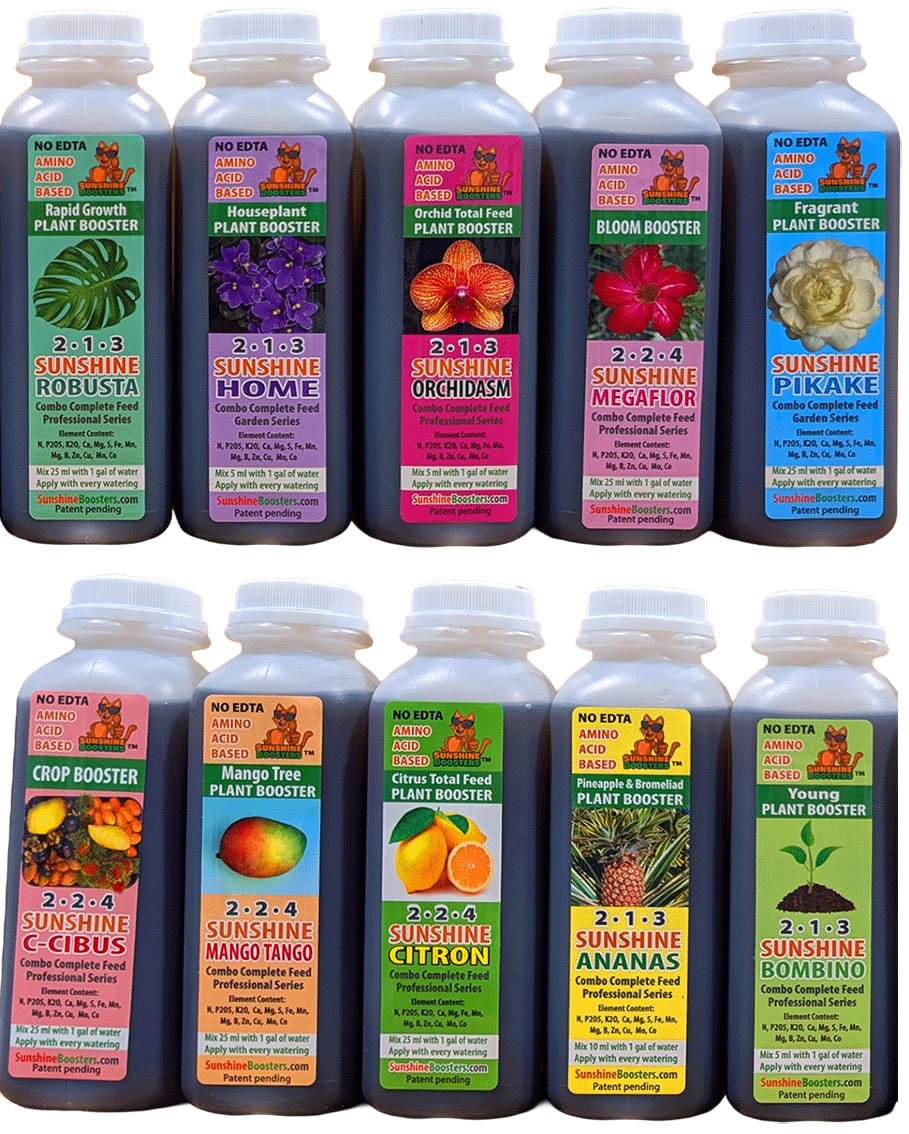
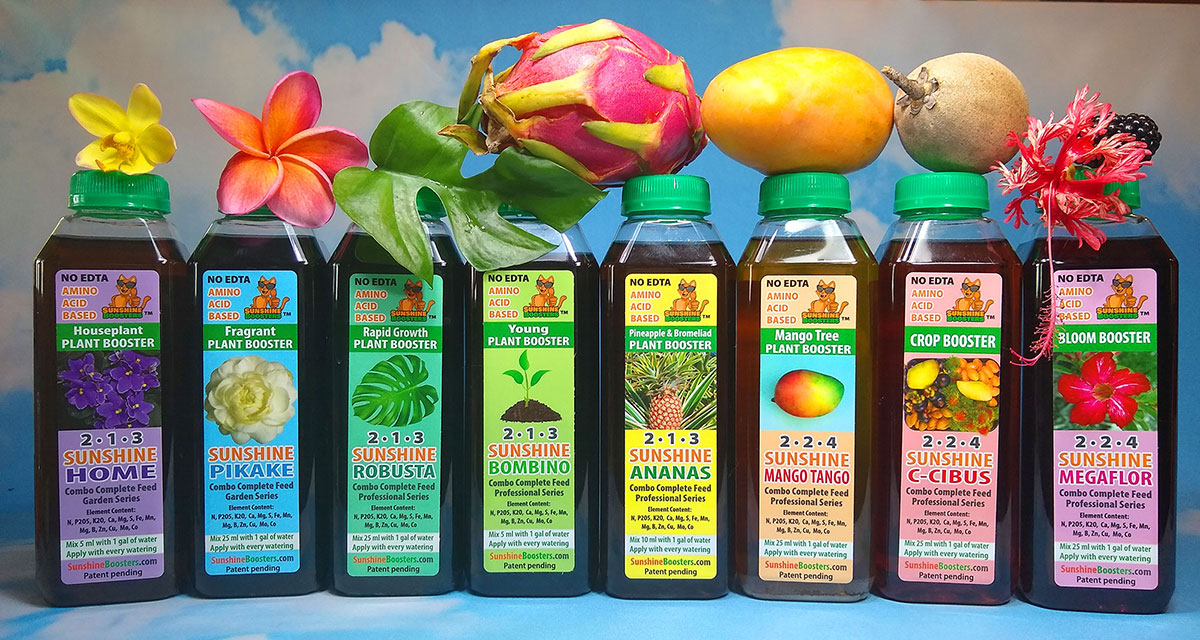
Sunshine Robusta - Rapid Growth Booster: general fertilizer for both foliage
plants and small starters that need an extra boost.
For Flowers
Sunshine Megaflor - Bloom Booster: boosts flowers on established plants; and Sunshine Pikake - Fragrant Plant Booster: best for fragrant flowers.
For Fruit Trees
Sunshine C-Cibus - Crop Booster: contains all necessary elements for fruit trees and their production. Sunshine Mango Tango - specifically formulated for Mango and Avocado
trees, and Sunshine Citron - ideal for citrus trees.
For Tender Perennials
Sunshine Orchidasm - Orchid Total Feed and Sunshine Ananas - Pineapple and Bromeliad Booster: mild formulas for these tender perennials.
5. Microelement Supplements Are a Must
Besides macronutrients, plants need additional microelements, just like
humans need vitamins. Be sure to apply these supplements along with your
regular plant food:
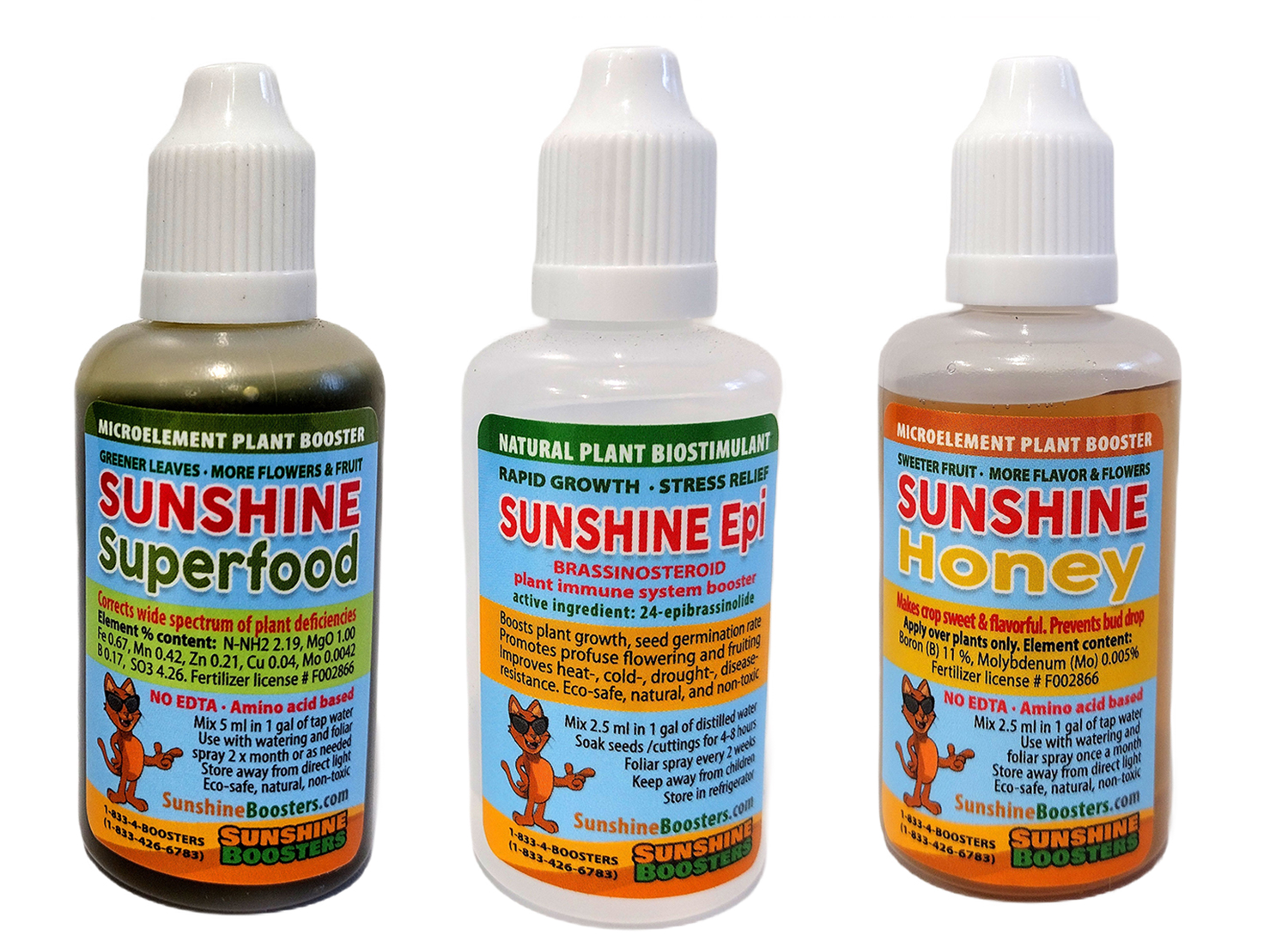
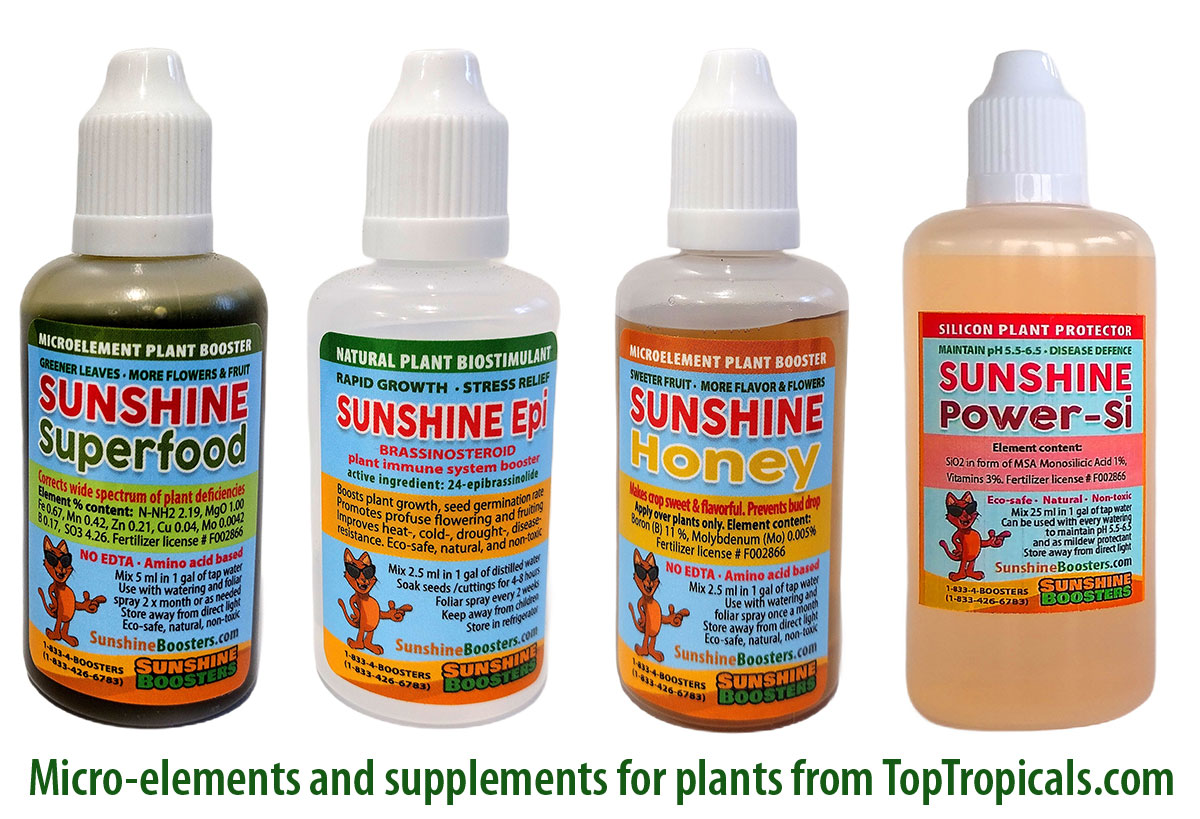
For Green Leaves and Health Sunshine SuperFood - Complex Microelement Supplement: a
must for healthy plants. Apply once a month.
For Stress Relief Sunshine-Epi - Brassinosteroid Plant
Hormone: essential for plants recovering from stress (shipping, transplanting,
drought, insect damage, cold stress, etc.). Apply as needed.
For Sweeter, Bigger Fruit
Sunshine Honey - Fruit Sugar Booster: application on fruit trees will make
fruit bigger and sweeter by directing sugars to the fruit from other plant parts, and helps to prevent bud
drop. Apply 4 times a year: at bud setting, flowering, fruit setting, and
after harvesting.
For Better Resistance
Sunshine Power Si - Silicon Protector - enhances resistance to insects, diseases, drought, and frost, while boosting growth. Apply once a
month, along with Sunshine SuperFood.
Q: I recently bought both the 5ml of the sunshine epi and the 100 ml
advanced nutrition kit. I read on the paper for the Epi not to use any other strong fertilizers along with this but I was
wondering if it'd be alright to use both this foliar spray and nutrition
watering together?
A: All solutions in SUNSHINE Booster Nutrition System (NPK-macro and micro-boosters) are
compatible.
The only exception is Sunshine-Epi - brassinosteroid bio-stimulant. Epi
should be mixed with distilled water separately from other boosters. The
reason is, it is very bio-active, and if mixed with other compounds, oxidizes
quickly which may affect its performance.
Sunshine-Epi solution must be prepared using distilled water and
applied as foliar spray only (it only works on contact with leaves and not through
the root system). Epi shows extremely impressive results when you apply it
before the application of other nutrients because it increases plant
metabolism; so all boosters become even more effective if you spray Epi the day
before.
When using Micro- and Macro-boosters, you may mix all components in one watering can/tank
(except for Epi), using regular tap water. Besides watering root ball, the
macro-micro solution can be also used for foliar spray. It is optional, as in some
circumstances growers prefer to keep leaves dry at all times: to stay away
from mold, fungus and other issues caused by the wet environment.
Here is an example of Sunshine Boosters Nutrition System application:
1. Daily watering in one can: NPK 25 ml/gal (one of 5, depending on growth stage) + Constanta 5 ml/gal + Ca-Support 5 ml/gal, mixed in tap water
2. Every 2 weeks: spray Sunshine-Epi 2.5 ml/gal - to boost the immune system and growth rate,
mixed in distilled water
3. From daily to every 2 weeks: Sunshine-Power-Si 25 ml/gal to protect from diseases and keep pH at
5.5-6.5. Can be used as often as daily and mixed with a daily watering solution
(1)
4. As needed: Sunshine SuperFood and GreenLeaf - for correcting deficiencies. Can be also mixed with the
daily solution (1)
Make sure to prepare a solution right before use and do not store
solution for more than 1 day.
Keep concentrates and solutions protected from bright sunlight.
🍲 What Fertilizer to Use Now and How?
Part 2. Macro elements, or everyday plant food
Sunshine Booster for different types of plants can be applied as often as with every watering.
✔️ For Rapid Growth
Sunshine Robusta - Rapid Growth Booster: general fertilizer for both foliage plants and small starters that need an extra boost.
✔️ For Flowers
Sunshine Megaflor - Bloom Booster: boosts flowers on established plants; and Sunshine Pikake - Fragrant Plant Booster: best for fragrant flowers.
✔️ For Fruit Trees
Sunshine C-Cibus - Crop Booster: contains all necessary elements for fruit trees and their production. Sunshine Mango Tango - specifically formulated for Mango and Avocado trees, and Sunshine Citron - ideal for citrus trees.
✔️ For Tender Perennials
Sunshine Orchidasm - Orchid Total Feed and Sunshine Ananas - Pineapple and Bromeliad Booster: mild formulas for these tender perennials.
✔️ Microelement Supplements Are a Must
Besides macronutrients, plants need additional microelements, just like humans need vitamins. We will explain in details about micro-elements in our next post 🔽
Smokey and Sunshine Prepare Plants for the Cold Night.
Smokey: Come on, Sunshine, help me move these plants inside before it gets
dark!
Sunshine: I am helping... see? I’m supervising the mango
tree.
Smokey: You call that supervising? The frost cloth’s upside down!
When the forecast drops into the 30s, panic is not a plan. This is your
simple, clear checklist to protect every tropical in your garden. Think of
it as the quick emergency manual that goes hand in hand with the previous
cold-weather newsletter.
"We
all love our tropical flowers, mangoes, bananas, and rare fruit trees. A
single cold night does
not have to be a disaster. The key is knowing what to do, when to do it, and
what mistakes to avoid." - Tatiana Anderson, Top Tropicals Plant
Expert
🌡️ FROST AND FREEZE
A frost and a freeze are not the same. A frost is when you see ice crystals
on leaves or grass, while a freeze is when the air temperature drops below
32 F. The tricky part is that you can get
frost even when the air is above freezing, and you can have a freeze with no
frost at all. It all depends on humidity and the dew point. If the dew
point
is below freezing, the ground can cool faster than the air, letting frost
form even when your thermometer reads 35 or 36 F. And once the air itself
drops below 32 F, even for an hour, tender tropicals can be damaged. For
plants, a freeze is far more dangerous, because freezing air pulls heat out
of stems, branches, and roots. Frost usually burns leaves, but a true freeze
can injure wood, kill buds, and damage the entire plant.
Frost on the grass and leaves on Winter morning in Central
Florida
WHAT TO DO
AND NOT TO DO BEFORE A COLD SNAP
✔️ 5 THINGS TO DO:
Water well. Hydrated plants tolerate cold better than dry, stressed
ones.
Add mulch. A thick layer around the base keeps roots warm.
Block the wind. Move pots to a sheltered corner or patio.
Cover at night, uncover in the morning. Let plants breathe and get
light.
Add gentle heat if needed. Non-LED Christmas lights or a small old style
15-20W light can raise temps a few degrees.
❌ 5 THINGS NOT TO DO:
Do not prune or trim. Fresh cuts freeze first.
Do not overwater. Wet, cold soil invites root rot.
Do not let plants dry out either. Wilted plants freeze more easily.
Do not use dry fertilizer. Gentle liquid feeds like Sunshine
Boosters are safe to use with every watering: its intake naturally slows
down as watering decreases.
Do not look only at the thermometer. A long, windy night can be worse
than a short freeze.
TEMPERATURE
ACTION GUIDE (40 to 25 F)
40 to 38 F: Move potted plants to shelter, water soil, and cover
tender tropicals.
37 to 33 F: Use frost cloth and anchor it down so the wind does
not lift it.
32 to 30 F: Add a heat source like non-LED lights.
29 to 25 F: Double-cover sensitive plants, wrap trunks, and
protect roots heavily.
COLD
TOLERANCE BY PLANT TYPE
Before a cold night, it really helps to know your plant’s exact
cold limits. Every species is different, and young plants are always more
sensitive than mature ones. Take a few minutes to look up your varieties in
our Tropical
Plants Encyclopedia
— it will tell you the safe temperature range, how much protection
each plant needs, and which ones must be covered or moved before the next
cold snap hits.
Bananas: leaf burn below 37 F
Mango, Annona: hurt around 32 F
Cold hardy avocados: Mature tree can take about 25 F. Young trees must
be protected
Olives, Citrus, Guava, Jaboticaba: usually OK outside with mulch
QUICK-ACTION
TABLE
Before the cold arrives, make yourself a quick list of every plant and
what action each one needs. It saves time when temperatures start dropping
and keeps you from scrambling in the dark. Check that you have enough frost
cloth, blankets, and supplies on hand so you can cover everything without
rushing. Planning ahead makes cold nights much less stressful.
Bring Indoors: Cacao, Bilimbi, Coffee. They need warm, bright
light.
Cover Outdoors: Mango, Jackfruit, Banana, Annona. Use frost cloth, not
plastic on leaves.
Covering large mango and avocado trees in pots at TopTropicals during
cold nights
GADGETS AND
TOOLS THAT HELP
Indoor helpers: LED lights, small heaters, bottom-heat mats,
timers.
Outdoor helpers: frost cloth rolls, mini greenhouses, non-LED Christmas
lights or small incandescent lights, smart thermometers.
Always keep electrical safety in mind, especially if you are using extension
cords outdoors. Use only weather-rated cords, keep all connections off the
ground, and protect plugs from moisture. Make sure heaters and lights are
stable, secured, and never touching fabric covers. A few minutes of safety
check
can prevent a dangerous situation on a cold, wet night.
And if you want to keep plants strong through winter, add Sunshine
Boosters to your watering routine. It is gentle, safe in cold weather,
and gives plants an extra edge.
AFTER THE
COLD PASSES
In the morning, uncover plants. Leaving covers on during the day can trap
heat and cook the tender new growth, especially under the sun. The only
exception is true frost cloth designed for all-day use, which allows air,
light, and moisture to pass through. Regular blankets, sheets, and plastic
must come off as soon as the sun rises.
Do not cut anything yet. A plant can look completely dead after a freeze,
but many branches are still alive under the bark. Cutting too soon removes
wood that would recover on its own. Wait until new growth begins in spring.
That is when you can see exactly which branches are truly dead.
Use the scratch test. Gently scratch the bark with your nail or a small
knife. If the layer underneath is green, the branch is alive. If it is brown
and dry, it is likely dead. But even then, wait until warm weather to be
sure, because sometimes only the tips die back while the lower part of the
branch survives.
Once the weather stabilizes, resume light feeding. Plants coming out of cold
stress need gentle support, not heavy fertilizer. A mild liquid feed like
Sunshine
Boosters helps them rebuild roots and push new growth without burning
tender tissue.
Your tropical garden can survive any cold night if you prepare right. Cold
snaps always feel stressful in the moment, but once you know your plants,
have the right supplies, and follow a simple plan, it becomes routine. A few
minutes of preparation before dark can save months of growth and keep your
collection healthy all winter.
Frost cloth is the true workhorse of cold protection: it keeps heat in,
keeps frost off, and will not suffocate plants the way plastic or blankets
can. Having a few rolls ready means you never have to scramble at the last
minute. Sunshine
Boosters give your plants gentle support during the colder months so
they stay strong enough to bounce back quickly when warm weather
returns.
A little planning now will pay off in spring, when your mango, banana,
citrus, and all your favorite tropicals come back happy and ready to
grow.
Prepare your plants for Winter with Sunshine Boosters
We usually stop using dry slow-release fertilizers from November to March. However,
liquid Sunshine Boosters, which are natural plant food, can be used all year. They help your plants survive winter. When it gets colder, we water less,
so the fertilizer decreases too. The plants only use what they need. To learn more about how Sunshine Boosters work and why they're safe and helpful, check
out this blog: Using Sunshine Booster during Winter.
New Boosters for the New Year! Sunshine Total Feed: Orchidasm and Citron
How to grow everblooming orchids?
Q: I ended up with a large collection of orchids that I was given as
presents... They grow well but unfortunately after the showy blooms were gone, I don't see any more flowers, just green leaves. What do I need to do to make them bloom again? Should I fertilize them with Azalea bloom booster?
A: Orchids culture is different from garden ornamental plants. First big difference, they are epiphytes, growing in a loose bark medium rather than soil, and
benefit from daily mist. Second difference is a type of fertilizer. You can not use a regular garden fertilizer on orchids,
because they are very sensitive to salts. Orchids need special, acidic type of fertilizer, very mild in action.
Luckily, Sunshine Boosters formulas are exactly what orchids need! They are amino-acid based, have very mild formulas, and do not create nutrient lock up (building up salts is one of the biggest
enemies of tender orchids).
A new Sunshine Boosters Orchidasm TotalFeed is scientifically balanced orchid food that contains all
necessary nutrients, including micro-elements, for healthy, happy, vigorous orchids. It can be used as often as daily with every foliage spray. From our testing experience, after using Orchidasm Booster, orchids not only got happy and thriving -
they also bloom more often - up to several times a year, shooting new flower spikes one after another! (while normal blooming cycle for most
orchids is once a year). It gets even better - the flower display lasts twice longer!
To enjoy these beautiful flowers year around - treat them with Love, give them some
Orchidasm!
Q: We planted several citrus trees in our yard - Meyer Lemon, Grapefruit and Blood Orange. The trees came from
the store full of flowers and even had a few fruit, but a year after planting - no more flowers! The old leaves are green, but new growth doesn't look
healthy, leaves are yellowish and have spots, maybe eaten by bugs (?), and how do we get them to fruit?
A: Citrus plants are not the easiest trees to grow; they are susceptible to various diseases, pests, and deficiencies, especially in areas with high humidity/rainfall like Florida.
Fungi, viruses, leaf minors, chlorosis - this is not a complete list of citrus common problems. In commercial groves, these conditions are kept under
control by using harsh chemicals on solid schedule.
For home gardeners, growing citrus trees may become a challenge. Many people don't want to use harsh
chemicals on their edibles; and those who do, may not always have time to apply treatments on a professional schedule. So as much as we all love a fresh juicy orange,
growing your own may become quite a pain! Sunshine
Citron TotalFeed is your simple, eco-safe solution to a healthy looking, productive citrus tree with organic fruit! Amino-acid based formula provides all
necessary elements to strengthen the tree and make it resistant to possible problems.
Did you know that treatment of leaf chlorosis (yellow leaves with dark
green veins), commonly treated with iron supplements, in fact requires a complex combination of nutrients - both balanced NPK and micro-elements?
Use Sunshine Citron in combination with Sunshine GreenLeaf and
Sunshine SuperFood and never see yellow chlorotic leaves again!
Apply Sunshine Epi on regular basis (every 2 weeks) and help your tree boost its immune system and stay virus-free.
Add Sunshine Honey, and you will have large, juicy fruit that
are much sweeter and more flavorful than those from the store! All these boosters are compatible with each other, and perfectly natural. Eat your fruit safely and enjoy...
Q: We have an early Spring here in Florida. All plants in my
garden flushing out new leaves and buds opening. Can I start fertilizing? I have
Mango, Avocado, Peach trees, many medicinal herbs and flowering shrubs: Angel
trumpets, plumerias, bromeliads. I prefer mild organic fertilizers; can you
suggest something that is safe for edibles and butterflies?
Q: As a rule of thumb, tropical gardeners start regular
fertilizing when the minimum temperatures (at night) go above 65F. Keep in mind that
Sunshine Boosters fertilizers can be applied year around because they
have mild formulas and used with every watering; during cooler period, you water
less frequently, so feeding is reduced accordingly. Another advantage of
Sunshine Boosters - they are natural (derived from organic amino acids which is
the basics of Life). They are safe for edibles as well as pollinating
insects.
Here is the feeding plan for your plants: 1. The most universal solution for all plants (both potted and
in-ground): get a complete set of Sunshine Boosters Pro system: Advantage-Pro for vegetative growth, BloomBoom Pro for flowering stage, and Ca-Support-Pro + Constanta-Pro as necessary daily supplements. You will need all these 4
components for your garden. 2. Start adding these liquid boosters with every watering according
to dozing directions and you will notice amazing growth boost within a
week. 3. Apply Sunshine Epi plant hormone every 2 weeks as a foliar spray to boost
immune system and metabolism of plants and protect them from diseases. Epi
makes plants (especially young plants and those "waking up" from dormancy)
grow twice faster! It also enhances effect of fertilizers by increasing plant
metabolism. 4. After cool winter temperatures, some plants may develop element
deficiencies like chlorosis (yellowing leaves). Additional microelement boost
can be provided with Sunshine Greenleaf (iron supplement) and Sunshine Superfood (micro-elements). 5. For additional boosting of flowering and setting fruit, use the
following individual boosters:
Sunshine Robusta - for foliage plants and when you need rapid vegetative
growth
Sunshine TotalFeed - for Plumerias and other fragrant plants
Sunshine Megaflor - for Brugmansias and other flowering heavy feeders
Sunshine C-Cibus - for improving fruit production and quality
Sunshine Honey - for sweeter fruit (must be applied 4-5 times a year) 6. For young/small plants (seedlings, rooted cuttings) as well as
tender tropicals like bromeliads, and orchids - Sunshine Bombino is a perfect choice due to its mild formula. 7. To save money, order complete sets rather than individual
boosters; you will be able to safe up to 40%! Sunshine Complete Nutrition System
Kits: Combo
Kit, and Pro Kit.
If you are a fan of organic gardening, do not use dry fertilizers. While
water-soluble and granulated (smart-realease) fertilizers are popular choice
in plant nurseries due to their convenience, they are not as safe as liquid
boosters because they create salt build-up in soil and have a high risk of
overdosing/burning plant roots, especially potted plants, plants at breaking
dormancy, at establishing, and at early stages of plant development. Besides,
dry fertilizers may affect the taste of your fruit and herbs. See advantages of liquid boosters over dry fertilizers.
The year is almost over but the winter is not. This Christmas weekend at
our Sebring B-farm we had it down to 30F. As a tropical gardener, winter can
be challenging, especially if you grow plants outside of tropical zones.
To protect your garden from the cold, consider the following:
1. Monitor freeze watches and be prepared to take action if
necessary.
2. Create temporary structures like mini-greenhouses using PVC pipes,
carport frames, or bamboo sticks to support covers.
3. Use covers such as frost cloth, cardboard boxes, blankets, and bed
sheets.
4. Use Christmas lights and other heating elements, including propane
heaters, to keep plants warm.
5. Add a layer of heavy mulch around plant trunks to protect them from the
cold.
6. Apply plant boosters that improve cold hardiness, such as Sunshine Epi,
Sunshine-Si, and Sunshine Superfood.
At TopTropicals B-Farm, we sprayed our plants with a special cold hardiness treatment Sunshine-Si and covered and wrapped
everything we could. We also moved cold sensitive species inside greenhouses.
All of our plants are looking great and happy!
Photo above: Mulching mango trunks and using Christmas lights for
cold protection
Photo above: Temporary wrapping of a section of a greenhouse with a
plastic or frost cloth protects from a windchill. It may also win you a few
degrees even without a heater. In this particular case, according to our temp
sensors, it was 30F outside, and 41F inside this "dome", no heaters used.
Sunshine Boosters:
Last chance to stock up at a lower price!
Sunshine
Boosters are natural, amino acid-based liquid fertilizers made with only
the highest quality ingredients. Starting in 2023, the pricing for Sunshine
Boosters will be adjusting to reflect the increasing cost of supplies. This is
your last chance to stock up on Sunshine Boosters before the end of the year!
Sunshine Boosters are safe to use year around, with every watering.
Don't miss out on this opportunity to get the best
value for your money!
Use discount for even better
deal:
22FOR22
for 22% off orders $220+
Min order $220. Offer expires 12-31-22
Date: 28 Sep 2016
Helping plants to survive winter:
SUNSHINE BOOSTERS - FROM SUNSHINE STATE
A magic plant hormone so wanted by gardeners, is finally here! When people purchase plants and trees either on-line, or from their local nursery, expectation and anticipation for their new find is high. Many times, however, disappointment is encountered due to a variety of reasons. These reasons include changes in light, temperature, water, soil conditions and transportation; just to name a few. So how can the stress on newly transported and transplanted plants be mitigated? Easy! There are plant stimulators able to reduce the shock encountered.
One such plant stimulator, produced at TT Laboratories is SUNSHINE, a revolutionary, broad spectrum, plant stress reliever. Extracted initially from plant pollen, SUNSHINE can bring back and keep the vigor to stressed plants in both the home and garden. Sunshine is indeed a plant stimulator on the cutting edge of plant care technology. Reasonably priced, and easy to use, SUNSHINE will be your plants' best friend, next to yourself, of course.
SUNSHINE will help your plants:
- recover from stress
- dramatically increase growth rate
- get profuse flowering and fruiting
- improve disease resistance, cold hardiness, and heat resistance
- promote seed germination and root cuttings easily
Great for indoor plants and improving cold tolerance!
Line of products: SUNSHINE-E - general plant booster, growth stimulator and immune booster
SUNSHINE-BC - Bonsai and Caudex developer
SUNSHINE-S - seeds and cuttings pre-treatment
SUNSHINE-T - Thermo-protection for overwintering tropical plants
SUNSHINE-Micro - ultimate micro-element mix from TT Laboratories
On the photo: Tomato seedlings, with and without Sunshine-E treatment; 1 week after treatment, 09-01-2016. Continue reading...
Add a little Sunshine
to keep your plants looking their best
By Ed Jones, the Booster Guy
...Just like people, a little sunshine goes a long way in keeping them
happy. It is usually easier to keep a plant healthy than it is to fix it when
it is not well. Proper plant nutrition is often times the issue. The good
news is that it is easy to keep your plants looking good by following proper
nutrition practices...
...Feeding your plants with micronutrients that they just don't get in
regular fertilizers can prevent deficiencies. Let's get started on a regular
program of using foliar sprays to help keep your plants looking their best...
We recommend using three products in combination - the Complete SUNSHINE Microelement Supplement Kit that consists of:
We are recommending a foliar spray once per week to maintain optimal
health conditions. This is based on recent studies done in Ukraine by the scientist who invented Sunshine Boosters products... Continue reading to see an easy treatment schedule that will provide
your plants with:
- Increased photosynthetic activity
- Increased insect and disease resistance
- Reduced mineral toxicity
- Improvement of nutrient imbalance
- Enhanced drought and frost tolerance
- Enhanced plant growth
Sunshine Boosters are developed in Ukraine
and manufactured in the USA. We support Ukraine fight for freedom. All
profits from these fertilizers will be donated to support our Team in Ukraine.