Garden Blog - Top Tropicals

Date: 23 Feb 2026

Macadamia Tree Care

By Tatiana Anderson, Horticulture Expert at Top Tropicals with Smokey & Sunshine help
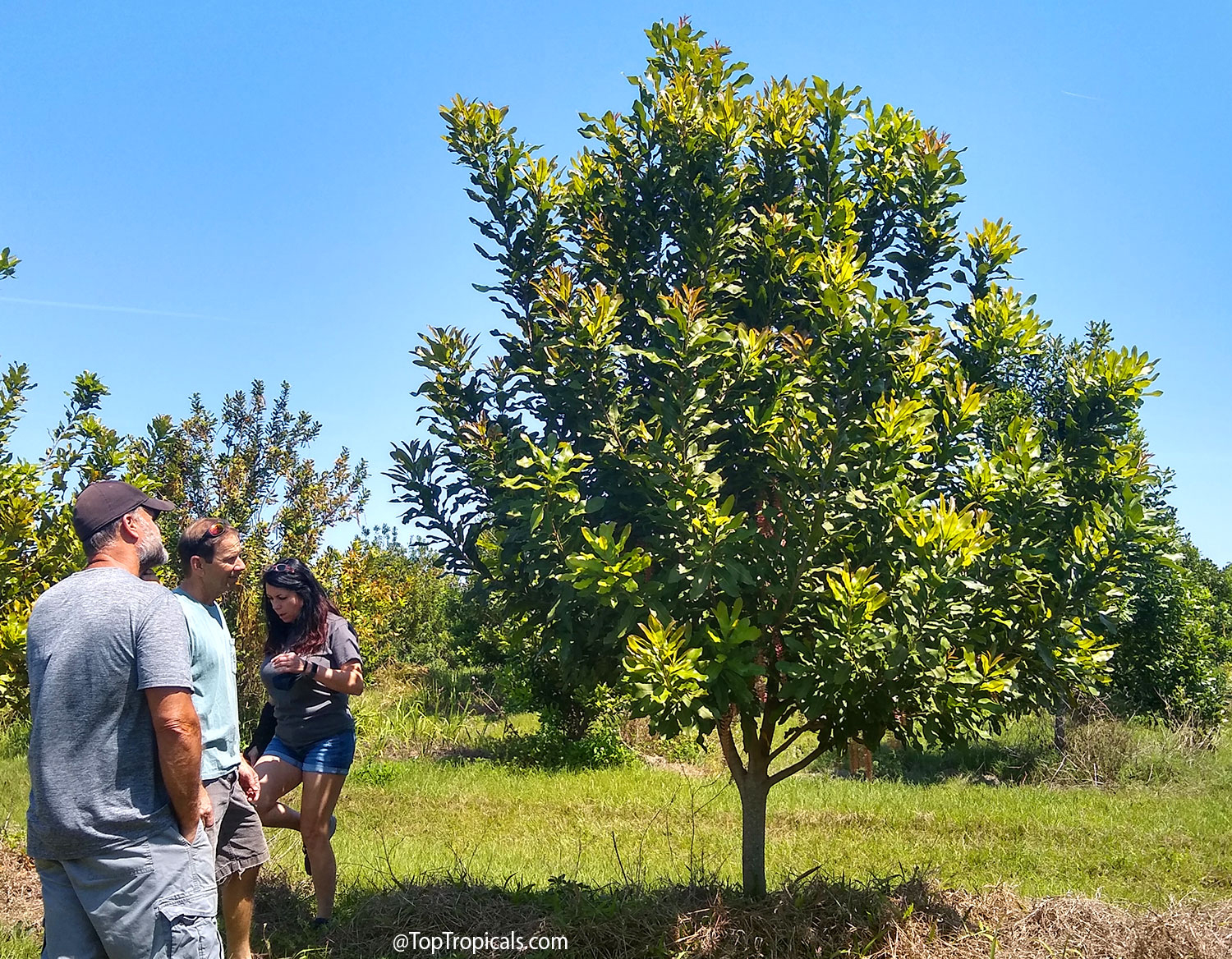
Mature  macadamia  tree  with  well-shaped  canopy  growing  in  Florida 


orchard.

Macadamia tree maturing into a productive, manageable canopy.

🌳 Growing Macadamia Tree

Macadamia is not a fragile tree, but it does have preferences. If you respect them from the beginning, the tree rewards you for decades.

  • Start with the site. Drainage is everything. Macadamia will tolerate cool weather better if planted in a well-drained area. Avoid low spots where water sits after rain. If your soil is dense or clay-like, build a mound or improve drainage before planting.
  • Choose full sun whenever possible for the best nut production.
  • Planting location matters. A south or southeast exposure near a wall can create a warmer microclimate that buffers cold nights. Freeze plus wind is more damaging than temperature alone. Macadamia handles cold better when protected from winter wind.
  • Dig a hole about twice as wide as the container, but no deeper than the root ball. Set the tree level with the surrounding soil. Do not bury the trunk.
  • Water regularly during the first three months while the tree establishes roots.
  • Fertilize lightly. Macadamia does not respond well to over-fertilizing. Macadamias prefer mild liquid fertilizers, SUNSHINE Boosters Robusta is ideal for it. You may also use controlled release Green Magic every 6 months, it is especially formulated for hot climate. To keep leaves healthy deep green without yellowing, micro elements must be applied on regular basis, we recommend to always have handy Sunshine Superfood micro nutrients complex.
  • Young trees should be protected if temperatures drop below freezing. Once established, they become far more resilient.
  • Harvest timing: Nuts mature 6-7 months after flowering. Husk splits naturally when ready. Fallen nuts should be collected quickly.
  • Flower and Nut Drop: Many gardeners panic when they see flowers or small nuts drop, but Macadamia naturally sheds excess fruit. It does not mean failure; the tree simply keeps what it can afford to feed.
  • Macadamia is relatively low-maintenance, but watch for squirrels and rats. They love the rich nuts as much as humans do, so be sure to collect fallen nuts quickly.
  • Root Sensitivity: Macadamia roots dislike disturbance. Transplant carefully. Avoid root damage.
  • Macadamia is not a fast-return crop. It begins producing a few years and increases gradually. But once mature, it becomes a steady, reliable part of your garden.

Learn more: Macadamia - Hard Sweet Nut and Hardy Tree
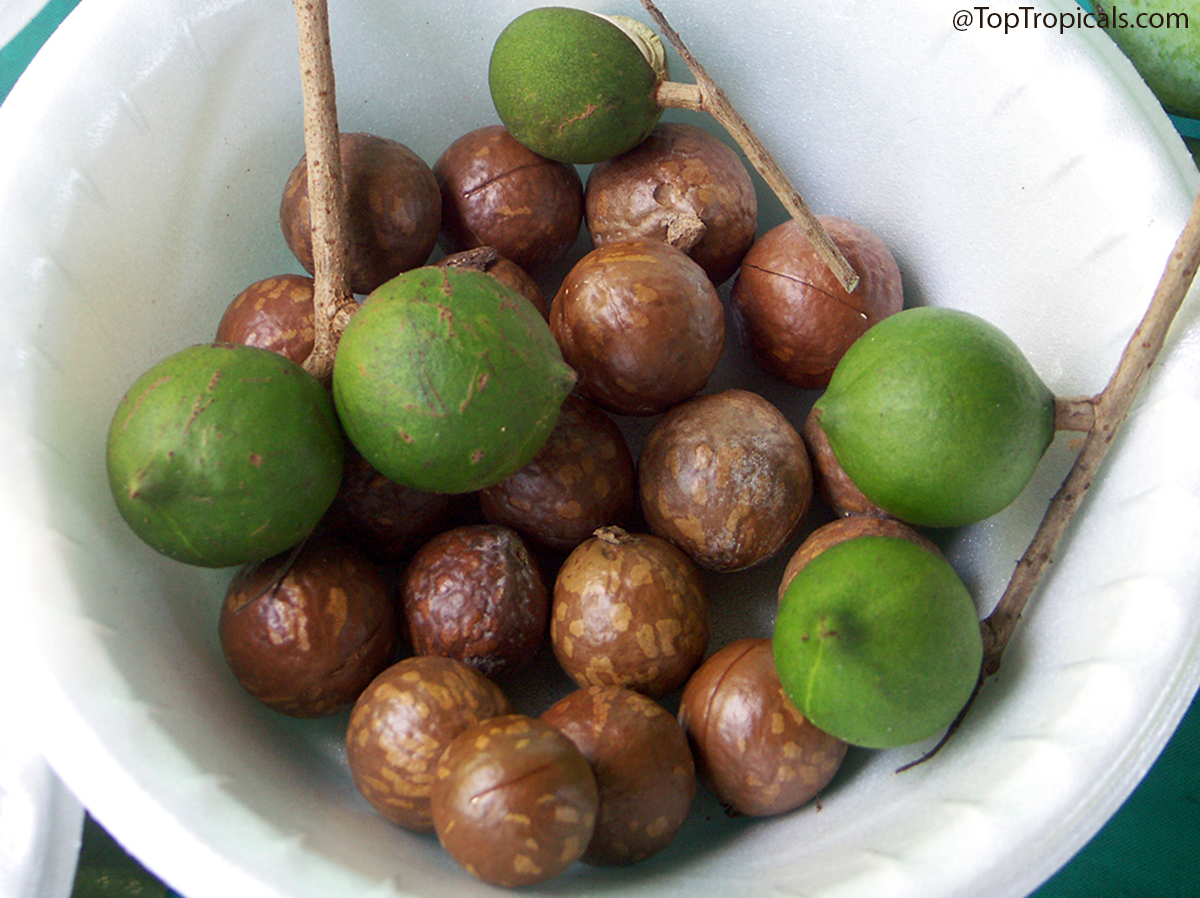
Fresh  green  macadamia  fruit  and  brown  hard-shelled  nuts  collected  in  a 


bowl.

Macadamia fruit showing green outer husk and mature brown shell inside.

🌱 Growing Macadamia in a Pot

  • Container size: Start large. A 15-25 gallon pot is ideal for long-term growth.
  • Drainage: Critical. Use a container with multiple drainage holes.
  • Soil mix: Use a high-quality, well-draining container mix. Avoid heavy garden soil. Top Tropicals Abundance soil-less mix is specially formulated for pot growing
  • Light: Full sun is best. Strong light improves flowering and nut production.
  • Watering: Water deeply, then allow the top layer to dry slightly before watering again. Avoid constant saturation.
  • Feed lightly and consistenly. SUNSHINE Boosters Robusta liquid fertilizer is safe to use with with every watering. During hot season you may add controlled release Green Magic every 6 months. It is essential to apply micro elements on Macadamias: Sunshine Superfood micro nutrients complex.
  • Cold protection: If temperatures drop below freezing, move the container to a protected area such as a garage or greenhouse.
  • Pruning: Prune lightly to control size and maintain airflow within the canopy.
  • Expectations: Container trees may produce fewer nuts than in-ground trees, but they offer mobility and climate control.
  • Smokey says: Container trees offer mobility and climate control so you never have to worry about a freeze!

✍️ More About Macadamia from Garden Blog
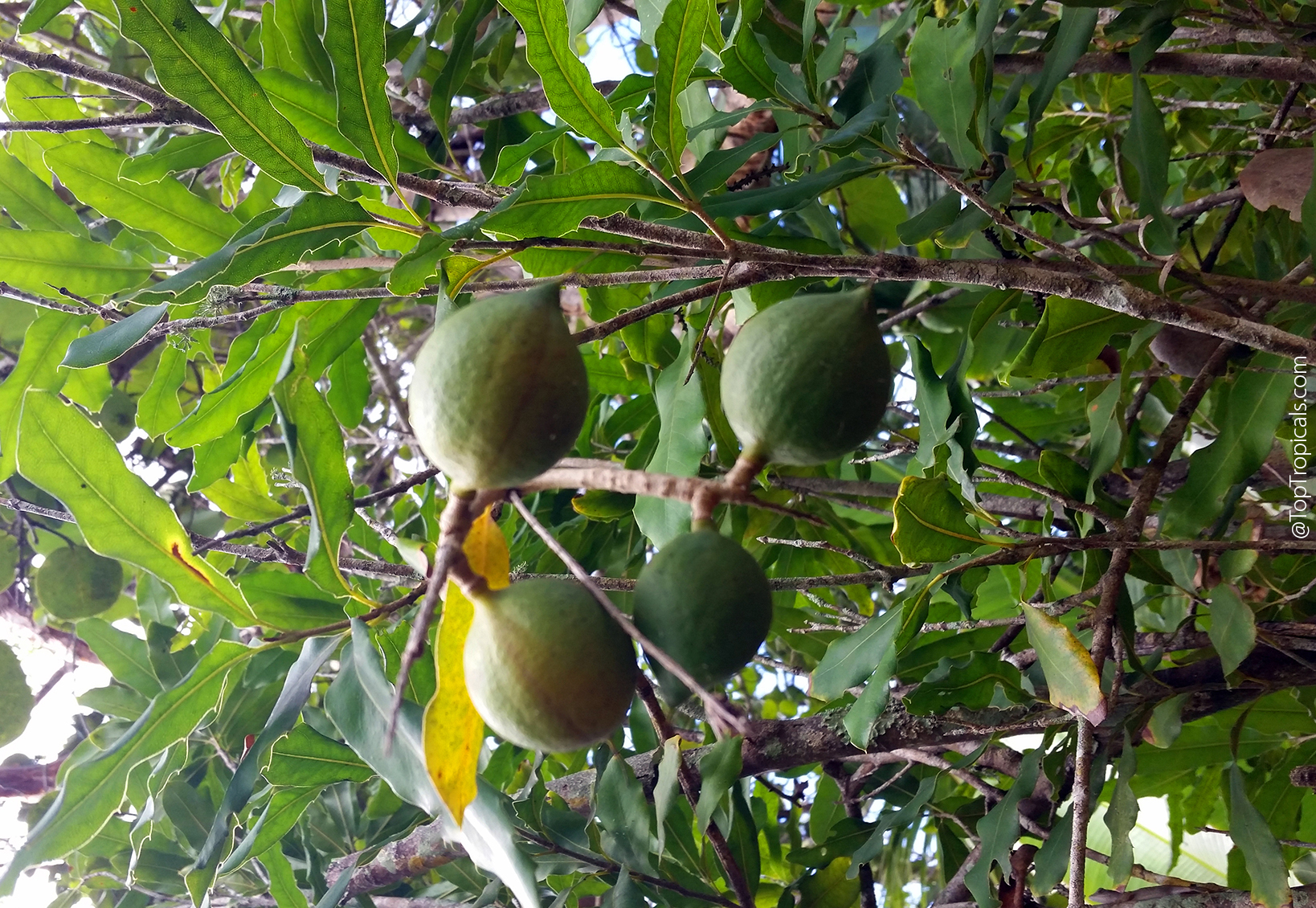
Green  macadamia  nuts  developing  on  tree  branch  among  glossy  leaves.

Macadamia nuts developing on the tree before the husk splits.

🚫 Common Mistakes When Growing Macadamia

  • Planting in poorly drained soil:
    The most common mistake. Macadamia will decline quickly in heavy, waterlogged ground. If drainage is questionable, plant on a mound.
  • Overwatering young trees:
    Newly planted trees need consistent moisture, not constant saturation. Wet roots lead to root problems.
  • Over-fertilizing:
    Too much fertilizer causes weak growth and nutrient imbalance. Feed lightly and avoid heavy nitrogen applications.
  • Planting too deep:
    The top of the root ball should sit level with or slightly above the surrounding soil. Do not bury the trunk.
  • Ignoring micronutrients:
    Macadamia is very prone to iron, zinc, and copper deficiencies. Yellowing leaves may signal a micronutrient issue. Applly Sunshine Superfood on regular basis.
  • Expecting instant production:
    Macadamia takes time. Early years build structure. Patience is part of success.
  • Skipping cold protection for young trees:
    Established trees are tougher, but young plants should be protected below freezing.
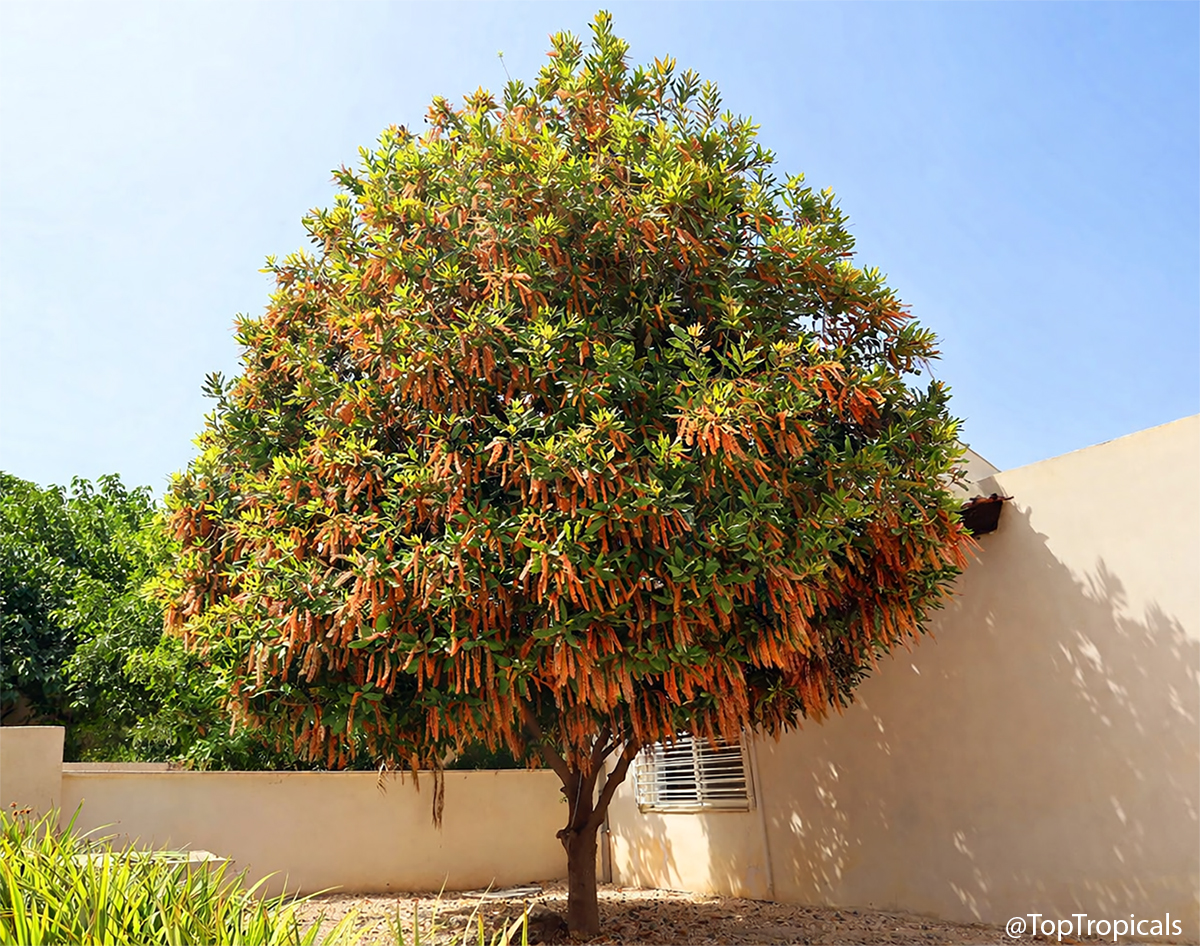
Macadamia  tree  in  full  bloom  covered  with  long  orange  flower  racemes.

Macadamia tree in full bloom with abundant flower clusters.

❓Frequently Asked Questions (FAQ)

  • Is Macadamia toxic to pets? While the nuts are a superfood for humans, they are toxic to dogs. If you have a dog that tends to forage in the garden, ensure you harvest fallen nuts promptly or fence the base of the tree during the drop season.
  • Which varieties are best for the "Survivor" garden? Look for Macadamia integrifolia (smooth-shell) or hybrids like 'Beaumont' (M. tetraphylla x M. integrifolia). Hybrids often show slightly better cold tolerance and more consistent "home garden" production.
  • How tall will my tree get? In the ground, an unpruned Macadamia can reach 20–30 feet. However, they respond very well to "heading back" (pruning the top) to keep them at a manageable 12–15 feet for easy harvesting.
  • Do I need two trees for cross-pollination? Macadamias are self-fertile, meaning one tree will produce nuts. However, planting two varieties near each other often results in a significantly heavier "nut set" due to cross-pollination.
  • Why are the leaves on my Macadamia prickly? Don't panic—this is normal! Some species, particularly M. tetraphylla, have serrated, holly-like leaves. This actually makes them a great "defensive" hedge against intruders or deer.
  • When exactly should I harvest? The tree tells you when it's ready. Don't shake the tree; wait for the nuts to fall naturally. In Florida, this usually happens between August and November. If the green outer husk hasn't split yet, let them sit in a shaded, dry spot until they do.
  • My tree has "clusters" of flowers but no nuts. What happened? Macadamias produce long racemes (flower spikes) with hundreds of tiny blooms. It is normal for 90% of these to fall off. The tree only keeps what it can afford to "feed." Boost your success by using a combination of Sunshine C-Cibus liquid fertilizer and SUNSHINE Superfood micro element supplement during the flowering stage to help the tree retain more fruit.
  • Can I grow them from a nut I bought at the store? Unlikely. Commercial nuts are usually roasted or dried at high heat, killing the embryo. Even if a raw nut sprouts, it may take 10–12 years to fruit and the quality is a gamble. Buying a grafted tree saves you a decade of waiting.

We don’t just sell plants; we test them. The data from this February freeze proves that with the right selection and proper drainage, 'tropical' doesn’t have to mean 'fragile.' Don’t wait for the next cold front to find out what in your garden is vulnerable. It is time to replace those empty spots with proven survivors that offer both beauty and a premium harvest. If it can stand up to 25F in our fields, it’s ready for your backyard.

Coming in Part 2...

Smokey is already crunching the numbers on our next survivor, and Sunshine found another tree that stayed perfectly green in the wind. Stay tuned to see which fruit tree made the cut!
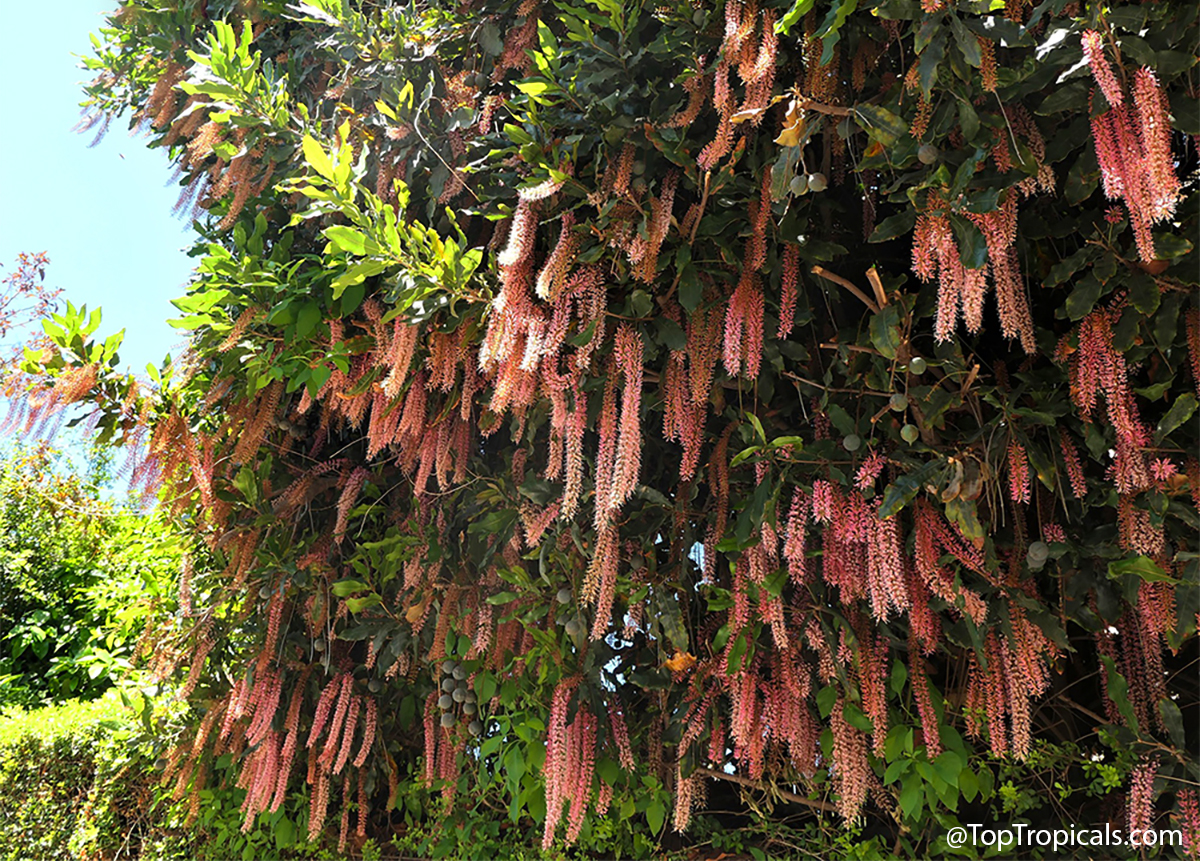
Macadamia  tree  covered  in  long  pink  flower  racemes  during  peak  bloom.

Macadamia flowers forming long cascading racemes before nut set.

🎥 More Macadamia videos from our channel

🛒 Add Macadamia Tree to your garden

Date: 2 Mar 2026

Eugenia Cherries 🍒

By Tatiana Anderson, Horticulture Expert at Top Tropicals with Smokey & Sunshine help

Eugenia brasiliensis - Grumichama fruit on the branch

Growing Eugenia Cherries (Cherry of the Rio Grande & Grumichama)

Cherry of the Rio Grande and Grumichama are compact, adaptable tropical fruit trees well suited to Southern landscapes. While forgiving, they perform best when planted correctly from the beginning.

Site and Planting

  • Drainage is essential. Avoid low areas where water collects. Plant on a slight mound if soil is heavy or clay-like.
  • Choose full sun for best flowering and fruit production. Partial shade is tolerated.
  • A south or southeast exposure near a wall improves cold resilience and reduces wind stress.
  • Dig a hole twice as wide as the container, but no deeper than the root ball.
  • Set the tree level with surrounding soil. Do not bury the trunk.

Water and Feeding

  • Water regularly during the first few months while roots establish.
  • Once established, trees tolerate short dry periods but fruit best with moderate, consistent moisture.
  • Feed lightly and consistenly. SUNSHINE Boosters Robusta liquid fertilizer is safe to use with with every watering. During hot season you may add controlled release Green Magic every 6 months. It is essential to apply micro elements: Sunshine Superfood micro nutrients complex

Cold Tolerance

  • Protect young trees during hard freezes.
  • Established Cherry of the Rio Grande can tolerate brief drops into the low 20s.
  • Established Grumichama tolerates temperatures into the upper 20s.

Harvest and Production

  • Cherry of the Rio Grande fruits from late spring into summer. Pick when fully dark and slightly soft.
  • Grumichama ripens quickly, often within four weeks after flowering. Pick when glossy and deep purple-black.
  • Both trees often begin fruiting within 2–3 years and increase production steadily with maturity.

Growing in Containers

  • Use at least a 10–20 gallon pot for long-term growth.
  • Ensure multiple drainage holes.
  • Use a high-quality, well-draining container mix. Avoid heavy garden soil. Top Tropicals Abundance soil-less mix is specially formulated for pot growing
  • Place in full sun for best fruiting.
  • Water deeply, then allow the top layer to dry slightly before watering again.
  • Move containers to a protected area during hard freezes.
  • Prune lightly to maintain shape and airflow.

Common Mistakes

  • Planting in poorly drained soil.
  • Overwatering and keeping soil constantly saturated.
  • Over-fertilizing with excessive nitrogen.
  • Planting too deep and burying the trunk.
  • Expecting heavy crops immediately instead of allowing time for maturity.
  • Skipping cold protection for young plants.

Learn more: Tropical Cherries – Eugenias

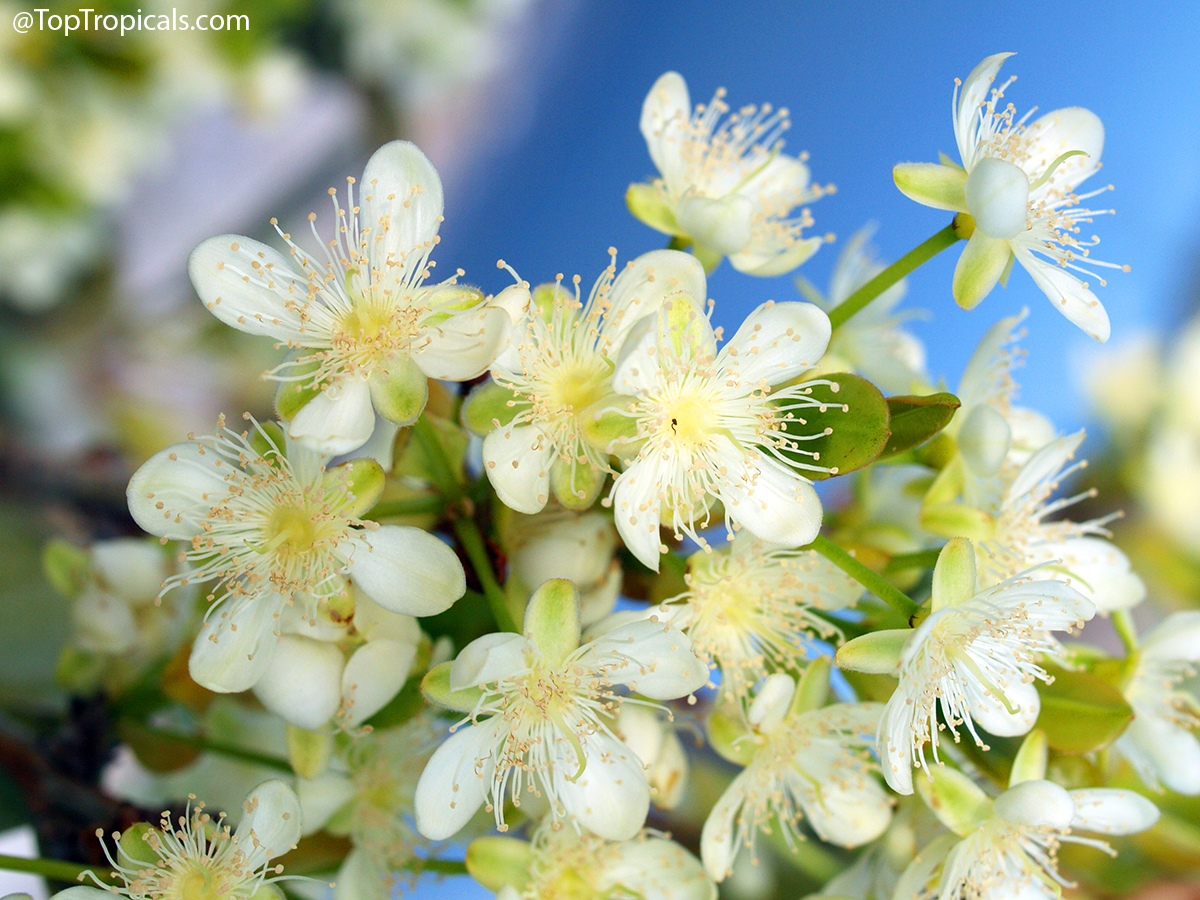
EGrumichama  flowers  (Eugenia  brasiliensis)  in  close-up  showing  white 


petals  and  long 


stamens

Eugenia brasiliensis - Grumichama flowers

❓Frequently Asked Questions: Eugenia cherries (FAQ)

  • Which one tastes better – Cherry of the Rio Grande or Grumichama?
    Cherry of the Rio Grande has a deeper, classic “sweet cherry” flavor with slight richness. Grumichama is softer, juicier, and often described as cherry with hints of grape and plum. Both are excellent fresh; Grumichama is especially popular for jam.
  • Which tree produces more fruit?
    Grumichama typically produces heavier crops once mature and can carry hundreds of fruits in a season. Cherry of the Rio Grande produces consistently but in slightly smaller volumes.
  • Do birds take all the fruit?
    Birds are attracted to both trees, especially Grumichama. Netting during peak ripening or harvesting promptly usually solves the issue.
  • Are these true "tropical" trees or subtropical?
    They are best described as subtropical tropicals. Unlike ultra-tender tropical fruits, Eugenia cherries tolerate occasional frost once established, making them more reliable in Southern landscapes.
  • Do they drop fruit messily?
    Fruit will fall if overripe, but the trees are compact and manageable. Regular harvesting prevents ground drop and keeps the area clean.
  • Can they be used for hedging or screening?
    Yes. Their dense evergreen foliage and upright growth make them suitable for edible hedges or privacy screens while still producing fruit.

Choosing between them is not about survival — both have proven resilient. It is about flavor preference, crop volume, and how you want to use the fruit in your kitchen and landscape.

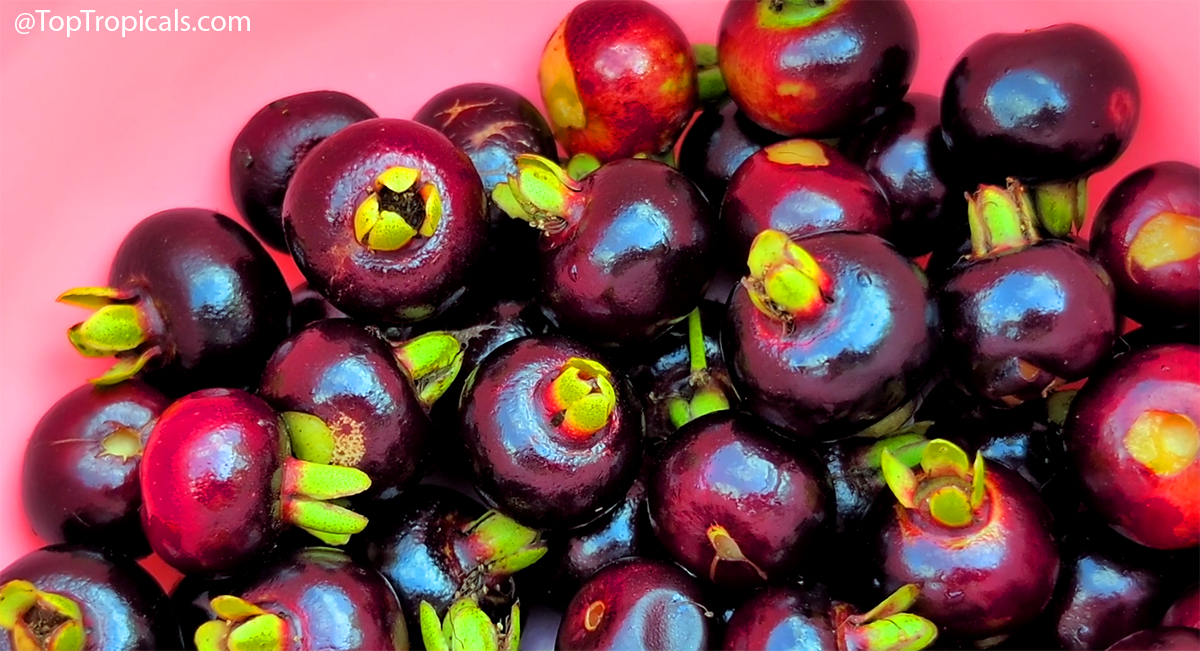
Freshly  harvested  Grumichama  fruits  (Eugenia  brasiliensis)  showing  dark
 
 
  purple  skin  and  green 


calyx

Eugenia brasiliensis - Grumichama fruit close up

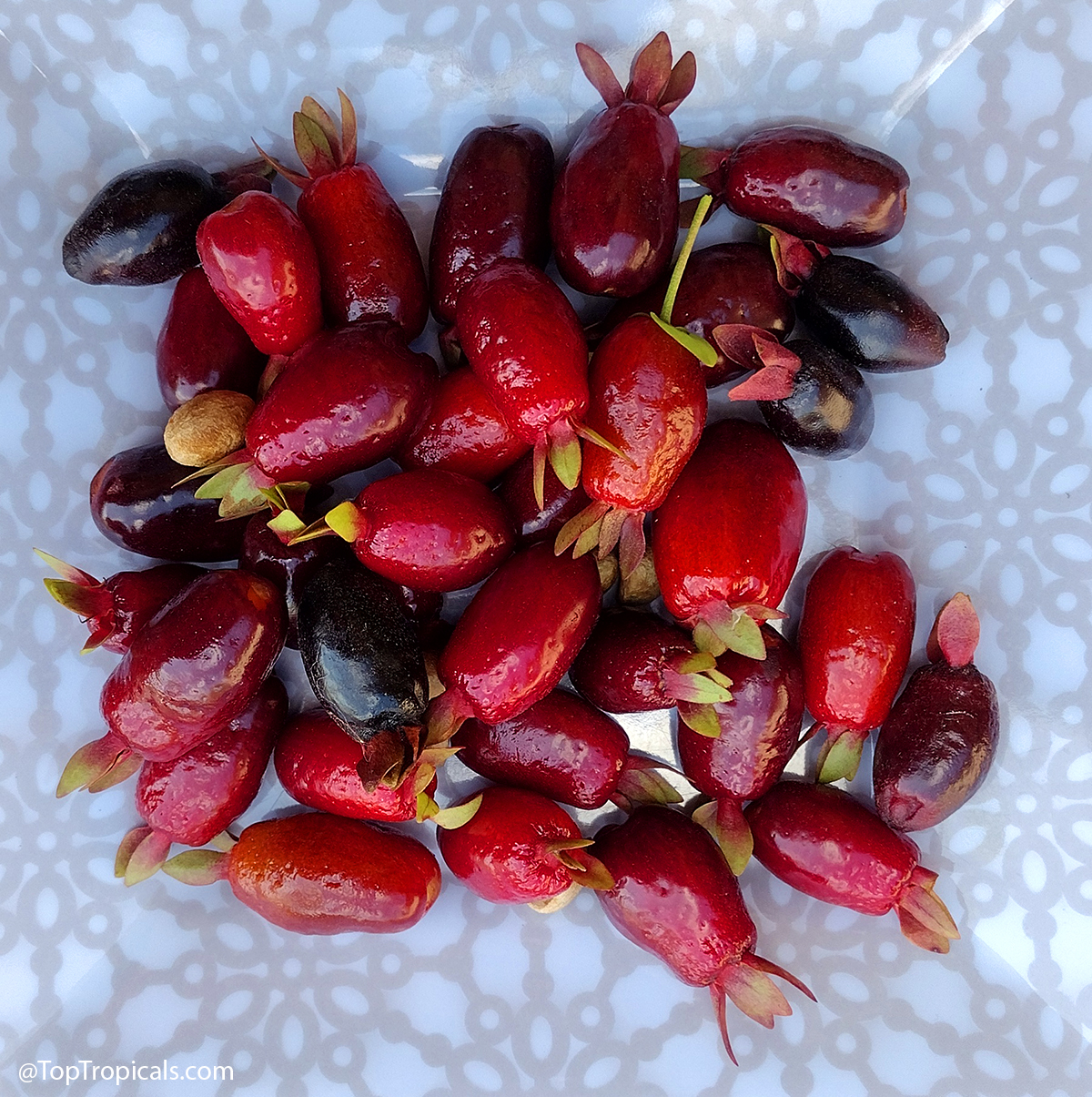
Harvested  Cherry  of  the  Rio  Grande  fruits  (Eugenia  aggregata  cv. 


Calycina)  showing  red  to  dark  purple  ripening  stages


Caption:

Eugenia aggregata (cv. Calycina), Cherry of the Rio Grande

🛒 Add Eugenia cherries to your garden

✍️ Top Ten Fruit Tree Winners of Florida 2026 Record Freeze

Date: 6 Feb 2026

💘Rooted love lasts longer than flowers

Smokey  the  tuxedo  cat  and  Sunshine  the  ginger  cat  sit  in  a  greenhouse 


beside  a  Sweetheart  Hoya  with  heart-shaped  leaves,  a  tag  reading  rooted 


love,  and  a  cup  of  coffee  with  donuts  on  a  wooden 


table.
Sunshine: Valentine Day soon. We need flowers.
Smokey: Nope. Heart-shaped hoya. Flowers fade. Plants stay.
Sunshine: Alright. One for my Valentine. One for me, with coffee.

💖 Sweetheart Hoya: a Valentine gift that lasts

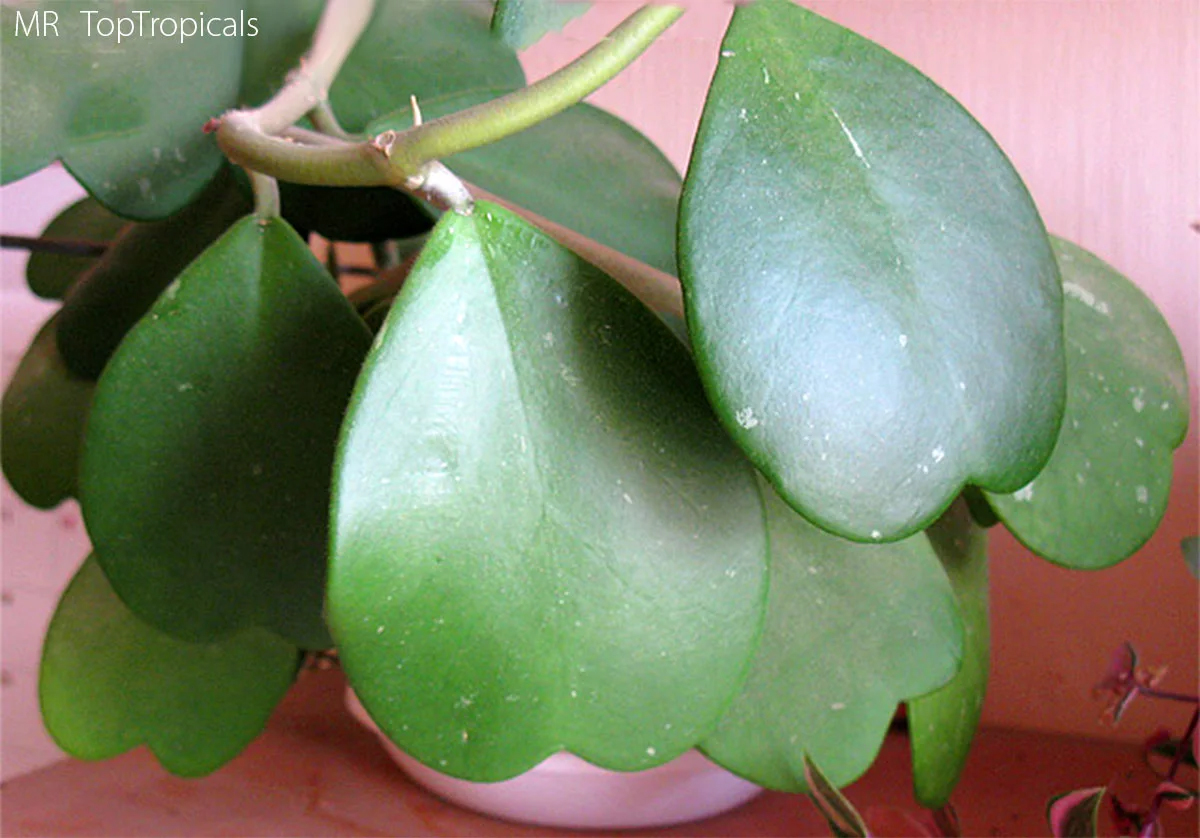
Sweetheart Hoya (Hoya kerrii) has thick, heart-shaped leaves and a compact form that fits easily on a windowsill, desk, or shelf. It does not need constant attention, bright sun, or frequent watering. In fact, it prefers a lighter touch.

This is a plant that works well indoors, grows slowly, and forgives missed waterings. It is comfortable in normal home conditions and does not require special tools or experience. That makes it a good gift not only for plant lovers, but also for people who have never kept a houseplant before.

Unlike flowers, it does not come with an expiration date. It becomes part of daily life and stays there quietly, doing its job. Over time, it feels less like a purchase and more like something chosen with intention.

For Valentines Day, Sweetheart Hoya is a simple, lasting way to give something real.

Sweetheart Hoya care: quick how-to

  • Light: Bright window light is ideal. Avoid harsh, hot direct sun.
  • Water: Let the potting mix dry between waterings. When you water, water thoroughly, then let it drain.
  • Feeding: Light feeding during active growth helps. A balanced fertilizer like Sunshine™ Robusta keeps growth steady and leaves healthy.
  • Pace: Slow-growing and patient. Do not overwater or overpot.

❓Sweetheart Hoya: quick FAQ

  • Is it good for beginners? Yes. It is forgiving and does not need constant attention.
  • Can it live indoors year-round? Yes, in bright indoor light and normal home conditions.
  • Does it need flowers to be special? No. The heart-shaped leaves are the main feature.
  • Learn more: What is the best Valentines Day gift that actually lasts?

♥️ Shop Sweetheart Hoya

Valentine  Sweetheart  Hoya  Plant

Date: 18 Feb 2026

⭐️ Choosing the Right Variety of Jasmine Sambac

By Tatiana Anderson, Horticulture Expert at Top Tropicals

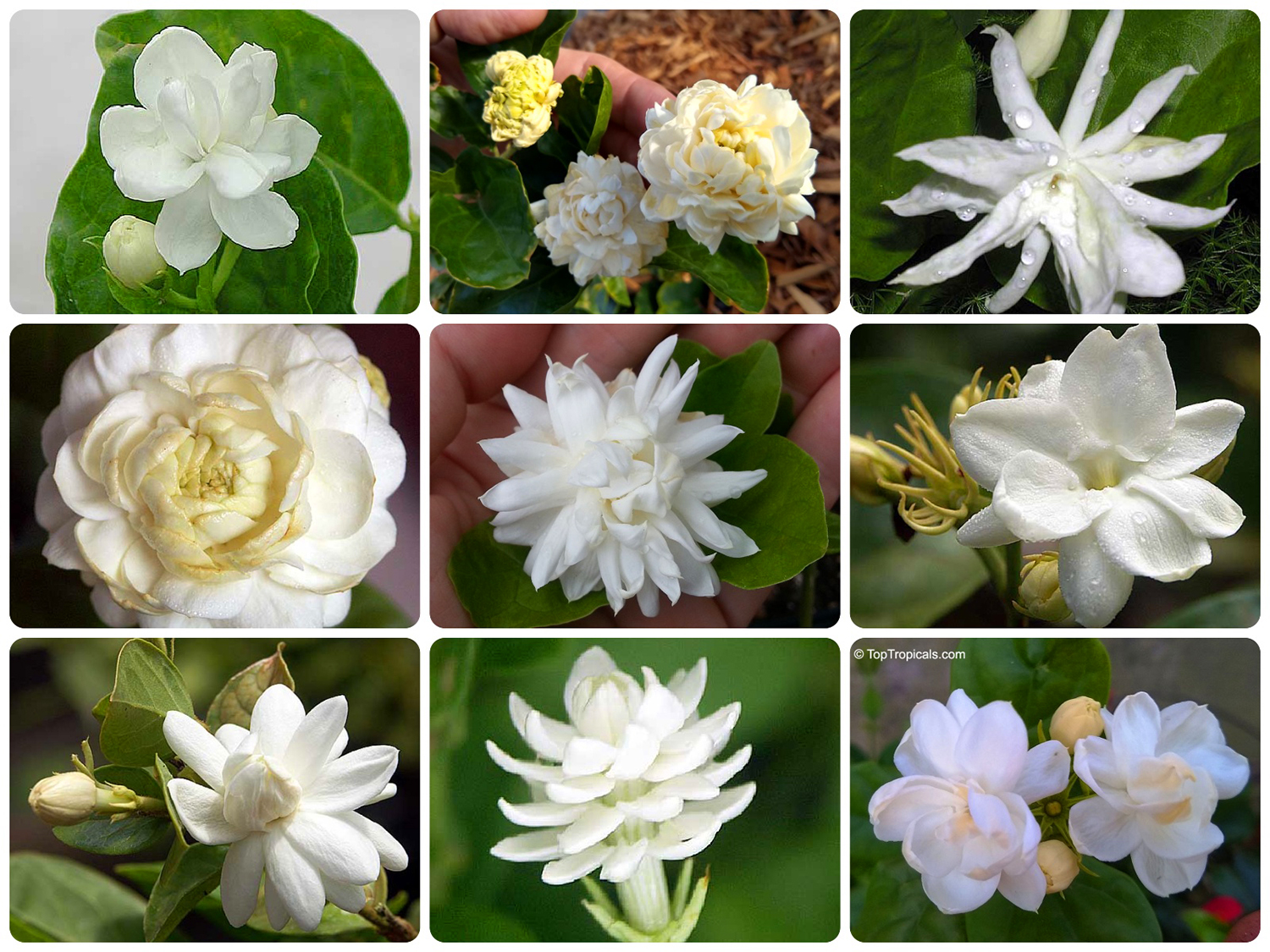
Jasmine  Sambac  varieties  collage  showing  single,  double,  and 


multi-layered  white  fragrant  flowers  including  Belle  of  India,  Grand  Duke, 


Arabian  Nights,  and  other 


forms.

Jasmine Sambac varieties: Arabian Nights, Little Duke, Belle of India, Grand Duke, Duke Supreme, Maid of Orleans, Mysore Mulli, Malichat, Gundu Mallii

One of the reasons Jasmine Sambac is so fascinating is that it does not come in just one form. Each variety has its own personality.

If you want a compact patio plant, Arabian Nights or Little Duke are excellent choices. They stay tidy, bloom generously, and are easy to manage in containers.

If you prefer elegant, elongated petals and a refined look, Belle of India is a favorite. It can be grown as a small bush or trained lightly as a vine.

For those who love full, carnation-like double flowers, Grand Duke of Tuscany and Grand Duke Supreme are classic selections. They are vigorous and make impressive shrubs in warm climates.

If you need a stronger climber for fences or hedges, Maid of Orleans performs beautifully in full sun while Mysore Mulli prefers semi-shade.

Collectors often enjoy rare forms like Mali Chat or newer hybrids such as Gundu Malli, which combine traits from different lines.

How to Grow Jasmine Sambac Successfully

Sambac is not difficult, but it responds best to consistency.

Light: Full sun produces the most flowers. In very hot climates, light afternoon shade is acceptable. Indoors, place it in the brightest window available.

Soil: Use a well-draining potting mix such as Sunshine Abundance. Sambac does not like heavy, constantly wet soil.

Water: Water thoroughly, then allow the top layer to dry slightly before watering again. Reduce watering during cooler months.

Pruning: Light trimming after a bloom cycle encourages branching. More branches mean more flower buds.

Feeding: Sambac is a heavy bloomer, and fragrance takes energy. During active growth, feed regularly with a balanced fertilizer that supports flowering such as Green Magic (controlled release every 6 months) or liquid Sunshine Boosters Pikake (formulated especially for fragrant flowers) - with every watering. I prefer formulas slightly higher in potassium to encourage stronger bud formation and richer bloom cycles. Consistent feeding during warm months makes a visible difference in both flower count and intensity of scent.

With proper care, Jasmine Sambac will reward you not just with flowers, but with perfume that changes the atmosphere of your entire garden.

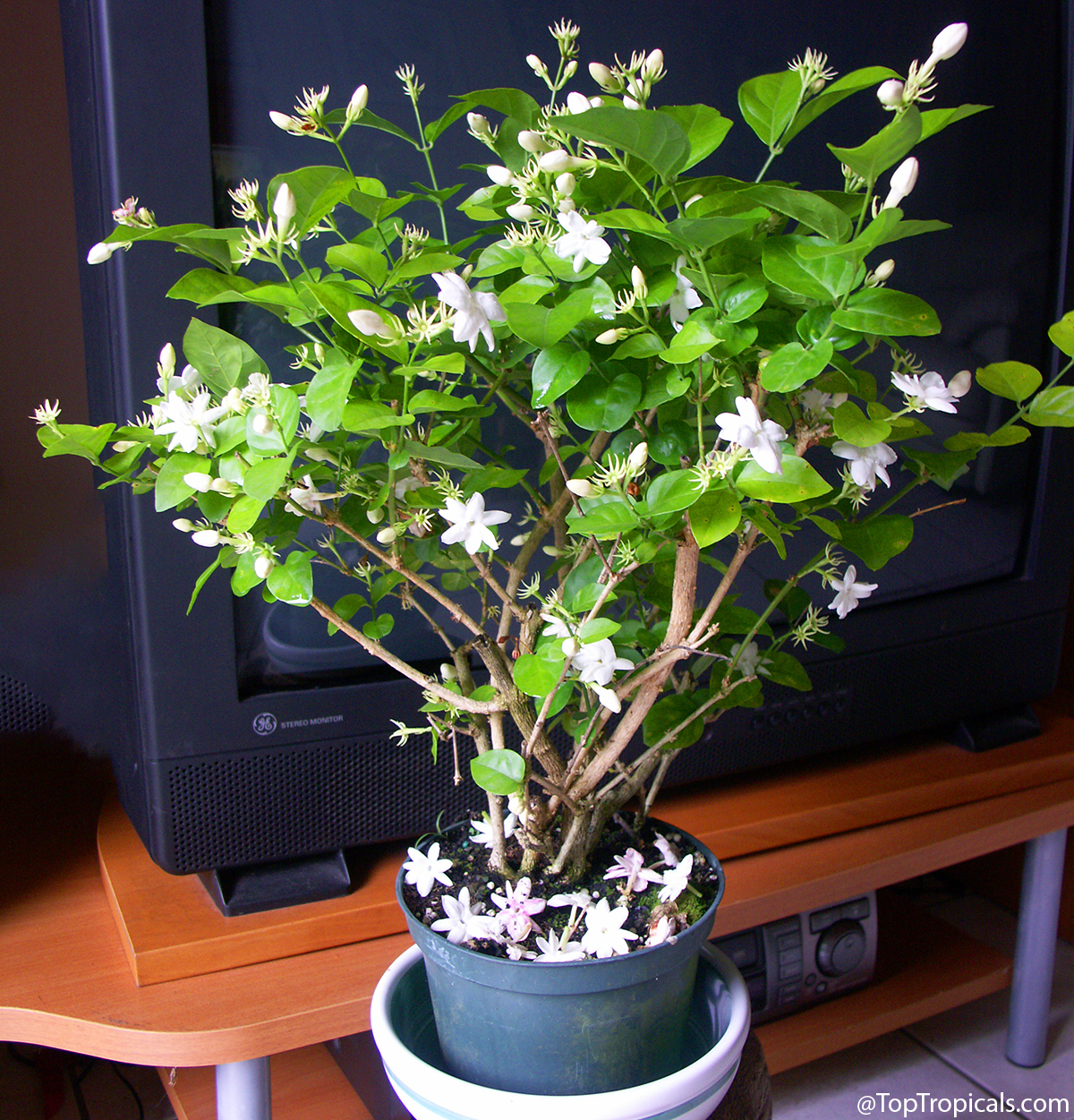
Jasmine  Sambac  Maid  of  Orleans  blooming  indoors  in  a  container  with 


numerous  white  star-shaped  flowers  and  glossy  green 


leaves.

Jasmine Sambac Maid of Orleans flowering indoors in a container under bright light.

❓Frequently Asked Questions About Jasmine Sambac

  • Does Jasmine Sambac need full sun?
    It flowers best in full sun. In very hot climates, light afternoon shade is acceptable. Indoors, give it the brightest window possible.
  • Can I grow it in a pot?
    Yes. Sambac performs beautifully in containers. Many gardeners prefer pots because it is easier to control size and move during cold weather.
  • How often does it bloom?
    With proper light and feeding, it blooms in cycles throughout the warm season. Consistency in care makes flowering more reliable.
  • Why is my plant not blooming?
    The most common reasons are insufficient light or irregular feeding. Increase light first, then review your fertilizing routine.
  • Is it difficult to grow indoors?
    Not if you provide strong light and good air circulation. Compact varieties adapt especially well.
  • Is it frost tolerant?
    No. Jasmine Sambac is tropical. Protect it from temperatures below 40F and bring it indoors before frost.

🌸 Year of the Horse Special – Jasmine Bonus

Celebrate 2026 with the fragrance of Jasmine plants. For a limited time, enjoy special savings when you grow one of the most wanted perfume plants in cultivation.

Jasmine Sale - 15% Off
Save 15% on all Jasmine plants. Discount is already applied in the online store - no code needed.
Offer valid through 02/28/2026.

🛒 Explore varieties of Sambac

Date: 7 Oct 2025

⭐ The Winter Stars: 8 Flowering Trees That Steal the Show

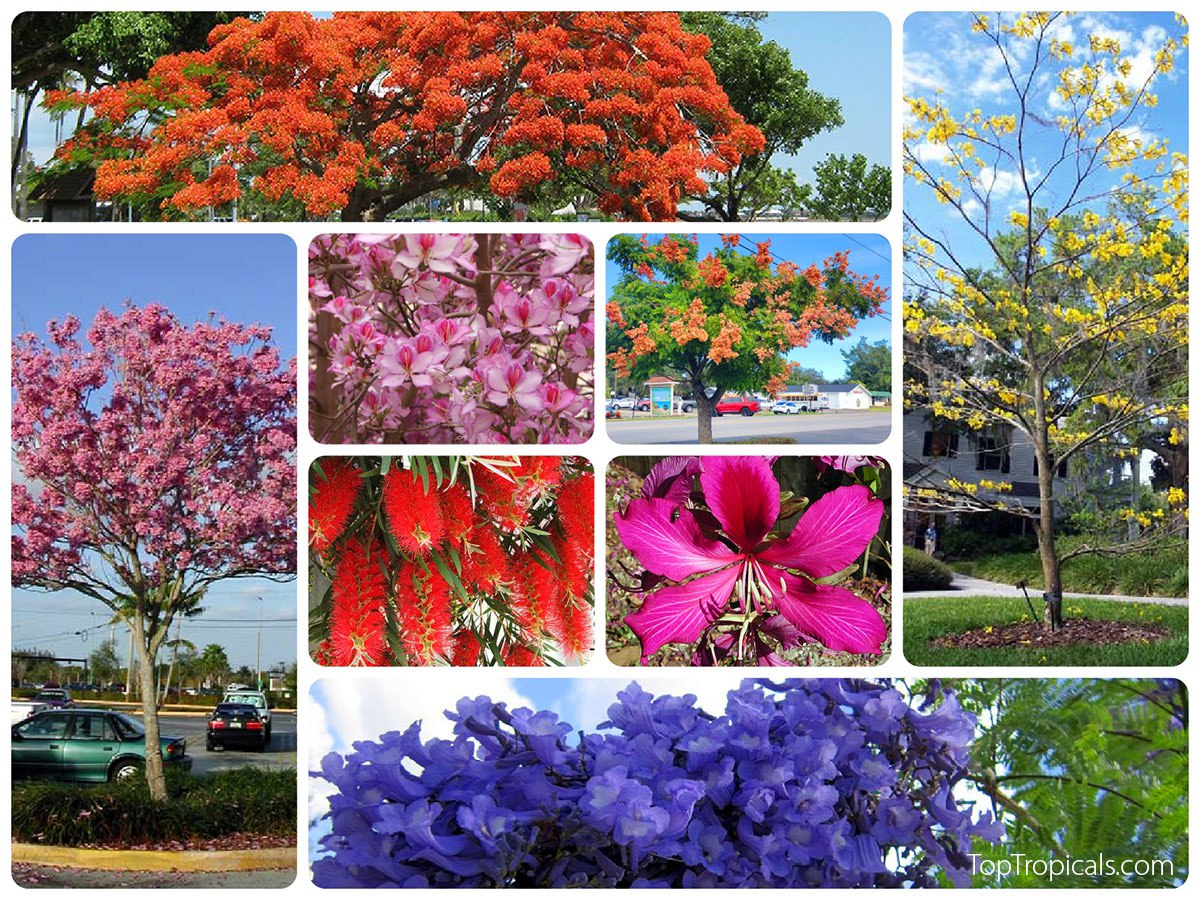
Collage  showing  eight  tropical  and  subtropical  winter-flowering  trees: 


Royal  Poinciana  with  red-orange  canopy,  Dwarf  Pink  Tabebuia,  Dwarf  Golden 


Tabebuia,  Pink  Butterfly  Orchid  Tree,  Golden  Rain  Tree,  Weeping  Red 


Bottlebrush,  Hong  Kong  Orchid  Tree,  and  Jacaranda  with  purple 


flowers.

8 Best Flowering Trees That Bloom in Winter: Royal Poinciana with red-orange canopy, Dwarf Pink Tabebuia, Dwarf Golden Tabebuia, Pink Butterfly Orchid Tree, Golden Rain Tree, Weeping Red Bottlebrush, Hong Kong Orchid Tree, and Jacaranda with purple flowers.

Royal Poinciana (Delonix regia)

The diva of tropical trees. Huge red-orange flowers blanket the branches from late winter through summer. If you’ve ever seen one in full bloom, you know — it stops traffic. Best in large yards or open spaces, but young ones do great in big pots for a few years. 🛒 Shop
Tatiana: “If you want a tree that makes people say ‘wow,’ this is it.”

Tabebuia chrysotricha – Dwarf Golden Tabebuia

Small tree, big drama. It turns solid gold just before new leaves appear. Blooms while completely bare — a stunning contrast of yellow on brown wood. Perfect for patios, courtyards, and containers. Handles cool nights down to the mid-20s F. Bright, cheerful, and forgiving — the kind of tree that always looks like it’s celebrating. 🛒 Shop

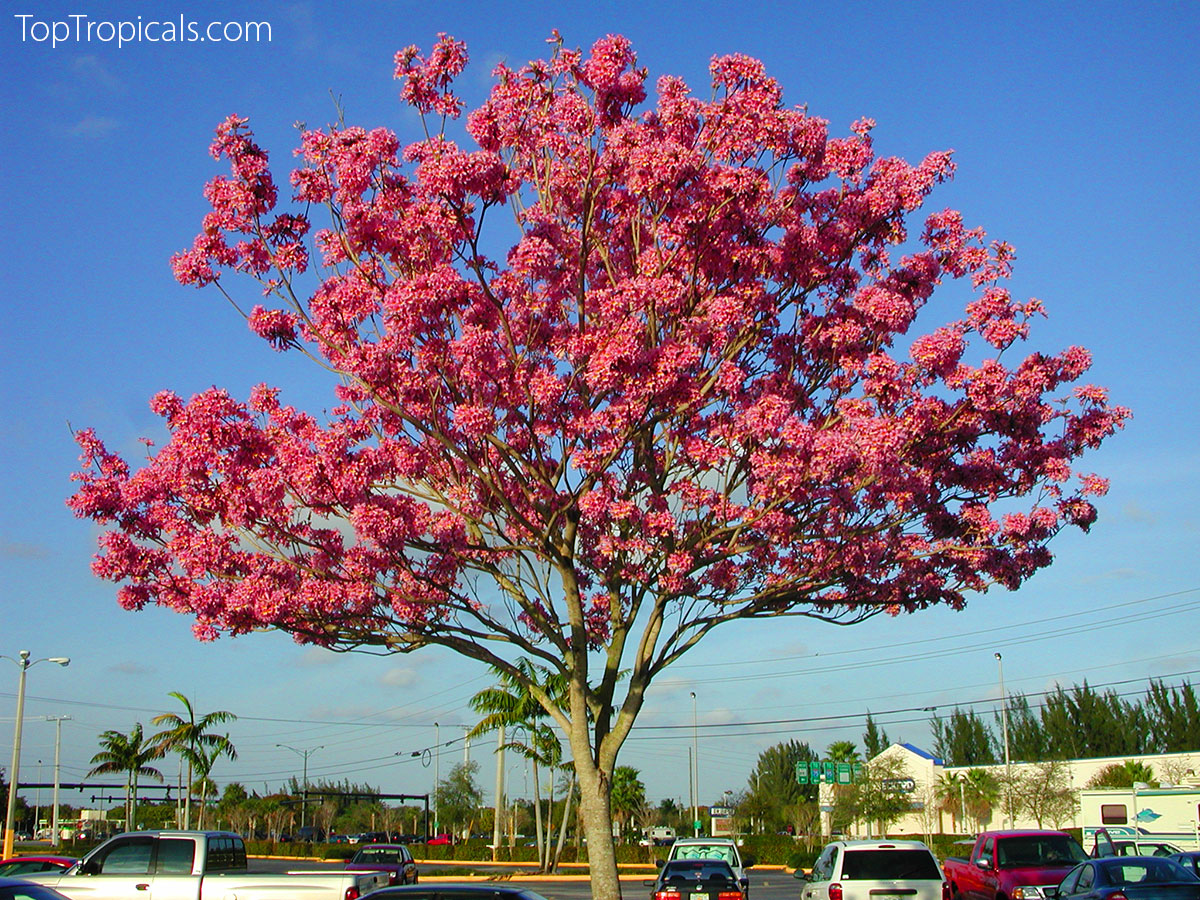
Tabebuia impetiginosa – Dwarf Pink Tabebuia (Pau D’Arco)

The Florida “cherry blossom.” Pink-lavender flowers smother the branches each winter, often before any leaves return. Thrives in sandy soil, tolerates drought, and grows beautifully in large planters or pots indoors near a sunny window. Ideal for seasonal residents or anyone who wants color when everything else is asleep. 🛒 Shop

Jacaranda mimosifolia

If color had music, this would be jazz. Soft, fern-like leaves and cascades of violet-blue trumpet flowers — airy, elegant, unforgettable. Outdoors, it makes a graceful shade tree; in containers, it stays compact with regular pruning. Jacarandas reward patience — they bloom bigger each year. 🛒 Shop

Koelreuteria paniculata – Golden Rain Tree

A favorite for its surprises — golden blooms in summer, pink paper lantern pods in fall, and bronze leaves before rest. Fast-growing, tough, and easy. Loves full sun and moderate water. Great for open lawns or patio tubs. The kind of tree that gives you something new to look at every month. 🛒 Shop

Callistemon citrinus – Bottlebrush Tree

The hummingbird magnet. Bright red, brush-shaped flowers bloom several times a year — sometimes even in cool weather. The dwarf form, ‘Little John,’ stays about 4 feet tall, perfect for pots or small borders. Trim lightly after flowering to keep it compact and colorful. 🛒 Shop
Tatiana: “If you’ve never grown a tropical tree before — start here. It’s the friendliest one.”

Bauhinia variegata – Pink Butterfly Tree

Graceful, fragrant, and forgiving. Its pink-lavender orchid-like flowers open from late winter through spring, filling the garden with color and pollinators. It’s fast-growing, drought-tolerant, and excellent for both ground and pots. Even the buds are edible — a fun bonus for adventurous gardeners. 🛒 Shop

Bauhinia blakeana – Hong Kong Orchid Tree

The queen of them all. Huge magenta-purple blooms that last for months, from fall through spring. Fragrant, clean (no messy seed pods), and perfect for patios or large decorative containers. Give it sun, a little water, and it will reward you with bloom after bloom. 🛒 Shop
Tatiana: “It’s the one tree that never lets winter win.”

A note on grafted Hong Kong Orchid Trees: Most Hong Kong Orchid Trees are grafted, and that’s actually a big advantage. Because they don’t grow from seed, grafted plants mature faster and begin blooming while still small — sometimes within the first year. That makes them perfect for patio pots or small gardens where space is limited.

Bringing the Tropics Home

Whether your garden faces the Gulf or your window faces the snow, these trees let you live in color year-round. Plant them outdoors in warm zones or grow them in pots indoors — they adapt, they bloom, they brighten every corner.

Gardening isn’t about waiting for spring — it’s about finding joy in every season. And when a tree blooms in January, that joy feels twice as sweet.

🛒 Shop Winter Flowering Plants

Tabebuia  impetiginosa  -  Dwarf  Pink  Tabebuia,  Pau  DArco,  Taheebo

✍️ Winter Bloomer Q&A

Q: Can these trees really bloom indoors?

Yes! Smaller species like Bottlebrush ‘Little John,’ Dwarf Tabebuias, and many Bauhinias bloom beautifully in pots with bright light or grow lamps.

Q: Do they lose their leaves in winter?

Some, like Tabebuias and Jacarandas, drop leaves right before blooming — it’s normal and part of their charm. Others, like Bottlebrush, stay evergreen.

Q: What fertilizer works best?

We use Sunshine Boosters — gentle, balanced, and perfect for tropicals. Feed every 2–3 weeks during active growth.

Q: How do I know when to water?

Touch the soil! If it’s dry an inch or two down, water deeply. Overwatering is the main mistake with tropicals.

Q: Can they handle frost?

A quick dip into the upper 20s F is fine for most mature trees. Cover young ones or move containers under shelter if colder.

Q: Which are best for beginners?

Start with Bottlebrush ‘Little John’ or Golden Tabebuia — compact, colorful, and nearly foolproof.

Q: When will they bloom?

Usually within few years if they get enough sun and warmth. Grafted plants blooms much sooner

Q: Which of these trees are best for pot growing?

For patios, balconies, or indoor sunrooms, choose the compact or grafted types:

🎥 Watch videos of Dwarf trees in bloom:

Dwarf Golden Tabebuia

Dwarf Pink Tabebuia

🛒 Shop Winter Flowering Plants

Date: 26 Jan 2022

Don't miss this one:
PodCast Premiere!

Episode 1
How to Protect Tropical plants in Winter: Q & A

Featuring Horticulturist Mark Hooten

...We are introducing our new Series: Top Tropicals Podcast. Growing tropicals and pushing the limits. Watch the first episode:

How to Protect Tropical plants in Winter

...Who doesn't like tropical beauty? Everyone wants tropical plants. But not everyone lives in a warm climate. Is it possible to grow tropicals outside of Tropics?
Top Tropicals horticulturist Mark Hooten, who is well known to many gardeners as the Garden Doc with his Saturday Plant Clinic, is answering gardeners' questions about how to prepare and protect tropical plants during winter...

Premiere scheduled:
Thursday, January 27, 8:00 AM

More about cold hardiness and cold protection:

Cold hardy tropical fruit trees
Growing Stephanotis and cold protection
Cold protection of tropical container plants
Plumeria cold protection
Ghost Cold Protection
Seven rules of cold protection for tropicals
Improving cold hardiness before winter: fertilizer and micro-elements
3D garden ideas and winter cold protection
Cold protection - winter action for your plant collection
About Cold Protection

Date: 14 Feb 2026

🍭 From Vine to Bean: A Practical Guide

Vanilla  planifolia  vine  climbing  a  support,  close-up  of  vanilla  flower,
 
 
  and  cured  vanilla  beans

Vanilla planifolia Vine, Flower, and Cured Vanilla Beans

How to Grow Vanilla: quick how-to

Vanilla is not complicated, but it does have preferences. Start with a pot and regular, well-draining mix. It does not need anything exotic. Give it:

  • Bright, indirect light
  • Warm temperatures
  • Good humidity
  • Air movement

Most importantly, give it something solid to climb. A wooden trellis, a log, or a burlap-covered board works well. The surface should be porous so the aerial roots can grip.

As it grows, guide the vine gently. You can prune it to control size. Vanilla is slow to mature. That is normal.

The Bloom Secret

Vanilla does not bloom just because it looks healthy. It blooms when it feels secure.

This is a climbing orchid. It must attach firmly to a solid, porous support such as a wood log, trellis, or burlap-covered board. When the aerial roots grip and the plant reaches maturity, flowering becomes possible.

Once the flowers appear, they usually need to be hand pollinated to produce pods. Each flower stays open for only a short time, so timing matters.

How to pollinate vanilla: In this video, we show you exactly how to pollinate vanilla step by step

❓Vanilla care: quick FAQ

  • Does Vanilla planifolia really produce vanilla beans?
    Yes. Vanilla planifolia is the commercial source of vanilla. After flowering, it can form long green pods (vanilla beans). The aroma develops later during curing.
  • What is the secret to getting vanilla to bloom?
    Let it climb. Vanilla is a climbing orchid and usually will not bloom until its aerial roots attach firmly to a solid, porous support like a wood log, trellis, or burlap-covered board.
  • Do I need to pollinate vanilla flowers?
    Yes. In most home growing conditions, vanilla flowers must be hand pollinated to produce pods. Each flower is open for only a short time, so timing matters.
  • Can I grow vanilla indoors?
    Yes, if you can provide bright, indirect light, warmth, humidity, and a support to climb. A sunny room with filtered light and a trellis or log can work well.
  • What should I use for support?
    Use a sturdy trellis, a wood log, or a burlap-covered board. The key is a porous surface that aerial roots can grip. Avoid chemically treated wood. Check out this very unusual way to grow Vanilla Orchid over a wall.
  • What potting mix should I use for Vanilla plant?
    Start in a pot with a regular, well-draining potting mix such as Sunshine Abundance. As the plant matures, it relies more on its support and aerial roots than the soil.
  • What fertilizer should I use?
    Sunshine Boosters Orchidasm is formulated specifically for orchids and will work perfecty for Vanilla orchid as well.
  • How big will it get?
    As big as you let it. Train it and prune it. Vanilla grows according to the structure and space you provide.
  • How long until it flowers?
    Typically a few years. Vanilla is a long-term project, but it is very rewarding once established.

For Collectors and Enthusiasts:

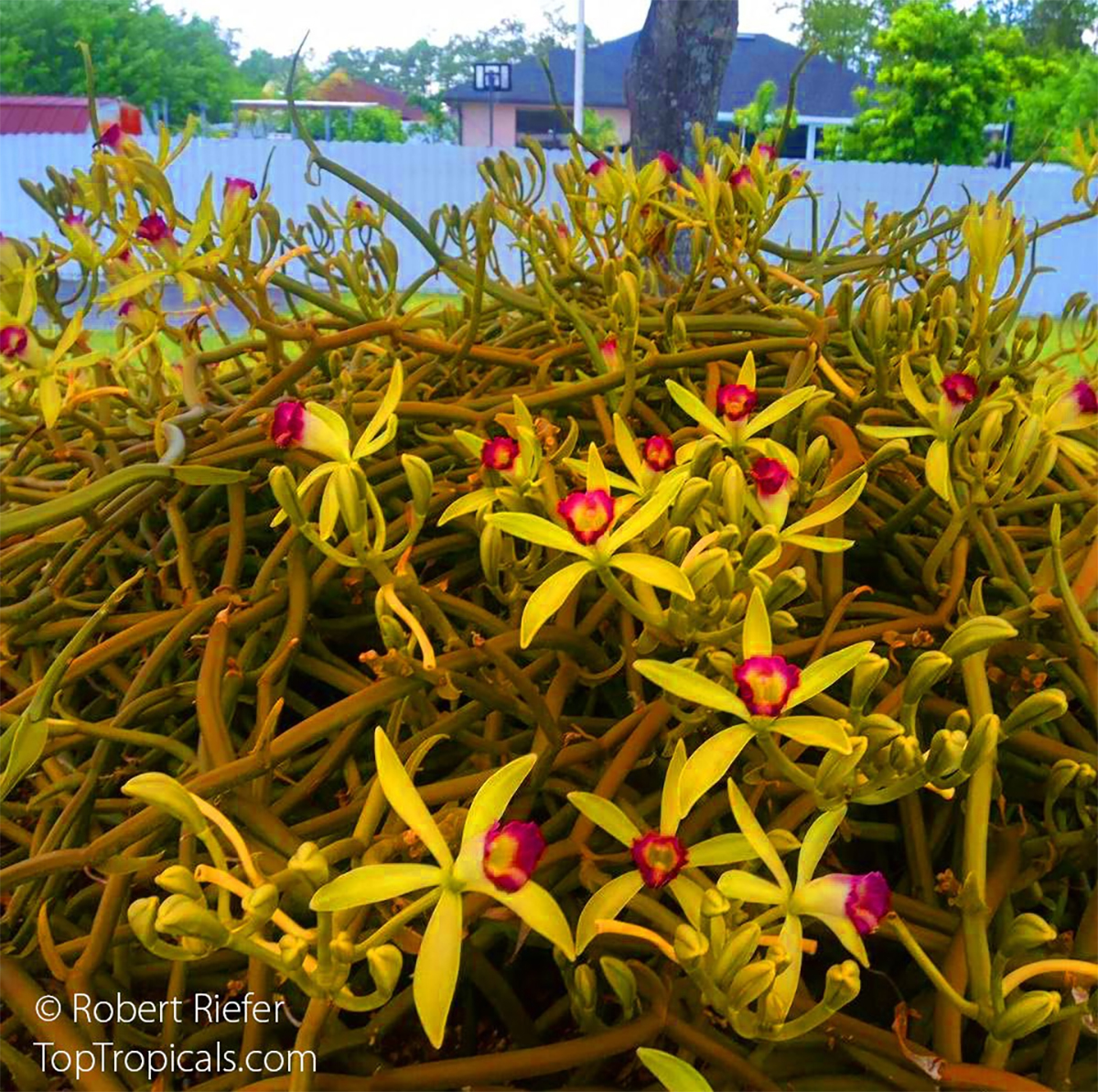
Vanilla  dilloniana  vine  covered  in  yellow-green  flowers  with  red 


centers  growing  outdoors  in  100  gal  pot

Vanilla dilloniana in Bloom - Rare Florida Native Orchid

We also offer Vanilla dilloniana, a rare Florida native species with distinctive flowers.

One remarkable specimen of this species, grown by our friend Robert Riefer, became so vigorous over many years that it outgrew a 100 gallon container and was eventually moved into a 250 gallon pool on wheels.

The plants we offer are propagated from that very specimen:

That kind of growth reflects deliberate cultivation and ideal conditions - not something that happens unintentionally.

Vanilla grows according to the space and structure you provide.

For gardeners focused on producing real vanilla beans for the kitchen, Vanilla planifolia remains the right place to start.

✍️ More About Vanilla Orchids from Blog

🎁 Shop Vanilla Orchids

Date: 27 Apr 2020

PeopleCats of TopTropicals. Cats of the day: Biggy's Cat Hospital

Biggy checking on patient Abu when he couldn't walk

During these challenging times for the whole planet, we receive kind letters from our customers checking on how our PeopleCats are doing, especially those that previously were ill. And since we promised to follow up on everyone, including heart-breaking story of Raja and Abu, today's report is about everybody's progress!

As we mentioned in our previous newsletter, several cats in TopTropicals Cat Sanctuary had a coronavirus (we call it COVID-Cat-20), or simply a cat respiratory infection. Chiefy, Snitch, Marco and Biggy had it really bad, but some other PeopleCats surprisingly didn't get it! Just like with humans. Lucky King didn't have a single sneeze!
Finally, everybody has recovered by now, but it has been a very stressful couple of weeks for us, considering limited vet availability at this stay-home time. On top of that, Lil S had an abscess and was also contained in a home hospital, away from flu-quarantined PeopleCats. Our homes become real cat hospitals!
We are thankful to our customers support, especially Silvia who made several donations for our PeopleCats, and also recommended antiseptic pads - those worked great for Lil S!
Abu and Raja's adventures were not over... After 2 weeks of seeing a vet treating their infections and injuries, they got worse... Then after a couple of weeks in another hospital (and a couple thousand more in bills) we were suggested to put them down as hopeless since they would never walk again... But Kristi did not want to believe it, she did not give up! The kittens heard her. They won. Today, they are all better, walking, jumping and playing!

Thank you Kristi!
Never give up hope!

Stay safe and healthy with your PeoplePets!

TopTropicals PeopleCat Club

Thank you everybody for supporting us in helping PeopleCat Community!
Make your kind donation today and receive a surprise gift from us. Every little bit helps! Thank you and God bless you and your pets!

Date: 22 Oct 2025

💞 Cassia or Bauhinia?

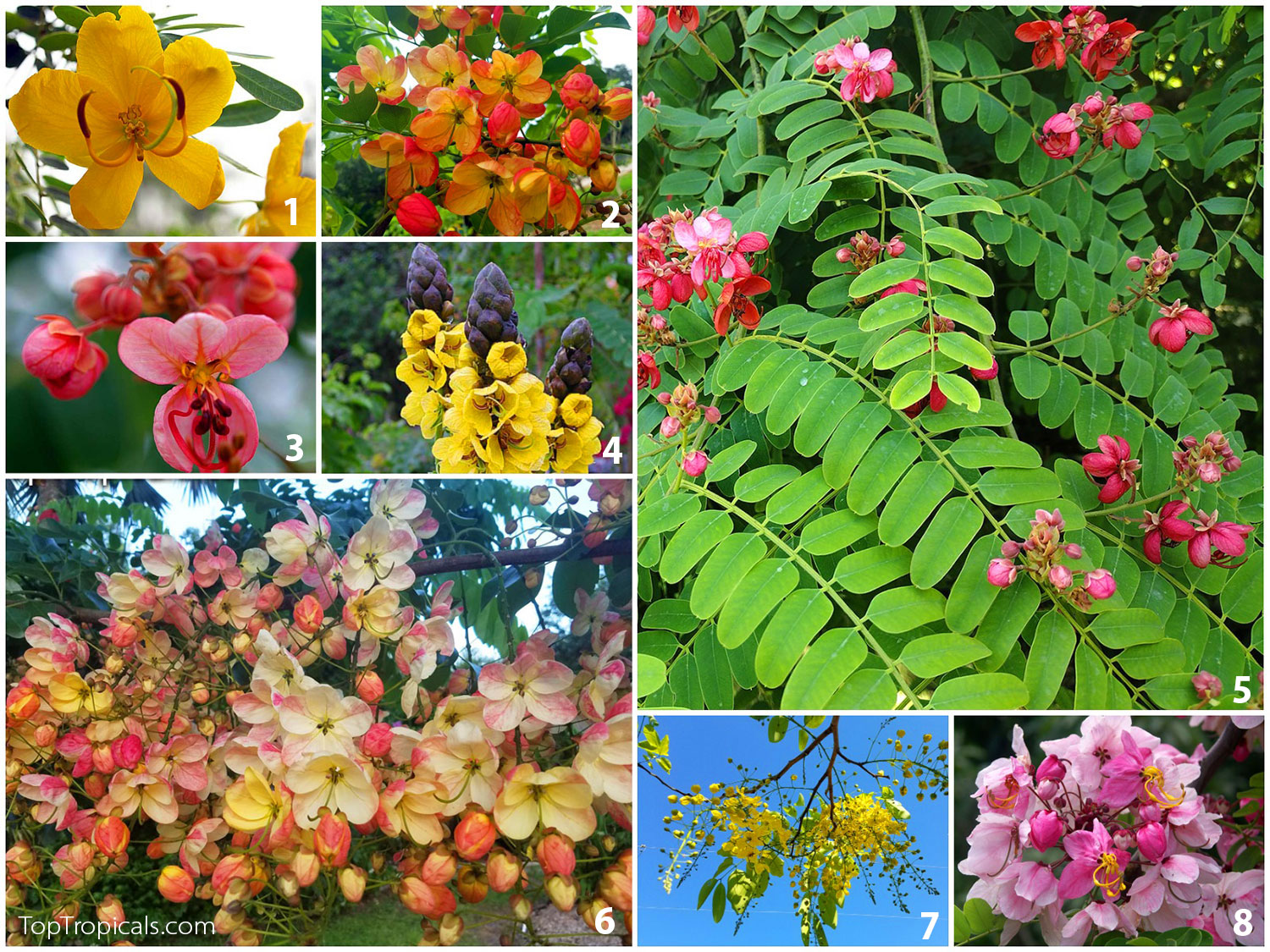
Collage  of  Cassia  and  Senna  flowering  trees:


1  –  Cassia  bicapsularis  (Butterfly  Bush),


2  –  Cassia  x  natalensis  (Rainbow  Cassia),


3  –  Cassia  grandis  (Red  Cassia),


4  –  Cassia  didymobotrya  (Popcorn  Cassia),  similar  to  Senna  alata 


(Empress  Candles),


5  –  Cassia  javanica  (Apple  Blossom  Tree),


6  –  Cassia  roxburghii  (Ceylon  Senna),


7  –  Cassia  fistula  (Golden  Shower  Tree),


8  –  Cassia  x  nodosa  (Pink  Shower).

Looking for a small tree that blooms like fireworks but still fits on your patio? We hear this question all the time at Top Tropicals: Cassia or Bauhinia? Both are tropical showstoppers, but they shine in very different ways.

🌞 Cassias: Sunshine Fireworks

Cassia trees are some of the most rewarding tropical bloomers you can grow. Fast-growing, free-flowering, and surprisingly cold-tolerant, they thrive in full sun and summer heat. Their bright clusters come in shades of yellow, orange, pink, red, and even multicolor blends. The famous Rainbow Cassias show swirls of coral, gold, and rose on the same tree, creating a living fireworks display.

For gardeners in warm regions, these trees become spectacular focal points in the landscape. In containers, compact yellow forms like Cassia didymobotrya (Popcorn Cassia) and Senna alata (Empress Candles) stay manageable and bloom freely through summer.

Cassias can also be grown in pots with pruning and patience. Once mature, they reward you with breathtaking color that turns any patio or pool deck into a tropical show. Most showy cassias (numbers correspond to the photos in the collage above):

  1. Cassia bicapsularis (Butterfly Bush) - is a fast-growing, low-maintenance shrub covered in bright yellow, butterfly-like blooms from fall through winter.
  2. Cassia x natalensis (Rainbow Cassia)
  3. Cassia grandis (Red cassia) - a medium size tree having profuse blooms of dark pink to crimson flowers throughout the Spring.
  4. Cassia didymobotrya (Popcorn Cassia), small tree producing golden-yellow flowers with a distinct scent of peanut butter that open from brown buds in late summer and autumn. Similar to Senna alata (Empress Candles)
  5. Cassia roxburghii (Ceylon Senna) - graceful tree with spreading, drooping branches appearing to be overweighed by its wealth of clustering red blossoms.
  6. Cassia x nodosa (Pink Shower) - is a spectacular medium-sized, fast-growing tree with cascading clusters of fragrant pink-and-white appleblossom blooms in spring and summer.
  7. Cassia fistula (Golden Shower) - to many tropical gardeners, the most beautiful of cassias with masses of bright gold flower clusters appear on almost every branch.
  8. Cassia javanica (Apple Blossom) - dazzles with dense clusters of pink-to-white blossoms that change shades as they bloom, creating a spectacular display that lasts for months.
"Cassias love the heat and sunshine," says Tatiana Anderson, Top Tropicals Plant Expert. "They are perfect for anyone who wants big bursts of color and doesn’t mind giving them space and light to grow."

👉 Explore Cassia Trees

Bauhinia Magic: Orchid-Like Blooms in a Compact Size

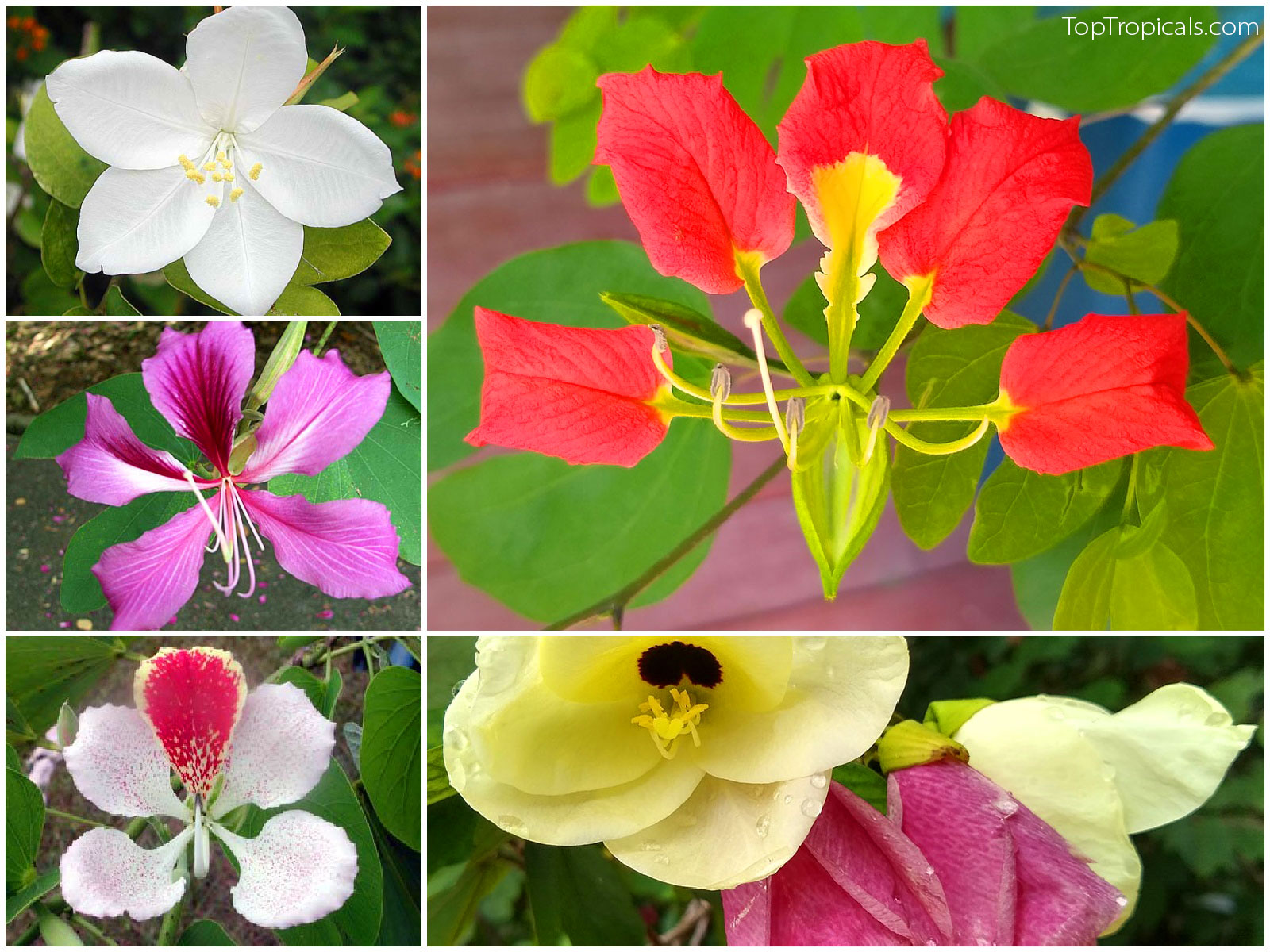
Collage  of  Bauhinia  orchid  trees:  top  left  –  Bauhinia  acuminata 


(Dwarf  White  Orchid  Tree),  middle  left  –  Bauhinia  blakeana  (Hong  Kong 


Orchid  Tree),  bottom  left  –  Bauhinia  monandra  (Napoleon’s  Plume 


Orchid  Tree),  top  right  –  Bauhinia  madagascariensis  (Red  Dwarf  Orchid 


Tree),  and  bottom  right  –  Bauhinia  tomentosa  (Yellow  Orchid 


Tree)

Bauhinia orchid trees: top left – Bauhinia acuminata (Dwarf White Orchid Tree), middle left – Bauhinia blakeana (Hong Kong Orchid Tree), bottom left – Bauhinia monandra (Napoleon’s Plume Orchid Tree), top right – Bauhinia madagascariensis (Red Dwarf Orchid Tree), and bottom right – Bauhinia tomentosa (Yellow Orchid Tree)

Bauhinia trees known as Orchid Trees, bring a touch of tropical luxury to any space. Their butterfly-shaped leaves and orchid-like blossoms appear in shades of red, pink, purple, white, and yellow, often lasting up to ten months a year. Bauhinias are ideal for gardeners who want nonstop color in a manageable size. Most species grow well in large pots and bloom young, often within the first season.

The following compact varieties stay neat and flower almost continuously in warm weather:

The Hong Kong Orchid Tree is especially prized because it is sterile and produces no messy seed pods, keeping patios clean. Grafted Buhinia blakeana trees begin blooming while still small, making them perfect for containers or tight spaces.

"Bauhinias are generous bloomers," Tatiana explains. "They respond beautifully to regular feeding and full sun. If nights turn too cold, just move the pot to a sunny porch - they’ll keep their tropical charm most of the year."

Give them full sun, regular fertilizer, and a well-drained mix such as Sunshine Abundance, and they will reward you with months of vivid blooms. When nights turn too cold, simply move the pot to a sunny porch or bright window. Bauhinias adjust beautifully and keep their tropical grace year after year.

🎥 Watch Short Videos:

💲 Special Offer – 20% off Cassias and Bauhinias!

Get 20% OFF Cassias and Bauhinias with code

RAINBOW2025

Min order $100. Excluding S/H, valid online only, cannot be combined with other offers.

Hurry, offer expires October 30, 2025!

👉 Explore Bauhinias - Orchid Trees

Date: 10 Nov 2025

❄️ How to Prepare Your Tropical Garden for Winter

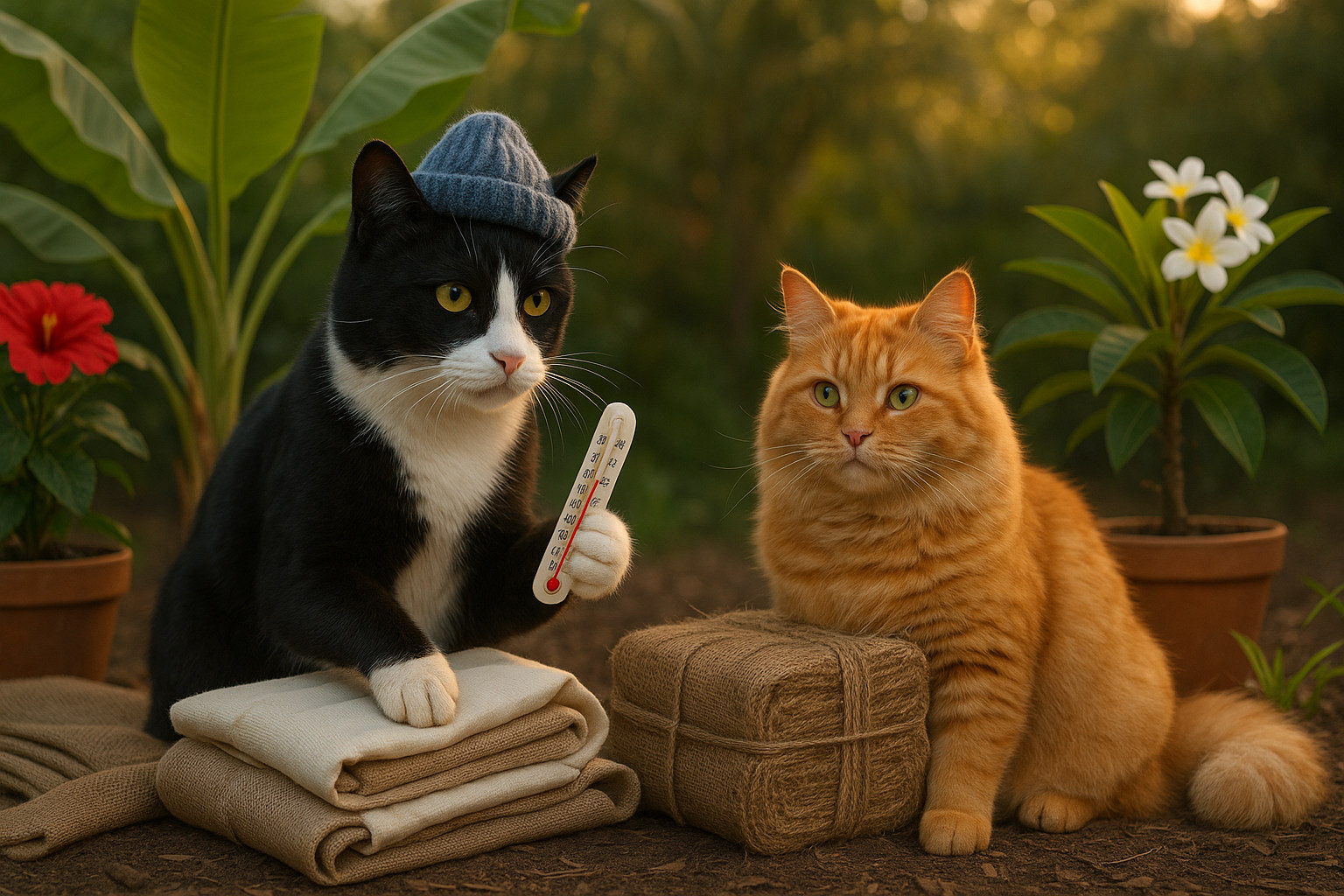
Two  cats  in  a  tropical  garden  at  sunset.  Smokey,  a  black-and-white 


tuxedo  cat  wearing  a  wool  cap,  holds  a  thermometer  while  Sunshine,  a  fluffy 


orange  tabby,  sits  beside  mulch  and  folded  frost  cloths  surrounded  by  banana
 
 
  and  hibiscus  plants.

Smokey and Sunshine Wrap Up the Garden with Frost Cloth Before the Chill.

Smokey: "Thermometer says 45. Time to wrap the bananas!"
Sunshine: "You wrap the bananas. I’ll guard the mulch… from this sunny spot."
Smokey: "Teamwork, Sunshine. Teamwork."

🌡️ Cold nights are coming - but your tropicals do not need to shiver!

Even in sunny Florida and other warm zones, one cold snap can undo months of growth. Preparation is everything. Tropical plants can handle a lot, but they dislike surprises. Let’s make sure your garden stays safe, strong, and happy all winter long.

Tips from Tatiana Anderson, Top Tropicals Plant Expert

👉 Group and Check Your Plants

You already know which plants are in pots and which are in the ground. What matters now is prioritizing by cold sensitivity. Identify the tender tropicals – papaya, banana, plumeria, adenium, heliconia – and decide which ones get covered first when temperatures drop. Keep frost cloths or old sheets near those areas, ready to grab fast. If your garden is large, label protection zones or mark plants that always need extra care. The goal is to have a plan, not a panic, when the cold alert hits.

Once you know your priorities, you can plan the rest of your protection strategy.

👉 Feed and Mulch

Stop using high-nitrogen fertilizers by late fall. They push soft new growth that freezes easily. Add compost around the base of your plants and top with 3 to 4 inches of mulch. Mulch acts like a blanket: it keeps warmth in, protects the roots, and keeps soil moisture steady. Just make sure the soil drains well; cold and soggy soil leads to root rot. In raised beds, check that water flows away easily.

After you feed and mulch, it is time to look at how your local zone changes the game.

👉 Zone-by-Zone Tips

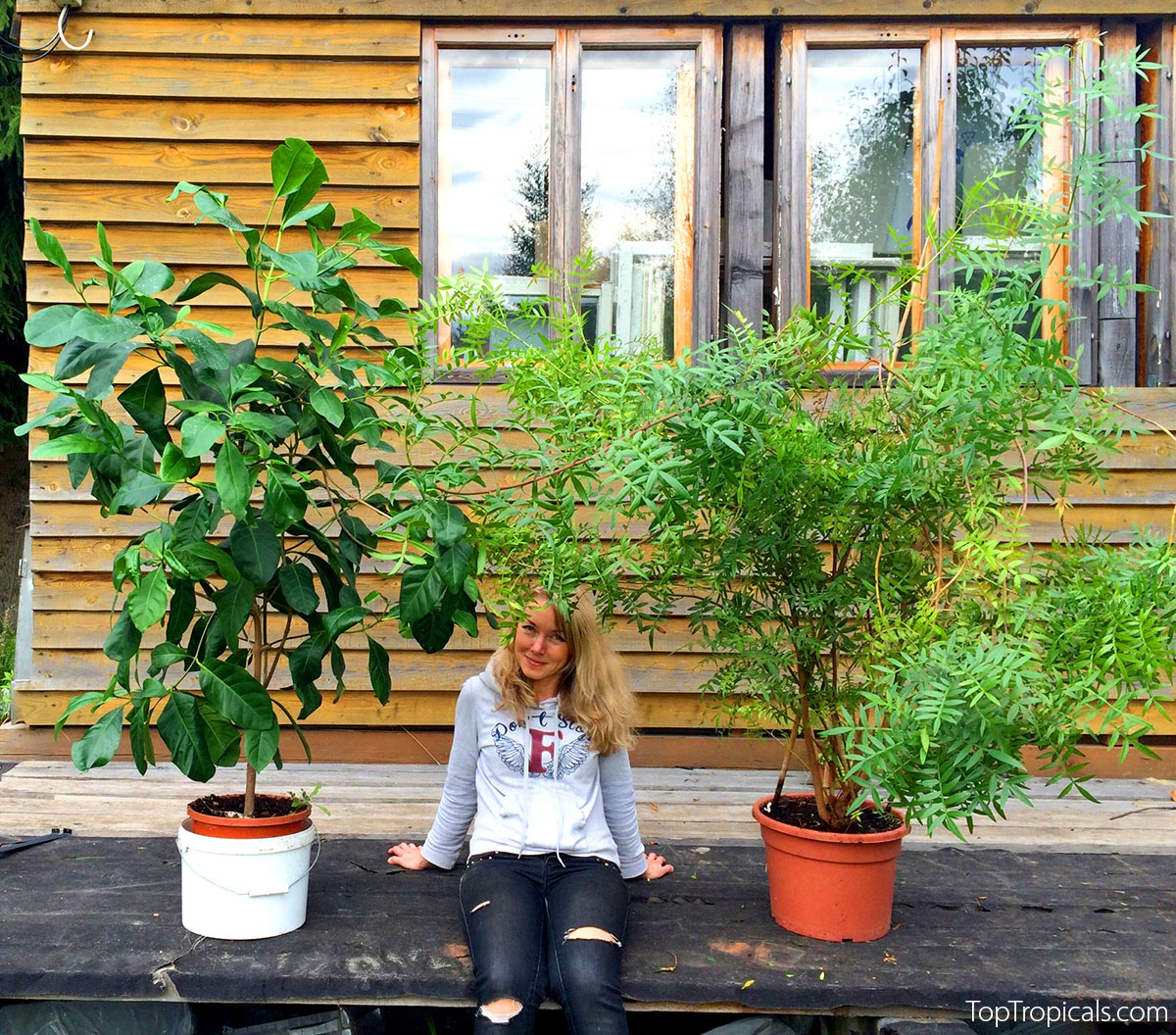
Woman  sitting  between  two  large  potted  tropical  plants  on  a  wooden  deck
 
 
  in  front  of  a  house,  preparing  to  move  them  indoors  for  the  winter.

Moving Tropical Plants Indoors for Winter Protection

  • Zone 10: You are lucky! This is mostly a maintenance season. Watch for root rot after heavy rain, trim lightly if needed, and protect tender young trees during surprise chills. Keep some frost cloth ready just in case.
  • Zone 9: This is the main action zone. Nights can dip into the 30s. Deep-water your trees once before cold nights to insulate the roots. Apply heavy mulch, and have frost protection ready to go. If you grow tropical fruit like mango or guava, consider wrapping young trunks in burlap or foam pipe insulation.
  • Zone 8: This is where tropical gardening becomes creative. Stick to cold-hardy tropicals such as loquat, guava, or cold-hardy avocado varieties. Use portable greenhouses, wrap trunks, and move smaller plants indoors or to a heated porch when frost threatens.

Now that the garden beds are set, let’s look at your pots and containers – your most mobile plants.

👉 Container and Patio Plants

Potted plants are the easiest to protect but also the quickest to freeze. Start reducing watering now so roots do not stay too wet in cooler weather. Before moving them, check for insects hiding under leaves or in the soil. Group your pots close to a wall for reflected heat and wind protection. If you plan to bring them indoors, do it gradually. Move them closer to the house for a few days before bringing them all the way inside to help them adjust to lower light and humidity.

When the chill starts, many gardeners rush to move everything inside at once – but a smooth transition works much better.

👉 Indoor Plants

When bringing plants inside, give them a good rinse to remove dust and bugs, and flush the soil to wash out salts from summer fertilizing. Keep them separate from your houseplants for a week to make sure no pests come along. Expect some leaf drop – it is normal as they adjust to lower light. Give them bright light near a window, and cut watering by about half until spring. Avoid misting too much; good airflow matters more than humidity during winter.

Many tropicals, like hibiscus, brugmansia, and crotons, may look tired for a while, but they will bounce back quickly once days get longer.

👉 Timing Is Everything

The key is to prepare before the first cold warning. Check your weather app regularly once nights start dropping into the 50s. Keep covers, mulch, and supplies ready so you are not running outside at midnight with a flashlight and a frozen hose. Have your frost cloths labeled by plant group and stored in an easy spot. A little organization now saves a lot of stress later.

Many tropicals, like hibiscus, brugmansia, and crotons, may look tired for a while, but they will bounce back quickly once days get longer.

Remember: the goal is to help your plants rest safely. Many gardeners prune or fertilize too late in the season – we will talk about why that can be risky next week." — says Tatiana Anderson, Top Tropicals Plant Expert

Coming next mail-list: The best gadgets for cold protection (lights, heaters, frost covers) and what NOT to do in winter.

📚 Learn more from Top Tropicals Blog:

Cold protection - winter action for your plant collection

What plants are good to order in Winter?

How to take care of house plants in Winter

How to protect tropical plants in Winter

How to take care of a mango tree in winter

How to protect Avocado from cold

Overwintering Adeniums outside of tropics

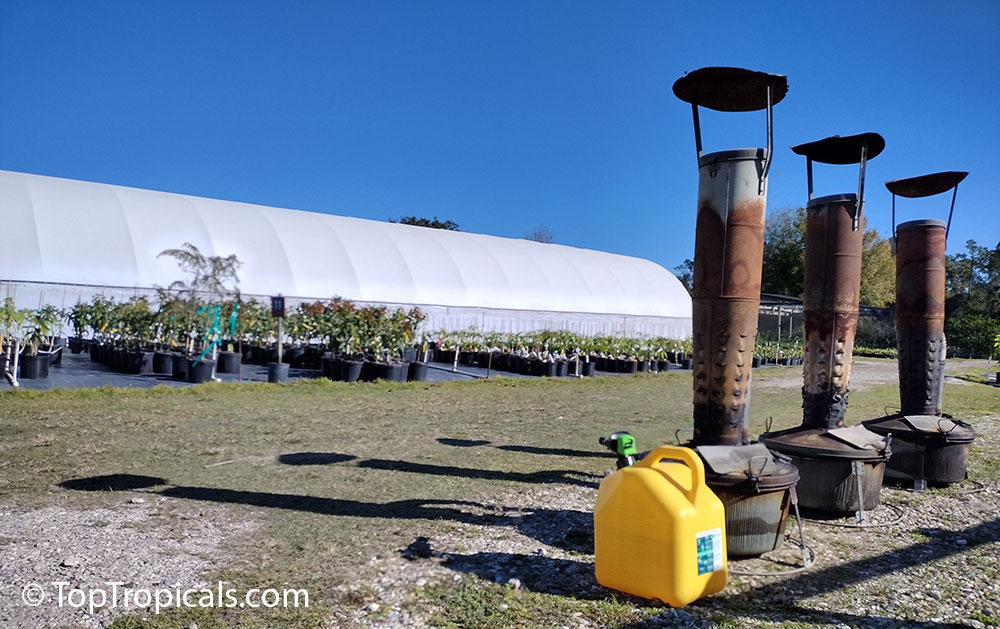
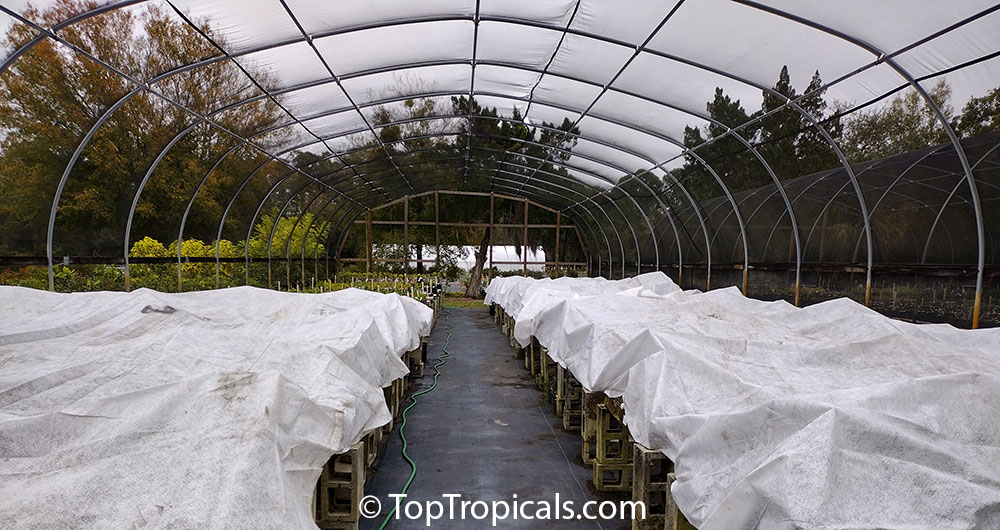
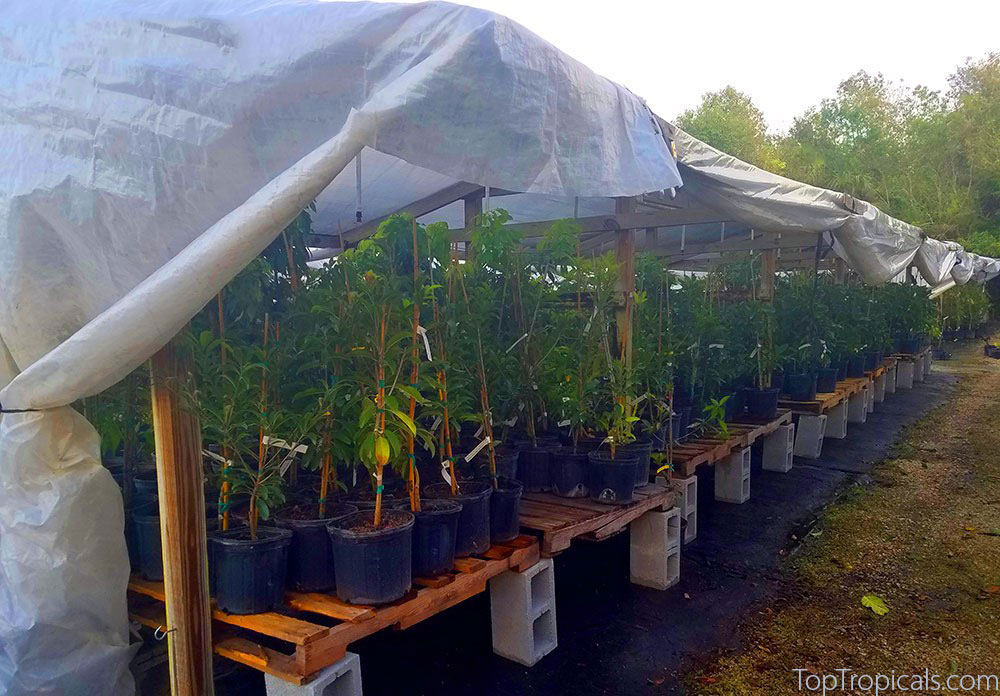
Rows  of  tropical  plants  in  black  pots  covered  with  frost  cloth  and 


plastic  sheeting  for  winter  protection  at  Top  Tropicals  nursery.

Protecting Tropical Plants with Frost Covers at Top Tropicals Nursery